Quantum Accreditation with Non-Clifford Two-qubit Gates
Pith reviewed 2026-05-20 06:44 UTC · model grok-4.3
The pith
Protocols upper-bound the total variation distance between ideal and erroneous outputs for quantum circuits using non-Clifford two-qubit gates.
A machine-rendered reading of the paper's core claim, the machinery that carries it, and where it could break.
Core claim
We develop a family of quantum accreditation protocols for quantum circuits with non-Clifford two-qubit gates. The latter includes families of gates such as the fSim and XY families of gates, native to existing hardwares. We provide practical and scalable protocols that upper-bound the total variation distance between the probability distributions of error-free and erroneous quantum computations. We also establish the robustness of our protocols to small perturbations and generalize Pauli twirling to non-Pauli single-qubit bases, which may be of independent interest.
What carries the argument
Accreditation protocols that employ non-Clifford two-qubit gates to produce upper bounds on the total variation distance between error-free and erroneous output distributions.
If this is right
- The protocols can be run directly on hardware that natively supports fSim or XY gates without requiring additional gate decompositions.
- An experimenter obtains a concrete numerical upper bound on how far the observed output statistics can deviate from the ideal case.
- The robustness result implies that modest levels of noise do not invalidate the accreditation bounds.
- Generalization of twirling to non-Pauli bases extends the reach of error-analysis tools to a wider set of single-qubit operations.
Where Pith is reading between the lines
- The same bounding technique could be layered with existing error-mitigation methods to tighten estimates of computational reliability on near-term devices.
- If the protocols scale as described, they offer a route to pre-fault-tolerance verification of algorithms that rely on non-Clifford resources.
- Hardware designers might prioritize gate families that admit these accreditation protocols when selecting native two-qubit interactions.
- The non-Pauli twirling extension may prove useful for characterizing coherent errors in systems where standard Pauli twirling is insufficient.
Load-bearing premise
The protocols require that the hardware can implement or access the chosen families of non-Clifford two-qubit gates and that any perturbations stay small enough for the stated robustness to apply.
What would settle it
Execute an accreditation protocol on a device implementing an fSim or XY gate, then compare the protocol's reported upper bound on total variation distance against the actual measured deviation in output probabilities from repeated runs of the same circuit.
Figures






read the original abstract
We develop a family of quantum accreditation protocols for quantum circuits with non-Clifford two-qubit gates. The latter includes families of gates such as the fSim and XY families of gates, native to existing hardwares. We provide practical and scalable protocols that upper-bound the total variation distance between the probability distributions of error-free and erroneous quantum computations. We also establish the robustness of our protocols to small perturbations and generalize Pauli twirling to non-Pauli single-qubit bases, which may be of independent interest.
Editorial analysis
A structured set of objections, weighed in public.
Referee Report
Summary. The paper develops a family of quantum accreditation protocols tailored to quantum circuits that incorporate non-Clifford two-qubit gates, specifically the fSim and XY families native to current hardware. It supplies practical, scalable protocols that upper-bound the total variation distance between the output probability distributions of error-free and erroneous computations. The work further claims robustness of these protocols to small perturbations and presents a generalization of Pauli twirling to non-Pauli single-qubit bases.
Significance. If the central claims hold, the contribution is significant because it extends accreditation techniques beyond Clifford circuits to gates that are directly implementable on existing superconducting and trapped-ion platforms. The provision of explicit TVD upper bounds and the generalization of twirling could facilitate more realistic error characterization in near-term devices and may find independent use in quantum error mitigation literature.
major comments (1)
- [Robustness analysis] Robustness analysis: the claim that the protocols remain robust to small perturbations does not include an explicit quantitative regime relating the perturbation magnitude to the continuous parameters of the non-Clifford gates (e.g., the fSim angle θ or the XY interaction strength). Without such a bound, it is unclear whether the generalized twirling procedure fully eliminates residual coherent errors arising from the interaction between the perturbation and the gate's non-Pauli structure, which is load-bearing for the TVD upper-bound guarantee.
minor comments (2)
- [Introduction] The abstract and introduction would benefit from a brief comparison table or paragraph contrasting the new protocols with existing accreditation methods for Clifford circuits to clarify the precise advance.
- Notation for the generalized twirling operators should be introduced with an explicit definition before its first use to improve readability for readers unfamiliar with non-Pauli bases.
Simulated Author's Rebuttal
We thank the referee for their careful reading of the manuscript and for the constructive major comment. We address the point on robustness analysis below and have revised the manuscript to strengthen the presentation of the quantitative regime.
read point-by-point responses
-
Referee: Robustness analysis: the claim that the protocols remain robust to small perturbations does not include an explicit quantitative regime relating the perturbation magnitude to the continuous parameters of the non-Clifford gates (e.g., the fSim angle θ or the XY interaction strength). Without such a bound, it is unclear whether the generalized twirling procedure fully eliminates residual coherent errors arising from the interaction between the perturbation and the gate's non-Pauli structure, which is load-bearing for the TVD upper-bound guarantee.
Authors: We agree that an explicit quantitative regime would make the robustness claim more precise and directly address potential interactions between perturbations and the non-Pauli character of the gates. In the revised manuscript we have added Lemma 4 in Section IV, which derives a sufficient condition on the perturbation operator norm: for an fSim gate with angle θ, if ||Δ||_2 < (1 − |cos θ|)/4, then the residual coherent error after generalized twirling is bounded by O(δ) and the TVD upper bound continues to hold with an additive term linear in δ. An analogous bound is stated for the XY family in terms of the interaction strength. The proof proceeds by expanding the perturbed gate in the non-Pauli basis, showing that the twirling projector annihilates the first-order coherent terms provided the above inequality is satisfied. This regime is non-vacuous for all θ ∈ (0, π/2) and becomes tighter as the gate approaches a Clifford point, which we now discuss explicitly. revision: yes
Circularity Check
No significant circularity; protocols derived from standard quantum information methods
full rationale
The paper develops accreditation protocols by generalizing Pauli twirling to non-Pauli bases and bounding total variation distance for circuits with fSim/XY gates. No quoted steps reduce by construction to self-definition, fitted inputs renamed as predictions, or load-bearing self-citations. The robustness claim to small perturbations is presented as established from the protocol structure itself, with independent grounding in error bounding techniques rather than circular reduction. The derivation remains self-contained against external benchmarks in quantum accreditation.
Axiom & Free-Parameter Ledger
axioms (1)
- domain assumption Quantum circuits can be modeled with error channels that allow bounding total variation distance via accreditation protocols
Lean theorems connected to this paper
-
IndisputableMonolith/Foundation/AbsoluteFloorClosure.leanreality_from_one_distinction unclear?
unclearRelation between the paper passage and the cited Recognition theorem.
We develop a family of quantum accreditation protocols for quantum circuits with non-Clifford two-qubit gates... upper-bound the total variation distance... robustness... generalize Pauli twirling to non-Pauli single-qubit bases
-
IndisputableMonolith/Cost/FunctionalEquation.leanwashburn_uniqueness_aczel unclear?
unclearRelation between the paper passage and the cited Recognition theorem.
Twirling and accrediting circuits with two-qubit non-Clifford gates
What do these tags mean?
- matches
- The paper's claim is directly supported by a theorem in the formal canon.
- supports
- The theorem supports part of the paper's argument, but the paper may add assumptions or extra steps.
- extends
- The paper goes beyond the formal theorem; the theorem is a base layer rather than the whole result.
- uses
- The paper appears to rely on the theorem as machinery.
- contradicts
- The paper's claim conflicts with a theorem or certificate in the canon.
- unclear
- Pith found a possible connection, but the passage is too broad, indirect, or ambiguous to say the theorem truly supports the claim.
Reference graph
Works this paper leans on
-
[1]
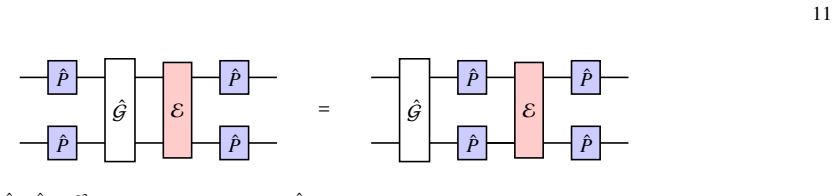
Main Differences From Ref. [17] and Introducing Delta Gates In the ideal – but not likely – case, where all the two-qubit gates are surrounded immediately by the same two-qubit gate acting on the same qubits, the trap circuits of this new protocol behave exactly as in the Protocol in Ref. [17] does. In this case all the ˆτ1 and ˆτ2 gates in the trap circu...
-
[2]
[17] is in the trap and target circuits,all else is exactly the same
Defining Trap and Target Circuits As mentioned earlier, the only way the protocol of this pa- per differs from the Protocol in Ref. [17] is in the trap and target circuits,all else is exactly the same. This section is 3 Meaning the one with the same Pauli gate in the centre. 9 FIG. 5. Example where the error fails to propagate due to a mis-match in the ˆτ...
-
[3]
newTarg=C 2.forQubit with initial state|i⟩do (a) Change the initial state of the qubit to|ˆτ1⟩ (defined via Def. 17) (b) Add a gate mapping|ˆτ1⟩) to the original input state,|i⟩immediately after the state preparation. 3.forMeasurment in|i⟩basisdo (a) Change the measurement basis toβ ˆτ1 (b) Before the measurement add a single-qubit gate mapping from the o...
-
[4]
(ˆτ1,ˆτ2)-twirl, as in Def.15, everyGgate innewTarg
-
[5]
We start by defining the simpler of the two, the target cir- cuits, in Algorithm 2
With probability 0.5: (a) Add ˆτ† 1 ˆZˆτ1 on each qubit after state preparation of newTarg (b) Add ˆτ† 1 ˆZˆτ1 before each measurement of newTarg Return: newTarg where these changes are detailed and we present the trap and target circuits to use in our protocol. We start by defining the simpler of the two, the target cir- cuits, in Algorithm 2. This algor...
-
[6]
Remove all single-qubit gates from newTrap, replacing them with identity gates
-
[7]
Apply Algorithm 2 to newTrap
-
[8]
Add ˆ∆and ˆ∆† gates to newTrap as per Algorithm 4
-
[9]
With probability 0.5, add ˆτ† 1Hˆτ1 immediately before measurement and after state preparation to newTrap. Return: newTrap Theorem 3.AssumingN1andN2, any circuit where the only type of two-qubit gate, ˆG, isˆτ-decomposable can be accred- ited. Proof.We proceed via Theorem 1, showing the conditions required for it to apply (that is, the conditions in Def. ...
-
[10]
ˆI⊗ ˆI, ˆX⊗ ˆI, ˆY⊗ ˆI, ˆZ⊗ ˆI
-
[11]
ˆI⊗ ˆI, ˆX⊗ ˆY, ˆZ⊗ ˆY, ˆZ⊗ ˆX, ˆI⊗ ˆX
-
[12]
ˆZ⊗ ˆY, ˆZ⊗ ˆX, ˆI⊗ ˆX, ˆY⊗ ˆI Theorem 4.All XY-twirlable errors occurring in a XY- decomposable gate can be twirled to stochastic Pauli error by conjugating it with Pauli gates (including the identity) chosen uniformly at random. In fact we can further expand the error that can be twirled to stochastic error to any stochastic combination of XY-twirlable ...
-
[13]
j-Vanishing Blocks Definition 21.Aj-vanishing block is a subcircuit of the form in Fig. 7. Thejparameter is present only in the single-qubit gates in Fig. 7. This makes the sub-circuit different for different values ofj. We can then proceed to prove the vital properties ofj- vanishing blocks. A pre-requisite of this is Lemma 8, which is based on the time ...
-
[14]
Using an approach similar to Ref
Erroneous j-vanishing blocks With the behavior ofj-vanishing blocks in the error-free case established, we now consider their erroneous implemen- tation. Using an approach similar to Ref. [22, Lemma 1], we consider the single-qubit gates in aj-vanishing block to be error-free by folding their error into the error of the two-qubit gates of that samej-vanis...
-
[15]
Traps and Target The traps and target required for the QAP for circuits with XY-interaction gates are constructed as defined in Algorithms 5, 6, and 7, in accordance with Algorithm 1. Informally, the traps and target are constructed by replacing every instance of a two-qubit gate with either a 1-vanishing block (in the case of traps, which implement the i...
-
[16]
Re-express each single-qubit state preparation inCas preparing the state|0⟩then applying a single-qubit gate
-
[17]
Re-express each single-qubit measurement inCas applying a single-qubit gate then measuring in the computational basis Return: UpdatedC Algorithm 6:Algorithm to generate target circuits Input: •A circuit,C, where all two-qubit gates are of the form exp −i ˆHt for somet∈R
-
[19]
Replace every two-qubit gate inCwith a 0-vanishing gate Return: UpdatedC Algorithm 7:Algorithm to generate trap circuits Input: •A circuit,C, where all two-qubit gates are of the form exp −i ˆHt for somet∈R
-
[20]
ConvertCto standard form via Algorithm 5
-
[21]
Remove all single-qubit gates
-
[22]
Replace every two-qubit gate inCwith a 1-vanishing gate
-
[23]
With probability 0.5, place a Hadamard gate on every qubit immediately after state prep and before measurement
-
[24]
For each qubit, with probability 0.5 add a Pauli Z gate immediately before measurement
-
[25]
For each qubit, with probability 0.5 add a Pauli Z gate immediately after state preparation
-
[26]
22, that QAPs are linearly robust
Merge any neighboring Hadamard and Pauli Z gates added in the preceding steps Return: UpdatedC We can therefore see, by considering Def. 22, that QAPs are linearly robust. The practical use of this then follows in Corollary 3. Corollary 3.Consider a circuit execution experiencing error ‘weakly’ dependent on some feature of the execution or circuit (e.g. g...
-
[27]
A. W. Harrow and A. Montanaro, Quantum computational supremacy, Nature549, 203 (2017)
work page 2017
-
[28]
P. Shor, Algorithms for quantum computation: discrete loga- rithms and factoring, inProceedings 35th Annual Symposium on Foundations of Computer Science(1994) pp. 124–134
work page 1994
-
[29]
Lloyd, Universal quantum simulators, Science273, 1073 (1996)
S. Lloyd, Universal quantum simulators, Science273, 1073 (1996)
work page 1996
-
[30]
A. Aspuru-Guzik, A. D. Dutoi, P. J. Love, and M. Head- Gordon, Simulated quantum computation of molecular ener- gies, Science309, 1704 (2005)
work page 2005
- [31]
-
[32]
A. N. Chowdhury, R. D. Somma, and Y . Subas ¸ı, Computing partition functions in the one-clean-qubit model, Physical Re- view A103, 032422 (2021)
work page 2021
-
[33]
A. Jackson, T. Kapourniotis, and A. Datta, Partition-function estimation: Quantum and quantum-inspired algorithms, Physi- cal Review A107, 012421 (2023)
work page 2023
-
[34]
Preskill, Quantum computing in the NISQ era and beyond, Quantum2, 79 (2018)
J. Preskill, Quantum computing in the NISQ era and beyond, Quantum2, 79 (2018)
work page 2018
-
[35]
S. J. Devitt, W. J. Munro, and K. Nemoto, Quantum error correction for beginners, Reports on Progress in Physics76, 076001 (2013)
work page 2013
-
[36]
A. Kandala, K. Temme, A. D. C ´orcoles, A. Mezzacapo, J. M. Chow, and J. M. Gambetta, Error mitigation extends the com- putational reach of a noisy quantum processor, Nature567, 491 (2019)
work page 2019
-
[37]
M. B. Ritter, Near-term quantum algorithms for quantum many- body systems, Journal of Physics: Conference Series1290, 012003 (2019)
work page 2019
-
[38]
P. J. Ollitrault, A. Kandala, C.-F. Chen, P. K. Barkoutsos, A. Mezzacapo, M. Pistoia, S. Sheldon, S. Woerner, J. M. Gam- betta, and I. Tavernelli, Quantum equation of motion for com- puting molecular excitation energies on a noisy quantum pro- cessor, Physical Review Research2, 043140 (2020)
work page 2020
-
[39]
D. Lall, A. Agarwal, W. Zhang, L. Lindoy, T. Lindstrom, S. Webster, S. Hall, N. Chancellor, P. Wallden, R. Garcia- Patron, E. Kashefi, V . Kendon, J. Pritchard, A. Rossi, A. Datta, T. Kapourniotis, K. Georgopoulos, and I. Rungger, A re- view and collection of metrics and benchmarks for quantum computers: definitions, methodologies and software (2025), arX...
-
[40]
A. Hashim, L. B. Nguyen, N. Goss, B. Marinelli, R. K. Naik, T. Chistolini, J. Hines, J. Marceaux, Y . Kim, P. Gokhale, T. Tomesh, S. Chen, L. Jiang, S. Ferracin, K. Rudinger, T. Proc- tor, K. C. Young, I. Siddiqi, and R. Blume-Kohout, Practical introduction to benchmarking and characterization of quantum computers, PRX Quantum6, 030202 (2025)
work page 2025
-
[41]
S. Ferracin, T. Kapourniotis, and A. Datta, Accrediting outputs of noisy intermediate-scale quantum computing devices, New Journal of Physics21, 113038 (2019)
work page 2019
-
[42]
A. Gheorghiu, T. Kapourniotis, and E. Kashefi, Verification of quantum computation: An overview of existing approaches, Theory of Computing Systems63, 715 (2018)
work page 2018
-
[43]
S. Ferracin, S. T. Merkel, D. McKay, and A. Datta, Experimen- tal accreditation of outputs of noisy quantum computers, Phys- ical Review A104, 042603 (2021)
work page 2021
-
[44]
J. Liu, X. Chen, L. Xu, and L. Zhang, Accrediting outputs of noisy all-optical quantum circuits, Chinese Optics Letters24, 042701 (2026)
work page 2026
- [45]
- [46]
-
[47]
A. Jackson, Accreditation against limited adversarial noise, Ad- vanced Quantum Technologies , e00337 (2025)
work page 2025
-
[48]
A. Jackson, T. Kapourniotis, and A. Datta, Accreditation of analogue quantum simulators, Proceedings of the National Academy of Sciences121, e2309627121 (2024)
work page 2024
-
[49]
A. Jackson and A. Datta, Improved accreditation of ana- logue quantum simulation and establishing quantum advantage (2025), arXiv:2502.06463 [quant-ph]
-
[50]
T. Proctor, S. Seritan, E. Nielsen, K. Rudinger, K. Young, R. Blume-Kohout, and M. Sarovar, Establishing trust in quan- tum computations (2022), arXiv:2204.07568 [quant-ph]
-
[51]
Gottesman, Theory of fault-tolerant quantum computation, Physical Review A57, 127 (1998)
D. Gottesman, Theory of fault-tolerant quantum computation, Physical Review A57, 127 (1998)
work page 1998
-
[52]
E. Devereux and A. Datta, Quantum algorithms for solving a drift-diffusion equation: analysing circuit depths (2025), arXiv:2509.21509 [quant-ph]
-
[53]
F. Arute, K. Arya, R. Babbush, D. Bacon, J. C. Bardin, R. Barends, R. Biswas, S. Boixo, F. G. S. L. Brandao, D. A. Buell, B. Burkett, Y . Chen, Z. Chen, B. Chiaro, R. Collins, W. Courtney, A. Dunsworth, E. Farhi, B. Foxen, A. Fowler, C. Gidney, M. Giustina, R. Graff, K. Guerin, S. Habegger, M. P. Harrigan, M. J. Hartmann, A. Ho, M. Hoffmann, T. Huang, T. ...
work page 2019
-
[54]
M.-R. Yun, Z. Shan, L.-L. Sun, L.-L. Yan, Y . Jia, S.-L. Su, and G. Chen, One-step implementation of a nonadiabatic geometric fsim gate in superconducting circuits, Phys. Rev. A110, 022608 (2024)
work page 2024
-
[55]
K. Tsoukalas, A. Orekhov, B. Het ´enyi, U. von L¨upke, J. Arun- seangroj, I. Seidler, L. Sommer, E. G. Kelly, L. Massai, M. Aldeghi, M. Pita-Vidal, S. W. Bedell, S. Paredes, F. J. Schupp, M. Mergenthaler, G. Salis, A. Fuhrer, and P. Harvey- Collard, Resonant two-qubit gates for fermionic simulations with spin qubits (2025), arXiv:2507.13781 [cond-mat.mes- hall]
-
[56]
Z. Jiang and M. H. Ansari, Concurrent fermionic simulation gate, Phys. Rev. Appl.24, 024050 (2025)
work page 2025
-
[57]
Google Quantum AI, Cirq documentation, cirq.fsimgate (2025)
work page 2025
-
[58]
S. E. Rasmussen and N. T. Zinner, Simple implementation of high fidelity controlled- i swap gates and quantum circuit expo- nentiation of non-hermitian gates, Physical Review Research2, 033097 (2020)
work page 2020
-
[59]
L. R. B. Picard, A. J. Park, G. E. Patenotte, S. Gebretsadkan, D. Wellnitz, A. M. Rey, and K.-K. Ni, Entanglement and iswap gate between molecular qubits, Nature637, 821 (2024)
work page 2024
-
[60]
M. Bergonzoni, S. Jandura, and G. Pupillo, iswap gate with polar molecules: Robustness criteria for entangling operations, Phys. Rev. A112, 032621 (2025)
work page 2025
-
[61]
Q.-P. Liu and Z.-Y . Xue, Robust iswap gates for semiconductor spin qubits with local driving, Phys. Rev. A112, 042618 (2025)
work page 2025
-
[62]
Google Quantum AI, Cirq documentation, cirq google.ops.sycamoregate (2025)
work page 2025
- [63]
-
[64]
A. Carignan-Dugas, J. J. Wallman, and J. Emerson, Character- izing universal gate sets via dihedral benchmarking, Phys. Rev. A92, 060302 (2015)
work page 2015
-
[65]
A. W. Cross, E. Magesan, L. S. Bishop, J. A. Smolin, and J. M. Gambetta, Scalable randomised benchmarking of non-clifford gates, npj Quantum Information2, 16012 (2016)
work page 2016
-
[66]
N. Schuch and J. Siewert, Natural two-qubit gate for quantum computation using the xy interaction, Phys. Rev. A67, 032301 (2003)
work page 2003
-
[67]
D. M. Abrams, N. Didier, B. R. Johnson, M. P. d. Silva, and C. A. Ryan, Implementation of xy entangling gates with a single calibrated pulse, Nature Electronics3, 744 (2020)
work page 2020
-
[68]
Chen, Faster Probabilistic Error Cancellation (2025), arXiv:2506.04468 [quant-ph]
Y .-H. Chen, Faster Probabilistic Error Cancellation (2025), arXiv:2506.04468 [quant-ph]
- [69]
-
[70]
W. Hoeffding, Probability inequalities for sums of bounded ran- dom variables, Journal of the American Statistical Association 58, 13 (1963)
work page 1963
-
[71]
M. Keyl and R. F. Werner, How to correct small quantum errors, inCoherent Evolution in Noisy Environments(Springer Berlin Heidelberg, 2002) pp. 263–286
work page 2002
-
[72]
Quantum Inspire, Knowledge base: T Gate (2022)
work page 2022
-
[73]
B. Foxen, C. Neill, A. Dunsworth, P. Roushan, B. Chiaro, A. Megrant, J. Kelly, Z. Chen, K. Satzinger, R. Barends, F. Arute, K. Arya, R. Babbush, D. Bacon, J. C. Bardin, S. Boixo, D. Buell, B. Burkett, Y . Chen, R. Collins, E. Farhi, A. Fowler, C. Gidney, M. Giustina, R. Graff, M. Harrigan, T. Huang, S. V . Isakov, E. Jeffrey, Z. Jiang, D. Kafri, K. Keched...
work page 2020
-
[74]
L. B. Nguyen, Y . Kim, A. Hashim, N. Goss, B. Marinelli, B. Bhandari, D. Das, R. K. Naik, J. M. Kreikebaum, A. N. Jor- dan, D. I. Santiago, and I. Siddiqi, Programmable heisenberg in- teractions between floquet qubits, Nature Physics20, 240–246 (2024)
work page 2024
-
[75]
I. D. Kivlichan, J. McClean, N. Wiebe, C. Gidney, A. Aspuru- Guzik, G. K.-L. Chan, and R. Babbush, Quantum simulation of electronic structure with linear depth and connectivity, Physical Review Letters120, 110501 (2018)
work page 2018
-
[76]
N. Schuch and J. Siewert, Natural two-qubit gate for quantum computation using the xy interaction, Physical Review A67, 032301 (2003)
work page 2003
-
[77]
J. Carrasco, M. Langer, A. Neven, and B. Kraus, Gaining con- fidence on the correct realization of arbitrary quantum compu- tations, Physical Review Research6, L032074 (2024)
work page 2024
-
[78]
X. Xu, Manabputra, C. Vignes, M. H. Ansari, and J. M. Marti- nis, Lattice hamiltonians and stray interactions within quantum processors, Phys. Rev. Appl.22, 064030 (2024)
work page 2024
-
[79]
R. Bhatia, Partial traces and entropy inequalities, Linear Alge- bra and its Applications370, 125 (2003)
work page 2003
-
[80]
A. Gonzales, R. Shaydulin, Z. H. Saleem, and M. Suchara, Quantum error mitigation by pauli check sandwiching, Scien- tific Reports13, 2122 (2023). 19 Appendix A: Formal Definitions of Twirlable and Accreditable Error Definition 23.Relative to a given two-qubit gate, a family of CPTP maps are termed twirlable if the error they represent, when it occurs in ...
work page 2023
-
[81]
The first of these is commutator functions
Pre-requisites: Commutator Functions and Superoperators Before beginning the proof of Lemma 3, we require two definitions of objects featured in the proof of Lemma 3. The first of these is commutator functions. Definition 26.Define the commutator function ,ξ, between two operators (ˆaand ˆb) by: ˆa◦ˆb=ξ(ˆa, ˆb)ˆb◦ˆa. ∀N∈N, if both arguments of the commuta...
discussion (0)
Sign in with ORCID, Apple, or X to comment. Anyone can read and Pith papers without signing in.