Decay constants of B_c-mesons with vector and tensor currents
Pith reviewed 2026-06-25 20:27 UTC · model grok-4.3
The pith
QCD sum rules yield the first tensor decay constants for the B_c^* and B_c1 mesons while refining the vector ones.
A machine-rendered reading of the paper's core claim, the machinery that carries it, and where it could break.
Core claim
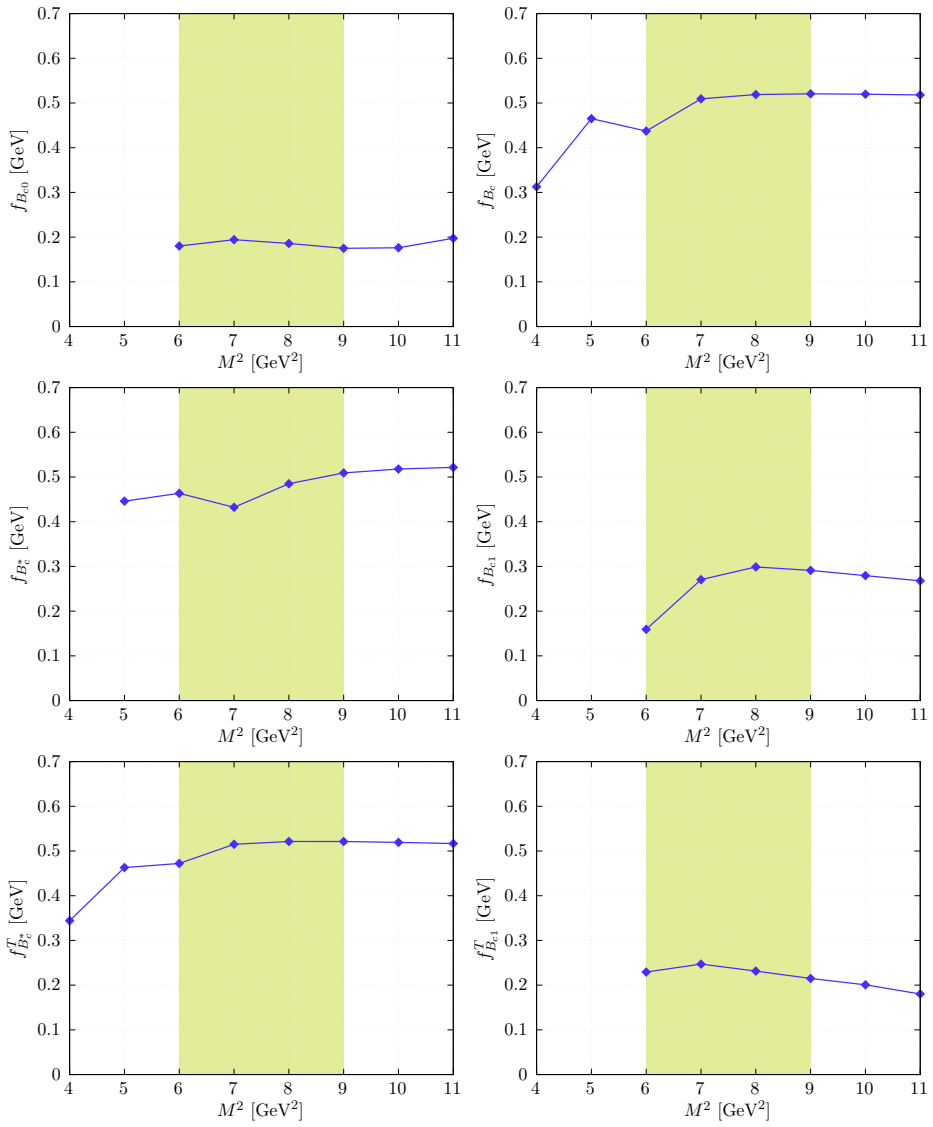
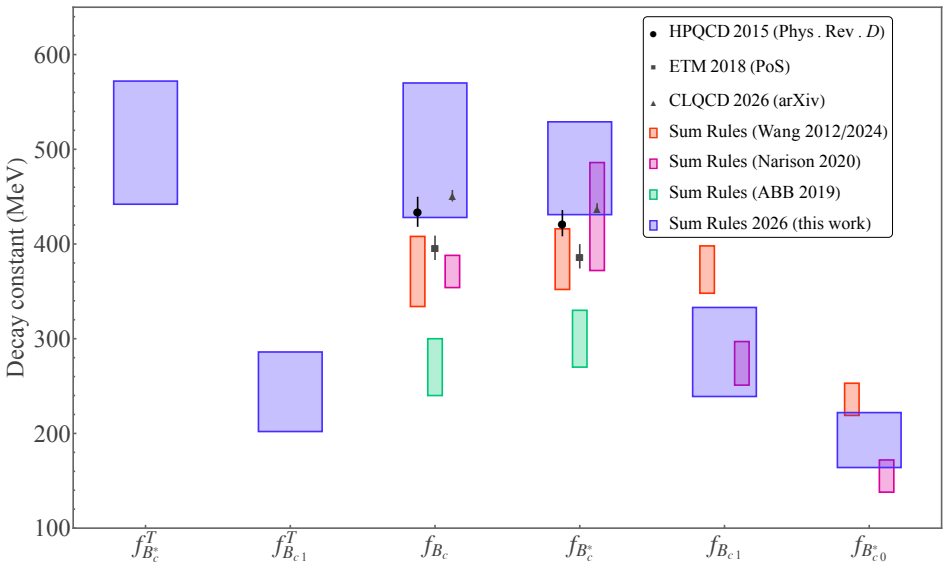
Within the QCD sum-rule framework, the (axial-)tensor decay constants of the B_c^* and B_c1 mesons are obtained for the first time; simultaneously, the (axial-)vector decay constants are updated with higher-order power corrections and a comprehensive uncertainty analysis.
What carries the argument
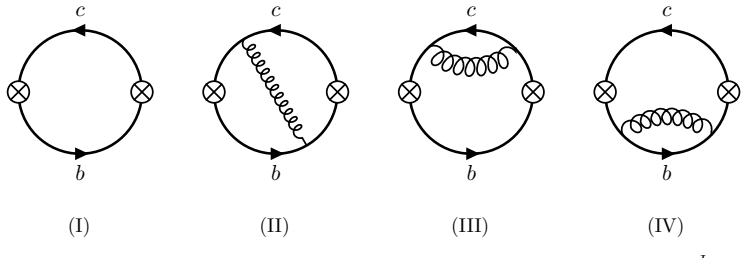
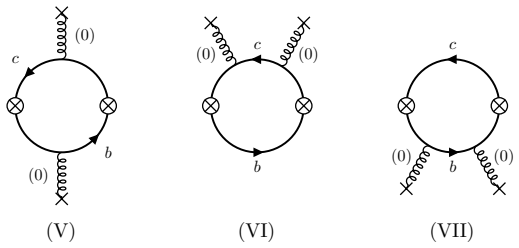
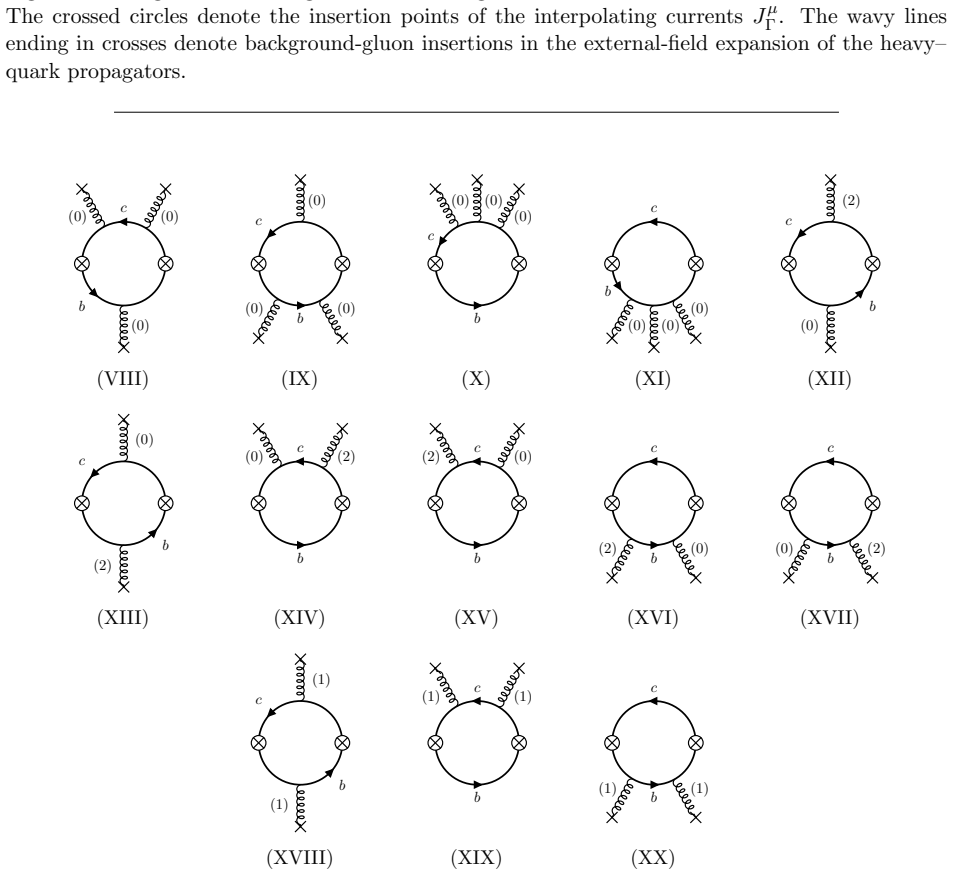
Two-point correlation functions of (axial-)vector and (axial-)tensor interpolating currents, evaluated via the operator product expansion truncated at dimension-six condensates, Borel transformation, and a continuum model.
If this is right
- Theoretical predictions for purely leptonic B_c decays become more precise.
- Unitarity constraints on b to c form factors are strengthened.
- Predictions for semileptonic B-bar to D^{(*)} lepton-neutrino decays gain accuracy.
- The extracted value of |V_cb| from exclusive decays improves.
Where Pith is reading between the lines
- The new tensor constants supply independent benchmarks that lattice groups can target to cross-check sum-rule methods.
- The same correlation-function setup could be reused for excited B_c states or for analogous constants in other heavy-light systems.
- Tighter |V_cb| bounds from these inputs may help quantify or reduce existing tensions between exclusive and inclusive determinations.
Load-bearing premise
The operator-product expansion truncated at dimension-six condensates together with the chosen continuum model and Borel window adequately captures the non-perturbative physics of the B_c system.
What would settle it
A lattice QCD calculation that produces tensor decay constants for the B_c^* or B_c1 differing by several standard deviations from the sum-rule central values would falsify the new results.
Figures
read the original abstract
We calculate the decay constants of the lowest-lying $B_c$ mesons in the spin-parity channels $J^P = 0^-,\,0^+,\,1^-,\,1^+$, commonly referred to as the $B_c,\, B_{c0}^*,\, B_c^*,\, B_{c1}$ mesons, respectively. Within the framework of QCD sum rules, we consider the decay constants associated with both the (axial-)vector and (axial-)tensor interpolating currents. The decay constants with (axial-)vector currents have already been studied in the literature. We refine previous QCD sum rule results by including higher-order power corrections and performing a comprehensive uncertainty analysis. Furthermore, we provide the first determination of the (axial-)tensor decay constants of the $B_c^*$ and $B_{c1}$ mesons. These new results will not only improve theoretical predictions for purely leptonic $B_c$ decays, but also strengthen unitarity constraints on $b \to c$ form factors, thereby improving the precision of predictions for $\bar{B} \to D^{(*)} \ell \bar\nu$ decays and the determination of \(|V_{cb}|\).
Editorial analysis
A structured set of objections, weighed in public.
Referee Report
Summary. The paper calculates the decay constants of the lowest-lying B_c mesons (B_c, B_{c0}^*, B_c^*, B_{c1}) in the J^P = 0^-, 0^+, 1^-, 1^+ channels using QCD sum rules. It considers both (axial-)vector and (axial-)tensor interpolating currents, refines prior results for the vector/axial-vector cases by including higher-order power corrections and a comprehensive uncertainty analysis, and provides the first determinations of the tensor decay constants for B_c^* and B_{c1}. These are intended to improve predictions for leptonic B_c decays and unitarity constraints on b → c form factors relevant to |V_cb|.
Significance. If the results hold, the refined vector/axial-vector values and the new tensor determinations supply useful inputs for phenomenology, particularly leptonic widths and constraints on semileptonic form factors that enter |V_cb| extractions from B → D^{(*)} ℓ ν. The extension to tensor currents within the same sum-rule framework is a clear addition to the existing literature on B_c systems.
minor comments (2)
- The abstract states that higher-order power corrections are included, but the main text should explicitly list the highest dimension retained in the OPE (e.g., dimension 6 or 8) and show the numerical size of each term in a table or figure for at least one channel to allow readers to judge convergence.
- The uncertainty analysis is described as comprehensive; the manuscript should tabulate the individual contributions (Borel mass variation, s_0 variation, condensate uncertainties, etc.) for each decay constant so that the dominant source of error is transparent.
Simulated Author's Rebuttal
We thank the referee for the positive summary, significance assessment, and recommendation of minor revision. No specific major comments appear in the provided report, so we have no individual points requiring point-by-point rebuttal or revision at this stage.
Circularity Check
No significant circularity identified
full rationale
The paper applies the established QCD sum-rule framework (OPE matched to hadronic dispersion relation) to compute decay constants for vector/axial-vector and tensor currents, refining prior results with higher-order power corrections and providing first tensor determinations. No load-bearing step reduces by construction to a self-citation, fitted input renamed as prediction, or self-definitional relation; the central outputs are independent extractions within the standard setup, with no quoted equations showing equivalence to inputs.
Axiom & Free-Parameter Ledger
free parameters (3)
- Borel parameter M^2
- continuum threshold s0
- quark condensate values
axioms (2)
- domain assumption Quark-hadron duality holds above the continuum threshold
- domain assumption Operator-product expansion truncated at dimension six is sufficient
Reference graph
Works this paper leans on
-
[1]
J. de Jong,Feasibility study of the branching fraction measurements ofB + c →τ +νand B+ c →τ +νat LHCb, Master’s Thesis, University of Groningen, Groningen, The Netherlands, June, 2022
2022
- [2]
-
[3]
Galati,Looking forward toB + c →τ +ντ, Ph.D
M.D. Galati,Looking forward toB + c →τ +ντ, Ph.D. thesis, U. Groningen (main), 3, 2026
2026
- [4]
-
[5]
C.G. Boyd, B. Grinstein and R.F. Lebed,Precision corrections to dispersive bounds on form-factors,Phys. Rev. D56(1997) 6895 [hep-ph/9705252]
Pith/arXiv arXiv 1997
-
[6]
I. Caprini, L. Lellouch and M. Neubert,Dispersive bounds on the shape of ¯B→D (∗)ℓ¯ν form-factors,Nucl. Phys. B530(1998) 153 [hep-ph/9712417]
Pith/arXiv arXiv 1998
-
[7]
Gubernari,Unitarity bounds and form-factor predictions forB-meson decays,2605.26213
N. Gubernari,Unitarity bounds and form-factor predictions forB-meson decays,2605.26213
-
[8]
M. Bordone, N. Gubernari, M. Jung and D. van Dyk,Challenging B(s) →D (∗) (s) form factors with the heavy quark expansion,JHEP11(2025) 051 [2507.03569]
arXiv 2025
-
[9]
M. Bordone and A. Juttner,New strategies for probingB→D ∗ℓ¯νℓ lattice and experimental data,Eur. Phys. J. C85(2025) 129 [2406.10074]. [10]HPQCDcollaboration,B-meson decay constants: a more complete picture from full lattice QCD,Phys. Rev. D91(2015) 114509 [1503.05762]. [11]ETMcollaboration,Masses and decay constants ofB (∗) c mesons withN f = 2 + 1 + 1twi...
arXiv 2025
-
[10]
Colangelo, G
P. Colangelo, G. Nardulli and N. Paver,QCD sum rules calculation ofB c decays,Z. Phys. C 57(1993) 43
1993
-
[11]
Narison, mc and mb fromM Bc and improved estimates off Bc andf Bc(2S),Phys
S. Narison, mc and mb fromM Bc and improved estimates off Bc andf Bc(2S),Phys. Lett. B 802(2020) 135221 [1906.03614]
arXiv 2020
-
[12]
Wang,Analysis of the vector and axialvectorB c mesons with QCD sum rules,Eur
Z.-G. Wang,Analysis of the vector and axialvectorB c mesons with QCD sum rules,Eur. Phys. J. A49(2013) 131 [1203.6252]
Pith/arXiv arXiv 2013
- [13]
-
[14]
Narison,Spectra and decay constants ofB c-like andB ∗ 0 mesons in QCD,Phys
S. Narison,Spectra and decay constants ofB c-like andB ∗ 0 mesons in QCD,Phys. Lett. B807 (2020) 135522 [2004.03622]
arXiv 2020
-
[15]
Wang,B c meson and its scalar cousin with QCD sum rules*,Chin
Z.-G. Wang,B c meson and its scalar cousin with QCD sum rules*,Chin. Phys. C48(2024) 103104 [2401.12571]. [19]Particle Data Groupcollaboration,Review of particle physics,Phys. Rev. D110(2024) 030001. 23
arXiv 2024
-
[16]
R.J. Dowdall, C.T.H. Davies, T.C. Hammant and R.R. Horgan,Precise heavy-light meson masses and hyperfine splittings from lattice QCD including charm quarks in the sea,Phys. Rev. D86(2012) 094510 [1207.5149]. [21]ATLAScollaboration,Observation of aB ∗+ c meson with the ATLAS detector,2605.16228
Pith/arXiv arXiv 2012
-
[17]
Shifman, A.I
M.A. Shifman, A.I. Vainshtein and V.I. Zakharov,QCD and Resonance Physics. Theoretical Foundations,Nucl. Phys. B147(1979) 385
1979
-
[18]
Reinders, H
L.J. Reinders, H. Rubinstein and S. Yazaki,Hadron Properties from QCD Sum Rules,Phys. Rept.127(1985) 1
1985
-
[19]
P. Colangelo and A. Khodjamirian,QCD sum rules, a modern perspective,hep-ph/0010175
-
[20]
Khodjamirian,Hadron Form Factors, CRC Press (4, 2020), 10.1201/9781315142005
A. Khodjamirian,Hadron Form Factors, CRC Press (4, 2020), 10.1201/9781315142005
-
[21]
P. Gelhausen, A. Khodjamirian, A.A. Pivovarov and D. Rosenthal,Radial excitations of heavy-light mesons from QCD sum rules,Eur. Phys. J. C74(2014) 2979 [1404.5891]
Pith/arXiv arXiv 2014
-
[22]
N. Gubernari, A. Khodjamirian, R. Mandal and T. Mannel,B→D 1(2420)and B→D ′ 1(2430)form factors from QCD light-cone sum rules,JHEP05(2022) 029 [2203.08493]
arXiv 2022
-
[23]
N. Gubernari, A. Khodjamirian, R. Mandal and T. Mannel,B→D ∗ 0 andB s →D ∗ s0 form factors from QCD light-cone sum rules,JHEP12(2023) 015 [2309.10165]
arXiv 2023
-
[24]
E. Bagan, H.G. Dosch, P. Gosdzinsky, S. Narison and J.M. Richard,Hadrons with charm and beauty,Z. Phys. C64(1994) 57 [hep-ph/9403208]
Pith/arXiv arXiv 1994
-
[25]
Nikolaev and A.V
S.N. Nikolaev and A.V. Radyushkin,Vacuum Corrections to QCD Charmonium Sum Rules: Basic Formalism andO(G 3)Results,Nucl. Phys. B213(1983) 285
1983
-
[26]
A. Djouadi and P. Gambino,Electroweak gauge bosons selfenergies: Complete QCD corrections,Phys. Rev. D49(1994) 3499 [hep-ph/9309298]
Pith/arXiv arXiv 1994
-
[27]
T. Generet, N. Gubernari and E. Loisa,Correlator with tensor currents and two masses at two loops,Eur. Phys. J. C86(2026) 112 [2509.02776]
arXiv 2026
-
[28]
Nikolaev and A.V
S.N. Nikolaev and A.V. Radyushkin,Method for Computing Higher Gluonic Power Corrections to QCD Charmonium Sum Rules,Phys. Lett. B110(1982) 476
1982
-
[29]
Nikolaev and A.V
S.N. Nikolaev and A.V. Radyushkin,QCD Charmonium Sum Rules up toO(G 4).,Phys. Lett. B124(1983) 243
1983
-
[30]
Novikov, M.A
V.A. Novikov, M.A. Shifman, A.I. Vainshtein and V.I. Zakharov,Calculations in External Fields in Quantum Chromodynamics. Technical Review,Fortsch. Phys.32(1984) 585
1984
-
[31]
Schwinger,On gauge invariance and vacuum polarization,Phys
J.S. Schwinger,On gauge invariance and vacuum polarization,Phys. Rev.82(1951) 664
1951
-
[32]
Smolyakov,Farri’s Theorem for Nonabelian Gauge Lagrangians,Theor
N.V. Smolyakov,Farri’s Theorem for Nonabelian Gauge Lagrangians,Theor. Math. Phys.50 (1982) 225
1982
-
[33]
Patel,Package-X 2.0: A Mathematica package for the analytic calculation of one-loop integrals,Comput
H.H. Patel,Package-X 2.0: A Mathematica package for the analytic calculation of one-loop integrals,Comput. Phys. Commun.218(2017) 66 [1612.00009]
Pith/arXiv arXiv 2017
-
[34]
V. Shtabovenko, R. Mertig and F. Orellana,FeynCalc 10: Do multiloop integrals dream of computer codes?,Comput. Phys. Commun.306(2025) 109357 [2312.14089]
arXiv 2025
-
[35]
Shtabovenko,FeynHelpers: Connecting FeynCalc to FIRE and Package-X,Comput
V. Shtabovenko,FeynHelpers: Connecting FeynCalc to FIRE and Package-X,Comput. Phys. Commun.218(2017) 48 [1611.06793]. 24
Pith/arXiv arXiv 2017
-
[36]
Lee,Presenting LiteRed: a tool for the Loop InTEgrals REDuction,1212.2685
R.N. Lee,Presenting LiteRed: a tool for the Loop InTEgrals REDuction,1212.2685
-
[37]
Ioffe,Condensates in quantum chromodynamics,Phys
B.L. Ioffe,Condensates in quantum chromodynamics,Phys. Atom. Nucl.66(2003) 30 [hep-ph/0207191]. [43]Flavour Lattice A veraging Group (FLAG)collaboration,FLAG Review 2021,Eur. Phys. J. C82(2022) 869 [2111.09849]
Pith/arXiv arXiv 2003
-
[38]
P. Gelhausen, A. Khodjamirian, A.A. Pivovarov and D. Rosenthal,Decay constants of heavy-light vector mesons from QCD sum rules,Phys. Rev. D88(2013) 014015 [1305.5432]
Pith/arXiv arXiv 2013
-
[39]
B. Pullin and R. Zwicky,Radiative decays of heavy-light mesons and thef (T) H,H ∗,H1 decay constants,JHEP09(2021) 023 [2106.13617]
arXiv 2021
-
[40]
K.G. Chetyrkin, J.H. Kuhn and M. Steinhauser,RunDec: A Mathematica package for running and decoupling of the strong coupling and quark masses,Comput. Phys. Commun. 133(2000) 43 [hep-ph/0004189]
Pith/arXiv arXiv 2000
-
[41]
F. Herren and M. Steinhauser,Version 3 of RunDec and CRunDec,Comput. Phys. Commun. 224(2018) 333 [1703.03751]
Pith/arXiv arXiv 2018
-
[42]
Wingate,Quark flavor physics and lattice QCD,Eur
M. Wingate,Quark flavor physics and lattice QCD,Eur. Phys. J. A57(2021) 239 [2103.17224]
arXiv 2021
-
[43]
J. Grigo, J. Hoff, P. Marquard and M. Steinhauser,Moments of heavy quark correlators with two masses: exact mass dependence to three loops,Nucl. Phys. B864(2012) 580 [1206.3418]
Pith/arXiv arXiv 2012
-
[44]
D. Bigi, P. Gambino and S. Schacht,R(D ∗),|V cb|, and the Heavy Quark Symmetry relations between form factors,JHEP11(2017) 061 [1707.09509]
Pith/arXiv arXiv 2017
-
[45]
A. Gopal and N. Gubernari,Unitarity bounds with subthreshold and anomalous cuts for b-hadron decays,Phys. Rev. D111(2025) L031501 [2412.04388]. 25
arXiv 2025
discussion (0)
Sign in with ORCID, Apple, or X to comment. Anyone can read and Pith papers without signing in.