The M-σ Relation Has to Break
Pith reviewed 2026-06-26 13:28 UTC · model grok-4.3
The pith
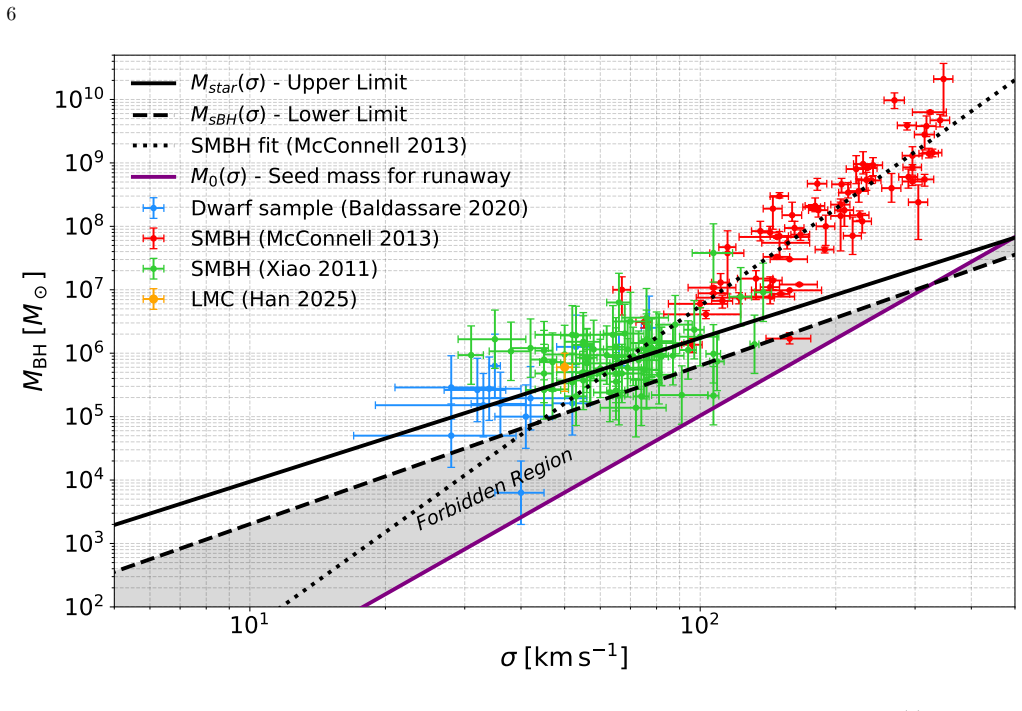
Capture-driven growth of black holes requires the M-σ relation to flatten below 10^5 solar masses.
A machine-rendered reading of the paper's core claim, the machinery that carries it, and where it could break.
Core claim
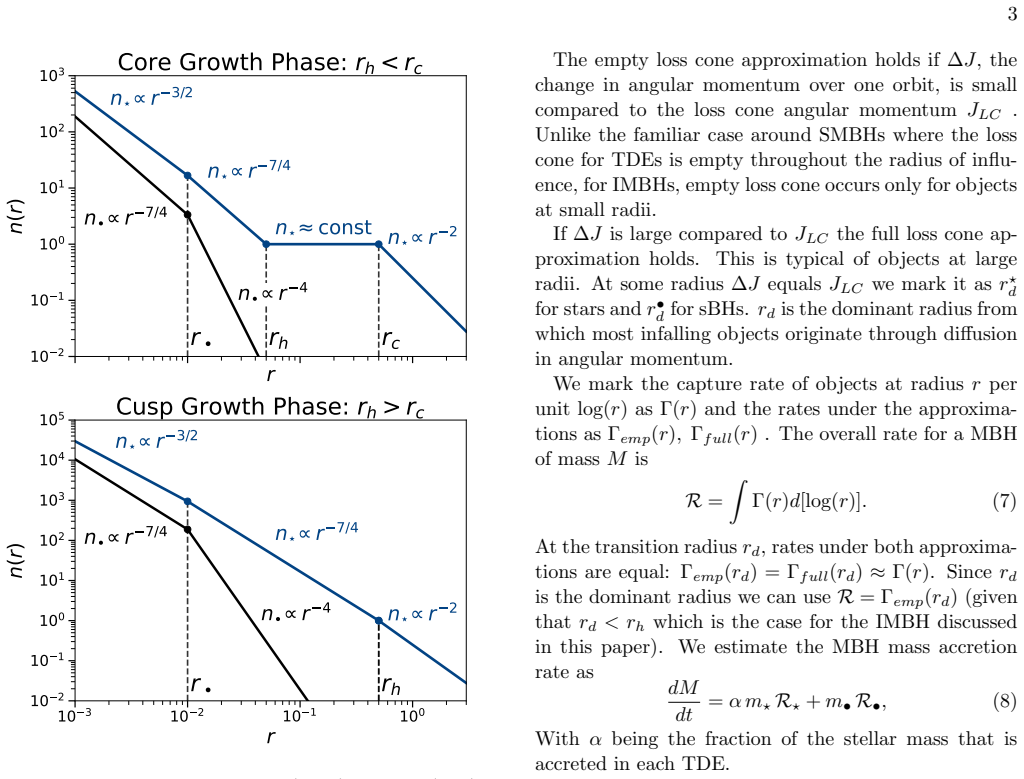
In dense cluster cores exceeding 10^6 solar masses per cubic parsec, seeds above 100 solar masses grow rapidly by swallowing stars and stellar black holes until their sphere of influence exceeds the core size. After that, growth continues as a power law whose normalization yields M ≈ 10^5 solar masses times (σ / 50 km s^{-1})^{2.5}. Because this lies above the downward extrapolation of the observed M ∝ σ^5 relation, the scaling must flatten to an index between 2.26 and 2.5 below 10^5 solar masses.
What carries the argument
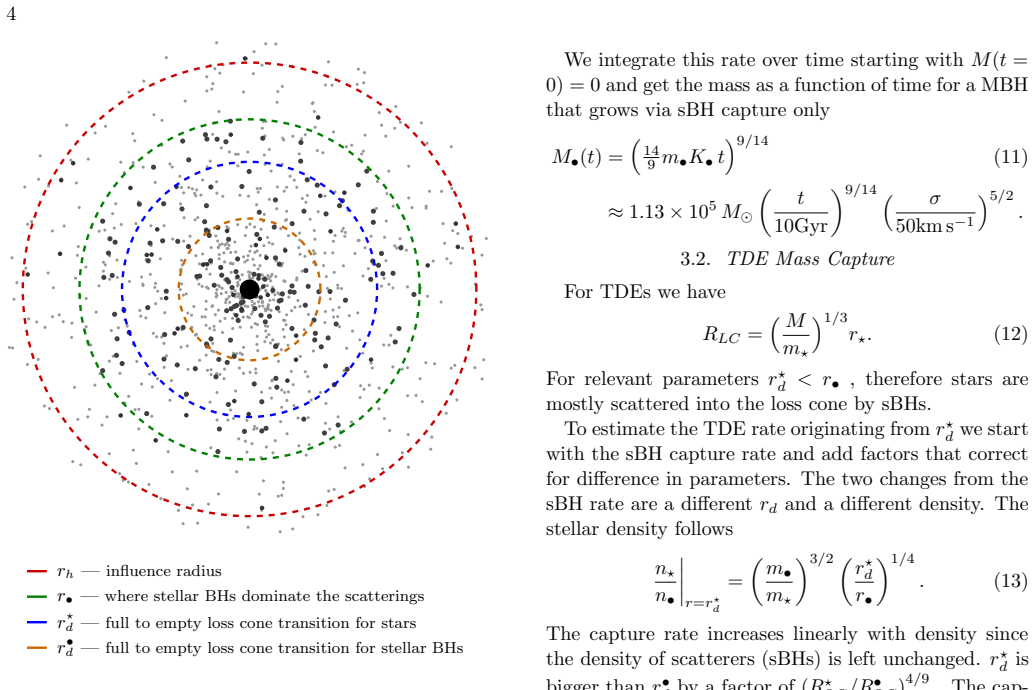
Runaway capture of stellar black holes and stars in dense cores, terminating when the central black hole's radius of influence exceeds the core radius.
If this is right
- The M-σ relation changes from β ≈ 5 to a shallower index 2.26–2.5 below 10^5 solar masses.
- Intermediate-mass black holes form in dense cores within a few billion years via this channel.
- The contribution from stellar-black-hole plunges is fixed while the tidal-disruption contribution can vary by up to a factor of three.
- Captured mass already exceeds the extrapolated supermassive-black-hole relation at low masses.
Where Pith is reading between the lines
- Low-mass galaxies should show a population of intermediate-mass black holes whose masses track velocity dispersion more weakly than in massive galaxies.
- Dynamical measurements in dwarf galaxies or globular clusters could directly test whether the relation flattens as predicted.
- If the break is absent, other growth channels must dominate even at these masses.
Load-bearing premise
Runaway growth ends once the black hole's radius of influence reaches the core radius or most of the core mass is consumed.
What would settle it
An observational sample of black holes below 10^5 solar masses that continues to follow M ∝ σ^5 with no flattening would contradict the predicted break.
Figures
read the original abstract
We revisit the growth of central black holes via tidal disruption events (TDEs) and plunges of stellar-mass black holes (sBHs). Our model incorporates the current understanding of mass segregation, where sBHs sink to the center, enhancing the rates of both TDEs and plunges. We demonstrate that in dense cluster cores, with densities exceeding $10^6\,\mathrm{M_\odot\,{pc}^{-3}}$, seeds of initial mass $M_0\gtrsim100\,M_\odot$ undergo runaway growth. This runaway terminates once the black hole radius of influence surpasses the core radius, or equivalently, most of the core mass has been consumed. This typically results in an intermediate-mass black hole (IMBH), within a few $\mathrm{Gyr}$. Subsequent growth proceeds as a power law. In contrast to observed supermassive black holes (SMBHs), which tightly follow the famous $M \propto \sigma^\beta$ with $\beta \cong5$, our derived sBH accretion rates, integrated over a galactic lifetime, predict final masses of $M\approx10^5\,M_\odot \times(\sigma/50\mathrm{km\;s^{-1}})^{2.5}$. While our prediction for the contribution of plunges to the growth of the IMBH is robust, the TDE contribution can be negligible if only a small fraction of their mass is actually accreted or up to 3 times higher than the plunges contribution if half a stellar mass gets accreted in each event. Below $M\sim10^5\,M_{\odot}$ this accreted star and sBH mass exceeds the extrapolation of the observed $M$-$\sigma$ relation. This predicts that the $M$-$\sigma$ scaling must flatten below $M \sim 10^5\,M_{\odot}$ to a shallower, $2.26<\beta<2.5$ profile. If confirmed by observations, this would indicate capture-driven growth.
Editorial analysis
A structured set of objections, weighed in public.
Referee Report
Summary. The manuscript models the growth of central black holes through tidal disruption events (TDEs) and plunges of stellar-mass black holes (sBHs), incorporating mass segregation that enhances rates in galactic nuclei. It argues that in dense cores with ρ > 10^6 M_⊙ pc^{-3}, seeds with M0 ≳ 100 M_⊙ experience runaway growth that terminates when the black hole's radius of influence exceeds the core radius (or core mass is exhausted), producing IMBHs within a few Gyr. Subsequent integration of the sBH accretion rates over a galactic lifetime yields a predicted scaling M ≈ 10^5 M_⊙ × (σ/50 km s^{-1})^{2.5}. This exceeds the extrapolation of the observed M-σ relation (β ≈ 5) below ~10^5 M_⊙, implying the relation must flatten to a shallower slope 2.26 < β < 2.5, which would indicate capture-driven growth. The plunge contribution is described as robust while the TDE contribution ranges from negligible to up to 3× higher depending on the accreted mass fraction per event.
Significance. If the derivations hold, the work supplies a concrete, observationally testable prediction for a break in the M-σ relation at low masses arising from capture-driven accretion, which could distinguish this channel from other IMBH formation scenarios. The explicit separation of robust plunge versus parameter-dependent TDE contributions and the use of mass segregation represent strengths that ground the scaling in current dynamical understanding. The result is falsifiable via future low-mass BH measurements and provides a physical motivation for deviations from the high-mass power law.
major comments (2)
- [Abstract] Abstract, first paragraph: The termination criterion for runaway growth (r_infl surpasses core radius or most of the core mass consumed) is stated without derivation, explicit integration over core parameters, or robustness checks against variations in density profile, mass segregation efficiency, or loss-cone refilling; this condition directly fixes the ~10^5 M_⊙ starting mass that sets the subsequent σ^{2.5} scaling and the claimed flattening, making it load-bearing for the central prediction.
- [Abstract] Abstract, second paragraph: The statement that 'derived sBH accretion rates, integrated over a galactic lifetime, predict final masses of M ≈ 10^5 M_⊙ × (σ/50 km s^{-1})^{2.5}' is presented without the explicit rate expressions, the integration steps, error propagation, or confirmation that the rates are independent of fitted normalizations from observed M-σ data; this integration is the direct source of the 2.5 exponent and the excess-mass argument.
minor comments (1)
- [Abstract] Abstract: The phrase 'within a few Gyr' for IMBH formation is given without reference to a specific timescale calculation or dependence on initial conditions.
Simulated Author's Rebuttal
We thank the referee for their detailed and constructive report. We address the two major comments below, agreeing that the abstract would benefit from greater self-containment while noting that the underlying derivations appear in the main text.
read point-by-point responses
-
Referee: [Abstract] Abstract, first paragraph: The termination criterion for runaway growth (r_infl surpasses core radius or most of the core mass consumed) is stated without derivation, explicit integration over core parameters, or robustness checks against variations in density profile, mass segregation efficiency, or loss-cone refilling; this condition directly fixes the ~10^5 M_⊙ starting mass that sets the subsequent σ^{2.5} scaling and the claimed flattening, making it load-bearing for the central prediction.
Authors: The termination criterion is derived in Section 3 via explicit integration over core mass and radius, with robustness checks against density-profile variations and mass-segregation efficiency included there. The abstract condenses this result; the ~10^5 M_⊙ value is representative for the fiducial dense cores considered. We will revise the abstract to briefly reference the Section 3 derivation and the typical core parameters used. revision: yes
-
Referee: [Abstract] Abstract, second paragraph: The statement that 'derived sBH accretion rates, integrated over a galactic lifetime, predict final masses of M ≈ 10^5 M_⊙ × (σ/50 km s^{-1})^{2.5}' is presented without the explicit rate expressions, the integration steps, error propagation, or confirmation that the rates are independent of fitted normalizations from observed M-σ data; this integration is the direct source of the 2.5 exponent and the excess-mass argument.
Authors: Section 4 derives the sBH plunge and TDE rates from mass-segregated loss-cone dynamics, performs the galactic-lifetime integration, and shows that the resulting σ^{2.5} scaling arises directly from the dynamical rates without reference to observed M-σ normalizations. Error propagation and parameter ranges are discussed in that section. We will revise the abstract to note that the scaling follows from the Section 4 integration. revision: yes
Circularity Check
No significant circularity; derivation is self-contained from model assumptions
full rationale
The central chain derives sBH accretion rates from mass segregation in dense cores (ρ > 10^6 M_⊙ pc^{-3}), applies a termination condition when r_infl exceeds r_core (or core mass exhausted), obtains an IMBH seed scale, and integrates the rates over galactic lifetime to arrive at M ≈ 10^5 M_⊙ (σ/50 km s^{-1})^{2.5}. This scaling is presented as a model output that contrasts with the observed β ≅ 5 relation rather than being fitted to it. No self-citations, fitted normalizations from M-σ data, or self-definitional steps are invoked in the provided text. The TDE/plunge range (0–3×) reflects parameter uncertainty but does not reduce the prediction to its inputs by construction. The paper is therefore self-contained against external benchmarks.
Axiom & Free-Parameter Ledger
free parameters (3)
- initial seed mass threshold M0 =
100 M_⊙
- core density threshold =
10^6 M_⊙ pc^{-3}
- TDE accreted mass fraction =
0 to 0.5
axioms (2)
- domain assumption Mass segregation causes sBHs to sink to the center, enhancing TDE and plunge rates.
- domain assumption Runaway growth terminates when BH radius of influence exceeds core radius or most core mass is consumed.
Reference graph
Works this paper leans on
-
[1]
2009, The Astrophysical Journal, 697, 1861–1869, doi: 10.1088/0004-637x/697/2/1861
Alexander, T., & Hopman, C. 2009, The Astrophysical Journal, 697, 1861–1869, doi: 10.1088/0004-637x/697/2/1861
-
[2]
2018, Living Reviews in Relativity, 21, doi: 10.1007/s41114-018-0013-8
Amaro-Seoane, P. 2018, Living Reviews in Relativity, 21, doi: 10.1007/s41114-018-0013-8
-
[3]
Bahcall, J. N., & Wolf, R. A. 1976, ApJ, 209, 214, doi: 10.1086/154711 —. 1977, ApJ, 216, 883, doi: 10.1086/155534
-
[4]
F., Dickey, C., Geha, M., & Reines, A
Baldassare, V. F., Dickey, C., Geha, M., & Reines, A. E. 2020, ApJL, 898, L3, doi: 10.3847/2041-8213/aba0c1 10
-
[5]
2008, Galactic Dynamics: Second Edition, Princeton Series in Astrophysics (Princeton University Press)
Binney, J., & Tremaine, S. 2008, Galactic Dynamics: Second Edition, Princeton Series in Astrophysics (Princeton University Press). https://books.google.co.il/books?id=qxWt20TH--cC
2008
-
[6]
2025, The Astrophysical Journal Letters, 980, L22, doi: 10.3847/2041-8213/adace7
Natarajan, P. 2025, The Astrophysical Journal Letters, 980, L22, doi: 10.3847/2041-8213/adace7
-
[7]
2018, ApJ, 867, 20, doi: 10.3847/1538-4357/aadfda
Chen, J.-H., & Shen, R.-F. 2018, ApJ, 867, 20, doi: 10.3847/1538-4357/aadfda
-
[8]
A Fundamental Relation Between Supermassive Black Holes and Their Host Galaxies
Ferrarese, L., & Merritt, D. 2000, ApJL, 539, L9, doi: 10.1086/312838
work page internal anchor Pith review doi:10.1086/312838 2000
-
[9]
2018, The Astrophysical Journal, 852, 51, doi: 10.3847/1538-4357/aaa0d7
Fragione, G., & Sari, R. 2018, The Astrophysical Journal, 852, 51, doi: 10.3847/1538-4357/aaa0d7
-
[10]
Frank, J., & Rees, M. J. 1976, MNRAS, 176, 633, doi: 10.1093/mnras/176.3.633
-
[11]
Greene, J. E., & Ho, L. C. 2006, ApJL, 641, L21, doi: 10.1086/500507
-
[12]
J., El-Badry, K., Lucchini, S., et al
Han, J. J., El-Badry, K., Lucchini, S., et al. 2025, ApJ. https://arxiv.org/abs/2502.00102
arXiv 2025
-
[13]
Hilker, M., Baumgardt, H., Sollima, A., & Bellini, A. 2019, Proceedings of the International Astronomical Union, 14, 451–454, doi: 10.1017/s1743921319006823
-
[14]
2003, ApJL, 596, L27, doi: 10.1086/379143
King, A. 2003, ApJL, 596, L27, doi: 10.1086/379143
-
[15]
King, I. R. 1966, AJ, 71, 64, doi: 10.1086/109857
-
[16]
Kormendy, J., & Ho, L. C. 2013, Annual Review of Astronomy and Astrophysics, 51, 511–653, doi: 10.1146/annurev-astro-082708-101811
work page internal anchor Pith review doi:10.1146/annurev-astro-082708-101811 2013
-
[17]
Krolik, J., Piran, T., Svirski, G., & Cheng, R. M. 2016, The Astrophysical Journal, 827, 127, doi: 10.3847/0004-637x/827/2/127
-
[18]
Lightman, A. P., & Shapiro, S. L. 1977, ApJ, 211, 244, doi: 10.1086/154925
-
[19]
2022, The Astrophysical Journal, 940, 101, doi: 10.3847/1538-4357/ac9bfd
Linial, I., & Sari, R. 2022, The Astrophysical Journal, 940, 101, doi: 10.3847/1538-4357/ac9bfd
-
[20]
Lousto, C. O., & Zlochower, Y. 2011, Physical Review Letters, 107, doi: 10.1103/physrevlett.107.231102 L¨ utzgendorf, N., Kissler-Patig, M., Neumayer, N., et al. 2013, Astronomy & Astrophysics, 555, A26, doi: 10.1051/0004-6361/201321183
-
[21]
Magorrian, J., & Tremaine, S. 1999a, Monthly Notices of the Royal Astronomical Society, 309, 447, doi: 10.1046/j.1365-8711.1999.02853.x —. 1999b, Monthly Notices of the Royal Astronomical Society, 309, 447, doi: 10.1046/j.1365-8711.1999.02853.x
-
[22]
1998, AJ, 115, 2285, doi: 10.1086/300353
Magorrian, J., Tremaine, S., Richstone, D., et al. 1998, AJ, 115, 2285, doi: 10.1086/300353
-
[23]
Marconi, A., Risaliti, G., Gilli, R., et al. 2004, MNRAS, 351, 169, doi: 10.1111/j.1365-2966.2004.07765.x
-
[24]
McConnell, N. J., & Ma, C.-P. 2013, The Astrophysical Journal, 764, 184, doi: 10.1088/0004-637x/764/2/184
work page internal anchor Pith review doi:10.1088/0004-637x/764/2/184 2013
-
[25]
Miller, M. C., & Hamilton, D. P. 2002, The Astrophysical Journal, 576, 894, doi: 10.1086/341788 Portegies Zwart, S. F., Baumgardt, H., Hut, P., Makino, J., & McMillan, S. L. W. 2004, Nature, 428, 724, doi: 10.1038/nature02448
-
[26]
Prieto, E. G., Rodriguez, C. L., & Cabrera, T. 2025, Growing the Intermediate-mass Black Hole in Omega Centauri. https://arxiv.org/abs/2507.06316
arXiv 2025
-
[27]
2022, Physical Review D, 106, doi: 10.1103/physrevd.106.104040 —
Rom, B., & Sari, R. 2022, Physical Review D, 106, doi: 10.1103/physrevd.106.104040 —. 2025, Segregation in Nuclear Stellar Clusters: Rates and Mass Distributions of TDEs, QPEs, Plunges, and EMRIs. https://arxiv.org/abs/2502.13209
-
[28]
Shapiro, S. L., & Teukolsky, S. A. 1983, Black holes, white dwarfs and neutron stars. The physics of compact objects (John Wiley & Sons, Ltd), doi: 10.1002/9783527617661
-
[29]
1987, Dynamical evolution of globular clusters,
Spitzer, L. 1987, Dynamical evolution of globular clusters,
1987
-
[30]
Stone, N. C., K¨ upper, A. H. W., & Ostriker, J. P. 2017, MNRAS, 467, 4180, doi: 10.1093/mnras/stx097
-
[31]
Strubbe, L. E., & Quataert, E. 2009, Monthly Notices of the Royal Astronomical Society, 400, 2070, doi: 10.1111/j.1365-2966.2009.15599.x van Velzen, S. 2018, ApJ, 852, 72, doi: 10.3847/1538-4357/aa998e
-
[32]
Xiao, T., Barth, A. J., Greene, J. E., et al. 2011, The Astrophysical Journal, 739, 28, doi: 10.1088/0004-637x/739/1/28
discussion (0)
Sign in with ORCID, Apple, or X to comment. Anyone can read and Pith papers without signing in.