REVIEW 2 major objections 2 minor 45 references
The singularities of the resonance surface determine the global organization of resonance tongues in periodically forced dynamical systems.
Reviewed by Pith at T0; open to challenge. T0 means a machine referee read the full paper against a public rubric. the ladder, T0–T4 →
T0 review · grok-4.3
2026-06-30 08:26 UTC pith:NCYVCF5H
load-bearing objection The paper introduces a resonance surface (graph of rotation number) whose boundary singularities, analyzed via Morse theory, organize resonance tongue arrangements, and demonstrates this with six patterns in an ocean-mixing model. the 2 major comments →
Devil's terraces: determining the organization of resonance tongues in a periodically forced dynamical system
The pith
A machine-rendered reading of the paper's core claim, the machinery that carries it, and where it could break.
Core claim
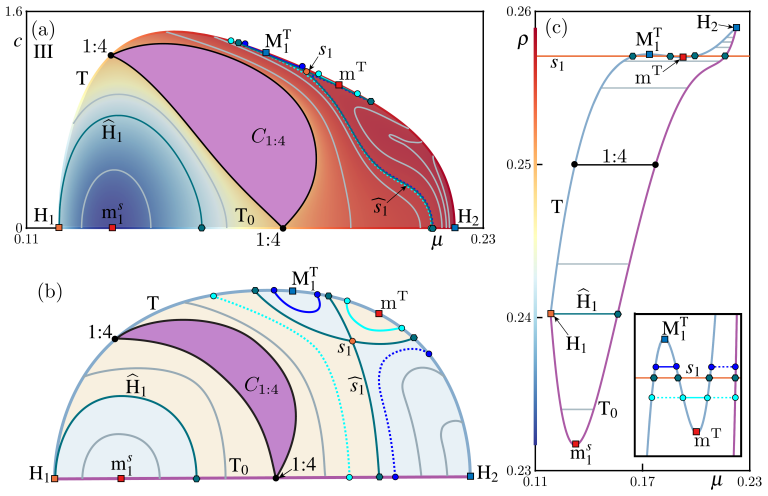
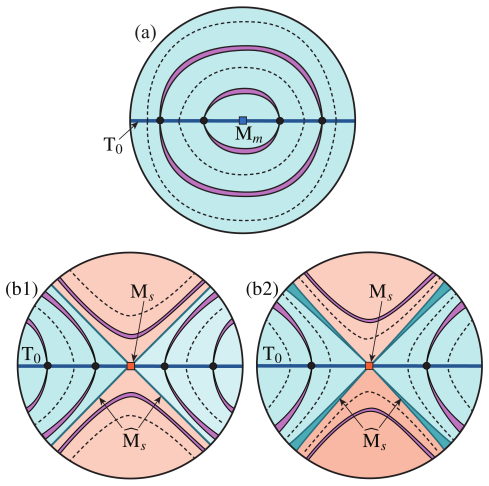
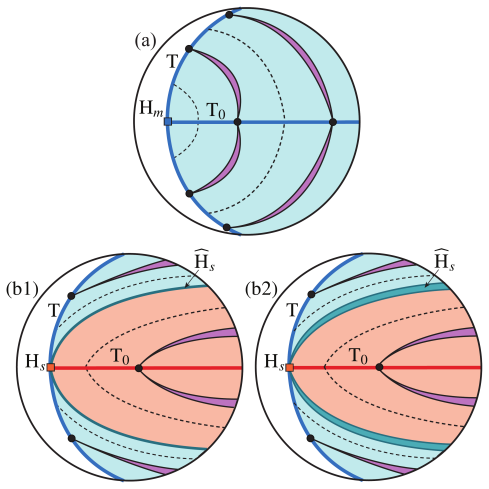
Resonance tongues appear as terraces of the resonance surface at rational values of the rotation number, and their global arrangement is determined by the singularities of this surface. In the periodically forced model of vertical mixing, six distinct resonance-tongue arrangements are identified, and the transitions between them are due to changes in the number and type of singularities on the boundary of the resonance surface.
What carries the argument
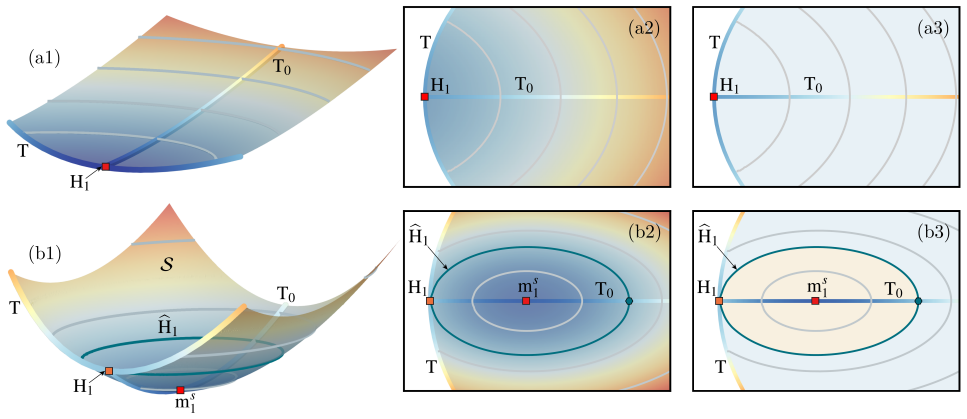
The two-dimensional resonance surface, defined as the graph of the rotation number over the parameter plane, whose singularities dictate the organization and connectivity of resonance tongues.
Load-bearing premise
The singularities of the resonance surface fully determine the global topological arrangement of resonance tongues without additional dynamical constraints from the underlying flow.
What would settle it
Computation of the resonance surface for the model followed by observation of a tongue arrangement whose ordering or connectivity fails to match the singularities on the computed boundary would falsify the central claim.
If this is right
- Exactly six distinct resonance-tongue arrangements appear as a third parameter is varied.
- Transitions between arrangements occur exactly when the number or type of boundary singularities changes.
- High-resolution computation of the rotation number is required to locate and classify the singularities that organize the tongues.
- The topological classification applies directly to any periodically forced system once its resonance surface is resolved.
Where Pith is reading between the lines
- The same surface construction could be used to classify resonance organization in other forced oscillators or maps once the rotation number is computable.
- Singularities on the boundary may correspond to codimension-one bifurcations of the invariant torus that alter locking regions.
- The algorithm for accurate rotation-number computation could be applied to experimental time series to test whether real systems exhibit the predicted terrace arrangements.
Editorial analysis
A structured set of objections, weighed in public.
Referee Report
Summary. The paper develops a topological framework grounded in Morse theory for organizing resonance tongues in periodically forced dynamical systems. The central object is the resonance surface, defined as the graph of the rotation number ρ over the parameter plane; resonance tongues appear as terraces at rational ρ values, and their global arrangements and transitions are claimed to be determined by the number and type of singularities on the surface boundary. An efficient algorithm is presented for high-resolution computation of ρ. The framework is applied to a periodically forced model of vertical mixing in the North Atlantic, identifying six distinct resonance-tongue arrangements whose transitions arise from changes in surface singularities under variation of a third parameter.
Significance. If the central claim holds, the work provides a systematic Morse-theoretic approach to the global organization of resonance tongues, a topic that has received limited attention beyond individual tongues. The high-resolution algorithm for computing ρ is a concrete practical contribution that enables the analysis. The application to the ocean-mixing model supplies a physically relevant example with potential implications for understanding parameter dependence in forced oscillators. The explicit identification of six arrangements and their singularity-driven transitions is a clear, falsifiable output.
major comments (2)
- [§3] §3 (topological framework) and the paragraph stating the main claim: the assertion that 'resonance transitions between them are due to changes in the number and type of singularities on the boundary of the resonance surface' treats ρ as an arbitrary Morse function whose singularities alone fix the terrace arrangements. No explicit argument or theorem shows that the continuity, monotonicity, and invariance properties inherited from the underlying flow (ρ as limit of (1/n) times the lift of the n-th iterate) do not impose additional constraints that could restrict possible configurations or alter relative ordering and connectivity. This is load-bearing for the determination of the six arrangements.
- [§4] §4 (application to the North Atlantic model) and the transition analysis: the six arrangements are reported as fully determined by singularity changes, yet the text provides no cross-check (e.g., via direct simulation of the flow or comparison against an alternative topological invariant) confirming that flow-specific constraints on ρ are either incorporated or ruled out. Without this, the causal attribution of transitions to singularities alone remains incomplete.
minor comments (2)
- [Figure 2] Figure 2 caption: the labeling of singularity types (fold, cusp, etc.) on the resonance-surface boundary is not cross-referenced to the definitions in §2.2, making it difficult to verify the count of singularities for each arrangement.
- [§2] Notation: the symbol for the resonance surface is introduced without an explicit equation number; adding 'let Σ = {(x, y, ρ(x,y))} ' in §2 would improve clarity.
Simulated Author's Rebuttal
We thank the referee for their thoughtful review and valuable suggestions. We address each major comment below, providing clarifications on the topological framework and the application to the North Atlantic model.
read point-by-point responses
-
Referee: [§3] §3 (topological framework) and the paragraph stating the main claim: the assertion that 'resonance transitions between them are due to changes in the number and type of singularities on the boundary of the resonance surface' treats ρ as an arbitrary Morse function whose singularities alone fix the terrace arrangements. No explicit argument or theorem shows that the continuity, monotonicity, and invariance properties inherited from the underlying flow (ρ as limit of (1/n) times the lift of the n-th iterate) do not impose additional constraints that could restrict possible configurations or alter relative ordering and connectivity. This is load-bearing for the determination of the six arrangements.
Authors: The resonance surface is defined as the graph of ρ, where ρ is computed as the limit of (1/n) times the lift of the n-th iterate of the Poincaré map, ensuring that all continuity, monotonicity, and invariance properties from the flow are built into the surface by construction. Morse theory is applied to this specific surface, and the singularities determine the terrace arrangements precisely because of these properties; arbitrary Morse functions might allow more configurations, but the rotation number's properties restrict it to those observed. The six arrangements in the application arise from this. We will add a clarifying paragraph in §3 explaining how the dynamical properties of ρ are compatible with and support the Morse-theoretic analysis without additional constraints altering the conclusions. revision: partial
-
Referee: [§4] §4 (application to the North Atlantic model) and the transition analysis: the six arrangements are reported as fully determined by singularity changes, yet the text provides no cross-check (e.g., via direct simulation of the flow or comparison against an alternative topological invariant) confirming that flow-specific constraints on ρ are either incorporated or ruled out. Without this, the causal attribution of transitions to singularities alone remains incomplete.
Authors: The computation of the resonance surface in §4 is performed using the high-resolution algorithm applied directly to the periodically forced North Atlantic mixing model. This means the surface and its singularities are obtained from the actual dynamics of the flow, thereby incorporating all flow-specific constraints on ρ. The observed transitions between the six arrangements coincide exactly with the changes in boundary singularities as the third parameter is varied. This direct computation serves as the empirical cross-check. We will revise the text in §4 to explicitly state that the numerical construction from the model validates the attribution. revision: partial
Circularity Check
No circularity: topological framework derived independently via Morse theory
full rationale
The derivation defines the resonance surface explicitly as the graph of the rotation number ρ and invokes standard Morse theory to link its singularities to terrace arrangements. This is presented as a general topological construction applied to the periodically forced system, with the North Atlantic model serving as an illustrative computation rather than a fitting source. No equations reduce a claimed prediction to a fitted input by construction, no load-bearing uniqueness theorems are imported via self-citation, and the abstract and framework statements contain no self-definitional loops or ansatz smuggling. The approach remains self-contained against external topological benchmarks.
Axiom & Free-Parameter Ledger
axioms (1)
- domain assumption Morse theory applies to the resonance surface and its boundary singularities classify the global tongue arrangement
invented entities (1)
-
resonance surface
no independent evidence
read the original abstract
In periodically forced dynamical systems, resonance tongues are open regions of a parameter plane in which the dynamics on an invariant torus locks to a stable periodic orbit. While individual resonance tongues are well understood, the principles governing their global arrangement remain largely unexplored. We develop a topological framework, grounded in applied topology and Morse theory, whose central object is the two-dimensional resonance surface, defined as the graph of the rotation number $\rho$ over a parameter plane. Within this framework, resonance tongues appear as terraces of the resonance surface at rational values of $\rho$, and their global arrangement is determined by the singularities of this surface. Resolving the resonance surface requires the accurate computation of $\rho$, and we present an algorithm that does so efficiently and at high resolution. As a specific example, we examine a periodically forced model of vertical mixing in the North Atlantic, a process relevant to the Atlantic Meridional Overturning Circulation, and study how its resonance surface changes under variation of a third parameter. We identify six distinct resonance-tongue arrangements and show that the resonance transitions between them are due to changes in the number and type of singularities on the boundary of the resonance surface.
Figures








Reference graph
Works this paper leans on
-
[1]
A. Farokhniaee, E. W. Large, Mode-locking behavior of Izhikevich neurons under periodic external forcing, Physical Review E 95 (6) (2017) 062414
work page 2017
-
[2]
S.-G. Lee, S. Kim, Bifurcation analysis of mode-locking structure in a Hodgkin–Huxley neuron under sinusoidal current, Physical Review E 73 (4) (2006) 041924
work page 2006
-
[3]
H. Wang, Y. Sun, Y. Li, Y. Chen, Influence of autapse on mode-locking structure of a Hodgkin– Huxley neuron under sinusoidal stimulus, Journal of Theoretical Biology 358 (2014) 25–30
work page 2014
-
[4]
S. Terrien, B. Krauskopf, N. G. R. Broderick, V. A. Pammi, R. Braive, I. Sagnes, G. Beaudoin, K. Pantzas, S. Barbay, Merging and disconnecting resonance tongues in a pulsing excitable mi- crolaser with delayed optical feedback, Chaos: An Interdisciplinary Journal of Nonlinear Science 33 (2) (2023) 023142
work page 2023
-
[5]
J. Simonet, M. Warden, E. Brun, Locking and arnol’d tongues in an infinite-dimensional system: The nuclear magnetic resonance laser with delayed feedback, Physical Review E 50 (5) (1994) 3383
work page 1994
- [6]
- [7]
-
[8]
E. Tziperman, M. A. Cane, S. E. Zebiak, Irregularity and locking to the seasonal cycle in an ENSO prediction model as explained by the quasi-periodicity route to chaos, Journal of Atmospheric Sciences 52 (3) (1995) 293–306
work page 1995
-
[9]
B. Krauskopf, J. Sieber, Bifurcation analysis of delay-induced resonances of the El Niño southern oscillation, Proceedings of the Royal Society A: Mathematical, Physical and Engineering Sciences 470 (2169) (2014) 20140348
work page 2014
-
[10]
A. L. Lin, A. Hagberg, E. Meron, H. L. Swinney, Resonance tongues and patterns in periodically forced reaction-diffusion systems, Physical Review E 69 (6) (2004) 066217. 30
work page 2004
- [11]
-
[12]
Wiggins, Introduction to Applied Nonlinear Dynamical Systems and Chaos, Vol
S. Wiggins, Introduction to Applied Nonlinear Dynamical Systems and Chaos, Vol. 2, Springer, 2003
work page 2003
-
[13]
Y. A. Kuznetsov, Elements of Applied Bifurcation Theory, Vol. 112, Springer, 1998
work page 1998
-
[14]
L. P. Shil’nikov, Methods of qualitative theory in nonlinear dynamics, Vol. 5, World Scientific, 2001
work page 2001
-
[15]
V. I. Arnold, Small denominators. i. mapping of the circumference onto itself, American Mathe- matical Society Translations, Series 2 46 (1965) 213–284
work page 1965
- [16]
-
[17]
F. Takens, Forced oscillations and bifurcations, in: Global analysis of dynamical systems, Institute of Physics Publishing, 2001, pp. 1–61
work page 2001
-
[18]
V. I. Arnold, Loss of stability of self-oscillation close to resonance and versal deformations of equivariant vector fields, Functional Analysis and its Applications 11 (2) (1977) 85–92
work page 1977
-
[19]
H. W. Broer, M. Golubitsky, G. Vegter, The geometry of resonance tongues: a singularity theory approach, Nonlinearity 16 (4) (2003) 1511
work page 2003
-
[20]
B. B. Peckham, C. E. Frouzakis, I. G. Kevrekidis, Bananas and banana splits: a parametric degeneracy in the Hopf bifurcation for maps, SIAM Journal on Mathematical Analysis 26 (1) (1995) 190–217
work page 1995
-
[21]
B. B. Peckham, I. G. Kevrekidis, Lighting Arnold flames: resonance in doubly forced periodic oscillators, Nonlinearity 15 (2) (2002) 405–428
work page 2002
-
[22]
F. Schilder, B. B. Peckham, Computing Arnol’d tongue scenarios, Journal of Computational Physics 220 (2) (2007) 932–951
work page 2007
-
[23]
S. Bolduc-St-Aubin, A. R. Humphries, Seasonal-forcing-dominated dynamics of a piecewise- smooth Ghil–Zaliapin–Thompson ENSO model, arXiv:2510.27084 (2025)
- [24]
-
[25]
T. Detroux, J.-P. Noël, L. N. Virgin, G. Kerschen, Experimental study of isolas in nonlinear systems featuring modal interactions, PLOS ONE 13 (3) (2018) e0194452
work page 2018
-
[26]
R. J. Kuether, L. Renson, T. Detroux, C. Grappasonni, G. Kerschen, M. S. Allen, Nonlinear normal modes, modal interactions and isolated resonance curves, Journal of Sound and Vibration 351 (2015) 299–310
work page 2015
-
[27]
A. Marchionne, P. Ditlevsen, S. Wieczorek, Synchronisation vs. resonance: Isolated resonances in damped nonlinear oscillators, Physica D: Nonlinear Phenomena 380 (2018) 8–16. 31
work page 2018
-
[28]
H. Edelsbrunner, J. Harer, Computational Topology: an introduction, American Mathematical Soc., 2010
work page 2010
-
[29]
H. Carr, J. Snoeyink, U. Axen, Computing contour trees in all dimensions, Computational Ge- ometry 24 (2) (2003) 75–94
work page 2003
- [30]
-
[31]
J. W. Milnor, Morse theory, no. 51, Princeton University Press, 1963
work page 1963
- [32]
-
[33]
Matsumoto, An introduction to Morse theory, Vol
Y. Matsumoto, An introduction to Morse theory, Vol. 208, American Mathematical Soc., 2002
work page 2002
-
[34]
J. Cerf, La stratification naturelle des espaces de fonctions différentiables réelles et le théoreme de la pseudo-isotopie, Publications Mathématiques de l’IHÉS 39 (1970) 5–173
work page 1970
-
[35]
P. Welander, Thermohaline effects in the ocean circulation and related simple models, in: Large- scale transport processes in oceans and atmosphere, Springer, 1986, pp. 163–200
work page 1986
-
[36]
P. Cessi, A simple box model of stochastically forced thermohaline flow, Journal of Physical Oceanography 24 (9) (1994) 1911–1920
work page 1994
- [37]
-
[38]
P. Cessi, Convective adjustment and thermohaline excitability, Journal of Physical Oceanography 26 (4) (1996) 481–491
work page 1996
-
[39]
I. Yashayaev, J. W. Loder, Recurrent replenishment of Labrador Sea Water and associated decadal-scale variability, Journal of Geophysical Research: Oceans 121 (11) (2016) 8095–8114
work page 2016
-
[40]
N. P. Holliday, S. A. Cunningham, C. Johnson, S. F. Gary, C. Griffiths, J. F. Read, T. Sherwin, Multidecadal variability of potential temperature, salinity, and transport in the eastern subpolar North Atlantic, Journal of Geophysical Research: Oceans 120 (9) (2015) 5945–5967
work page 2015
-
[41]
S. Das, Y. Saiki, E. Sander, J. A. Yorke, Quantitative quasiperiodicity, Nonlinearity 30 (11) (2017) 4111–4140
work page 2017
-
[42]
J. M. Lee, Introduction to Topological Manifolds, Springer, 2000
work page 2000
-
[43]
V. I. Arnold, Singularity theory, Vol. 53, Cambridge University Press, 1981
work page 1981
-
[44]
S. Bolduc-St-Aubin, B. Krauskopf, From resonance to chaos in a DDE climate model, in: 24th IFAC World Congress, Busan, Republic of Korea, 2026
work page 2026
-
[45]
S. Bolduc-St-Aubin, P. Subramanian, B. Krauskopf, Resonance structure of a periodically forced delay differential equation model for the El Niño–Southern Oscillation, Preprint (2026). 32
work page 2026
discussion (0)
Sign in with ORCID, Apple, or X to comment. Anyone can read and Pith papers without signing in.