REVIEW 3 major objections 4 minor 22 references
Enabling Simulation of High-Dimensional Micro-Macro Biophysical Models through Hybrid CPU and Multi-GPU Parallelism
T0 review · 3 major / 4 minor · reviewed 2026-08-14 · deepseek-v4-flash
Pith's one-line read This paper argues that a micro-macro model of a gliding motility assay can be simulated dramatically faster by restructuring the algorithm around GPU hardware, claiming up to 27x speedup over a prior hybrid CPU-GPU implementation and up…
desk verdict Measured 27x speedup on a real micro-macro simulation with careful engineering; the main weakness is that the numerical changes are asserted to be accuracy-neutral without any quantitative check. read the letter →
The pith
A machine-rendered reading of the paper's core claim, the machinery that carries it, and where it could break.
The reading
What carries the argument
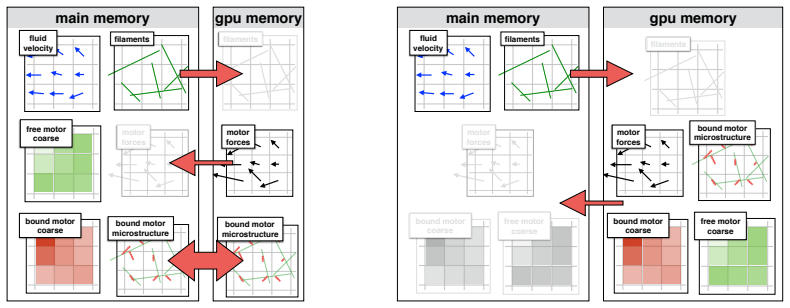
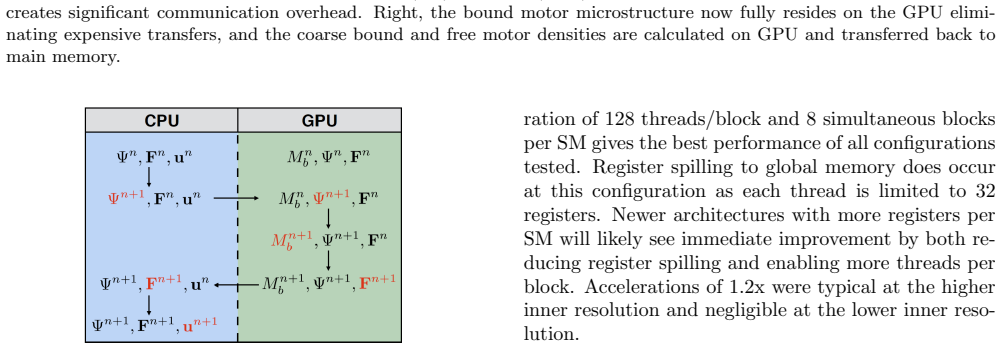
The central object is the bound-motor density Mb(r0, x, θ, s), a high-dimensional field: for each motor tail anchor r0 on the substrate, it stores the density as a function of the filament's position x, orientation θ, and arclength s. Because a motor can only bind to filament segments within a capture radius, Mb is supported on a compact set Brc(r0), which limits storage. The load-bearing mechanism is a fused GPU kernel that, for each r0 independently, loops over local adaptive time steps, updates Mb with Runge-Kutta 2, computes the coarse bound-motor density, rescales if needed, and updates the free-motor density, all without leaving the GPU. This removes a global synchronization point (the old global time step) and keeps the low-dimensional fluid and filament solves on the CPU, so CPU-GPU transfers carry only coarse quantities.
What would settle it
Run the original algorithm and the optimized algorithm on the same initial condition and resolution, using the original double-precision Adams-Bashforth 2 scheme with the original global time step, and compare the filament density, bound-motor density, and vortex-lattice structure at matched output times; if the fields diverge by more than the original scheme's truncation error, or the emergent pattern changes, then the speedups do not preserve the physics.
Extended reading notes
Core claim
The paper's discovery is that the bottleneck in hybrid CPU-GPU simulation of the gliding assay is not raw arithmetic but data movement and global synchronization. By restructuring so that the high-dimensional bound-motor density Mb(r0, x, θ, s) resides solely in GPU memory and is updated by a single fused kernel with a per-cell local time step, the expensive global time-step reduction is eliminated and inter-node communication is reduced to broadcasts, gathers, and reductions of coarse macroscale arrays. Combined with switching the motor-density time integration from Adams-Bashforth 2 to Runge-Kutta 2, storing Mb and Mf in single precision, and tuning memory layout and block shape, the authors report speedups of up to 27x over their earlier implementation and demonstrate near-linear scaling from one to four GPUs. They interpret this as evidence that aligning data residency and simulation scales with the hardware is more effective than accelerating individual functions in isolation.
Load-bearing premise
The numerical changes introduced to gain speed, namely per-cell local time stepping, Runge-Kutta 2 replacing Adams-Bashforth 2, and single-precision storage and updates of the motor densities, are assumed to leave the simulated physics unchanged; the paper states that stability and accuracy were not adversely affected, but gives no comparison of simulation outputs, error norms, or convergence behavior.
Editorial extensions
If this is right
- A day-long simulation at 128^2 x 32^2 resolution drops to under an hour on a four-GPU cluster, making iterative parameter-space exploration of the model practical.
- Simulations at 256^2 x 32^2, which previously could not even fit in single-GPU double-precision memory, become runnable with the mixed-precision and multi-GPU scheme.
- Multi-GPU scaling is nearly linear at the resolutions tested, so adding more GPUs (8 or more) is expected to yield further proportional speedups.
- The bottleneck shifts to the semi-spectral fluid solve and filament update, pointing to CPU offloading on non-root processes as the next optimization target.
Reading between the lines
- The local-time-step removal of the global reduction suggests a more general recipe: for any simulation where per-cell stability limits force a tiny global step, replacing it with independent per-cell steps can remove a scaling bottleneck without changing the physics, provided the coupling between cells is weak enough that this approximation stays valid.
- Because the paper does not report error norms, the speedup and the physics preservation are separate claims; a reader who cares about simulation fidelity should treat the 27x and 540x numbers as about throughput only, not about accuracy.
- The sharpest test of the holistic-restructuring principle would be to apply the same residency and synchronization changes to a different micro-macro model, such as a viscoelastic flow with a FENE or dumbbell microstructure, and check whether comparable per-GPU speedups appear.
Signed reviews
Editorial analysis
A structured set of objections, weighed in public.
Referee Report
Summary. The paper presents a hybrid CPU and multi-GPU implementation of a micro-macro kinetic model of a gliding motility assay. The main contributions are a set of algorithmic and data-layout changes: per-cell local adaptive time stepping, replacement of Adams-Bashforth 2 with Runge-Kutta 2, mixed-precision storage and update of the bound and free motor densities, full GPU residency of the microscale data, several single-GPU optimizations, and an MPI-based multi-GPU decomposition. The abstract claims speedups of up to 27x over the authors' previous hybrid CPU-GPU implementation and up to 540x over a single-threaded implementation. The results section reports timing tables for resolutions up to 256^2 x 32^2 and shows nearly linear multi-GPU scaling for the motor-density and motor-force kernels.
Significance. If the numerical changes are shown to preserve the simulated model, the paper would be a useful engineering contribution: it demonstrates that a holistic data-residency and scheduling approach can make high-dimensional micro-macro simulations practical, and it quantifies the individual contributions of mixed precision, fast math, launch bounds, dimension mapping, storage reordering, unrolling, and block shaping. The multi-GPU scaling results are also valuable for practitioners porting similar kinetic-theory solvers. The central weakness is that the paper's headline speedups are, as presented, only timing improvements of a modified numerical scheme; the authors assert but do not demonstrate that the modifications leave the simulated physics unchanged.
major comments (3)
- [§3.1 and Algorithm 2] The statement 'Stability and accuracy were not adversely affected' is the only support for replacing Adams-Bashforth 2 with Runge-Kutta 2, introducing per-cell local time steps, and storing/updating Mb and Mf in single precision. These changes alter local truncation error, stability limits, and round-off behavior, and the manuscript provides no error norm, convergence study, or direct comparison of Psi, Mb, or fluid fields between the old and new implementations. Because the paper's stated purpose is to simulate the same model at higher resolution, the speedups in Tables 2-4 alone do not establish that the accelerated code solves the original discrete model to comparable accuracy. Please add quantitative accuracy comparisons, such as field differences, convergence rates under refinement, and a double-vs-single precision test, for at least representative 128^2 x 32^2 and 256^2 x 32^2 cases.
- [§5 and Table 4] The 540x speedup over the single-threaded implementation is not measured in this paper. Table 4 compares the optimized multi-GPU code only against the authors' previous single-GPU implementation, and the multiplicative 20x factor is taken from Reference [8]. Unless the baseline CPU implementation, hardware, and problem sizes are identical, the product need not be valid; even under those assumptions, it remains a derived estimate rather than a direct measurement. Please either include a direct single-threaded CPU timing for at least one resolution or explicitly label the 540x figure as a derived bound and state which configuration realizes each factor in the product.
- [§4, Tables 2-3] The timing tables report average times without any measure of variability, run count, or experimental procedure, such as whether processor clocks were locked and which time steps were included in the average. Some optimization comparisons are small enough to be within run-to-run noise, notably the unroll-reduction row (0.98-1.06) and the reorder-storage row at 128^2 x 16^2 and 256^2 x 16^2 (1.0). Adding standard deviations or repeated-run ranges would make both the individual optimization claims and the headline speedup factors more credible.
minor comments (4)
- [Abstract and §1] The phrase 'parallel algorithm for simulation a high-dimensional micro-macro model' is missing a word; it should read 'for simulating a high-dimensional micro-macro model.'
- [Table 3] In the launch-bounds row at resolution 256^2 x 16^2, the slowdown factor is listed as '99'; this appears to be a typo, likely '1.99'.
- [Figures 5 and 6] Figures 5 and 6 are captioned and discussed in the text but the corresponding images are not included in the provided manuscript, so the claimed near-ideal scaling and the sample 256^2 x 32^2 output cannot be inspected.
- [§3.2] The claim that compiling with CUDA's fast math library produces 'no noticeable change in simulation behavior' should be supported with the same kind of quantitative comparison requested for the mixed-precision change, since fast-math instructions can alter floating-point results.
Circularity Check
No circularity: the reported speedups are measured benchmarks against the authors' own prior implementation, and the self-cited 20x multiplier is a published baseline rather than a circular input.
full rationale
The paper's central claims are engineering speedups, not derived physical predictions. The 27x figure (Table 4) is a direct wall-clock comparison between the new multi-GPU implementation and the authors' previous hybrid CPU-GPU implementation [8,2]; no parameter is fitted and no output is defined in terms of an input. The 540x abstract/conclusion figure is the product of this measured 27x and the previously published 20x speedup from [8], a legitimate published baseline; multiplying two independently measured speedups is arithmetic, not a circular reduction. No equation in the paper is equivalent to another by construction, and no uniqueness theorem or ansatz is imported from self-citations. The unsupported assertions in Section 3.1 ('Stability and accuracy were not adversely affected') and Section 3.2 ('without causing appreciable change in simulation behavior', 'without noticeable change in simulation behavior') are a validation gap: the paper does not quantify how local time stepping, RK2, or single-precision Mb/Mf alter the simulated fields. If those assumptions fail, the speedups would not demonstrate that the same model is solved faster, but this is a correctness risk, not circularity, because the accuracy-neutrality claim is an unverified premise rather than a conclusion that reduces to its own input.
Assumptions & free parameters
assumptions (3)
- domain assumption The micro-macro model of the gliding assay (Table 1 equations, inherited from [2,8]) is an accurate representation of the physical system.
- ad hoc to paper Changing from global to local adaptive time steps, from Adams-Bashforth 2 to Runge-Kutta 2, and from double to single precision for Mb and Mf does not materially change the simulated behavior.
- ad hoc to paper The 20x speedup over single-threaded execution reported in prior work [8] applies to the same baseline used for the 27x comparison in this paper, making the multiplicative 540x figure valid.
Cite this review
Pith. "Pith review of Enabling Simulation of High-Dimensional Micro-Macro Biophysical Models through Hybrid CPU and Multi-GPU Parallelism." pith.science (2026). https://pith.science/paper/ND4SLUWR
@misc{pith2026190804279,
  author       = {Pith},
  title        = {Pith review of: Enabling Simulation of High-Dimensional Micro-Macro Biophysical Models through Hybrid CPU and Multi-GPU Parallelism},
  year         = {2026},
  howpublished = {\url{https://pith.science/paper/ND4SLUWR}},
  note         = {Machine review of arXiv:1908.04279}
}
read the original abstract
Micro-macro models provide a powerful tool to study the relationship between microscale mechanisms and emergent macroscopic behavior. However, the detailed microscopic modeling may require tracking and evolving a high-dimensional configuration space at high computational cost. In this work, we present a parallel algorithm for simulation a high-dimensional micro-macro model of a gliding motility assay. We utilize a holistic approach aligning the data residency and simulation scales with the hybrid CPU and multi-GPU hardware. With a combination of algorithmic modifications, GPU optimizations, and scaling to multiple GPUs, we achieve speedup factors of up to 27 over our previous hybrid CPU-GPU implementation and up to 540 over our single-threaded implementation. This approach enables micro-macro simulations of higher complexity and resolution than would otherwise be feasible.
Figures

Figures from the paper (3 more)


Reference graph
Works this paper leans on
-
[8]
C. Hohenegger, S. Cook, and T. Shinar. Di- mensional Reduction of a Multiscale Continuum Model of Microtubule Gliding Assays.SIAM Jour- nal on Applied Mathematics , 74(5):1338–1353, Jan. 2014
work page 2014
-
[1]
D. Cai, L. Tao, M. Shelley, and D. W. McLaughlin. An effective kinetic representation of fluctuation- driven neuronal networks with application to sim- ple and complex cells in visual cortex. Pro- ceedings of the National Academy of Sciences , 101(20):7757–7762, 2004
work page 2004
-
[2]
S. C. Cook, C. Hohenegger, and T. Shinar. A micro-macro framework for analyzing steric and hydrodynamic interactions in gliding assays. Mul- tiscale Modeling & Simulation , 15(4):1768–1796, 2017
work page 2017
-
[3]
N. Corporation. Nvidia visual profiler. https://developer.nvidia.com/nvidia-visual- profiler, 2017
work page 2017
-
[4]
B. Ezhilan, M. J. Shelley, and D. Saintillan. In- stabilities and nonlinear dynamics of concentrated active suspensions. Physics of Fluids , 25:070607, 2013
work page 2013
-
[5]
A. Frezzotti, G. P. Ghiroldi, and L. Gibelli. Solv- ing kinetic equations on gpu’s. Technical report, DTIC Document, 2011
work page 2011
-
[6]
W. Ge, J. Xu, Q. Xiong, X. Wang, F. Chen, L. Wang, C. Hou, M. Xu, and J. Li. Multi-scale continuum-particle simulation on cpu–gpu hybrid supercomputer. In GPU Solutions to Multi-scale Problems in Science and Engineering , pages 143–
-
[7]
M. Harris. Optimizing cuda. SC07: High Perfor- mance Computing With CUDA , 60, 2007
work page 2007
Show all 22 references
-
[9]
Hohenegger and M
C. Hohenegger and M. J. Shelley. Dynamics of complex biofluids. In M. Ben Amar, A. Goriely, M. M. M¨ uller, and L. F. Cugliandolo, editors,New Trends in the Physics and Mechanics of Biological Systems, Ecole de Physique des Houches Session XCII, 6–31 July 2009, chapter 3, pages...
2009
-
[10]
Jiang, M
H. Jiang, M. Manzella, L. Djapic, and N. Gane- san. Computational framework for in-silico study of virtual cell biology via process simulation and multiscale modeling. In Proceedings of the 7th ACM International Conference on Bioinformat- ics, Computational Biology, and Health...
2016
-
[11]
Keunings
R. Keunings. Micro-macro methods for the mul- tiscale simulation of viscoelastic flow using molec- ular models of kinetic theory. Rheology reviews, pages 67–98, 2004
2004
-
[12]
N´ ed´ elec
F. N´ ed´ elec. Computer simulations reveal mo- tor properties generating stable antiparallel micro- tubule interactions. The Journal of Cell Biology , 158(6):1005–1015, Sept. 2002
2002
-
[13]
N´ ed´ elec and D
F. N´ ed´ elec and D. Foethke. Collective langevin dy- namics of flexible cytoskeletal fibers. New Journal of Physics, 9(11):427, 2007
2007
-
[14]
F. J. N´ ed´ elec and T. Surrey. Dynamics of microtubule aster formation by motor com- plexes. Comptes-Rendus de l’Acad´ emie des Sci- ences Paris, 4(2):841–847, May 2001
2001
-
[15]
K. E. Niemeyer and C.-J. Sung. Recent progress and challenges in exploiting graphics processors in computational fluid dynamics. The Journal of Supercomputing, 67(2):528–564, 2014
2014
-
[16]
Nvidia cuda c programming guide
Nvidia. Nvidia cuda c programming guide. Nvidia Corporation, 2011
2011
-
[17]
C. Peskin. The immersed boundary method. Acta Numerica, 11:479–517, July 2003
2003
-
[18]
Saintillan and M
D. Saintillan and M. J. Shelley. Instabilities, pat- tern formation, and mixing in active suspensions. Physics of Fluids , 20(12):16, 2008
2008
-
[19]
Sumino, K
Y. Sumino, K. H. Nagai, Y. Shitaka, D. Tanaka, K. Yoshikawa, H. Chate, and K. Oiwa. Large-scale vortex lattice emerging from collectively moving microtubules. Nature, 483(7390):448–452, Mar. 2012
2012
-
[20]
V. Volkov. Better performance at lower occu- pancy. In Proceedings of the GPU technology con- ference, GTC, volume 10, page 16. San Jose, CA, 2010
2010
-
[21]
Westphal, S
E. Westphal, S. Singh, C.-C. Huang, G. Gompper, and R. G. Winkler. Multiparticle collision dynam- ics: Gpu accelerated particle-based mesoscale hy- drodynamic simulations. Computer Physics Com- munications, 185(2):495–503, 2014
2014
-
[22]
Zabelok, R
S. Zabelok, R. Arslanbekov, and V. Kolobov. Adaptive kinetic-fluid solvers for heterogeneous computing architectures. Journal of Computa- tional Physics, 303:455–469, 2015
2015
Reviewed August 14, 2026 · model on record in the stance chip above.
Discussion (0). Continue with ORCID to comment.