An FFT-based solver with general boundary conditions for stationary diffusion problems based on Chebyshev collocation
Pith reviewed 2026-06-26 13:41 UTC · model grok-4.3
The pith
Chebyshev collocation paired with FFT operators solves diffusion problems with arbitrary Dirichlet and Neumann boundaries while keeping n log n cost.
A machine-rendered reading of the paper's core claim, the machinery that carries it, and where it could break.
Core claim
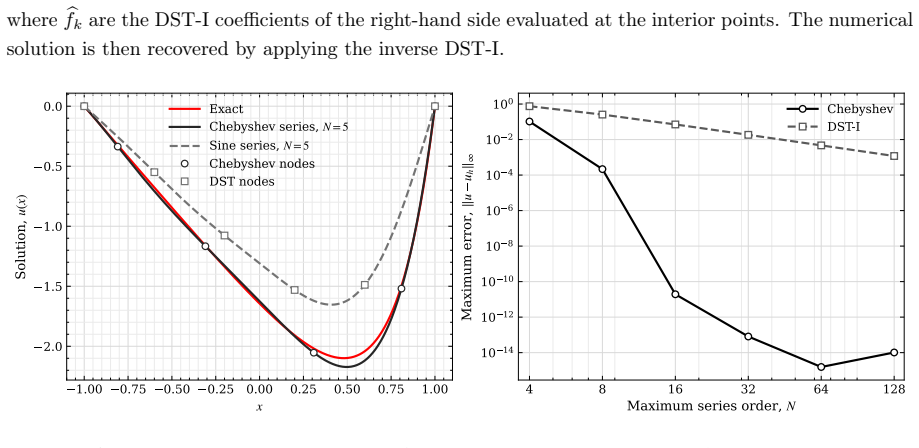
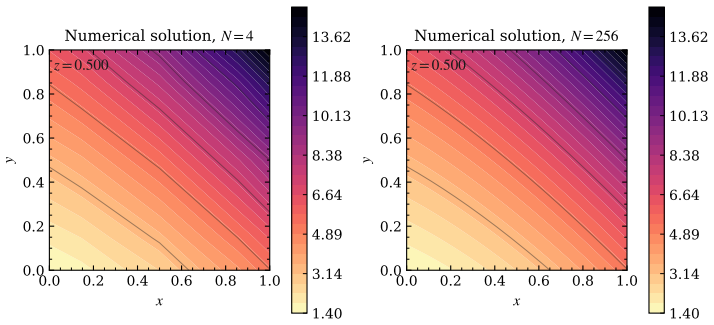
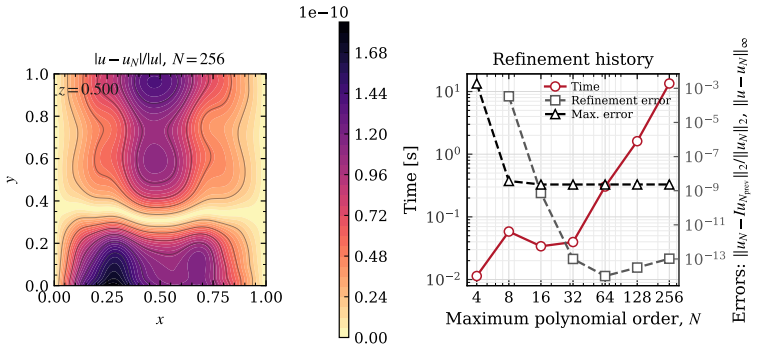
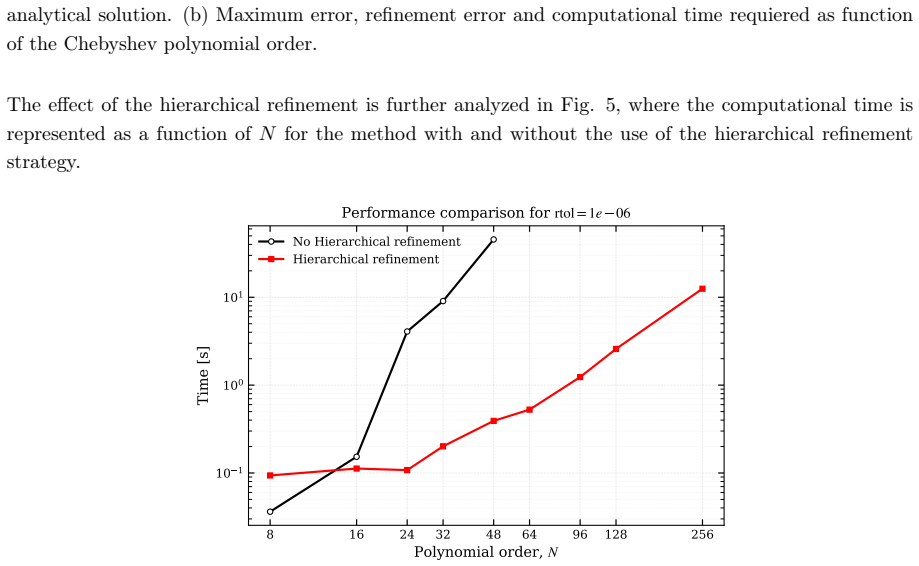
The proposed method achieves convergence to analytical solutions in a few iterations with smaller errors than DCT/DST approaches; discretizations up to 256^3 are achieved thanks to the hierarchical refinement strategy while preserving the FFT scaling of order n log n in all cases studied.
What carries the argument
Matrix-free Chebyshev collocation at Gauss-Lobatto points whose differential operator is realized through FFT, solved by LGMRES and stabilized by hierarchical modal prolongation.
If this is right
- The same discretization and solver apply without change to heterogeneous media and to nonlinear constitutive relations.
- Three-dimensional problems at engineering resolutions become tractable on standard hardware while retaining spectral accuracy.
- The approach yields accuracy comparable to periodic FFT methods once the boundary conditions are incorporated through the Chebyshev basis.
Where Pith is reading between the lines
- If modal prolongation preserves spectral accuracy across refinement levels, the same hierarchy could be reused for time-dependent diffusion or for other linear elliptic operators.
- The technique may transfer to other global spectral bases that suffer convergence stalls on refined meshes.
Load-bearing premise
The hierarchical refinement strategy based on modal prolongation overcomes convergence problems on fine grids without introducing unacceptable errors or instability.
What would settle it
Solve the same manufactured Poisson problem on a 256 cubed grid with mixed boundaries and verify whether the observed error continues to drop while iteration count and wall-clock time remain proportional to n log n.
Figures
read the original abstract
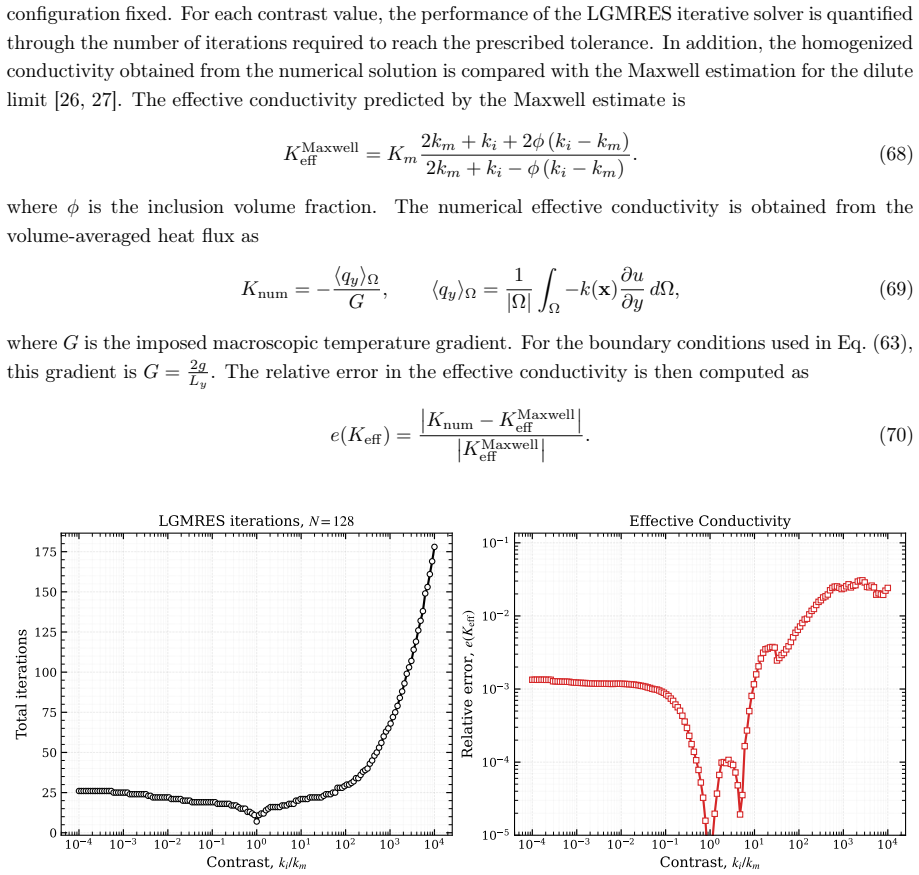
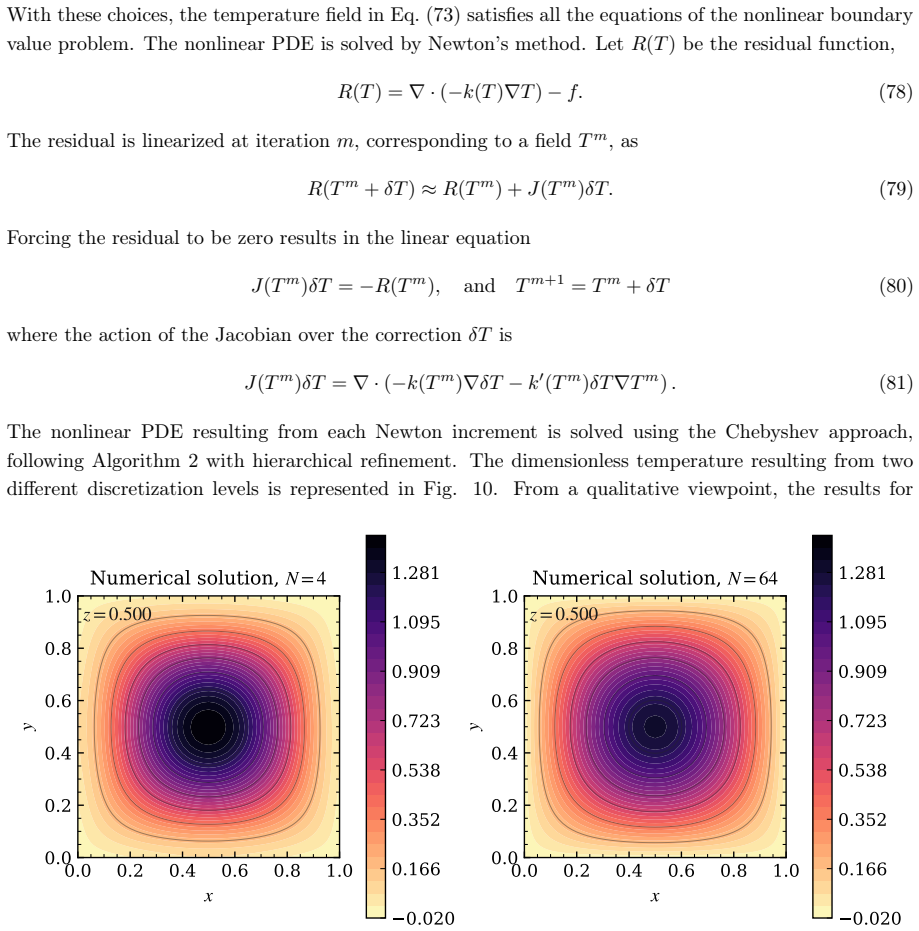
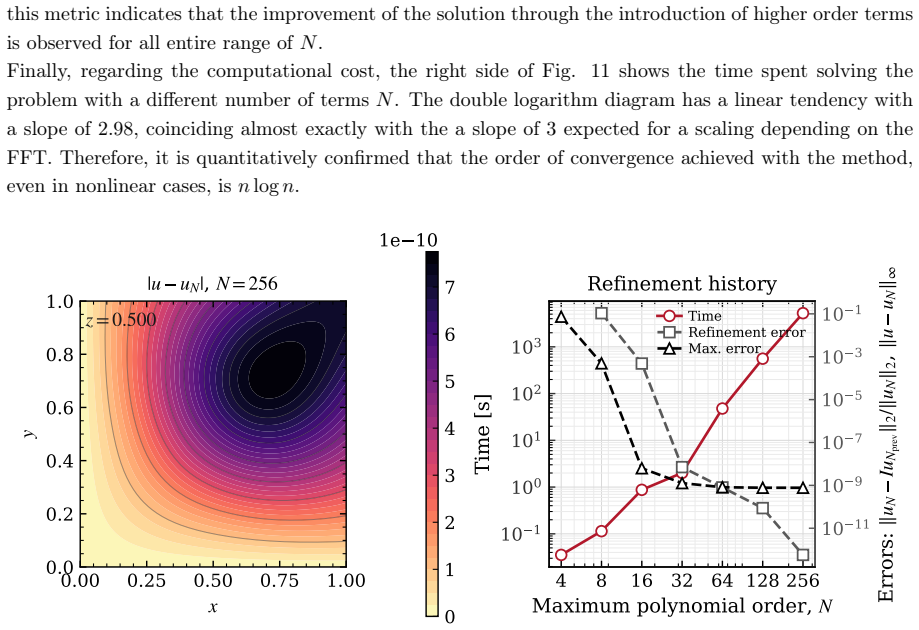
An efficient and robust FFT-based solver is proposed for diffusion-type problems with general Neumann and Dirichlet boundary conditions, based on a Chebyshev collocation framework. The method combines Chebyshev polynomial approximations with FFT-based operators to provide a matrix-free implementation of the discrete differential operator at the Chebyshev-Gauss-Lobatto points. The linear system of equations resulting from the Chebyshev discretization is solved using LGMRES. To overcome convergence problems on fine grids, a hierarchical refinement strategy based on modal prolongation is proposed, enabling the solution of very large 3D problems. The methodology is applicable to homogeneous and heterogeneous domains, as well as to linear and nonlinear constitutive equations. The accuracy of the proposed method is analyzed by solving the Poisson equation in homogeneous 1D and 3D domains with general boundary conditions, using manufactured analytical solutions as references. Convergence to the analytical solution is achieved in a few iterations, with smaller errors than those obtained using DCT/DST approaches. Discretizations of up to $256^3$ are achieved thanks to the hierarchical refinement strategy. In the case of heterogeneous domains, the accuracy and efficiency obtained are similar to those of a standard periodic FFT approach. It is found that the computational complexity of the method preserves the FFT scaling, of order $n\log n$, in all the cases studied.
Editorial analysis
A structured set of objections, weighed in public.
Referee Report
Summary. The manuscript presents an FFT-based solver for stationary diffusion problems with general Neumann and Dirichlet boundary conditions, utilizing a Chebyshev collocation framework. The approach combines Chebyshev polynomial approximations with FFT-based operators for a matrix-free discrete differential operator at Chebyshev-Gauss-Lobatto points. The resulting linear system is solved using LGMRES, with a hierarchical refinement strategy based on modal prolongation to address convergence issues on fine grids. Validation is performed on the Poisson equation in 1D and 3D homogeneous domains using manufactured solutions, showing convergence in few iterations with smaller errors than DCT/DST methods. The method scales to 256^3 discretizations while preserving O(n log n) complexity, and is extended to heterogeneous and nonlinear cases.
Significance. If the results hold, the work offers a significant advancement in solving diffusion problems with non-periodic boundary conditions efficiently using FFT techniques, which are typically limited to periodic cases. The hierarchical strategy enables large-scale 3D computations, making it valuable for applications in heat transfer, fluid dynamics, and materials science. The preservation of FFT scaling and applicability to heterogeneous and nonlinear problems strengthens its practical utility. The use of manufactured solutions provides independent verification of accuracy.
major comments (2)
- [§4.1] §4.1 (Numerical results, 3D homogeneous case): the claim that the hierarchical modal prolongation enables 256^3 solutions without unacceptable errors requires explicit comparison of iteration counts and residual norms with and without the prolongation operator; the current description leaves open whether the strategy introduces additional truncation error that offsets the reported accuracy gain.
- [§3.3] §3.3 (LGMRES solver with FFT operator): the statement that FFT scaling of order n log n is preserved relies on the matrix-free operator being applied in O(n log n) time, but no operation count or timing breakdown is given for the Chebyshev-to-FFT conversion step at the collocation points; this is load-bearing for the central efficiency claim.
minor comments (2)
- [Abstract] Abstract: the phrase 'convergence to the analytical solution is achieved in a few iterations' should be accompanied by the specific iteration count and tolerance used in the LGMRES solver.
- [Figure 5] Figure 5 (scaling plots): the log-log axes should include the reference line with slope 1 to allow visual confirmation of the n log n behavior.
Simulated Author's Rebuttal
We thank the referee for the positive assessment and the recommendation of minor revision. We address the two major comments below, agreeing to strengthen the manuscript with the requested clarifications and data.
read point-by-point responses
-
Referee: [§4.1] §4.1 (Numerical results, 3D homogeneous case): the claim that the hierarchical modal prolongation enables 256^3 solutions without unacceptable errors requires explicit comparison of iteration counts and residual norms with and without the prolongation operator; the current description leaves open whether the strategy introduces additional truncation error that offsets the reported accuracy gain.
Authors: We agree that an explicit side-by-side comparison would strengthen the claim. In the revised manuscript we will add a table (or figure) reporting iteration counts and final residual norms for the 256^3 Poisson problem both with and without the modal prolongation. The prolongation is a spectral interpolation in the Chebyshev modal basis; it therefore preserves the truncation error of the underlying collocation discretization and cannot offset the reported accuracy gain. The improvement arises solely from improved conditioning of the LGMRES iteration on the finer grids. revision: yes
-
Referee: [§3.3] §3.3 (LGMRES solver with FFT operator): the statement that FFT scaling of order n log n is preserved relies on the matrix-free operator being applied in O(n log n) time, but no operation count or timing breakdown is given for the Chebyshev-to-FFT conversion step at the collocation points; this is load-bearing for the central efficiency claim.
Authors: We acknowledge that a detailed operation-count breakdown for the conversion step would make the complexity argument fully transparent. The conversion consists of a fast barycentric interpolation from the Chebyshev-Gauss-Lobatto grid to an auxiliary uniform grid (O(n) work) followed by the FFT-based differentiation (O(n log n)). In the revised Section 3.3 we will supply the explicit flop count and a timing table that isolates the conversion cost, confirming that it remains sub-dominant and that the overall per-application cost stays O(n log n) up to the 256^3 grids reported. revision: yes
Circularity Check
No significant circularity
full rationale
The paper's derivation chain consists of a standard Chebyshev collocation discretization combined with FFT operators and an LGMRES solver, augmented by a hierarchical modal prolongation strategy for fine-grid convergence. All accuracy claims are assessed against independent manufactured analytical solutions for the Poisson equation in 1D and 3D, with direct comparisons to external DCT/DST and periodic FFT baselines; computational complexity is verified to retain n log n scaling through explicit timing on grids up to 256^3. No step reduces by construction to a fitted parameter, self-referential metric, or self-citation chain, and the method is presented as applicable to heterogeneous and nonlinear cases without internal redefinition of its own outputs.
Axiom & Free-Parameter Ledger
Reference graph
Works this paper leans on
-
[1]
L. N. Trefethen,Spectral Methods in Matlab. SIAM, 2000
2000
-
[2]
J. P. Boyd,Chebyshev and Fourier Spectral Methods. Dover, 2 ed., 2001
2001
-
[3]
Canuto, M
C. Canuto, M. Y. Hussaini, A. Quarteroni, and T. A. Zang,Spectral Methods: Fundamentals in Single Domains. Springer, 2007
2007
-
[4]
J. Shen, T. Tang, and L.-L. Wang,Spectral Methods: Algorithms, Analysis and Applications. Springer, 2011
2011
-
[5]
A fast numerical method for computing the linear and nonlinear mechanical properties of composites,
H. Moulinec and P. Suquet, “A fast numerical method for computing the linear and nonlinear mechanical properties of composites,”Comptes Rendus de l’Académie des Sciences, Série II, vol. 318, pp. 1417–1423, 1994. 25
1994
-
[6]
A numerical method for computing the overall response of nonlinear composites with complex microstructure,
H. Moulinec and P. Suquet, “A numerical method for computing the overall response of nonlinear composites with complex microstructure,”Computer Methods in Applied Mechanics and Engineering, vol. 157, no. 1–2, pp. 69–94, 1998
1998
-
[7]
A computational scheme for linear and non-linear composites with arbitrary phase contrast,
P. Suquet, “A computational scheme for linear and non-linear composites with arbitrary phase contrast,”International Journal for Numerical Methods in Engineering, vol. 52, no. 1–2, pp. 283–301, 2001
2001
-
[8]
An fft-based galerkin method for homogenization of periodic media,
J. Vondřejc, J. Zeman, and I. Marek, “An fft-based galerkin method for homogenization of periodic media,”Computers & Mathematics with Applications, vol. 68, no. 3, pp. 156–173, 2014
2014
-
[9]
A modified FFT-based solver for the mechanical simulation of heterogeneous materials with Dirichlet boundary conditions,
L. Gélébart, “A modified FFT-based solver for the mechanical simulation of heterogeneous materials with Dirichlet boundary conditions,”Comptes Rendus. Mécanique, vol. 348, no. 8-9, pp. 693–704, 2020
2020
-
[10]
Extended fft-based micromechanical formulation to consider general non-periodic boundary conditions,
M. Zecevic and R. A. Lebensohn, “Extended fft-based micromechanical formulation to consider general non-periodic boundary conditions,”International Journal of Solids and Structures, vol. 311, p. 113225, 2025
2025
-
[11]
An implicit fft-based method for wave propagation in elastic heterogeneous media,
R. Sancho, V. Rey-de Pedraza, P. Lafourcade, R. A. Lebensohn, and J. Segurado, “An implicit fft-based method for wave propagation in elastic heterogeneous media,”Computer Methods in Applied Mechanics and Engineering, vol. 404, p. 115772, 2023
2023
-
[12]
An fft based chemo-mechanical framework with fracture: Application to mesoscopic electrode degradation,
G. Zarzoso, E. Roque, F. Montero-Chacón, and J. Segurado, “An fft based chemo-mechanical framework with fracture: Application to mesoscopic electrode degradation,”Mechanics of Materials, vol. 201, p. 105211, 2025
2025
-
[13]
New rve concept in thermoelasticity of periodic composites subjected to compact support loading,
V. Buryachenko, “New rve concept in thermoelasticity of periodic composites subjected to compact support loading,” International Journal for Multiscale Computational Engineering, 2025
2025
-
[14]
FFT-based simulations of heterogeneous conducting materials with combined non-uniform Neumann, periodic and Dirichlet boundary conditions,
L. Gélébart, “FFT-based simulations of heterogeneous conducting materials with combined non-uniform Neumann, periodic and Dirichlet boundary conditions,”European Journal of Mechanics - A/Solids, vol. 105, p. 105248, 2024
2024
-
[15]
A Discrete Sine-Cosine Transforms Galerkin Method for the Conductivity of Heterogeneous Materials with Mixed Dirichlet/Neumann Boundary Conditions,
J. Paux, L. Morin, and L. Gélébart, “A Discrete Sine-Cosine Transforms Galerkin Method for the Conductivity of Heterogeneous Materials with Mixed Dirichlet/Neumann Boundary Conditions,”International Journal for Numerical Methods in Engineering, vol. 126, no. 1, p. e7615, 2025
2025
-
[16]
Imposing different boundary conditions for thermal computational homogenization problems with FFT- and tensor-train-based Green’s operator methods,
L. Risthaus and M. Schneider, “Imposing different boundary conditions for thermal computational homogenization problems with FFT- and tensor-train-based Green’s operator methods,”International Journal for Numerical Methods in Engineering, vol. 125, no. 7, p. e7423, 2024
2024
-
[17]
Imposing Dirichlet boundary conditions directly for FFT-based computational mi- cromechanics,
L. Risthaus and M. Schneider, “Imposing Dirichlet boundary conditions directly for FFT-based computational mi- cromechanics,”Computational Mechanics, vol. 74, no. 5, pp. 1089–1113, 2024
2024
-
[18]
A discrete sine–cosine based method for the elasticity of het- erogeneous materials with arbitrary boundary conditions,
J. Paux, L. Morin, L. Gélébart, and A. M. A. Sanoko, “A discrete sine–cosine based method for the elasticity of het- erogeneous materials with arbitrary boundary conditions,”Computer Methods in Applied Mechanics and Engineering, vol. 433, p. 117488, 2025
2025
-
[19]
Implementation of boundary conditions,
J. Hoepffner, “Implementation of boundary conditions,” tech. rep., Université de Provence, 2007. Technical report
2007
-
[20]
Spectral derivatives,
P. Komarov, “Spectral derivatives,” 2024
2024
-
[21]
SciPy, 2024
SciPy Developers,scipy.fftpack.dct — SciPy v1.11.0 Manual. SciPy, 2024. Online documentation
2024
-
[22]
A FFT-based numerical scheme for the transient conductivity of heterogeneous materials with non-periodic boundary conditions,
A. M. A. Sanoko, S. Essongue, L. Gélébart, L. Lapostolle, L. Morin, and J. Paux, “A FFT-based numerical scheme for the transient conductivity of heterogeneous materials with non-periodic boundary conditions,”European Journal of Mechanics / A Solids, vol. 113, p. 105680, 2025
2025
-
[23]
L. N. Trefethen,Approximation Theory and Approximation Practice. Philadelphia, PA: Society for Industrial and Applied Mathematics, 2013
2013
-
[24]
DBFFT: A displacement based fft approach for non-linear homogenization of the me- chanical behavior,
S. Lucarini and J. Segurado, “DBFFT: A displacement based fft approach for non-linear homogenization of the me- chanical behavior,”International Journal of Engineering Science, vol. 144, p. 103131, 2019
2019
-
[25]
On the accuracy of spectral solvers for micromechanics based fatigue modeling,
S. Lucarini and J. Segurado, “On the accuracy of spectral solvers for micromechanics based fatigue modeling,”Com- putational Mechanics, vol. 63, p. 365–382, July 2018
2018
-
[26]
J. C. Maxwell,A Treatise on Electricity and Magnetism. Oxford: Clarendon Press, 1873. 26
-
[27]
Maxwell-type models for the effective thermal conductivity of a porous material with radiative transfer in the pores,
K. B. Kiradjiev, R. Anguelov, M. Vynnycky, and R. A. Van Gorder, “Maxwell-type models for the effective thermal conductivity of a porous material with radiative transfer in the pores,”International Journal of Thermal Sciences, 2019
2019
-
[28]
FFT based approaches in micromechanics: fundamentals, methods and applications,
S. Lucarini, M. V. Upadhyay, and J. Segurado, “FFT based approaches in micromechanics: fundamentals, methods and applications,”Modelling and Simulation in Materials Science and Engineering, vol. 30, no. 2, p. 023002, 2022. 27
2022
discussion (0)
Sign in with ORCID, Apple, or X to comment. Anyone can read and Pith papers without signing in.