REVIEW 3 major objections 5 minor 62 references
Adaptive Embedding Gate for Attention-Based Scene Text Recognition
T0 review · 3 major / 5 minor · reviewed 2026-08-14 · deepseek-v4-flash
Pith's one-line read The paper claims that feeding the previous prediction into an attention decoder with a fixed weight is harmful, and that an adaptive gate on that embedding improves accuracy and robustness across scene text benchmarks.
desk verdict A simple gating module with consistent but modest gains in scene text recognition; the empirical work is broad, but the ablations leave the central mechanism under-identified. read the letter →
The pith
A machine-rendered reading of the paper's core claim, the machinery that carries it, and where it could break.
The reading
What carries the argument
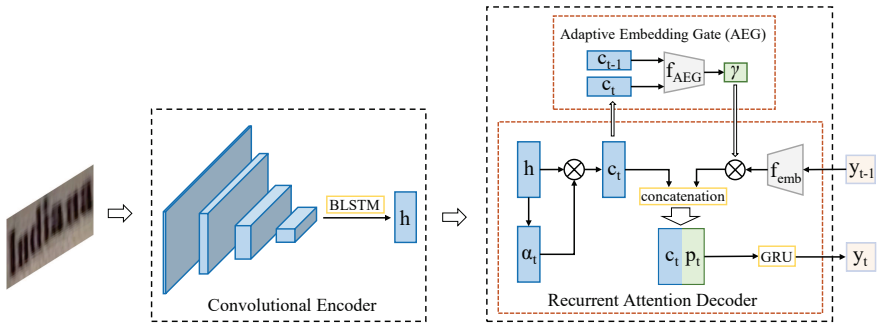
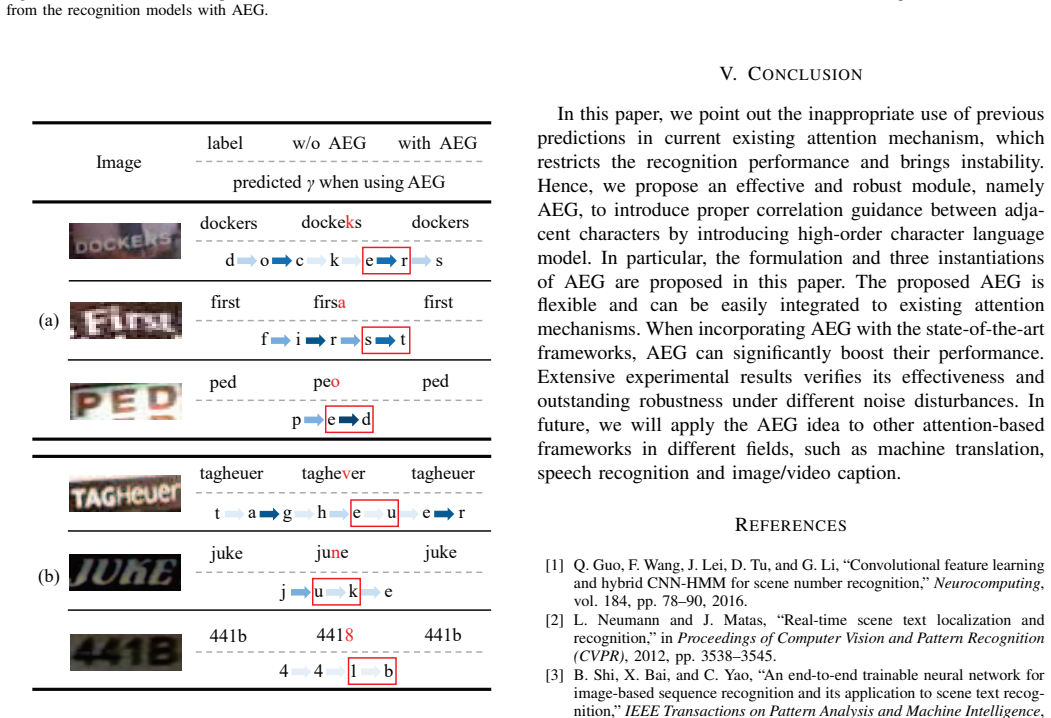
The central object is the Adaptive Embedding Gate (AEG), a learned scalar multiplier placed on the embedded previous prediction inside the attention decoder: $p_t = f_{\text{AEG}}(c_t, c_{t-1}) f_{\text{emb}}(y_{t-1})$, with the gated vector $p_t$ replacing the raw embedding in the recurrent decoder's Gated Recurrent Unit (GRU) update. The gate's output, the AEG score $\gamma_t$, is a sigmoid-bounded estimate of the correlation between the previous decoded character and the current one, computed from the attention context vectors $c_{t-1}$ and $c_t$. What the gate carries is the character language model: its training target $\gamma_{\text{gt}}$ is a probability or root-membership label for each adjacent pair, so the gate learns to pass strong-correlated pairs through at full strength and to suppress weak-correlated or misleading transitions. The same differential weighting is what makes the decoder more robust, since a corrupted image that produces a wrong previous prediction can be partially rescued by down-weighting that prediction's influence.
What would settle it
Train the same AEG model with the $26\times 26$ transition matrix shuffled (so 'strong-correlated' pairs no longer match English statistics) and evaluate on the reported benchmarks; if accuracy stays at the AEG level, the improvement cannot be attributed to the character language model.
Extended reading notes
Core claim
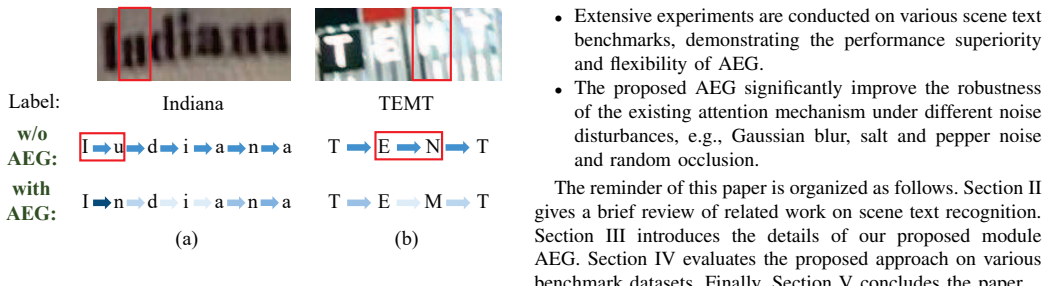
The central claim is that the attention decoder's practice of using the previous prediction's embedding with a fixed weight is a structural flaw: it treats a strong pair like 'In' and a weak pair like 'ia' exactly alike, and propagates errors when the previous character itself was misrecognized. AEG replaces that fixed weighting with $p_t = f_{\text{AEG}}(c_t, c_{t-1}) f_{\text{emb}}(y_{t-1})$, where $f_{\text{AEG}}$ outputs a score in $[0,1]$ estimated from the current and previous attention context vectors $c_t$ and $c_{t-1}$. Three instantiations of $f_{\text{AEG}}$ are given — additive, dot-product, and concatenation — and the additive form performs best. AEG is trained by minimizing a mean-squared-error (MSE) loss between its scores and a target vector $\gamma_{\text{gt}}$ derived from the ground-truth string; the target is built either from a $26\times 26$ transition-probability matrix over adjacent letter pairs counted from a 9,121-word dictionary, or from a table of 707 English roots, or left to weak supervision. The paper reports consistent accuracy gains over its own baseline on all seven benchmarks, gains when AEG is inserted into ASTER and MORAN-v2, and larger performance margins as noise intensity increases on blur, salt-and-pepper, and occlusion tests.
Load-bearing premise
The gate's training signal $\gamma_{\text{gt}}$ is built entirely from English word statistics (a 9,121-word dictionary and a 707-root table), so the method assumes those statistics are a valid proxy for the character correlations that matter in natural scene text — including distorted, low-resolution, digit-heavy, or out-of-vocabulary words.
Editorial extensions
If this is right
- AEG is a drop-in module: it can be attached to any attention-based sequence decoder that feeds the previous prediction embedding into a recurrent state update, requiring no change to the encoder or attention mechanism.
- Plugging AEG into ASTER and MORAN-v2 improves their lexicon-free accuracy on standard benchmarks, e.g., +3.5 on SVT-P for ASTER and +2.2 on CUTE for MORAN-v2, and the gains are complementary to image rectification.
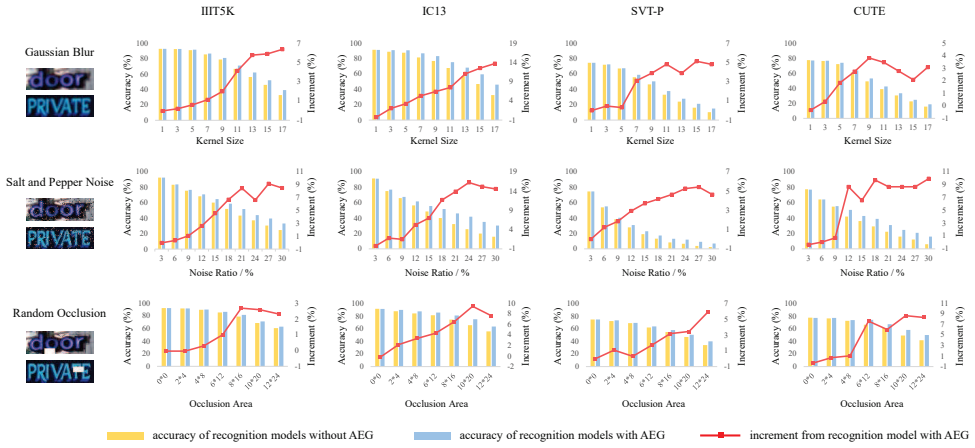
- Under Gaussian blur, salt-and-pepper noise, and random occlusion, the AEG model degrades more gracefully than the baseline, indicating the gate acts partly as a robustness mechanism against input corruption.
- The close performance of word-frequency and root-table supervision suggests that the precise character prior matters less than the fact that the gate is supervised at all; alternative priors could be substituted without retraining the framework.
Reading between the lines
- A testable extension the authors do not run is replacing the fixed dictionary/root priors with a prior learned from the training corpus itself, or conditioned on the input image; if gains persist, the gate is learning a generalizable correlation structure rather than memorizing English bigrams.
- The same gating idea could transfer to other sequence-to-sequence tasks — machine translation or speech recognition — where exposure bias from feeding back the model's own previous prediction is a known failure mode; the paper's robustness results suggest a gated embedding could reduce error cascades there.
- Because $\gamma_{\text{gt}}$ assigns zero to digit-letter and digit-digit transitions, the gate is explicitly trained to suppress cross-category pairs; evaluating on digit-only strings or mixed alphanumeric license plates would test whether that inductive bias helps or hurts outside the 26-letter English vocabulary.
- The robustness plots suggest an implicit regularization effect: early-stopped AEG models match baseline accuracy at zero noise but degrade more slowly as noise grows; comparing the gate's learned scores on clean vs corrupted versions of the same image could reveal whether the gate explicitly detects input corruption or simply relies on less error-prone context.
Signed reviews
Editorial analysis
A structured set of objections, weighed in public.
Referee Report
Summary. The paper argues that standard attention-based scene text recognizers use the previous step's prediction with an invariant weight, which is inappropriate for weakly correlated adjacent characters and can cause recognition errors. It proposes an Adaptive Embedding Gate (AEG) that computes a scalar score between the current and previous attention context vectors and multiplies the previous embedding by this score before it enters the GRU decoder. The gate is trained either by an auxiliary MSE loss against character-pair transition statistics derived from a 9,121-word dictionary, a 707-root table, or with weak supervision from the recognition loss alone. The method is evaluated on IIIT5K, SVT, IC03, IC13, SVT-P, CUTE80, and IC15, and is also plugged into ASTER and MORAN-v2. The reported results show consistent accuracy gains over the baseline and over the two base recognizers, plus robustness curves under Gaussian blur, salt-and-pepper noise, and random occlusion.
Significance. If the central claim holds, AEG is a simple, lightweight, and portable module that could be added to existing attentional recognizers with little engineering cost. The paper has genuine strengths: consistent gains across seven benchmarks, integration into two state-of-the-art recognizers without extra data, a clean architectural motivation, and ablations comparing three instantiations and three supervision schemes. The authors also provide a concrete falsifiable prediction, namely that adaptive gating of the previous prediction improves both accuracy and noise robustness. However, the experimental design does not currently isolate the effect of the gate from the effect of the auxiliary loss, and the robustness comparison lacks a specified stopping rule and variance estimates. These gaps weaken the attribution of the observed gains to the gating mechanism itself.
major comments (3)
- [Section III-C, III-E; Tables I-III] The ablations do not isolate the gating mechanism from the auxiliary prediction loss. In the proposed model, Eq. (10) changes the decoder by multiplying the previous embedding by a scalar gate, while Eq. (14) adds an MSE loss on the AEG scores; both changes alter the gradient signal reaching the encoder and attention mechanism. In Table III, 'No pre' removes the previous prediction altogether, 'Random pre' corrupts y_{t-1} but retains both the gate and the auxiliary loss, and the weakly-supervised row (b) in Table II also retains both. None of these conditions removes the gate while keeping the auxiliary loss, or fixes the gate to a constant 1 while training with Eq. (14). Without such a gate-off control, the reported improvements are equally consistent with the auxiliary character-pair loss acting as a feature-reshaping regularizer, rather than with the adaptive gating operation itself. Please add a condition that trains with Eq. (14) on the same context vectors but replaces p_t in Eq. (9) with f_emb(y_{t-1}) (gate fixed to 1), and report it on the Table I benchmarks.
- [Section IV-F] The robustness claim, which is listed as a primary contribution, is supported only by accuracy curves with no specified stopping rule or variance. The text says the AEG model is made comparable to baseline by 'stopping training earlier', but it does not state the criterion used, the number of steps or epochs, whether the same rule is applied to the baseline, or how many random seeds are averaged. Please specify the early-stopping criterion, report mean and standard deviation over at least three seeds, and state whether the noise injections are identical across the compared models.
- [Section III-D, Algorithms 1 and 2] The construction of gamma_gt rests entirely on external English word-list statistics (a 9,121-word dictionary and a 707-root table), yet no evidence is given that these statistics transfer to distorted, low-resolution, or out-of-vocabulary strings in the test benchmarks. Digraphs involving digits are set to zero, which may be a reasonable prior but is not justified. In addition, Algorithm 1 contains an indexing error: line 4 assigns gamma_gt[t] inside a loop over l, while t is not defined; the loop variable should be used. Algorithm 2 is also underspecified: the condition 'if root ri in g' is used for a string g without specifying whether substring matching is intended, and the handling of overlapping roots and the normalization step are not described precisely.
minor comments (5)
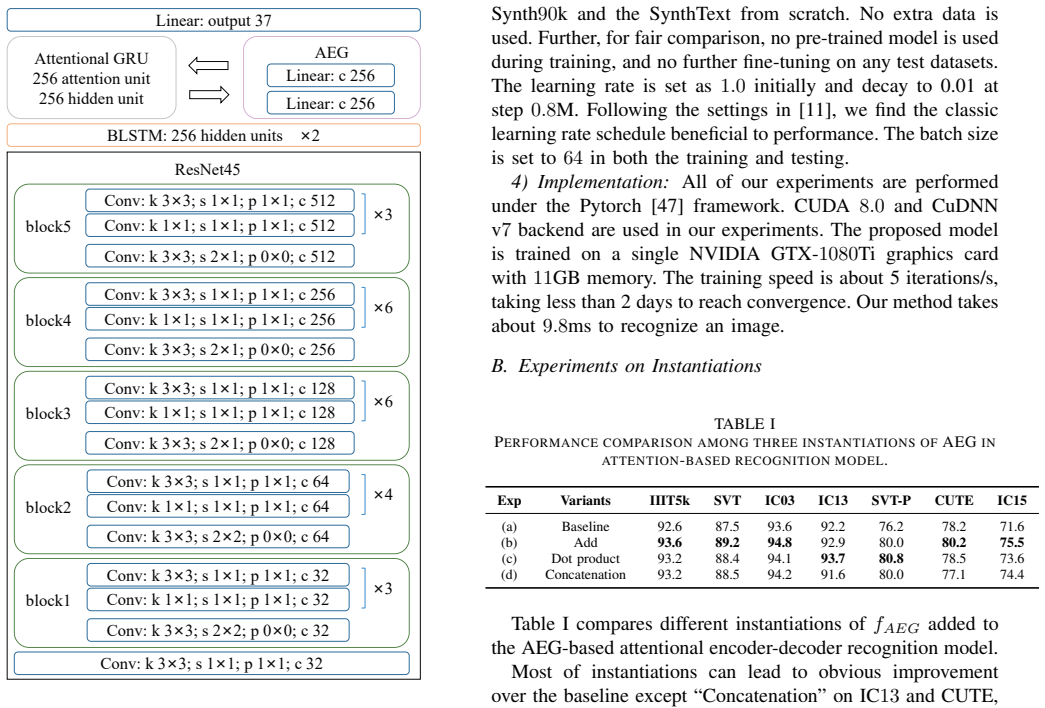
- [Section IV-A.2] The text says 'two-layers of BSLTM'; this should be 'two layers of BLSTM'.
- [Section III-D.3] The weakly supervised variant should state explicitly that the AEG loss LAEG is omitted from Eq. (15) and that gamma is trained only through the recognition loss L_attn.
- [Equations (10)-(13)] Equation (10) multiplies a scalar f_AEG with a vector f_emb(y_{t-1}); please state explicitly that the scalar is applied elementwise to the embedding vector.
- [Figure 5] The caption of Figure 5 says 'Visualization of the text prediction', but the figure shows robustness curves; the caption should describe the curves and the noise levels.
- [Section IV-F] The three noise types and their intensity ranges are only given in the figure axes; a short description in the text would make the experimental procedure reproducible.
Circularity Check
No circularity: AEG is an auxiliary supervised gate trained on external character-pair statistics; benchmark gains are independently evaluated.
full rationale
I walked the paper's derivation chain. The AEG score gamma_t is produced by Eq. (10) as fAEG(c_t, c_{t-1}) and is trained with the auxiliary MSE loss of Eq. (14) against gamma_gt constructed in Algorithms 1 and 2. Those labels come from an external 9,121-word dictionary or 707-root table, applied to the ground-truth training string g, not from the model's own outputs or from the test benchmarks. The final objective Eq. (15) is L_attn + lambda * L_AEG, where L_attn is the standard recognition cross-entropy. The quantities reported as predictions are full word-recognition accuracies on IIIT5K, SVT, SVT-P, CUTE80, and ICDAR, which are external benchmarks evaluated separately from the training labels. No equation in the paper reduces the reported accuracy to the fitted gate values, and no fitted parameter is renamed as a benchmark prediction. The main self-citation is MORAN-v2 [4], by co-authors Luo and Jin, used as an integration baseline and comparison point; this is a normal architectural baseline rather than a load-bearing justification of AEG's mechanism, and the central claim does not depend on an unverified self-cited theorem. The paper's ablation choices, such as the 'Random pre' condition in Table III, may leave an attribution gap between the gating operation and the auxiliary loss, but that is an experimental limitation, not a circular derivation. Overall, the derivation is self-contained and the empirical gains are independently measured.
Assumptions & free parameters
free parameters (1)
- lambda =
1
assumptions (4)
- domain assumption Character-pair transition probabilities from a 9,121-word dictionary are a valid proxy for natural scene text correlations.
- domain assumption The decoder is trained with teacher forcing (ground truth previous character) and this transfers to inference with predicted previous characters.
- ad hoc to paper The pairwise functions of AEG (add, dot, concat) with a sigmoid output are sufficient to estimate adjacent-character correlation.
- domain assumption The ResNet45 + BLSTM + attention GRU baseline is a representative attentional scene text recognizer.
Cite this review
Pith. "Pith review of Adaptive Embedding Gate for Attention-Based Scene Text Recognition." pith.science (2026). https://pith.science/paper/NDEFKN6A
@misc{pith2026190809475,
  author       = {Pith},
  title        = {Pith review of: Adaptive Embedding Gate for Attention-Based Scene Text Recognition},
  year         = {2026},
  howpublished = {\url{https://pith.science/paper/NDEFKN6A}},
  note         = {Machine review of arXiv:1908.09475}
}
abstract
Scene text recognition has attracted particular research interest because it is a very challenging problem and has various applications. The most cutting-edge methods are attentional encoder-decoder frameworks that learn the alignment between the input image and output sequences. In particular, the decoder recurrently outputs predictions, using the prediction of the previous step as a guidance for every time step. In this study, we point out that the inappropriate use of previous predictions in existing attention mechanisms restricts the recognition performance and brings instability. To handle this problem, we propose a novel module, namely adaptive embedding gate(AEG). The proposed AEG focuses on introducing high-order character language models to attention mechanism by controlling the information transmission between adjacent characters. AEG is a flexible module and can be easily integrated into the state-of-the-art attentional methods. We evaluate its effectiveness as well as robustness on a number of standard benchmarks, including the IIIT$5$K, SVT, SVT-P, CUTE$80$, and ICDAR datasets. Experimental results demonstrate that AEG can significantly boost recognition performance and bring better robustness.
Figures

Figures from the paper (3 more)
Reference graph
Works this paper leans on
-
[1]
Convolutional feature learning and hybrid CNN-HMM for scene number recognition,
Q. Guo, F. Wang, J. Lei, D. Tu, and G. Li, “Convolutional feature learning and hybrid CNN-HMM for scene number recognition,” Neurocomputing, vol. 184, pp. 78–90, 2016
work page 2016
-
[2]
Real-time scene text localization and recognition,
L. Neumann and J. Matas, “Real-time scene text localization and recognition,” in Proceedings of Computer Vision and Pattern Recognition (CVPR), 2012, pp. 3538–3545
work page 2012
-
[3]
B. Shi, X. Bai, and C. Yao, “An end-to-end trainable neural network for image-based sequence recognition and its application to scene text recog- nition,”IEEE Transactions on Pattern Analysis and Machine Intelligence, vol. 39, no. 11, pp. 2298–2304, 2017
work page 2017
-
[4]
MORAN: A multi-object rectified attention network for scene text recognition,
C. Luo, L. Jin, and Z. Sun, “MORAN: A multi-object rectified attention network for scene text recognition,” Pattern Recognition , vol. 90, pp. 109–118, 2019
work page 2019
-
[5]
Reading scene text with fully convolutional sequence modeling,
Y . Gao, Y . Chen, J. Wang, M. Tang, and H. Lu, “Reading scene text with fully convolutional sequence modeling,” Neurocomputing, vol. 339, pp. 161–170, 2019
work page 2019
-
[6]
Twenty years of document image analysis in pami,
G. Nagy, “Twenty years of document image analysis in pami,” IEEE Transactions on Pattern Analysis & Machine Intelligence , no. 1, pp. 38– 62, 2000
work page 2000
-
[7]
Perspective scene text recognition with feature compression and ranking,
Y . Zhou, S. Liu, Y . Zhang, Y . Wang, and W. Lin, “Perspective scene text recognition with feature compression and ranking,” in Proceedings of Asian Conference on Computer Vision (ACCV) , 2014, pp. 181–195
work page 2014
-
[8]
End-to-end scene text recog- nition,
K. Wang, B. Babenko, and S. Belongie, “End-to-end scene text recog- nition,” in Proceedings of International Conference on Computer Vision (ICCV), 2011, pp. 1457–1464
work page 2011
Show all 62 references
-
[9]
Photoocr: Reading text in uncontrolled conditions,
A. Bissacco, M. Cummins, Y . Netzer, and H. Neven, “Photoocr: Reading text in uncontrolled conditions,” in Proceedings of International Confer- ence on Computer Vision (ICCV) , 2013, pp. 785–792
2013
-
[10]
Recursive recurrent nets with attention modeling for ocr in the wild,
C.-Y . Lee and S. Osindero, “Recursive recurrent nets with attention modeling for ocr in the wild,” in Proceedings of Computer Vision and Pattern Recognition (CVPR), 2016, pp. 2231–2239
2016
-
[11]
ASTER: An attentional scene text recognizer with flexible rectification,
B. Shi, M. Yang, X. Wang, P. Lyu, C. Yao, and X. Bai, “ASTER: An attentional scene text recognizer with flexible rectification,” IEEE Transactions on Pattern Analysis and Machine Intelligence , pp. 1–1, 2018
2018
-
[12]
Learning phrase representations using RNN encoder-decoder for statistical machine translation,
K. Cho, B. Van Merri ¨enboer, C. Gulcehre, D. Bahdanau, F. Bougares, H. Schwenk, and Y . Bengio, “Learning phrase representations using RNN encoder-decoder for statistical machine translation,” in Proceedings of Empirical Methods in Natural Language Processing (EMNLP) , 2014, ...
2014
-
[13]
Long short-term memory,
S. Hochreiter and J. Schmidhuber, “Long short-term memory,” Neural computation, vol. 9, no. 8, pp. 1735–1780, 1997
1997
-
[14]
Connection- ist temporal classification: labelling unsegmented sequence data with recurrent neural networks,
A. Graves, S. Fern ´andez, F. Gomez, and J. Schmidhuber, “Connection- ist temporal classification: labelling unsegmented sequence data with recurrent neural networks,” in Proceedings of the 23rd international conference on Machine learning . ACM, 2006, pp. 369–376
2006
-
[15]
Neural machine translation by jointly learning to align and translate,
D. Bahdanau, K. Cho, and Y . Bengio, “Neural machine translation by jointly learning to align and translate,” CoRR abs/1409.0473, 2014
2014 arXiv
-
[16]
Robust scene text recognition with automatic rectification,
B. Shi, X. Wang, P. Lyu, C. Yao, and X. Bai, “Robust scene text recognition with automatic rectification,” in Proceedings of Computer Vision and Pattern Recognition (CVPR) , 2016, pp. 4168–4176
2016
-
[17]
Focusing atten- tion: Towards accurate text recognition in natural images,
Z. Cheng, F. Bai, Y . Xu, G. Zheng, S. Pu, and S. Zhou, “Focusing atten- tion: Towards accurate text recognition in natural images,” inProceedings of International Conference on Computer Vision (ICCV), 2017, pp. 5086– 5094
2017
-
[18]
Edit probability for scene text recognition,
F. Bai, Z. Cheng, Y . Niu, S. Pu, and S. Zhou, “Edit probability for scene text recognition,” in Proceedings of Computer Vision and Pattern Recognition (CVPR), 2018, pp. 1508–1516
2018
-
[19]
A neural proba- bilistic language model,
Y . Bengio, R. Ducharme, P. Vincent, and C. Jauvin, “A neural proba- bilistic language model,” Journal of machine learning research , vol. 3, no. Feb, pp. 1137–1155, 2003
2003
-
[20]
Comparing word relatedness mea- sures based on google n-grams-grams,
A. Islam, E. Milios, and V . Keselj, “Comparing word relatedness mea- sures based on google n-grams-grams,” in Proceedings of COLING 2012: Posters, 2012, pp. 495–506
2012
-
[21]
Character-aware neural language models,
Y . Kim, Y . Jernite, D. Sontag, and A. M. Rush, “Character-aware neural language models,” in Proceedings of Association for the Advancement of Artificial Intelligence (AAAI) , 2016
2016
-
[22]
Led dot matrix text recognition method in natural scene,
K. Jo et al., “Led dot matrix text recognition method in natural scene,” Neurocomputing, vol. 151, pp. 1033–1041, 2015
2015
-
[23]
Multi-oriented text detec- tion and verification in video frames and scene images,
A. Sain, A. K. Bhunia, P. P. Roy, and U. Pal, “Multi-oriented text detec- tion and verification in video frames and scene images,”Neurocomputing, vol. 275, pp. 1531–1549, 2018
2018
-
[24]
Text detection and recognition in imagery: A survey,
Q. Ye and D. Doermann, “Text detection and recognition in imagery: A survey,”IEEE transactions on pattern analysis and machine intelligence , vol. 37, no. 7, pp. 1480–1500, 2014
2014
-
[25]
Scene text detection and recognition: Recent advances and future trends,
Y . Zhu, C. Yao, and X. Bai, “Scene text detection and recognition: Recent advances and future trends,” Frontiers of Computer Science , vol. 10, no. 1, pp. 19–36, 2016
2016
-
[26]
Scene text detection and recognition: The deep learning era,
S. Long, X. He, and C. Ya, “Scene text detection and recognition: The deep learning era,” CoRR abs/1811.04256, 2018
2018 arXiv
-
[27]
End-to-end text recognition with convolutional neural networks,
T. Wang, D. J. Wu, A. Coates, and A. Y . Ng, “End-to-end text recognition with convolutional neural networks,” in Proceedings of International Conference on Pattern Recognition (ICPR) , 2012, pp. 3304–3308
2012
-
[28]
A unified framework for multioriented text detection and recognition,
C. Yao, X. Bai, and W. Liu, “A unified framework for multioriented text detection and recognition,” IEEE Transactions on Image Processing, vol. 23, no. 11, pp. 4737–4749, 2014
2014
-
[29]
Deep features for text spotting,
M. Jaderberg, A. Vedaldi, and A. Zisserman, “Deep features for text spotting,” in Proceedings of European Conference on Computer Vision (ECCV), 2014, pp. 512–528
2014
-
[30]
Star-net: A spatial attention residue network for scene text recognition
W. Liu, C. Chen, K.-Y . K. Wong, Z. Su, and J. Han, “Star-net: A spatial attention residue network for scene text recognition.” in Proceedings of British Machine Vision Conference (BMVC) , 2016, p. 7
2016
-
[31]
Squeezedtext: A real- time scene text recognition by binary convolutional encoder-decoder network,
Z. Liu, Y . Li, F. Ren, W. L. Goh, and H. Yu, “Squeezedtext: A real- time scene text recognition by binary convolutional encoder-decoder network,” in Proceedings of Association for the Advancement of Artificial Intelligence (AAAI), 2018, pp. 7194–7201
2018
-
[32]
Vd-san: Visual-densely semantic attention network for image caption generation,
X. He, Y . Yang, B. Shi, and X. Bai, “Vd-san: Visual-densely semantic attention network for image caption generation,” Neurocomputing, vol. 328, pp. 48–55, 2019
2019
-
[33]
Using a statistical language model to improve the performance of an hmm-based cursive handwriting recognition sys- tem,
U.-V . Marti and H. Bunke, “Using a statistical language model to improve the performance of an hmm-based cursive handwriting recognition sys- tem,” in Hidden Markov models: applications in computer vision. World Scientific, 2001, pp. 65–90
2001
-
[34]
A vector space modeling approach to spoken language identification,
H. Li, B. Ma, and C.-H. Lee, “A vector space modeling approach to spoken language identification,” IEEE Transactions on Audio, Speech, and Language Processing , vol. 15, no. 1, pp. 271–284, 2006
2006
-
[35]
Deep residual learning for image recognition,
K. He, X. Zhang, S. Ren, and J. Sun, “Deep residual learning for image recognition,” in Proceedings of Computer Vision and Pattern Recognition (CVPR), 2016, pp. 770–778
2016
-
[36]
A novel connectionist system for unconstrained hand- writing recognition,
A. Graves, M. Liwicki, S. Fern ´andez, R. Bertolami, H. Bunke, and J. Schmidhuber, “A novel connectionist system for unconstrained hand- writing recognition,” IEEE transactions on pattern analysis and machine intelligence, vol. 31, no. 5, pp. 855–868, 2008
2008
-
[37]
Sequence to sequence learning with neural networks,
I. Sutskever, O. Vinyals, and Q. V . Le, “Sequence to sequence learning with neural networks,” in Proceedings of Advances in Neural Information Processing Systems (NIPS) , 2014, pp. 3104–3112
2014
-
[38]
A simple neural network module for relational reasoning,
A. Santoro, D. Raposo, D. G. Barrett, M. Malinowski, R. Pascanu, P. Battaglia, and T. Lillicrap, “A simple neural network module for relational reasoning,” in Advances in neural information processing systems, 2017, pp. 4967–4976
2017
-
[39]
Scene text recognition using higher order language priors,
A. Mishra, K. Alahari, and C. Jawahar, “Scene text recognition using higher order language priors,” in Proceedings of British Machine Vision Conference (BMVC), 2012, pp. 1–11
2012
-
[40]
ICDAR 2003 robust reading competitions,
S. M. Lucas, A. Panaretos, L. Sosa, A. Tang, S. Wong, and R. Young, “ICDAR 2003 robust reading competitions,” in Proceedings of Inter- national Conference on Document Analysis and Recognition (ICDAR) , 2003, pp. 682–687
2003
-
[41]
IC- DAR 2013 robust reading competition,
D. Karatzas, F. Shafait, S. Uchida, M. Iwamura, L. G. i Bigorda, S. R. Mestre, J. Mas, D. F. Mota, J. A. Almazan, and L. P. De Las Heras, “IC- DAR 2013 robust reading competition,” in Proceedings of International Conference on Document Analysis and Recognition (ICDAR) , 2013, ...
2013
-
[42]
A robust arbitrary text detection system for natural scene images,
A. Risnumawan, P. Shivakumara, C. S. Chan, and C. L. Tan, “A robust arbitrary text detection system for natural scene images,” Expert Systems with Applications, vol. 41, no. 18, pp. 8027–8048, 2014
2014
-
[43]
ICDAR 2015 competition on robust reading,
D. Karatzas, L. Gomez-Bigorda, A. Nicolaou, S. Ghosh, A. Bagdanov, M. Iwamura, J. Matas, L. Neumann, V . R. Chandrasekhar, S. Lu et al., “ICDAR 2015 competition on robust reading,” in Proceedings of Inter- national Conference on Document Analysis and Recognition (ICDAR) , 2015...
2015
-
[44]
Synthetic data and artificial neural networks for natural scene text recognition,
M. Jaderberg, K. Simonyan, A. Vedaldi, and A. Zisserman, “Synthetic data and artificial neural networks for natural scene text recognition,” in Proceedings of Advances in Neural Information Processing Deep Learn. Workshop (NIPS-W), 2014
2014
-
[45]
Synthetic data for text localisation in natural images,
A. Gupta, A. Vedaldi, and A. Zisserman, “Synthetic data for text localisation in natural images,” in Proceedings of Computer Vision and Pattern Recognition (CVPR), 2016, pp. 2315–2324
2016
-
[46]
Adadelta: an adaptive learning rate method,
M. D. Zeiler, “Adadelta: an adaptive learning rate method,” CoRR abs/1212.5701, 2012
2012 arXiv
-
[47]
Automatic differentiation in pytorch,
A. Paszke, S. Gross, S. Chintala, G. Chanan, E. Yang, Z. DeVito, Z. Lin, A. Desmaison, L. Antiga, and A. Lerer, “Automatic differentiation in pytorch,” in Proceedings of Advances in Neural Information Processing Systems Autodiff Workshop (NIPS-W) , 2017
2017
-
[48]
Top-down and bottom-up cues for scene text recognition,
A. Mishra, K. Alahari, and C. Jawahar, “Top-down and bottom-up cues for scene text recognition,” in Proceedings of Computer Vision and Pattern Recognition (CVPR), 2012, pp. 2687–2694
2012
-
[49]
Learning to read irregular text with attention mechanisms,
X. Yang, D. He, Z. Zhou, D. Kifer, and C. L. Giles, “Learning to read irregular text with attention mechanisms,” inProceedings of International Joint Conference on Artificial Intelligence (IJCAI), 2017, pp. 3280–3286
2017
-
[50]
AON: Towards arbitrarily-oriented text recognition,
Z. Cheng, Y . Xu, F. Bai, Y . Niu, S. Pu, and S. Zhou, “AON: Towards arbitrarily-oriented text recognition,” in Proceedings of the IEEE Con- ference on Computer Vision and Pattern Recognition (CVPR) , 2018, pp. 5571–5579
2018
-
[51]
Char-net: A character-aware neural network for distorted scene text recognition
W. Liu, C. Chen, and K.-Y . K. Wong, “Char-net: A character-aware neural network for distorted scene text recognition.” in Proceedings of Association for the Advancement of Artificial Intelligence (AAAI) , 2018, pp. 7154–7161
2018
-
[52]
Esir: End-to-end scene text recognition via iterative image rectification,
F. Zhan and S. Lu, “Esir: End-to-end scene text recognition via iterative image rectification,” in Proceedings of Computer Vision and Pattern Recognition (CVPR), 2019, pp. 2059–2068
2019
-
[53]
Word spotting and recognition with embedded attributes,
J. Almaz ´an, A. Gordo, A. Forn ´es, and E. Valveny, “Word spotting and recognition with embedded attributes,” IEEE Transactions on Pattern Analysis and Machine Intelligence, vol. 36, no. 12, pp. 2552–2566, 2014
2014
-
[54]
Strokelets: A learned multi-scale representation for scene text recognition,
C. Yao, X. Bai, B. Shi, and W. Liu, “Strokelets: A learned multi-scale representation for scene text recognition,” in Proceedings of Computer Vision and Pattern Recognition (CVPR) , 2014, pp. 4042–4049
2014
-
[55]
Accurate scene text recognition based on recurrent neural network,
B. Su and S. Lu, “Accurate scene text recognition based on recurrent neural network,” inProceedings of Asian Conference on Computer Vision (ACCV), 2014, pp. 35–48
2014
-
[56]
Supervised mid-level features for word image representation,
A. Gordo, “Supervised mid-level features for word image representation,” in Proceedings of Computer Vision and Pattern Recognition (CVPR) , 2015, pp. 2956–2964
2015
-
[57]
Reading text in the wild with convolutional neural networks,
M. Jaderberg, K. Simonyan, A. Vedaldi, and A. Zisserman, “Reading text in the wild with convolutional neural networks,” International Journal of Computer Vision (IJCV) , vol. 116, no. 1, pp. 1–20, 2016
2016
-
[58]
Deep structured output learning for unconstrained text recogni- tion,
——, “Deep structured output learning for unconstrained text recogni- tion,” in Proceedings of International Conference on Learning Represen- tations (ICLR), 2015
2015
-
[59]
Scene text recognition with sliding convolutional character models,
F. Yin, Y .-C. Wu, X.-Y . Zhang, and C.-L. Liu, “Scene text recognition with sliding convolutional character models,” in Proceedings of Interna- tional Conference on Computer Vision (ICCV) , 2017
2017
-
[60]
Synthetically supervised feature learning for scene text recognition,
Y . Liu, Z. Wang, H. Jin, and I. Wassell, “Synthetically supervised feature learning for scene text recognition,” in Proceedings of European Conference on Computer Vision (ECCV) , 2018, pp. 449–465
2018
-
[61]
Dense chained attention network for scene text recognition,
Y . Gao, Y . Chen, J. Wang, M. Tang, and H. Lu, “Dense chained attention network for scene text recognition,” in Proceedings of International Conference on Image Processing (ICIP) , 2018, pp. 679–683
2018
-
[62]
Sequence-to- sequence domain adaptation network for robust text image recognition,
Y . Zhang, S. Nie, W. Liu, X. Xu, D. Zhang, and H. T. Shen, “Sequence-to- sequence domain adaptation network for robust text image recognition,” in Proceedings of Computer Vision and Pattern Recognition (CVPR) , 2019, pp. 2740–2749
2019
Reviewed August 14, 2026 · model on record in the stance chip above.
Discussion (0). Continue with ORCID to comment.