REVIEW 3 major objections 4 minor 88 references
Second-Derivative-Corrected FANPT for Robust Continuation of Nonlinear Wavefunction Equations
T0 review · 3 major / 4 minor · reviewed 2026-08-15 · deepseek-v4-flash
Pith's one-line read Retaining the overlap Hessian makes FANPT continuation stable for nonlinear wavefunctions.
desk verdict A solid, honest incremental extension of FANPT—the Hessian correction improves continuation stability, but the benchmark protocol and missing code make the quantitative claims conditional. read the letter →
The pith
A machine-rendered reading of the paper's core claim, the machinery that carries it, and where it could break.
The reading
What carries the argument
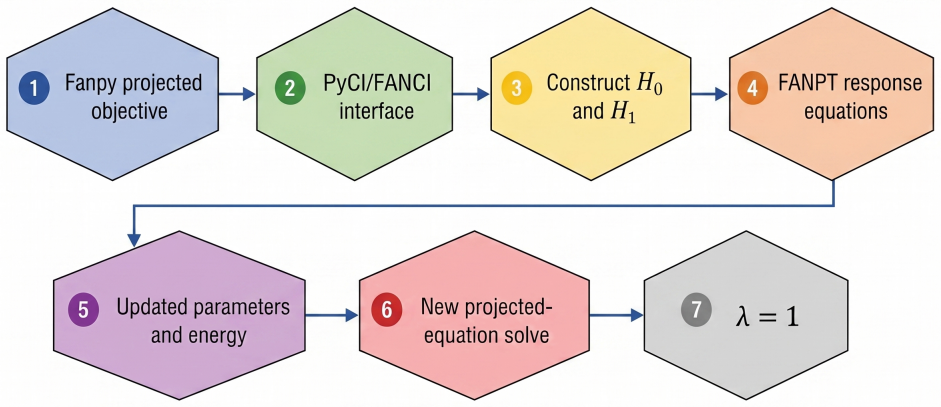
The central object is the overlap Hessian, $\partial^2 f_m/\partial p_k\partial p_l$, the second derivative of a determinant overlap with respect to two wavefunction parameters, which the original quasilinear approximation set to zero. For coupled-cluster wavefunctions written as a product over excitation operators, each overlap is a sum over excitation paths, and the Hessian counts paths containing both differentiated amplitudes with their fermionic signs, while diagonal elements vanish. This Hessian builds the residual tensors $G_{n,kl}$, $G_{n,klE}$, and $G_{n,kl\lambda}$ that enter the FANPT constant vectors $B_n^{(r)}$. Because these terms appear only on the right-hand side, all orders share the same first-order response matrix as qao=2, so the correction changes the predictor rather than the linear system being solved.
What would settle it
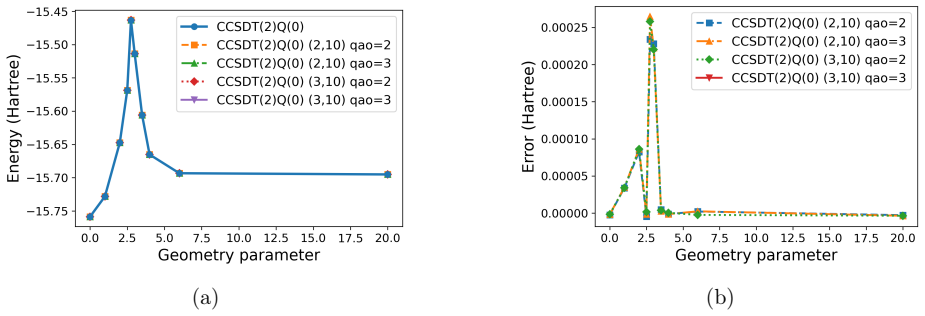
Take the BeH2/CCSDT(2)Q(0) system, run both qao=2 and qao=3 with 10, 20, and 100 steps, and record the same-$\lambda$ Frobenius norms and the number of solver failures at each geometry; if the qao=3 advantage shrinks or reverses at fine step sizes, or if the large norms simply move to different $\lambda$ values, the claimed stabilization is limited to the coarsest steps rather than a property of the corrected predictor. Also check the condition number of the response matrix at the largest-norm points, since near-singularity would mean the norm reports parameter redundancy rather than poor guesses.
Extended reading notes
Core claim
The central claim is that including the leading nonlinear response of the wavefunction ansatz—the second derivative of each determinant overlap with respect to the active wavefunction parameters—makes FANPT a noticeably more robust continuation method for nonlinear FANCI equations without altering the final energies. For coupled-cluster wavefunctions the overlap Hessian has a simple path-product form: a derivative of an overlap picks out excitation paths containing the differentiated amplitude, and second derivatives pick out paths containing both amplitudes, while diagonal elements vanish when an excitation appears at most once in a path. Feeding this Hessian into the FANPT response equations adds terms in $G_{n,kl}$, $G_{n,klE}$, and $G_{n,kl\lambda}$ to the order-dependent constant vectors, while the left-hand-side response matrix is unchanged. Numerically, qao=3 reduces the mean same-$\lambda$ Frobenius norm of the parameter correction from $1.26\times10^{-1}$ to $1.72\times10^{-2}$ for the 100-step LiH/CCSD(0) second-order run, and from 4.32 to 0.567 (maximum from 99.88 to 5.24) for the reduced-step BeH2/CCSD(0) run; the largest reductions occur at stretched geometries and at $\lambda$ near 1, where qao=2 produces excursions of order $10^2$–$10^3$ in the norm. The paper therefore concludes that the second-derivative correction acts as a stabilizing term for continuation, not as an energy correction: for linear CI the Hessian vanishes, and for the tested molecules the final energies differ from qao=2 by only about $10^{-7}$ hartree (LiH) or remain within the existing energy-error trends (BeH2).
Load-bearing premise
The load-bearing premise is that the independently optimized FANCI solution at each $\lambda$ is the right benchmark, so the same-$\lambda$ Frobenius norm measures the quality of the FANPT guess; this requires a unique converged FANCI solution at each $\lambda$ and treats every parameter as equally important, which may fail if the response matrix has near-zero eigenvalues or the nonlinear equations have several solutions.
Editorial extensions
If this is right
- Linear CI wavefunctions see no change: the overlap Hessian vanishes, so qao=3 reduces exactly to the original quasilinear FANPT, making the benefit specific to nonlinear ansätze.
- Larger $\lambda$-steps become usable: in the BeH2 tests, 10-step qao=3 runs attain mean same-$\lambda$ norms comparable to or better than 50–100-step qao=2 runs, while removing nearly all norms above 10.
- Continuation becomes more predictable: the LiH runs show fewer function evaluations (1299 versus 1378 in the second-order case) and lower wall time (102.4 versus 118.2 seconds), even though final energies differ by roughly $10^{-7}$ hartree.
- The response-matrix structure is preserved, so existing FANPT linear solvers can be reused; the added cost is one extra power of the number of active parameters in constructing the constant vector and storing the Hessian.
Reading between the lines
- A natural next step is to include third-order overlap derivatives (qao=4) to see whether the stabilization saturates or reverses, since the constant-vector-completion pattern suggests the mechanism generalizes beyond the Hessian.
- For geminal and tensor-network ansätze whose overlaps are also products or polynomial functions of parameters, the same Hessian construction should transfer directly, so the stabilization may be a general feature of product-form wavefunctions rather than a coupled-cluster-specific effect.
- A sparse or symmetry-adapted overlap Hessian could lower the $\mathcal{O}(P^2)$ overhead identified in the scaling analysis, making the correction practical for larger active spaces where the dense implementation would be the bottleneck.
- The same-$\lambda$ norm diagnostic could be complemented by measuring the basin of attraction or the number of Newton iterations required from each guess; if the Hessian correction reduces solver failures rather than just norms, the practical gain would be larger than reported.
Signed reviews
Editorial analysis
A structured set of objections, weighed in public.
Referee Report
Summary. The paper develops a second-derivative-corrected FANPT variant, denoted qao=3, which retains the overlap Hessian for nonlinear wavefunction ansätze while neglecting only third- and higher-order parameter derivatives. The authors derive the corresponding second-, third-, and fourth-order response equations, implement the overlap Hessian for coupled-cluster wavefunctions in the FanPy/FANCI framework, and test the method on LiH and on the BeH2 insertion coordinate with CCSD(0) and CCSDT(2)Q(0) wavefunctions in the STO-6G basis. The central claim is that, especially for large λ-steps, qao=3 yields same-λ parameter vectors much closer to the optimized FANCI solutions than the original qao=2 approximation, suppressing large parameter-space excursions, while leaving final energies essentially unchanged.
Significance. If the central claim is correct, the contribution is a useful practical refinement of FANPT: it includes the leading nonlinear overlap response without changing the response-matrix structure, and the authors are transparent about the additional O(MP^2) cost. The derivation is clear and the scaling analysis is explicit, and the paper honestly reports local degradations in addition to the favorable global trends. The main unresolved question is whether the same-λ norm is a reliable benchmark for guess quality, because the manuscript does not document the convergence thresholds, starting-point protocol, or root structure of the FANCI projected equations used as the comparison target.
major comments (3)
- [Results and Discussion, BeH2; Computational Details and Model Systems] The central diagnostic is the same-λ Frobenius norm between the FANPT-propagated guess and the 'independently optimized' FANCI solution, but the independence of the benchmark solutions is not documented. Since the FANPT prediction is described as providing the initial guess for solving the FANCI equations at the next λ, the reader cannot tell whether the benchmark optimizations used FANPT-independent starting points. Please report the residual convergence threshold used in the benchmark FANCI optimizations, the starting-point protocol (e.g., from RHF at every λ or from an explicitly FANPT-independent path), and a root-uniqueness or branch-continuity check for the projected equations at least at the geometries where qao=2 norms exceed 100 (r=3.0–4.0 and r=20.0). Without this information, the reductions of up to 10^3 in Tables 5, 7, 10, and 12 could reflect loose convergence or branch switching rather than improved initial guesses.
- [Computational Details and Model Systems; Tables 4–12] The number of FANPT continuation steps is not reported consistently. Table 4 is labeled 'reduced number of FANPT continuation steps' without giving the number, while Table 6 explicitly states '10 continuation steps'; similarly, Figure 4 discusses 10-, 50-, and 100-step runs for CCSDT(2)Q(0), but the mean and standard-deviation values for the 50- and 100-step runs are not tabulated. Please state the step count in every table caption and provide a table of the Figure 4 data so that the claimed cost–quality improvements can be verified quantitatively.
- [Computational Scaling and Continuation Quality] The practical benefit of a better initial guess for BeH2 is not demonstrated end-to-end. Figure 4 shows that qao=3 with 10 steps costs roughly 1.5 times more FANPT wall time than qao=2 with 100 steps, and no downstream FANCI optimization effort (function evaluations, iterations, or wall time) is reported for the BeH2 calculations. The paper should either show that the reduced same-λ norms translate into fewer nonlinear FANCI solves, or be explicit that the claim is limited to the parameter-space quality of the predictor rather than total computational cost.
minor comments (4)
- [TOC Graphic] The placeholder 'TOC ENTRY REQUIRED' remains in the manuscript and should be replaced with the actual table-of-contents graphic.
- [Throughout] The notation is inconsistent: the text uses 'qao=2' and 'qao=3', while Figure 4 and the scaling section use 'QAO=2' and 'QAO=3'. Please standardize the capitalization.
- [Table 4] The rows 'Mean parameter norm' and 'Maximum parameter norm' are identical to the 'Mean Frobenius norm' and 'Maximum Frobenius norm' rows, making the table redundant. If these are meant to be different quantities, the definitions should be given.
- [Computational Details and Model Systems] The manuscript does not provide a data availability statement or explicit software version numbers for PySCF and FanPy, and no numerical thresholds are given for the FANCI optimizations. Adding these details would aid reproducibility.
Circularity Check
No significant circularity: the qao=3 correction is derived from overlap derivatives and benchmarked against pre-optimized same-λ FANCI solutions, not fitted to them.
full rationale
The paper's central derivation is self-contained: the second-derivative-corrected FANPT equations follow by differentiating the projected residual (Eq. 11) and retaining the overlap-Hessian terms Gn,kl, Gn,klE, and Gn,klλ (Eqs. 20-22). No benchmark datum or fitted parameter enters the derivation; the qao=3 constant-vector terms are constructed from the CC overlap Hessian, Eq. (40), with no regression or tuning. The numerical claim is assessed by the same-λ Frobenius norm between the FANPT-propagated guess and the 'independently optimized FANCI parameters at the same value of λ' (Abstract and Computational Details). The paper states that these FANCI wavefunctions were first optimized independently, before FANPT propagation, so the benchmark is not a function of the qao=3 predictor. The self-citations to FANCI/FANPT (Refs. 61-62) define the framework but do not carry the new result: the overlap-Hessian terms, the modified response equations, and the numerical stabilization are derived and implemented in this work. The paper's honest reporting of local deteriorations, e.g., qao=3 giving larger same-λ norms near r=2.5, further indicates that the comparison is not manufactured. Concerns about convergence thresholds, root uniqueness, and shared FanPy implementation are correctness or reproducibility risks, not circularity.
Assumptions & free parameters
free parameters (2)
- FANPT continuation step count =
100 for LiH; 10/50/100 for BeH2
- FANPT expansion order =
2 or 3
assumptions (5)
- standard math Taylor expansion and Faa di Bruno differentiation of the projected residual are valid along the adiabatic connection.
- domain assumption The adiabatic connection H(λ)=F+λV is smooth and differentiable on [0,1].
- domain assumption The response matrix G_{n,k} is nonsingular at every continuation point.
- domain assumption The FANCI projected equations have a unique, converged solution at each λ, making same-λ parameter norms a valid diagnostic.
- domain assumption For the CC product ansatz, each valid excitation path contains a given operator at most once, so diagonal overlap Hessian elements vanish.
Cite this review
Pith. "Pith review of Second-Derivative-Corrected FANPT for Robust Continuation of Nonlinear Wavefunction Equations." pith.science (2026). https://pith.science/paper/NDFD3HCS
@misc{pith2026260811421,
  author       = {Pith},
  title        = {Pith review of: Second-Derivative-Corrected FANPT for Robust Continuation of Nonlinear Wavefunction Equations},
  year         = {2026},
  howpublished = {\url{https://pith.science/paper/NDFD3HCS}},
  note         = {Machine review of arXiv:2608.11421}
}
abstract
We present a second-derivative-corrected extension of the Flexible Ansatz for N-body Perturbation Theory (FANPT) for solving nonlinear Flexible Ansatz for N-body Configuration Interaction (FANCI) wavefunction equations. The original quasilinear FANPT approximation neglects second- and higher-order derivatives of the determinant overlap with respect to wavefunction parameters. In this work, we retain the overlap Hessian and neglect only third- and higher-order parameter derivatives, thereby including the leading nonlinear response of the wavefunction ansatz while preserving the same response-matrix structure used in the original FANPT formulation. The resulting additional terms enter only through the constant vector of the response equations and are implemented for coupled-cluster wavefunctions in the FanPy/FANCI framework. The new approximation is tested on the Lithium Hydride molecule and the insertion of Beryllium into H$_2$ using seniority-restricted coupled-cluster wavefunctions in the STO-6G basis. The main advantage of the second-derivative correction is that it provides a better initial guess for solving the projected FANCI equations at the next point along the adiabatic connection. This improvement is diagnosed by comparing the FANPT-propagated parameters with the independently optimized FANCI parameters at the same value of $\lambda$. For nonlinear coupled-cluster ansatzes, especially when larger $\lambda$-steps are used, the corrected approximation reduces the same-$\lambda$ parameter deviations and suppresses large parameter-space excursions. These results show that the leading nonlinear overlap correction improves the reliability of FANPT as a continuation strategy for nonlinear wavefunction equations.
Figures

Figures from the paper (1 more)

Reference graph
Works this paper leans on
-
[1]
Szabo, A.; Ostlund, N. S. Modern quantum chemistry: introduction to advanced electronic structure theory; Courier Corporation, 1996
1996
-
[2]
Molecular electronic-structure theory; John Wiley & Sons, 2013
Helgaker, T.; Jorgensen, P.; Olsen, J. Molecular electronic-structure theory; John Wiley & Sons, 2013
2013
-
[3]
O.; Taylor, P
Roos, B. O.; Taylor, P. R.; Sigbahn, P. E. A complete active space SCF method (CASSCF) using a density matrix formulated super-CI approach. Chemical Physics 1980, 48, 157--173
1980
-
[4]
E.; Alml \"o f, J.; Heiberg, A.; Roos, B
Siegbahn, P. E.; Alml \"o f, J.; Heiberg, A.; Roos, B. O. The complete active space SCF (CASSCF) method in a Newton--Raphson formulation with application to the HNO molecule. The Journal of Chemical Physics 1981, 74, 2384--2396
1981
-
[5]
Roos, B. O. The complete active space SCF method in a fock-matrix-based super-CI formulation. International Journal of Quantum Chemistry 1980, 18, 175--189
1980
-
[6]
Roos, B. O. The complete active space self-consistent field method and its applications in electronic structure calculations. Advances in Chemical Physics: Ab Initio Methods in Quantum Chemistry Part 2 1987, 69, 399--445
1987
-
[7]
Hierarchy Configuration Interaction: Combining Seniority Number and Excitation Degree
Kossoski, F.; Damour, Y.; Loos, P.-F. Hierarchy Configuration Interaction: Combining Seniority Number and Excitation Degree. The Journal of Physical Chemistry Letters 2022, 13, 4342--4349, PMID: 35537704
2022
-
[8]
A.; Tubman, N
Holmes, A. A.; Tubman, N. M.; Umrigar, C. J. Heat-Bath Configuration Interaction: An Efficient Selected Configuration Interaction Algorithm Inspired by Heat-Bath Sampling. Journal of Chemical Theory and Computation 2016, 12, 3674--3680, PMID: 27428771
2016
Show all 88 references
-
[9]
B.; Evangelista, F
Schriber, J. B.; Evangelista, F. A. Communication: An adaptive configuration interaction approach for strongly correlated electrons with tunable accuracy. The Journal of chemical physics 2016, 144
2016
-
[10]
A.; de Moura, C
Lokhande, R. A.; de Moura, C. E. V.; Gaikwad, P. B.; Miranda-Quintana, R. A. Exploring New Construction Schemes for Extended-Hierarchy Configuration–Interaction Wave Functions. The Journal of Physical Chemistry A 2026, 130, 4074--4085, PMID: 42118961
2026
-
[11]
J.; Handy, N
Knowles, P. J.; Handy, N. C. A Determinant Based Full Configuration Interaction Program. Computer Physics Communications 1989, 54, 75--83
1989
-
[12]
J.; Handy, N
Knowles, P. J.; Handy, N. C. A New Determinant-Based Full Configuration Interaction Method. Chemical Physics Letters 1984, 111, 315--321
1984
-
[13]
Knowles, P. J. Very Large Full Configuration Interaction Calculations. Chemical Physics Letters 1989, 155, 513--517
1989
-
[14]
J.; Musia , M
Bartlett, R. J.; Musia , M. Coupled-cluster theory in quantum chemistry. Rev. Mod. Phys. 2007, 79, 291--352
2007
-
[15]
Shavitt, I.; Bartlett, R. J. Many-body methods in chemistry and physics: MBPT and coupled-cluster theory; Cambridge university press, 2009
2009
-
[16]
Bartlett, R. J. The coupled-cluster revolution. Molecular Physics 2010, 108, 2905--2920
2010
-
[17]
Lokhande, R.; de Moura, C. E. V.; Zsigmond, K.; Ayers, P. W.; Miranda-Quintana, R. A. A New Family of Seniority-Restricted Coupled Cluster Methods. The Journal of Physical Chemistry A 2026, 130, 4469--4478, PMID: 42210909
2026
-
[18]
A.; Harrison, J
Nicely, V. A.; Harrison, J. F. Geminal product wavefunctions: A general formalism. The Journal of Chemical Physics 1971, 54, 4363--4368
1971
-
[19]
Geminal-based electronic structure methods in quantum chemistry
Tecmer, P.; Boguslawski, K. Geminal-based electronic structure methods in quantum chemistry. Toward a geminal model chemistry. Physical Chemistry Chemical Physics 2022, 24, 23026--23048
2022
-
[20]
A.; Xu, F
Rassolov, V. A.; Xu, F. Geminal model chemistry III: Partial spin restriction. The Journal of Chemical Physics 2007, 126, 234112
2007
-
[21]
A.; Xu, F.; Garashchuk, S
Rassolov, V. A.; Xu, F.; Garashchuk, S. Geminal model chemistry II. Perturbative corrections. The Journal of Chemical Physics 2004, 120, 10385--10394
2004
-
[22]
Rassolov, V. A. A geminal model chemistry. The Journal of Chemical Physics 2002, 117, 5978--5987
2002
-
[23]
Mazziotti, D. A. Energy functional of the one-particle reduced density matrix: A geminal approach. Chemical Physics Letters 2001, 338, 323--328
2001
-
[24]
Mazziotti, D. A. Geminal functional theory: A synthesis of density and density matrix methods. The Journal of Chemical Physics 2000, 112, 10125--10130
2000
-
[25]
Extended geminal models
R eggen, I. Extended geminal models. Correlation and Localization 1999, 203, 89
1999
-
[26]
Extremal electron pairs
Kutzelnigg, W.; Vogtner, S. Extremal electron pairs. International Journal of Quantum Chemistry 1996, 60, 235--248
1996
-
[27]
J.; Shull, H.; Hagstrom, S
Levy, M.; Stevens, W. J.; Shull, H.; Hagstrom, S. Transferability of electron pairs between H2O and H2O2. The Journal of Chemical Physics 1974, 61, 1844--1856
1974
-
[28]
Diagrammatical Method for Geminals
Paldus, J.; Sengupta, S.; C \'i z ek, J. Diagrammatical Method for Geminals. II. Applications. The Journal of Chemical Physics 1972, 57, 652--666
1972
-
[29]
Diagrammatical Method for Geminals
Paldus, J. Diagrammatical Method for Geminals. I. Theory. The Journal of Chemical Physics 1972, 57, 638--651
1972
-
[30]
Geminal Localization in the Separated-Pair pi-Electronic Model of Benzene
Paldus, J.; C \'i z ek, J.; Sengupta, S. Geminal Localization in the Separated-Pair pi-Electronic Model of Benzene. The Journal of Chemical Physics 1971, 55, 2452--2462
1971
-
[31]
Silver, D. M. Electron Pair Correlation: Products of N(N - 1)/2 Geminals for N Electrons. The Journal of Chemical Physics 1971, 55, 1461--1467
1971
-
[32]
J.; Shull, H.; Hagstrom, S
Levy, M.; Stevens, W. J.; Shull, H.; Hagstrom, S. Transferability of Strongly Orthogonal Geminals between H2O and H2O2. The Journal of Chemical Physics 1970, 52, 5483--5485
1970
-
[33]
Silver, D. M. Bilinear orbital expansion of geminal-product correlated wavefunctions. The Journal of Chemical Physics 1970, 52, 299--303
1970
-
[34]
Silver, D. M. Natural orbital expansion of interacting geminals. The Journal of Chemical Physics 1969, 50, 5108--5116
1969
-
[35]
F.; Davidson, E
Bender, C. F.; Davidson, E. R.; Peat, F. D. Application of geminal methods to molecular calculations. Physical Review 1968, 174, 75--80
1968
-
[36]
Coleman, A. J. Structure of fermion density matrices. II. Antisymmetrized geminal powers. Journal of Mathematical Physics 1965, 6, 1425--1431
1965
-
[37]
W.; Fogel, S
Smith, D. W.; Fogel, S. J. Natural Orbitals and Geminals of the Beryllium Atom. The Journal of Chemical Physics 1965, 43, S91--S96
1965
-
[38]
A.; Limacher, P
Johnson, P. A.; Limacher, P. A.; Kim, T. D.; Richer, M.; Miranda-Quintana, R. A.; Heidar-Zadeh, F.; Ayers, P. W.; Bultinck, P.; De Baerdemacker, S.; Van Neck, D. Strategies for extending geminal-based wavefunctions: Open shells and beyond. Computational and Theoretical Chemist...
2017
-
[39]
B.; Kim, T
Gaikwad, P. B.; Kim, T. D.; Richer, M.; Lokhande, R. A.; Sánchez-Díaz, G.; Limacher, P. A.; Ayers, P. W.; Miranda-Quintana, R. A. Coupled cluster-inspired geminal wavefunctions. The Journal of Chemical Physics 2024, 160, 144108
2024
-
[40]
Surjan, P. R. In Correlation and Localization ; Surjan, P. R., Ed.; Topics in Current Chemistry ; 1999; Vol. 203; pp 63--88
1999
-
[41]
R.; Szabados, A.; Jeszenszki, P.; Zoboki, T
Surjan, P. R.; Szabados, A.; Jeszenszki, P.; Zoboki, T. Strongly Orthogonal Geminals: Size-Extensive and Variational Reference States. Journal of Mathematical Chemistry 2012, 50, 534--551
2012
-
[42]
A.; Limacher, P
Tecmer, P.; Boguslawski, K.; Johnson, P. A.; Limacher, P. A.; Chan, M.; Verstraelen, T.; Ayers, P. W. Assessing the Accuracy of New Geminal-Based Approaches . Journal of Physical Chemistry A 2014, 118, 9058--9068
2014
-
[43]
A.; Fecteau, C.- \'E .; Berthiaume, F.; Cloutier, S.; Carrier, L.; Gratton, M.; Bultinck, P.; De Baerdemacker, S.; Van Neck, D.; Limacher, P.; Ayers, P
Johnson, P. A.; Fecteau, C.- \'E .; Berthiaume, F.; Cloutier, S.; Carrier, L.; Gratton, M.; Bultinck, P.; De Baerdemacker, S.; Van Neck, D.; Limacher, P.; Ayers, P. W. Richardson-- Gaudin Mean-Field for Strong Correlation in Quantum Chemistry. The Journal of Chemical Physics 2...
2020
-
[44]
D.; Ayers, P
Richer, M.; Kim, T. D.; Ayers, P. W. Graphical Approach to Interpreting and Efficiently Evaluating Geminal Wavefunctions . International Journal of Quantum Chemistry 2025, 125, e70000
2025
-
[45]
I.; Verstraete, F
Cirac, J. I.; Verstraete, F. Renormalization and tensor product states in spin chains and lattices. Journal of Physics A: Mathematical and Theoretical 2009, 42, 504004
2009
-
[46]
Class of quantum many-body states that can be efficiently simulated
Vidal, G. Class of quantum many-body states that can be efficiently simulated. Physical Review Letters 2008, 101, 110501
2008
-
[47]
Entanglement renormalization
Vidal, G. Entanglement renormalization. Physical Review Letters 2007, 99, 220405
2007
-
[48]
Fannes, M.; Nachtergaele, B.; Werner, R. F. Ground states of VBS models on Cayley trees. Journal of Statistical Physics 1992, 66, 939--973
1992
-
[49]
A.; De Baerdemacker, S
Gunts, K.; Van Neck, D.; Limacher, P. A.; De Baerdemacker, S. The seniority quantum number in Tensor Network States. SciPost Chemistry 2020, 1, 001
2020
-
[50]
H.; Reiher, M
Marti, K. H.; Reiher, M. The Density Matrix Renormalization Group Algorithm in Quantum Chemistry . Zeitschrift Fur Physikalische Chemie-International Journal of Research in Physical Chemistry & Chemical Physics 2010, 224, 583--599
2010
-
[51]
J.; Kinder, J
Changlani, H. J.; Kinder, J. M.; Umrigar, C. J.; Chan, G. K.-L. Approximating Strongly Correlated Wave Functions with Correlator Product States. Physical Review B 2009, 80, 245116
2009
-
[52]
H.; Bauer, B.; Reiher, M.; Troyer, M.; Verstraete, F
Marti, K. H.; Bauer, B.; Reiher, M.; Troyer, M.; Verstraete, F. Complete-Graph Tensor Network States: A New Fermionic Wave Function Ansatz for Molecules. New Journal of Physics 2010, 12, 103008
2010
-
[53]
K.-L.; Keselman, A.; Nakatani, N.; Li, Z.; White, S
Chan, G. K.-L.; Keselman, A.; Nakatani, N.; Li, Z.; White, S. R. Matrix product operators, matrix product states, and ab initio density matrix renormalization group algorithms. The Journal of Chemical Physics 2016, 145, 014102
2016
-
[54]
The density-matrix renormalization group in the age of matrix product states
Schollw \"o ck, U. The density-matrix renormalization group in the age of matrix product states. Annals of Physics 2011, 326, 96--192
2011
-
[55]
Thermodynamic limit of density matrix renormalization
\"O stlund, S.; Rommer, S. Thermodynamic limit of density matrix renormalization. Physical Review Letters 1995, 75, 3537--3540
1995
-
[56]
A practical introduction to tensor networks: Matrix product states and projected entangled pair states
Or \'u s, R. A practical introduction to tensor networks: Matrix product states and projected entangled pair states. Annals of Physics 2014, 349, 117--158
2014
-
[57]
Schuch, N.; Cirac, J. I. Matrix product state and mean-field solutions for one-dimensional systems can be found efficiently. Physical Review A 2010, 82, 012314
2010
-
[58]
I.; Verstraete, F
Schuch, N.; Cirac, J. I.; Verstraete, F. Computational difficulty of finding matrix product ground states. Physical Review Letters 2008, 100, 250501
2008
-
[59]
I.; Perez-Garcia, D.; Schuch, N.; Verstraete, F
Cirac, J. I.; Perez-Garcia, D.; Schuch, N.; Verstraete, F. Matrix product states and projected entangled pair states: Concepts, symmetries, theorems. Reviews of Modern Physics 2021, 93, 045003
2021
-
[60]
McCulloch, I. P. From density-matrix renormalization group to matrix product states. Journal of Statistical Mechanics: Theory and Experiment 2007, 2007, P10014
2007
-
[61]
D.; Miranda-Quintana, R
Kim, T. D.; Miranda-Quintana, R. A.; Richer, M.; Ayers, P. W. Flexible ansatz for N-body configuration interaction. Computational and Theoretical Chemistry 2021, 1202, 113187
2021
-
[62]
A.; Kim, T
Miranda-Quintana, R. A.; Kim, T. D.; Lokhande, R. A.; Richer, M.; Sánchez-Díaz, G.; Gaikwad, P. B.; Ayers, P. W. Flexible Ansatz for N-Body Perturbation Theory. The Journal of Physical Chemistry A 2024, 128, 3458--3467, PMID: 38651558
2024
-
[63]
Dalgarno, A.; Lewis, J. T. The exact calculation of long-range forces between atoms by perturbation theory. Proceedings of the Royal Society of London. Series A. Mathematical and Physical Sciences 1955, 233, 70
1955
-
[64]
Peng, H. W. Perturbation theory for the self-consistent field. Proceedings of the Royal Society of London. Series A. Mathematical and Physical Sciences 1941, 178, 499
1941
-
[65]
Divergence in M ller--Plesset theory: A simple explanation based on a two-state model
Olsen, J.; J rgensen, P.; Helgaker, T.; Christiansen, O. Divergence in M ller--Plesset theory: A simple explanation based on a two-state model. The Journal of Chemical Physics 2000, 112, 9736--9748
2000
-
[66]
Stillinger, F. H. M ller--Plesset convergence issues in computational quantum chemistry. The Journal of Chemical Physics 2000, 112, 9711--9715
2000
-
[67]
On perturbation expansions of the extended Koopmans' theorem
Olsen, J.; Sundholm, D. On perturbation expansions of the extended Koopmans' theorem. Chemical Physics Letters 1998, 288, 282--288
1998
-
[68]
O.; Andersson, K.; F \"u lscher, M
Roos, B. O.; Andersson, K.; F \"u lscher, M. P.; Malmqvist, P.- .; Serrano-Andr \'e s, L.; Pierloot, K.; Merch \'a n, M. Advances in Chemical Physics: New Methods in Computational Quantum Mechanics; John Wiley & Sons: New York, 1996; Vol. 93; pp 219--331
1996
-
[69]
W.; Pople, J
Raghavachari, K.; Trucks, G. W.; Pople, J. A.; Head-Gordon, M. A fifth-order perturbation comparison of electron correlation theories. Chemical Physics Letters 1989, 157, 479--483
1989
-
[70]
Bartlett, R. J. Many-body perturbation theory and coupled cluster theory for electron correlation in molecules. Annual review of physical chemistry 1981, 32, 359--401
1981
-
[71]
Goodson, D. Z. A summation procedure that improves the accuracy of the fourth-order M ller--Plesset perturbation theory. The Journal of Chemical Physics 2000, 113, 6461--6464
2000
-
[72]
RI-MP2: First derivatives and global consistency
Weigend, F.; H \"a ser, M. RI-MP2: First derivatives and global consistency. Theoretical Chemistry Accounts 1997, 97, 331--340
1997
-
[73]
Surprising cases of divergent behavior in M ller--Plesset perturbation theory
Olsen, J.; Christiansen, O.; Koch, H.; J rgensen, P. Surprising cases of divergent behavior in M ller--Plesset perturbation theory. The Journal of Chemical Physics 1996, 105, 5082--5090
1996
-
[74]
Raghavachari, K.; Anderson, J. B. Electron correlation effects in molecules. The Journal of Physical Chemistry 1996, 100, 12960--12973
1996
-
[75]
McDouall, J. J. W.; Peasley, K.; Robb, M. A. A simple MC SCF perturbation theory: Orthogonal valence bond M ller-Plesset 2 (OVB MP2). Chemical Physics Letters 1988, 148, 183--189
1988
-
[76]
L.; Nielsen, I
Janssen, C. L.; Nielsen, I. M. B. New diagnostics for coupled-cluster and M ller--Plesset perturbation theory. Chemical Physics Letters 1998, 290, 423--430
1998
-
[77]
B.; Messmer, R
Murphy, R. B.; Messmer, R. P. Generalized M ller--Plesset perturbation theory applied to general MCSCF reference wave functions. Chemical Physics Letters 1991, 183, 443--448
1991
-
[78]
Second-order M ller--Plesset perturbation theory applied to extended systems
Gr \"u neis, A.; Marsman, M.; Kresse, G. Second-order M ller--Plesset perturbation theory applied to extended systems. II. Structural and energetic properties. The Journal of Chemical Physics 2010, 133, 074107
2010
-
[79]
G.; Sherrill, C
Hohenstein, E. G.; Sherrill, C. D. Efficient evaluation of triple excitations in symmetry-adapted perturbation theory via second-order M ller--Plesset perturbation theory natural orbitals. The Journal of Chemical Physics 2010, 133, 104107
2010
-
[80]
S.; Bogdanov, N
Sun, Q.; Zhang, X.; Banerjee, S.; Bao, P.; Barbry, M.; Blunt, N. S.; Bogdanov, N. A.; Booth, G. H.; Chen, J.; Cui, Z.-H.; Eriksen, J. J.; Gao, Y.; Guo, S.; Hermann, J.; Hermes, M. R.; Koh, K.; Koval, P.; Lehtola, S.; Li, Z.; Liu, J.; Mardirossian, N.; McClain, J. D.; Motta, M....
2020
-
[81]
C.; Blunt, N
Sun, Q.; Berkelbach, T. C.; Blunt, N. S.; Booth, G. H.; Guo, S.; Li, Z.; Liu, J.; McClain, J. D.; Sharma, S.; Wouters, S.; Chan, G. K.-L. PySCF: The Python-based simulations of chemistry framework. WIREs Computational Molecular Science 2018, 8, e1340
2018
-
[82]
Libcint: An efficient general integral library for Gaussian basis functions
Sun, Q. Libcint: An efficient general integral library for Gaussian basis functions. Journal of Computational Chemistry 2015, 36, 1664--1671
2015
-
[83]
https://github.com/mqcomplab/Fanpy, 2024; Accessed: 2025-05-15
MQCompLab Fanpy: A Python package for ansatz-based quantum chemistry. https://github.com/mqcomplab/Fanpy, 2024; Accessed: 2025-05-15
2024
-
[84]
D.; Richer, M.; Sánchez-Díaz, G.; Miranda-Quintana, R
Kim, T. D.; Richer, M.; Sánchez-Díaz, G.; Miranda-Quintana, R. A.; Verstraelen, T.; Heidar-Zadeh, F.; Ayers, P. W. Fanpy: A python library for prototyping multideterminant methods in ab initio quantum chemistry. Journal of Computational Chemistry 2023, 44, 697--709
2023
-
[85]
D.; Tehrani, A.; Wang, S.; Gaikwad, P
Richer, M.; S \'a nchez-D \'i az , G.; Mart \'i nez-Gonz \'a lez , M.; Chuiko, V.; Kim, T. D.; Tehrani, A.; Wang, S.; Gaikwad, P. B.; de Moura , C. E. V.; Masschelein, C.; Miranda-Quintana , R. A.; Gerolin, A.; Heidar-Zadeh , F.; Ayers, P. W. PyCI : A Python-scriptable Library...
2024
-
[86]
Zsigmond, K.; Lokhande, R.; de Moura, C. E. V.; Gaikwad, P. B.; Mart \'i nez-Gonz \'a lez, M.; Richer, M.; Calero-Osorio, D. F.; Ayers, P. W.; Miranda-Quintana, R. A. Fanpy 2.0: Wavefunction Implementation and Analysis Tools for Flexible Ansatz Design. 2026; https://arxiv.org/...
2026 arXiv
-
[87]
D.; Shepard, R.; Brown, F
Purvis III, G. D.; Shepard, R.; Brown, F. B.; Bartlett, R. J. C2V Insertion pathway for BeH2: A test problem for the coupled-cluster single and double excitation model. International Journal of Quantum Chemistry 1983, 23, 835--845
1983
-
[88]
B.; Kim, T
Gaikwad, P. B.; Kim, T. D.; Richer, M.; Lokhande, R. A.; Sánchez-Díaz, G.; Limacher, P. A.; Ayers, P. W.; Miranda-Quintana, R. A. Coupled cluster-inspired geminal wavefunctions. The Journal of Chemical Physics 2024, 160, 144108 mcitethebibliography
2024
Reviewed August 15, 2026 · model on record in the stance chip above.
Discussion (0). Continue with ORCID to comment.