REVIEW 2 major objections 6 minor 26 references
Energy-Efficient Path Planning with Multi-Location Object Pickup for Mobile Robots on Uneven Terrain
T0 review · 2 major / 6 minor · reviewed 2026-08-05 · deepseek-v4-flash
Pith's one-line read This paper shows that a payload-aware path database lets a concurrent search solve object-pickup energy routing on uneven terrain with near-optimal cost and one-to-two-orders-of-magnitude speedup.
desk verdict Worth reading for the OMEPP problem and PCPD idea, but the feasibility logic in §4.2 is backwards and needs fixing before the near-optimality claim holds. read the letter →
The pith
A machine-rendered reading of the paper's core claim, the machinery that carries it, and where it could break.
The reading
What carries the argument
The Payload-Constrained Path Database (PCPD) is the load-bearing object. It is a family of Compressed Path Databases, one per payload bucket, where each CPD(ρ) stores the first move along the minimum-energy path between every pair of nodes under the slope constraint and energy model for payload ρ. At runtime, successor generation takes the two buckets bracketing the robot's actual payload, reads their suggested first moves, and keeps the union—so each side of the search branches at most twice. This converts a full energy-aware search from every pickup point into a small number of precomputed move choices, which is what produces the speedup; the two-bucket union is what protects solution qual
What would settle it
Build or locate a terrain cell where the minimum-energy route to a pickup point enters through an edge whose slope lies between the climb limits for the two payload buckets, then set the robot's actual payload to the heavier bucket. If the concurrent PCPD search follows the lighter bucket's first move through that edge, reconstructing the returned path and checking every edge against Equation (2)'s slope limit at the true payload will show a violation, refuting the claim that PCPD successors are always feasible.
Extended reading notes
Core claim
The central claim is that OMEPP can be solved online by a two-level best-first search that runs Z* searches for all pickup points concurrently, guided by PCPD. PCPD is an array of CPD(ρ_i) databases, each built by a modified Dijkstra that only traverses edges with slope within the limit for payload ρ_i and assigns energy costs by the same friction-plus-gravity model as Z*. At an expanded node, the algorithm queries the two databases whose payloads bracket the actual total payload; if both suggest the same first move, one successor is generated, otherwise both candidates are kept, capping branching at four per side. The paper argues that although this pruning sacrifices the optimality guarant
Load-bearing premise
The method assumes the first move suggested by the lighter-payload database is always a legal move for the heavier real robot; if that edge is steeper than the robot's actual slope limit, the generated successor path can be infeasible.
Editorial extensions
If this is right
- An outdoor robot can answer 'which pickup point and which route' in milliseconds rather than seconds, because the expensive energy-aware search is moved offline into PCPD.
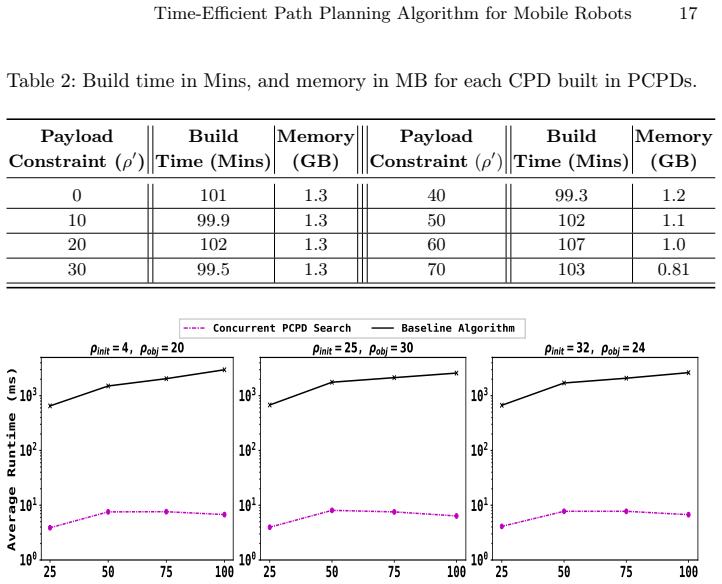
- Runtime stays nearly flat as the number of candidate pickup points grows, since the global queue expands the most promising pickup first and prunes the rest.
- The returned path is a single energy-minimal route from start to target with a payload switch at the chosen pickup point, so it can be handed directly to a low-level controller.
- A fixed set of eight payload databases covers a 0-to-70 kg range on one terrain; the same databases can be reused for many queries without rebuilding.
Reading between the lines
- If the two-bucket agreement heuristic is as reliable as the experiments suggest, the approach could extend to multi-object pickups by looking up first moves under cumulative payloads; the paper names this as future work but does not test whether agreement still predicts optimality.
- The suboptimality figures come from random start-target pairs on one DEM; a stress terrain where the energy-optimal path changes discontinuously as payload crosses a bucket boundary could reveal how often the union of lower and upper first moves misses the true CPD(ρinit).
- A direct test of successor quality would compare the search's generated successors against the true CPD(ρinit) first move; if the agreement rate is high, PCPD's pruning is essentially oracle-guided for that terrain.
Editorial analysis
A structured set of objections, weighed in public.
Referee Report
Summary. The paper defines the Object-Pickup Minimum Energy Path Problem (OMEPP): a mobile robot on uneven terrain must travel from a source to a target and pick up an object from one of several candidate pickup points, with the payload increasing after pickup. The authors propose a baseline algorithm that runs Z* for every pickup point, guaranteeing optimality but at high computational cost, and a heuristic Concurrent PCPD Search that interleaves Z* searches for all pickup points while using a Payload-Constrained Compressed Path Database (PCPD) to prune successors. The central claim is that the concurrent search is one to two orders of magnitude faster than the baseline while maintaining near-optimal path quality, with average suboptimality below 1% on real-world DEM data.
Significance. The problem is practically motivated and, to the best of the authors' knowledge, new. The PCPD idea, extending Compressed Path Databases with payload-dependent slope constraints, is a reasonable engineering approach, and the experiments are carried out on a realistic DEM with a standard UGV model. If the reported speedups and near-optimality are valid, the method would be a useful step toward real-time energy-aware pickup routing for outdoor robots. The empirical work is a strength: real-world terrain, 1,000 random queries, and multiple payload configurations. However, the central feasibility invariant in the successor-generation logic is reversed, so the near-optimality and even validity of the returned paths are not established as written.
major comments (2)
- [§4.2, Successors Generation] The feasibility claim is reversed. Eq. (2) shows that the maximum uphill slope angle φγ decreases as the total payload ρ increases (the argument of sin⁻¹ grows, so φ_f decreases). Thus a CPD built for ρ_lower ≤ ρ_init permits steeper slopes than a robot carrying ρ_init can actually climb, so CPD(ρ_lower)[v_i,p_i] is not 'always feasible'. The safe database is CPD(ρ_upper), whose moves are automatically feasible for ρ_init because ρ_upper ≥ ρ_init means its slope threshold is tighter. The bullet list in §4.2 states the opposite. Algorithm 2, line 11, contains no explicit edge-feasibility check; without one, a generated successor may be assigned infinite cost via Eq. (5), silently distorting the search, or worse, the returned path may violate the robot's traction limits. Table 2 confirms that feasible first-move sets shrink as payload grows, so this is not a pathological corner case. Pleas
- [Abstract; §5.2, Table 3] The paper repeatedly states that suboptimality is 'below 1%' (Abstract, Conclusion) and that Table 3 shows this 'across all payload settings'. Table 3, row (ρ_init=45, ρ_obj=8), reports an average suboptimality of 0.01065, i.e. 1.065%, which is above 1%. Either correct the claim to 'at most about 1.1%' or clarify that the <1% statement refers to an average across configurations. As written, a headline quantitative claim is contradicted by the paper's own data.
minor comments (6)
- [Eq. (6)] The last case of the heuristic contains a garbled inequality: 'θ_c < θ(vc,t) > θγ' should presumably be 'θ_c < θ(vc,t) < θγ'.
- [Algorithm 2, line 10 and output comment] The pseudocode and the output comment say 'Return optimal path', but Section 4.2 and the experiments explicitly acknowledge that the PCPD-based successor pruning does not guarantee optimality. Please revise the wording to 'best found path' or 'near-optimal path' to avoid contradicting the heuristic nature of the algorithm.
- [Table 2 caption] The caption says 'memory in MB', but the table entries (1.3, 1.2, etc.) and the text in §5.2 refer to GB. The caption unit should be corrected.
- [Notation in §3.1 and §4.2] The maximum uphill slope is denoted φγ in Eq. (2) and the surrounding text, but θγ is used in Eq. (6) and elsewhere. Use a single symbol to prevent confusion.
- [Example 2, Fig. 3] Example 2 states ρ_obj = 24 at the beginning, but later computes ρ_init + ρ_obj = 12 + 15 = 27, and Fig. 3 says 'Object Payload = 15 kg'. The example is internally inconsistent and should be reconciled.
- [References] References [3] and [4] appear to be the same paper ('Time-efficient path planning algorithm for mobile robots on uneven terrain', same authors) published in two different venues. Please verify and avoid duplicate citation.
Circularity Check
No significant circularity: the speedup and near-optimality claims are empirical comparisons against an external Z* baseline, not consequences of fitting or self-citation.
full rationale
The paper's derivation chain is self-contained with respect to its central claims. OMEPP is defined from the physical energy model (Eqs. 1-5), the baseline is built on the external Z* algorithm [8], and the PCPD is constructed by a modified Dijkstra search that explicitly uses the same energy model. The claimed near-optimal performance and one-to-two-orders-of-magnitude speedup are measured empirically in Table 3 and Figure 4 against the optimal baseline, not derived by definition from a fitted parameter. The self-citations [3] and [4] are cited only as an example of CPD application on uneven terrain and as prior work; no load-bearing uniqueness theorem or ansatz is imported from them. The questionable feasibility assertion in Section 4.2 (that a move from CPD(rho_lower) is always feasible for the larger payload rho_init) is a logical/physical correctness concern relative to Eq. (2), but it is not circular reasoning: the paper's conclusion does not reduce to its own input by construction. No fitted value is renamed as a prediction, and no known result is merely relabeled. Accordingly, the paper exhibits no significant circularity.
Assumptions & free parameters
free parameters (3)
- Payload bucket width and count for PCPD =
8 buckets, 10 kg steps from 0 to 70 kg
- AMR physical parameters and payload cap =
m=80 kg, v=1 m/s, Pmax=819.2 W, μ=0.5, μs=1.0, cap 70 kg
- Query configuration =
1000 random s-t pairs, 50 pickup points, 10 runs averaged after discarding best and worst, random ρinit and ρobj
assumptions (5)
- domain assumption The energy model of Ganganath et al. [8] (Eqs. 1-5) exactly describes energy consumption and slope feasibility for a wheeled robot.
- domain assumption The maximum uphill slope angle is the minimum of traction and static friction limits, and the downhill braking limit is tan^-1(μ) (Eqs. 2-4).
- domain assumption A DEM sampled at 1 m spacing with 8-neighbor grid edges is a faithful model of traversability.
- ad hoc to paper Two adjacent payload buckets CPD(ρlower) and CPD(ρupper) provide enough first-move information to keep the search near-optimal.
- domain assumption CPD first-move tables and RLE compression from prior work remain correct when weights are energy costs rather than distances.
Cite this review
Pith. "Pith review of Energy-Efficient Path Planning with Multi-Location Object Pickup for Mobile Robots on Uneven Terrain." pith.science (2026). https://pith.science/paper/NDPTX7UE
@misc{pith2026250906061,
  author       = {Pith},
  title        = {Pith review of: Energy-Efficient Path Planning with Multi-Location Object Pickup for Mobile Robots on Uneven Terrain},
  year         = {2026},
  howpublished = {\url{https://pith.science/paper/NDPTX7UE}},
  note         = {Machine review of arXiv:2509.06061}
}
read the original abstract
Autonomous Mobile Robots (AMRs) operate on battery power, making energy efficiency a critical consideration, particularly in outdoor environments where terrain variations affect energy consumption. While prior research has primarily focused on computing energy-efficient paths from a source to a destination, these approaches often overlook practical scenarios where a robot needs to pick up an object en route - an action that can significantly impact energy consumption due to changes in payload. This paper introduces the Object-Pickup Minimum Energy Path Problem (OMEPP), which addresses energy-efficient route planning for AMRs required to pick up an object from one of many possible locations and deliver it to a destination. To address OMEPP, we first introduce a baseline algorithm that employs the Z star algorithm, a variant of A star tailored for energy-efficient routing, to iteratively visit each pickup point. While this approach guarantees optimality, it suffers from high computational cost due to repeated searches at each pickup location. To mitigate this inefficiency, we propose a concurrent PCPD search that manages multiple Z star searches simultaneously across all pickup points. Central to our solution is the Payload-Constrained Path Database (PCPD), an extension of the Compressed Path Database (CPD) that incorporates payload constraints. We demonstrate that PCPD significantly reduces branching factors during search, improving overall performance. Although the concurrent PCPD search may produce slightly suboptimal solutions, extensive experiments on real-world datasets show it achieves near-optimal performance while being one to two orders of magnitude faster than the baseline algorithm.
Figures


Figures from the paper (1 more)
Reference graph
Works this paper leans on
-
[1]
Aksamentov, E., Zakharov, K., Tolopilo, D., Usina, E.: Approach to robotic mo- bile platform path planning upon analysis of aerial imaging data. In: Proceedings of 15th International Conference on Electromechanics and Robotics" Zavalishin’s Readings" ER (ZR) 2020, Ufa, Russia, 15–18 April 2020. pp. 93–103. Springer (2020) Time-Efficient Path Planning Algo...
work page 2020
-
[2]
European Transport Research Review16(1), 4 (2024)
Alverhed, E., Hellgren, S., Isaksson, H., Olsson, L., Palmqvist, H., Flodén, J.: Autonomous last-mile delivery robots: a literature review. European Transport Research Review16(1), 4 (2024)
work page 2024
-
[3]
Babakano, F., Fahmin, A., Shen, B., Cheema, M.A.: Time-efficient path planning algorithm for mobile robots on uneven terrain. In: Databases Theory and Appli- cations - 35th Australasian Database Conference, ADC 2024, Gold Coast, QLD, Australia, December 16-18, 2024, Proceedings. vol. 15449, pp. 279–292. Springer (2024)
work page 2024
-
[4]
In: Australasian Database Confer- ence
Babakano, F., Fahmin, A., Shen, B., Cheema, M.A.: Time-efficient path planning algorithm for mobile robots on uneven terrain. In: Australasian Database Confer- ence. pp. 279–292. Springer (2025)
work page 2025
-
[5]
Botea, A.: Ultra-fast optimal pathfinding without runtime search. In: Proceedings of the Seventh AAAI Conference on Artificial Intelligence and Interactive Digital Entertainment, AIIDE 2011, October 10-14, 2011, Stanford, California, USA, 122-
work page 2011
-
[6]
In: 2012 9th International Conference on Ubiquitous Robots and Ambient Intelligence (URAI)
Choi, S., Park, J., Lim, E., Yu, W.: Global path planning on uneven elevation maps. In: 2012 9th International Conference on Ubiquitous Robots and Ambient Intelligence (URAI). pp. 49–54. IEEE (2012)
work page 2012
-
[7]
In: 2014 10th France-Japan/8th Europe-Asia Congress on Mecatronics (MECATRONICS2014-Tokyo)
Ganganath, N., Cheng, C.T., Chi, K.T.: Finding energy-efficient paths on uneven terrains. In: 2014 10th France-Japan/8th Europe-Asia Congress on Mecatronics (MECATRONICS2014-Tokyo). pp. 383–388. IEEE (2014)
work page 2014
-
[8]
IEEE transactions on industrial informatics11(3), 601–611 (2015)
Ganganath, N., Cheng, C.T., Chi, K.T.: A constraint-aware heuristic path plan- ner for finding energy-efficient paths on uneven terrains. IEEE transactions on industrial informatics11(3), 601–611 (2015)
work page 2015
Show all 26 references
-
[9]
In: 2016 IEEE International Symposium on Circuits and Systems (ISCAS)
Ganganath, N., Cheng, C.T., Chi, K.T.: Multiobjective path planning on uneven terrains based on namoa. In: 2016 IEEE International Symposium on Circuits and Systems (ISCAS). pp. 1846–1849. IEEE (2016)
2016
-
[10]
Computers & Industrial Engineering196, 110476 (2024)
Jeong, J., Moon, I.: Dynamic pickup and delivery problem for autonomous delivery robots in an airport terminal. Computers & Industrial Engineering196, 110476 (2024)
2024
-
[11]
IEEE Transactions on Robotics38(4), 2481–2494 (2022)
Kyaw, P.T., Le, A.V., Veerajagadheswar, P., Elara, M.R., Thu, T.T., Nhan, N.H.K., Van Duc, P., Vu, M.B.: Energy-efficient path planning of reconfigurable robots in complex environments. IEEE Transactions on Robotics38(4), 2481–2494 (2022)
2022
-
[12]
IEEE/ASME Transactions on Mechatronics19(2), 401– 411 (2013)
Liu, S., Sun, D.: Minimizing energy consumption of wheeled mobile robots via optimal motion planning. IEEE/ASME Transactions on Mechatronics19(2), 401– 411 (2013)
2013
-
[13]
Robotica39(5), 862–884 (2021)
Nguyen, L., Kodagoda, S., Ranasinghe, R., Dissanayake, G.: Mobile robotic sensors for environmental monitoring using gaussian markov random field. Robotica39(5), 862–884 (2021)
2021
-
[14]
Rowe, N.C., Ross, R.S.: Optimal grid-free path planning across arbitrarily- contoured terrain with anisotropic friction and gravity effects (1990)
1990
-
[15]
In: 2019 IEEE International Symposium on Signal Processing and Information Technology (ISSPIT)
Saad, M., Salameh, A.I., Abdallah, S.: Energy-efficient shortest path planning on uneven terrains: A composite routing metric approach. In: 2019 IEEE International Symposium on Signal Processing and Information Technology (ISSPIT). pp. 1–6. IEEE (2019)
2019
-
[16]
In: Proceedings of the Twenty-Ninth International Joint Conference on Artificial Intelligence, IJCAI 2020
Shen, B., Cheema, M.A., Harabor, D., Stuckey, P.J.: Euclidean pathfinding with compressed path databases. In: Proceedings of the Twenty-Ninth International Joint Conference on Artificial Intelligence, IJCAI 2020. pp. 4229–4235. ijcai.org (2020) 22 F. Babakano et al
2020
-
[17]
In: Proceedings of the Thirty-First International Con- ference on Automated Planning and Scheduling, ICAPS 2021, Guangzhou, China (virtual), August 2-13, 2021
Shen, B., Cheema, M.A., Harabor, D.D., Stuckey, P.J.: Contracting and compress- ing shortest path databases. In: Proceedings of the Thirty-First International Con- ference on Automated Planning and Scheduling, ICAPS 2021, Guangzhou, China (virtual), August 2-13, 2021. pp. 322–...
2021
-
[18]
In: Proceedings of the Seventh Annual Symposium on Combinatorial Search, SOCS 2014, Prague, Czech Republic, 15-17 August 2014
Strasser, B., Harabor, D., Botea, A.: Fast first-move queries through run-length encoding. In: Proceedings of the Seventh Annual Symposium on Combinatorial Search, SOCS 2014, Prague, Czech Republic, 15-17 August 2014. AAAI Press (2014)
2014
-
[19]
In: Proceedings of the Symposium on Combinatorial Search (SoCS)
Sturtevant,N.R.,Traish,J.M.,Tulip,J.R.,Uras,T.,Koenig,S.,Strasser,B.,Botea, A., Harabor, D., Rabin, S.: The Grid-based Path Planning Competition: 2014 Entries and Results. In: Proceedings of the Symposium on Combinatorial Search (SoCS). pp. 241–251 (2015)
2014
-
[20]
IEEE Transac- tions on Robotics21(1), 102–114 (2005).https://doi.org/10.1109/TRO.2004
Sun, Z., Reif, J.: On finding energy-minimizing paths on terrains. IEEE Transac- tions on Robotics21(1), 102–114 (2005).https://doi.org/10.1109/TRO.2004. 837232
2005 doi
-
[21]
IFAC Proceedings Volumes37(8), 962–967 (2004)
Vacariu, L., Csaba, B.P., Letia, I.A., Fodor, G., Cret, O.: A multiagent coopera- tive mobile robotics approach for search and rescue missions. IFAC Proceedings Volumes37(8), 962–967 (2004)
2004
-
[22]
In: 2019 IEEE/RSJ International Conference on Intelligent Robots and Systems (IROS)
Wei, M., Isler, V.: Air to ground collaboration for energy-efficient path planning for ground robots. In: 2019 IEEE/RSJ International Conference on Intelligent Robots and Systems (IROS). pp. 1949–1954. IEEE (2019)
2019
-
[23]
In: Conference on Robot Learning
Wei, M., Isler, V.: Energy-efficient path planning for ground robots by and combin- ing air and ground measurements. In: Conference on Robot Learning. pp. 766–775. PMLR (2020)
2020
-
[24]
IEEE Trans- actions on Knowledge and Data Engineering (2024)
Wei, V.J., Wong, R.C.W., Long, C., Mount, D.M., Samet, H.: On efficient shortest path computation on terrain surface: A direction-oriented approach. IEEE Trans- actions on Knowledge and Data Engineering (2024)
2024
-
[25]
In: Interactive Collaborative Robotics: 5th International Conference, ICR 2020, St Petersburg, Russia, October 7-9, 2020, Proceedings 5
Zakharov, K., Saveliev, A., Sivchenko, O.: Energy-efficient path planning algorithm on three-dimensional large-scale terrain maps for mobile robots. In: Interactive Collaborative Robotics: 5th International Conference, ICR 2020, St Petersburg, Russia, October 7-9, 2020, Procee...
2020
-
[127]
The AAAI Press (2011)
2011
Reviewed August 5, 2026 · model on record in the stance chip above.
Discussion (0). Continue with ORCID to comment.