HYVINT: Intensity-Driven Hypergraph Generation with Variational Representations
Pith reviewed 2026-05-19 19:56 UTC · model grok-4.3
The pith
HYVINT generates hypergraphs by linking latent interaction strengths to binary incidences with an intensity-driven mechanism.
A machine-rendered reading of the paper's core claim, the machinery that carries it, and where it could break.
Core claim
The authors claim that by introducing an intensity-driven incidence formation mechanism linking latent interaction strength to binary incidence and a tractable lower-bound variational estimator for latent representations, HYVINT achieves strong fidelity while maintaining substantial novelty and diversity on synthetic and real-world hypergraphs, supported by generation error bounds with asymptotic convergence rates.
What carries the argument
The intensity-driven incidence formation mechanism that links latent interaction strength to binary incidence and the associated variational lower-bound estimator for learning latent representations.
If this is right
- Hypergraph generation can be performed with explicit mechanistic interpretation of incidence formation.
- Generation errors are bounded and converge asymptotically to zero.
- The approach produces hypergraphs that are both similar to real data and diverse in structure.
- It applies successfully across synthetic test cases and real-world datasets from various domains.
Where Pith is reading between the lines
- If the intensity mechanism is accurate, it may enable inverse design where desired interaction patterns are specified to generate targeted hypergraphs.
- Similar intensity-driven ideas could be applied to generating other complex discrete objects beyond hypergraphs.
- The variational approach might reduce computational costs in learning representations for large hypergraphs.
Load-bearing premise
That linking latent interaction strength to binary incidence via an intensity-driven mechanism supplies a meaningfully more interpretable and accurate model of heterogeneous higher-order interactions than prior implicit latent spaces or continuous decoders.
What would settle it
Running generation experiments on benchmark hypergraph datasets and finding that HYVINT's outputs do not achieve higher fidelity scores or greater novelty and diversity than current methods, or that the generation errors do not decrease according to the claimed asymptotic rates.
Figures


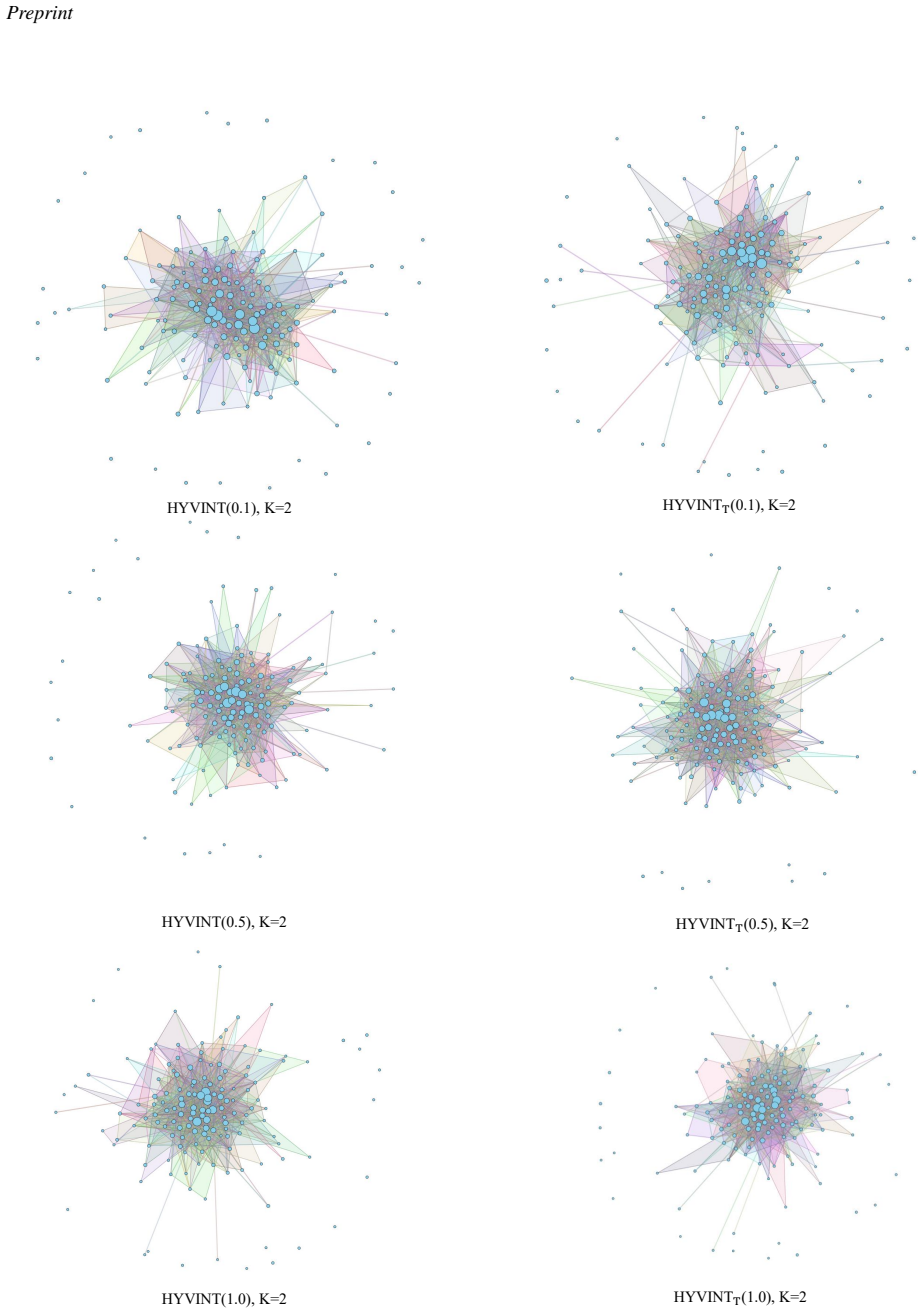


read the original abstract
Hypergraphs provide a principled framework for modeling polyadic interactions, with applications in recommendation systems, social networks, and molecular modeling. Hypergraph generation remains challenging because incidence structures are discrete, sparse, and governed by heterogeneous higher-order interactions. Existing generators often rely on implicit latent spaces or continuous incidence decoders, which provide limited mechanistic interpretation of how node-hyperedge incidences arise. To address these limitations, we propose HYVINT, an intensity-driven hypergraph generative framework. Our key innovations are twofold: (i) we develop an intensity-driven incidence formation mechanism for hypergraphs that links latent interaction strength to binary incidence, and (ii) we derive a tractable lower-bound variational estimator for learning latent representations. We provide generation error bounds with asymptotic convergence rates and empirically show that HYVINT achieves strong fidelity while maintaining substantial novelty and diversity on synthetic and real-world hypergraphs.
Editorial analysis
A structured set of objections, weighed in public.
Referee Report
Summary. The manuscript introduces HYVINT, a variational framework for generating hypergraphs. It proposes an intensity-driven incidence formation mechanism that links latent interaction strengths to binary node-hyperedge incidences, together with a tractable variational lower-bound estimator for learning the latent representations. The authors derive generation error bounds with asymptotic convergence rates and report empirical results showing strong fidelity alongside substantial novelty and diversity on both synthetic and real-world hypergraphs.
Significance. If the error bounds are shown to be tight and the empirical fidelity results are reproducible, the intensity-driven mechanism could supply a more mechanistically interpretable alternative to existing implicit latent-space or continuous-decoder approaches for modeling heterogeneous higher-order interactions. The combination of a discrete incidence model with variational inference and explicit asymptotic rates would be a constructive contribution to the hypergraph generation literature.
major comments (2)
- [§5] §5 (Generation error bounds): the central claim that the derived bounds with asymptotic convergence rates control the fidelity gap on finite heterogeneous hypergraphs holds only if the tractable variational lower bound remains sufficiently tight after the intensity function maps continuous latent strengths to sparse binary incidences. Any looseness introduced by the variational family or by the discretization step would invalidate both the convergence guarantee and the reported empirical fidelity; a finite-sample tightness argument or explicit bound on the discretization error is required to support this load-bearing step.
- [§3.2] §3.2 (Variational estimator): the assertion that the lower-bound estimator is tractable and yields consistent latent representations is presented without an explicit check that the incidence probabilities defined by the fitted intensity function do not reduce to quantities already determined by the latent parameters, which risks circularity in the convergence claims.
minor comments (2)
- [Abstract] Abstract: the claims of error bounds, asymptotic rates, and empirical fidelity are stated at a high level without even brief quantitative indicators or dataset names; adding one sentence with these details would improve readability.
- [Notation] Notation: the intensity function and the mapping to binary incidence should be defined with a single consistent symbol and equation number on first use, then referenced uniformly in later sections to avoid ambiguity.
Simulated Author's Rebuttal
We thank the referee for their detailed and insightful comments on our manuscript. We address each of the major comments below and have revised the paper accordingly to improve clarity and strengthen the theoretical guarantees.
read point-by-point responses
-
Referee: [§5] §5 (Generation error bounds): the central claim that the derived bounds with asymptotic convergence rates control the fidelity gap on finite heterogeneous hypergraphs holds only if the tractable variational lower bound remains sufficiently tight after the intensity function maps continuous latent strengths to sparse binary incidences. Any looseness introduced by the variational family or by the discretization step would invalidate both the convergence guarantee and the reported empirical fidelity; a finite-sample tightness argument or explicit bound on the discretization error is required to support this load-bearing step.
Authors: We agree with the referee that additional analysis on the finite-sample tightness is valuable. In the revised manuscript, we have expanded §5 to include a finite-sample tightness argument for the variational lower bound and an explicit upper bound on the discretization error arising from the intensity-driven mapping to binary incidences. Specifically, we show that the discretization error is bounded by O(1/sqrt(n)) under mild Lipschitz assumptions on the intensity function, which preserves the asymptotic convergence rates while controlling the fidelity gap for finite hypergraphs. revision: yes
-
Referee: [§3.2] §3.2 (Variational estimator): the assertion that the lower-bound estimator is tractable and yields consistent latent representations is presented without an explicit check that the incidence probabilities defined by the fitted intensity function do not reduce to quantities already determined by the latent parameters, which risks circularity in the convergence claims.
Authors: We thank the referee for pointing out this potential issue. The incidence probabilities are not circular because they are obtained by applying a parameterized intensity function to the latent representations, where the function is learned as part of the model and introduces additional degrees of freedom. The variational estimator remains tractable as it uses a mean-field approximation that factorizes over nodes and hyperedges. In the revised version, we have added an explicit statement and a short proof in §3.2 demonstrating that the incidence probabilities depend on both the latent parameters and the intensity parameters in a way that avoids degeneracy and ensures consistency of the learned representations. revision: yes
Circularity Check
No significant circularity; derivation remains self-contained
full rationale
The abstract outlines an intensity-driven incidence mechanism linking latent strengths to binary incidences and a derived tractable variational lower bound, plus generation error bounds with asymptotic rates. No equations or self-citations are provided that reduce the bounds or estimator to fitted parameters by construction, nor does any step rename a known result or import uniqueness via overlapping-author citations. The variational estimator and convergence claims are presented as derived outputs rather than tautological inputs, and the empirical fidelity results stand as separate validation. This is the normal case of a paper whose central claims have independent content from its modeling assumptions.
Axiom & Free-Parameter Ledger
invented entities (1)
-
intensity-driven incidence formation mechanism
no independent evidence
Lean theorems connected to this paper
-
IndisputableMonolith/Cost/FunctionalEquation.leanwashburn_uniqueness_aczel unclear?
unclearRelation between the paper passage and the cited Recognition theorem.
intensity-driven incidence formation mechanism ... λviej = αvi ρej θ⊤vi βej ... p(bviej=1|λviej)=1−exp(−λviej)
-
IndisputableMonolith/Foundation/RealityFromDistinction.leanreality_from_one_distinction unclear?
unclearRelation between the paper passage and the cited Recognition theorem.
generation error bounds with asymptotic convergence rates ... Δ(Θn,An)=Op(ϵ²m,n)
What do these tags mean?
- matches
- The paper's claim is directly supported by a theorem in the formal canon.
- supports
- The theorem supports part of the paper's argument, but the paper may add assumptions or extra steps.
- extends
- The paper goes beyond the formal theorem; the theorem is a base layer rather than the whole result.
- uses
- The paper appears to rely on the theorem as machinery.
- contradicts
- The paper's claim conflicts with a theorem or certificate in the canon.
- unclear
- Pith found a possible connection, but the passage is too broad, indirect, or ambiguous to say the theorem truly supports the claim.
Reference graph
Works this paper leans on
-
[1]
Dengyong Zhou, Jiayuan Huang, and Bernhard Sch¨olkopf. Learning with hypergraphs: Clustering, classification, and embedding.Advances in neural information processing systems, 19, 2006
work page 2006
-
[2]
Molecular hypergraph grammar with its application to molecular optimization
Hiroshi Kajino. Molecular hypergraph grammar with its application to molecular optimization. InInternational Conference on Machine Learning, pages 3183–3191. PMLR, 2019
work page 2019
-
[3]
Unai Alvarez-Rodriguez, Federico Battiston, Guilherme Ferraz de Arruda, Yamir Moreno, Matjaˇz Perc, and Vito Latora. Evolutionary dynamics of higher-order interactions in social networks.Nature Human Behaviour, 5(5): 586–595, 2021
work page 2021
-
[4]
Hypergraph contrastive col- laborative filtering
Lianghao Xia, Chao Huang, Yong Xu, Jiashu Zhao, Dawei Yin, and Jimmy Huang. Hypergraph contrastive col- laborative filtering. InProceedings of the 45th International ACM SIGIR conference on research and development in information retrieval, pages 70–79, 2022
work page 2022
-
[5]
Wei Li, Bin Xiang, Fan Yang, Yu Rong, Yanbin Yin, Jianhua Yao, and Han Zhang. scmhnn: a novel hypergraph neural network for integrative analysis of single-cell epigenomic, transcriptomic and proteomic data.Briefings in Bioinformatics, 24(6):bbad391, 2023
work page 2023
-
[6]
ChunYan Meng and Hooman Motevalli. Link prediction in social networks using hyper-motif representation on hypergraph.Multimedia Systems, 30(3):123, 2024
work page 2024
-
[7]
Meng Ma, Chao Deng, Yan Liu, Qingqing Cao, Fang Liu, and Yan Zhang. A hypergraph neural network for prioritizing alzheimer’s disease risk genes.Frontiers in Genetics, 16:1668200, 2025
work page 2025
-
[8]
A survey on hypergraph representation learning.ACM Computing Surveys, 56(1):1–38, 2023
Alessia Antelmi, Gennaro Cordasco, Mirko Polato, Vittorio Scarano, Carmine Spagnuolo, and Dingqi Yang. A survey on hypergraph representation learning.ACM Computing Surveys, 56(1):1–38, 2023
work page 2023
-
[9]
Hypergraph theory.An introduction
Alain Bretto. Hypergraph theory.An introduction. Mathematical Engineering. Cham: Springer, 1:209–216, 2013
work page 2013
-
[10]
Yuanzhao Zhang, Maxime Lucas, and Federico Battiston. Higher-order interactions shape collective dynamics differently in hypergraphs and simplicial complexes.Nature communications, 14(1):1605, 2023
work page 2023
-
[11]
Ioana Dumitriu, Hai-Xiao Wang, and Yizhe Zhu. Partial recovery and weak consistency in the non-uniform hypergraph stochastic block model.Combinatorics, Probability and Computing, 34(1):1–51, 2025
work page 2025
-
[12]
A survey on hypergraph neural networks: an in-depth and step-by-step guide
Sunwoo Kim, Soo Yong Lee, Yue Gao, Alessia Antelmi, Mirko Polato, and Kijung Shin. A survey on hypergraph neural networks: an in-depth and step-by-step guide. InProceedings of the 30th ACM SIGKDD Conference on Knowledge Discovery and Data Mining, pages 6534–6544, 2024
work page 2024
-
[13]
Geon Lee, Fanchen Bu, Tina Eliassi-Rad, and Kijung Shin. A survey on hypergraph mining: Patterns, tools, and generators.ACM Computing Surveys, 57(8):1–36, 2025
work page 2025
-
[14]
Junren Pan, Baiying Lei, Yanyan Shen, Yong Liu, Zhiguang Feng, and Shuqiang Wang. Characterization multimodal connectivity of brain network by hypergraph gan for alzheimer’s disease analysis. InChinese Conference on Pattern Recognition and Computer Vision (PRCV), pages 467–478. Springer, 2021
work page 2021
-
[15]
Qiankun Zuo, Baiying Lei, Yanyan Shen, Yong Liu, Zhiguang Feng, and Shuqiang Wang. Multimodal representa- tions learning and adversarial hypergraph fusion for early alzheimer’s disease prediction. InChinese Conference on Pattern Recognition and Computer Vision (PRCV), pages 479–490. Springer, 2021
work page 2021
-
[16]
Hypergraph structure learning for hypergraph neural networks
Derun Cai, Moxian Song, Chenxi Sun, Baofeng Zhang, Shenda Hong, and Hongyan Li. Hypergraph structure learning for hypergraph neural networks. InIJCAI, pages 1923–1929, 2022
work page 1923
-
[17]
Generating real-world hypergraphs via deep generative models.Information Sciences, 647:119412, 2023
Xianglin Zuo, Wenqi Chen, Xianduo Song, Xin Wang, and Ying Wang. Generating real-world hypergraphs via deep generative models.Information Sciences, 647:119412, 2023
work page 2023
-
[18]
Hyperplr: Hypergraph generation through projection, learning, and reconstruction
Weihuang Wen and Tianshu Yu. Hyperplr: Hypergraph generation through projection, learning, and reconstruction. InThe Thirteenth International Conference on Learning Representations, 2025
work page 2025
-
[19]
Hygene: A diffusion-based hypergraph generation method
Dorian Gailhard, Enzo Tartaglione, Lirida Naviner, and Jhony H Giraldo. Hygene: A diffusion-based hypergraph generation method. InProceedings of the AAAI Conference on Artificial Intelligence, volume 39, pages 16682– 16690, 2025. 13 Preprint
work page 2025
-
[20]
Denoising Diffused Embeddings: a Generative Approach for Hypergraphs
Shihao Wu, Junyi Yang, Gongjun Xu, and Ji Zhu. Denoising diffused embeddings: a generative approach for hypergraphs.arXiv preprint arXiv:2501.01541, 2025
work page internal anchor Pith review Pith/arXiv arXiv 2025
-
[21]
Zhixuan Chu, Yan Wang, Qing Cui, Longfei Li, Wenqing Chen, Zhan Qin, and Kui Ren. Llm-guided multi-view hypergraph learning for human-centric explainable recommendation.arXiv preprint arXiv:2401.08217, 2024
-
[22]
Modeling hypergraph using large language models.arXiv preprint arXiv:2510.11728, 2025
Bingqiao Gu, Jiale Zeng, Xingqin Qi, and Dong Li. Modeling hypergraph using large language models.arXiv preprint arXiv:2510.11728, 2025
-
[23]
Xiaojie Guo and Liang Zhao. A systematic survey on deep generative models for graph generation.IEEE Transactions on Pattern Analysis and Machine Intelligence, 45(5):5370–5390, 2022
work page 2022
-
[24]
Recent advances in hypergraph neural networks: M.-r
Mu-Rong Yang and Xin-Jian Xu. Recent advances in hypergraph neural networks: M.-r. yang, x.-j. xu.Journal of the Operations Research Society of China, pages 1–37, 2025
work page 2025
-
[25]
Shihao Wu, Gongjun Xu, and Ji Zhu. A general latent embedding approach for modeling non-uniform high- dimensional sparse hypergraphs with multiplicity.arXiv preprint arXiv:2410.12108, 2024
-
[26]
Evolution of real-world hypergraphs: Patterns and models without oracles
Yunbum Kook, Jihoon Ko, and Kijung Shin. Evolution of real-world hypergraphs: Patterns and models without oracles. In2020 IEEE International Conference on Data Mining (ICDM), pages 272–281. IEEE, 2020
work page 2020
-
[27]
Yiran Li, Gongyao Guo, Chen Feng, and Jieming Shi. Effective and efficient attributed hypergraph embedding on nodes and hyperedges.arXiv preprint arXiv:2508.08807, 2025
-
[28]
Implicit hypergraph neural network.arXiv preprint arXiv:2508.14101, 2025
Akash Choudhuri, Yongjian Zhong, and Bijaya Adhikari. Implicit hypergraph neural network.arXiv preprint arXiv:2508.14101, 2025
-
[29]
Deep unsupervised learning using nonequilibrium thermodynamics
Jascha Sohl-Dickstein, Eric Weiss, Niru Maheswaranathan, and Surya Ganguli. Deep unsupervised learning using nonequilibrium thermodynamics. InInternational conference on machine learning, pages 2256–2265. pmlr, 2015
work page 2015
-
[30]
Jonathan Ho, Ajay Jain, and Pieter Abbeel. Denoising diffusion probabilistic models.Advances in neural information processing systems, 33:6840–6851, 2020
work page 2020
-
[31]
Improved denoising diffusion probabilistic models
Alexander Quinn Nichol and Prafulla Dhariwal. Improved denoising diffusion probabilistic models. InInterna- tional conference on machine learning, pages 8162–8171. PMLR, 2021
work page 2021
-
[32]
Denoising Diffusion Implicit Models
Jiaming Song, Chenlin Meng, and Stefano Ermon. Denoising diffusion implicit models.arXiv preprint arXiv:2010.02502, 2020
work page internal anchor Pith review Pith/arXiv arXiv 2010
-
[33]
Tero Karras, Miika Aittala, Timo Aila, and Samuli Laine. Elucidating the design space of diffusion-based generative models.Advances in neural information processing systems, 35:26565–26577, 2022
work page 2022
-
[34]
Feiyan Ma, Shihao Wu, Gongjun Xu, and Ji Zhu. Relash: Reconstructing joint latent spaces for efficient generation of synthetic hypergraphs with hyperlink attributes. InThe Fourteenth International Conference on Learning Representations, 2026
work page 2026
-
[35]
Convergence of score-based generative modeling for general data distributions
Holden Lee, Jianfeng Lu, and Yixin Tan. Convergence of score-based generative modeling for general data distributions. InInternational Conference on Algorithmic Learning Theory, pages 946–985. PMLR, 2023
work page 2023
-
[36]
Towards faster non-asymptotic convergence for diffusion-based generative models
Gen Li, Yuting Wei, Yuxin Chen, and Yuejie Chi. Towards faster non-asymptotic convergence for diffusion-based generative models.arXiv preprint arXiv:2306.09251, 2023
-
[37]
arXiv preprint arXiv:2308.03686 , year =
Joe Benton, Valentin De Bortoli, Arnaud Doucet, and George Deligiannidis. Nearly d-linear convergence bounds for diffusion models via stochastic localization.arXiv preprint arXiv:2308.03686, 2023
-
[38]
Yumiharu Nakano. Convergence of the denoising diffusion probabilistic models for general noise schedules.arXiv preprint arXiv:2406.01320, 2024
-
[39]
Francesco Pedrotti, Jan Maas, and Marco Mondelli. Improved convergence of score-based diffusion models via prediction-correction.arXiv preprint arXiv:2305.14164, 2023
-
[40]
Fengshuo Zhang and Chao Gao. Convergence rates of variational posterior distributions.The Annals of Statistics, 48(4):2180–2207, 2020
work page 2020
-
[41]
Ze Wang, Jiang Wang, Zicheng Liu, and Qiang Qiu. Binary latent diffusion. InProceedings of the IEEE/CVF conference on computer vision and pattern recognition, pages 22576–22585, 2023. 14 Preprint
work page 2023
-
[42]
Yi-Ting Guo, Qin-Qin Li, and Chun-Sheng Liang. The rise of nonnegative matrix factorization: Algorithms and applications.Information Systems, 123:102379, 2024
work page 2024
-
[43]
Austin R Benson, Rediet Abebe, Michael T Schaub, Ali Jadbabaie, and Jon Kleinberg. Simplicial closure and higher-order link prediction.Proceedings of the National Academy of Sciences, 115(48):E11221–E11230, 2018
work page 2018
-
[44]
Jacob Austin, Daniel D Johnson, Jonathan Ho, Daniel Tarlow, and Rianne Van Den Berg. Structured denoising diffusion models in discrete state-spaces.Advances in neural information processing systems, 34:17981–17993, 2021
work page 2021
-
[45]
Emiel Hoogeboom, Didrik Nielsen, Priyank Jaini, Patrick Forr´e, and Max Welling. Argmax flows and multinomial diffusion: Learning categorical distributions.Advances in neural information processing systems, 34:12454–12465, 2021
work page 2021
-
[46]
Daniel Lee and H Sebastian Seung. Algorithms for non-negative matrix factorization.Advances in neural information processing systems, 13, 2000
work page 2000
-
[47]
Hyunsoo Kim and Haesun Park. Nonnegative matrix factorization based on alternating nonnegativity constrained least squares and active set method.SIAM journal on matrix analysis and applications, 30(2):713–730, 2008
work page 2008
-
[48]
Momentum contrast for unsupervised visual representation learning
Kaiming He, Haoqi Fan, Yuxin Wu, Saining Xie, and Ross Girshick. Momentum contrast for unsupervised visual representation learning. InProceedings of the IEEE/CVF conference on computer vision and pattern recognition, pages 9729–9738, 2020
work page 2020
-
[49]
Lanling Xu, Jianxun Lian, Wayne Xin Zhao, Ming Gong, Linjun Shou, Daxin Jiang, Xing Xie, and Ji-Rong Wen. Negative sampling for contrastive representation learning: A review.arXiv preprint arXiv:2206.00212, 2022
-
[50]
Ankit Singh Rawat, Jiecao Chen, Felix Xinnan X Yu, Ananda Theertha Suresh, and Sanjiv Kumar. Sampled softmax with random fourier features.Advances in Neural Information Processing Systems, 32, 2019. 15 Preprint Appendix A Synthetic Data Generation Details We provide a full description of the synthetic hypergraph generation procedure used throughout our si...
-
[51]
log ( dPRm dP bRm (Rm) )# +E PRm
The lower bound forT viej is given by: Tviej ≥ −E q[λviej] + log exp exp(Sviej) −1 ,(63) whereS viej =E q logλ viej . 45 Preprint Proof.Since 1−e −λvi ej =P(x viej ≥1|λ viej) = ∞X xvi ej =1 λ xvi ej viej e−λvi ej xviej! = ∞X xvi ej =1 Pois(xviej |λviej),(64) we rewriteT viej as follows: Tviej =E q log ∞X xvi ej =1 Pois(xviej |λviej) .(65) We first ...
-
[52]
Applying the Bernoulli KL upper bound, dKL Bern(p∗ ij)∥Bern(bpij) ≤ (p∗ ij −bpij)2 bpij(1−bpij) ≤ 4 (p∗ ij −bpij)2 c1¯λm,n ≤ 4|λ ∗ ij −bλij|2 c1¯λm,n ,(122) where the second inequality usesbpij(1−bpij)≥ c1 4 ¯λm,n, and the third inequality applies the mean value theorem as |p∗ ij −bpij|=e −ξij |λ∗ ij −bλij| ≤ |λ ∗ ij −bλij| (since e−ξij ≤1 ). Summing Eq. ...
-
[53]
(131) viaP (nm) ϑ =P (nm) Φ(ϑ)
= exp −Ctϵ2/¯λm,n ,(135) giving Eq. (131) viaP (nm) ϑ =P (nm) Φ(ϑ) . 53 Preprint Proposition L.10(Sieve Mass).LetD m,n := (K+ 1)(m+n). For a constantB >0, define the sieve Hm,n(ϵ) := ϑ∈ H m,n :e −Bϵ2/¯λm,n ≤z ℓ ≤e Bϵ2/¯λm,n ,∀ℓ .(136) There existA, B, C s >0such that, wheneverϵ 2 ≥AK(m∨n) ¯λm,nLm,n, Πfac Hm,n(ϵ)c ≤exp −Cs ϵ2/¯λm,n .(137) Proof.SetT ϵ :=Bϵ...
discussion (0)
Sign in with ORCID, Apple, or X to comment. Anyone can read and Pith papers without signing in.