REVIEW 4 major objections 6 minor 41 references
CALM: Contextual Analog Logic with Multimodality
T0 review · 4 major / 6 minor · reviewed 2026-08-07 · deepseek-v4-flash
Pith's one-line read Graded logic grounded in images beats pure logic and LLM baselines
desk verdict CALM's domain-tree truth-factor mechanism is genuinely new and the experiments are promising, but the renormalization used in maximization and sampling contradicts the paper's own truth-evaluation semantics — a core bug that needs fixing before the algorithms can be trusted. read the letter →
The pith
A machine-rendered reading of the paper's core claim, the machinery that carries it, and where it could break.
The reading
What carries the argument
The load-bearing object is the domain tree: each unknown attribute of a variable entity is a hierarchy of nested subdomains, and a predicate's truth factor at each node is a number in $[0,1]$ computed by a neural network from the current subdomain plus multimodal context. Truth along a refinement path is the product of truth factors, mirroring the chain rule for joint probabilities; a hard component can force a factor to zero so that impossible placements score exactly 0. Inference procedures—truth evaluation, greedy-then-pruned truth maximization, and truth-proportional sampling with blocking and renormalization—traverse these trees, while training uses cross-entropy to make the neural components put high truth on the subdomains containing the ground-truth placements.
What would settle it
Construct a predicate whose true graded truth is a non-factorizable function of two attributes, for example a target region shaped like a checkerboard or diagonal band, train CALM's neural components, and compare product-of-factors truth with brute-force truth at every grounding; if the product systematically misses the joint pattern (e.g., high truth only when both attributes are aligned), the chain-rule product assumption is refuted.
Extended reading notes
Core claim
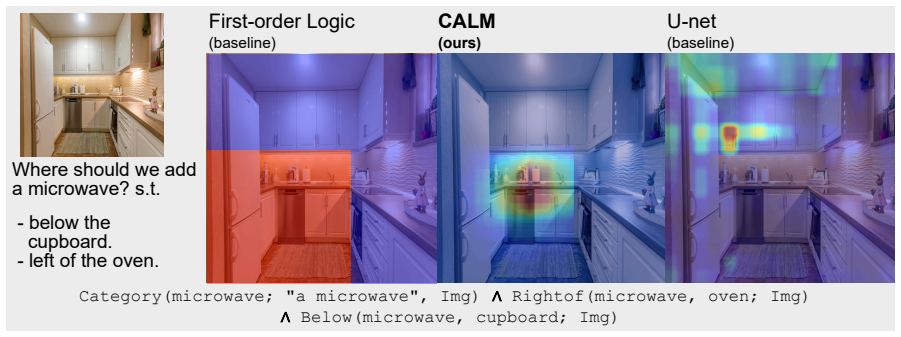
CALM's central claim is that symbolic predicates can be evaluated as products of context-dependent truth factors along a domain tree: at each refinement step a neural component distributes truth over subdomains, a hard component zeroes any branch that violates a clear constraint, and the predicate's analog truth is the product of chosen factors from root to leaf. Because every predicate is grounded in image and text features, the same predicate can mean different things in different scenes—'below' a cupboard points to the countertop, while for a dog it points to the floor. This makes logic composable (conjunction, disjunction, negation, thresholded quantifiers) while remaining sensitive to perceptual context, and it supports three inferences: scoring a given placement, finding the placement that maximizes truth, and sampling placements with probability proportional to truth.
Load-bearing premise
A predicate's truth value is assumed to equal the product of independently generated truth factors along the paths of a domain tree; if choices at different tree levels (or across attributes) are not conditionally independent, the product no longer represents the intended graded truth and the evaluation would be invalid.
Editorial extensions
If this is right
- CALM's graded truth values let a single logic statement express both hard spatial constraints and soft contextual preferences, so 'below the cupboard' rules out the floor without excluding it as a hard zero.
- Truth-proportional sampling turns the same logic into a generative prior: feeding sampled bounding boxes to a diffusion model yields diverse yet constraint-respecting object insertions.
- The 92.2% fill-in-the-blank accuracy at 50% spatial logic suggests the framework extracts more from partial constraints than either pure symbolic search or a vision-language model.
- Since predicates are composable, heatmaps for conjunctions and disjunctions can be built from simple predicate truthscapes, preserving interpretability as formulas grow.
- CALM's separation of logical structure from perceptual grounding lets it serve as a reasoning backbone for downstream generators without sacrificing logical guarantees.
Reading between the lines
- If the product-of-truth-factors form is taken literally, the framework presupposes that subdomain decisions are conditionally independent along each attribute's tree; a natural test is comparing product-based truth with a directly learned graded-truth function on predicates where truth depends on joint attribute combinations.
- The same domain-tree machinery could grade constraints in other modalities, for example scoring robot trajectories for safety or naturalness rather than only spatial bounding boxes.
- A cleaner falsification target: collect human graded-truth judgments over a dense grid of placements for a fixed logic statement, then check whether CALM's heatmap converges to those judgments as the neural components get more data.
- The approximate sampler for compound statements is an admitted weakness; an exact sampler for arbitrary connectives would make truth-proportional sampling a fully principled probability model rather than a proposal-then-resample heuristic.
Editorial analysis
A structured set of objections, weighed in public.
Referee Report
Summary. The paper introduces CALM, a neuro-symbolic framework in which predicates take analog truth values computed as products of neural truth factors along a domain tree, with hard constraints able to force a zero truth value. The framework defines three inference procedures: truth evaluation, truth maximization, and truth-proportional sampling. The authors train predicate networks with CLIP-based multimodal context and evaluate CALM on a fill-in-the-blank object placement task (reporting 92.2% object accuracy at 50% spatial-logic completeness), a human study comparing CALM heatmaps with a U-net baseline (reporting p<0.0001 on a text-alignment rating), and a qualitative inpainting demonstration using Stable Diffusion. The central claim is that CALM combines logical structure, analog truth, and multimodal grounding better than purely neural or purely bivalent-logic baselines.
Significance. If the formal inference procedures were made consistent with the stated semantics, the paper would make a useful contribution to neuro-symbolic reasoning: it proposes a concrete, learnable representation of analog predicates (domain trees with neural truth factors), explicitly defines three inference tasks, and evaluates them against sensible baselines including classical logic and a vision-language model. The idea of composing neural truth factors through logical connectives while retaining hard constraints is attractive, and the empirical setup, while limited, is clearly described. The paper also honestly acknowledges that exact truth-proportional sampling for compound statements remains open. However, the formal inconsistency between truth evaluation and the blocking/renormalization used in maximization and sampling is a substantive correctness gap, and the headline empirical claims currently lack error bars and proper repeated-measures analysis. With revisions that resolve these points, the paper could meet the standard for publication; as it stands, the central inference guarantees are not supported.
major comments (4)
- [§3.2.1, §3.2.2, §3.2.3] The renormalization of truth factors after hard-component blocking is inconsistent with the truth-evaluation semantics defined in §3.2.1. In §3.2.1 a predicate's truth is the product of the truth factors along the path actually traversed, with a hard-blocked subdomain evaluating to 0. In §3.2.3, when a child is blocked, the remaining children's truth factors are renormalized to sum to 1 and sampling proceeds with those renormalized factors. Concretely, consider a depth-2 tree with root factors (0.5, 0.5), children under L given by (0.9, 0.1), children under R given by (0.9, 0.1), and L1 hard-blocked. The §3.2.1 truth values of the surviving groundings are L2 = 0.05, R1 = 0.45, R2 = 0.05, so exact truth-proportional sampling should assign probabilities (0.0909, 0.8182, 0.0909). The §3.2.3 procedure instead assigns probabilities (0.5, 0.45, 0.05). Thus the claimed 'efficient exact sampling' for a single predicate does not sample proportionally to the truth values the paper defines, and the inpainting demonstration in §4.3 inherits this issue.
- [§3.2.2] The pruning bound used in truth maximization is invalid once renormalization is applied. The paper states that 'the product of truth factors monotonically decreases with deeper refinements' and uses this to prune branches whose truth-so-far is below the current best. But after blocking renormalizes a child factor from q_j to q_j / sum, the truth-so-far can increase along a path; in the same depth-2 example, the L2 branch has truth-so-far 0.5 after renormalization, whereas its §3.2.1 truth value is 0.05. Consequently, the DFS with pruning can discard a branch whose §3.2.1 truth value is the true maximum, and the algorithm is not guaranteed to return the maximizing grounding under the semantics defined in §3.2.1.
- [§4.1.2, §4.1.1] The 92.2% headline fill-in-the-blank figure is reported without error bars, confidence intervals, or variance across random subsets of the 50% condition, and the evaluation is simplified in two ways that can inflate accuracy: candidate locations are exactly the original ground-truth bounding boxes, so the task is assignment among known boxes rather than open-ended localization, and the 50% condition draws a random subset of pairwise relations with no analysis of the resulting variability. As reported, the results support a qualitative ordering (CALM > FOL > LLM at 50%) but not the precise margin of 92.2% versus 86.3%.
- [§4.2.2] The human-study significance test treats each pairwise rating as an independent observation (mean 3.76, sd 1.38, t = 8.34, p < 0.0001). Ratings from the same participant across the same 10 backgrounds are correlated, so a repeated-measures or mixed-effects analysis is needed before claiming p < 0.0001. Given that only 10 unique backgrounds were used, the conclusion that CALM's heatmaps are significantly more aligned with the provided logic is stronger than the current analysis supports.
minor comments (6)
- [§4.1.1] The setup says the agent 'evaluated all injective mappings from objects to blank regions' rather than using the greedy/exhaustive truth maximization described in §3.2.2; please clarify which inference procedure actually produced the headline fill-in-the-blank results.
- [Figure 8] The axes of Figure 8 are not labeled, and no confidence intervals or error bars are shown; adding these would make the comparison across logic-completeness levels easier to interpret.
- [§3.2.2 worked example] The arithmetic in the worked example is internally inconsistent: after normalizing leaf2's rightof factor to 1.0, the rightof truth-so-far should be 0.9 (0.9 × 1.0), not 0.18, and the category value 0.12 (0.3 × 0.4) does not follow from the stated factor values 0.6 and 0.5.
- [§4.1.1, references] The text refers to the LLM baseline as GPT-4o, but reference [20] is titled 'GPT-4o mini'; please align the terminology and citation.
- [§4.2.1] The demographics report 24 participants but state that one was removed, leaving 23; the counts (18 phone + 5 laptop + 1 desktop = 24, and 8 normal + 16 corrected = 24) apparently include the removed participant, so the description should be clarified.
- [§3.2.3] The statement that blocking and renormalization 'follows the principle established by SampleSearch' is not supported by the cited mechanism: SampleSearch uses weighted importance sampling with a global correction for determinism, not purely local renormalization of truth factors.
Circularity Check
No significant circularity: CALM's central results rest on held-out COCO evaluation and human ratings; the only self-citation (SPRING) is inspirational, not load-bearing.
full rationale
CALM defines predicate truth as the product of neural truth factors along domain-tree paths (§3.2.1); this is a formal definition, not a derivation of a result from an input that already contains it. The neural components are trained on COCO ground-truth decisions and then used in fill-in-the-blank placement, where accuracy is measured against annotated object locations; the 92.2% figure is an empirical, held-out-style evaluation, not an algebraic consequence of the definition. The human heatmap study likewise provides external ratings (p < 0.0001), so the central claims are independently testable. The only author self-citation is to SPRING [10], credited as inspiration for the inpainting demonstration; it is not load-bearing for the main results and does not smuggle in an unverified premise. The renormalization of truth factors after hard-component blocking (§§3.2.2–3.2.3) may make truth maximization/sampling inconsistent with the §3.2.1 truth-product semantics in some blocking cases, but that is an internal-correctness issue, not circularity: no claimed output is equivalent to its input by construction. The paper also explicitly states that exact truth-proportional sampling for compound statements is an open limitation. Accordingly, no circular step is exhibited; score 2 reflects only the minor, non-load-bearing self-citation.
Assumptions & free parameters
free parameters (3)
- Domain tree branching factor k =
2
- Hard component threshold for Leftof =
centerx < left_edge (x - width/2)
- Neural network hyperparameters (batch size, learning rate, epochs) =
batch 128, lr 2e-4, epochs 200
assumptions (4)
- domain assumption The truth value of a predicate is the product of truth factors along the refinement path (chain rule).
- domain assumption CLIP embeddings capture sufficient multimodal context for predicate evaluation.
- domain assumption Ground-truth bounding boxes in COCO define correct object placements.
- domain assumption The softmax outputs of the predicate networks can be meaningfully multiplied to represent truth values.
invented entities (2)
-
Domain tree
-
Truth factor
Cite this review
Pith. "Pith review of CALM: Contextual Analog Logic with Multimodality." pith.science (2026). https://pith.science/paper/NDUGCYYF
@misc{pith2026250614936,
  author       = {Pith},
  title        = {Pith review of: CALM: Contextual Analog Logic with Multimodality},
  year         = {2026},
  howpublished = {\url{https://pith.science/paper/NDUGCYYF}},
  note         = {Machine review of arXiv:2506.14936}
}
read the original abstract
In this work, we introduce Contextual Analog Logic with Multimodality (CALM). CALM unites symbolic reasoning with neural generation, enabling systems to make context-sensitive decisions grounded in real-world multi-modal data. Background: Classic bivalent logic systems cannot capture the nuance of human decision-making. They also require human grounding in multi-modal environments, which can be ad-hoc, rigid, and brittle. Neural networks are good at extracting rich contextual information from multi-modal data, but lack interpretable structures for reasoning. Objectives: CALM aims to bridge the gap between logic and neural perception, creating an analog logic that can reason over multi-modal inputs. Without this integration, AI systems remain either brittle or unstructured, unable to generalize robustly to real-world tasks. In CALM, symbolic predicates evaluate to analog truth values computed by neural networks and constrained search. Methods: CALM represents each predicate using a domain tree, which iteratively refines its analog truth value when the contextual groundings of its entities are determined. The iterative refinement is predicted by neural networks capable of capturing multi-modal information and is filtered through a symbolic reasoning module to ensure constraint satisfaction. Results: In fill-in-the-blank object placement tasks, CALM achieved 92.2% accuracy, outperforming classical logic (86.3%) and LLM (59.4%) baselines. It also demonstrated spatial heatmap generation aligned with logical constraints and delicate human preferences, as shown by a human study. Conclusions: CALM demonstrates the potential to reason with logic structure while aligning with preferences in multi-modal environments. It lays the foundation for next-gen AI systems that require the precision and interpretation of logic and the multimodal information processing of neural networks.
Figures


Figures from the paper (5 more)


Reference graph
Works this paper leans on
-
[1]
R. E. Bellman and L. A. Zadeh. Decision-making in a fuzzy environment.Management Science, 17(4):B–141–B–164, 1970
work page 1970
-
[2]
Christian Bessiere, Remi Coletta, Eugene C. Freuder, and Barry O’Sullivan. Leveraging the learning power of examples in automated constraint acquisition. In Mark Wallace, editor,Principles and Prac- tice of Constraint Programming – CP 2004, pages 123–137, Berlin, Heidelberg, 2004. Springer Berlin Heidelberg
work page 2004
-
[3]
Programming with a differentiable forth interpreter
Matko Bo ˇsnjak, Tim Rockt ¨aschel, Jason Naradowsky, and Sebastian Riedel. Programming with a differentiable forth interpreter. In Doina Precup and Yee Whye Teh, editors,Proceedings of the 34th International Conference on Machine Learning, volume 70 ofProceedings of Machine Learning Re- search, pages 547–556. PMLR, 06–11 Aug 2017
work page 2017
-
[4]
End-to-end object detection with transformers.CoRR, abs/2005.12872, 2020
Nicolas Carion, Francisco Massa, Gabriel Synnaeve, Nicolas Usunier, Alexander Kirillov, and Sergey Zagoruyko. End-to-end object detection with transformers.CoRR, abs/2005.12872, 2020
arXiv 2005
-
[5]
An image is worth 16x16 words: Transformers for image recognition at scale
Alexey Dosovitskiy, Lucas Beyer, Alexander Kolesnikov, Dirk Weissenborn, Xiaohua Zhai, Thomas Unterthiner, Mostafa Dehghani, Matthias Minderer, Georg Heigold, Sylvain Gelly, Jakob Uszkoreit, and Neil Houlsby. An image is worth 16x16 words: Transformers for image recognition at scale. In International Conference on Learning Representations, 2021
2021
-
[6]
Neocognitron: A self-organizing neural network model for a mechanism of pattern recognition unaffected by shift in position.Biological cybernetics, 36(4):193–202, 1980
Kunihiko Fukushima. Neocognitron: A self-organizing neural network model for a mechanism of pattern recognition unaffected by shift in position.Biological cybernetics, 36(4):193–202, 1980
1980
-
[7]
Samplesearch: Importance sampling in presence of determinism
Vibhav Gogate and Rina Dechter. Samplesearch: Importance sampling in presence of determinism. Artificial Intelligence, 175(2):694–729, 2011
work page 2011
-
[8]
Deep residual learning for image recog- nition
Kaiming He, Xiangyu Zhang, Shaoqing Ren, and Jian Sun. Deep residual learning for image recog- nition. InProceedings of the IEEE Conference on Computer Vision and Pattern Recognition (CVPR), pages 770–778, 2016. 24
work page 2016
Show all 41 references
-
[9]
Openclip, July 2021
Gabriel Ilharco, Mitchell Wortsman, Ross Wightman, Cade Gordon, Nicholas Carlini, Rohan Taori, Achal Dave, Vaishaal Shankar, Hongseok Namkoong, John Miller, Hannaneh Hajishirzi, Ali Farhadi, and Ludwig Schmidt. Openclip, July 2021. If you use this software, please cite it as below
2021
-
[10]
Jacobson and Yexiang Xue
Maxwell J. Jacobson and Yexiang Xue. Integrating symbolic reasoning into neural generative models for design generation.Artificial Intelligence (AIJ), 2025. To appear
2025
-
[11]
Anfis: Adaptive-network-based fuzzy inference system.IEEE Transactions on Systems, Man, and Cybernetics, 23(3):665–685, 1993
Jyh-Shing Roger Jang. Anfis: Adaptive-network-based fuzzy inference system.IEEE Transactions on Systems, Man, and Cybernetics, 23(3):665–685, 1993
1993
-
[12]
YOLOv5 by Ultralytics, 5 2020
Glenn Jocher. YOLOv5 by Ultralytics, 5 2020
2020
-
[13]
Kingma and Jimmy Ba
Diederik P. Kingma and Jimmy Ba. Adam: A method for stochastic optimization. In3rd International Conference on Learning Representations (ICLR), 2015
2015
-
[14]
Berg, Wan-Yen Lo, Piotr Doll´ar, and Ross Girshick
Alexander Kirillov, Eric Mintun, Nikhila Ravi, Hanzi Mao, Chloe Rolland, Laura Gustafson, Tete Xiao, Spencer Whitehead, Alexander C. Berg, Wan-Yen Lo, Piotr Doll´ar, and Ross Girshick. Segment anything.arXiv:2304.02643, 2023
2023 arXiv
-
[15]
Handwritten digit recognition with a back-propagation network
Yann LeCun, Bernhard Boser, John S Denker, Donnie Henderson, Richard E Howard, Wayne Hubbard, and Lawrence D Jackel. Handwritten digit recognition with a back-propagation network. InAdvances in neural information processing systems, pages 396–404, 1990
1990
-
[16]
Microsoft coco: Common objects in context
Tsung-Yi Lin, Michael Maire, Serge Belongie, James Hays, Pietro Perona, Deva Ramanan, Piotr Doll´ar, and C Lawrence Zitnick. Microsoft coco: Common objects in context. InEuropean con- ference on computer vision, pages 740–755. Springer, 2014
2014
-
[17]
Mamdani and S
E.H. Mamdani and S. Assilian. An experiment in linguistic synthesis with a fuzzy logic controller. International Journal of Man-Machine Studies, 7(1):1–13, 1975
1975
-
[18]
Neural probabilistic logic programming in deepproblog.Artificial Intelligence, 298:103504, 2021
Robin Manhaeve, Sebastijan Duman ˇci´c, Angelika Kimmig, Thomas Demeester, and Luc De Raedt. Neural probabilistic logic programming in deepproblog.Artificial Intelligence, 298:103504, 2021
2021
-
[19]
LINC: A neurosymbolic approach for logical reasoning by combining language mod- els with first-order logic provers
Theo Olausson, Alex Gu, Ben Lipkin, Cedegao Zhang, Armando Solar-Lezama, Joshua Tenenbaum, and Roger Levy. LINC: A neurosymbolic approach for logical reasoning by combining language mod- els with first-order logic provers. In Houda Bouamor, Juan Pino, and Kalika Bali, editors,...
2023
-
[20]
Gpt-4o mini.https://openai.com/index/ gpt-4o-mini-advancing-cost-efficient-intelligence/, 2024
OpenAI. Gpt-4o mini.https://openai.com/index/ gpt-4o-mini-advancing-cost-efficient-intelligence/, 2024. Accessed: 2025-05-30
2024
-
[21]
A survey on industrial applications of fuzzy control.Com- puters in Industry, 62(3):213–226, 2011
Radu-Emil Precup and Hans Hellendoorn. A survey on industrial applications of fuzzy control.Com- puters in Industry, 62(3):213–226, 2011
2011
-
[22]
S. D. Prestwich, E. C. Freuder, B. O’Sullivan, and D. Browne. Classifier-based constraint acquisition. Annals of Mathematics and Artificial Intelligence, 89(7):655–674, 2021
2021
-
[23]
Learning transferable visual models from natural language supervision
Alec Radford, Jong Wook Kim, Chris Hallacy, Aditya Ramesh, Gabriel Goh, Sandhini Agarwal, Girish Sastry, Amanda Askell, Pam Mishkin, Jack Clark, Gretchen Krueger, and Ilya Sutskever. Learning transferable visual models from natural language supervision. InInternational confere...
2021
-
[24]
Markov logic networks.Machine learning, 62:107–136, 2006
Matthew Richardson and Pedro Domingos. Markov logic networks.Machine learning, 62:107–136, 2006
2006
-
[25]
High- resolution image synthesis with latent diffusion models, 2021
Robin Rombach, Andreas Blattmann, Dominik Lorenz, Patrick Esser, and Bj ¨orn Ommer. High- resolution image synthesis with latent diffusion models, 2021
2021
-
[26]
U-net: Convolutional networks for biomedical image segmentation
Olaf Ronneberger, Philipp Fischer, and Thomas Brox. U-net: Convolutional networks for biomedical image segmentation. InMedical Image Computing and Computer-Assisted Intervention – MICCAI 2015, pages 234–241. Springer International Publishing, 2015
2015
-
[27]
Scalable neural- probabilistic answer set programming.Journal of Artificial Intelligence Research, 78:579–617, 2023
Arseny Skryagin, Daniel Ochs, Devendra Singh Dhami, and Kristian Kersting. Scalable neural- probabilistic answer set programming.Journal of Artificial Intelligence Research, 78:579–617, 2023
2023
-
[28]
Fuzzy identification of systems and its applications to modeling and control.IEEE Transactions on Systems, Man, and Cybernetics, SMC-15(1):116–132, 1985
Tomohiro Takagi and Michio Sugeno. Fuzzy identification of systems and its applications to modeling and control.IEEE Transactions on Systems, Man, and Cybernetics, SMC-15(1):116–132, 1985
1985
-
[29]
Deep neuro-fuzzy system application trends, challenges, and future perspectives: A systematic survey.Artificial Intelligence Review, 56(2):865–913, 2023
Noureen Talpur, Said Jadid Abdulkadir, Hitham Alhussian, Mohd Hilmi Hasan, Norshakirah Aziz, and Alwi Bamhdi. Deep neuro-fuzzy system application trends, challenges, and future perspectives: A systematic survey.Artificial Intelligence Review, 56(2):865–913, 2023
2023
-
[30]
An image inpainting technique based on the fast marching method.Journal of graphics tools, 9(1):23–34, 2004
Alexandru Telea. An image inpainting technique based on the fast marching method.Journal of graphics tools, 9(1):23–34, 2004
2004
-
[31]
Attention is all you need
Ashish Vaswani, Noam Shazeer, Niki Parmar, Jakob Uszkoreit, Llion Jones, Aidan N Gomez, Łukasz Kaiser, and Illia Polosukhin. Attention is all you need. InAdvances in neural information processing systems, volume 30, 2017
2017
-
[32]
Chain-of-thought prompting elicits reasoning in large language models, 2023
Jason Wei, Xuezhi Wang, Dale Schuurmans, Maarten Bosma, Brian Ichter, Fei Xia, Ed Chi, Quoc Le, and Denny Zhou. Chain-of-thought prompting elicits reasoning in large language models, 2023
2023
-
[33]
L.A. Zadeh. Fuzzy sets.Information and Control, 8(3):338–353, 1965
1965
-
[34]
Lotfi A. Zadeh. Calculus of fuzzy restrictions. In Lotfi A. Zadeh, King-Sun Fu, Kenshi Tanaka, and Masami Shimura, editors,Fuzzy Sets and their Applications to Cognitive and Decision Processes, pages 1–39. Academic Press, New York, 1975
1975
-
[35]
Lotfi A. Zadeh. The concept of a linguistic variable and its application to approximate reasoning—i. Information Sciences, 8(3):199–249, 1975
1975
-
[36]
Lotfi A. Zadeh. The concept of a linguistic variable and its application to approximate reasoning—ii. Information Sciences, 8(4):301–357, 1975
1975
-
[37]
Lotfi A. Zadeh. The concept of a linguistic variable and its application to approximate reasoning—iii. Information Sciences, 9(1):43–80, 1975
1975
-
[38]
Lotfi A. Zadeh. Fuzzy logic. In T.-Y . Lin, W. Pedrycz, and A. Bargiela, editors,Granular, Fuzzy, and Soft Computing, pages 19–49. Springer-Verlag, 2009. Originally published in Meyers, R. A. (Ed.), Encyclopedia of Complexity and Systems Science
2009
-
[39]
Adding conditional control to text-to-image diffu- sion models, 2023
Lvmin Zhang, Anyi Rao, and Maneesh Agrawala. Adding conditional control to text-to-image diffu- sion models, 2023
2023
-
[40]
Deviation-sparse fuzzy c-means with neighbor information constraint.IEEE Transactions on Fuzzy Systems, 27(1):185–199, 2019
Yuxuan Zhang, Xiangzhi Bai, Ruirui Fan, and Zihan Wang. Deviation-sparse fuzzy c-means with neighbor information constraint.IEEE Transactions on Fuzzy Systems, 27(1):185–199, 2019. 26
2019
-
[41]
Deep tsk fuzzy classifier with stacked generalization and triplely concise interpretability guarantee for large data.IEEE Transactions on Fuzzy Systems, 25(5):1207–1221, 2017
Ta Zhou, Fu-Lai Chung, and Shitong Wang. Deep tsk fuzzy classifier with stacked generalization and triplely concise interpretability guarantee for large data.IEEE Transactions on Fuzzy Systems, 25(5):1207–1221, 2017. 27
2017
Reviewed August 7, 2026 · model on record in the stance chip above.
Discussion (0). Sign in to comment.