Attractive and repulsive Yang-Mills--Higgs magnetic monopoles on mathbb{R}³
Pith reviewed 2026-05-20 04:32 UTC · model grok-4.3
The pith
A new SO(3)-gauged Higgs model on R^3 admits magnetic monopoles in both attractive and repulsive phases.
A machine-rendered reading of the paper's core claim, the machinery that carries it, and where it could break.
Core claim
The model supports static finite-energy SO(3) magnetic monopoles whose total energy is stabilized by the Higgs analogue of the Chern-Pontryagin charge rather than by the conventional Higgs-Chern-Pontryagin charge; depending on the choice of parameters these monopoles realize either an attractive or a repulsive regime.
What carries the argument
The Higgs analogue of the Chern-Pontryagin charge, which supplies the topological lower bound that stabilizes the energy of the monopole configurations.
If this is right
- Monopoles in the attractive phase can form bound states with lower total energy than isolated monopoles.
- Monopoles in the repulsive phase behave as particles of like charge and resist clustering.
- The energy of every solution remains strictly above the conventional Higgs-Chern-Pontryagin bound.
- The phase transition between attraction and repulsion is controlled by a continuous parameter in the Lagrangian.
Where Pith is reading between the lines
- The construction supplies a non-BPS laboratory for studying monopole dynamics that could be compared with lattice simulations of Yang-Mills-Higgs theories.
- Similar charge analogues might be introduced in other dimensions or gauge groups to produce tunable soliton interactions.
- Coupling the model to gravity could reveal whether attractive monopoles source new classes of gravitating solutions.
Load-bearing premise
Static finite-energy solutions to the second-order Euler-Lagrange equations exist and realize both attractive and repulsive regimes without saturating the conventional topological lower bound.
What would settle it
Numerical solution of the field equations for representative parameter values that shows either the absence of stable monopoles or that their energy always exceeds the value set by the Higgs analogue of the Chern-Pontryagin charge.
Figures
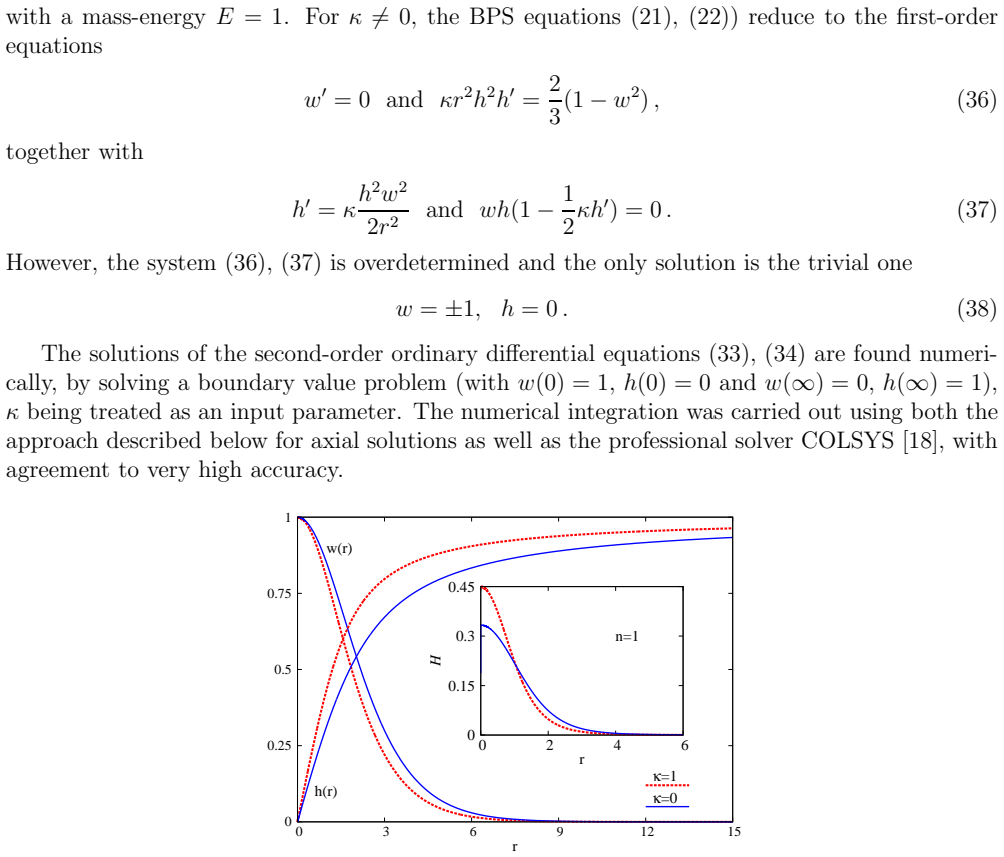
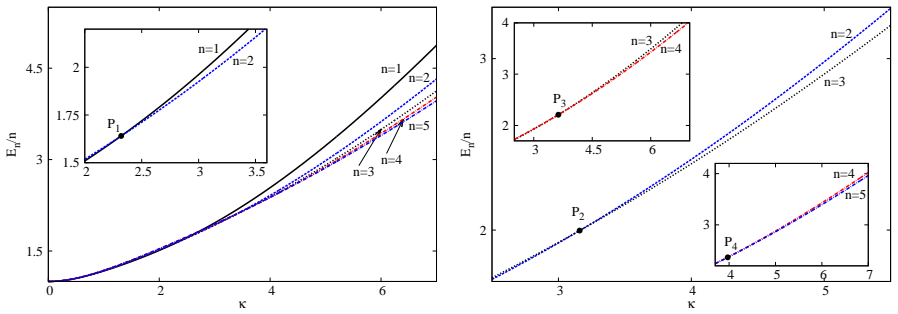


read the original abstract
An $SO(3)$-gauged Higgs model on $\mathbb{R}^3$ is proposed that, like the Abelian Higgs model on $\mathbb{R}^2$, features both attractive and repulsive phases, though unlike the latter its solutions do not saturate the topological lower bound. What distinguishes this model is that its energy is stabilised by the "Higgs analogue of the Chern-Pontryagin" charge, rather than the usual "Higgs--Chern-Pontryagin" charge which is a dimensional descendant of the Chern-Pontryagin charge.
Editorial analysis
A structured set of objections, weighed in public.
Referee Report
Summary. The paper proposes an SO(3)-gauged Higgs model on R^3 whose magnetic monopole solutions exhibit both attractive and repulsive phases. The energy is stabilized by a Higgs analogue of the Chern-Pontryagin charge rather than the conventional Higgs-Chern-Pontryagin charge, and the solutions do not saturate the usual topological lower bound, in analogy with the Abelian Higgs model on R^2.
Significance. If the claimed non-saturating solutions exist and the two charges can be cleanly distinguished, the construction would supply a three-dimensional example of tunable monopole interactions outside the Bogomolny regime. This could be useful for studying non-topological stabilization mechanisms in gauge-Higgs systems, though the absence of any explicit solutions or energy bounds leaves the practical significance unclear at present.
major comments (2)
- The central claim that static, finite-energy solutions realizing both attractive and repulsive phases exist and are stabilized by the Higgs analogue of the Chern-Pontryagin charge (rather than saturating the topological bound) is load-bearing, yet the manuscript provides neither an explicit ansatz, numerical construction, nor a proof of existence for the second-order Euler-Lagrange equations on R^3. This is the weakest assumption identified in the stress-test note and directly undermines verification of the two phases.
- No derivation or explicit comparison is given showing how the new charge differs from the dimensional descendant of the Chern-Pontryagin charge or why it provides a lower bound that the solutions can approach without saturating the conventional topological bound. A concrete energy functional or Bogomolny-type inequality in §2 or §3 would be required to substantiate the distinction.
minor comments (2)
- The abstract refers to 'attractive and repulsive phases' without defining the sign of the force or the inter-monopole potential; a brief clarification of the diagnostic used (e.g., sign of the derivative of the energy with separation) would improve readability.
- Notation for the two charges ('Higgs analogue of the Chern-Pontryagin' versus 'Higgs-Chern-Pontryagin') is introduced without an equation or reference; adding a short notational table or explicit integral expressions would help.
Simulated Author's Rebuttal
We thank the referee for the careful reading of the manuscript and for the constructive comments. We address each major point below and indicate where revisions will be made.
read point-by-point responses
-
Referee: The central claim that static, finite-energy solutions realizing both attractive and repulsive phases exist and are stabilized by the Higgs analogue of the Chern-Pontryagin charge (rather than saturating the topological bound) is load-bearing, yet the manuscript provides neither an explicit ansatz, numerical construction, nor a proof of existence for the second-order Euler-Lagrange equations on R^3. This is the weakest assumption identified in the stress-test note and directly undermines verification of the two phases.
Authors: We acknowledge that the current manuscript does not contain an explicit ansatz, numerical construction, or rigorous existence proof for the solutions. The work is framed as a model proposal that identifies the stabilizing charge and argues for the existence of the two phases by structural analogy with the Abelian Higgs model on R^2. We agree this constitutes a limitation for verification. In the revised version we will add a proposed spherically symmetric ansatz for the gauge and Higgs fields together with a qualitative discussion of how the energy functional permits both attractive and repulsive regimes. A complete numerical solution or existence theorem lies beyond the present scope and is noted as future work. revision: partial
-
Referee: No derivation or explicit comparison is given showing how the new charge differs from the dimensional descendant of the Chern-Pontryagin charge or why it provides a lower bound that the solutions can approach without saturating the conventional topological bound. A concrete energy functional or Bogomolny-type inequality in §2 or §3 would be required to substantiate the distinction.
Authors: We agree that the distinction between the two charges requires a more explicit treatment. The Higgs analogue of the Chern-Pontryagin charge is constructed directly from the three-dimensional fields in a manner that yields a lower bound on the energy without forcing the solutions to saturate the standard topological bound. In the revised manuscript we will insert, in Section 2, the explicit energy functional, the precise definition of the new charge, a direct comparison with the dimensional descendant of the four-dimensional Chern-Pontryagin density, and the associated Bogomolny-type inequality that the energy approaches but does not saturate. revision: yes
- A rigorous proof of existence for static finite-energy solutions of the Euler-Lagrange equations
Circularity Check
No significant circularity; derivation is self-contained proposal
full rationale
The paper proposes an SO(3)-gauged Higgs model on R^3 featuring attractive and repulsive monopole phases stabilized by the Higgs analogue of the Chern-Pontryagin charge rather than the standard Higgs-Chern-Pontryagin charge. No equations, fitted parameters, or self-referential definitions appear in the abstract or claims. The central assertion is an existence claim for static finite-energy solutions realizing both regimes without saturating the usual topological bound, presented as a model proposal analogous to the Abelian Higgs model on R^2. No load-bearing step reduces by construction to inputs, self-citations, or ansatze smuggled from prior work. The derivation chain is therefore independent of the target result.
Axiom & Free-Parameter Ledger
Lean theorems connected to this paper
-
IndisputableMonolith/Foundation/AlexanderDuality.leanalexander_duality_circle_linking echoes?
echoesECHOES: this paper passage has the same mathematical shape or conceptual pattern as the Recognition theorem, but is not a direct formal dependency.
An SO(3)-gauged Higgs model on R^3 is proposed that, like the Abelian Higgs model on R^2, features both attractive and repulsive phases... stabilised by the 'Higgs analogue of the Chern-Pontryagin' charge
-
IndisputableMonolith/Cost/FunctionalEquation.leanwashburn_uniqueness_aczel unclear?
unclearRelation between the paper passage and the cited Recognition theorem.
the energy density (26) ... single positive and dimensionless parameter κ
What do these tags mean?
- matches
- The paper's claim is directly supported by a theorem in the formal canon.
- supports
- The theorem supports part of the paper's argument, but the paper may add assumptions or extra steps.
- extends
- The paper goes beyond the formal theorem; the theorem is a base layer rather than the whole result.
- uses
- The paper appears to rely on the theorem as machinery.
- contradicts
- The paper's claim conflicts with a theorem or certificate in the canon.
- unclear
- Pith found a possible connection, but the passage is too broad, indirect, or ambiguous to say the theorem truly supports the claim.
Reference graph
Works this paper leans on
-
[1]
Magnetic monopoles in unified gauge theorie s,
G. ’t Hooft, “Magnetic monopoles in unified gauge theorie s,” Nucl. Phys. B 79 (1974) 276
work page 1974
-
[2]
Particle spectrum in quantum field theor y,
A. M. Polyakov, “Particle spectrum in quantum field theor y,” JETP Lett. 20 (1974) 194 [Pisma Zh. Eksp. Teor. Fiz. 20 (1974) 430]
work page 1974
-
[3]
An Exact Classical Sol ution for the ’t Hooft Monopole and the Julia-Zee Dyon,
M. K. Prasad and C. M. Sommerfield, “An Exact Classical Sol ution for the ’t Hooft Monopole and the Julia-Zee Dyon,” Phys. Rev. Lett. 35 (1975), 760-762. 13
work page 1975
-
[4]
Stability of Classical Solutions,
E. B. Bogomolny, “Stability of Classical Solutions,” So v. J. Nucl. Phys. 24 (1976), 449 PRINT-76- 0543 (LANDAU-INST.)
work page 1976
-
[5]
Vortices and monopoles. Structure of static gauge theories ,
A. M. Jaffe and C. H. Taubes, “ Vortices and monopoles. Structure of static gauge theories ,” Birkh¨ auser, Boston, Basel, Stuttgart, 1980, ISBN 3-7643-3025-2
work page 1980
-
[6]
N. S. Manton and P. Sutcliffe, “ Topological solitons,” Cambridge University Press, 2004, ISBN 978-0-521-04096-9, 978-0-521-83836-8, 978-0-511-20783 -9
work page 2004
-
[7]
Two-Dimensional and Three-Dimensional Ins tantons,
M. A. Lohe, “Two-Dimensional and Three-Dimensional Ins tantons,” Phys. Lett. B 70 (1977), 325- 328
work page 1977
-
[8]
Selfgravitating magnetic monopoles, global monopoles and black holes
G. W. Gibbons, “Selfgravitating magnetic monopoles, gl obal monopoles and black holes,” Lect. Notes Phys. 383 (1991), 110-138 [arXiv:1109.3538 [gr-qc]]
work page internal anchor Pith review Pith/arXiv arXiv 1991
-
[9]
Interaction Energy of `t Hooft-Polyakov Monopoles
B. Kleihaus, J. Kunz and D. H. Tchrakian, “Interaction en ergy of ‘t Hooft-Polyakov monopoles,” Mod. Phys. Lett. A 13 (1998), 2523-2530 [arXiv:hep-th/9804192 [hep-th]]
work page internal anchor Pith review Pith/arXiv arXiv 1998
-
[10]
Interaction Energy of Supercon ducting Vortices,
L. Jacobs and C. Rebbi, “Interaction Energy of Supercon ducting Vortices,” Phys. Rev. B 19 (1979), 4486-4494
work page 1979
-
[11]
Interaction Energies of Generalised Monopoles
B. Kleihaus, D. O’Keeffe and D. H. Tchrakian, “Interactio n energies of generalized monopoles,” Nucl. Phys. B 536 (1998), 381-403 [arXiv:hep-th/9806088 [hep-th]]
work page internal anchor Pith review Pith/arXiv arXiv 1998
-
[12]
D. Y. Grigoriev, P. M. Sutcliffe and D. H. Tchrakian, “Skyr med monopoles,” Phys. Lett. B 540 (2002), 146-152 [arXiv:hep-th/0206160 [hep-th]]
work page internal anchor Pith review Pith/arXiv arXiv 2002
-
[13]
T. Tchrakian, “Notes on Yang-Mills–Higgs monopoles an d dyons on RD, and Chern-Simons–Higgs solitons on RD− 2: Dimensional reduction of Chern-Pontryagin densities,” J . Phys. A 44 (2011), 343001 [arXiv:1009.3790 [hep-th]]
work page internal anchor Pith review Pith/arXiv arXiv 2011
-
[14]
Interaction energy of generalized Abelian Higgs vor- tices,
K. Arthur, Y. Brihaye and D. H. Tchrakian, “Interaction energy of generalized Abelian Higgs vor- tices,” J. Math. Phys. 39 (1998), 3031-3042
work page 1998
-
[15]
Winding number versus Chern-Pontryagi n Charge
T. Tchrakian, “Winding number versus Chern-Pontryagi n Charge”, in Volume in Honor of Sergei Matinyan, “From Integrable Models to Gauge Theories”, Editors: V.G. Gurzadyan and A.G. Se- drakian, https/doi.org/10.1142/4939 (April 2002)
-
[16]
Dirac-Yang monopoles in all dimensions and their regular counterparts,
T. Tchrakian, “Dirac-Yang monopoles in all dimensions and their regular counterparts,” Phys. Atom. Nucl. 71 (2008), 1116-1122
work page 2008
-
[17]
Comments on nonlinear wave equations as models for elementary particles,
G. H. Derrick, “Comments on nonlinear wave equations as models for elementary particles,” J. Math. Phys. 5 (1964), 1252-1254
work page 1964
-
[18]
A Colloca tion Solver for Mixed Order Systems of Boundary Value Problems,
U. Ascher, J. Christiansen and R. D. Russell, “A Colloca tion Solver for Mixed Order Systems of Boundary Value Problems,” Math. Comput. 33 (1979) no.146, 659-679
work page 1979
-
[19]
Static Axially Symmetric Solutions of Einstein-Yang-Mills-Dilaton Theory
B. Kleihaus and J. Kunz, “Static axially symmetric solu tions of Einstein Yang-Mills dilaton theory,” Phys. Rev. Lett. 78 (1997), 2527-2530 [arXiv:hep-th/9612101 [hep-th]]
work page internal anchor Pith review Pith/arXiv arXiv 1997
-
[20]
Gravitationally bound monopoles
B. Hartmann, B. Kleihaus and J. Kunz, “Gravitationally bound monopoles,” Phys. Rev. Lett. 86 (2001), 1422-1425 [arXiv:hep-th/0009195 [hep-th]]
work page internal anchor Pith review Pith/arXiv arXiv 2001
-
[21]
W. Sch¨ onauer and R. Weiß, “Efficient vectorizable PDE so lvers,“ J. Comput. Appl. Math. 27, 279 (1989) 279; M. Schauder, R. Weiß and W. Sch¨ onauer, The CADSOL Program Package , Universit¨ at Karlsruhe, Interner Bericht Nr. 46/92 (1992). 14
work page 1989
discussion (0)
Sign in with ORCID, Apple, or X to comment. Anyone can read and Pith papers without signing in.