REVIEW 3 major objections 4 minor 1 cited by
Cross-View Completion Models are Zero-shot Correspondence Estimators
T0 review · 3 major / 4 minor · reviewed 2026-08-11 · deepseek-v4-flash
Pith's one-line read The paper claims that a cross-view completion model's decoder cross-attention map already encodes dense geometric correspondence, and that reading it as a cost volume yields zero-shot matching that outperforms prior unsupervised baselines.
desk verdict The core observation is real: CroCo-v2's cross-attention maps are surprisingly good zero-shot correspondence estimators, but the paper overreaches on some SOTA claims and leaves a load-bearing component unspecified. read the letter →
The pith
A machine-rendered reading of the paper's core claim, the machinery that carries it, and where it could break.
The reading
What carries the argument
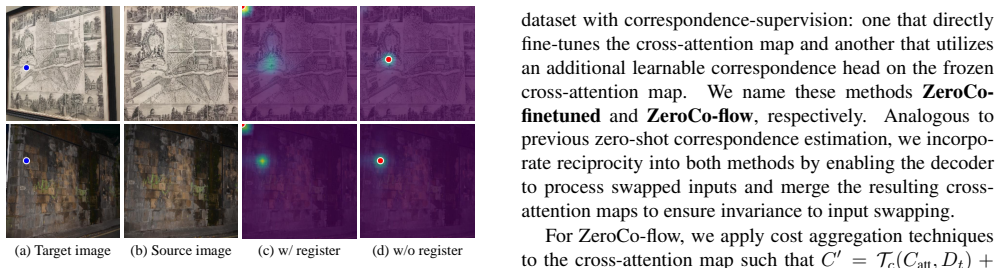
The load-bearing object is the cross-attention map $C^l_{\mathrm{att}}(i,j)=\mathrm{softmax}(D^{l,Q}_t(i)\cdot D^{l,K}_s(j)/\sqrt{d})$ inside each decoder layer of a cross-view completion model: the attention distribution by which the decoder retrieves source patches to reconstruct the masked target. ZeroCo treats the layer-averaged map as a dense cost volume, enforces reciprocity by adding the transposed map computed from the swapped input pair, suppresses register-token artifacts by replacing those attention values with the minimum, and reads out flow by applying $\mathrm{softargmax}$. This map carries the correspondence signal; correlations of encoder or decoder features are broader, noisier, and match far worse.
What would settle it
Run the ZeroCo cost volume on image pairs with the same geometry but artificially decorrelated appearance, such as grayscale or strong color jitter on one view: if the cross-attention map's AEPE advantage over encoder and decoder correlations shrinks toward zero, the map is matching appearance rather than geometry, and the central claim fails. The paper's own resolution sweep already bounds the claim, since at 448x448 the advantage collapses to 186.73 AEPE from 35.39 at 224x224.
Extended reading notes
Core claim
The central claim is that the geometric knowledge learned by cross-view completion lives in the decoder's cross-attention map, not in the encoder or decoder feature descriptors that earlier systems such as DUSt3R, MASt3R, and CroCo-flow have used. The argument rests on an analogy: the cross-view completion objective, which warps source features through a softmax attention distribution to reconstruct a masked target, is the same computation as self-supervised correspondence learning, where a cost volume is softmaxed into a matching distribution and used to warp the source view. The paper verifies this by comparing matching costs from encoder features, decoder features, and the cross-attention map, and the attention map is sharper, less noisy, and far more accurate. The resulting zero-shot procedure, ZeroCo, fuses the forward and swapped cross-attention maps and reaches 9.41 AEPE on HPatches-240 and 12.72 on ETH3D, compared with 26.14 and 25.69 for the best prior zero-shot baselines. With small learnable heads on top of the same map, the paper also reports competitive learned geometric matching and self-supervised multi-frame depth estimation on KITTI and Cityscapes.
Load-bearing premise
The load-bearing premise is that CroCo-v2's reconstruction loss trained the decoder cross-attention to retrieve geometrically corresponding source patches rather than appearance-based lookalikes; if that premise fails, the zero-shot gains collapse on appearance-changing pairs.
Editorial extensions
If this is right
- Pretrained cross-view completion models can be used as zero-shot dense matchers by reading the cross-attention map as a cost volume and applying soft-argmax, with no training or fine-tuning.
- Previous CVC-based systems that used encoder or decoder descriptors, such as DUSt3R and MASt3R, were built on the weaker signal; the paper's layer analysis implies that routing their matching through cross-attention maps would improve them.
- The cross-attention cost volume can replace epipolar cost volumes in multi-frame depth estimation, improving robustness to dynamic objects and image noise while reaching 0.090 AbsRel on KITTI.
- With a small learnable aggregation and upsampling head on top of the frozen map, learned matching reaches 13.61 AEPE on HPatches-Original and 2.88 on ETH3D, competitive with heavily pretrained baselines.
- The zero-shot property is tied to the exact pretraining setup: it degrades sharply at 448 and 672 resolution and does not appear in CroCo-v1 cross-attention, so the result is specific to CroCo-v2-style training rather than a universal property of cross-attention.
Reading between the lines
- Because the effect is sensitive to pretraining resolution and data scale, the natural next experiment is to pretrain cross-view completion at higher resolution and with harder viewpoint pairs; the paper's own resolution analysis predicts this would extend zero-shot matching to finer scales.
- The reciprocal fusion of forward and swapped attention maps is a generic cycle-consistency mechanism that could be dropped into any cross-attention cost volume, including ones in models already trained with cross-view completion, without retraining.
- A direct appearance-shortcut probe, such as grayscaling or color-jittering one view and watching the cross-attention AEPE, would separate geometric retrieval from appearance matching; the paper does not run this experiment.
- The same reading of cross-attention as a cost volume may transfer to other two-view objectives, such as stereo or video frame prediction, where reconstruction pressure also forces retrieval of matching source regions.
Signed reviews
Editorial analysis
A structured set of objections, weighed in public.
Referee Report
Summary. The paper studies the CroCo-v2 cross-view completion (CVC) model and argues that the cross-attention maps in its decoder encode dense geometric correspondence more effectively than the encoder or decoder features that prior work (e.g., DUSt3R, MASt3R, CroCo-Flow) has used. The authors propose ZeroCo, a zero-shot inference technique that averages cross-attention maps over decoder layers and enforces reciprocity by running the model on swapped input pairs; they also introduce learning-based variants (ZeroCo-finetuned, ZeroCo-flow, ZeroCo-depth) with lightweight heads for supervised geometric matching and multi-frame depth estimation. The paper reports large improvements over prior zero-shot matchers (DIFT, SD-DINO, DINOv2) on HPatches and ETH3D, and competitive results for learning-based matching and depth, with ablations supporting the use of cross-attention maps.
Significance. If the central claim holds, the paper identifies a previously underused signal in cross-view completion models: the decoder cross-attention map, rather than the descriptor features, is the carrier of geometric correspondence knowledge. The main strengths are the controlled comparisons on the same CroCo-v2 backbone (Tabs. 1, 2, 8), the genuinely frozen pretrained setting for the zero-shot experiments, and the large reported margins over existing zero-shot baselines (9.41 vs. 26.14 AEPE on HPatches-240). The paper also provides useful layer-wise and pretrained-weight analyses in the supplement. However, the significance is currently limited by two issues: the 'dense zoom-in' component that is necessary for the best zero-shot number is never specified, and the title/abstract claim about 'cross-view completion models' is broader than the evidence, which only supports a specific pretrained CroCo-v2 checkpoint at its native 224x224 resolution.
major comments (3)
- [§4.5, Tab. 7, Supp. §A.1] The 'dense zoom-in' component is load-bearing for the headline zero-shot result but is never defined. Tab. 7 shows that without dense zoom-in the AEPE on HPatches-240 is 10.85 (row I) and with it the reported result is 9.41 (row VII); the main text only says that incorporating it 'significantly enhances zero-shot performance.' The supplementary material, including the zero-shot implementation details in Sec. A.1, does not describe the component: there is no algorithm, no resolution schedule, no statement of which tokens or layers it modifies, and no mention in Fig. 6. Because the paper's central claim is that the cross-attention map itself is a zero-shot correspondence estimator, the headline metric cannot be attributed to the geometric content of the cross-attention map unless this post-processing step is fully specified and ablated. This also prevents independent reproduction.
- [Supp. Tabs. 9 and 10, title/abstract] The paper's title and abstract claim a property of 'cross-view completion models' in general, but the evidence supports only CroCo-v2 at 224x224 resolution. Supp. Tab. 10 shows that for CroCo-v1, the cross-attention map (39.41 AEPE on HPatches-240) is actually worse than the encoder correlation (30.56), directly contradicting the general claim. Supp. Tab. 9 shows that ZeroCo degrades dramatically at higher input resolutions (35.39 AEPE at 224x224 vs. 186.73 at 448x448 on HPatches-Original). The authors acknowledge these facts in Sec. C.2-C.3, but the central claim is not correspondingly qualified. The paper should either restrict the claim to CroCo-v2 at its training resolution or provide evidence for a broader class of CVC models.
- [§3.2, Eq. (7), Supp. §A.1] The 'zero-shot' claim should be qualified by the amount of benchmark-specific tuning in the inference procedure. The soft-argmax temperature (tau = 1e-4), the register-token replacement, and the dense zoom-in are all selected or validated on the HPatches-240 benchmark (Tab. 7, Supp. Tab. 11). While the model weights are frozen, the inference pipeline is not parameter-free; at minimum, the paper should state whether any components were tuned on the evaluation set and report sensitivity to tau and to the dense zoom-in configuration.
minor comments (4)
- [§3.1, Eq. (1)] Equation (1) should specify the axis over which the softmax is computed; based on the text and Eq. (2), it is over source positions j, but this should be stated explicitly.
- [Tabs. 1 and 9] The label 'HPatches-Original' is misleading: Supp. Sec. A.1 states that all inputs are resized to 224x224 for the main experiments, and Tab. 9 confirms that the 'HPatches-Original' numbers at 224x224 match those in Tab. 1. Consider renaming the column to reflect the actual input resolution.
- [Supp. Tab. 12] The row label 'ZeroCo(ZeroCo-finetuned)' is unclear; it should be clarified whether this entry measures the zero-shot inference of the fine-tuned model or the full learning-based pipeline, since the memory/time values are close to the zero-shot 'ZeroCo' row.
- [§3.2] The register-token replacement procedure should specify how many register tokens are present in CroCo-v2, how they are identified across layers, and whether the 'minimum attention value' is computed per query or globally.
Circularity Check
No significant circularity: the zero-shot result is a forward pass of an externally pretrained CroCo-v2 evaluated on external benchmarks; the main claim does not reduce to its inputs.
full rationale
The central claim is that the cross-attention map of CroCo-v2 is a better zero-shot correspondence cost volume than encoder/decoder correlations. The supporting numbers in Tabs. 1-2 are produced by a fixed, frozen pretrained network (CroCo-v2, [91]) evaluated on HPatches/ETH3D, with no learned parameters fitted to those benchmarks. The reciprocity fusion, register-token correction, and soft-argmax temperature are inference choices described by Eq. (7) and Sec. A.1; none of these is a fitted constant derived from the benchmark targets. The analogy in Sec. 3.1 between CVC and self-supervised matching is an interpretative claim, not a derivation: the paper does not define correspondence in terms of the cross-attention map, nor does it define the cross-attention map in terms of the AEPE metric. The cost-aggregation heads for the learning-based extensions cite the authors' earlier CATS/CATS++/CATSEG work [9-11], but this borrowing is architectural, standard, and not load-bearing for the zero-shot claim. One genuine gap is that the 'dense zoom-in' component that improves the headline HPatches-240 number (9.41 vs 10.85, Tab. 7 row VII) is never specified in the main text or supplement's zero-shot implementation details (Sec. A.1); this makes the exact 9.41 result hard to verify and partially attributes that number to an undisclosed post-process. That is a reproducibility and benchmark-selection concern, not circularity: the cross-attention-vs-descriptor comparison remains valid even without dense zoom-in (10.85 is still far below the 26.14 next-best), and no equation in the paper makes the reported AEPE equal to a fitted parameter by construction. Accordingly the circularity score is low.
Assumptions & free parameters
free parameters (3)
- soft-argmax temperature tau =
1e-4
- dense zoom-in configuration =
not reported
- layer averaging of cross-attention maps =
all 12 layers
assumptions (4)
- domain assumption CroCo-v2 frozen weights at 224x224 provide a general source of geometric correspondences for unseen image pairs.
- domain assumption Masked reconstruction of the target view from the source view induces geometrically meaningful attention rather than appearance matching.
- domain assumption Register token attention is a shortcut artifact and can be removed by setting it to the minimum value.
- domain assumption Averaging pre-softmax query-key products and symmetrizing with swapped inputs yields an improved cost volume.
Cite this review
Pith. "Pith review of Cross-View Completion Models are Zero-shot Correspondence Estimators." pith.science (2026). https://pith.science/paper/NF2YCBN6
@misc{pith2026241209072,
  author       = {Pith},
  title        = {Pith review of: Cross-View Completion Models are Zero-shot Correspondence Estimators},
  year         = {2026},
  howpublished = {\url{https://pith.science/paper/NF2YCBN6}},
  note         = {Machine review of arXiv:2412.09072}
}
read the original abstract
In this work, we explore new perspectives on cross-view completion learning by drawing an analogy to self-supervised correspondence learning. Through our analysis, we demonstrate that the cross-attention map within cross-view completion models captures correspondence more effectively than other correlations derived from encoder or decoder features. We verify the effectiveness of the cross-attention map by evaluating on both zero-shot matching and learning-based geometric matching and multi-frame depth estimation. Project page is available at https://cvlab-kaist.github.io/ZeroCo/.
Figures


Figures from the paper (11 more)


Forward citations
Cited by 1 Pith paper
-
Emergent Temporal Correspondences from Video Diffusion Transformers
Video diffusion transformers encode temporal correspondences primarily in query-key similarities of a few specific attention layers, which can be extracted for zero-shot point tracking and used for training-free motio...
Reference graph
Works this paper leans on
-
[1]
Multimae: Multi-modal multi-task masked autoencoders
Roman Bachmann, David Mizrahi, Andrei Atanov, and Amir Zamir. Multimae: Multi-modal multi-task masked autoencoders. In European Conference on Computer Vi- sion, pages 348–367. Springer, 2022. 2
2022
-
[2]
Multi-view depth estimation by fusing single-view depth probability with multi-view geometry
Gwangbin Bae, Ignas Budvytis, and Roberto Cipolla. Multi-view depth estimation by fusing single-view depth probability with multi-view geometry. In Proceedings of the IEEE/CVF Conference on Computer Vision and Pattern Recognition, pages 2842–2851, 2022. 3 9
2022
-
[3]
Hpatches: A benchmark and evaluation of handcrafted and learned local descriptors
Vassileios Balntas, Karel Lenc, Andrea Vedaldi, and Krys- tian Mikolajczyk. Hpatches: A benchmark and evaluation of handcrafted and learned local descriptors. In Proceed- ings of the IEEE conference on computer vision and pattern recognition, pages 5173–5182, 2017. 6, 7, 9, 17, 19, 20, 21, 23
2017
-
[4]
Dualrefine: Self-supervised depth and pose estima- tion through iterative epipolar sampling and refinement to- ward equilibrium
Antyanta Bangunharcana, Ahmed Magd, and Kyung-Soo Kim. Dualrefine: Self-supervised depth and pose estima- tion through iterative epipolar sampling and refinement to- ward equilibrium. In Proceedings of the IEEE/CVF Con- ference on Computer Vision and Pattern Recognition, pages 726–738, 2023. 3, 8, 9, 17, 31
2023
-
[5]
Beit: Bert pre- training of image transformers
Hangbo Bao, Li Dong, and Furu Wei. Beit: Bert pre- training of image transformers. arXiv, 2021. 3
2021
-
[6]
Unsupervised learn- ing of visual features by contrasting cluster assignments
Mathilde Caron, Ishan Misra, Julien Mairal, Priya Goyal, Piotr Bojanowski, and Armand Joulin. Unsupervised learn- ing of visual features by contrasting cluster assignments. Advances in neural information processing systems , 33: 9912–9924, 2020. 2
2020
-
[7]
Unsupervised monocular depth and ego-motion learning with structure and semantics
Vincent Casser, Soeren Pirk, Reza Mahjourian, and Anelia Angelova. Unsupervised monocular depth and ego-motion learning with structure and semantics. In Proceedings of the IEEE/CVF Conference on Computer Vision and Pattern Recognition Workshops, pages 0–0, 2019. 23
2019
-
[8]
Adaptive fusion of single-view and multi-view depth for autonomous driving
Junda Cheng, Wei Yin, Kaixuan Wang, Xiaozhi Chen, Shi- jie Wang, and Xin Yang. Adaptive fusion of single-view and multi-view depth for autonomous driving. In Proceed- ings of the IEEE/CVF Conference on Computer Vision and Pattern Recognition, pages 10138–10147, 2024. 3
2024
Show all 103 references
-
[9]
Cats: Cost aggregation transformers for visual correspondence
Seokju Cho, Sunghwan Hong, Sangryul Jeon, Yunsung Lee, Kwanghoon Sohn, and Seungryong Kim. Cats: Cost aggregation transformers for visual correspondence. Advances in Neural Information Processing Systems , 34: 9011–9023, 2021. 5, 33
2021
-
[10]
Cats++: Boosting cost aggregation with convolutions and transformers
Seokju Cho, Sunghwan Hong, and Seungryong Kim. Cats++: Boosting cost aggregation with convolutions and transformers. IEEE Transactions on Pattern Analysis and Machine Intelligence, 45(6):7174–7194, 2022. 33
2022
-
[11]
Cat- seg: Cost aggregation for open-vocabulary semantic seg- mentation
Seokju Cho, Heeseong Shin, Sunghwan Hong, Anurag Arnab, Paul Hongsuck Seo, and Seungryong Kim. Cat- seg: Cost aggregation for open-vocabulary semantic seg- mentation. In Proceedings of the IEEE/CVF Conference on Computer Vision and Pattern Recognition, pages 4113– 4123, 2024. 5
2024
-
[12]
Emerging property of masked token for effective pre-training
Hyesong Choi, Hunsang Lee, Seyoung Joung, Hyejin Park, Jiyeong Kim, and Dongbo Min. Emerging property of masked token for effective pre-training. In European Con- ference on Computer Vision , pages 272–289. Springer,
-
[13]
Salience-based adaptive masking: re- visiting token dynamics for enhanced pre-training
Hyesong Choi, Hyejin Park, Kwang Moo Yi, Sungmin Cha, and Dongbo Min. Salience-based adaptive masking: re- visiting token dynamics for enhanced pre-training. In Eu- ropean Conference on Computer Vision , pages 343–359. Springer, 2025. 2
2025
-
[14]
The cityscapes dataset for semantic urban scene understanding
Marius Cordts, Mohamed Omran, Sebastian Ramos, Timo Rehfeld, Markus Enzweiler, Rodrigo Benenson, Uwe Franke, Stefan Roth, and Bernt Schiele. The cityscapes dataset for semantic urban scene understanding. In Pro- ceedings of the IEEE conference on computer vision and pattern re...
2016
-
[15]
Vision transformers need registers
Timoth ´ee Darcet, Maxime Oquab, Julien Mairal, and Pi- otr Bojanowski. Vision transformers need registers. arXiv preprint arXiv:2309.16588, 2023. 5
2023 arXiv
-
[16]
Bert: Pre-training of deep bidirectional transformers for language understanding
Jacob Devlin. Bert: Pre-training of deep bidirectional transformers for language understanding. arXiv preprint arXiv:1810.04805, 2018. 2
2018 arXiv
-
[17]
An image is worth 16x16 words: Transformers for image recognition at scale
Alexey Dosovitskiy. An image is worth 16x16 words: Transformers for image recognition at scale. arXiv preprint arXiv:2010.11929, 2020. 3, 6, 15, 16
2010 arXiv
-
[18]
Dkm: Dense kernelized feature matching for geometry estimation
Johan Edstedt, Ioannis Athanasiadis, M ˚arten Wadenb¨ack, and Michael Felsberg. Dkm: Dense kernelized feature matching for geometry estimation. In Proceedings of the IEEE/CVF Conference on Computer Vision and Pattern Recognition, pages 17765–17775, 2023. 3, 4
2023
-
[19]
Roma: Robust dense feature matching
Johan Edstedt, Qiyu Sun, Georg B ¨okman, M ˚arten Wadenb¨ack, and Michael Felsberg. Roma: Robust dense feature matching. In Proceedings of the IEEE/CVF Confer- ence on Computer Vision and Pattern Recognition , pages 19790–19800, 2024. 3, 4
2024
-
[20]
Predicting depth, surface nor- mals and semantic labels with a common multi-scale con- volutional architecture
David Eigen and Rob Fergus. Predicting depth, surface nor- mals and semantic labels with a common multi-scale con- volutional architecture. In Proceedings of the IEEE inter- national conference on computer vision, pages 2650–2658,
-
[21]
Probing the 3d awareness of visual foundation models
Mohamed El Banani, Amit Raj, Kevis-Kokitsi Maninis, Abhishek Kar, Yuanzhen Li, Michael Rubinstein, Deqing Sun, Leonidas Guibas, Justin Johnson, and Varun Jampani. Probing the 3d awareness of visual foundation models. In Proceedings of the IEEE/CVF Conference on Computer Vi- si...
2024
-
[22]
Single-view and multi-view depth fusion
Jos ´e M F ´acil, Alejo Concha, Luis Montesano, and Javier Civera. Single-view and multi-view depth fusion. IEEE Robotics and Automation Letters, 2(4):1994–2001, 2017. 3
1994
-
[23]
Corrupted image modeling for self-supervised visual pre-training
Yuxin Fang, Li Dong, Hangbo Bao, Xinggang Wang, and Furu Wei. Corrupted image modeling for self-supervised visual pre-training. arXiv preprint arXiv:2202.03382 ,
-
[24]
Disentangling object motion and occlusion for unsupervised multi-frame monocular depth
Ziyue Feng, Liang Yang, Longlong Jing, Haiyan Wang, YingLi Tian, and Bing Li. Disentangling object motion and occlusion for unsupervised multi-frame monocular depth. In European Conference on Computer Vision , pages 228–
-
[25]
Vision meets robotics: The kitti dataset.The Inter- national Journal of Robotics Research, 32(11):1231–1237,
Andreas Geiger, Philip Lenz, Christoph Stiller, and Raquel Urtasun. Vision meets robotics: The kitti dataset.The Inter- national Journal of Robotics Research, 32(11):1231–1237,
-
[26]
Unsupervised monocular depth estimation with left- right consistency
Cl ´ement Godard, Oisin Mac Aodha, and Gabriel J Bros- tow. Unsupervised monocular depth estimation with left- right consistency. InProceedings of the IEEE conference on computer vision and pattern recognition , pages 270–279,
-
[27]
Digging into self-supervised monocular 10 depth estimation
Cl ´ement Godard, Oisin Mac Aodha, Michael Firman, and Gabriel J Brostow. Digging into self-supervised monocular 10 depth estimation. In Proceedings of the IEEE/CVF inter- national conference on computer vision, pages 3828–3838,
-
[28]
Depth from videos in the wild: Unsupervised monocular depth learning from unknown cameras
Ariel Gordon, Hanhan Li, Rico Jonschkowski, and Anelia Angelova. Depth from videos in the wild: Unsupervised monocular depth learning from unknown cameras. In Proceedings of the IEEE/CVF international conference on computer vision, pages 8977–8986, 2019. 2, 23
2019
-
[29]
Bootstrap your own latent-a new approach to self-supervised learning
Jean-Bastien Grill, Florian Strub, Florent Altch ´e, Corentin Tallec, Pierre Richemond, Elena Buchatskaya, Carl Do- ersch, Bernardo Avila Pires, Zhaohan Guo, Mohammad Gheshlaghi Azar, et al. Bootstrap your own latent-a new approach to self-supervised learning. Advances in neur...
2020
-
[30]
3d packing for self-supervised monocular depth estimation
Vitor Guizilini, Rares Ambrus, Sudeep Pillai, Allan Raven- tos, and Adrien Gaidon. 3d packing for self-supervised monocular depth estimation. In Proceedings of the IEEE/CVF conference on computer vision and pattern recognition, pages 2485–2494, 2020. 2, 8, 17
2020
-
[31]
Geometric unsupervised domain adaptation for semantic segmentation
Vitor Guizilini, Jie Li, Rares , Ambrus,, and Adrien Gaidon. Geometric unsupervised domain adaptation for semantic segmentation. In Proceedings of the IEEE/CVF interna- tional conference on computer vision , pages 8537–8547,
-
[32]
Multi-frame self-supervised depth with transformers
Vitor Guizilini, Rares , Ambrus,, Dian Chen, Sergey Za- kharov, and Adrien Gaidon. Multi-frame self-supervised depth with transformers. In Proceedings of the IEEE/CVF Conference on Computer Vision and Pattern Recognition , pages 160–170, 2022. 3, 5, 8, 17
2022
-
[33]
Siamese masked autoencoders
Agrim Gupta, Jiajun Wu, Jia Deng, and Fei-Fei Li. Siamese masked autoencoders. Advances in Neural Information Processing Systems, 36:40676–40693, 2023. 1, 2
2023
-
[34]
Few-shot object de- tection with foundation models
Guangxing Han and Ser-Nam Lim. Few-shot object de- tection with foundation models. In Proceedings of the IEEE/CVF Conference on Computer Vision and Pattern Recognition, pages 28608–28618, 2024. 1
2024
-
[35]
Deep residual learning for image recognition
Kaiming He, Xiangyu Zhang, Shaoqing Ren, and Jian Sun. Deep residual learning for image recognition. In Proceed- ings of the IEEE conference on computer vision and pattern recognition, pages 770–778, 2016. 4
2016
-
[36]
Momentum contrast for unsupervised visual rep- resentation learning
Kaiming He, Haoqi Fan, Yuxin Wu, Saining Xie, and Ross Girshick. Momentum contrast for unsupervised visual rep- resentation learning. In Proceedings of the IEEE/CVF con- ference on computer vision and pattern recognition , pages 9729–9738, 2020. 1, 2
2020
-
[37]
Masked autoencoders are scal- able vision learners
Kaiming He, Xinlei Chen, Saining Xie, Yanghao Li, Piotr Doll´ar, and Ross Girshick. Masked autoencoders are scal- able vision learners. In Proceedings of the IEEE/CVF con- ference on computer vision and pattern recognition , pages 16000–16009, 2022. 1, 2, 3
2022
-
[38]
Ra-depth: Resolution adaptive self-supervised monocular depth estimation
Mu He, Le Hui, Yikai Bian, Jian Ren, Jin Xie, and Jian Yang. Ra-depth: Resolution adaptive self-supervised monocular depth estimation. In European Conference on Computer Vision, pages 565–581. Springer, 2022. 8, 17
2022
-
[39]
Stereo processing by semiglobal matching and mutual information
Heiko Hirschmuller. Stereo processing by semiglobal matching and mutual information. IEEE Transactions on pattern analysis and machine intelligence , 30(2):328–341,
-
[40]
Deep matching prior: Test-time optimization for dense correspondence
Sunghwan Hong and Seungryong Kim. Deep matching prior: Test-time optimization for dense correspondence. In Proceedings of the IEEE/CVF International Conference on Computer Vision, pages 9907–9917, 2021. 7, 8
2021
-
[41]
Cost aggregation with 4d convolutional swin transformer for few-shot segmentation
Sunghwan Hong, Seokju Cho, Jisu Nam, Stephen Lin, and Seungryong Kim. Cost aggregation with 4d convolutional swin transformer for few-shot segmentation. In European Conference on Computer Vision, pages 108–126. Springer,
-
[42]
Neural matching fields: Implicit representation of matching fields for visual correspondence
Sunghwan Hong, Jisu Nam, Seokju Cho, Susung Hong, Sangryul Jeon, Dongbo Min, and Seungryong Kim. Neural matching fields: Implicit representation of matching fields for visual correspondence. Advances in Neural Information Processing Systems, 35:13512–13526, 2022. 4
2022
-
[43]
Unifying feature and cost aggregation with transformers for semantic and visual correspondence
Sunghwan Hong, Seokju Cho, Seungryong Kim, and Stephen Lin. Unifying feature and cost aggregation with transformers for semantic and visual correspondence. In The Twelfth International Conference on Learning Repre- sentations, 2024. 2, 4, 16
2024
-
[44]
Self-supervised monocular trained depth estimation using self-attention and discrete disparity volume
Adrian Johnston and Gustavo Carneiro. Self-supervised monocular trained depth estimation using self-attention and discrete disparity volume. In Proceedings of the ieee/cvf conference on computer vision and pattern recognition , pages 4756–4765, 2020. 2
2020
-
[45]
Barron, Ariel Gordon, Kurt Konolige, and Anelia Angelova
Rico Jonschkowski, Austin Stone, Jonathan T. Barron, Ariel Gordon, Kurt Konolige, and Anelia Angelova. What matters in unsupervised optical flow, 2020. 2, 3
2020
-
[46]
Re- purposing diffusion-based image generators for monocular depth estimation
Bingxin Ke, Anton Obukhov, Shengyu Huang, Nando Met- zger, Rodrigo Caye Daudt, and Konrad Schindler. Re- purposing diffusion-based image generators for monocular depth estimation. In Proceedings of the IEEE/CVF Confer- ence on Computer Vision and Pattern Recognition , pages 94...
2024
-
[47]
Recurrent transformer net- works for semantic correspondence
Seungryong Kim, Stephen Lin, Sang Ryul Jeon, Dongbo Min, and Kwanghoon Sohn. Recurrent transformer net- works for semantic correspondence. Advances in neural information processing systems, 31, 2018. 5, 33
2018
-
[48]
Adam: A method for stochastic optimization
Diederik P Kingma and Jimmy Ba. Adam: A method for stochastic optimization. arXiv preprint arXiv:1412.6980 ,
-
[49]
Cottereau, and Wei Tsang Ooi
Lingdong Kong, Shaoyuan Xie, Hanjiang Hu, Lai Xing Ng, Benoit R. Cottereau, and Wei Tsang Ooi. Robodepth: Robust out-of-distribution depth estimation under corrup- tions. In Advances in Neural Information Processing Sys- tems, 2023. 6, 9, 18
2023
-
[50]
Sfnet: Learning object-aware semantic correspon- dence
Junghyup Lee, Dohyung Kim, Jean Ponce, and Bumsub Ham. Sfnet: Learning object-aware semantic correspon- dence. In Proceedings of the IEEE/CVF Conference on Computer Vision and Pattern Recognition , pages 2278– 2287, 2019. 15
2019
-
[51]
Grounding image matching in 3d with mast3r
Vincent Leroy, Yohann Cabon, and J ´erˆome Revaud. Grounding image matching in 3d with mast3r. arXiv preprint arXiv:2406.09756, 2024. 2, 4, 7, 8, 17, 19, 21, 22, 23, 24, 28, 29
2024 arXiv
-
[52]
Unsupervised monocular depth learn- ing in dynamic scenes
Hanhan Li, Ariel Gordon, Hang Zhao, Vincent Casser, and Anelia Angelova. Unsupervised monocular depth learn- ing in dynamic scenes. In Conference on Robot Learning, pages 1908–1917. PMLR, 2021. 2, 23 11
1908
-
[53]
Learning to fuse monocular and multi-view cues for multi- frame depth estimation in dynamic scenes
Rui Li, Dong Gong, Wei Yin, Hao Chen, Yu Zhu, Kaix- uan Wang, Xiaozhi Chen, Jinqiu Sun, and Yanning Zhang. Learning to fuse monocular and multi-view cues for multi- frame depth estimation in dynamic scenes. In Proceedings of the IEEE/CVF Conference on Computer Vision and Pat- ...
2023
-
[54]
Megadepth: Learning single-view depth prediction from internet photos
Zhengqi Li and Noah Snavely. Megadepth: Learning single-view depth prediction from internet photos. In Pro- ceedings of the IEEE conference on computer vision and pattern recognition, pages 2041–2050, 2018. 16, 17
2018
-
[55]
Self- low: Self-supervised learning of optical flow
Pengpeng Liu, Michael Lyu, Irwin King, and Jia Xu. Self- low: Self-supervised learning of optical flow. In Proceed- ings of the IEEE/CVF conference on computer vision and pattern recognition, pages 4571–4580, 2019. 2, 3
2019
-
[56]
Swin transformer: Hierarchical vision transformer using shifted windows
Ze Liu, Yutong Lin, Yue Cao, Han Hu, Yixuan Wei, Zheng Zhang, Stephen Lin, and Baining Guo. Swin transformer: Hierarchical vision transformer using shifted windows. In Proceedings of the IEEE/CVF international conference on computer vision, pages 10012–10022, 2021. 15
2021
-
[57]
Flowdiffuser: Advancing optical flow estimation with diffusion models
Ao Luo, Xin Li, Fan Yang, Jiangyu Liu, Haoqiang Fan, and Shuaicheng Liu. Flowdiffuser: Advancing optical flow estimation with diffusion models. In Proceedings of the IEEE/CVF Conference on Computer Vision and Pattern Recognition, pages 19167–19176, 2024. 1
2024
-
[58]
Unflow: Un- supervised learning of optical flow with a bidirectional cen- sus loss
Simon Meister, Junhwa Hur, and Stefan Roth. Unflow: Un- supervised learning of optical flow with a bidirectional cen- sus loss. In Proceedings of the AAAI conference on artificial intelligence, 2018. 2
2018
-
[59]
Dgc-net: Dense geometric correspondence network
Iaroslav Melekhov, Aleksei Tiulpin, Torsten Sattler, Marc Pollefeys, Esa Rahtu, and Juho Kannala. Dgc-net: Dense geometric correspondence network. In 2019 IEEE Winter Conference on Applications of Computer Vision (WACV) , pages 1034–1042. IEEE, 2019. 2, 6, 7
2019
-
[60]
Hypercorrela- tion squeeze for few-shot segmentation
Juhong Min, Dahyun Kang, and Minsu Cho. Hypercorrela- tion squeeze for few-shot segmentation. In Proceedings of the IEEE/CVF International Conference on Computer Vi- sion (ICCV), 2021. 16
2021
-
[61]
Efficientps: Efficient panoptic segmentation
Rohit Mohan and Abhinav Valada. Efficientps: Efficient panoptic segmentation. International Journal of Computer Vision, 129(5):1551–1579, 2021. 18
2021
-
[62]
Diffusion model for dense matching
Jisu Nam, Gyuseong Lee, Sunwoo Kim, Hyeonsu Kim, Hyoungwon Cho, Seyeon Kim, and Seungryong Kim. Diffusion model for dense matching. arXiv preprint arXiv:2305.19094, 2023. 7, 8, 16, 17, 30
2023 arXiv
-
[63]
Maxime Oquab, Timoth ´ee Darcet, Theo Moutakanni, Huy V . V o, Marc Szafraniec, Vasil Khalidov, Pierre Fernan- dez, Daniel Haziza, Francisco Massa, Alaaeldin El-Nouby, Russell Howes, Po-Yao Huang, Hu Xu, Vasu Sharma, Shang-Wen Li, Wojciech Galuba, Mike Rabbat, Mido Ass- ran, N...
2023
-
[64]
Automatic differentiation in pytorch
Adam Paszke, Sam Gross, Soumith Chintala, Gregory Chanan, Edward Yang, Zachary DeVito, Zeming Lin, Al- ban Desmaison, Luca Antiga, and Adam Lerer. Automatic differentiation in pytorch. 2017. 16
2017
-
[65]
Pytorch: An imperative style, high-performance deep learning library
Adam Paszke, Sam Gross, Francisco Massa, Adam Lerer, James Bradbury, Gregory Chanan, Trevor Killeen, Zeming Lin, Natalia Gimelshein, Luca Antiga, et al. Pytorch: An imperative style, high-performance deep learning library. Advances in neural information processing systems , 32,
-
[66]
Context encoders: Feature learning by inpainting
Deepak Pathak, Philipp Krahenbuhl, Jeff Donahue, Trevor Darrell, and Alexei A Efros. Context encoders: Feature learning by inpainting. In Proceedings of the IEEE con- ference on computer vision and pattern recognition , pages 2536–2544, 2016. 3
2016
-
[67]
Don’t forget the past: Recurrent depth esti- mation from monocular video
Vaishakh Patil, Wouter Van Gansbeke, Dengxin Dai, and Luc Van Gool. Don’t forget the past: Recurrent depth esti- mation from monocular video. IEEE Robotics and Automa- tion Letters, 5(4):6813–6820, 2020. 8, 17
2020
-
[68]
Unidepth: Universal monocular metric depth estimation
Luigi Piccinelli, Yung-Hsu Yang, Christos Sakaridis, Mat- tia Segu, Siyuan Li, Luc Van Gool, and Fisher Yu. Unidepth: Universal monocular metric depth estimation. In Proceedings of the IEEE/CVF Conference on Computer Vi- sion and Pattern Recognition , pages 10106–10116, 2024. 3
2024
-
[69]
Movie gen: A cast of media foundation models
Adam Polyak, Amit Zohar, Andrew Brown, Andros Tjan- dra, Animesh Sinha, Ann Lee, Apoorv Vyas, Bowen Shi, Chih-Yao Ma, Ching-Yao Chuang, et al. Movie gen: A cast of media foundation models. arXiv preprint arXiv:2410.13720, 2024. 5
-
[70]
Vi- sion transformers for dense prediction
Ren ´e Ranftl, Alexey Bochkovskiy, and Vladlen Koltun. Vi- sion transformers for dense prediction. In Proceedings of the IEEE/CVF international conference on computer vi- sion, pages 12179–12188, 2021. 6, 16
2021
-
[71]
Unsupervised deep learning for optical flow estimation
Zhe Ren, Junchi Yan, Bingbing Ni, Bin Liu, Xiaokang Yang, and Hongyuan Zha. Unsupervised deep learning for optical flow estimation. In Proceedings of the AAAI confer- ence on artificial intelligence, 2017. 2
2017
-
[72]
Sacreg: Scene-agnostic co- ordinate regression for visual localization
Jerome Revaud, Yohann Cabon, Romain Br ´egier, JongMin Lee, and Philippe Weinzaepfel. Sacreg: Scene-agnostic co- ordinate regression for visual localization. In Proceedings of the IEEE/CVF Conference on Computer Vision and Pat- tern Recognition, pages 688–698, 2024. 1, 9
2024
-
[73]
Neighbourhood consensus networks
Ignacio Rocco, Mircea Cimpoi, Relja Arandjelovi ´c, Aki- hiko Torii, Tomas Pajdla, and Josef Sivic. Neighbourhood consensus networks. Advances in neural information pro- cessing systems, 31, 2018. 5
2018
-
[74]
High-resolution image synthesis with latent diffusion models
Robin Rombach, Andreas Blattmann, Dominik Lorenz, Patrick Esser, and Bj ¨orn Ommer. High-resolution image synthesis with latent diffusion models. In Proceedings of the IEEE/CVF conference on computer vision and pattern recognition, pages 10684–10695, 2022. 6
2022
-
[75]
Attention meets geometry: Geom- etry guided spatial-temporal attention for consistent self- supervised monocular depth estimation
Patrick Ruhkamp, Daoyi Gao, Hanzhi Chen, Nassir Navab, and Beniamin Busam. Attention meets geometry: Geom- etry guided spatial-temporal attention for consistent self- supervised monocular depth estimation. In 2021 Inter- national Conference on 3D Vision (3DV) , pages 837–847. ...
2021
-
[76]
A multi-view stereo benchmark with high- 12 resolution images and multi-camera videos
Thomas Schops, Johannes L Schonberger, Silvano Galliani, Torsten Sattler, Konrad Schindler, Marc Pollefeys, and An- dreas Geiger. A multi-view stereo benchmark with high- 12 resolution images and multi-camera videos. In Proceed- ings of the IEEE conference on computer vision a...
2017
-
[77]
Ransac-flow: generic two-stage image alignment
Xi Shen, Franc ¸ois Darmon, Alexei A Efros, and Mathieu Aubry. Ransac-flow: generic two-stage image alignment. In Computer Vision–ECCV 2020: 16th European Confer- ence, Glasgow, UK, August 23–28, 2020, Proceedings, Part IV 16, pages 618–637. Springer, 2020. 2
2020
-
[78]
Emergent correspondence from image diffusion
Luming Tang, Menglin Jia, Qianqian Wang, Cheng Perng Phoo, and Bharath Hariharan. Emergent correspondence from image diffusion. Advances in Neural Information Pro- cessing Systems, 36:1363–1389, 2023. 6, 7, 8, 17, 21, 22, 25, 26, 27
2023
-
[79]
Gocor: Bringing globally optimized correspon- dence volumes into your neural network
Prune Truong, Martin Danelljan, Luc V Gool, and Radu Timofte. Gocor: Bringing globally optimized correspon- dence volumes into your neural network. Advances in Neural Information Processing Systems, 33:14278–14290,
-
[80]
Glu- net: Global-local universal network for dense flow and cor- respondences
Prune Truong, Martin Danelljan, and Radu Timofte. Glu- net: Global-local universal network for dense flow and cor- respondences. In Proceedings of the IEEE/CVF conference on computer vision and pattern recognition , pages 6258– 6268, 2020. 2, 4, 5, 6, 7, 16, 17
2020
-
[81]
Learning accurate dense correspondences and when to trust them
Prune Truong, Martin Danelljan, Luc Van Gool, and Radu Timofte. Learning accurate dense correspondences and when to trust them. In Proceedings of the IEEE/CVF con- ference on computer vision and pattern recognition , pages 5714–5724, 2021. 3, 7, 16, 17
2021
-
[82]
Pdc-net+: Enhanced probabilistic dense corre- spondence network
Prune Truong, Martin Danelljan, Radu Timofte, and Luc Van Gool. Pdc-net+: Enhanced probabilistic dense corre- spondence network. IEEE Transactions on Pattern Analysis and Machine Intelligence, 45(8):10247–10266, 2023. 3, 4, 5, 7, 8, 16, 17, 30
2023
-
[83]
Attention is all you need
A Vaswani. Attention is all you need. Advances in Neural Information Processing Systems, 2017. 4, 6, 15, 16
2017
-
[84]
Dust3r: Geometric 3d vision made easy
Shuzhe Wang, Vincent Leroy, Yohann Cabon, Boris Chidlovskii, and Jerome Revaud. Dust3r: Geometric 3d vision made easy. In Proceedings of the IEEE/CVF Confer- ence on Computer Vision and Pattern Recognition , pages 20697–20709, 2024. 1, 2, 4, 7, 8, 9, 17, 19, 21, 22, 23, 24, 28, 29
2024
-
[85]
Crafting monocular cues and velocity guidance for self-supervised multi-frame depth learning
Xiaofeng Wang, Zheng Zhu, Guan Huang, Xu Chi, Yun Ye, Ziwei Chen, and Xingang Wang. Crafting monocular cues and velocity guidance for self-supervised multi-frame depth learning. In Proceedings of the AAAI Conference on Artificial Intelligence, pages 2689–2697, 2023. 3, 8, 17
2023
-
[86]
Unos: Unified unsupervised optical- flow and stereo-depth estimation by watching videos
Yang Wang, Peng Wang, Zhenheng Yang, Chenxu Luo, Yi Yang, and Wei Xu. Unos: Unified unsupervised optical- flow and stereo-depth estimation by watching videos. In Proceedings of the IEEE/CVF conference on computer vi- sion and pattern recognition , pages 8071–8081, 2019. 2, 4
2019
-
[87]
Sea-raft: Simple, efficient, accurate raft for optical flow
Yihan Wang, Lahav Lipson, and Jia Deng. Sea-raft: Simple, efficient, accurate raft for optical flow. In European Con- ference on Computer Vision, pages 36–54. Springer, 2025. 1
2025
-
[88]
Image quality assessment: from error visibility to structural similarity
Zhou Wang, Alan C Bovik, Hamid R Sheikh, and Eero P Simoncelli. Image quality assessment: from error visibility to structural similarity. IEEE transactions on image pro- cessing, 13(4):600–612, 2004. 2, 4
2004
-
[89]
The temporal opportunist: Self-supervised multi-frame monocular depth
Jamie Watson, Oisin Mac Aodha, Victor Prisacariu, Gabriel Brostow, and Michael Firman. The temporal opportunist: Self-supervised multi-frame monocular depth. In Proceed- ings of the IEEE/CVF conference on computer vision and pattern recognition, pages 1164–1174, 2021. 2, 3, 5,...
2021
-
[90]
Croco: Self-supervised pre-training for 3d vision tasks by cross-view completion
Philippe Weinzaepfel, Vincent Leroy, Thomas Lucas, Ro- main Br´egier, Yohann Cabon, Vaibhav Arora, Leonid Ants- feld, Boris Chidlovskii, Gabriela Csurka, and J ´erˆome Re- vaud. Croco: Self-supervised pre-training for 3d vision tasks by cross-view completion. Advances in Neura...
2022
-
[91]
Croco v2: Improved cross-view completion pre- training for stereo matching and optical flow
Philippe Weinzaepfel, Thomas Lucas, Vincent Leroy, Yohann Cabon, Vaibhav Arora, Romain Br ´egier, Gabriela Csurka, Leonid Antsfeld, Boris Chidlovskii, and J ´erˆome Revaud. Croco v2: Improved cross-view completion pre- training for stereo matching and optical flow. In Proceed-...
2023
-
[92]
Gmflow: Learning optical flow via global matching
Haofei Xu, Jing Zhang, Jianfei Cai, Hamid Rezatofighi, and Dacheng Tao. Gmflow: Learning optical flow via global matching. In Proceedings of the IEEE/CVF conference on computer vision and pattern recognition, pages 8121–8130,
-
[93]
Depth anything: Un- leashing the power of large-scale unlabeled data
Lihe Yang, Bingyi Kang, Zilong Huang, Xiaogang Xu, Ji- ashi Feng, and Hengshuang Zhao. Depth anything: Un- leashing the power of large-scale unlabeled data. In Pro- ceedings of the IEEE/CVF Conference on Computer Vision and Pattern Recognition, pages 10371–10381, 2024. 3
2024
-
[94]
Mvs2d: Efficient multi-view stereo via attention-driven 2d convolutions
Zhenpei Yang, Zhile Ren, Qi Shan, and Qixing Huang. Mvs2d: Efficient multi-view stereo via attention-driven 2d convolutions. In Proceedings of the IEEE/CVF conference on computer vision and pattern recognition , pages 8574– 8584, 2022. 3
2022
-
[95]
Met- ric3d: Towards zero-shot metric 3d prediction from a sin- gle image
Wei Yin, Chi Zhang, Hao Chen, Zhipeng Cai, Gang Yu, Kaixuan Wang, Xiaozhi Chen, and Chunhua Shen. Met- ric3d: Towards zero-shot metric 3d prediction from a sin- gle image. In Proceedings of the IEEE/CVF International Conference on Computer Vision , pages 9043–9053, 2023. 3
2023
-
[96]
Back to basics: Unsupervised learning of optical flow via brightness constancy and motion smoothness
Jason J Yu, Adam W Harley, and Konstantinos G Derpanis. Back to basics: Unsupervised learning of optical flow via brightness constancy and motion smoothness. In Computer Vision–ECCV 2016 Workshops: Amsterdam, The Nether- lands, October 8-10 and 15-16, 2016, Proceedings, Part I...
2016
-
[97]
A tale of two features: Stable diffusion complements dino for zero-shot semantic correspondence
Junyi Zhang, Charles Herrmann, Junhwa Hur, Luisa Pola- nia Cabrera, Varun Jampani, Deqing Sun, and Ming-Hsuan Yang. A tale of two features: Stable diffusion complements dino for zero-shot semantic correspondence. Advances in Neural Information Processing Systems, 36, 2024. 6, ...
2024
-
[98]
Monovit: Self-supervised monocular depth estimation with a vision transformer
Chaoqiang Zhao, Youmin Zhang, Matteo Poggi, Fabio Tosi, Xianda Guo, Zheng Zhu, Guan Huang, Yang Tang, and 13 Stefano Mattoccia. Monovit: Self-supervised monocular depth estimation with a vision transformer. In 2022 inter- national conference on 3D vision (3DV) , pages 668–678....
2022
-
[99]
Unsupervised learning of depth and ego- motion from video
Tinghui Zhou, Matthew Brown, Noah Snavely, and David G Lowe. Unsupervised learning of depth and ego- motion from video. In Proceedings of the IEEE conference on computer vision and pattern recognition , pages 1851– 1858, 2017. 6
2017
-
[100]
A survey on open- vocabulary detection and segmentation: Past, present, and future
Chaoyang Zhu and Long Chen. A survey on open- vocabulary detection and segmentation: Past, present, and future. IEEE Transactions on Pattern Analysis and Machine Intelligence, 2024. 1 14 Cross-View Completion Models are Zero-shot Correspondence Estimators - Supplementary Mater...
2024
-
[244]
3, 8, 9, 17, 18, 23, 32
Springer, 2022. 3, 8, 9, 17, 18, 23, 32
2022
-
[2013]
6, 8, 9, 16, 17, 22, 24, 31
-
[2019]
6, 8, 9, 16, 17, 18, 22, 23
Reviewed August 11, 2026 · model on record in the stance chip above.
Discussion (0). Continue with ORCID to comment.