Periodic Symmetry-Adapted Encoding: Qubit Reduction in Crystalline Electronic Structure
Pith reviewed 2026-06-28 01:19 UTC · model grok-4.3
The pith
Periodic symmetry-adapted encoding converts crystal space-group symmetries into 4-8 qubit reductions for electronic structure Hamiltonians.
A machine-rendered reading of the paper's core claim, the machinery that carries it, and where it could break.
Core claim
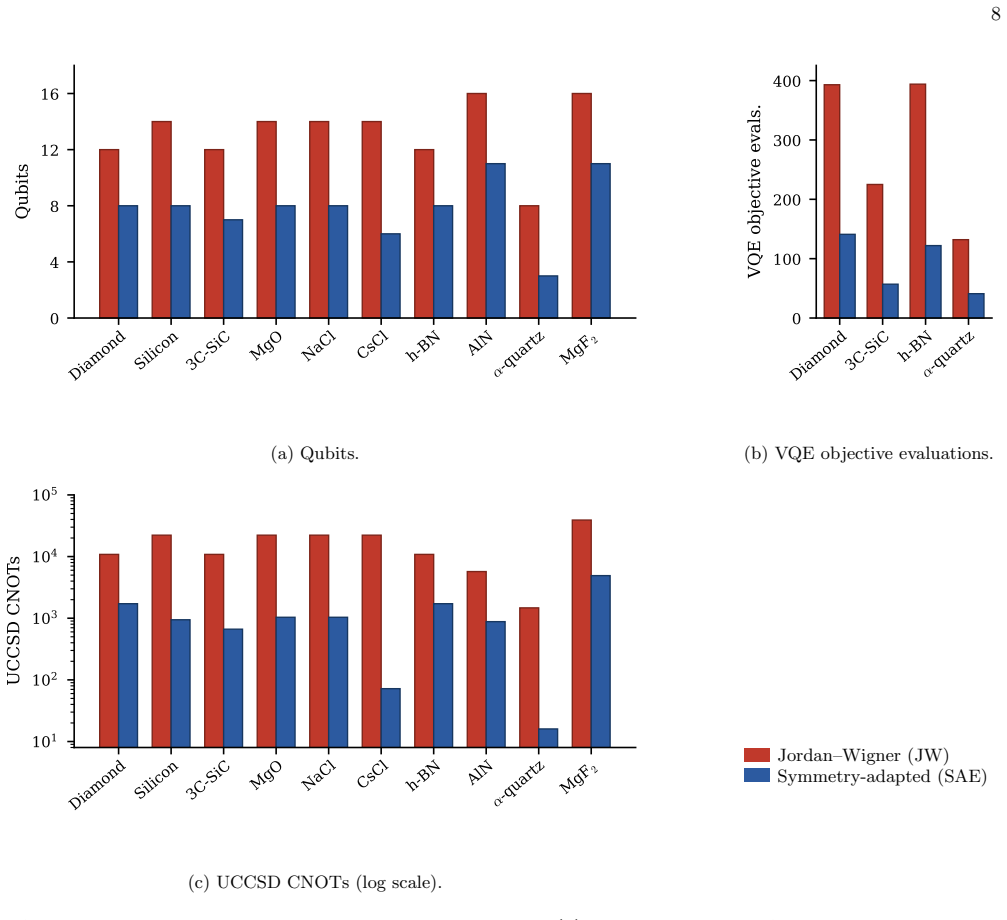
By constructing a Γ-point supercell Hamiltonian from a folded k-point calculation and systematically identifying spin-parity, point-group, and crystal translation symmetries, the periodic SAE produces qubit Hamiltonians with 4-8 fewer qubits than Jordan-Wigner; the largest reduction occurs for B2 CsCl where eight independent Boolean generators yield a symmetry group isomorphic to Z_2^8, mapping a CAS(6,7) problem from 14 to 6 qubits, while UCCSD-VQE energies stay below chemical accuracy and circuit resources drop by factors of 3-8 for parameters and up to 309 for CNOTs.
What carries the argument
Periodic symmetry-adapted encoding, which maps the full set of commuting space-group generators (spin-parity, point-group operations, and half-translations) onto independent Boolean symmetries that block-diagonalise the active-space Hamiltonian.
If this is right
- The reduced encodings preserve target energies to well below chemical accuracy in noiseless UCCSD-VQE.
- Variational parameter counts fall by factors of 3-8 relative to the unreduced case.
- CNOT gate counts fall by up to 309 times, with the largest savings when translation and point-group generators act independently.
- The approach works uniformly across cubic, hexagonal, trigonal, and tetragonal space groups when active spaces retain complete near-degenerate manifolds.
Where Pith is reading between the lines
- The extra half-translation generators supplied by the folded supercell could allow active-space sizes that remain intractable under molecular SAE alone.
- If the same folding procedure applies to supercells containing defects or surfaces, the qubit savings would extend beyond perfect crystals.
- The observed circuit compression suggests that periodic SAE could be combined with existing ansatz pruning techniques to push feasible system sizes on near-term hardware.
Load-bearing premise
Folding the k-point supercell to the Gamma point preserves every near-degenerate frontier orbital manifold and permits complete, error-free identification of all commuting space-group generators.
What would settle it
An exact-diagonalisation comparison on any benchmark material in which the reduced-encoding VQE energy deviates from the full-encoding energy by more than chemical accuracy.
Figures
read the original abstract
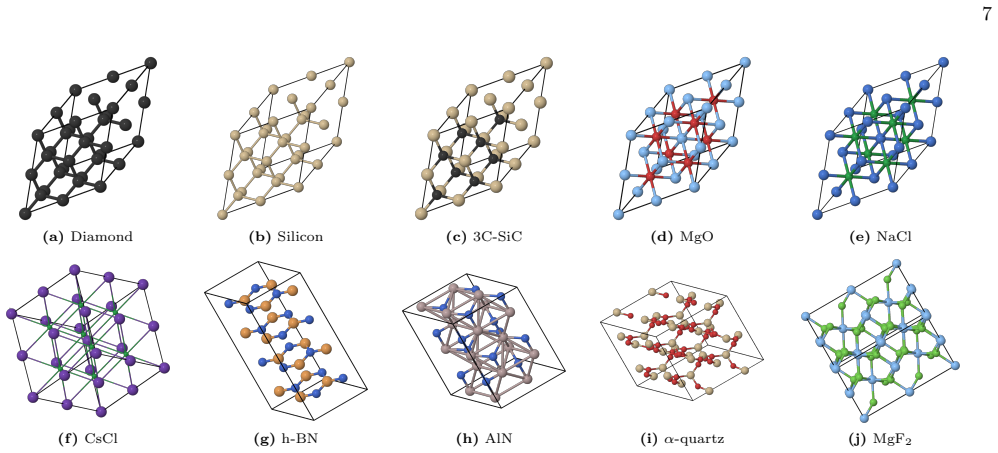
We extend the symmetry-adapted encoding (SAE) framework to periodic electronic structure, enabling qubit-efficient quantum simulation of crystalline materials. By constructing a $\Gamma$-point supercell Hamiltonian from a folded $k$-point calculation and systematically identifying all applicable space-group symmetry generators -- including spin-parity, point-group, and crystal translation symmetries -- we obtain qubit Hamiltonians with fewer qubits than the Jordan--Wigner starting point. We benchmark diamond, silicon, 3C-SiC, MgO, NaCl, CsCl, h-BN, wurtzite AlN, $\alpha$-quartz SiO$_2$, and MgF$_2$ using active spaces chosen to preserve complete near-degenerate frontier manifolds across cubic, hexagonal, trigonal, and tetragonal space groups. Across the suite the periodic SAE removes 4--8 qubits. The B2 CsCl benchmark realises eight independent Boolean generators, i.e. a symmetry group isomorphic to $\mathbb{Z}_2^8$, reducing CAS(6,7) from 14 to 6 qubits. This exceeds the $\mathbb{Z}_2^5$ maximum of molecular SAE, where only two spin parities and at most three independent Boolean point-group generators are available, because the folded crystal supplies three additional half-translation symmetries. Noiseless UCCSD-VQE benchmarks against exact diagonalisation in the active-space sector show that the reduced encodings preserve the target energies to well below chemical accuracy while reducing variational parameter counts by $3$--$8\times$ and CNOT counts by up to $309\times$. The largest circuit savings occur when translation and point-group generators act independently in the active space, demonstrating that periodic symmetry can be converted directly into both qubit and ansatz compression. The method is implemented in the open-source QuantumSymmetry package and requires no manual specification of symmetry generators.
Editorial analysis
A structured set of objections, weighed in public.
Referee Report
Summary. The manuscript extends the symmetry-adapted encoding (SAE) framework from molecular to periodic electronic structure by folding k-point calculations into a Γ-point supercell Hamiltonian, then systematically extracting commuting space-group symmetry generators (spin-parity, point-group, and half-translation) to produce qubit-reduced Hamiltonians. It reports 4–8 qubit reductions across ten materials (diamond, silicon, CsCl, etc.) with active spaces chosen to retain near-degenerate frontier manifolds; the CsCl CAS(6,7) case achieves an eight-generator ℤ₂⁸ reduction from 14 to 6 qubits. Noiseless UCCSD-VQE benchmarks are stated to match exact diagonalization to well below chemical accuracy while cutting variational parameters by 3–8× and CNOT counts by up to 309×. The method is implemented in the open-source QuantumSymmetry package.
Significance. If the central claims are substantiated, the work supplies a concrete route to convert crystal symmetries—especially the additional half-translation generators unavailable in molecular SAE—into both qubit and ansatz compression for crystalline Hamiltonians. The reported circuit savings and the open-source implementation constitute reproducible strengths that could accelerate variational simulations of periodic systems.
major comments (3)
- [Abstract] Abstract (CsCl benchmark paragraph): the claim that eight independent Boolean generators forming ℤ₂⁸ reduce CAS(6,7) from 14 to 6 qubits while preserving energies below chemical accuracy is load-bearing, yet the manuscript supplies neither the explicit list of generators nor any equation or table verifying that each commutes with the folded supercell Hamiltonian.
- [Abstract] Abstract (benchmark suite): the assertion that the folded Γ-point supercell Hamiltonian 'preserves complete near-degenerate frontier manifolds' for all listed materials is required for both the qubit-reduction counts and the VQE accuracy statements, but no derivation, active-space selection criteria, or numerical check of manifold preservation is provided.
- [Abstract] Abstract (VQE benchmarks): the statements that reduced encodings 'preserve the target energies to well below chemical accuracy' and yield up to 309× CNOT reduction rest on comparisons to exact diagonalization, yet no tables, figures, or numerical energy differences are supplied, preventing independent verification of the accuracy claim.
Simulated Author's Rebuttal
We thank the referee for the constructive comments, which identify specific gaps in substantiation for the abstract claims. We will revise the manuscript to incorporate the requested details, tables, and verifications while preserving the concise nature of the abstract.
read point-by-point responses
-
Referee: [Abstract] Abstract (CsCl benchmark paragraph): the claim that eight independent Boolean generators forming ℤ₂⁸ reduce CAS(6,7) from 14 to 6 qubits while preserving energies below chemical accuracy is load-bearing, yet the manuscript supplies neither the explicit list of generators nor any equation or table verifying that each commutes with the folded supercell Hamiltonian.
Authors: We agree the abstract claim requires explicit support. The main text outlines the systematic extraction of space-group generators, but the manuscript does not provide the explicit list or commutation table for the CsCl case. In revision we will add a dedicated table listing the eight generators (spin-parity, point-group, and half-translation) together with their commutation relations to the folded Hamiltonian. revision: yes
-
Referee: [Abstract] Abstract (benchmark suite): the assertion that the folded Γ-point supercell Hamiltonian 'preserves complete near-degenerate frontier manifolds' for all listed materials is required for both the qubit-reduction counts and the VQE accuracy statements, but no derivation, active-space selection criteria, or numerical check of manifold preservation is provided.
Authors: The active-space construction is described in the methods as selecting complete near-degenerate frontier manifolds, yet the manuscript lacks an explicit derivation or per-material verification table. We will add a supplementary section or table that states the selection criteria (orbital energy windows and degeneracy thresholds) and provides numerical checks confirming manifold preservation for each of the ten materials. revision: yes
-
Referee: [Abstract] Abstract (VQE benchmarks): the statements that reduced encodings 'preserve the target energies to well below chemical accuracy' and yield up to 309× CNOT reduction rest on comparisons to exact diagonalization, yet no tables, figures, or numerical energy differences are supplied, preventing independent verification of the accuracy claim.
Authors: The manuscript states that noiseless UCCSD-VQE matches exact diagonalization to well below chemical accuracy and reports circuit savings, but does not include the supporting numerical tables or figures. We will insert a results table (or figure) reporting the energy differences (in mHa) for each material and the corresponding CNOT counts before and after reduction. revision: yes
Circularity Check
No significant circularity; derivation is constructive and self-contained
full rationale
The paper's central procedure identifies commuting space-group generators (spin-parity, point-group, half-translations) directly from the folded Γ-point supercell Hamiltonian and converts them into Boolean qubit reductions. This is an explicit, algorithmic extraction rather than any self-definitional loop, fitted parameter renamed as prediction, or load-bearing self-citation chain. Benchmarks against exact diagonalization supply independent numerical verification of energy preservation. The extension of molecular SAE supplies context but does not reduce the reported periodic reductions (4–8 qubits, Z₂⁸ for CsCl) to prior inputs by construction.
Axiom & Free-Parameter Ledger
axioms (1)
- domain assumption Space-group symmetries (including translations) commute with the electronic Hamiltonian and can be used to construct a symmetry-adapted qubit encoding.
Reference graph
Works this paper leans on
-
[1]
KRHF calculation on the primitive cell atN k k- points usingPySCF
-
[2]
Folding to a commensurate Γ-point supercell rep- resentation
-
[3]
Symmetry-adaptation of the supercell MOs: degen- erate blocks are diagonalised in the basis of crystal translation operators and space-group involutions
-
[4]
Active-space Hamiltonian construction using the selected MOs and density-fitted two-electron inte- grals
-
[5]
Automatic detection of allZ 2 generators (spin- parity, point-group, translation)
-
[6]
Affine Clifford reduction to theN red-qubit Hamil- tonian. The method is implemented in the open-source QuantumSymmetryPython package and requires only standard periodic chemistry inputs: cell geometry, ba- sis set,k-point mesh, and active MO indices. III. RESUL TS A. Benchmark systems We benchmark the periodic SAE on ten insulating or semiconducting crys...
-
[7]
Picozzi and J
D. Picozzi and J. Tennyson, Symmetry-adapted encod- ings for qubit number reduction by point-group and other Boolean symmetries, Quantum Science and Technology 8, 035026 (2023)
2023
-
[8]
Picozzi and J
D. Picozzi and J. Tennyson, Symmetry-adapted qubit encoding with complete active space and Bravyi–Kitaev mapping for quantum chemistry on a quantum computer (2026), manuscript in preparation
2026
-
[9]
Babbush, C
R. Babbush, C. Gidney, D. W. Berry, N. Wiebe, J. Mc- Clean, A. Paler, A. Fowler, and H. Neven, Encoding elec- tronic spectra in quantum circuits with linear T complex- ity, Physical Review X8, 041015 (2018)
2018
-
[10]
Y. Su, D. W. Berry, N. Wiebe, N. Rubin, and R. Bab- bush, Fault-tolerant quantum simulations of chemistry in first quantization, PRX Quantum2, 040332 (2021)
2021
-
[11]
Bauer, S
B. Bauer, S. Bravyi, M. Motta, and G. K.-L. Chan, Quantum algorithms for quantum chemistry and quan- tum materials science, Chemical Reviews120, 12685 (2020)
2020
-
[12]
Yoshioka, T
N. Yoshioka, T. Zhao, Y. O. Nakagawa, and W. Mizukami, Hunting for quantum-classical crossover in condensed matter problems, npj Quantum Informa- tion8, 2 (2022)
2022
-
[13]
N. C. Rubin, D. W. Berry, H. Khatri, J. Lee, and R. Bab- bush, Fault-tolerant quantum simulation of materials us- ing Bloch orbitals, PRX Quantum4, 040303 (2023)
2023
-
[14]
H. Ma, M. Govoni, and G. Galli, Quantum simulations of materials on near-term quantum computers, npj Com- putational Materials6, 85 (2020)
2020
-
[15]
J. Liu, Y. Fan, Z. Li, and J. Yang, Quantum algorithms for electronic structures: basis sets and boundary condi- tions, Chemical Society Reviews51, 3263 (2022)
2022
-
[16]
N. W. Ashcroft and N. D. Mermin,Solid State Physics (Holt, Rinehart and Winston, New York, 1976)
1976
-
[17]
R. M. Martin,Electronic Structure: Basic Theory and Practical Methods(Cambridge University Press, Cam- bridge, 2004)
2004
-
[18]
C. J. Bradley and A. P. Cracknell,The Mathematical Theory of Symmetry in Solids: Representation Theory for Point Groups and Space Groups(Dover Publications, Mineola, NY, 2010)
2010
-
[19]
McClain, Q
J. McClain, Q. Sun, G. K.-L. Chan, and T. C. Berkel- bach, Gaussian-based coupled-cluster theory for the ground-state and band structure of solids, Journal of Chemical Theory and Computation13, 1209 (2017)
2017
-
[20]
Tapering off qubits to simulate fermionic Hamiltonians
S. Bravyi, J. M. Gambetta, A. Mezzacapo, and K. Temme, Tapering off qubits to simulate fermionic Hamiltonians, arXiv1701.08213(2017), arXiv:1701.08213
work page internal anchor Pith review Pith/arXiv arXiv 2017
-
[21]
Setia, R
K. Setia, R. Chen, J. E. Rice, A. Mezzacapo, M. Pistoia, and J. D. Whitfield, Reducing qubit requirements for quantum simulations using molecular point group sym- metries, Journal of Chemical Theory and Computation 16, 6091 (2020)
2020
-
[22]
Helgaker, P
T. Helgaker, P. Jørgensen, and J. Olsen,Molecular Electronic-Structure Theory(John Wiley & Sons, Chich- ester, 2000)
2000
-
[23]
Q. Sun, X. Zhang, S. Banerjee, P. Bao, M. Barbry, N. S. Blunt, N. A. Bogdanov, G. H. Booth, J. Chen, Z.-H. Cui, J. J. Eriksen, Y. Gao, S. Guo, J. Hermann, M. R. Hermes, K. Koh, P. Koval, S. Lehtola, Z. Li, J. Liu, N. Mardirossian, J. D. McClain, M. Motta, B. Mussard, H. Q. Pham, A. Pulkin, W. Purwanto, P. J. Robin- son, E. Ronca, E. R. Sayfutyarova, M. Sc...
2020
-
[24]
Q. Sun, T. C. Berkelbach, N. S. Blunt, G. H. Booth, S. Guo, Z. Li, J. Liu, J. D. McClain, E. R. Sayfut- yarova, S. Sharma, S. Wouters, and G. K.-L. Chan, PySCF: the Python-based simulations of chemistry framework, WIREs Computational Molecular Science8, e1340 (2018)
2018
-
[25]
Q. Sun, T. C. Berkelbach, J. D. McClain, and G. K.- L. Chan, Gaussian and plane-wave mixed density fitting for periodic systems, Journal of Chemical Physics147, 164119 (2017)
2017
-
[26]
P. P. Ewald, Die Berechnung optischer und elektro- statischer Gitterpotentiale, Annalen der Physik369, 253 (1921)
1921
-
[27]
Jordan and E
P. Jordan and E. P. Wigner, ¨Uber das Paulische ¨ aquivalenzverbot, Zeitschrift f¨ ur Physik47, 631 (1928)
1928
-
[28]
Goedecker, M
S. Goedecker, M. Teter, and J. Hutter, Separable dual- space Gaussian pseudopotentials, Physical Review B54, 1703 (1996)
1996
-
[29]
Hartwigsen, S
C. Hartwigsen, S. Goedecker, and J. Hutter, Relativistic separable dual-space Gaussian pseudopotentials from H to Rn, Physical Review B58, 3641 (1998)
1998
-
[30]
Romero, R
J. Romero, R. Babbush, J. R. McClean, C. Hempel, P. J. Love, and A. Aspuru-Guzik, Strategies for quantum com- puting molecular energies using the unitary coupled clus- ter ansatz, Quantum Science and Technology4, 014008 (2018)
2018
-
[31]
J. R. McClean, J. Romero, R. Babbush, and A. Aspuru- Guzik, The theory of variational hybrid quantum- classical algorithms, New Journal of Physics18, 023023 (2016)
2016
-
[32]
L. M. Fraser, W. M. C. Foulkes, G. Rajagopal, R. J. Needs, S. D. Kenny, and A. J. Williamson, Finite-size effects and Coulomb interactions in quantum Monte Carlo calculations for homogeneous systems with peri- odic boundary conditions, Physical Review B53, 1814 (1996)
1996
discussion (0)
Sign in with ORCID, Apple, or X to comment. Anyone can read and Pith papers without signing in.