REVIEW 2 major objections 1 minor 48 references
Fractional short-time dynamics in driven quantum gases
T0 review · 2 major / 1 minor · reviewed 2026-07-01 · grok-4.3
Pith's one-line read The pairing amplitude at small separation in driven quantum gases obeys a fractional differential equation derived from the time-dependent interaction.
desk verdict The paper derives a fractional DE for short-distance pairing amplitude under time-dependent interactions and ties it to a nonrelativistic conformal fixed point with self-similar scaling. read the letter →
The pith
A machine-rendered reading of the paper's core claim, the machinery that carries it, and where it could break.
The reading
What carries the argument
The fractional differential equation for the pairing amplitude at small separation, obtained directly from the time-dependent short-range interaction.
What would settle it
A time-resolved measurement of the short-distance pairing amplitude after a sudden quench that deviates from the analytic solution of the fractional differential equation would falsify the claim.
Extended reading notes
Core claim
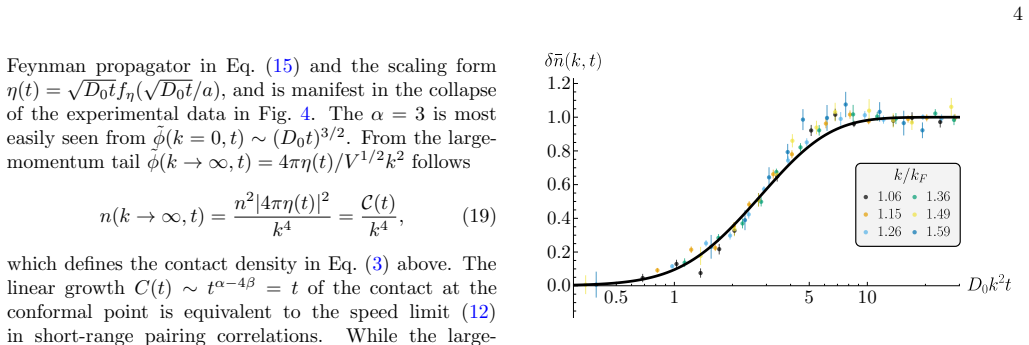
We find that the pairing amplitude at small separation satisfies a fractional differential equation (FDE). We derive analytic solutions of the pairing evolution for sudden interaction quenches and power-law drives toward resonant scattering. We observe universal short-time dynamics governed by a nonrelativistic conformal fixed point at which the momentum distribution exhibits self-similar dynamic scaling, in quantitative agreement with experiment. At longer times, many-body effects induce relaxation toward an equilibrium state. In this limit, the FDE turns into a Müller-Israel-Stewart type equation that describes a hydrodynamic attractor approaching equilibrium.
Load-bearing premise
The pairing amplitude at small separation can be isolated from longer-range many-body effects and obeys a closed fractional differential equation derived solely from the time-dependent short-range interaction.
Editorial extensions
If this is right
- Analytic expressions exist for the pairing evolution under sudden quenches and power-law drives.
- Short-time dynamics is universal and controlled by a nonrelativistic conformal fixed point.
- The momentum distribution displays self-similar dynamic scaling at early times.
- At later times the equation reduces to a hydrodynamic attractor that relaxes to equilibrium.
Reading between the lines
- The same fractional equation may describe short-time pair formation in other systems with tunable short-range interactions, such as Rydberg gases or excitons.
- The conformal fixed point identified here could be used to classify scaling in other nonrelativistic driven systems without needing microscopic details.
- Extending the drive protocols beyond power laws might reveal additional fixed points or crossover behaviors that experiments could target.
Editorial analysis
A structured set of objections, weighed in public.
Referee Report
Summary. The manuscript claims that in quantum gases with time-dependent short-range attractive interactions, the pairing amplitude at small separation obeys a closed fractional differential equation (FDE). Analytic solutions are derived for sudden quenches and power-law drives toward resonance. Universal short-time dynamics are identified at a nonrelativistic conformal fixed point, producing self-similar scaling in the momentum distribution that agrees quantitatively with experiment. At longer times, many-body effects cause relaxation, with the FDE reducing to a Müller-Israel-Stewart hydrodynamic attractor equation.
Significance. If the derivation of the isolated FDE is rigorous and the experimental agreement is not post-hoc, the work would supply an analytic bridge between few-body pairing dynamics, fractional calculus, and conformal symmetry in driven quantum gases, with potential implications for non-equilibrium universality and hydrodynamic attractors.
major comments (2)
- [Abstract] Abstract (first paragraph): the central claim that the pairing amplitude at small separation satisfies a closed FDE derived solely from the time-dependent short-range interaction rests on the unverified assumption that longer-range many-body effects can be neglected at short times; without the explicit derivation steps showing how the FDE is obtained and closed, it is impossible to assess whether this isolation is justified or introduces uncontrolled approximations.
- [Abstract] Abstract: the statement of 'quantitative agreement with experiment' for the self-similar dynamic scaling at the conformal fixed point does not specify whether the scaling exponents or fixed-point parameters are independently predicted from the FDE or adjusted to the same data used for validation; this distinction is load-bearing for the universality claim and must be demonstrated with explicit comparison (e.g., via a table of predicted vs. measured exponents).
minor comments (1)
- [Abstract] The transition from the FDE to the Müller-Israel-Stewart equation at longer times is stated without indicating the section or intermediate steps where the many-body terms are reintroduced.
Simulated Author's Rebuttal
We thank the referee for their careful reading and constructive comments on our manuscript. We address the two major comments point by point below, providing clarifications from the full text and indicating where revisions will strengthen the presentation.
read point-by-point responses
-
Referee: [Abstract] Abstract (first paragraph): the central claim that the pairing amplitude at small separation satisfies a closed FDE derived solely from the time-dependent short-range interaction rests on the unverified assumption that longer-range many-body effects can be neglected at short times; without the explicit derivation steps showing how the FDE is obtained and closed, it is impossible to assess whether this isolation is justified or introduces uncontrolled approximations.
Authors: The derivation of the closed FDE is given explicitly in Section II of the manuscript. Starting from the time-dependent two-body Schrödinger equation with a short-range attractive potential, we integrate over high-momentum components and obtain the fractional differential equation for the pairing amplitude at small separation. The isolation follows from a controlled short-time expansion in which longer-range many-body correlations enter only at higher orders due to the locality of the contact interaction; this is not an assumption but a consequence of the separation between the ultraviolet two-body scale and infrared many-body scales. We will revise the abstract to include a brief reference to this derivation in Section II. revision: yes
-
Referee: [Abstract] Abstract: the statement of 'quantitative agreement with experiment' for the self-similar dynamic scaling at the conformal fixed point does not specify whether the scaling exponents or fixed-point parameters are independently predicted from the FDE or adjusted to the same data used for validation; this distinction is load-bearing for the universality claim and must be demonstrated with explicit comparison (e.g., via a table of predicted vs. measured exponents).
Authors: The scaling exponents and fixed-point parameters are obtained analytically from the exact solution of the FDE at the nonrelativistic conformal fixed point (Section III), independent of any experimental input. These predictions are then compared to the measured momentum distributions. To make the distinction explicit, we will add a table in the revised manuscript that lists the FDE-derived exponents alongside the corresponding experimental values. revision: yes
Circularity Check
No significant circularity detected
full rationale
The provided abstract and description indicate that the central claim is a derivation of a closed FDE for the short-distance pairing amplitude directly from the time-dependent short-range interaction, followed by analytic solutions for quenches and drives, and observation of universal scaling. No self-definitional steps, fitted inputs renamed as predictions, load-bearing self-citations, or ansatzes smuggled via prior work are quoted or described. The derivation is presented as independent, with experimental agreement as external validation rather than input. This qualifies as self-contained against benchmarks, warranting score 0.
Assumptions & free parameters
assumptions (1)
- domain assumption Short-range attractive interactions cause pairing that can be isolated at small separation
Cite this review
Pith. "Pith review of Fractional short-time dynamics in driven quantum gases." pith.science (2026). https://pith.science/paper/NG3L3UAU
@misc{pith2026260528606,
  author       = {Pith},
  title        = {Pith review of: Fractional short-time dynamics in driven quantum gases},
  year         = {2026},
  howpublished = {\url{https://pith.science/paper/NG3L3UAU}},
  note         = {Machine review of arXiv:2605.28606}
}
read the original abstract
Quantum gases with short-range attractive interaction tend to form pairs. For time-dependent interaction we find that the pairing amplitude at small separation satisfies a fractional differential equation (FDE). We derive analytic solutions of the pairing evolution for sudden interaction quenches and power-law drives toward resonant scattering. We observe universal short-time dynamics governed by a nonrelativistic conformal fixed point at which the momentum distribution exhibits self-similar dynamic scaling, in quantitative agreement with experiment. At longer times, many-body effects induce relaxation toward an equilibrium state. In this limit, the FDE turns into a M\"uller-Israel-Stewart type equation that describes a hydrodynamic attractor approaching equilibrium.
Figures


Figures from the paper (1 more)

Reference graph
Works this paper leans on
-
[1]
to interacting particles (a(t >0) =a). For the attrac- tor solution (13) we obtain ˜ϕ(k, t) = −4πa V 1/2k2 h 1− k2a2 1 +k 2a2 erfcx(− p iD0t/a) − 1−kaerfi( √iD0k2t) 1 +k 2a2 exp(−iD0k2t) i ; (15) its Fourier transform agrees withϕ(r, t) computed in [28]. Specifically for a quench to the scattering resonance 1/a→0, this simplifies to (cf. [10] for a trappe...
-
[2]
A. Polkovnikov, K. Sengupta, A. Silva, and M. Vengalat- tore, Colloquium: Nonequilibrium dynamics of closed in- teracting quantum systems, Rev. Mod. Phys.83, 863 (2011)
work page 2011
-
[3]
C. Gogolin and J. Eisert, Equilibration, thermalisation, and the emergence of statistical mechanics in closed quantum systems, Rep. Prog. Phys.79, 056001 (2016)
work page 2016
- [4]
-
[5]
P. Calabrese and J. Cardy, Evolution of entanglement entropy in one-dimensional systems, J. Stat. Mech.2005, P04010 (2005)
work page 2005
-
[6]
A. M. Kaufman, M. E. Tai, A. Lukin, M. Rispoli, R. Schittko, P. M. Preiss, and M. Greiner, Quantum ther- malization through entanglement in an isolated many- body system, Science353, 794 (2016)
work page 2016
- [7]
- [8]
Show all 48 references
-
[9]
Ueda, Quantum equilibration, thermalization and prethermalization in ultracold atoms, Nature Rev
M. Ueda, Quantum equilibration, thermalization and prethermalization in ultracold atoms, Nature Rev. Phys. 2, 669 (2020)
2020
-
[10]
Makotyn, C
P. Makotyn, C. E. Klauss, D. L. Goldberger, E. A. Cor- nell, and D. S. Jin, Universal dynamics of a degenerate unitary Bose gas, Nature Phys.10, 116 (2014)
2014
-
[11]
A. G. Sykes, J. P. Corson, J. P. D’Incao, A. P. Koller, C. H. Greene, A. M. Rey, K. R. A. Hazzard, and J. L. Bohn, Quenching to unitarity: Quantum dynamics in a three-dimensional Bose gas, Phys. Rev. A89, 021601(R) (2014)
2014
-
[12]
L. W. Clark, A. Gaj, L. Feng, and C. Chin, Collective emission of matter-wave jets from driven Bose-Einstein condensates, Nature551, 356 (2017)
2017
-
[13]
Liebster, M
N. Liebster, M. Sparn, E. Kath, J. Duchene, K. Fujii, S. L. G¨ orlitz, T. Enss, H. Strobel, and M. K. Oberthaler, Observation of pattern stabilization in a driven super- fluid, Phys. Rev. X15, 011026 (2025)
2025
-
[14]
Huang and M
C.-H. Huang and M. A. Cazalilla, Total energy dynamics and asymptotics of the momentum distribution follow- ing an interaction quench in a two-component Fermi gas, Phys. Rev. A99, 063612 (2019)
2019
-
[15]
R. Qi, Z. Shi, and H. Zhai, Maximum Energy Growth Rate in Dilute Quantum Gases, Phys. Rev. Lett.126, 240401 (2021)
2021
-
[16]
P. Dyke, A. Hogan, I. Herrera, C. C. N. Kuhn, S. Hoinka, and C. J. Vale, Dynamics of a Fermi gas quenched to unitarity, Phys. Rev. Lett.127, 100405 (2021)
2021
-
[17]
L. Yi, S. Yu, M. Wu, S. Deng, and H. Wu, Quantum Thermalization Dynamics of Fermi Gases Quenched to the BEC-BCS Crossover, Adv. Sci.2025, e07343 (2025)
2025
-
[18]
F. J. Vivanco, A. Schuckert, S. Huang, G. L. Schumacher, G. G. T. Assump¸ c˜ ao, Y. Ji, J. Chen, M. Knap, and N. Navon, The strongly driven Fermi polaron, Nature Phys.21, 564 (2025)
2025
-
[19]
K. G. S. Xie, C. J. Dale, K. P. Grehan, M. F. Wang, T. Enss, P. S. Julienne, Z. Yu, and J. H. Thywissen, Dimer-projection contact and the clock shift of a unitary Fermi gas, Phys. Rev. Lett.136, 083402 (2026)
2026
-
[20]
M. P. Heller and M. Spali´ nski, Hydrodynamics beyond the gradient expansion: resurgence and resummation, Phys. Rev. Lett.115, 072501 (2015)
2015
-
[21]
Soloviev, Hydrodynamic attractors in heavy ion colli- sions: a review, Eur
A. Soloviev, Hydrodynamic attractors in heavy ion colli- sions: a review, Eur. Phys. J. C82, 319 (2022)
2022
-
[22]
Fujii and T
K. Fujii and T. Enss, Hydrodynamic Attractor in Ultra- cold Atoms, Phys. Rev. Lett.133, 173402 (2024)
2024
-
[23]
Mazeliauskas and T
A. Mazeliauskas and T. Enss, Hydrodynamic attractor in periodically driven ultracold quantum gases, Phys. Rev. Lett.136, 103402 (2026)
2026
-
[24]
Tan, Energetics of a strongly correlated Fermi gas, Ann
S. Tan, Energetics of a strongly correlated Fermi gas, Ann. Phys. (N.Y.)323, 2952 (2008)
2008
-
[25]
Tan, Large momentum part of a strongly correlated Fermi gas, Ann
S. Tan, Large momentum part of a strongly correlated Fermi gas, Ann. Phys. (N.Y.)323, 2971 (2008)
2008
-
[26]
Maki and F
J. Maki and F. Zhou, Quantum Many-Body Conformal Dynamics: Symmetries, Geometry, Conformal Tower States, and Entropy Production, Phys. Rev. A100, 023601 (2019)
2019
-
[27]
Martirosyan, M
G. Martirosyan, M. Gazo, J. Etrych, S. M. Fischer, S. J. Morris, C. J. Ho, C. Eigen, and Z. Hadzibabic, A univer- sal speed limit for spreading of coherence, Nature647, 608 (2025)
2025
-
[28]
T. Enss, N. C. Braatz, and G. Gori, Complex scaling flows in the quench dynamics of interacting particles, Phys. Rev. A106, 013308 (2022)
2022
-
[29]
Drescher, M
M. Drescher, M. Salmhofer, and T. Enss, Quench Dy- namics of the Ideal Bose Polaron at Zero and Nonzero Temperatures, Phys. Rev. A103, 033317 (2021)
2021
-
[30]
Sabzikar, M
F. Sabzikar, M. M. Meerschaert, and J. Chen, Tempered fractional calculus, J. Comput. Phys.293, 14 (2015)
2015
-
[31]
T. Enss, R. Haussmann, and W. Zwerger, Viscosity and scale invariance in the unitary Fermi gas, Ann. Phys. (N.Y.)326, 770 (2011)
2011
-
[32]
Rossi, T
R. Rossi, T. Ohgoe, E. Kozik, N. Prokof’ev, B. Svistunov, K. Van Houcke, and F. Werner, Contact and momentum distribution of the unitary Fermi gas, Phys. Rev. Lett. 121, 130406 (2018)
2018
-
[33]
Mukherjee, P
B. Mukherjee, P. B. Patel, Z. Yan, R. J. Fletcher, J. Struck, and M. W. Zwierlein, Spectral response and contact of the unitary Fermi gas, Phys. Rev. Lett.122, 203402 (2019)
2019
-
[34]
A. A. Kilbas and M. Saigo, On mittag-leffler type func- tion, fractional calculas operators and solutions of in- tegral equations, Integral Transforms and Special Func- tions4, 355 (1996)
1996
-
[35]
A. A. Kilbas,Theory and Applications of Fractional Dif- ferential Equations, North-Holland Mathematics Studies No. 204 (Elsevier, Boston, 2006)
2006
-
[36]
Boudabsa and T
L. Boudabsa and T. Simon, Some properties of the kilbas- saigo function, Mathematics9, 10.3390/math9030217 (2021). 9
2021 doi
-
[37]
Garrappa, Predictor-corrector for FDEs (MATLAB), version 2.0 (2025)
R. Garrappa, Predictor-corrector for FDEs (MATLAB), version 2.0 (2025)
2025
-
[38]
Garrappa, Numerical Solution of Fractional Differen- tial Equations: A Survey and a Software Tutorial, Math- ematics6, 16 (2018)
R. Garrappa, Numerical Solution of Fractional Differen- tial Equations: A Survey and a Software Tutorial, Math- ematics6, 16 (2018)
2018
-
[39]
Diethelm and A
K. Diethelm and A. D. Freed, The FracPECE subroutine for the numerical solution of differential equations of frac- tional order, Forschung und wissenschaftliches Rechnen 1999, 57 (1998)
1999
-
[40]
Nishida, Viscosity spectral functions of resonating fermions in the quantum virial expansion, Ann
Y. Nishida, Viscosity spectral functions of resonating fermions in the quantum virial expansion, Ann. Phys. (N.Y.)410, 167949 (2019)
2019
-
[41]
Enss, Bulk Viscosity and Contact Correlations in Attractive Fermi Gases, Phys
T. Enss, Bulk Viscosity and Contact Correlations in Attractive Fermi Gases, Phys. Rev. Lett.123, 205301 (2019)
2019
-
[42]
Hofmann, High-temperature expansion of the viscosity in interacting quantum gases, Phys
J. Hofmann, High-temperature expansion of the viscosity in interacting quantum gases, Phys. Rev. A101, 013620 (2020)
2020
-
[43]
C. H. Johansen, B. Frank, and J. Lang, Spectral functions of the strongly interacting three-dimensional Fermi gas, Phys. Rev. A109, 023324 (2024)
2024
-
[44]
Enss, Particle and pair spectra for strongly correlated Fermi gases: A real-frequency solver, Phys
T. Enss, Particle and pair spectra for strongly correlated Fermi gases: A real-frequency solver, Phys. Rev. A109, 023325 (2024)
2024
-
[45]
Dizer, J
E. Dizer, J. Horak, and J. M. Pawlowski, Spectral proper- ties and observables in ultracold Fermi gases, Phys. Rev. A109, 063311 (2024)
2024
-
[46]
Hudson Smith, Inducing resonant interactions in ul- tracold atoms with a modulated magnetic field, Phys
D. Hudson Smith, Inducing resonant interactions in ul- tracold atoms with a modulated magnetic field, Phys. Rev. Lett.115, 193002 (2015)
2015
-
[47]
A. A. Kilbas and M. Saigo, On solution of integral equation of Abel-Volterra type, Differential and Integral Equations8, 10.57262/die/1369056041 (1995)
1995 doi
-
[48]
Gorenflo, A
R. Gorenflo, A. Kilbas, and S. Rogosin, On the gener- alized mittag-leffler type functions, Integral Transforms and Special Functions7, 215 (1998)
1998
Reviewed July 1, 2026 · model on record in the stance chip above.
Discussion (0). Sign in to comment.