REVIEW 3 major objections 4 minor 65 references
Coloring Between the Lines: Personalization in the Null Space of Planning Constraints
T0 review · 3 major / 4 minor · reviewed 2026-08-07 · deepseek-v4-flash
Pith's one-line read This paper proposes that a robot can personalize to an individual user by learning parameterized constraints that select among the already-safe solutions of its planning constraints, rather than by changing those constraints.
desk verdict Solid framework paper for robot personalization via CSP null-space constraints; safety claim needs scoping but the mechanism and evaluation hold up. read the letter →
The pith
A machine-rendered reading of the paper's core claim, the machinery that carries it, and where it could break.
The reading
What carries the argument
The central object is the CSP null space: the set of assignments satisfying the robot's non-personalized constraints. CBTL's machinery is a CSP generator augmented with personalization generators, each of which emits parameterized constraints; parameters are learned online from interaction, and an entropy-based mathematical program selects solutions with maximum uncertainty about the user. A sampling-based solver finds solutions, with a fallback that re-plans without personalized constraints if they are unsatisfiable. This setup lets the robot personalize by reducing the null space rather than moving outside it.
What would settle it
Give CBTL a CSP generator that omits a collision constraint between the robot arm and the user's torso during feeding, then run it in a physical or simulated feeding task; if the robot ever executes a torso-colliding configuration while satisfying the stated constraints and the user-adaptive objective, the claim that personalization stays in a safe null space is refuted.
Extended reading notes
Core claim
The central claim is that the multiplicity of solutions of a planning constraint satisfaction problem is not a nuisance but a resource: it is a null space within which a robot can safely adapt to an individual user. CBTL operationalizes this by generating parameterized personalized constraints alongside the original constraints, where each constraint is produced by a generator with an initiation condition and a learnable parameter, and by updating those parameters from feedback history through supervised classification for numeric parameters and through natural-language summaries for large-language-model-implemented constraints. Active learning then solves an entropy-maximization program over the CSP's null space to pick the most informative next behavior. The paper demonstrates that this yields continual, flexible, active, and safe personalization in simulation, in a 60-participant web study, and on a real feeding robot.
Load-bearing premise
The robot's safety and everyday competence are entirely contained in the hand-written constraints of the CSP generator; if a constraint is missing or wrong, CBTL can freely explore behavior that is unsafe while still appearing to personalize.
Editorial extensions
If this is right
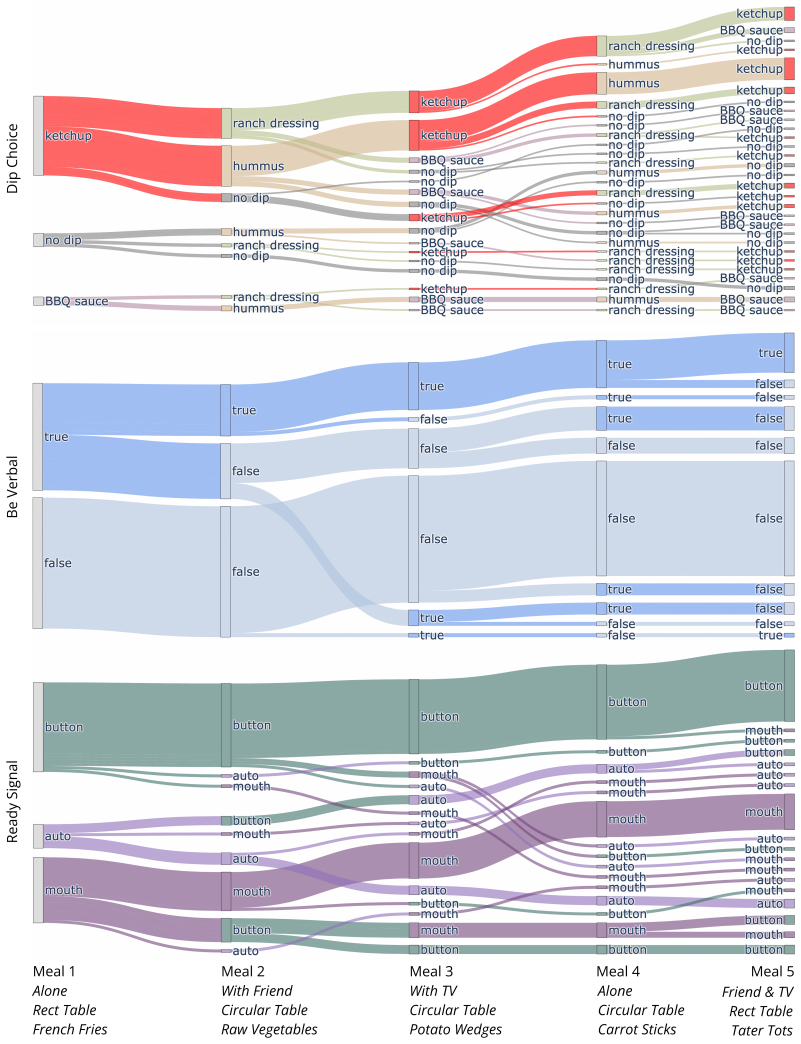
- A single method can personalize across qualitatively different preferences including dip choice, ready signal, verbosity, occlusion sensitivity, book taste, and functional reach, because each is expressed as a parameterized constraint in the same CSP.
- Personalization is sample-efficient: by actively maximizing entropy, CBTL needs fewer user interactions than unguided exploration or pure exploitation, as measured by user satisfaction in all three simulated environments.
- Learned personalized constraints transfer across scenarios: the occlusion-sensitivity constraint learned during feeding is reused to reposition plate and drink when a new object appears on the table.
- When personalized constraints cannot all be satisfied, CBTL can fall back to a non-personalized solution and still complete the task, maintaining task success at the cost of unmet preferences.
- By keeping the original CSP constraints fixed, CBTL's safety and competency guarantees coincide with the correctness of those constraints.
Reading between the lines
- The safety guarantee reduces to the correctness of the hand-written CSP generator, so automated verification or synthesis of these generators would be a natural, high-impact next step that the paper leaves open.
- The same null-space mechanism could serve as a general interface between human functional diversity and robot behavior, covering not just preferences but accessibility parameters such as reach envelopes and occlusion tolerance.
- Because the active-learning program only needs probabilistic personalized constraints, other probabilistic preference models, such as Gaussian processes, could replace the supervised and LLM constraints used here and potentially yield sharper uncertainty estimates.
- The framework suggests a direct extension to cost-based personalization, where preferences like speed could be optimized as soft objectives inside the same null space instead of hard constraints.
Editorial analysis
A structured set of objections, weighed in public.
Referee Report
Summary. This paper proposes Coloring Between the Lines (CBTL), a framework for robot personalization that treats the solution set of a planning constraint satisfaction problem (CSP) as a 'null space' and adds learnable, parameterized constraints to select solutions tailored to an individual user. The base CSP constraints are assumed to encode safety and general competency, while personalized constraints are learned online from user feedback, either through supervised classification or through LLM-based natural-language summaries. Exploration is driven by an entropy-maximizing objective over the personalized constraints, constrained by the base CSP. The paper evaluates CBTL in three simulation environments against four baselines, with a 60-participant web study and a real-robot assisted-feeding demonstration, and reports that CBTL personalizes more effectively and with fewer interactions.
Significance. If the claims hold, CBTL offers a useful unification of constraint-based planning, online preference learning, and active exploration for continual robot personalization. The paper is empirically broad: three simulation environments, a 60-participant web study, a real-robot demonstration, and released code for reproducing the results. The compositional structure of personalized constraint generators and the entropy-based active-learning criterion are the most novel elements, and the demonstration that a learned occlusion preference transfers from feeding to drink placement is a meaningful generalization result. The main weakness is that the advertised safety property is not directly established by any experiment, and the empirical comparisons would be stronger with explicit statistical testing.
major comments (3)
- [Abstract, §1, §5, §6] The paper advertises 'safe robot personalization' as a central contribution, but no experiment directly measures safety. No metric counts constraint violations, collisions, near-misses, or failures caused by incomplete or incorrect non-personalized CSP generators; the real-robot demonstration is n=1 and reports no quantitative safety evaluation. Section 6 explicitly concedes that 'the extent to which safety and competency are guaranteed by CBTL depends on the implementation of the CSP generators,' which means that the entropy-maximizing exploration will actively seek out any unsafe solution that the base constraints fail to exclude. This is acceptable as a conditional contribution, but the claim as stated overreaches. Please either soften the safety language throughout (e.g., 'safety-preserving given correct base CSP generators') or add a targeted experiment that varies the completeness/correctness of the generators and measures safety violations.
- [§5.1, Figure 4] The headline empirical claim that CBTL 'consistently personalizes better and faster' is supported only by mean learning curves with standard errors; no pairwise significance tests, confidence intervals, or effect sizes are reported for the three environments. The Cooking plot raises a further question: the caption notes that Epsilon-Greedy and Exploit Only obtain equal performance, and Appendix D attributes this to both being trapped in the same local minima under controlled seeding, which suggests the comparison may be sensitive to the evaluation protocol. Please report per-environment statistical comparisons over the 10 seeds and clarify whether the CBTL advantage in Cooking is significant and robust.
- [Appendix B, Section 4] The description of uncertainty quantification for LLM-based constraints is internally inconsistent. The text states that LLM next-token probabilities 'do not provide a useful measure of uncertainty' because the model is overconfident, but then defines the expected constraint probability as \sum_{i=0}^{10}(i/10)p_i, where p_i is the next-token probability. If these p_i are the same overconfident probabilities, the resulting entropy will be artificially low and the active-learning objective in Section 4 may not reflect true uncertainty. Please clarify whether p_i are raw token probabilities or a recalibrated or softened distribution, and specify whether the scalar response (e.g., '8') is converted directly to p=0.8 (in which case the formula with p_i is unnecessary) or used as a sample from a calibrated distribution.
minor comments (4)
- [Figure 4] The y-axis is not labeled, and the caption says units are deliberately omitted; however, the plotted quantity should at least be named (e.g., 'average user satisfaction' or 'held-out task score') so that readers can interpret the scale.
- [§5.2] The p<0.005 results are reported per meal without correction for multiple comparisons across five meals; please state whether these are pre-specified hypotheses or exploratory analyses.
- [§5.3] The real-robot demonstration is described as 'validates' and 'demonstrates real-world applicability'; with n=1 and no quantitative measurements of task success or safety, the wording is stronger than the evidence. Consider describing it as an illustrative pilot.
- [Appendix B] The LEARNINGPROMPT for Books asks the LLM to return multiple possible summaries of the user's preferences, and the entire response is used as θ; please explain how the CONSTRAINTPROMPT interprets a parameter containing several alternative summaries when deciding whether a book is enjoyable.
Circularity Check
No significant circularity: learned parameters are evaluated on held-out interactions, and safety is a stated delegation rather than a derived result.
full rationale
CBTL's central derivation is not circular. Personalized constraint parameters are learned from user feedback (supervised classification or LLM summarization) and then evaluated on held-out future interactions in simulation, on later meals in the web study, and on a new drink in the real-robot demonstration; the predicted choices are therefore not the fitted values by construction. The active-learning objective (mean entropy subject to non-personalized CSP constraints) selects high-uncertainty queries but does not define the satisfaction metrics used in evaluation, so the improvement over Exploit Only and Epsilon-Greedy is an empirical result rather than an identity. The 'null space' terminology is an analogy for the set of solutions of a CSP, and the paper's actual contribution is the parameterized constraint learning procedure, which is benchmarked independently. Self-citations ([1], [13], [26], [27], [30]) supply background models and inspiration (e.g., GRACE functionality embeddings, FEAST, Belkhale's occlusion model, Li and Silver's entropy-based active constraint learning); none is used as an unverified premise that forces the central claim. The safety guarantee is explicitly conditional on the hand-written CSP generators being correct: Section 6 states 'the extent to which safety and competency are guaranteed by CBTL depends on the implementation of the CSP generators.' That is a stated assumption and delegation, and a genuine limitation, but not a circular reduction of the method's output to its input. No equation in the paper equates a prediction to a fitted parameter or to a self-cited result.
Assumptions & free parameters
free parameters (3)
- Personalized constraint parameters (theta) =
learned online from user feedback
- N_improve =
500
- Epsilon-greedy exploration probability =
0.5
assumptions (5)
- domain assumption The non-personalized CSP constraints C fully capture safety and general competency.
- domain assumption User feedback in the interaction history is truthful and can be interpreted as labels for constraint satisfaction.
- ad hoc to paper An LLM's 0-to-10 response can be interpreted as an expected probability, P = sum_{i=0}^{10} (i/10) p_i.
- domain assumption The sampling-based CSP solver and the entropy random walk reliably find good solutions within the given timeouts.
- domain assumption The evaluation metrics (simulated user satisfaction, Likert preferences, prediction accuracy) are valid proxies for real personalization quality.
Cite this review
Pith. "Pith review of Coloring Between the Lines: Personalization in the Null Space of Planning Constraints." pith.science (2026). https://pith.science/paper/NGDJKNEL
@misc{pith2026250515503,
  author       = {Pith},
  title        = {Pith review of: Coloring Between the Lines: Personalization in the Null Space of Planning Constraints},
  year         = {2026},
  howpublished = {\url{https://pith.science/paper/NGDJKNEL}},
  note         = {Machine review of arXiv:2505.15503}
}
read the original abstract
Generalist robots must personalize in-the-wild to meet the diverse needs and preferences of long-term users. How can we enable flexible personalization without sacrificing safety or competency? This paper proposes Coloring Between the Lines (CBTL), a method for personalization that exploits the null space of constraint satisfaction problems (CSPs) used in robot planning. CBTL begins with a CSP generator that ensures safe and competent behavior, then incrementally personalizes behavior by learning parameterized constraints from online interaction. By quantifying uncertainty and leveraging the compositionality of planning constraints, CBTL achieves sample-efficient adaptation without environment resets. We evaluate CBTL in (1) three diverse simulation environments; (2) a web-based user study; and (3) a real-robot assisted feeding system, finding that CBTL consistently achieves more effective personalization with fewer interactions than baselines. Our results demonstrate that CBTL provides a unified and practical approach for continual, flexible, active, and safe robot personalization. Website: https://emprise.cs.cornell.edu/cbtl/
Figures


Figures from the paper (5 more)


Reference graph
Works this paper leans on
-
[1]
Z. Liu, Y . Ju, Y . Da, T. Silver, P. N. Thakkar, J. Li, J. Guo, K. Dimitropoulou, and T. Bhat- tacharjee. Grace: Generalizing robot-assisted caregiving with user functionality embeddings. Conference on Human-Robot Interaction (HRI), 2025
work page 2025
-
[2]
B. Liu. Learning on the job: Online lifelong and continual learning. InProceedings of the AAAI conference on artificial intelligence, 2020
work page 2020
-
[3]
R. Madan, R. K. Jenamani, V . T. Nguyen, A. Moustafa, X. Hu, K. Dimitropoulou, and T. Bhat- tacharjee. Sparcs: Structuring physically assistive robotics for caregiving with stakeholders- in-the-loop. In2022 IEEE/RSJ International Conference on Intelligent Robots and Systems (IROS), pages 641–648. IEEE, 2022
work page 2022
-
[4]
Robot Behavior Personalization from Sparse User Feedback
M. Patel and S. Chernova. Robot behavior personalization from sparse user feedback.arXiv preprint arXiv:2410.19219, 2024
work page Pith review arXiv 2024
- [5]
-
[6]
Y . Gao, H. J. Chang, and Y . Demiris. User modelling for personalised dressing assistance by humanoid robots. In2015 IEEE/RSJ International Conference on Intelligent Robots and Systems (IROS), pages 1840–1845. IEEE, 2015. 9
work page 2015
-
[7]
J. Saunders, D. S. Syrdal, K. L. Koay, N. Burke, and K. Dautenhahn. “Teach me show me”—end-user personalization of a smart home and companion robot.IEEE Transactions on Human-Machine Systems, 46(1):27–40, 2015
work page 2015
- [8]
Show all 65 references
-
[9]
Zhang, A
F. Zhang, A. Cully, and Y . Demiris. Personalized robot-assisted dressing using user modeling in latent spaces. In2017 IEEE/RSJ International Conference on Intelligent Robots and Systems (IROS), pages 3603–3610. IEEE, 2017
2017
-
[10]
Wilde, D
N. Wilde, D. Kuli ´c, and S. L. Smith. Learning user preferences in robot motion planning through interaction. In2018 IEEE International Conference on Robotics and Automation (ICRA), pages 619–626. IEEE, 2018
2018
-
[11]
Canal, G
G. Canal, G. Aleny `a, and C. Torras. Adapting robot task planning to user preferences: an assistive shoe dressing example.Autonomous Robots, 2019
2019
-
[12]
J. Wu, R. Antonova, A. Kan, M. Lepert, A. Zeng, S. Song, J. Bohg, S. Rusinkiewicz, and T. Funkhouser. Tidybot: Personalized robot assistance with large language models.arXiv preprint arXiv:2305.05658, 2023
2023 arXiv
-
[13]
R. K. Jenamani, T. Silver, B. Dodson, S. Tong, A. Song, Y . Yang, Z. Liu, B. Howe, A. Whit- neck, and T. Bhattacharjee. Feast: A flexible mealtime-assistance system towards in-the-wild personalization. InRobotics: Science and Systems (RSS), 2025
2025
-
[14]
T. Wei, B. Jin, R. Li, H. Zeng, Z. Wang, J. Sun, Q. Yin, H. Lu, S. Wang, J. He, et al. Towards unified multi-modal personalization: Large vision-language models for generative recommen- dation and beyond.arXiv preprint arXiv:2403.10667, 2024
2024 arXiv
-
[15]
J. Chen, Z. Liu, X. Huang, C. Wu, Q. Liu, G. Jiang, Y . Pu, Y . Lei, X. Chen, X. Wang, et al. When large language models meet personalization: Perspectives of challenges and opportuni- ties.World Wide Web, 27(4):42, 2024
2024
-
[16]
Zheng, C
J. Zheng, C. Shi, X. Cai, Q. Li, D. Zhang, C. Li, D. Yu, and Q. Ma. Lifelong learning of large language model based agents: A roadmap.arXiv preprint arXiv:2501.07278, 2025
2025
-
[17]
Lozano-P ´erez and L
T. Lozano-P ´erez and L. P. Kaelbling. A constraint-based method for solving sequential manip- ulation planning problems. In2014 IEEE/RSJ International Conference on Intelligent Robots and Systems, pages 3684–3691. IEEE, 2014
2014
-
[18]
C. R. Garrett, R. Chitnis, R. Holladay, B. Kim, T. Silver, L. P. Kaelbling, and T. Lozano-P´erez. Integrated task and motion planning.Annual review of control, robotics, and autonomous systems, 4(1):265–293, 2021
2021
-
[19]
Curtis, N
A. Curtis, N. Kumar, J. Cao, T. Lozano-P ´erez, and L. P. Kaelbling. Trust the proc3s: Solving long-horizon robotics problems with llms and constraint satisfaction. InConference on Robot Learning (CoRL), 2024
2024
-
[20]
Thumm, C
J. Thumm, C. Agia, M. Pavone, and M. Althoff. Text2interaction: Establishing safe and prefer- able human-robot interaction. InConference on Robot Learning, 2024
2024
-
[21]
Huang, C
W. Huang, C. Wang, Y . Li, R. Zhang, and L. Fei-Fei. Rekep: Spatio-temporal reasoning of relational keypoint constraints for robotic manipulation.arXiv preprint arXiv:2409.01652, 2024
2024 arXiv
-
[22]
Wachi, X
A. Wachi, X. Shen, and Y . Sui. A survey of constraint formulations in safe reinforcement learning.International Joint Conference on Artificial Intelligence (IJCAI), 2024. 10
2024
-
[23]
Nakamura, H
Y . Nakamura, H. Hanafusa, and T. Yoshikawa. Task-priority based redundancy control of robot manipulators.The International Journal of Robotics Research, 6(2):3–15, 1987
1987
-
[24]
O. Khatib. A unified approach for motion and force control of robot manipulators: The opera- tional space formulation.IEEE Journal on Robotics and Automation, 3(1):43–53, 1987
1987
-
[25]
Sciavicco and B
L. Sciavicco and B. Siciliano.Modelling and control of robot manipulators. Springer Science & Business Media, 2001
2001
-
[26]
R. K. Jenamani, P. Sundaresan, M. Sakr, T. Bhattacharjee, and D. Sadigh. Flair: Feeding via long-horizon acquisition of realistic dishes. InRobotics: Science and Systems (RSS), 2024
2024
-
[27]
Belkhale, E
S. Belkhale, E. K. Gordon, Y . Chen, S. Srinivasa, T. Bhattacharjee, and D. Sadigh. Balancing efficiency and comfort in robot-assisted bite transfer. In2022 International Conference on Robotics and Automation (ICRA), pages 4757–4763. IEEE, 2022
2022
-
[28]
Gpt-4o-mini.https://openai.com, 2024
OpenAI. Gpt-4o-mini.https://openai.com, 2024. Large language model
2024
-
[29]
Settles.Active learning literature survey
B. Settles.Active learning literature survey. PhD thesis, University of Wisconsin-Madison Department of Computer Sciences, 2009
2009
-
[30]
Li and T
A. Li and T. Silver. Embodied active learning of relational state abstractions for bilevel plan- ning.Conference on Lifelong Learning Agents (CoLLAs), 2023
2023
-
[31]
Brawer, D
J. Brawer, D. Ghose, K. Candon, M. Qin, A. Roncone, M. V ´azquez, and B. Scassellati. In- teractive policy shaping for human-robot collaboration with transparent matrix overlays. In Proceedings of the 2023 ACM/IEEE International Conference on Human-Robot Interaction, pages 525...
2023
-
[32]
Karagulle, N
R. Karagulle, N. Ar ´echiga, A. Best, J. DeCastro, and N. Ozay. A safe preference learning approach for personalization with applications to autonomous vehicles.IEEE Robotics and Automation Letters, 2024
2024
-
[33]
Mukherjee, J
D. Mukherjee, J. Hong, H. Vats, S. Bae, and H. Najjaran. Personalization of industrial human– robot communication through domain adaptation based on user feedback.User Modeling and User-Adapted Interaction, pages 1–41, 2024
2024
-
[34]
H. Wang, N. Chin, G. Gonzalez-Pumariega, X. Sun, N. Sunkara, M. A. Pace, J. Bohg, and S. Choudhury. Apricot: Active preference learning and constraint-aware task planning with llms. InConference on Robot Learning (CoRL), 2024
2024
-
[35]
Hellou, N
M. Hellou, N. Gasteiger, J. Y . Lim, M. Jang, and H. S. Ahn. Personalization and localization in human-robot interaction: A review of technical methods.Robotics, 10(4):120, 2021
2021
-
[36]
J. Z.-Y . He, Z. Erickson, D. S. Brown, A. Raghunathan, and A. Dragan. Learning represen- tations that enable generalization in assistive tasks. InConference on Robot Learning, pages 2105–2114. PMLR, 2023
2023
-
[37]
R. Wang, D. Zhao, D. Suh, Z. Yuan, G. Chen, and B.-C. Min. Personalization in human- robot interaction through preference-based action representation learning.arXiv preprint arXiv:2409.13822, 2024
2024 arXiv
-
[38]
M. K. Lee, J. Forlizzi, S. Kiesler, P. Rybski, J. Antanitis, and S. Savetsila. Personalization in hri: A longitudinal field experiment. InProceedings of the seventh annual ACM/IEEE international conference on Human-Robot Interaction, pages 319–326, 2012
2012
-
[39]
Leyzberg, A
D. Leyzberg, A. Ramachandran, and B. Scassellati. The effect of personalization in longer- term robot tutoring.ACM Transactions on Human-Robot Interaction (THRI), 7(3):1–19, 2018. 11
2018
-
[40]
Churamani, S
N. Churamani, S. Kalkan, and H. Gunes. Continual learning for affective robotics: Why, what and how? In2020 29th IEEE international conference on robot and human interactive communication (RO-MAN), pages 425–431. IEEE, 2020
2020
-
[41]
Spaulding, J
S. Spaulding, J. Shen, H. W. Park, and C. Breazeal. Lifelong personalization via gaussian process modeling for long-term hri.Frontiers in Robotics and AI, 8:683066, 2021
2021
-
[42]
D’Souza, S
A. D’Souza, S. Vijayakumar, and S. Schaal. Learning inverse kinematics. InProceedings 2001 IEEE/RSJ International Conference on Intelligent Robots and Systems. Expanding the Societal Role of Robotics in the the Next Millennium (Cat. No. 01CH37180), volume 1, pages 298–303. IEEE, 2001
2001
-
[43]
Sala ¨un, V
C. Sala ¨un, V . Padois, and O. Sigaud. Control of redundant robots using learned models: an operational space control approach. In2009 IEEE/RSJ International Conference on Intelligent Robots and Systems, pages 878–885. IEEE, 2009
2009
-
[44]
Towell, M
C. Towell, M. Howard, and S. Vijayakumar. Learning nullspace policies. In2010 IEEE/RSJ International Conference on Intelligent Robots and Systems, pages 241–248. IEEE, 2010
2010
-
[45]
Nordmann, C
A. Nordmann, C. Emmerich, S. R ¨uther, A. Lemme, S. Wrede, and J. Steil. Teaching nullspace constraints in physical human-robot interaction using reservoir computing. In2012 IEEE In- ternational Conference on Robotics and Automation, pages 1868–1875. IEEE, 2012
2012
-
[46]
Q. Yang, J. A. Stork, and T. Stoyanov. Null space based efficient reinforcement learning with hierarchical safety constraints. In2021 European Conference on Mobile Robots (ECMR), pages 1–6. IEEE, 2021
2021
-
[47]
P. Liu, D. Tateo, H. B. Ammar, and J. Peters. Robot reinforcement learning on the constraint manifold. InConference on Robot Learning, pages 1357–1366. PMLR, 2022
2022
-
[48]
P. Liu, H. Bou-Ammar, J. Peters, and D. Tateo. Safe reinforcement learning on the constraint manifold: Theory and applications.arXiv preprint arXiv:2404.09080, 2024
2024 arXiv
-
[49]
U. A. Mishra, S. Xue, Y . Chen, and D. Xu. Generative skill chaining: Long-horizon skill planning with diffusion models. InConference on Robot Learning, pages 2905–2925. PMLR, 2023
2023
-
[50]
K. Lin, C. Agia, T. Migimatsu, M. Pavone, and J. Bohg. Text2motion: From natural language instructions to feasible plans.Autonomous Robots, 47(8):1345–1365, 2023
2023
-
[51]
Loula, K
J. Loula, K. Allen, T. Silver, and J. Tenenbaum. Learning constraint-based planning models from demonstrations. In2020 IEEE/RSJ International Conference on Intelligent Robots and Systems (IROS), pages 5410–5416. IEEE, 2020
2020
-
[52]
Silver, R
T. Silver, R. Chitnis, N. Kumar, W. McClinton, T. Lozano-P´erez, L. Kaelbling, and J. B. Tenen- baum. Predicate invention for bilevel planning. InProceedings of the AAAI Conference on Artificial Intelligence, 2023
2023
-
[53]
B. Li, T. Silver, S. Scherer, and A. Gray. Bilevel learning for bilevel planning. InRobotics: Science and Systems (RSS), 2025
2025
-
[54]
Liang, N
Y . Liang, N. Kumar, H. Tang, A. Weller, J. B. Tenenbaum, T. Silver, J. F. Henriques, and K. Ellis. Visualpredicator: Learning abstract world models with neuro-symbolic predicates for robot planning.arXiv preprint arXiv:2410.23156, 2024
-
[55]
Athalye, N
A. Athalye, N. Kumar, T. Silver, Y . Liang, T. Lozano-P´erez, and L. P. Kaelbling. Predicate in- vention from pixels via pretrained vision-language models.arXiv preprint arXiv:2501.00296, 2024. 12
2024
-
[56]
Z. Wang, C. R. Garrett, L. P. Kaelbling, and T. Lozano-P´erez. Learning compositional models of robot skills for task and motion planning.The International Journal of Robotics Research, 40(6-7):866–894, 2021
2021
-
[57]
Kumar, T
N. Kumar, T. Silver, W. McClinton, L. Zhao, S. Proulx, T. Lozano-P ´erez, L. P. Kaelbling, and J. Barry. Practice makes perfect: Planning to learn skill parameter policies. InRobotics: Science and Systems (RSS), 2024
2024
-
[58]
Mendez-Mendez, L
J. Mendez-Mendez, L. P. Kaelbling, and T. Lozano-P´erez. Embodied lifelong learning for task and motion planning. InConference on Robot Learning, pages 2134–2150. PMLR, 2023
2023
-
[59]
C. R. Garrett, T. Lozano-P´erez, and L. P. Kaelbling. Pddlstream: Integrating symbolic planners and blackbox samplers via optimistic adaptive planning. InProceedings of the international conference on automated planning and scheduling, volume 30, pages 440–448, 2020
2020
-
[60]
Coumans and Y
E. Coumans and Y . Bai. Pybullet, a python module for physics simulation for games, robotics and machine learning, 2016. URLhttp://pybullet.org. Accessed: 2025-04-22
2016
-
[61]
Kinova gen3 7dof robotic arm, 2025
Kinova. Kinova gen3 7dof robotic arm, 2025. URLhttps://www.kinovarobotics.com/ uploads/User-Guide-Gen3-R07.pdf. (Accessed: 1st January, 2025)
2025
-
[62]
Nanavati, P
A. Nanavati, P. Alves-Oliveira, T. Schrenk, E. K. Gordon, M. Cakmak, and S. S. Srinivasa. Design principles for robot-assisted feeding in social contexts. InProceedings of the 2023 ACM/IEEE International Conference on Human-Robot Interaction, pages 24–33, 2023
2023
-
[63]
K. Hauser. The minimum constraint removal problem with three robotics applications.The International Journal of Robotics Research, 33(1):5–17, 2014
2014
-
[64]
Intel realsense d435i, 2025
Realsense. Intel realsense d435i, 2025. URLhttps://www.intelrealsense.com/ depth-camera-d435i/. (Accessed: 1st January, 2025)
2025
-
[65]
How much would the user enjoy the book on a scale from 0 to 10, where 0 means hate and 10 means love?
Robotiq. Robotic 2f-85 gripper, 2025. URLhttps://robotiq.com/products/ 2f85-140-adaptive-robot-gripper. (Accessed: 1st January, 2025). 13 A CSP Details: Generating, Solving, and Learning In this section, we describe details for the CSP generation, solving, and learning techniq...
2025
Reviewed August 7, 2026 · model on record in the stance chip above.
Discussion (0). Continue with ORCID to comment.