REVIEW 3 major objections 6 minor 48 references
Measuring the Orbital Parameters of Radial Velocity Systems in Mean Motion Resonance---a Case Study of HD 200964
T0 review · 3 major / 6 minor · reviewed 2026-08-14 · deepseek-v4-flash
Pith's one-line read HD 200964's two giant planets fit stable orbits in three resonances — 7:5, 3:2, and 4:3 — and the data cannot yet choose the winner because the ~30-year libration period exceeds the 14-year baseline.
desk verdict A careful, honest RV case study that finds multiple stable resonance solutions for HD 200964, though the '7:5 best' claim rests on a comparison the authors admit is not quantitatively rigorous. read the letter →
The pith
A machine-rendered reading of the paper's core claim, the machinery that carries it, and where it could break.
The reading
What carries the argument
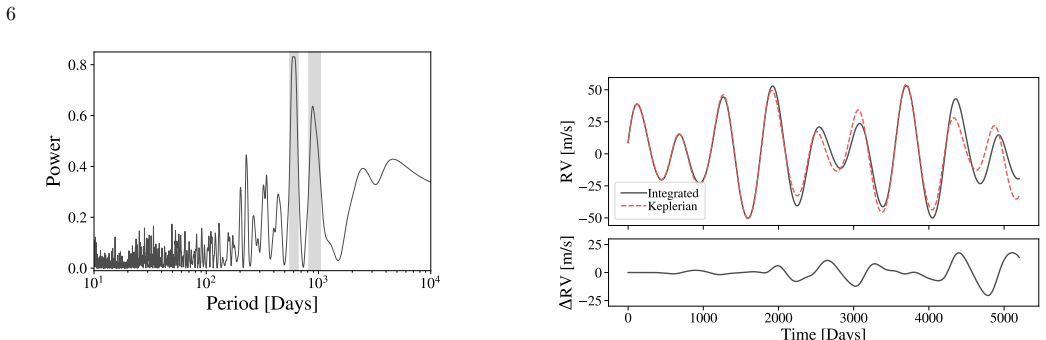
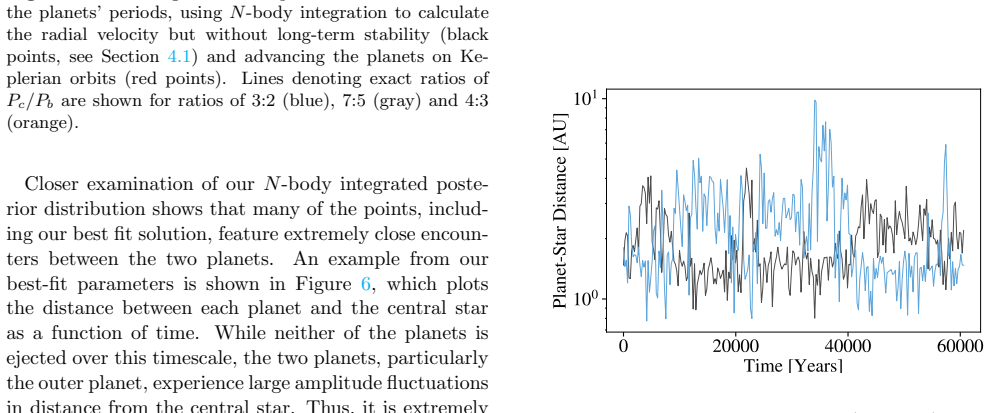
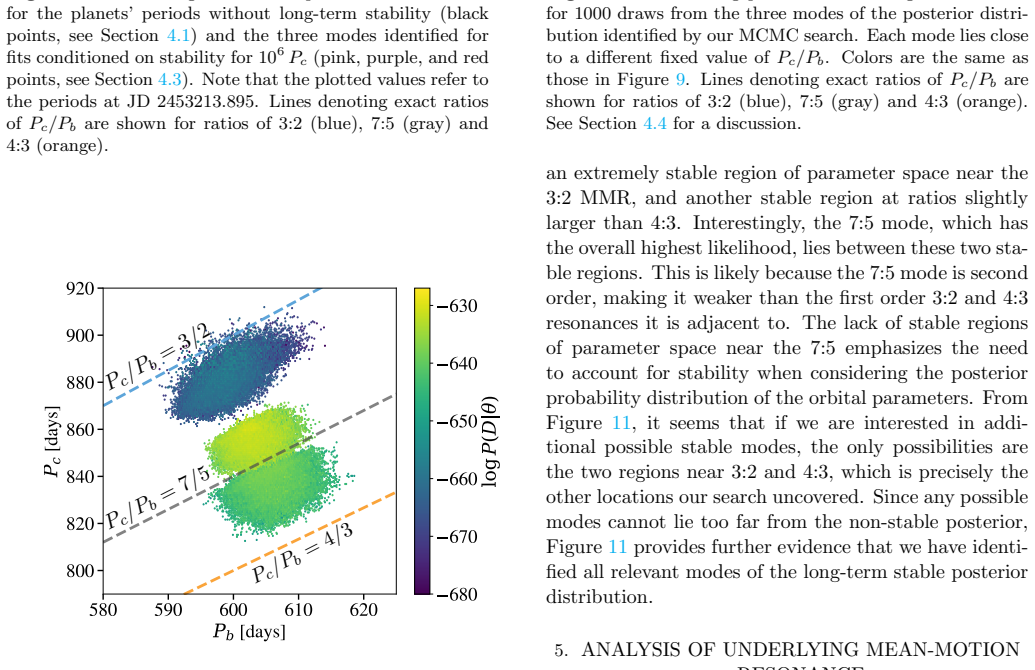
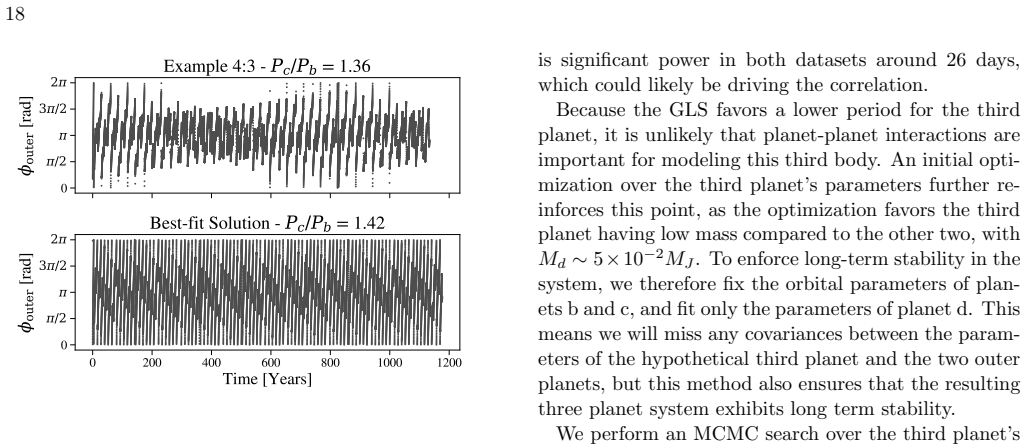
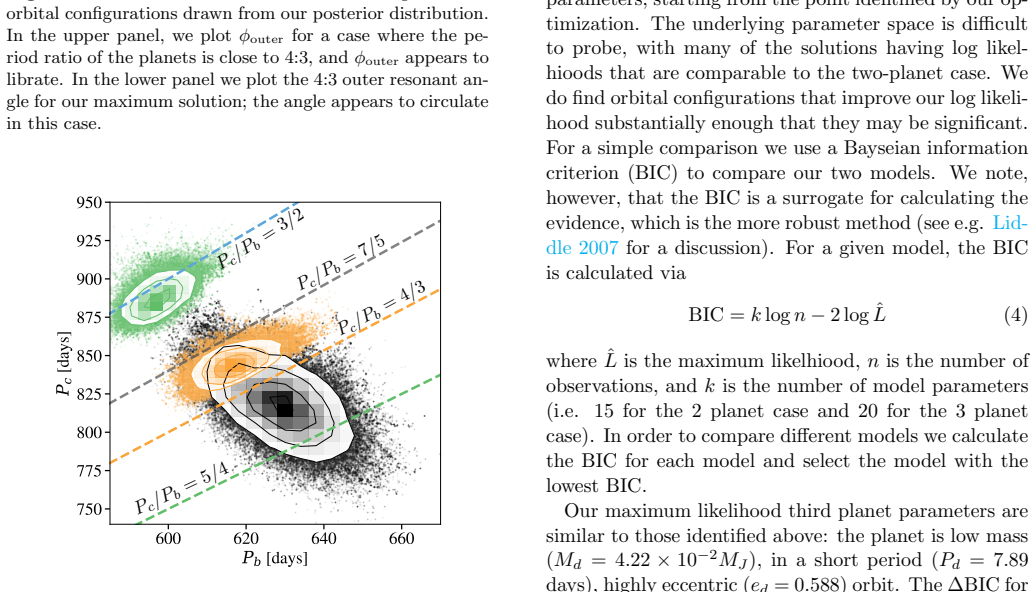
Three pieces of machinery carry the argument. The first is a stability-conditioned likelihood: an MCMC fit in which any trial orbit that fails to survive $10^6$ orbits of the outer planet in a numerical integration is assigned zero likelihood, so the posterior itself is conditioned on long-term survival; this replaces rejection sampling, which discards more than 99% of the naive posterior and leaves too few points to converge. The second is a high-order adaptive N-body integrator used to generate the theoretical radial velocities, since for these closely packed planets Keplerian orbits differ from the fully interacting signal by tens of meters per second over the observing campaign. The third is the resonant angle $\varphi = p\lambda_{\mathrm{outer}} - q\lambda_{\mathrm{inner}} - (p-q)\varpi$, whose libration about a fixed center is the diagnostic for whether a given period ratio is genuinely protected by resonance; much of the paper works out how this standard test-particle diagnostic degrades when both planets are Jupiter-mass, with synodic kicks and a circulating libration center obscuring the signal. A final Monte Carlo scan of period–period space, testing $10^6$ randomly drawn configurations, shows that stable regions trace diagonals of constant period ratio and supports — without fully proving — that the three found modes exhaust the stable possibilities.
What would settle it
Keep monitoring HD 200964's radial velocity for roughly another 16 years, until a full ~30-year librational cycle is covered: the three resonances predict different librational periods and different phase evolutions of the resonant angle, and a complete cycle would reveal whether the 7:5 configuration's angle oscillates coherently on the ~30-year timescale, as expected for a genuine massive-planet resonance, or instead precesses without that periodic structure, settling which commensurability actually protects the system.
Extended reading notes
Core claim
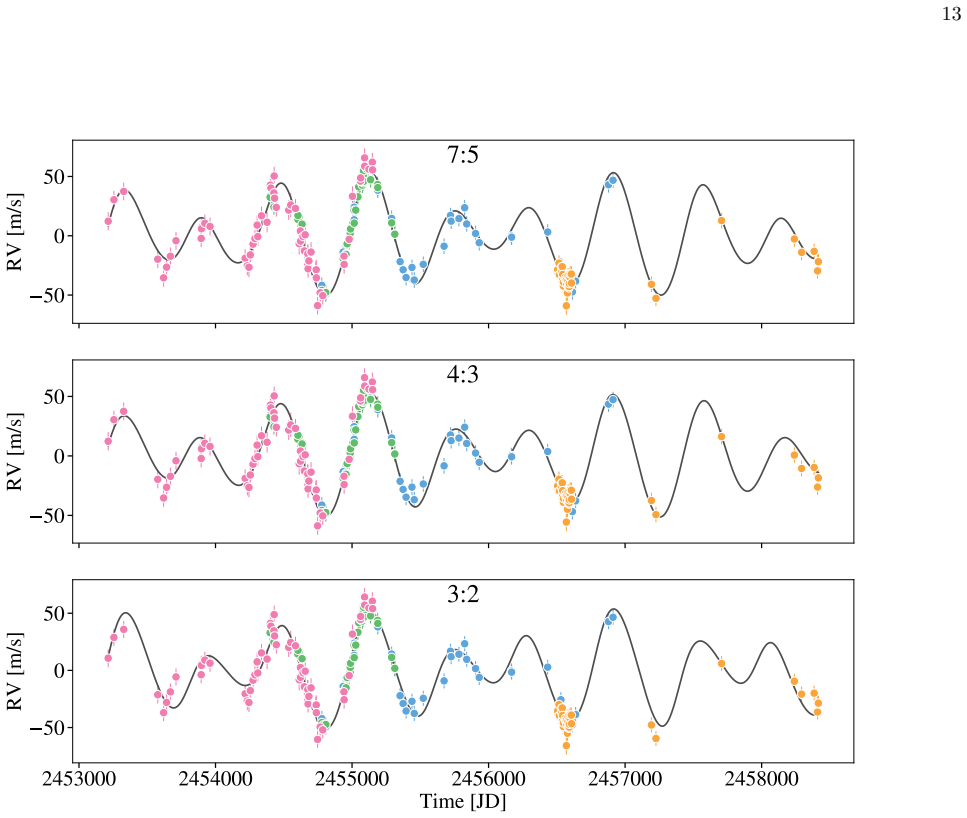
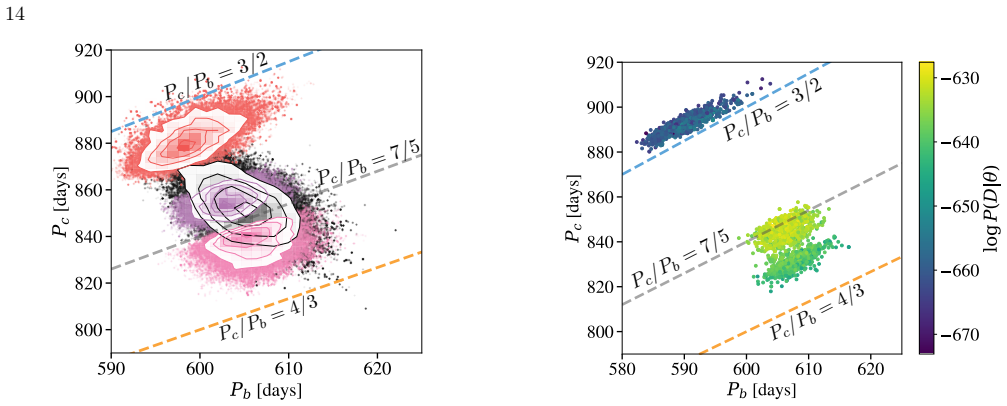
The paper's central claim is that HD 200964 hosts a pair of interacting giant planets whose radial velocity signal is compatible with long-term stable, fully self-gravitating solutions at three period commensurabilities: 7:5, 3:2, and 4:3. The maximum-likelihood stable solution sits near 7:5, beating the 4:3 mode by a likelihood factor of roughly $e^{10}$ to $e^{15}$ and the 3:2 mode by roughly $e^{20}$ to $e^{25}$, and giving a materially better fit than the originally published 4:3 configuration. Yet the resonance identification is not settled: the 3:2 solutions show the cleanest libration of the resonant angle, the 4:3 librates in only a limited subset of fits, and the 7:5 shows the smeared, synodically kicked behavior expected when two near-Jupiter-mass planets perturb one another. Because the baseline covers only part of the ~30-year libration, the authors conclude that the current best fit may not reflect the actual resonant configuration, and they show that re-analyzing only the original shorter-baseline data recovers the 4:3 and 3:2 modes but not the 7:5 — the preferred resonance shifts with the data span.
Load-bearing premise
The load-bearing premise is that the two planets are coplanar and seen edge-on ($i = 90^\circ$, $\Omega = 0$), so the fitted minimum masses $m\sin i$ are used as true masses in the stability integrations; if the planets had a significant mutual inclination, the true masses, the stability boundaries, and therefore which resonances survive would all change.
Editorial extensions
If this is right
- Published resonance identifications for RV systems whose baselines are shorter than the libration period are provisional: HD 200964 itself shows that the best-fitting period ratio can shift as more data are added, and the current best fit may not be the true configuration.
- Orbital fits for closely packed or resonant planets should have long-term stability built into the likelihood from the start; rejection sampling of a standard posterior is not enough when stable phase-space volumes are small, since fewer than 1% of the naive posterior points survived even a $10^3$-orbit test.
- Longer baselines change which resonances are even visible: reanalysis of the original short-baseline data recovers 4:3 and 3:2 solutions but not the 7:5, so the set of candidate resonances itself grows with the data span.
- If the 3:2 solution is the true one, formation by convergent migration of two gas giants is straightforward; if 7:5 or 4:3 wins, the formation channel must be more exotic, since capture into those resonances is difficult for giant planets.
- A marginal ~7.9-day, ~0.04 $M_J$ third-planet candidate is preferred by a BIC difference of 4.90, but the authors note it could be a stellar activity signal, so it neither confirms nor rules out a three-planet architecture.
Reading between the lines
- My extension: the same multi-resonance ambiguity likely afflicts other published gas-giant MMR systems whose baselines are short relative to their libration periods; their quoted period ratios may be biased toward whatever resonance the most recent data favor, and re-fitting with stability-conditioned likelihoods could reveal hidden alternative modes.
- My extension: if the ~30-year libration estimate holds, roughly another 16 years of radial velocity monitoring of HD 200964 should be enough to distinguish the three resonances observationally, making this a finite, testable forecast of when the ambiguity resolves.
- My extension: conditioning the likelihood on stability acts as a strong prior that excludes most of parameter space; applied to other tightly packed RV systems that appear marginally unstable under Keplerian fits, the same trick may turn some of them into resonant survivors rather than doomed systems.
- My extension: if future measurements show a significant mutual or line-of-sight inclination, the inferred masses rise and the stability grid changes, which could shrink or eliminate some of the three modes; the 3:2 solution, already the formation-favored one, would then become the leading interpretation.
Signed reviews
Editorial analysis
A structured set of objections, weighed in public.
Referee Report
Summary. The paper reanalyzes the two-planet radial velocity (RV) system HD 200964 using full N-body integrations in the likelihood, with the goal of finding orbital solutions that both fit the RV data and are long-term stable. The authors first show that the unstable best fits found without a stability constraint have period ratios near 7:5 but undergo close encounters and are destroyed on short timescales. They then condition the likelihood on stability with a 50-150% semi-major axis window for 10^6 outer-planet periods, and, using several initialization strategies, identify three posterior modes near period ratios 7:5, 3:2, and 4:3. The paper claims the 7:5 mode is the best match to the full dataset, that 3:2 is the most easily understood formation scenario, and that reanalysis of the shorter JPH11 baseline alone yields only the 4:3 and 3:2 modes. It also reports a tentative short-period third-planet signal with a small BIC improvement. The central methodological recommendation is that long-term stability should be incorporated into the fitting of RV systems in mean motion resonance (MMR), because rejection sampling retains too few stable points and because the resonant libration period exceeds the current observational baseline.
Significance. If the conclusions hold, the paper makes a useful methodological contribution by demonstrating that stability conditioning within MCMC, rather than rejection sampling afterward, is needed to explore multi-modal stable posterior distributions for massive planets in MMR. It also provides a concrete system in which three resonance interpretations remain viable, which is relevant to giant-planet migration and formation scenarios. The paper is commendably transparent: it publishes new Keck and APF RVs, uses adaptive N-body integration for the RVs, performs long-term stability integrations, runs a Monte Carlo survey of stable period-period space, and explicitly flags where its own comparisons are not quantitatively rigorous. These strengths make the manuscript a valuable case study, provided the central claims are supported by the analysis as it stands.
major comments (3)
- [Section 4.4, Figure 9; Abstract; Section 8] The claim that the 7:5 configuration 'provides the best match to the data' rests on a comparison that the authors themselves state 'is not a proper marginalization over the other parameters' and is 'without being quantitatively rigorous.' The three modes are produced by separate MCMC runs initialized in mode-specific regions, and the relative normalizations are not tracked. The quoted likelihood ratios (exp(10-15) vs. 4:3 and exp(20-25) vs. 3:2) are therefore not posterior odds or evidence ratios. This is load-bearing because it is the paper's headline result. Please replace the binned-likelihood comparison with a joint sampling scheme with a single normalization, or with an explicit model-comparison calculation (for example, parallel-tempered MCMC across the full period range, or evidence/Bayes-factor estimates for each resonance), and revise the abstract and conclusions to match whatever that calculation supports.
- [Section 5, Figures 13-15] The identification of the 7:5 and 4:3 modes as true MMRs is qualitative. For the 7:5 mode, the paper shows a complex resonant-angle evolution that is described as 'consistent with libration' based on a toy-mass sequence; no quantitative libration criterion is applied. For the 4:3 mode, the paper explicitly shows that data-matching configurations range from libration to circulation, with the maximum-likelihood configuration circulating. Since the title and abstract frame the paper as measuring orbital parameters of systems in mean motion resonance, the claim of stable solutions 'in the 7:5 and 3:2 MMRs in addition to the originally identified 4:3 MMR' requires a uniform, quantitative definition of libration—for example libration fraction, libration amplitude, or a frequency-domain test—applied to the posterior samples of all three modes. This would also clarify which fitted configurations are actually resonantly protected.
- [Section 4.1 and Section 4.4] The stability and resonance analyses assume i = 90 degrees and Omega = 0, so the fitted m sin i values are converted directly into the physical masses used in the N-body integrations. As the authors correctly note in Section 4.4, the RV signal and the stability behavior are sensitive to Mp, not just m sin i, and mutual inclination is not explored. The central conclusions about which resonances are stable are therefore conditional on an assumed edge-on, coplanar geometry. Please add a sensitivity test for the stability and libration results over a plausible range of mutual inclination or system inclination, or explicitly state in the abstract and conclusions that all stable-resonance claims are conditional on this geometric assumption.
minor comments (6)
- [Section 2] The new RV datasets are introduced as 'given in Tables 1 and 2', but Table 1 is already the stellar-parameter table; the RV tables should be renumbered so that the in-text references match the actual table numbers.
- [Section 4.3 and Section 4.5] There are several typographical errors, including 'preform' for 'perform' in Section 4.5, 'likelhiood' for 'likelihood' in Section 4.3, and 'Bayseian' for 'Bayesian' in Section 7; a copyedit pass is needed.
- [Figure 8] The text describes the three stable modes as 'pink, purple, and red points', but the figure would be clearer with a legend or distinct marker styles so that the modes can be separated in grayscale or color-blind-friendly rendering.
- [Section 4.2] The paper reports that 2,295 of 287,296 posterior points survive 10^3 P_c and then that 1,111 survive 10^7 P_c; the second-stage survival fraction (about 48% of the first-stage survivors) should be stated explicitly, because the raw count alone makes the attrition appear much larger than it is.
- [Section 4.3] The convergence discussion notes that the PSRF for the eccentricities and arguments of pericenter often does not fall below 1.1; since these parameters directly affect the resonant-angle analysis in Section 5, the paper should state whether any alternative convergence diagnostic was applied to them.
- [Figures 4 and 5] The captions and text do not always agree on which posterior is plotted in red: in Figure 4 the red points are described as the Keplerian fit, while in Figure 5 the red points are the JPH11-data N-body posterior; please make the captions consistent and explicit.
Circularity Check
No circularity: orbital parameters are fitted to RV data and then tested against independent dynamical criteria (N-body stability and resonant-angle libration).
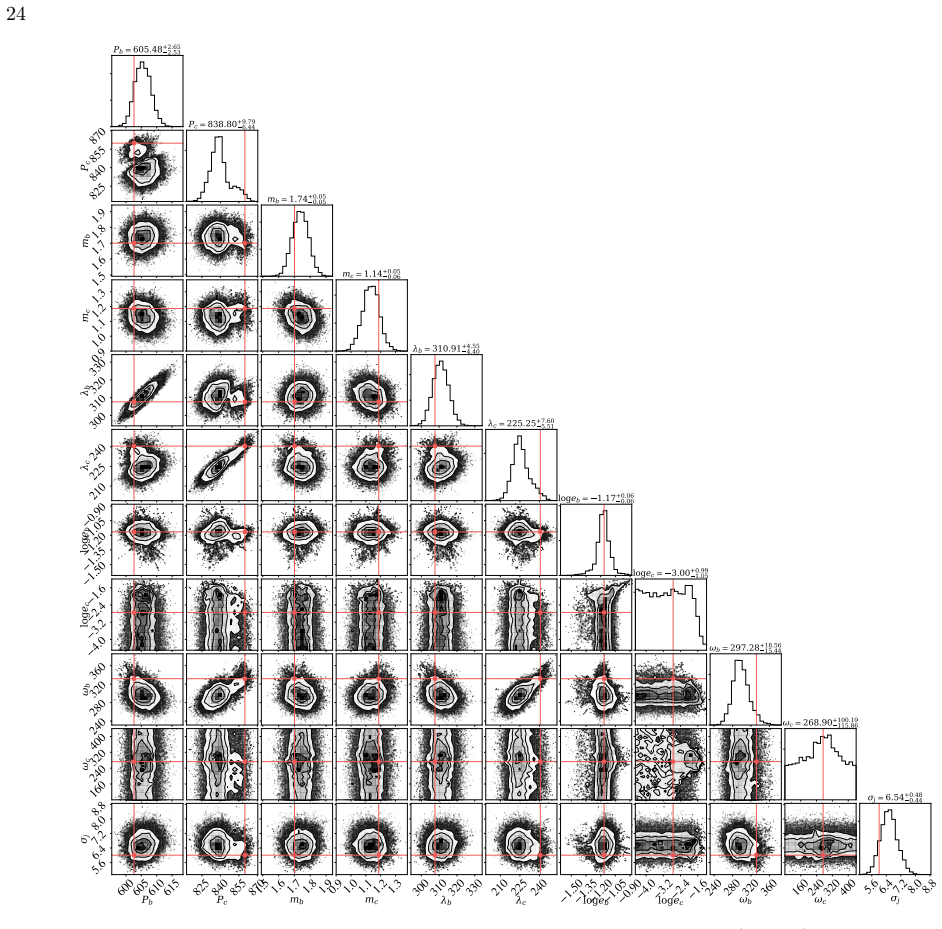
full rationale
The paper's derivation chain is empirical: MCMC fits of the two-planet N-body model to radial velocity data produce posterior modes near period ratios 7:5, 3:2, and 4:3; long-term stability is imposed through a modified likelihood (Section 4.3) and then verified with independent REBOUND/WHFAST integrations; resonant-angle libration (Section 5) is an external diagnostic evaluated from the fitted configurations. The stability criterion is an input constraint, not a derived prediction, and the paper says so explicitly ('we modify the likelihood function ... setting the likelihood function to be 0 if the system is not found to be stable'). The '7:5 best match' claim rests on an explicitly informal likelihood comparison (Section 4.4), which is a statistical-rigor concern rather than a circular reduction. Self-citations (e.g., Nelson et al. 2014, Fabrycky & Murray-Clay 2010) support methodological or contextual points but are not load-bearing for the central claim that multiple MMRs fit the data. No fitted parameter is renamed as a prediction, and no equation reduces to its input by construction.
Assumptions & free parameters
free parameters (6)
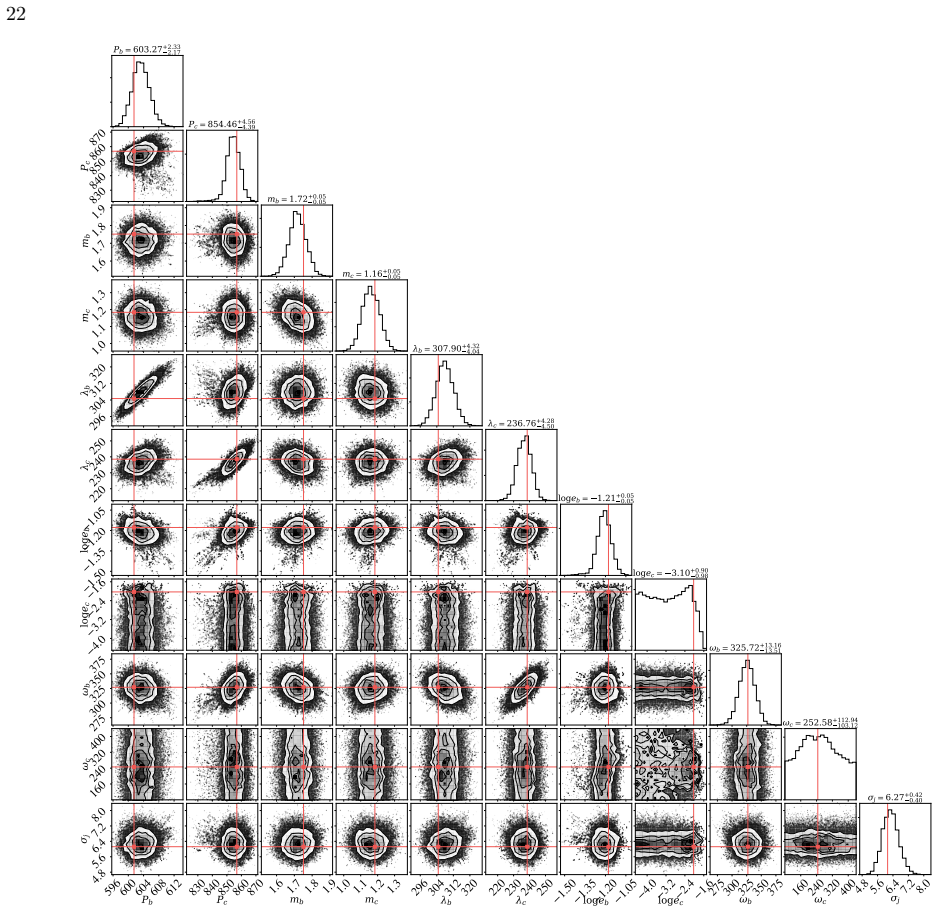
- Inner planet period P_b =
601.5 d (7:5 maximum likelihood)
- Outer planet period P_c =
856.8 d (7:5 maximum likelihood)
- Planetary masses m_b, m_c =
1.75 and 1.18 M_J (edge-on)
- Orbital eccentricities e_b, e_c =
log10 e = -1.18, -2.02 (7:5)
- Stellar jitter sigma_j =
6.1 m/s (7:5)
- Stability window and integration time =
50-150% of initial semi-major axes, 10^6 P_c
assumptions (5)
- domain assumption Stellar parameters M*=1.45 M_sun, R*=4.92 R_sun from Brewer et al. (2016)
- domain assumption The two planets are coplanar with the line of sight and edge-on (i=90 deg, Omega=0)
- domain assumption RV noise is Gaussian, independent, with a single jitter term for all instruments
- ad hoc to paper Long-term stability is proxied by semi-major axes remaining within 50-150% of initial values for 10^6 P_c
- domain assumption Resonant angle libration defined in Eq. (3) is a valid MMR diagnostic even for two massive planets
invented entities (1)
-
Possible third planet d
Cite this review
Pith. "Pith review of Measuring the Orbital Parameters of Radial Velocity Systems in Mean Motion Resonance---a Case Study of HD 200964." pith.science (2026). https://pith.science/paper/NHBJDYBQ
@misc{pith2026190804789,
  author       = {Pith},
  title        = {Pith review of: Measuring the Orbital Parameters of Radial Velocity Systems in Mean Motion Resonance---a Case Study of HD 200964},
  year         = {2026},
  howpublished = {\url{https://pith.science/paper/NHBJDYBQ}},
  note         = {Machine review of arXiv:1908.04789}
}
read the original abstract
The presence of mean motion resonances (MMRs) complicates analysis and fitting of planetary systems observed through the radial velocity (RV) technique. MMR can allow planets to remain stable in regions of phase space where strong planet-planet interactions would otherwise destabilize the system. These stable orbits can occupy small phase space volumes, allowing MMRs to strongly constrain system parameters, but making searches for stable orbital parameters challenging. Furthermore, libration of the resonant angle and dynamical interaction between the planets introduces another, long period variation into the observed RV signal, complicating analysis of the periods of the planets in the system. We discuss this phenomenon using the example of HD 200964. By searching through parameter space and numerically integrating each proposed set of planetary parameters to test for long term stability, we find stable solutions in the 7:5 and 3:2 MMRs in addition to the originally identified 4:3 MMR. The 7:5 configuration provides the best match to the data, while the 3:2 configuration provides the most easily understood formation scenario. In reanalysis of the originally published shorter-baseline data, we find fits in both the 4:3 and 3:2 resonances, but not the 7:5. Because the time baseline of the data is less than the resonant libration period, the current best fit to the data may not reflect the actual resonant configuration. In the absence of a full sample of the longer libration period, we find that it is of paramount importance to incorporate long term stability when fitting for the system's orbital configuration.
Figures


Figures from the paper (16 more)







Reference graph
Works this paper leans on
-
[1]
Baluev, R. V. 2009, MNRAS, 393, 969 Bowler, B. P., Johnson, J. A., Marcy, G. W., et al. 2010, ApJ, 709, 396 20
work page 2009
-
[2]
M., Fischer, D
Brewer, J. M., Fischer, D. A., Valenti, J. A., & Piskunov, N. 2016, ApJS, 225, 32
2016
-
[3]
1998, Journal of Computational and Graphical Statistics, 7, 434
Brooks, S., & Gelman, A. 1998, Journal of Computational and Graphical Statistics, 7, 434
work page 1998
-
[4]
P., Marcy, G
Butler, R. P., Marcy, G. W., Williams, E., et al. 1996, PASP, 108, 500
1996
- [5]
-
[6]
P., Marcy, G
Cumming, A., Butler, R. P., Marcy, G. W., et al. 2008, PASP, 120, 531
2008
-
[7]
Duncan, M. J., Levison, H. F., & Lee, M. H. 1998, AJ, 116, 2067 Emel’yanenko, V. V. 2012, Solar System Research, 46, 321
work page 1998
- [8]
Show all 48 references
-
[9]
2016, The Journal of Open Source Software, 24
Foreman-Mackey, D. 2016, The Journal of Open Source Software, 24
2016
-
[10]
W., Lang, D., & Goodman, J
Foreman-Mackey, D., Hogg, D. W., Lang, D., & Goodman, J. 2013, PASP, 125, 306
2013
-
[11]
Gelman, A., & Rubin, D. B. 1992, Statistical Science, 7, 457
1992
-
[12]
J., Fischer, D
Giguere, M. J., Fischer, D. A., Payne, M. J., et al. 2015, ApJ, 799, 89
2015
-
[13]
N., et al
Izidoro, A., Ogihara, M., Raymond, S. N., et al. 2017, MNRAS, 470, 1750 Jofr´ e, E., Petrucci, R., Saffe, C., et al. 2015, A&A, 574, A50
2017
-
[14]
A., Marcy, G
Johnson, J. A., Marcy, G. W., Fischer, D. A., et al. 2006, ApJ, 652, 1724
2006
-
[15]
A., Fischer, D
Johnson, J. A., Fischer, D. A., Marcy, G. W., et al. 2007, ApJ, 665, 785
2007
-
[16]
A., Bowler, B
Johnson, J. A., Bowler, B. P., Howard, A. W., et al. 2010, ApJL, 721, L153
2010
-
[17]
2001, SciPy: Open source scientific tools for Python, [Online]
Jones, E., Oliphant, T., Peterson, P., et al. 2001, SciPy: Open source scientific tools for Python, [Online]
2001
-
[18]
2019, MNRAS, 486, 4980
Kipping, D., Nesvorn´ y, D., Hartman, J., et al. 2019, MNRAS, 486, 4980
2019
-
[19]
H., & Peale, S
Lee, M. H., & Peale, S. J. 2002, ApJ, 567, 596
2002
-
[20]
Liddle, A. R. 2007, MNRAS, 377, L74
2007
-
[21]
J., Fabrycky, D
Lissauer, J. J., Fabrycky, D. C., Ford, E. B., et al. 2011, Nature, 470, 53
2011
-
[22]
K., Bastien, F
Luhn, J. K., Bastien, F. A., Wright, J. T., et al. 2019, AJ, 157, 149
2019
-
[23]
P., Wittenmyer, R
Marshall, J. P., Wittenmyer, R. A., Horner, J., et al. 2019, AJ, 157, 1
2019
-
[24]
Mia, R., & Kushvah, B. S. 2016, MNRAS, 457, 1089
2016
-
[25]
2018, AJ, 155, 106
Millholland, S., Laughlin, G., Teske, J., et al. 2018, AJ, 155, 106
2018
-
[26]
D., & Dermott, S
Murray, C. D., & Dermott, S. F. 1998, Solar System Dynamics (Cambridge University Press)
1998
-
[27]
E., Ford, E
Nelson, B. E., Ford, E. B., Wright, J. T., et al. 2014, MNRAS, 441, 442
2014
-
[28]
E., Robertson, P
Nelson, B. E., Robertson, P. M., Payne, M. J., et al. 2016, MNRAS, 455, 2484
2016
-
[29]
Peale, S. J. 1986, Orbital resonances, unusual configurations and exotic rotation states among planetary satellites, ed. J. A. Burns & M. S. Matthews, 159
1986
-
[30]
Peek, K. M. G., Johnson, J. A., Fischer, D. A., et al. 2009, PASP, 121, 613
2009
-
[31]
Perone, C. S. 2009, SIGEVOlution, 4, 12
2009
-
[32]
2012, A&A, 537, A128
Rein, H., & Liu, S.-F. 2012, A&A, 537, A128
2012
-
[33]
J., Veras, D., & Ford, E
Rein, H., Payne, M. J., Veras, D., & Ford, E. B. 2012, MNRAS, 426, 187
2012
-
[34]
Rein, H., & Spiegel, D. S. 2015, MNRAS, 446, 1424
2015
-
[35]
2015, MNRAS, 452, 376
Rein, H., & Tamayo, D. 2015, MNRAS, 452, 376
2015
-
[36]
2017, ARA&A, 55, 213 Tadeu dos Santos, M., Correa-Otto, J
Sharma, S. 2017, ARA&A, 55, 213 Tadeu dos Santos, M., Correa-Otto, J. A., Michtchenko, T. A., & Ferraz-Mello, S. 2015, A&A, 573, A94
2017
-
[37]
J., Lee, M
Tan, X., Payne, M. J., Lee, M. H., et al. 2013, ApJ, 777, 101
2013
-
[38]
2017, A&A, 602, L8
Trifonov, T., K¨ urster, M., Zechmeister, M., et al. 2017, A&A, 602, L8
2017
-
[39]
2019, AJ, 157, 93
Trifonov, T., Stock, S., Henning, T., et al. 2019, AJ, 157, 93
2019
-
[40]
Vogt, S. S. 1987, PASP, 99, 1214
1987
-
[41]
S., Allen, S
Vogt, S. S., Allen, S. L., Bigelow, B. C., et al. 1994, in Proc. SPIE, Vol. 2198, Instrumentation in Astronomy VIII, ed. D. L. Crawford & E. R. Craine, 362
1994
-
[42]
S., Radovan, M., Kibrick, R., et al
Vogt, S. S., Radovan, M., Kibrick, R., et al. 2014, PASP, 126, 359
2014
-
[43]
J., Morbidelli, A., Raymond, S
Walsh, K. J., Morbidelli, A., Raymond, S. N., O’Brien, D. P., & Mandell, A. M. 2011, Nature, 475, 206
2011
-
[44]
J., Graham, J
Wang, J. J., Graham, J. R., Dawson, R., et al. 2018, ArXiv e-prints, arXiv:1809.04107 [astro-ph.EP]
2018 arXiv
-
[45]
A., Horner, J., & Tinney, C
Wittenmyer, R. A., Horner, J., & Tinney, C. G. 2012, ApJ, 761, 165
2012
-
[46]
A., Tan, X., Lee, M
Wittenmyer, R. A., Tan, X., Lee, M. H., et al. 2014, ApJ, 780, 140
2014
-
[47]
A., Johnson, J
Wittenmyer, R. A., Johnson, J. A., Butler, R. P., et al. 2016, ApJ, 818, 35
2016
-
[48]
(null)">(null)</latexit><latexit sha1_base64=
Zechmeister, M., & K¨ urster, M. 2009, A&A, 496, 577 21 Pb = 604.69+3.38 3.10 820 840 860 880Pc Pc = 852.55+9.42 8.30 1.6 1.7 1.8 1.9mb mb = 1.72+0.05 0.05 1.05 1.20 1.35mc mc = 1.20+0.06 0.06 290 300 310 320b b = 307.40+5.26 5.06 210 225 240 255c c = 239.47+6.27 6.42 1.75 1.5...
2009
Reviewed August 14, 2026 · model on record in the stance chip above.
Discussion (0). Continue with ORCID to comment.