REVIEW 4 major objections 3 minor 66 references
Effective state as compatibility between agents
T0 review · 4 major / 3 minor · reviewed 2026-08-14 · deepseek-v4-flash
Pith's one-line read This paper claims that an effective coarse-grained state exists when two agents' data summaries are conditionally independent, and then the state is $c\,\sigma_1\rho^{-1}\sigma_2$.
desk verdict The main result is a restatement of a known theorem from Leifer and Spekkens, the advertised bridge to coarse-graining is never built, and a preliminary proposition is false; this does not deserve referee time. read the letter →
The pith
A machine-rendered reading of the paper's core claim, the machinery that carries it, and where it could break.
The reading
What carries the argument
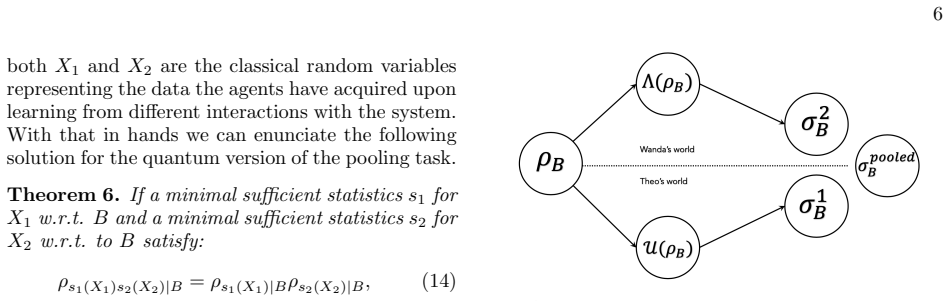
The machinery is the quantum conditional-state formalism, in which probabilities become trace-class operators and conditioning is written as $\sigma_{B|A} = \sigma_{AB} \star \sigma_A^{-1}$ using a non-commutative $\star$-product. Hybrid classical-quantum states keep classical variables classical, and compatibility of two assignments is characterized by overlapping supports. The state-pooling theorem, stated as Theorem 6, gives the pooled state $c\,\sigma^1_B \rho_B^{-1} \sigma^2_B$ when the minimal sufficient statistics satisfy Eq. (14). Result 7 applies that theorem to the coarse-graining scenario by treating the two agents' states as posterior assignments and the prior as $\rho_B$. The independence condition in Eq. (14) is the load-bearing step that converts the existence of an effective state into a factorization statement.
What would settle it
Take an explicit coarse-graining instance with a concrete unitary $U$, lossy map $\Lambda$, and prior $\rho_B$, then construct the agents' data sets from that instance. If Eq. (14) holds but $c\,\sigma^1_B \rho_B^{-1} \sigma^2_B$ fails to be a positive trace-one state, or if a compatible pooled state can be shown to exist while no choice of minimal sufficient statistics satisfies Eq. (14), then the claimed necessary and sufficient condition is false.
Extended reading notes
Core claim
On the paper's own terms, the discovery is that quantum state pooling supplies necessary and sufficient conditions for a coarse-grained effective state. Two assignment maps are compatible when the supports of their assigned states overlap, and when the data behind them have minimal sufficient statistics $s_1$ and $s_2$ satisfying the conditional-independence relation $\rho_{s_1(X_1)s_2(X_2)|B} = \rho_{s_1(X_1)|B}\rho_{s_2(X_2)|B}$, the unique pooled state is $\sigma_{\mathrm{pooled}} = c\,\sigma^1_B \rho_B^{-1} \sigma^2_B$. The same formula defines a map $\rho_B \mapsto c\,\sigma^1_B \rho_B^{-1} \sigma^2_B$ on the state space, which is generally non-linear. The paper presents this as a concrete alternative to demanding that the coarse-graining diagram commute or to solving an infinite family of semidefinite programs.
Load-bearing premise
The whole argument rests on assuming that the original lossy quantum process can be exactly recast as two agents sharing a prior and updating on two data sets whose key summaries are independent given the system, with each prior producing a unique pair of assignments.
Editorial extensions
If this is right
- Whenever two agents' data have conditionally independent minimal sufficient statistics, their combined assignment is fixed by $c\,\sigma^1_B \rho_B^{-1} \sigma^2_B$, so no additional rule for merging beliefs is needed.
- The effective map $\rho_B \mapsto c\,\sigma^1_B \rho_B^{-1} \sigma^2_B$ need not be a quantum channel, so coarse-graining can produce effective states that channel-based approaches would miss.
- The existence of a meaningful coarse-grained state can be certified by a single independence condition instead of an infinite family of semidefinite programs.
- The pooled state depends explicitly on the shared prior $\rho_B$, so the prior is not washed out by pooling.
- The compatibility criterion based on overlapping supports gives a direct way to check whether two agents' assignments can be reconciled at all.
Reading between the lines
- Not stated in the paper: the concrete construction of $X_1$, $X_2$, $s_1$, and $s_2$ from a given unitary $U$ and lossy map $\Lambda$ is left implicit; spelling out that construction would turn Result 7 into an applicable algorithm.
- A testable extension is to take a simple two-qubit model with two measurement devices, compute the minimal sufficient statistics explicitly, and check whether Eq. (14) holds and whether the resulting operator is positive and trace-one.
- If the non-linearity of the effective map is physically meaningful, then coarse-grained quantum dynamics may not be describable by completely positive trace-preserving maps at all, which would connect this result to broader discussions of state merging and non-linear Bayesian updating.
- The support-overlap compatibility condition suggests an experimental route: prepare ensembles whose assigned states have overlapping supports and verify that measurements match the predicted pooled state $c\,\sigma^1_B \rho_B^{-1} \sigma^2_B$.
Signed reviews
Editorial analysis
A structured set of objections, weighed in public.
Referee Report
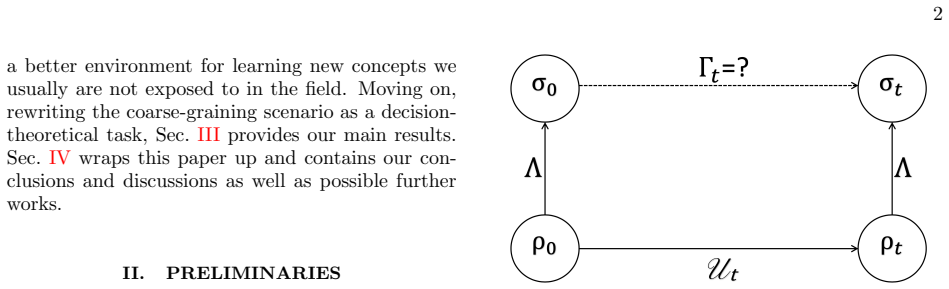
Summary. This manuscript proposes to reinterpret the coarse-graining problem of Ref. [14]—where a microscopic unitary evolution U and a lossy CPTP map Λ are to be replaced by an effective description—as a quantum state pooling problem between two Bayesian agents, Wanda and Theo. It reviews the conditional quantum states formalism, defines objective and subjective compatibility, and quotes a theorem from Leifer and Spekkens (Theorem 6) asserting that if minimal sufficient statistics for the agents' data are conditionally independent given the system B, then the pooled state is sigma_pooled = c sigma1 rho^{-1} sigma2. The paper states this same statement as Result 7, defines a non-linear map Gamma_tilde(rho_B) = c sigma1 rho^{-1} sigma2 in Eq. (17), and concludes that it has provided necessary and sufficient conditions for the existence of an effective coarse-grained state.
Significance. If the proposed translation were valid, the decision-theoretic reformulation could offer a new way to characterize effective coarse-grained states. The paper is transparent in attributing the pooling formula to Ref. [19], and it does not hide the fact that Result 7 is a restatement. However, the central claim of the paper—that Result 7 gives necessary and sufficient conditions for the original coarse-graining problem—is not established: the connection between the physical data (U, Lambda) and the pooling variables (X1, X2, s1, s2) is never constructed, no necessity proof is given, and an illustrative proposition in the preliminaries is false. These gaps are load-bearing, so the paper as it stands does not provide the advertised result.
major comments (4)
- [Section III, Result 7] Result 7 is identical to Theorem 6 quoted from Ref. [19] and is stated without proof. The abstract and conclusion claim 'necessary and sufficient conditions' for the existence of a well-defined coarse-grained state, but Result 7 is a conditional sufficiency statement: if the independence condition in Eq. (14) holds, then Eq. (16) holds. No converse is proved, and no equivalence with the commuting-diagram compatibility of Ref. [14] is established. The paper therefore does not support its advertised necessary-and-sufficient claim.
- [Section III, paragraph after Eq. (17)] The paper never constructs, from the original coarse-graining data (unitary U, CPTP map Lambda, and prior rho_B), the random variables X1 and X2, their minimal sufficient statistics s1 and s2, or the assignments sigma1_B and sigma2_B that appear in Result 7. Without this translation, Result 7 is a statement about an abstract pooling scenario, not about the coarse-graining diagram of Fig. 1; the sentence that the assignments 'could have originated out of a channel, from Bayesian condition or by any other means' does not supply the missing construction or a proof that the translation is faithful.
- [Section III, Eq. (17)] The map Gamma_tilde is only well-defined if each prior rho_B determines a unique pair of agent assignments sigma1_B and sigma2_B. The paper asserts this uniqueness in the paragraph after Eq. (17) but gives no proof and specifies no model of the agents' interactions or Bayesian updates. If the same prior can lead to different assignments (for example, through different data-sets or likelihoods), the map is not a function of rho_B alone.
- [Section II C, Proposition 2] Proposition 2 is false as stated. For binary Y, the assignments Q1=(1,0) and Q2=(1/2,1/2) have overlapping support, so Theorem 1 implies they are compatible, yet Proposition 2 declares them incompatible because p is not in (0,1). The proof's case analysis incorrectly assumes that if p=1 then q must be 0 or 1. Although this example is not used in the derivation of Result 7, it is a stated theorem in the paper and must be corrected.
minor comments (3)
- [Section II C, Definition 4] The first condition of Definition 4 reads 'Tr_B(rho_{X=x|B} sigma^i_B) for all x and for all i' with no predicate; presumably it should state that this quantity is positive (or nonzero).
- [Section II C, Proposition 2 proof] The proof of Proposition 2 refers to 'Eq. (12)' but the relevant condition is Eq. (9) from Theorem 1; the equation numbering should be corrected.
- [Throughout] There are several typographical and formatting issues, including 'Schroedinger' for 'Schrödinger', missing accents, and some incomplete sentences; a careful proofreading pass is needed.
Circularity Check
Minor circularity: Result 7 is the imported pooling theorem of Ref. [19] restated as the coarse-graining result; no independent derivation from (U, Λ) is supplied.
-
renaming known result
[Section II.C (Theorem 6) versus Section III (Result 7)]
"Theorem 6. If a minimal sufficient statistics s1 for X1 w.r.t. B and a minimal sufficient statistics s2 for X2 w.r.t. to B satisfy Eq. (14), then the pooled state σB_pooled is given by σB_pooled = cσ1_B ρ^{-1}_B σ2_B. ... Result 7. If a minimal sufficient statistics s1 for X1 w.r.t. B and a minimal sufficient statistics s2 for X2 w.r.t. to B satisfy the independence condition in Eq. (14), then the pooled state σB_pooled is given by σB_pooled = cσ1_B ρ^{-1}_B σ2_B."
Eq. (16) in Result 7 is identical to Eq. (15) in Theorem 6, which the paper has just quoted from Ref. [19]. The claimed main result is therefore not derived from the coarse-graining data (the unitary U, the CPTP map Λ, or the prior ρ_B); it is the same external theorem restated under a new vocabulary. The paper adds the terminological step of calling the pooled state the coarse-grained state, but no construction of X1, X2, s1, and s2 from the original scenario is provided. The central formula thus reduces by construction to its input theorem under a renaming, rather than being an independent derivation.
full rationale
The paper's central mathematical content is not fitted to data and does not rely on a self-citation chain: the formula σ_pooled = c σ1 ρ^{-1} σ2 is quoted from Leifer and Spekkens [19] and then restated as Result 7. Because the theorem is external and honestly cited, this is not a hidden circular derivation, and the score is not high. However, the paper presents the restatement as its own 'necessary and sufficient conditions' for the coarse-graining problem, without proving that the coarse-graining scenario of Ref. [14] can be translated into the pooling variables X1, X2, s1, s2 satisfying Eq. (14). The unproven translation is an applicability gap rather than a circular reduction, and the uniqueness assumption after Eq. (17) is also unproven. The only concrete circularity is that Result 7 is, by the paper's own equations, identical to the Theorem 6 stated earlier, so the claimed new result reduces to the known theorem under a renaming of the coarse-grained state as the pooled state. This warrants a mild score of 2.
Assumptions & free parameters
assumptions (5)
- domain assumption The conditional quantum states formalism (star-product, quantum Bayes rule) correctly represents agents' beliefs and updates.
- ad hoc to paper The original coarse-graining scenario of Ref. [14] can be translated into a two-agent pooling problem with shared prior rho and data X1, X2.
- ad hoc to paper Minimal sufficient statistics for the two agents are conditionally independent given B (Eq. (14)).
- domain assumption The prior rho_B is invertible.
- ad hoc to paper Each prior rho determines a unique pair of agent assignments, making the map Gamma in Eq. (17) well defined.
Cite this review
Pith. "Pith review of Effective state as compatibility between agents." pith.science (2026). https://pith.science/paper/NHIRJGOA
@misc{pith2026190804432,
  author       = {Pith},
  title        = {Pith review of: Effective state as compatibility between agents},
  year         = {2026},
  howpublished = {\url{https://pith.science/paper/NHIRJGOA}},
  note         = {Machine review of arXiv:1908.04432}
}
read the original abstract
Shedding a new light in the coarse-graining scenario, in this contribution we came up with different necessary and sufficient conditions for the existence of a well-defined coarse-grained state. For doing so, we had to break apart with the usual quantum channels perspective and assume a more decision-theoretical posture. Broadly speaking, we reinterpret the coarse-graining problem in the language of quantum state pooling, and by make an extensive use of the conditional quantum states toolkit we have been able to derive more tangible conditions for the emergence of a compatible, effective coarse-grained state.
Figures
Reference graph
Works this paper leans on
-
[14]
Wolfram, Reviews of Modern Physics 55, 601644 (1983)
S. Wolfram, Reviews of Modern Physics 55, 601644 (1983)
work page 1983
- [19]
-
[1]
Compatibility Before rigorously defining what we mean by state pooling, we need first define what we mean by com- patibility, or agreement. We will go through it su- perficially over the following lines, but for a deeper, detailed approach to the same topic we refer to [19]. In a nutshell, depending on the Bayesian perspective one might adopt about probabilit...
-
[2]
We wrap up this section describing how to do it through what is calledhybrid states
(6) Although there are some limitations [19, 20], the conditional states formalism is robust enough to handle with correlations among classical and quan- tum regions simultaneously. We wrap up this section describing how to do it through what is calledhybrid states. For a classical variable X we want to consider in conjunction with a quantum region B, we ...
-
[3]
P(X1 =x1,X 2 =x2)> 0
-
[4]
Definition 2 (Subjective Quantum Compatibility)
Qi(Y =y) = P(Y =y|Xi =xi), for all i∈{ 1, 2} and for all y∈ Out(Y ). Definition 2 (Subjective Quantum Compatibility). Two probability assignments Q1(Y ) and Q2(Y ), over a random variable Y , are compatible whenever it is possible to find another random variable X and a conditional distribution P(X|Y ) that both agents agrees upon such that:
-
[5]
∑ y∈Out(Y ) P(X = x|Y = y)Qi(Y = y) > 0 for all x and for all i∈{ 1, 2}
-
[6]
P1(Y|X = ˜x) = P2(Y|X = ˜x), for some value ˜x in Out(X), where Pi(Y =y|X =x) := P(X =x|Y =y)Qi(Y =y)∑ y P(X =x|Y =y)Qi(Y =y). (8) Although Def. 1 and Def. 2 must be seen within the scope of a Bayesian’s perspective of probability theory, the former is objective-like in its form, in the sense that it reflects the idea that objective agents can only disagre...
Show all 66 references
-
[7]
In either case, Eq
If either p orq were equal to one, then one of the cases would hold true: • either Q1 = (1, 0) and Q2 = (0, 1) • or Q1 = (0, 1) and Q2 = (1, 0). In either case, Eq. (12) would prevent the existence of agreement. As for the other direction, suppose that p,q ∈ (0, 1). In this ca...
-
[8]
Definition 4 (Subjective Quantum Compatibility)
σi B =ρB|Xi=xi, for all i∈{ 1, 2}. Definition 4 (Subjective Quantum Compatibility). Two assignments σ1 B and σ2 B, for a quantum region B, are compatible whenever it is possible to find an- other classical random variable X and a conditional state ρX|B that both agents agrees up...
-
[9]
Tr B ( ρX=x|Bσi B ) for all x and for all i ∈ {1, 2}
-
[10]
(11) As for the result connecting both quantum defini- tions we have: Theorem 4
ρ1 B|X=˜x = ρ2 B|X=˜x, for some value ˜x in Out(X), where each ρi B|X=x is given by the quantum Bayes’ rule [19] ρi B|X=˜x := ρX=x|B⋆σ i B TrB ( ρX=x|Bσi B ). (11) As for the result connecting both quantum defini- tions we have: Theorem 4. σ1 B andσ2 B are compatible, either su...
-
[11]
State Pooling Moving on, and getting back to the pooling task, to come up with a state that all the agents can agree on as being the assignment reflecting the views of the group as whole, we may use –once again– the results of Ref. [19]. For doing so, we will restrict ourselves...
-
[12]
H. B. Callen, Thermodynamics and an Introduction to Thermostatistics , 2nd ed. (Wiley, 1985)
1985
-
[13]
Castiglione, M
P. Castiglione, M. Falcioni, A. Lesne, and A. Vulpi- ani, Chaos and Coarse Grainings in Statistical Me- chanics (Cambridge University Press, 2008)
2008
-
[15]
J. M. Davidenko, A. V. Pertsov, R. Salomonsz, W. Baxter, and J. Jalife, Nature 355, 349351 (1992)
1992
-
[16]
M. J. Boniecki, G. Lach, W. K. Dawson, K. Tomala, P. Lukasz, T. Soltysinski, K. M. Rother, and J. M. Bujnicki, Nucleic Acids Research 44, e63 (2015), http://oup.prod.sis.lan/nar/article- pdf/44/7/e63/17438019/gkv1479.pdf
2015
-
[17]
D. A. Potoyan, A. Savelyev, and G. A. Papoian, Wiley Interdisciplinary Reviews: Computational Molecular Science 3, 6983 (2013)
2013
-
[18]
Baron, D
R. Baron, D. Trzesniak, A. H. de Vries, A. Elsener, S. J. Marrink, and W. F. van Gunsteren, ChemPhysChem 8, 452461 (2007)
2007
-
[20]
Naghibi Beidokhti, D
H. Naghibi Beidokhti, D. Janssen, M. Khoshgof- tar, A. Sprengers, E. S. Perdahcioglu, T. Van den Boogaard, and N. Verdonschot, Medical Engineer- ing and Physics 38, 11231130 (2016)
2016
-
[21]
M. J. Brennan and E. S. Schwartz, The Journal of Financial and Quantitative Analysis 13, 461 (1978)
1978
-
[22]
Ilachinski, Cellular automata: a discrete uni- verse, reprinted ed
A. Ilachinski, Cellular automata: a discrete uni- verse, reprinted ed. (World Scientific, 2002)
2002
-
[23]
Perrenoud, M
M. Perrenoud, M. Sipper, and M. Tomassini, IEEE Transactions on Computers 49, 11461151 (2000)
2000
-
[24]
G. J. Van Wylen and R. E. Sonntag, Fundamentals of classical thermodynamics , 3rd ed. (Wiley, 1986)
1986
-
[25]
Duarte, G
C. Duarte, G. D. Carvalho, N. K. Bernardes, and F. de Melo, Phys. Rev. A 96, 032113 (2017)
2017
-
[26]
P. C. S. Costa and F. de Melo, arXiv e- prints , arXiv:1905.10391 (2019), arXiv:1905.10391 [nlin.CG]
2019 arXiv
-
[27]
Silva Correia and F
P. Silva Correia and F. de Melo, arXiv e-prints , arXiv:1902.08574 (2019), arXiv:1902.08574 [quant- ph]
2019 arXiv
-
[28]
M. A. Nielsen and I. L. Chuang, Quantum computa- tion and quantum information (Cambridge Univer- sity Press, 2000)
2000
-
[29]
Quantum channels & opera- tions,
M. M. Wolf, “Quantum channels & opera- tions,” (2012), available at https://www- m5.ma.tum.de/foswiki/pub/M5/Allgemeines/MichaelWolf/
2012
-
[30]
M. S. Leifer and R. W. Spekkens, Journal of Physics A: Mathematical and Theoretical 47, 275301 (2014)
2014
-
[31]
M. S. Leifer and R. W. Spekkens, Phys. Rev. A 88, 052130 (2013)
2013
-
[32]
Leifer and D
M. Leifer and D. Poulin, Annals of Physics 323, 18991946 (2008)
2008
-
[33]
Kofler and C
J. Kofler and C. Brukner, Phys. Rev. Lett. 99, 180403 (2007)
2007
-
[34]
Gell-Mann and J
M. Gell-Mann and J. B. Hartle, Phys. Rev. A 89, 052125 (2014)
2014
-
[35]
Faist, Quantum Coarse-Graining: An Information-Theoretic Approach to Thermody- namics, Ph.D
P. Faist, Quantum Coarse-Graining: An Information-Theoretic Approach to Thermody- namics, Ph.D. thesis, ETH Zurich (2016), eprint: arXiv:1607.03104
2016 arXiv
-
[36]
Leifer, Quanta 3, 67 (2014)
M. Leifer, Quanta 3, 67 (2014)
2014
-
[37]
W. H. Zurek, Los Alamos Science 27, 2 (2002)
2002
-
[38]
W. H. Zurek, Nature Physics 5, 181188 (2009)
2009
-
[39]
Blume-Kohout and W
R. Blume-Kohout and W. H. Zurek, Physical Re- view A 73, 062310 (2006)
2006
-
[40]
F. G. S. L. Brando, M. Piani, and P. Horodecki, Nature Communications 6, 7908 (2015)
2015
-
[41]
R. W. Spekkens, Phys. Rev. A 75, 032110 (2007)
2007
-
[42]
Schmid, K
D. Schmid, K. Ried, and R. W. Spekkens, arXiv e- prints , arXiv:1806.02381 (2018), arXiv:1806.02381 [quant-ph]
2018 arXiv
-
[43]
Saideh, A
I. Saideh, A. D. Ribeiro, G. Ferrini, T. Coudreau, P. Milman, and A. Keller, Phys. Rev. A 92, 052334 (2015)
2015
-
[44]
Cohen-Tannoudji, B
C. Cohen-Tannoudji, B. Diu, and F. Lalo¨ e, Quan- tum Mechanics (Wiley, 1977)
1977
-
[45]
Peres, Quantum Theory: Concepts and Methods (Kluwer Academic Publishers, 1995)
A. Peres, Quantum Theory: Concepts and Methods (Kluwer Academic Publishers, 1995)
1995
-
[46]
Talbott, in The Stanford Encyclopedia of Philos- ophy, edited by E
W. Talbott, in The Stanford Encyclopedia of Philos- ophy, edited by E. N. Zalta (Metaphysics Research Lab, Stanford University, 2016) winter 2016 ed
2016
-
[47]
Anand, Foundations of rational choice under risk , paperback ed ed
P. Anand, Foundations of rational choice under risk , paperback ed ed. (Clarendon Press, 1995)
1995
-
[48]
French, Journal of the Royal Statistical Society
S. French, Journal of the Royal Statistical Society. Series A (General) 143, 43 (1980)
1980
-
[49]
Genest and J
C. Genest and J. V. Zidek, Statistical Science 1, 9 114135 (1986)
1986
-
[50]
R. A. Jacobs, Neural Computation 7, 867888 (1995)
1995
-
[51]
P. A. Morris, Management Science 20, 12331241 (1974)
1974
-
[52]
Herbut, Journal of Physics A: Mathematical and General 37, 52435250 (2004)
F. Herbut, Journal of Physics A: Mathematical and General 37, 52435250 (2004)
2004
-
[53]
Theory of quantum information. lecture notes
J. Watrous, “Theory of quantum information. lecture notes.” (2006), available on-line at https://cs.uwaterloo.ca/∼watrous/LectureNotes.html
2006
-
[54]
Semidefinite programs and combinato- rial optimization (lecture notes),
L. Lov´ asz, “Semidefinite programs and combinato- rial optimization (lecture notes),” (1995)
1995
-
[55]
Cavalcanti and P
D. Cavalcanti and P. Skrzypczyk, Reports on Progress in Physics 80, 024001 (2017)
2017
-
[56]
S. P. Boyd and L. Vandenberghe, Convex optimiza- tion (Cambridge University Press, 2004)
2004
-
[57]
Pearl, Causality: models, reasoning, and infer- ence, second edition, reprinted with corrections ed
J. Pearl, Causality: models, reasoning, and infer- ence, second edition, reprinted with corrections ed. (Cambridge University Press, 2013)
2013
-
[58]
Kleinberg, Causality, probability, and time (Cam- bridge University Press, 2013)
S. Kleinberg, Causality, probability, and time (Cam- bridge University Press, 2013)
2013
-
[59]
Pearl, Biometrika 82, 669688 (1995)
J. Pearl, Biometrika 82, 669688 (1995)
1995
-
[60]
Bareinboim and J
E. Bareinboim and J. Pearl, Proceedings of the National Academy of Sciences 113, 7345 (2016), https://www.pnas.org/content/113/27/7345.full.pdf
2016
-
[61]
Kurzyk and A
D. Kurzyk and A. Glos, Quantum Information Pro- cessing 15, 49274937 (2016)
2016
-
[62]
Barrett, R
J. Barrett, R. Lorenz, and O. Oreshkov, arXiv e- prints , arXiv:1906.10726 (2019), arXiv:1906.10726 [quant-ph]
2019 arXiv
-
[63]
P. G. Lewis, D. Jennings, J. Barrett, and T. Rudolph, Physical Review Letters 109, 150404 (2012)
2012
-
[64]
Costa and S
F. Costa and S. Shrapnel, New Journal of Physics 18, 063032 (2016)
2016
-
[65]
Frauchiger and R
D. Frauchiger and R. Renner, Nature Communica- tions 9, 3711 (2018)
2018
-
[66]
M. S. Leifer and M. F. Pusey, Proceedings of the Royal Society A: Mathematical, Physical and Engi- neering Sciences 473, 20160607 (2017)
2017
Reviewed August 14, 2026 · model on record in the stance chip above.
Discussion (0). Continue with ORCID to comment.