Charged Lepton Flavor Violation at Neutrino Telescopes
Pith reviewed 2026-06-26 17:24 UTC · model grok-4.3
The pith
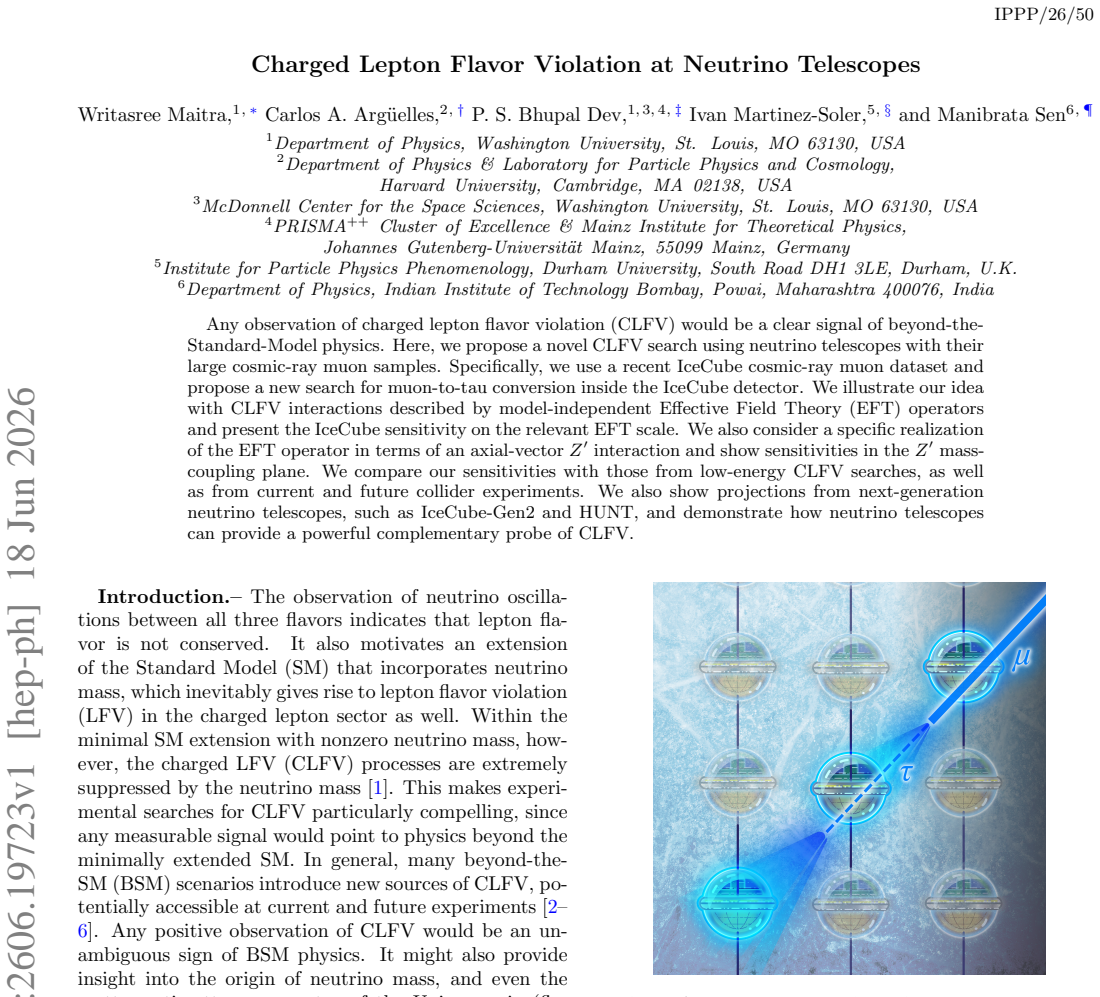
IceCube can search for muon-to-tau conversion using its cosmic-ray muon sample to probe charged lepton flavor violation.
A machine-rendered reading of the paper's core claim, the machinery that carries it, and where it could break.
Core claim
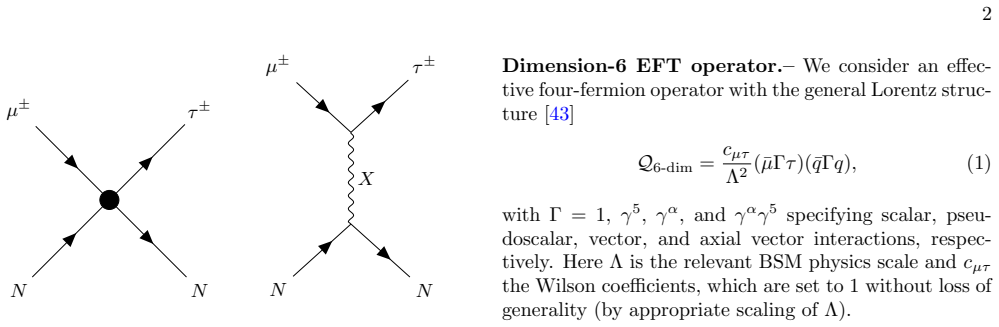
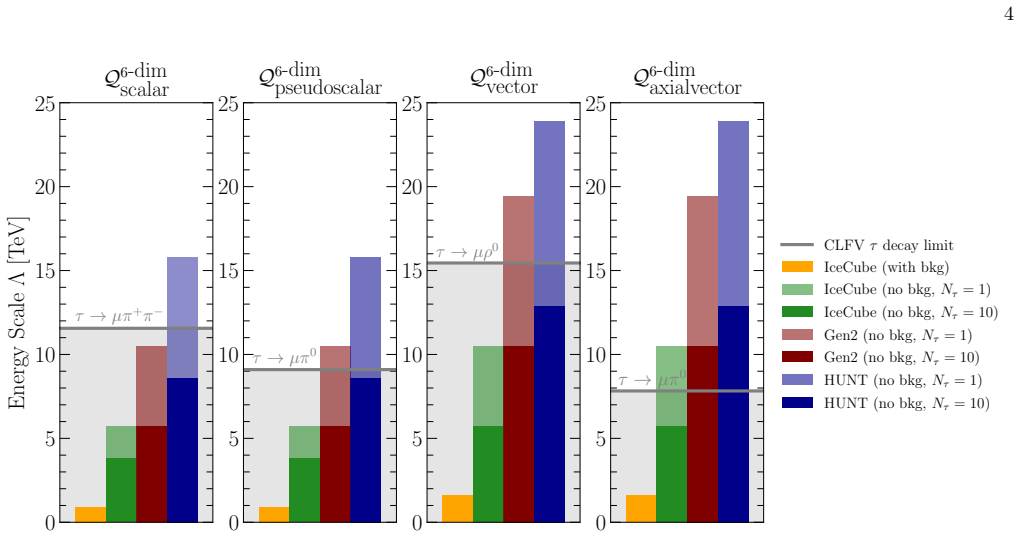
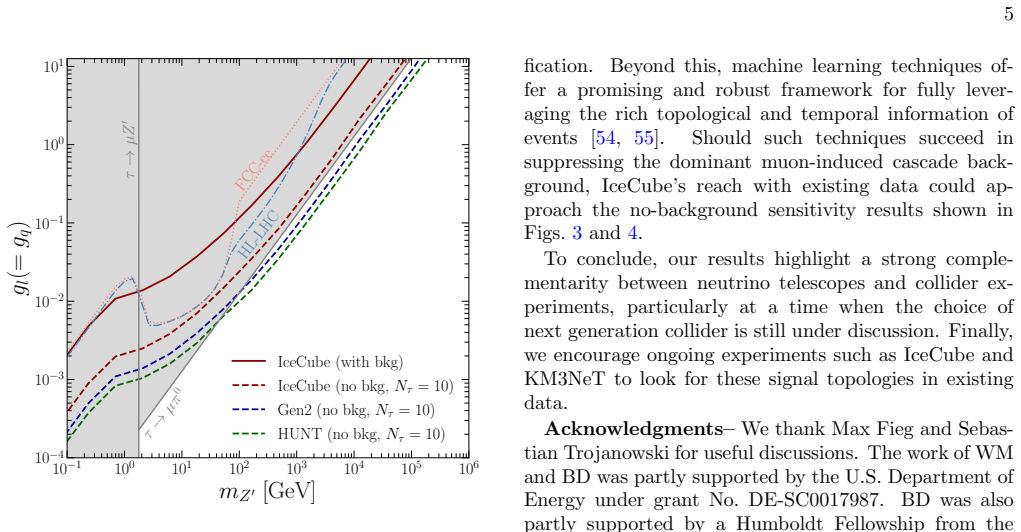
Neutrino telescopes can perform a new search for charged lepton flavor violation by identifying muon-to-tau conversions among cosmic-ray muons traversing the detector, yielding competitive constraints on the relevant EFT operators and on the mass-coupling plane of an axial-vector Z' mediator.
What carries the argument
Muon-to-tau conversion inside the IceCube volume, distinguished from ordinary muon interactions in the cosmic-ray muon sample.
If this is right
- Existing IceCube data already constrain the scale of CLFV EFT operators at levels comparable to some low-energy searches.
- A specific axial-vector Z' realization yields limits in the mass-coupling plane that complement collider bounds.
- IceCube-Gen2 and HUNT projections show substantially stronger reach for the same operators.
- The method supplies an independent probe that does not rely on neutrino beams or fixed-target setups.
Where Pith is reading between the lines
- The approach could be applied to any large-volume neutrino telescope that records high-energy muons.
- If a signal appears, it would directly constrain the flavor structure of any new physics responsible for neutrino masses.
- Combining this channel with collider searches could isolate whether the CLFV operator is vector or axial-vector in nature.
Load-bearing premise
Backgrounds from ordinary muon interactions and detector response can be controlled sufficiently to isolate a potential muon-to-tau conversion signal at the level needed for the quoted EFT sensitivities.
What would settle it
A background-only analysis of the IceCube cosmic-ray muon dataset that finds no excess of tau-like events after all standard rejection cuts would falsify the claimed sensitivity reach.
Figures
read the original abstract
Any observation of charged lepton flavor violation (CLFV) would be a clear signal of beyond-the-Standard-Model physics. Here, we propose a novel CLFV search using neutrino telescopes with their large cosmic-ray muon samples. Specifically, we use a recent IceCube cosmic-ray muon dataset and propose a new search for muon-to-tau conversion inside the IceCube detector. We illustrate our idea with CLFV interactions described by model-independent Effective Field Theory (EFT) operators and present the IceCube sensitivity on the relevant EFT scale. We also consider a specific realization of the EFT operator in terms of an axial-vector $Z'$ interaction and show sensitivities in the $Z'$ mass-coupling plane. We compare our sensitivities with those from low-energy CLFV searches, as well as from current and future collider experiments. We also show projections from next-generation neutrino telescopes, such as IceCube-Gen2 and HUNT, and demonstrate how neutrino telescopes can provide a powerful complementary probe of CLFV.
Editorial analysis
A structured set of objections, weighed in public.
Referee Report
Summary. The manuscript proposes a novel search for charged lepton flavor violation (CLFV) via muon-to-tau conversion using the large sample of cosmic-ray muons in IceCube. It employs model-independent effective field theory (EFT) operators to derive projected sensitivities on the EFT scale, considers a specific axial-vector Z' realization, compares the reach to low-energy CLFV searches and collider experiments, and provides projections for IceCube-Gen2 and HUNT.
Significance. If the background separation can be achieved, the approach would furnish a high-energy, complementary probe of CLFV that leverages existing cosmic-ray muon statistics in neutrino telescopes. The EFT framework is standard and the comparisons to other experiments are useful; the projections for next-generation detectors illustrate the method's scalability.
major comments (2)
- [IceCube analysis and sensitivity section] The central sensitivity claims rest on the assumption that ordinary cosmic-ray muon energy loss, stochastic losses, and detector response can be controlled to isolate a potential muon-to-tau signal after selection cuts. No explicit background model, fake-rate estimates, efficiency curves, or data-driven validation is supplied in the IceCube analysis section, rendering the quoted EFT bounds unverifiable.
- [Comparison with other experiments] The comparison of IceCube sensitivities to existing and future experiments assumes a particular matching of the EFT operators between the high-energy scale and the low-energy scale; the running or matching procedure is not shown explicitly, which affects the direct numerical comparison presented.
minor comments (2)
- [Introduction] The specific IceCube cosmic-ray muon dataset reference should be cited explicitly when first introducing the sample.
- [EFT framework] Notation for the EFT operators (e.g., the precise definition of the scale Λ) should be stated once in a dedicated subsection for clarity.
Simulated Author's Rebuttal
We thank the referee for the thorough review and constructive feedback on our manuscript. We address each of the major comments below and plan to revise the manuscript to incorporate the suggested improvements.
read point-by-point responses
-
Referee: [IceCube analysis and sensitivity section] The central sensitivity claims rest on the assumption that ordinary cosmic-ray muon energy loss, stochastic losses, and detector response can be controlled to isolate a potential muon-to-tau signal after selection cuts. No explicit background model, fake-rate estimates, efficiency curves, or data-driven validation is supplied in the IceCube analysis section, rendering the quoted EFT bounds unverifiable.
Authors: We agree with the referee that the manuscript does not provide a detailed background model or efficiency curves, as the current work focuses on a phenomenological proposal for a new search channel rather than a full experimental analysis. The sensitivities are estimated based on the known large statistics of cosmic-ray muons in IceCube and standard assumptions about the distinguishability of tau-induced signatures. In the revised manuscript, we will expand the IceCube analysis section to include a more detailed discussion of the key assumptions, potential backgrounds, and how they might be mitigated, while clearly stating that these are projected sensitivities that would require dedicated experimental validation. We will also reference relevant IceCube publications on muon propagation and energy loss. revision: yes
-
Referee: [Comparison with other experiments] The comparison of IceCube sensitivities to existing and future experiments assumes a particular matching of the EFT operators between the high-energy scale and the low-energy scale; the running or matching procedure is not shown explicitly, which affects the direct numerical comparison presented.
Authors: We acknowledge that the explicit running and matching procedure for the EFT operators was not detailed in the manuscript. The comparisons assume standard matching at the electroweak scale with no additional running effects beyond the usual QCD and QED running for the relevant operators. In the revision, we will add an appendix or subsection that explicitly shows the matching conditions and any relevant renormalization group evolution used to relate the high-energy IceCube scale to the low-energy scales of other experiments, ensuring the numerical comparisons are fully transparent. revision: yes
Circularity Check
No circularity: proposal applies standard EFT to external IceCube dataset without self-referential reductions.
full rationale
The paper is a forward-looking proposal for a CLFV search in IceCube cosmic-ray muons using model-independent EFT operators. Sensitivities are computed from standard EFT cross sections folded with detector response and an external public dataset; no equations define a quantity in terms of itself, rename a fitted parameter as a prediction, or reduce the central result to a self-citation chain. The derivation chain remains independent of the paper's own inputs and relies on externally verifiable assumptions about backgrounds and efficiencies.
Axiom & Free-Parameter Ledger
Reference graph
Works this paper leans on
-
[1]
S. T. Petcov, The Processesµ→e+γ, µ→e+ e, ν′ →ν+γin the Weinberg-Salam Model with Neutrino Mixing, Sov. J. Nucl. Phys.25, 340 (1977), [Erratum: Sov.J.Nucl.Phys. 25, 698 (1977), Erratum: Yad.Fiz. 25, 1336 (1977)]
1977
-
[2]
A. de Gouvea and P. Vogel, Lepton Flavor and Number Conservation, and Physics Beyond the Standard Model, Prog. Part. Nucl. Phys.71, 75 (2013), arXiv:1303.4097 [hep-ph]
Pith/arXiv arXiv 2013
-
[3]
R. H. Bernstein and P. S. Cooper, Charged Lepton Flavor Violation: An Experimenter’s Guide, Phys. Rept.532, 27 (2013), arXiv:1307.5787 [hep-ex]
Pith/arXiv arXiv 2013
-
[4]
L. Calibbi and G. Signorelli, Charged Lepton Flavour Vi- olation: An Experimental and Theoretical Introduction, Riv. Nuovo Cim.41, 71 (2018), arXiv:1709.00294 [hep- ph]
Pith/arXiv arXiv 2018
-
[5]
M. Ardu and G. Pezzullo, Introduction to Charged 6 Lepton Flavor Violation, Universe8, 299 (2022), arXiv:2204.08220 [hep-ph]
arXiv 2022
-
[6]
S. Davidson, B. Echenard, R. H. Bernstein, J. Heeck, and D. G. Hitlin, Charged Lepton Flavor Violation, (2022), arXiv:2209.00142 [hep-ex]
arXiv 2022
-
[7]
Fukugita and T
M. Fukugita and T. Yanagida, Baryogenesis Without Grand Unification, Phys. Lett. B174, 45 (1986)
1986
-
[8]
P. S. B. Dev, P. Di Bari, B. Garbrecht, S. Lavignac, P. Millington, and D. Teresi, Flavor effects in lep- togenesis, Int. J. Mod. Phys. A33, 1842001 (2018), arXiv:1711.02861 [hep-ph]
Pith/arXiv arXiv 2018
-
[9]
M. G. Aartsenet al.(IceCube), The IceCube Neu- trino Observatory: Instrumentation and Online Systems, JINST12(03), P03012, [Erratum: JINST 19, E05001 (2024)], arXiv:1612.05093 [astro-ph.IM]
arXiv 2024
-
[10]
M. G. Aartsenet al.(IceCube), First observation of PeV- energy neutrinos with IceCube, Phys. Rev. Lett.111, 021103 (2013), arXiv:1304.5356 [astro-ph.HE]
Pith/arXiv arXiv 2013
-
[11]
M. G. Aartsenet al.(IceCube), Evidence for High- Energy Extraterrestrial Neutrinos at the IceCube Detec- tor, Science342, 1242856 (2013), arXiv:1311.5238 [astro- ph.HE]
Pith/arXiv arXiv 2013
-
[12]
M. G. Aartsenet al.(IceCube), Observation of High- Energy Astrophysical Neutrinos in Three Years of Ice- Cube Data, Phys. Rev. Lett.113, 101101 (2014), arXiv:1405.5303 [astro-ph.HE]
Pith/arXiv arXiv 2014
-
[13]
M. G. Aartsenet al.(IceCube), Detection of a parti- cle shower at the Glashow resonance with IceCube, Na- ture591, 220 (2021), [Erratum: Nature 592, E11 (2021)], arXiv:2110.15051 [hep-ex]
arXiv 2021
-
[14]
R. Abbasiet al.(IceCube), Evidence for neutrino emis- sion from the nearby active galaxy NGC 1068, Science 378, 538 (2022), arXiv:2211.09972 [astro-ph.HE]
arXiv 2022
-
[15]
R. Abbasiet al.(IceCube), Observation of high-energy neutrinos from the Galactic plane, Science380, adc9818 (2023), arXiv:2307.04427 [astro-ph.HE]
arXiv 2023
-
[16]
R. Abbasiet al.(IceCube), Observation of Cosmic-Ray Anisotropy in the Southern Hemisphere with 12 yr of Data Collected by the IceCube Neutrino Observatory, Astrophys. J.981, 182 (2025), arXiv:2412.05046 [astro- ph.HE]
arXiv 2025
-
[17]
Lagarrigue and C
A. Lagarrigue and C. Peyrou, , Comptes Rendus Acad. Sci. Paris234, 1873 (1952)
1952
-
[18]
Dohmenet al.(SINDRUM II), Test of lepton flavor conservation in mu —>e conversion on titanium, Phys
C. Dohmenet al.(SINDRUM II), Test of lepton flavor conservation in mu —>e conversion on titanium, Phys. Lett. B317, 631 (1993)
1993
-
[19]
Kaulardet al.(SINDRUM II), Improved limit on the branching ratio of mu- –>e+ conversion on titanium, Phys
J. Kaulardet al.(SINDRUM II), Improved limit on the branching ratio of mu- –>e+ conversion on titanium, Phys. Lett. B422, 334 (1998)
1998
-
[20]
Honeckeret al.(SINDRUM II), Improved limit on the branching ratio of mu —>e conversion on lead, Phys
W. Honeckeret al.(SINDRUM II), Improved limit on the branching ratio of mu —>e conversion on lead, Phys. Rev. Lett.76, 200 (1996)
1996
-
[21]
W. H. Bertlet al.(SINDRUM II), A Search for muon to electron conversion in muonic gold, Eur. Phys. J. C47, 337 (2006)
2006
-
[22]
Afanacievet al.(MEG II), New limit on theµ + →e +γ decay with the MEG II experiment, Eur
K. Afanacievet al.(MEG II), New limit on theµ + →e +γ decay with the MEG II experiment, Eur. Phys. J. C85, 1177 (2025), [Erratum: Eur.Phys.J.C 85, 1317 (2025)], arXiv:2504.15711 [hep-ex]
arXiv 2025
-
[23]
S. N. Gninenko, M. M. Kirsanov, N. V. Krasnikov, and V. A. Matveev, Probing lepton flavor violation in muon- neutrino + N —>tau + ... scattering and mu —>tau conversion on nucleons, Mod. Phys. Lett. A17, 1407 (2002), arXiv:hep-ph/0106302
Pith/arXiv arXiv 2002
-
[24]
M. Sher and I. Turan, Mu + N —>tau + N at a muon or neutrino factory, Phys. Rev. D69, 017302 (2004), arXiv:hep-ph/0309183
Pith/arXiv arXiv 2004
-
[25]
S. Gninenko, S. Kovalenko, S. Kuleshov, V. E. Lyubovit- skij, and A. S. Zhevlakov, Deep inelastice−τandµ−τ conversion in the NA64 experiment at the CERN SPS, Phys. Rev. D98, 015007 (2018), arXiv:1804.05550 [hep- ph]
Pith/arXiv arXiv 2018
- [26]
-
[27]
S. Kanemura, Y. Kuno, M. Kuze, and T. Ota, A Study of lepton flavor violating mu N (eN) —>tau X reactions in supersymmetric models, Phys. Lett. B607, 165 (2005), arXiv:hep-ph/0410044
Pith/arXiv arXiv 2005
-
[28]
P. Paradisi, Higgs-mediated tau —>mu and tau —>e transitions in II Higgs doublet model and supersymme- try, JHEP02, 050, arXiv:hep-ph/0508054
-
[29]
A. Bolanos, A. Fernandez, A. Moyotl, and G. Tavares- Velasco, Analysis ofµ−τconversion throughµN→τ X deep inelastic scattering induced by unparticles, Phys. Rev. D87, 016004 (2013), arXiv:1212.0904 [hep-ph]
Pith/arXiv arXiv 2013
-
[30]
A. Abada, V. De Romeri, J. Orloff, and A. M. Teix- eira, In-flight cLFV conversion:e−µ,e−τand µ−τin minimal extensions of the standard model with sterile fermions, Eur. Phys. J. C77, 304 (2017), arXiv:1612.05548 [hep-ph]
Pith/arXiv arXiv 2017
-
[31]
M. Takeuchi, Y. Uesaka, and M. Yamanaka, Higgs me- diated CLFV processesµN ( eN )→τX via gluon oper- ators, Phys. Lett. B772, 279 (2017), arXiv:1705.01059 [hep-ph]
Pith/arXiv arXiv 2017
-
[32]
R. Abbasiet al.(IceCube-Gen2), Sensitivity studies for the IceCube-Gen2 radio array, PoSICRC2021, 1183 (2021), arXiv:2107.08910 [astro-ph.HE]
arXiv 2021
-
[33]
Chen (HUNT), HUNT: An ultra-large-scale neu- trino astronomy telescope, Nucl
M. Chen (HUNT), HUNT: An ultra-large-scale neu- trino astronomy telescope, Nucl. Instrum. Meth. A1086, 171374 (2026)
2026
-
[34]
Adrian-Martinezet al.(KM3NeT Collaboration), Let- ter of intent for KM3NeT 2.0, J
S. Adrian-Martinezet al.(KM3NeT Collaboration), Let- ter of intent for KM3NeT 2.0, J. Phys. G43, 084001 (2016), arXiv:1601.07459 [astro-ph.IM]
Pith/arXiv arXiv 2016
-
[35]
M. Agostiniet al.(P-ONE Collaboration), The Pa- cific Ocean Neutrino Experiment, Nature Astron.4, 913 (2020), arXiv:2005.09493 [astro-ph.HE]
arXiv 2020
-
[36]
A. D. Avrorinet al., Status and recent results of the BAIKAL-GVD project, Phys. Part. Nucl.46, 211 (2015)
2015
-
[37]
Z. P. Yeet al.(TRIDENT Collaboration), A multi- cubic-kilometre neutrino telescope in the western Pacific Ocean, Nature Astron.7, 1497 (2023), arXiv:2207.04519 [astro-ph.HE]
arXiv 2023
-
[38]
C. A. Arg¨ uelleset al.(TAMBO), TAMBO: A Deep- Valley Neutrino Observatory, (2025), arXiv:2507.08070 [astro-ph.HE]
arXiv 2025
-
[39]
A. A. Abudet al.(DUNE), Design, construction and op- eration of the ProtoDUNE-SP Liquid Argon TPC, JINST 17(01), P01005, arXiv:2108.01902 [physics.ins-det]
-
[40]
D. S. Ayreset al.(NOvA), NOvA: Proposal to Build a 30 Kiloton Off-Axis Detector to Studyν µ →ν e Oscillations in the NuMI Beamline, (2004), arXiv:hep-ex/0503053
Pith/arXiv arXiv 2004
-
[41]
A. Alloul, N. D. Christensen, C. Degrande, C. Duhr, and B. Fuks, FeynRules 2.0 - A complete toolbox for tree-level phenomenology, Comput. Phys. Commun.185, 2250 (2014), arXiv:1310.1921 [hep-ph]
Pith/arXiv arXiv 2014
-
[42]
J. Alwall, R. Frederix, S. Frixione, V. Hirschi, F. Maltoni, O. Mattelaer, H. S. Shao, T. Stelzer, P. Torrielli, and 7 M. Zaro, The automated computation of tree-level and next-to-leading order differential cross sections, and their matching to parton shower simulations, JHEP07, 079, arXiv:1405.0301 [hep-ph]
-
[43]
D. Black, T. Han, H.-J. He, and M. Sher, tau - mu flavor violation as a probe of the scale of new physics, Phys. Rev. D66, 053002 (2002), arXiv:hep-ph/0206056
Pith/arXiv arXiv 2002
-
[44]
R. Foot, X. G. He, H. Lew, and R. R. Volkas, Model for a light Z-prime boson, Phys. Rev. D50, 4571 (1994), arXiv:hep-ph/9401250
Pith/arXiv arXiv 1994
-
[45]
W. Altmannshofer, C.-Y. Chen, P. S. Bhupal Dev, and A. Soni, Lepton flavor violating Z’ explanation of the muon anomalous magnetic moment, Phys. Lett. B762, 389 (2016), arXiv:1607.06832 [hep-ph]
Pith/arXiv arXiv 2016
-
[46]
R. Abbasiet al.(IceCube), An improved method for mea- suring muon energy using the truncated mean of dE/dx, Nucl. Instrum. Meth. A703, 190 (2013), arXiv:1208.3430 [physics.data-an]
Pith/arXiv arXiv 2013
-
[47]
Jin, Charm meson induced double cascades in neu- trino telescopes (2024)
M. Jin, Charm meson induced double cascades in neu- trino telescopes (2024)
2024
-
[48]
J. H. Koehne, K. Frantzen, M. Schmitz, T. Fuchs, W. Rhode, D. Chirkin, and J. Becker Tjus, PROPOSAL: A tool for propagation of charged leptons, Comput. Phys. Commun.184, 2070 (2013)
2070
-
[49]
Navaset al.(Particle Data Group), Review of particle physics, Phys
S. Navaset al.(Particle Data Group), Review of particle physics, Phys. Rev. D110, 030001 (2024)
2024
-
[50]
Aubertet al.(BaBar), Search for Lepton Flavor Vi- olating Decaysτ ± →ℓ ±π0,ℓ ±η,ℓ ±η′, Phys
B. Aubertet al.(BaBar), Search for Lepton Flavor Vi- olating Decaysτ ± →ℓ ±π0,ℓ ±η,ℓ ±η′, Phys. Rev. Lett. 98, 061803 (2007), arXiv:hep-ex/0610067
Pith/arXiv arXiv 2007
-
[51]
K. Unoet al.(Belle), Search for lepton-flavor- violating tau decays toℓαat Belle, JHEP08, 155, arXiv:2503.22195 [hep-ex]
-
[52]
Abadaet al.(FCC), FCC-ee: The Lepton Collider: Future Circular Collider Conceptual Design Report Vol- ume 2, Eur
A. Abadaet al.(FCC), FCC-ee: The Lepton Collider: Future Circular Collider Conceptual Design Report Vol- ume 2, Eur. Phys. J. ST228, 261 (2019)
2019
-
[53]
X. Cid Vidalet al., Report from Working Group 3: Be- yond the Standard Model physics at the HL-LHC and HE-LHC, CERN Yellow Rep. Monogr.7, 585 (2019), arXiv:1812.07831 [hep-ph]
arXiv 2019
-
[54]
L. Wille and D. Xu (IceCube), Astrophysical Tau Neutrino Identification with IceCube Waveforms, PoS ICRC2019, 1036 (2020), arXiv:1909.05162 [astro- ph.HE]
arXiv 2020
-
[55]
R. Abbasiet al.(IceCube), Observation of Seven Astro- physical Tau Neutrino Candidates with IceCube, Phys. Rev. Lett.132, 151001 (2024), arXiv:2403.02516 [astro- ph.HE]
arXiv 2024
-
[56]
G. Aadet al.(ATLAS), Search for lepton-flavor- violation inZ-boson decays withτ-leptons with the ATLAS detector, Phys. Rev. Lett.127, 271801 (2022), arXiv:2105.12491 [hep-ex]
arXiv 2022
-
[57]
A. Hayrapetyanet al.(CMS), Search for charged lepton flavor violating Z and Z’ boson decays in proton-proton collisions at s=13 TeV, Phys. Rev. D112, 112011 (2025), arXiv:2508.07512 [hep-ex]
arXiv 2025
-
[58]
A. M. Sirunyanet al.(CMS), Search for lepton-flavor violating decays of the Higgs boson in theµτand eτfinal states in proton-proton collisions at √s= 13 TeV, Phys. Rev. D104, 032013 (2021), arXiv:2105.03007 [hep-ex]
arXiv 2021
-
[59]
G. Aadet al.(ATLAS), Searches for lepton-flavour- violating decays of the Higgs boson intoeτandµτin√s= 13 TeVppcollisions with the ATLAS detector, JHEP07, 166, arXiv:2302.05225 [hep-ex]
-
[60]
A. Hayrapetyanet al.(CMS), Measurement of the Higgs boson total decay width using the H→WW→eνµνde- cay channel in proton-proton collisions at √s= 13 TeV, (2026), arXiv:2601.05168 [hep-ex]
Pith/arXiv arXiv 2026
-
[61]
de Florianet al.(LHC Higgs Cross Section Working Group), Handbook of LHC Higgs Cross Sections: 4
D. de Florianet al.(LHC Higgs Cross Section Working Group), Handbook of LHC Higgs Cross Sections: 4. De- ciphering the Nature of the Higgs Sector, CERN Yellow Rep. Monogr.2, 1 (2017), arXiv:1610.07922 [hep-ph]
Pith/arXiv arXiv 2017
-
[62]
Robertson,Edepillim: a new muon energy reconstruc- tion for the IceCube Neutrino Observatory, Ph.D
S. Robertson,Edepillim: a new muon energy reconstruc- tion for the IceCube Neutrino Observatory, Ph.D. thesis, University of Adelaide (2018)
2018
-
[63]
Hill and S
G. Hill and S. Robertson, Muon Energy Reconstruction for Neutrino Detectors with Edepillim, PoSICRC2019, 909 (2020)
2020
-
[64]
N. Tsuzukiet al.(Belle), Search for lepton-flavor- violatingτdecays into a lepton and a vector me- son using the full Belle data sample, JHEP06, 118, arXiv:2301.03768 [hep-ex]
-
[65]
W. Sun, A. Alexandru, Y. Chen, T. Draper, Z. Liu, and Y.-B. Yang (χQCD), Anatomy of theρresonance from lattice QCD at the physical point, Chin. Phys. C42, 063102 (2018), arXiv:1507.02541 [hep-ph]
Pith/arXiv arXiv 2018
-
[66]
Y. Miyazakiet al.(Belle), Search for Lepton-Flavor- Violating and Lepton-Number-Violatingτ→ℓhh ′ Decay Modes, Phys. Lett. B719, 346 (2013), arXiv:1206.5595 [hep-ex]
Pith/arXiv arXiv 2013
-
[67]
M. Lindner, M. Platscher, and F. S. Queiroz, A Call for New Physics : The Muon Anomalous Magnetic Moment and Lepton Flavor Violation, Phys. Rept.731, 1 (2018), arXiv:1610.06587 [hep-ph]
Pith/arXiv arXiv 2018
-
[68]
I. Adachiet al.(Belle-II), Test of light-lepton universality inτdecays with the Belle II experiment, JHEP08, 205, arXiv:2405.14625 [hep-ex]
-
[69]
D. P. Aguillardet al.(2), Final Report on the Measure- ment of the Positive Muon Anomalous Magnetic Moment at Fermilab to 127 ppb, (2026), arXiv:2606.17323 [hep- ex]
arXiv 2026
-
[70]
G. Aadet al.(ATLAS), Measurement of vector boson production cross sections and their ratios using pp col- lisions at s=13.6 TeV with the ATLAS detector, Phys. Lett. B854, 138725 (2024), arXiv:2403.12902 [hep-ex]
arXiv 2024
-
[71]
S. Schaelet al.(ALEPH, DELPHI, L3, OPAL, SLD, LEP Electroweak Working Group, SLD Electroweak Group, SLD Heavy Flavour Group), Precision electroweak mea- surements on theZresonance, Phys. Rept.427, 257 (2006), arXiv:hep-ex/0509008
Pith/arXiv arXiv 2006
-
[72]
Pich, Precision Tau Physics, Prog
A. Pich, Precision Tau Physics, Prog. Part. Nucl. Phys. 75, 41 (2014), arXiv:1310.7922 [hep-ph]
Pith/arXiv arXiv 2014
-
[73]
Alibertiet al., The anomalous magnetic moment of the muon in the Standard Model: an update, Phys
R. Alibertiet al., The anomalous magnetic moment of the muon in the Standard Model: an update, Phys. Rept. 1143, 1 (2025), arXiv:2505.21476 [hep-ph]. 8 Supplemental Material I.µ ±N→τ ±Ncross-section The neutral current (NC) deep inelastic cross-section ofµ ±N→τ ±N(whereN=p, nis the nucleon, withpand nbeing protons and neutrons) mediated byZ ′, and normali...
Pith/arXiv arXiv 2025
-
[74]
(S7) into |Aτ µ M |=− 1 (4π)2 gg SM Z,A I +− µ +I +− τ , |Aτ µ E |= i (4π)2 gg SM Z,V I −− µ +I −+ τ .(S9) V
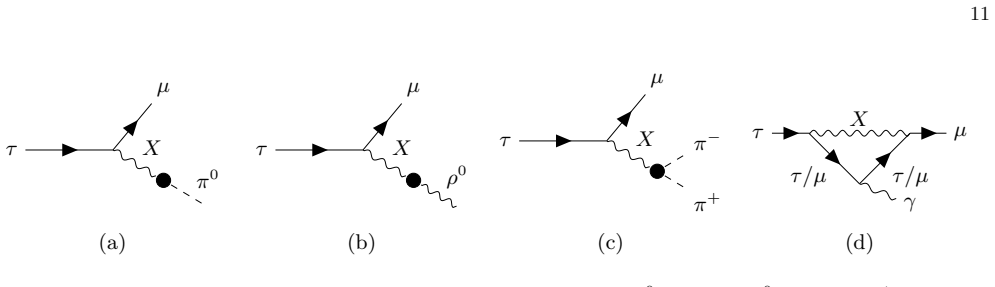
This further simplifies the Eq. (S7) into |Aτ µ M |=− 1 (4π)2 gg SM Z,A I +− µ +I +− τ , |Aτ µ E |= i (4π)2 gg SM Z,V I −− µ +I −+ τ .(S9) V. Details on existing constraints inZ ′ parameter space The strongest constraint in our LFVZ ′ parameter space comes from the search for LFV decayτ→µπ 0. The Feynman diagram of this process is shown in Fig. S5(a). The...
discussion (0)
Sign in with ORCID, Apple, or X to comment. Anyone can read and Pith papers without signing in.