REVIEW 3 major objections 5 minor 27 references
On the Trade-off Between Consistency and Coverage in Multi-label Rule Learning Heuristics
T0 review · 3 major / 5 minor · reviewed 2026-08-14 · deepseek-v4-flash
Pith's one-line read The right rule-learning heuristic for multi-label data is not fixed; it depends on the measure you want to maximize.
desk verdict A solid first systematic look at multi-label rule-learning heuristics, with a real but not fatal blind spot around candidate-rule representativeness. read the letter →
The pith
A machine-rendered reading of the paper's core claim, the machinery that carries it, and where it could break.
The reading
What carries the argument
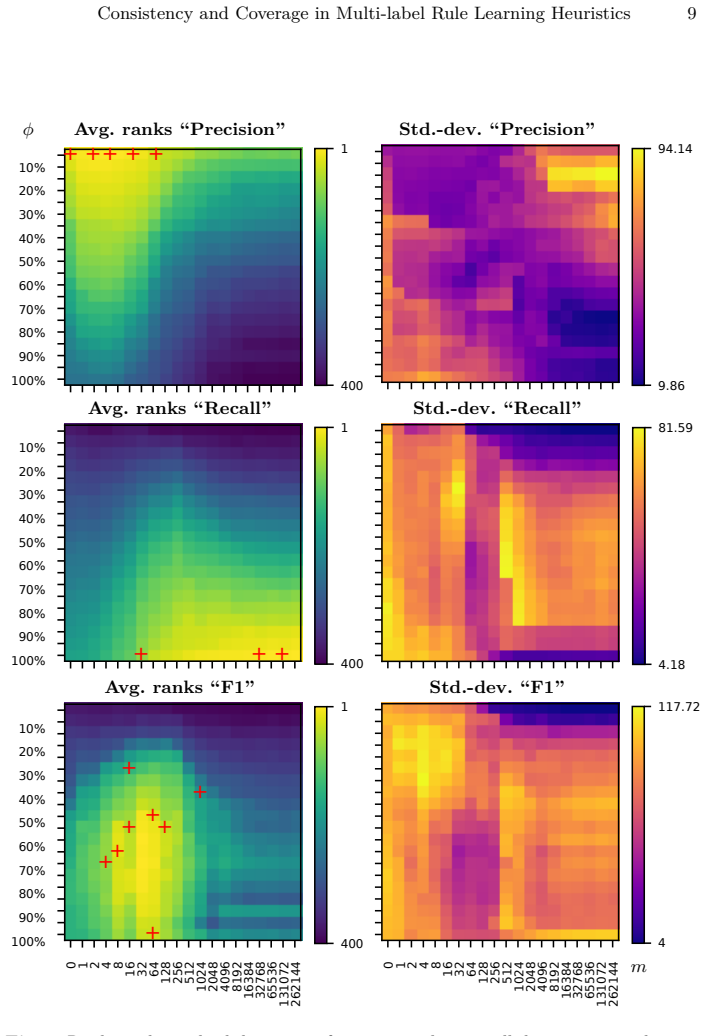
The carrier of the argument is the family of m-estimate heuristics $\delta_m(C)= (TP + m\cdot P/(P+N)) / (TP+FP+m)$, where $P=TP+FN$ and $N=FP+TN$. With $m=0$ it reduces to precision, and as $m\to\infty$ it approaches weighted relative accuracy. The authors pair this heuristic with a separate-and-conquer selection strategy, greedily adding the best remaining rule until all positive training examples are covered, and then apply a threshold $\varphi$ that filters rules by their heuristic value at prediction time. Sweeping $m$ over $\{0,2^1,\dots,2^{19}\}$ and threshold levels from 100 percent down to 5 percent retention lets them trace the consistency-coverage spectrum and identify which region optimizes each multi-label measure.
What would settle it
Repeat the experiment on a small multi-label data set by enumerating all rules up to a fixed number of conditions instead of drawing candidates from random forests; if the best parameter regions for each measure move noticeably, the representative-sample assumption fails.
Extended reading notes
Core claim
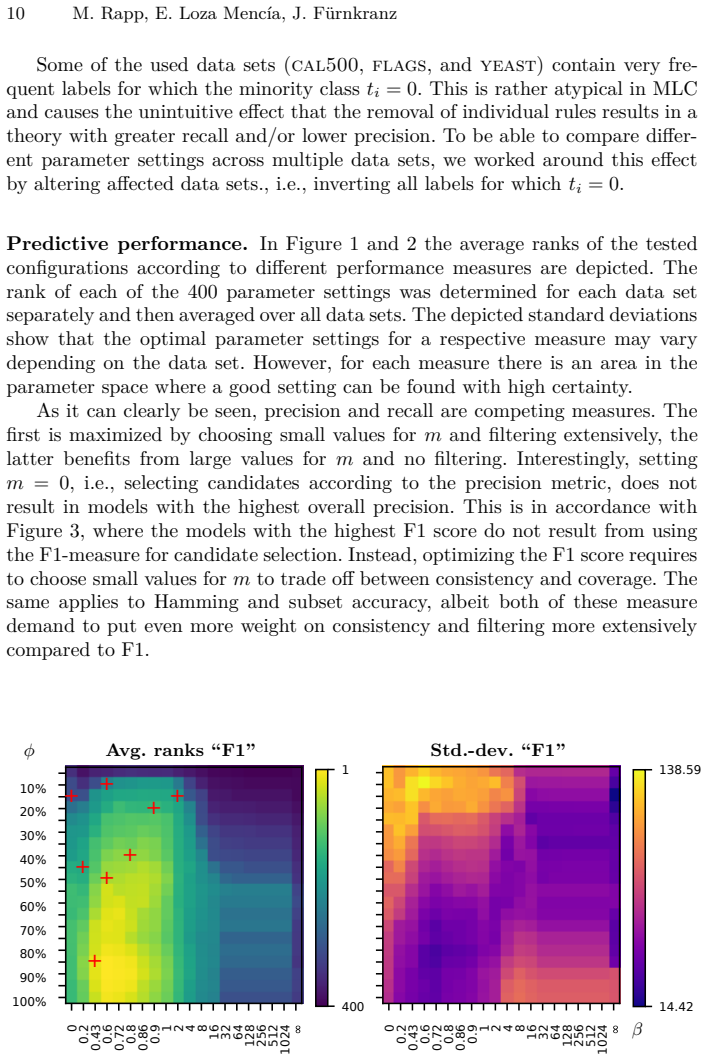
The paper's central discovery is that no single rule-quality heuristic suits all multi-label evaluation measures, because the measures sit at different points on a consistency-coverage spectrum. Using a two-parameter construction, candidate selection by the m-estimate with m ranging from 0 to very large values followed by threshold filtering, the authors map 400 configurations on eight data sets. They find that micro-averaged precision is maximized by small m and aggressive filtering, recall by large m and no filtering, and F1, Hamming accuracy, and subset accuracy by small m with moderate to strong filtering. The local/global result is equally central: using the F-measure to select rules does not produce the best global F1 model, so the mapping from heuristic to final model is indirect and must be validated empirically.
Load-bearing premise
The study assumes that the rules pulled out of random forests are a representative sample of the space of all possible rules, so the heuristic rankings it finds are not an artifact of how candidates were generated.
Editorial extensions
If this is right
- A rule learner for multi-label data should expose a configurable heuristic, such as the m-estimate, and a filtering threshold, with settings chosen by validation against the target measure.
- Models optimized for F1, Hamming accuracy, or subset accuracy will tend to be smaller and contain more specific rules, since those measures favor consistency over coverage.
- Selecting rules that score well on a measure locally, e.g., by the F-measure, will not generally yield a globally optimal model for that measure; tuning on a validation set is required.
- Against Ripper-style baselines, a simpler configurable learner tuned to the target measure is competitive or better on the tested data sets, especially when pruning is disabled.
- The same region of parameter space tends to work for a given measure across data sets, so the tuning does not need to be fine-grained.
Reading between the lines
- If the random-forest candidate pool is representative, the consistency-heavy optimum for F1, Hamming accuracy, and subset accuracy should transfer to other rule-induction frameworks; if the pool is biased, the central empirical conclusion may be an artifact of candidate generation, and an exact enumeration test on a small data set would settle this.
- The local/global mismatch suggests a broader principle: any rule learner that scores rules locally should tune its scoring function on validation data rather than assuming the target loss is optimized by local selection, and this likely extends beyond multi-label to other structured losses.
- The paper restricts models to rules that predict one direction per label and to micro-averaged measures; allowing absence-predicting rules and macro-averaged measures could shift the optimal consistency-coverage balance.
- A practical extension would predict the best parameter pair from dataset characteristics such as label cardinality, imbalance, and feature noise, making the tuning step automatic.
Signed reviews
Editorial analysis
A structured set of objections, weighed in public.
Referee Report
Summary. This paper presents an empirical study of rule learning heuristics for multi-label classification. The authors propose a flexible framework that generates candidate rules from random forests (Section 3.1), selects rules using the m-estimate heuristic (Section 3.2), and optionally filters rules by a threshold (Section 3.3). On eight multi-label data sets, they train 400 theories per data set by varying the m parameter and the threshold, and evaluate the resulting models with micro-averaged precision, recall, F1, Hamming accuracy, and subset accuracy. The central findings are that the optimal consistency-coverage trade-off depends on the multi-label evaluation measure, that local heuristic optimization does not generally yield models that optimize the corresponding global measure, and that configurable learners are therefore needed (Sections 4.2 and 6). The framework is also compared with JRip using binary relevance, with parameters tuned via nested cross-validation (Section 4.3).
Significance. If the empirical findings are robust, the paper provides actionable guidance for practitioners who build rule-based multi-label classifiers: the choice of heuristic and filtering threshold should be tailored to the target evaluation measure, and simply optimizing a heuristic locally is insufficient. This is a useful and timely contribution, as multi-label rule learning is an active area and the paper addresses a gap in the literature. Strengths include the thorough experimental design (8 data sets, 400 configurations, 10-fold cross-validation, nested cross-validation for baseline tuning), the public availability of source code, and the inclusion of model-characteristic analyses (rule counts, conditions). The study is descriptive rather than predictive, but that is appropriate for the research question. The main limitation is that the generalization of the results rests on an untested representativeness assumption about the candidate rule generation process, which a sensitivity analysis could address.
major comments (3)
- [Section 3.1] The load-bearing assumption that candidate rules generated from random forests are 'representative samples for the space of all possible rules' is stated but not tested. Random forest paths are produced by greedy, information-gain-based splits over randomly selected attribute subsets, which likely biases the candidate pool toward particular rule lengths, attribute combinations, and coverage patterns. If the optimal parameter settings for the m-estimate and threshold differ when candidate rules are generated by another procedure (e.g., exhaustive depth-limited enumeration, beam search, or randomized rule construction), then the main empirical claims in Section 4.2 would be artifacts of the generation procedure rather than general properties of multi-label rule learning heuristics. I request a sensitivity analysis with at least one alternative candidate generator, or a concrete argument for why the random-forest candidate pool spans the rule space in the relevant dimensions.
- [Section 4.2] The modification of the cal500, flags, and yeast data sets by inverting labels for which the minority class is t_i = 0 changes the semantics of precision and recall for those data sets, and the paper does not analyze the impact of this alteration on the cross-dataset average ranks. Since the central conclusion is that optimal parameter settings depend on the evaluation measure, it is important to know whether the reported average-rank maps are stable under this transformation. Please report results for the unmodified data sets separately or justify why the inversion is neutral for the comparisons being made.
- [Section 4.2] The paper makes strong comparative claims based on average ranks and standard deviations without any statistical significance testing. For example, 'for each measure there is an area in the parameter space where a good setting can be found with high certainty' and the baseline-comparison conclusions in Section 4.3 rely on rank differences that are not tested. The authors should apply appropriate significance tests (e.g., Friedman test with post-hoc comparisons, or at least Wilcoxon signed-rank tests for pairwise comparisons) to support the claims that one parameter region outperforms another and that the proposed approach ranks above JRip configurations. Reporting confidence intervals or effect sizes would also strengthen the analysis.
minor comments (5)
- [Section 4.1] The description of threshold selection is ambiguous: 'The thresholds have been chosen such that they are satisfied by at least 100%, 95%, ..., 5% of the selected rules.' It would be clearer to state exactly how a threshold value is computed from each percentile of the heuristic values of the selected rules.
- [Section 3.1] Algorithm 1 returns a rule set R but the pseudocode is incomplete: it does not show how trainForest and extractRules interact with the label-specific loops. Consider adding a few lines to clarify the extraction step.
- [Section 2.4] Equation (6) defines the m-estimate, but the text says 'As m approaches +∞, it converges to WRA'; this is correct but could be made more explicit by noting that the term m·P/(P+N) dominates for large m.
- [Section 4.2] Figure 3 is discussed only briefly; please state explicitly that the F-measure results support the same conclusions as the m-estimate experiments, and clarify why only the F1 ranking is shown rather than all measures.
- [References] Reference [16] contains a formatting error ('Yiming" Yang'); please correct it.
Circularity Check
No significant circularity: the central claims are empirical observations from sweeping heuristic parameters over independently generated candidate rules, with nested cross-validation for tuning.
full rationale
The paper's central claim—that the optimal consistency-coverage trade-off in multi-label rule learning depends on the evaluation measure and that local heuristic optimization does not imply global objective maximization—is established by direct experimentation, not by construction or by fitted predictions. Candidate rules are first generated from random forests (Section 3.1), independently of the heuristics under study; the same candidate pool is then used to build theories via separate-and-conquer selection with varying m-estimate parameters and thresholds (Sections 3.2–3.3), and performance is evaluated on held-out test folds. The conclusion that m=0 does not yield maximum precision and that F1-selection does not maximize F1 (Section 4.2) is a contingent empirical result about local-versus-global optimization, not a logical consequence of the definitions. The baseline comparison (Section 4.3) uses nested 5-fold cross-validation on the training data, so tuned parameters are not fit on test folds. Self-citations to prior work on the consistency-coverage view of rule heuristics (e.g., [12], [14], [15]) are used as background framing, not as the evidence for the reported rankings. The stated assumption that generated rules are 'representative samples for the space of all possible rules' (Section 3.1) is an external-validity limitation and a possible correctness risk, but it is not circular: the candidate pool is produced by a procedure independent of the evaluated heuristics, and the heuristic rankings are conditional on that pool. Similarly, the label-inversion workaround for cal500, flags, and yeast (Section 4.2) is a data preprocessing choice, not a circular reduction. No fitted input is renamed as a prediction, and no uniqueness or optimality claim is imported from author-only work. Honest non-finding: no significant circularity.
Assumptions & free parameters
free parameters (2)
- m (m-estimate parameter) =
Swept over {0, 2^1, ..., 2^19}; for baseline configs selected by nested 5-fold CV
- φ (threshold) =
Swept over thresholds satisfied by 5% to 100% of selected rules; for baseline configs selected by nested CV
assumptions (3)
- ad hoc to paper Candidate rules generated from random forests are representative of the space of all possible rules.
- domain assumption Binary relevance, treating each label independently, is an adequate decomposition for studying multi-label heuristics.
- domain assumption The m-estimate and F-measure parameterize the consistency-coverage tradeoff monotonically as claimed.
Cite this review
Pith. "Pith review of On the Trade-off Between Consistency and Coverage in Multi-label Rule Learning Heuristics." pith.science (2026). https://pith.science/paper/NITKKJXS
@misc{pith2026190803032,
  author       = {Pith},
  title        = {Pith review of: On the Trade-off Between Consistency and Coverage in Multi-label Rule Learning Heuristics},
  year         = {2026},
  howpublished = {\url{https://pith.science/paper/NITKKJXS}},
  note         = {Machine review of arXiv:1908.03032}
}
read the original abstract
Recently, several authors have advocated the use of rule learning algorithms to model multi-label data, as rules are interpretable and can be comprehended, analyzed, or qualitatively evaluated by domain experts. Many rule learning algorithms employ a heuristic-guided search for rules that model regularities contained in the training data and it is commonly accepted that the choice of the heuristic has a significant impact on the predictive performance of the learner. Whereas the properties of rule learning heuristics have been studied in the realm of single-label classification, there is no such work taking into account the particularities of multi-label classification. This is surprising, as the quality of multi-label predictions is usually assessed in terms of a variety of different, potentially competing, performance measures that cannot all be optimized by a single learner at the same time. In this work, we show empirically that it is crucial to trade off the consistency and coverage of rules differently, depending on which multi-label measure should be optimized by a model. Based on these findings, we emphasize the need for configurable learners that can flexibly use different heuristics. As our experiments reveal, the choice of the heuristic is not straight-forward, because a search for rules that optimize a measure locally does usually not result in a model that maximizes that measure globally.
Figures

Figures from the paper (2 more)


Reference graph
Works this paper leans on
-
[1]
Effective rule-based multi-label classification with learning classifier systems
Miltiadis Allamanis, Fani A Tzima, and Pericles A Mitkas. Effective rule-based multi-label classification with learning classifier systems. In International Confer- ence on Adaptive and Natural Computing Algorithms , 2013
work page 2013
-
[2]
An evolutionary multi label classification using associative rule mining for spatial preferences
J Arunadevi and V Rajamani. An evolutionary multi label classification using associative rule mining for spatial preferences. IJCA Special Issue on Artificial Intelligence Techniques-Novel Approaches and Practical Applications, 2011
work page 2011
-
[3]
Evolving multi-label classification rules with gene expression programming: A preliminary study
Jos´ e Luis´Avila-Jim´ enez, Eva Gibaja, and Sebasti´ an Ventura. Evolving multi-label classification rules with gene expression programming: A preliminary study. In International Conference on Hybrid Artificial Intelligence Systems , 2010
work page 2010
-
[4]
Learning multi-label scene classification
Matthew R Boutell, Jiebo Luo, Xipeng Shen, and Christopher M Brown. Learning multi-label scene classification. Pattern Recognition, 37(9), 2004
work page 2004
-
[5]
L. Breiman. Random forests. Machine Learning, 45(1), 2001
work page 2001
-
[6]
Gibaja, and Sebasti´ an Ventura
Alberto Cano, Amelia Zafra, Eva L. Gibaja, and Sebasti´ an Ventura. A grammar- guided genetic programming algorithm for multi-label classification. In Genetic Programming, 2013
work page 2013
-
[7]
William W Cohen. Fast effective rule induction. In International Conference on Machine Learning, 1995
work page 1995
-
[8]
Protein classification with multiple algorithms
Sotiris Diplaris, Grigorios Tsoumakas, Pericles A Mitkas, and Ioannis Vlahavas. Protein classification with multiple algorithms. In Panhellenic Conference on In- formatics, 2005. Consistency and Coverage in Multi-label Rule Learning Heuristics 15
work page 2005
Show all 27 references
-
[9]
The geometry of ROC space: Understanding machine learning met- rics through ROC isometrics
Peter A Flach. The geometry of ROC space: Understanding machine learning met- rics through ROC isometrics. In International Conference on Machine Learning , 2003
2003
-
[10]
An analysis of stopping and filtering criteria for rule learning
Johannes F¨ urnkranz and Peter Flach. An analysis of stopping and filtering criteria for rule learning. In European Conference on Machine Learning, 2004
2004
-
[11]
An analysis of rule evaluation metrics
Johannes F¨ urnkranz and Peter A Flach. An analysis of rule evaluation metrics. In International Conference on Machine Learning , 2003
2003
-
[12]
Roc ’n’ rule learning - towards a better understanding of covering algorithms
Johannes F¨ urnkranz and Peter A Flach. Roc ’n’ rule learning - towards a better understanding of covering algorithms. Machine Learning, 58(1), 2005
2005
-
[13]
Springer Science & Business Media, 2012
Johannes F¨ urnkranz, Dragan Gamberger, and Nada Lavraˇ c.Foundations of Rule Learning. Springer Science & Business Media, 2012
2012
-
[14]
An empirical investigation of the trade- off between consistency and coverage in rule learning heuristics
Frederik Janssen and Johannes F¨ urnkranz. An empirical investigation of the trade- off between consistency and coverage in rule learning heuristics. In International Conference on Discovery Science, 2008
2008
-
[15]
On the quest for optimal rule learning heuristics
Frederik Janssen and Johannes F¨ urnkranz. On the quest for optimal rule learning heuristics. Machine Learning, 78(3), 2010
2010
-
[16]
The enron corpus: A new dataset for email classification research
Bryan Klimt, Yiming” Yang, Floriana Esposito, Fosca Giannotti, and Dino Pe- dreschi. The enron corpus: A new dataset for email classification research. In European Conference on Machine Learning, 2004
2004
-
[17]
Interpretable decision sets: A joint framework for description and prediction
Himabindu Lakkaraju, Stephen H Bach, and Jure Leskovec. Interpretable decision sets: A joint framework for description and prediction. In International Conference on Knowledge Discovery and Data Mining , 2016
2016
-
[18]
An evaluation of phrasal and clustered representations on a text categorization task
David D Lewis. An evaluation of phrasal and clustered representations on a text categorization task. In International Conference on Research and Development in Information Retrieval, 1992
1992
-
[19]
Multi-label Classification based on Associ- ation Rules with Application to Scene Classification
Bo Li, Hong Li, Min Wu, and Ping Li. Multi-label Classification based on Associ- ation Rules with Application to Scene Classification. In International Conference for Young Computer Scientists , 2008
2008
-
[20]
Learning rules for multi-label classifica- tion: A stacking and a separate-and-conquer approach
Eneldo Loza Menc´ ıa and Frederik Janssen. Learning rules for multi-label classifica- tion: A stacking and a separate-and-conquer approach. Machine Learning, 105(1), 2016
2016
-
[21]
A shared task involving multi- label classification of clinical free text
John P Pestian, Christopher Brew, Pawe/suppress l Matykiewicz, Dj J Hovermale, Neil John- son, K Bretonnel Cohen, and W/suppress lodzis/suppress law Duch. A shared task involving multi- label classification of clinical free text. In Workshop on BioNLP 2007: Biological, Translat...
2007
-
[22]
Exploiting anti- monotonicity of multi-label evaluation measures for inducing multi-label rules
Michael Rapp, Eneldo Loza Menc´ ıa, and Johannes F¨ urnkranz. Exploiting anti- monotonicity of multi-label evaluation measures for inducing multi-label rules. In Pacific-Asia Conference on Knowledge Discovery and Data Mining , 2018
2018
-
[23]
MMAC: A new multi-class, multi-label associative classification approach
Fadi A Thabtah, Peter Cowling, and Yonghong Peng. MMAC: A new multi-class, multi-label associative classification approach. In IEEE International Conference on Data Mining , 2004
2004
-
[24]
Multiple labels associative classification
Fadi Abdeljaber Thabtah, Peter Cowling, and Yonghong Peng. Multiple labels associative classification. Knowledge and Information Systems , 9(1), 2006
2006
-
[25]
Multi-label classification of music into emotions
Konstantinos Trohidis, Grigorios Tsoumakas, George Kalliris, and Ioannis P Vla- havas. Multi-label classification of music into emotions. In International Society for Music Information Retrieval , 2008
2008
-
[26]
Mining multi-label data
Grigorios Tsoumakas, Ioannis Katakis, and Ioannis Vlahavas. Mining multi-label data. In Data Mining and Knowledge Discovery Handbook . Springer, 2009
2009
-
[27]
Semantic annotation and retrieval of music and sound effects
Douglas Turnbull, Luke Barrington, David Torres, and Gert Lanckriet. Semantic annotation and retrieval of music and sound effects. IEEE Transactions on Audio, Speech, and Language Processing, 16(2), 2008
2008
Reviewed August 14, 2026 · model on record in the stance chip above.
Discussion (0). Continue with ORCID to comment.