REVIEW 2 major objections 4 minor 39 references
Cooperative adsorption and diffusion trapping induced by AlF3 intercalation in graphite
T0 review · 2 major / 4 minor · reviewed 2026-08-08 · deepseek-v4-flash
Pith's one-line read Subsurface AlF3 turns graphite surface into a kinetic trap
desk verdict A plausible coverage-dependent adsorption mechanism with a real finite-size problem; worth refereeing, but the experimental link is oversold. read the letter →
The pith
A machine-rendered reading of the paper's core claim, the machinery that carries it, and where it could break.
The reading
What carries the argument
The load-bearing object is the intercalation-induced blister: a localized out-of-plane deformation of the top graphene layer, purely elastic, expanding the interlayer spacing from 3.35 Å to 5.07 Å above the molecule and decaying to ~3.56 Å at the cell edges. The paper shows that this curvature, together with intercalation-induced charge redistribution, drives three coupled effects: spontaneous dimerization of surface monomers, cooperative (coverage-strengthening) adsorption energies, and raised diffusion barriers. The electronic mechanism is identified through charge-density differences and Mulliken populations: the intercalated AlF3 maintains a nearly constant charge (~0.96 e) while acting as a reservoir that deepens the surface potential wells, so that above the blister the charge-accumulation regions of four surface molecules merge into one continuous lobe spanning the blister.
What would settle it
Low-temperature STM tracking of individual AlF3 molecules on a graphite surface with a known subsurface intercalant would settle the claim: the model predicts hop times above the blister of ~2.7–5.3 ps for short jumps and ~16.5 ns for the hexagon-crossing jump, versus 1.6–1.8 ps and 55.8 ps on pristine terraces, and a desorption-energy crossover from weakening to strengthening with coverage; observing no such barrier increase or no coverage strengthening would refute it.
Extended reading notes
Core claim
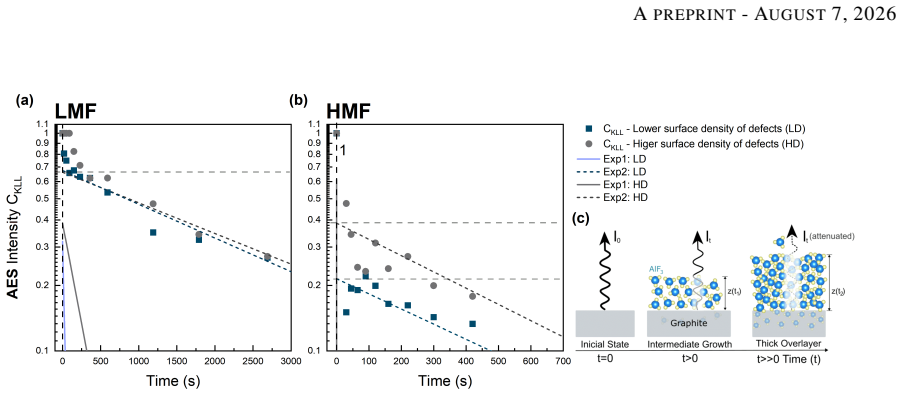
The central discovery is that a subsurface intercalated AlF3 molecule does not merely expand the graphite lattice; it creates a specific surface condition—a blister—that reverses the sign of the coverage dependence of adsorption and suppresses lateral diffusion. At the DFT-D3 level, with one intercalated AlF3 molecule in a 7×6×1 Bernal graphite supercell, the interlayer spacing expands from 3.35 Å to 5.07 Å above the intercalant and relaxes to ~3.56 Å at the cell edges, with no C–C bond breaking. Adsorption energies per AlF3 molecule on this blistered surface strengthen with coverage (−0.853, −1.171, −1.281, −1.498 eV for n=1–4), while pristine graphite shows monotonic weakening (−1.035 to −0.830 eV); the blistered surface also spontaneously dimerizes monomers that do not dimerize on pristine graphite. Nudged elastic band calculations show diffusion barriers rise from 12.4–103.9 meV on pristine graphite to 25.8–251.0 meV on the blister, reducing the effective 2D diffusion coefficient from 6.4×10⁻⁹ to 2.8×10⁻⁹ m²/s at 300 K, with the ratio growing to ~8 at 100 K. Charge-density difference and Mulliken analysis show the intercalant transfers 0.552 e to graphite, perturbs 61 carbons, and keeps charge transfer per surface molecule 1.7–2.1× higher than pristine at all coverages, with surface molecules' accumulation regions merging into a single lobe at n=4. The paper interprets this as the intercalant acting as a stable electronic reservoir that deepens the surface potential landscape, and proposes that this blister-induced trapping is the mechanism behind the experimentally observed crossover from a fast, defect-gated intercalation component to a slow, substrate-independent adsorption component in the biexponential AES kinetics.
Load-bearing premise
The load-bearing premise is that a single intercalated AlF3 molecule in a periodic 7×6×1 supercell adequately represents an intercalation-conditioned graphite surface, even though the blister deformation does not fully decay before the cell edge (spacings reach ~3.56 Å versus 3.35 Å pristine), leaving image interactions present but unquantified.
Editorial extensions
If this is right
- The two exponential components in the measured Auger attenuation curves are explained as a fast, defect-gated intercalation channel followed by a slow adsorption channel, with blister trapping preventing further intercalation.
- Molecular clustering on pristine graphite is ruled out as an independent thermodynamic pathway; dimer formation becomes spontaneous only after a blister exists.
- The mobility gap between pristine and blistered graphite grows at low temperature, from a factor of 2.3 at 300 K to about 8 at 100 K, so low-temperature experiments maximize the contrast.
- Preferential AlF3 accumulation around intercalation-induced blisters is predicted, providing a spatial signature to look for in local-probe microscopy.
- Deposition flux and substrate defect density become tunable parameters for controlling the balance between surface adsorption and interlayer intercalation in AlF3-modified carbon electrodes.
Reading between the lines
- The mechanism is likely not specific to AlF3: any subsurface guest that produces a comparable elastic blister in the top graphene layer should generate similar cooperative adsorption and kinetic trapping, which could be tested computationally for ions such as AlCl4−.
- Because the blister deformation does not fully decay in the 7×6×1 cell, the 0.2–0.5 eV cooperative-binding differences probably include image contributions; a supercell-size convergence test would either confirm or revise the crossover magnitude.
- A direct experimental falsification would be measuring the hop time of individual molecules above a known subsurface blister by low-temperature STM and comparing with the predicted ~16.5 ns hexagon-crossing time.
- The self-limiting picture suggests a design rule: pre-intercalating graphite with AlF3 could intentionally cap further molecular uptake, which could be tested by comparing AlF3 deposition on fresh versus pre-intercalated substrates.
Editorial analysis
A structured set of objections, weighed in public.
Referee Report
Summary. The paper reports a DFT-D3 study of AlF3 adsorption and diffusion on pristine graphite and on a graphite surface containing a subsurface intercalated AlF3 molecule in a 7×6×1 supercell. The central claim is that the intercalant creates a blister-like deformation that turns the surface into a coverage-activated cooperative adsorption center and a kinetic trap: on the blistered surface, the adsorption energy per molecule strengthens from -0.853 eV at n=1 to -1.498 eV at n=4, whereas on pristine graphite it weakens from -1.035 to -0.830 eV; simultaneously, the P3 diffusion barrier rises from 103.9 to 251.0 meV and the computed 2D diffusion coefficient drops from 6.4×10^-9 to 2.8×10^-9 m^2/s at 300 K. The authors connect these results to a previously reported biexponential AES sorption kinetics and propose a self-limiting intercalation mechanism.
Significance. If the reported crossover is robust, the paper offers a novel and potentially important structure-property relationship for intercalation-induced surface modification in graphite, with direct relevance to AlF3-coated carbon electrodes. The computational work is internally consistent: reproducing Eqs. (2)-(3) from Table 3 gives the stated D values, and the authors compare two clearly defined structural models without fitting parameters to the target kinetics. The paper also tests two explicit hypotheses (molecular clustering vs. intercalation-induced conditioning), which is a methodological strength. However, the central quantitative claim rests on a single supercell size, and the reported elastic deformation does not decay within that cell. This finite-size issue is load-bearing because the cooperative binding and barrier increases are energy differences of 0.2-0.5 eV; without convergence checks, the paper's headline conclusions remain conditional.
major comments (2)
- [Section 3.3 and Figure 3] The finite-size convergence of the supercell is not addressed. The interlayer spacing at the supercell edges is reported as ~3.56 Å versus 3.35 Å pristine, indicating that the blister deformation does not fully decay within the 7×6×1 cell. The cooperative adsorption strengthening (n=1: -0.853 eV; n=4: -1.498 eV, Table 2 and Figure 2) and the NEB P3 barrier increase (103.9 to 251.0 meV, Table 3) rely on energy differences of 0.2-0.5 eV. Because the intercalant and the adsorbed molecules interact with periodic images of both the strain field and the intercalant's charge reservoir (0.552 e, Table 4), the claimed crossover from repulsive to cooperative adsorption could be an artifact of the image interactions. I request convergence tests with at least one larger lateral supercell (e.g., 10×10×1 or 12×10×1) for the n=1 and n=4 adsorption energies and for the P3 barrier.
- [Equation (3) and Table 3] The effective diffusion coefficient in Eq. (3) sums over the three pathways P1-P3 with one term per pathway, without accounting for the multiplicity of equivalent jump directions on the hexagonal graphite lattice. On a surface with ABAB stacking, each type of jump can occur along several symmetry-equivalent directions; omitting these multiplicities changes D by an integer factor. The claim that Dblister/Dpristine = 2.3 at 300 K depends on this choice. The authors should state the multiplicities used for each pathway and verify that the same multiplicities apply to both the pristine and blistered surfaces; otherwise the reported mobility reduction may be quantitatively incorrect.
minor comments (4)
- [Section 3.2] The phrase 'spontaneous formation and adsorption of AlF3 dimers' is contradicted later in the same section by the statement that dimers did not form spontaneously and required manual construction. Please rephrase to describe the investigation of preformed dimer configurations.
- [Section 3.5 and Table 4] The text claims that 'the charge on the intercalated Al atom remains essentially constant at ~0.96 e across all surface coverages,' but Table 4 lists only the surface Al charges (qAl) for the blistered-surface rows; the intercalant charge is not reported for n=1-4. Either include these values in Table 4 or qualify the claim as coming from separate analysis.
- [Section 3.4] The α and β hollow sites and the precursor P0 are introduced without a structural illustration; adding them to Figure 4's inset would improve clarity, especially since the NEB pathways are described relative to these sites.
- [Section 3.1] There is a typo in 'Volmer–Weber' rendered as 'V olmer–Weber'; also, the experimental data in Figure 1 are reproduced from Ref. [17] and this should be stated explicitly in the figure caption, not only in Section 2.1.
Circularity Check
No circularity: the DFT comparison of pristine vs. blistered graphite is self-contained; experimental context from the authors' prior work is motivational, not load-bearing.
full rationale
The paper's derivation chain is self-contained. Both the pristine and the blistered surface are modeled with the same DFT-D3 method, identical supercells, basis sets, k-point grids, and convergence criteria, and no parameter is fitted to the experimentally observed sorption kinetics. The central adsorption-energy comparison (Eq. 1) and the NEB diffusion barriers (Section 3.4) are computed outputs rather than imposed inputs: the cooperative crossover from weakening to strengthening arises from the calculated energies, and the barrier increases emerge from the relaxed NEB pathways. The only self-citation, Ref. [17], supplies the experimental AES/REELS context and the biexponential fitting used to motivate hypotheses (a) and (b); that interpretation is not re-derived from the DFT data, but neither is it used as a mathematical input that forces the computational results. No equation reduces to another by construction, and no fitted parameter is renamed as a prediction. The finite-size/image-interaction concern raised by the reader is a correctness and convergence issue, not a circularity issue, because the pristine and blistered models are affected symmetrically in method and the conclusion does not depend on reusing the experimental fit as an input.
Assumptions & free parameters
free parameters (3)
- attempt frequency (nu) =
1e12 Hz (from Campbell et al., Ref. [33])
- initial interlayer separation for the intercalated structure =
6 Angstroms
- Mulliken perturbation threshold =
|Delta q_C| > 0.005 e
assumptions (5)
- domain assumption PBE+DFT-D3(BJ) gives quantitatively reliable AlF3-graphite interaction energies, including the delicate balance between lateral repulsion on pristine graphite and curvature-mediated cooperative binding on the blister.
- domain assumption A single intercalant per 7x6x1 supercell with periodic boundaries represents the intercalation-conditioned surface of the experimental system.
- domain assumption The fast, substrate-dependent exponential component in the AES attenuation corresponds to intercalation and the slow, substrate-independent one to overlayer accumulation.
- domain assumption Mulliken population charges provide reliable relative charge-transfer trends for this system despite basis-set dependence.
- standard math Eyring-Kramers transition state theory with a coverage-independent attempt frequency describes AlF3 surface hops on graphite.
Cite this review
Pith. "Pith review of Cooperative adsorption and diffusion trapping induced by AlF3 intercalation in graphite." pith.science (2026). https://pith.science/paper/NIY32KYG
@misc{pith2026260805305,
  author       = {Pith},
  title        = {Pith review of: Cooperative adsorption and diffusion trapping induced by AlF3 intercalation in graphite},
  year         = {2026},
  howpublished = {\url{https://pith.science/paper/NIY32KYG}},
  note         = {Machine review of arXiv:2608.05305}
}
read the original abstract
Graphite's structural and electronic response to molecular intercalation is central to its performance as a carbon-based electrode material, yet the microscopic coupling between subsurface intercalation and surface adsorption remains poorly understood. We present a first-principles investigation of AlF3 adsorption and intercalation in graphite to explain the microscopic origin of a recently observed two-step self-limiting sorption mechanism. Using density functional theory (DFT-D3), we show that a single intercalated AlF3 molecule locally transforms the structure, electronic properties, and diffusion behavior of graphite through a blister-like surface deformation. Comparing pristine graphite with a graphite surface containing a subsurface intercalated molecule, coverage-dependent adsorption energetics reveal a crossover from repulsive lateral interactions to cooperative binding above the blister, driven by local curvature and intercalation-induced charge redistribution. Diffusion-barrier calculations show that the blister simultaneously acts as a kinetic trap, raising diffusion barriers and transitioning surface mobility from a quasi-barrierless to a thermally activated regime. Charge-density difference and Mulliken population analyses identify the intercalant as a stable electronic reservoir that deepens the surface potential landscape, kinetically immobilizing adsorbed species. Together, these results establish a structure-property relationship for intercalation-induced deformation in graphite, offering a quantitative framework for controlling intercalation efficiency in carbon-based energy storage and conversion systems.
Figures


Figures from the paper (4 more)


Reference graph
Works this paper leans on
-
[17]
H. S. Betancourt, S. Montoro, A. E. Candia, S. J. Rodríguez, M. C. G. Passeggi, R. A. Vidal, G. Ruano, and F. J. Bonetto. Kinetic and spectroscopic analysis of AlF 3 film growth on graphitic substrates: Flux and microstructure effects on intercalation and surface adsorption.Surf. Interfaces, 89:109142, 2026. 13 APREPRINT- AUGUST7, 2026
work page 2026
-
[1]
M. S. Dresselhaus and G. Dresselhaus. Intercalation compounds of graphite.Adv. Phys., 51(1):1–186, 2002
work page 2002
-
[2]
G. Wang, M. Yu, and X. Feng. Carbon materials for ion-intercalation involved rechargeable battery technologies. Chem. Soc. Rev., 50(4):2388–2443, 2021
work page 2021
- [3]
-
[4]
R. Yivlialin, G. Bussetti, L. Brambilla, C. Castiglioni, M. Tommasini, L. Duò, M. Passoni, M. Ghidelli, C. S. Casari, and A. Li Bassi. Microscopic analysis of the different perchlorate anions intercalation stages of graphite. The Journal of Physical Chemistry C, 121(26):14246–14253, 2017
work page 2017
-
[5]
H. Bouaamlat, A. P. Seitsonen, G. Bussetti, R. Yivlialin, S. De Rosa, P. Branchini, and L. Tortora. Nano-protrusions in intercalated graphite: understanding the structural and electronic effects through DFT.Phys. Chem. Chem. Phys., 26(16):12269–12281, 2024
work page 2024
-
[6]
P. Bhauriyal, A. Mahata, and B. Pathak. The staging mechanism of AlCl− 4 intercalation in a graphite electrode for an aluminium-ion battery.Phys. Chem. Chem. Phys., 19:7980–7989, 2017
work page 2017
- [7]
Show all 39 references
-
[8]
M. S. Whittingham. Lithium batteries and cathode materials.Chem. Rev., 104(10):4271–4302, 2004
2004
-
[9]
Y . Liu, B. V . Merinov, and W. A. Goddard III. Origin of low sodium capacity in graphite and generally weak substrate binding of Na and Mg among alkali and alkaline earth metals.Proc. Natl. Acad. Sci., 113(14):3735–3739, 2016
2016
-
[10]
Y . He, Y . Dong, Y . Zhang, Y . Li, and H. Li. Graphene nano-blister in graphite for future cathode in dual-ion batteries: Fundamentals, advances, and prospects.Adv. Sci., 10(15):e2207426, 2023
2023
-
[11]
Filoni, B
C. Filoni, B. Shirzadi, M. Menegazzo, E. Martinelli, C. Di Natale, A. Li Bassi, L. Magagnin, L. Duò, and G. Bussetti. Compared EC-AFM analysis of laser-induced graphene and graphite electrodes in sulfuric acid electrolyte.Molecules, 26(23):7333, 2021
2021
-
[12]
M. C. Lin, M. Gong, B. Lu, Y . Wu, D. Y . Wang, M. Guan, et al. An ultrafast rechargeable aluminium-ion battery. Nature, 520(7547):324–328, 2015
2015
-
[13]
G. A. Elia, K. Marquardt, K. Hoeppner, S. Fantini, R. Lin, E. Knipping, et al. An overview and future perspectives of aluminum batteries.Adv. Mater ., 28(35):7564–7579, 2016
2016
-
[14]
G. Xu, Y . Ding, F. Bai, Y . Zhang, J. Yin, and C. Chen. AlF3-modified carbon anodes for aluminum electrolysis: Oxidation resistance and microstructural evolution.Inorganics, 13(5):165, 2025
2025
-
[15]
G. R. Li, X. Feng, Y . Ding, S. H. Ye, and X. P. Gao. AlF3-coated Li(Li0.17Ni0.25Mn0.58)O2 as cathode material for Li-ion batteries.Electrochim. Acta, 78:308–315, 2012
2012
-
[16]
F. Ding, W. Xu, D. Choi, W. Wang, X. Li, M. H. Engelhard, X. Chen, Z. Yang, and J.-G. Zhang. Enhanced performance of graphite anode materials by AlF3 coating for lithium-ion batteries.J. Mater . Chem., 22(25):12745– 12751, 2012
2012
-
[18]
S. J. Rodríguez, A. E. Candia, M. C. G. Passeggi, Jr., E. A. Albanesi, and G. D. Ruano. A theoretical study on the intercalation and diffusion of AlF3 in graphite.Phys. Chem. Chem. Phys., 23(34):19579–19589, 2021
2021
-
[19]
A. E. Candia, S. J. Rodríguez, E. A. Albanesi, G. Bernardi, D. Fregenal, G. E. Zampieri, M. C. G. Passeggi, and G. Ruano. Aluminum fluoride intercalation in graphite for rechargeable batteries design.Carbon, 186:724–736, 2022
2022
-
[20]
Rodríguez, I
S. Rodríguez, I. Stankovic, M. C. Passeggi, Jr., E. A. Albanesi, and G. D. Ruano. Study of in-plane and interlayer interactions during aluminum fluoride intercalation in graphite.ACS Appl. Nano Mater ., 6(9):10045–10057, 2023
2023
-
[21]
Y . Tang, H. Zhang, Z. Shen, M. Zhao, Y . Li, and X. Dai. The electronic and diffusion properties of metal adatoms on graphene sheets: a first-principles study.RSC Adv., 7(53):33208–33218, 2017
2017
-
[22]
Gervilla, M
V . Gervilla, M. Zarshenas, D. G. Sangiovanni, and K. Sarakinos. Anomalous versus normal room-temperature diffusion of metal adatoms on graphene.J. Phys. Chem. Lett., 11(21):8930–8936, 2020
2020
-
[23]
T. Ozaki. Variationally optimized atomic orbitals for large-scale electronic structures.Phys. Rev. B, 67(15):155108, 2003
2003
-
[24]
J. P. Perdew, K. Burke, and M. Ernzerhof. Generalized gradient approximation made simple.Phys. Rev. Lett., 77(18):3865–3868, 1996
1996
-
[25]
Grimme, J
S. Grimme, J. Antony, S. Ehrlich, and H. Krieg. A consistent and accurate ab initio parametrization of density functional dispersion correction (DFT-D) for the 94 elements H-Pu.J. Chem. Phys., 132:154104, 2010
2010
-
[26]
Grimme, S
S. Grimme, S. Ehrlich, and L. Goerigk. Effect of the damping function in dispersion corrected density functional theory.J. Comput. Chem., 32:1456–1465, 2011
2011
-
[27]
Björkman, A
T. Björkman, A. Gulans, A. V . Krasheninnikov, and R. M. Nieminen. van der Waals bonding in layered compounds from advanced density-functional first-principles calculations.Phys. Rev. Lett., 108(23):235502, 2012
2012
-
[28]
Henkelman, B
G. Henkelman, B. P. Uberuaga, and H. Jónsson. A climbing image nudged elastic band method for finding saddle points and minimum energy paths.J. Chem. Phys., 113:9901–9904, 2000
2000
-
[29]
Ruano, J
G. Ruano, J. C. Moreno-López, M. C. G. Passeggi, Jr., R. A. Vidal, J. Ferrón, M. A. Niño, R. Miranda, and J. J. de Miguel. Morphology and thermal stability of AlF 3 thin films grown on Cu(100).Surf. Sci., 606:573–579, 2012
2012
-
[30]
R. A. Vidal and J. Ferrón. A detailed Auger electron spectroscopy study of the first stages of the growth of C60 thin films.J. Phys. D: Appl. Phys., 48(43):435302, 2015
2015
-
[31]
A. E. Candia, L. Gómez, R. A. Vidal, J. Ferrón, and M. C. G. Passeggi, Jr. An STM and Monte Carlo study of the AlF3 thin film growth on Cu(111).J. Phys. D: Appl. Phys., 48(26):265305, 2015
2015
-
[32]
Pomiro, A
F. Pomiro, A. E. Candia, S. M. Montoro, M. C. G. Passeggi, Jr., G. Ruano, and J. Ferrón. Iron nanoparticle generation by He+ ion bombardment.J. Phys. Chem. C, 121(46):26117–26124, 2017
2017
-
[33]
C. T. Campbell, L. Arnadóttir, and J. R. Sellers. Kinetic prefactors of reactions on solid surfaces.Z. Phys. Chem., 227(9-11):1435–1454, 2012
2012
-
[34]
Kevin T. Chan, J. B. Neaton, and Marvin L. Cohen. First-principles study of metal adatom adsorption on graphene. Physical Review B, 77(23):235430, 2008
2008
-
[35]
Deshlahra, J
P. Deshlahra, J. Conway, E. E. Wolf, and W. F. Schneider. Influence of dipole–dipole interactions on coverage- dependent adsorption: CO and NO on Pt(111).Langmuir, 28(22):8408–8417, 2012
2012
-
[36]
Ala-Nissila, R
T. Ala-Nissila, R. Ferrando, and S. C. Ying. Collective and single particle diffusion on surfaces.Adv. Phys., 51(3):949–1078, 2002
2002
-
[37]
Tachikawa, Y
H. Tachikawa, Y . Izumi, T. Iyama, S. Abe, and I. Watanabe. Aluminum-doping effects on the electronic states of graphene nanoflake: diffusion and hydrogen storage mechanism.Nanomaterials, 13(14):2046, 2023
2023
-
[38]
V . M. Pereira and A. H. Castro Neto. Strain engineering of graphene’s electronic structure.Phys. Rev. Lett., 103:046801, 2009
2009
-
[39]
Khestanova, F
E. Khestanova, F. Guinea, L. Fumagalli, A. K. Geim, and I. V . Grigorieva. Universal shape and pressure inside bubbles appearing in van der Waals heterostructures.Nat. Commun., 7:12587, 2016. 14
2016
Reviewed August 8, 2026 · model on record in the stance chip above.
Discussion (0). Continue with ORCID to comment.