REVIEW 3 major objections 4 minor 18 references
NAVARO II, a Novel Scissor-Based Planar Parallel Robot 1
T0 review · 3 major / 4 minor · reviewed 2026-08-14 · deepseek-v4-flash
Pith's one-line read Scissor legs give a planar parallel robot one inverse-kinematics solution per actuation mode and closed-form singularity equations.
desk verdict A credible kinematic design paper for a scissor-based 3-RPR; the main caveat is the missing transmission model, not the core geometry. read the letter →
The pith
A machine-rendered reading of the paper's core claim, the machinery that carries it, and where it could break.
The reading
What carries the argument
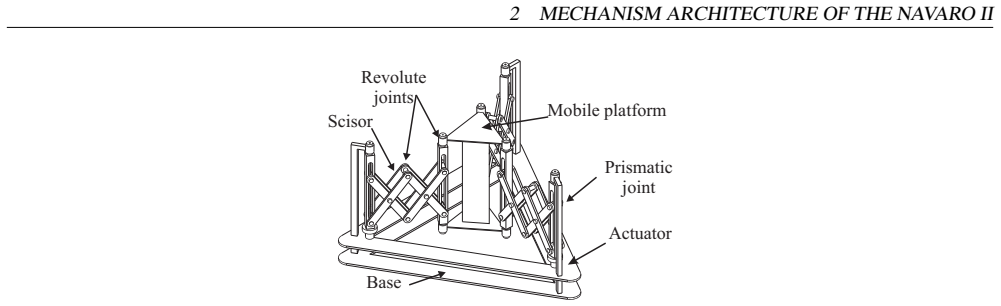
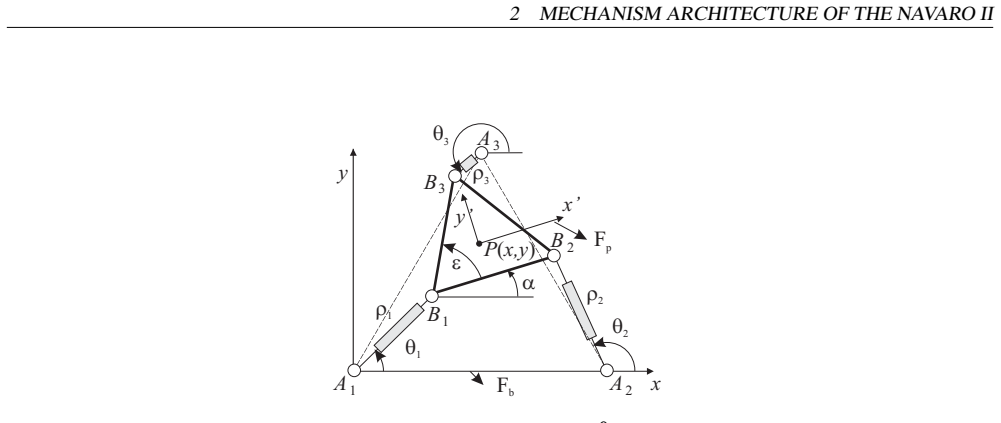
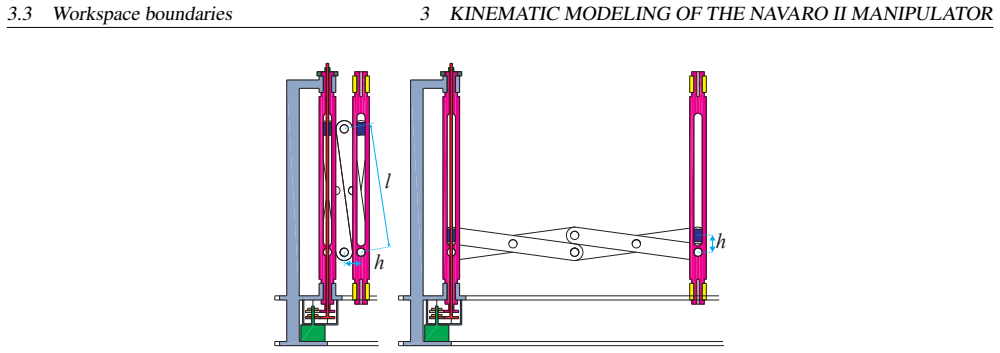
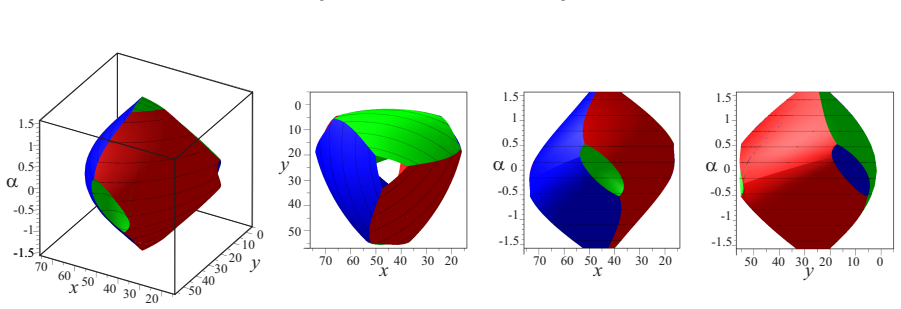
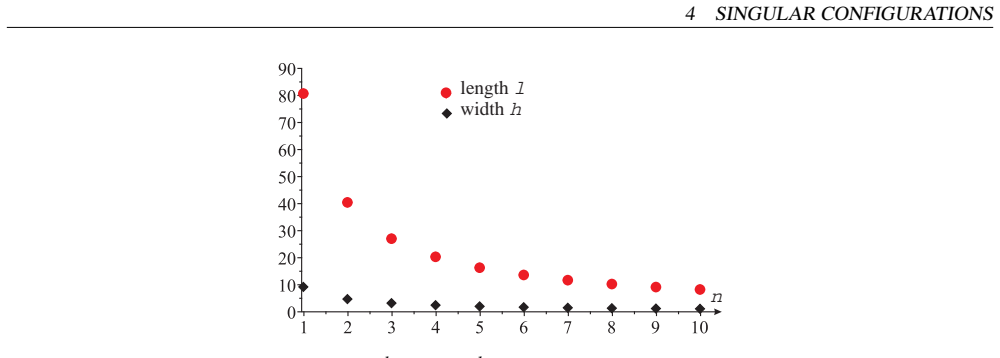
The mechanism that carries the argument is the scissor-as-prismatic-joint leg: a scissor lift mounted vertically, with extension $\rho_i$ computed from the position of the prismatic link shaft and the scissor bar length, which is kinematically equivalent to a sliding joint in the planar 3-RPR constraint loop. The algebraic machinery is the loop-closure and pose equations (Eqs. 7-12), the direct and inverse Jacobian matrices $A$ and $B$, and an algebraic elimination step that turns $\det(A)=0$ into the compact polynomial singularity equations for the eight modes in the Appendix. The workspace boundary is then defined simply by $r_{\min} \le \rho_i \le r_{\max}$, which lets the authors choose scissor dimensions (bar length $l$, height $h$, number of scissors $n$) to enclose a prescribed regular workspace.
What would settle it
Take the eight determinant equations from the Appendix and search for a real pose $(x, y, \alpha)$ inside the nominal workspace that satisfies two different mode equations simultaneously; any such pose is a configuration where the claimed strategy cannot find a non-singular actuation mode. The same check could be run on a physical prototype by commanding a path through such a pose and observing whether the platform stiffens or drifts.
Extended reading notes
Core claim
The core discovery is that a scissor mechanism placed in the plane orthogonal to the robot's motion plane can replace the second revolute joint of each leg of a 3-RRR robot, and the resulting kinematics are exactly those of a 3-RPR robot: each leg becomes a base revolute joint plus a prismatic joint of length $\rho_i$ plus a platform revolute joint. Because the direct and inverse Jacobian matrices factor cleanly for this structure, the determinant of the direct Jacobian, set to zero, yields explicit polynomial singularity surfaces for each of the eight actuation modes (Appendix, Eqs. 31-38). With a symmetrical base and mobile platform, the paper shows that these surfaces are not superposed within the workspace bounded by $r_{\min} \le \rho_i \le r_{\max}$, and concludes that any pose can be reached by selecting a non-singular actuation mode. It also derives, from the workspace-boundary equations, the scissor bar lengths and heights needed to guarantee a prescribed regular workspace.
Load-bearing premise
The load-bearing premise is that each vertically mounted scissor behaves exactly like an ideal sliding joint of length $\rho_i$ in the robot's plane; if the scissors bend, bind, or constrain the platform out of plane, the Jacobian, singularity surfaces, and workspace bounds do not describe the physical robot.
Editorial extensions
If this is right
- Each of the eight actuation modes has a single inverse-kinematics solution, so switching modes never requires also jumping between different inverse solutions.
- The singularity surfaces are available as closed algebraic expressions for the symmetric architecture, which makes exact singularity checks possible for any candidate pose rather than per-orientation numerical sampling.
- Because the singularity surfaces do not coincide inside the nominal workspace, the actuation-mode-selection algorithm can route any end-effector path through poses that would be singular in one mode by switching to another mode.
- Workspace requirements can be translated directly into scissor dimensions: given the desired regular disc and orientation range, the formulas fix the minimum and maximum leg lengths and hence the bar length, height, and number of scissor stages.
Reading between the lines
- If the ideal-scissor substitution survives prototype testing, a three-motor, six-clutch architecture could offer a low-cost way to retrofit planar parallel robots with singularity avoidance, since no extra power amplifiers are needed.
- The closed-form singularity equations invite a direct-kinematics and cuspidality analysis per actuation mode, which the paper names as future work; one testable extension is to count direct-kinematics solutions for each mode.
- The non-superposition observation is geometric, not yet a proof of global path feasibility; an extension would be to check whether the same property holds under asymmetry of the base and platform or under looser joint limits.
- Near the minimum scissor length, physical clearance in the scissor joints may make the serial-singularity limit $\rho_i = 0$ approachable, so $r_{\min}$ should be chosen with a safety margin calibrated by measurement.
Signed reviews
Editorial analysis
A structured set of objections, weighed in public.
Referee Report
Summary. The paper introduces NAVARO II, a planar 3-RPR parallel robot whose three prismatic joints are replaced by scissor mechanisms mounted in planes orthogonal to the motion plane. Each leg can be actuated either at its base revolute joint (angle theta_i) or at the scissor-driven prismatic coordinate (length rho_i), giving eight actuation modes selected by dual clutches. The authors write the loop-constraint equations for a symmetric equilateral base and platform, define the workspace boundary by rmin <= rho_i <= rmax, derive scissor dimensions for a prescribed regular workspace, and present compact algebraic singularity surfaces for all eight actuation modes. They claim that the 3-RPR kinematics gives exactly one inverse-kinematic solution in every actuation mode, and that because the eight singularity surfaces are not superposed, the whole workspace can be traversed without singularities by switching actuation modes.
Significance. If the central modeling equivalence between the scissor mechanism and an ideal prismatic joint is valid, this is an attractive mechanical realization of variable actuation: it retains the unique inverse-kinematic solution of the 3-RPR, replaces bulky prismatic actuators with compact scissors, and provides a single algebraic description of the parallel-singularity surfaces for all actuation modes. The explicit singularity equations in the Appendix are a potentially valuable reference, and the numerical design procedure for the scissor dimensions is straightforward to reuse. The paper does not rely on fitted parameters or circular reasoning; the constraint equations (7)-(12) are consistent with the stated geometry. However, the two load-bearing claims -- the scissor-to-prismatic equivalence and the path-feasibility inference from non-superposed singularity plots -- are not established by the current manuscript.
major comments (3)
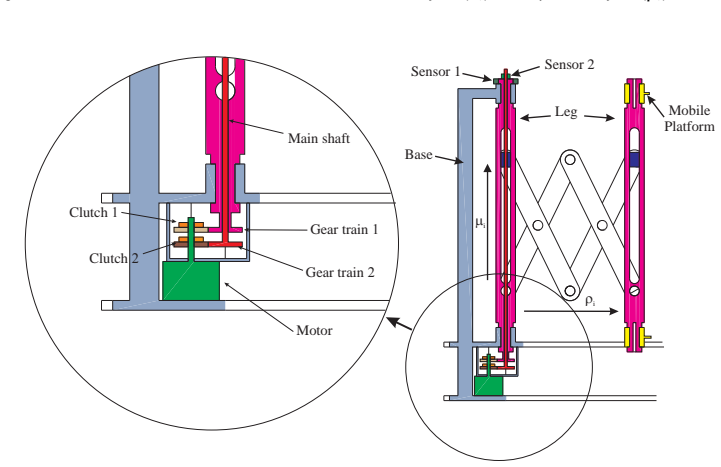
- [Section 2 / Section 3.1, Eq. (5)] The kinematic model treats rho_i as an independent, ideal prismatic-joint coordinate: the Jacobian factorization (5) uses q_i = rho_i, and the workspace boundary is rmin <= rho_i <= rmax. However, the physical actuator is the screw position mu_i, and the manuscript only states that 'the length of the scissor rho_i is computed thanks to the position of prismatic link shaft mu_i and the length l of the scissors' without giving the mapping rho_i = f(mu_i). If f has transmission singularities f'(mu_i) = 0 inside the allowed range, or if f is not injective on that range, then the true singularity surfaces include extra factors and the claimed unique inverse-kinematic solution holds only in the rho-coordinates, not in the actuator coordinates. Because every later result depends on this equivalence, the authors should derive f, state its domain, prove injectivity and f' != 0 over [rmin, rmax], or incorporate the transmission Jacobian into the singularity analysis.
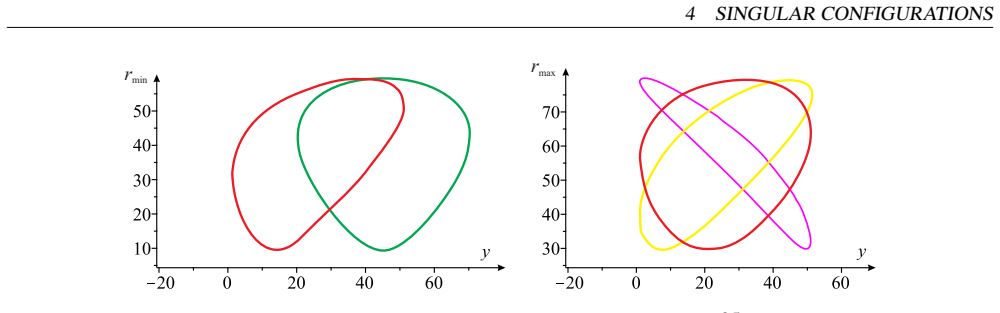
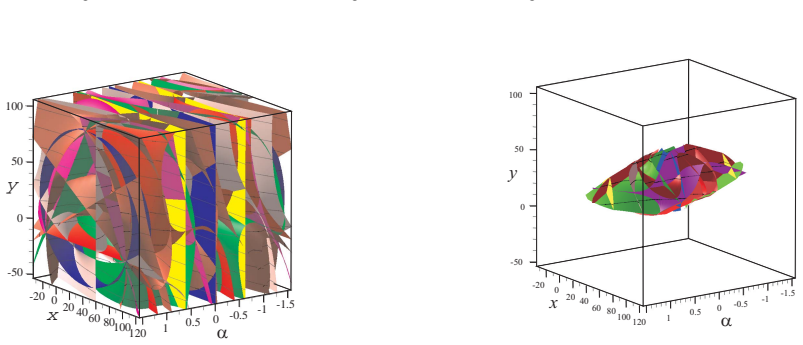
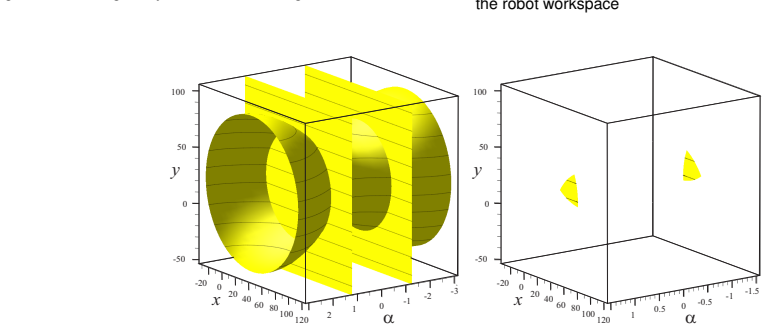
- [Section 4, paragraph after Figs. 10-11] The sentence 'As none of them are superposed, it is possible to completely move through the workspace by choosing a non singular actuation mode for any pose of the mobile platform' is not a valid inference. Non-superposition of the eight singularity surfaces only says that no two surfaces coincide everywhere; it does not imply that the union of the surfaces is not a separating barrier, nor that a continuous path avoiding all of them exists between arbitrary configurations with feasible actuation-mode switches. The later remark that an 'unrepresented singularity exists for alpha = pi' in mode 8 further complicates the picture. The authors should either provide a topological proof of path-connectedness of the singularity-free union of the mode regions, or demonstrate the mode-switching path planner on representative trajectories inside the workspace.
- [Appendix, Eqs. (31)-(38)] The eight singularity equations are given without derivation, and no elimination script, intermediate polynomial system, or verification procedure is provided. Since these equations are the main technical result supporting the non-superposition and traversability claims, the reader cannot independently confirm that the displayed compact forms are correct or complete. The authors should supply the Maple/Siropa computation or an independent verification method, and should state explicitly for which portions of the workspace the algebraic elimination is valid, including any exceptional configurations such as alpha = pi in Eq. (38).
minor comments (4)
- [Section 2, Table 1 caption] The caption reads 'The eight actuating modes of the 3-RRR VAM', but the robot and table describe a 3-RPR variable-actuation mechanism; this appears to be a copy-paste error from the NaVARo I paper.
- [Section 3.1, Eqs. (3)-(4)] The definitions of h_i for eliminating theta_i vs rho_i are mathematically consistent, but the sentence 'defined, for dot theta_i as h_i = (b_i - a_i)' is easy to misread as applying when theta_i is the actuated joint rather than the passive joint that must be eliminated; rewording would improve clarity.
- [Section 3.4, Eq. (30)] The relation h = 9/n and l = sqrt(6481)/n is presented without comment on the units or the approximation steps; the derivation from rmin = 9.64 and rmax = 79.77 to the rounded values 9 and 80.5 should be stated explicitly.
- [Section 4, Fig. 12] The sentence 'Figures 12 represents the singularities of the first actuation mode' has subject-verb disagreement, and the figure caption does not identify which panel corresponds to the workspace-limited case; adding labels would help.
Circularity Check
No significant circularity: all derived results follow algebraically from explicit constraint equations and stated architectural assumptions.
full rationale
The paper's derivations are self-contained. The central singularity equations (31)-(38) are obtained by eliminating passive joint variables from the loop-closure constraint equations (7)-(12) and the Jacobian factorization (5)-(6); nothing is fitted to produce a target result. The claimed advantage that the inverse kinematic model has only one solution is inherited from the 3-RPR structure, not manufactured by the paper's definitions. The scissor-to-prismatic equivalence is a stated modeling assumption, not a circular derivation, and it enters explicitly before all subsequent kinematics and workspace analysis. Self-citations appear only for context, such as the prior NaVARo I design [7], the working-mode concept [1], and the actuation-mode-selection algorithm [18]; none of these citations is load-bearing for the algebraic derivation of the singularity surfaces or the workspace boundaries. The inference from non-superposed singularity plots to global path feasibility is a potential logical gap, but it is not circularity. Therefore the paper earns a score of zero on the circularity scale.
Assumptions & free parameters
free parameters (3)
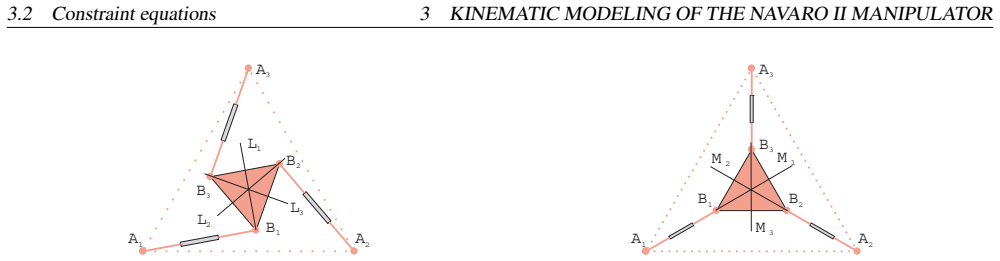
- base and platform dimensions (A1A2=90, B1B2=30, epsilon=pi/3) =
90, 30, pi/3
- regular workspace target (rw=25, alpha in [-pi/2, pi/2]) =
rw=25, alpha range [-pi/2, pi/2]
- number of scissor units n =
unspecified integer
assumptions (5)
- standard math Standard algebraic geometry: Groebner basis elimination and cylindrical algebraic decomposition are valid methods to derive singularity and workspace equations.
- domain assumption The planar 3-RPR closed-loop geometric model (Eqs. 7-12) represents the physical NAVARO II.
- domain assumption Workspace boundaries are determined only by the scissor length limits rmin and rmax; revolute joints are unlimited and no inter-leg collisions occur otherwise.
- ad hoc to paper Non-superposition of the eight singularity surfaces in the plotted workspace implies a singularity-free path exists through any pose by switching actuation modes.
- domain assumption Scissors placed orthogonally provide increased rigidity in the third dimension.
invented entities (1)
-
NAVARO II variable-actuation transmission with dual clutches and orthogonal scissor legs
Cite this review
Pith. "Pith review of NAVARO II, a Novel Scissor-Based Planar Parallel Robot 1." pith.science (2026). https://pith.science/paper/NIZZ6PLV
@misc{pith2026190802090,
  author       = {Pith},
  title        = {Pith review of: NAVARO II, a Novel Scissor-Based Planar Parallel Robot 1},
  year         = {2026},
  howpublished = {\url{https://pith.science/paper/NIZZ6PLV}},
  note         = {Machine review of arXiv:1908.02090}
}
read the original abstract
This article presents a new variable actuation mechanism based on the 3-RPR parallel robot. This mechanismis an evolution of the NaVARo robot, a 3-RRR parallel robot, for which the second revolute joint of the threelegs is replaced by a scissor to obtain a larger working space and avoid the use of parallelograms to operate thesecond revolute joint. To obtain better spatial rigidity, the leg mechanism is constructed by placing the scissorsin an orthogonal plane to the plane of the manipulator displacement (3-RRR or even the 3-RPR). This geometricproperty brings the significant consequence of allowing the scissors to directly substitute the prismatic chains in the3-RPR and enjoy the same kinematics advantages for the overall robots as only one solution to the inverse kinematicmodel. From the Jacobian expression, surfaces of singularity can be calculated and presented in a compact form.The singularity equations are presented for a robot with a similar base and mobile platform. The properties of thescissors are then determined to have a prescribed regular workspace.
Figures
Figures from the paper (7 more)
Reference graph
Works this paper leans on
-
[1]
Chablat, D. and Wenger, P., Working Modes and Aspects in Fully-Parallel Manipulator,Proceeding IEEE International Conference on Robotics and Automation, pp. 1964–1969, May, 1998
work page 1964
-
[2]
Chablat, D. and Wenger, P., Moveability and Collision Analysis for Fully-Parallel Manipulators, 12th CISM-IFTOMM Symposium, RoManSy, pp. 61-68, Paris, July, 1998
work page 1998
-
[3]
Kinematic Analysis of a New Parallel Machine Tool: the Orthoglide, Advances in Robot Kinematics, J
Wenger, P., and Chablat, D. Kinematic Analysis of a New Parallel Machine Tool: the Orthoglide, Advances in Robot Kinematics, J. Lenarcic and M. M. Stanisic, eds., Kluwer Academic Publishers, pp. 305-314, 2000
work page 2000
-
[4]
Alba-Gomez, O., Wenger, P. and Pamanes, A., Consistent Kinetostatic Indices for Planar 3-DOF Parallel Manipulators, Application to the Optimal Kinematic Inversion, Proceedings of the ASME 2005 IDETC/CIE Conference, 2005
work page 2005
-
[5]
Theingin, Chen, I.-M., Angeles, J. and Li, C., Management of parallel-manipulator singularities using joint-coupling Advanced Robotics, vol. 21, no. 5-6, pp. 583–600, 2007
work page 2007
-
[6]
Arakelian, V ., Briot, S. and Glazunov, V ., Increase of Singularity-Free Zones in the Workspace of Parallel Manipulators Using Mechanisms of Variable Structure. Mechanism and Machine Theory, 43(9), pp. 1129-1140, 2008
work page 2008
-
[7]
Rakotomanga, N., Chablat, D., and Caro, S., Kinetostatic performance of a planar parallel mechanism with variable actuation, 11th International Symposium on Advances in Robot Kinematics, Kluwer Academic Publishers, Nantes, France, June, 2008
work page 2008
-
[8]
Bonev, I. A., and Gosselin, C. M., Singularity Loci of Planar Parallel Manipulators with Revolute Joints, Proc. 2nd Workshop on Computational Kinematics, Seoul, 2001
work page 2001
Show all 18 references
-
[9]
In Industrial Informatics (INDIN), IEEE 14th International Conference on (pp
Chablat, D., Jha, R., and Caro, S., A framework for the control of a parallel manipulator with several actuation modes. In Industrial Informatics (INDIN), IEEE 14th International Conference on (pp. 190-195), 2016
2016
-
[10]
In 2018 International Russian Automation Conference (RusAutoCon) (pp
Klimchik, A., Pashkevich, A., and Chablat, D., Stiffness Analysis of Parallel Manipulator NaVaRo with Dual Actuation Modes. In 2018 International Russian Automation Conference (RusAutoCon) (pp. 1-7). IEEE, 2018
2018
-
[11]
In New Trends in Medical and Service Robots (pp
Caro, S., Chablat, D., Wenger, P., and Kong, X., Kinematic and dynamic modeling of a parallel manipulator with eight actuation modes. In New Trends in Medical and Service Robots (pp. 315-329). Springer, 2014
2014
-
[12]
Advanced Robotics, 30(15), 1014-1026, 2016
Takesue, N., Komoda, Y ., Murayama, H., Fujiwara, K., and Fujimoto, H., Scissor lift with real-time self-adjustment ability based on variable gravity compensation mechanism. Advanced Robotics, 30(15), 1014-1026, 2016
2016
-
[13]
Islam, M. T., Yin, C., Jian, S., and Rolland, L., Dynamic analysis of Scissor Lift mechanism through bond graph modeling, IEEE/ASME International Conference on Advanced Intelligent Mechatronics, 2014
2014
-
[14]
In Advanced Strategies for Robot Manipulators
Rolland, L., Kinematics Synthesis of a New Generation of Rapid Linear Actuators for High Velocity Robotics. In Advanced Strategies for Robot Manipulators. InTech, 2010
2010
-
[15]
Siropa, Algebraic and robotic functions, http://siropa.gforge.inria.fr/doc/files/siropa-mpl.html, 2018
2018
-
[16]
and Moroz, G., Workspace, Joint space and Singularities of a family of Delta-Like Robot Mechanism and Machine Theory, V ol
Jha, R., Chablat, D., Barin, L., Rouillier, F. and Moroz, G., Workspace, Joint space and Singularities of a family of Delta-Like Robot Mechanism and Machine Theory, V ol. 127, pp.73–95, September 2018
2018
-
[17]
Quantifier Elimination for Real Closed Fields by Cylindrical Algebraic Decomposition
Collins, G. E., “Quantifier Elimination for Real Closed Fields by Cylindrical Algebraic Decomposition”, Springer Verlag, 1975
1975
-
[18]
Caro, S., Chablat, D. and Hu, Y ., Algorithm for the Actuation Mode Selection of the Parallel Manipulator NA V ARO ASME 2014 International Design Engineering Technical Conferences and Computers and Information in Engineering Conference, Buffalo, 2014. 6 Appendix JMR-18-1364, D...
2014
Reviewed August 14, 2026 · model on record in the stance chip above.
Discussion (0). Continue with ORCID to comment.