Rapid Cavity-Based Mid-Circuit Measurement and Feedforward in a Neutral Atom Array
Pith reviewed 2026-06-25 23:48 UTC · model grok-4.3
The pith
Local light shifts shield unmeasured qubits during cavity-enhanced mid-circuit measurements, enabling real-time feedforward below 100 μs in neutral-atom arrays.
A machine-rendered reading of the paper's core claim, the machinery that carries it, and where it could break.
Core claim
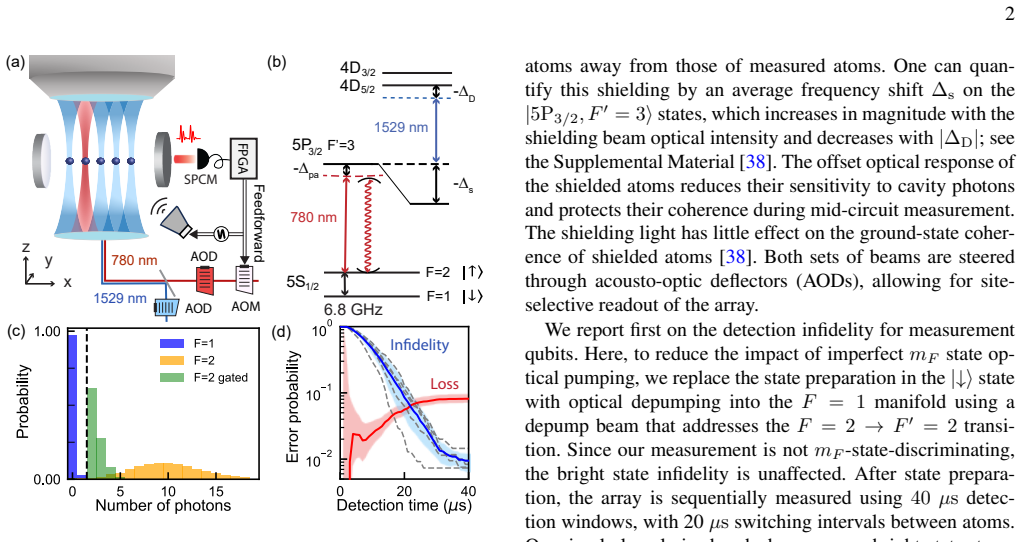
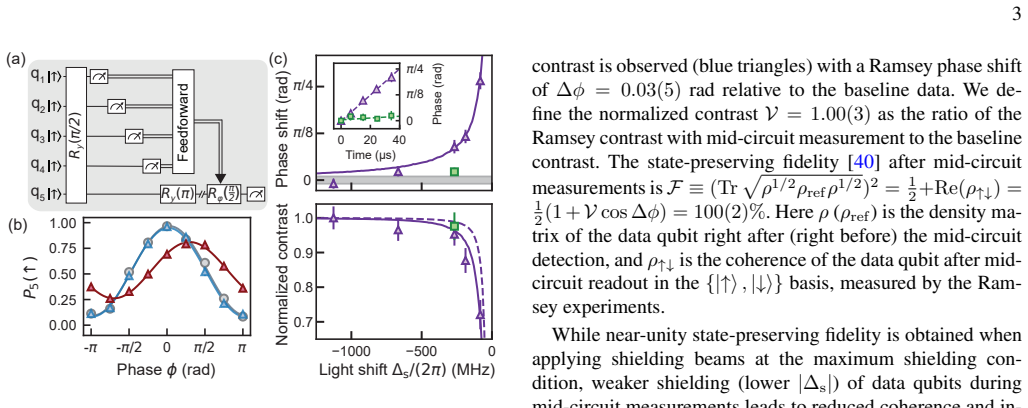
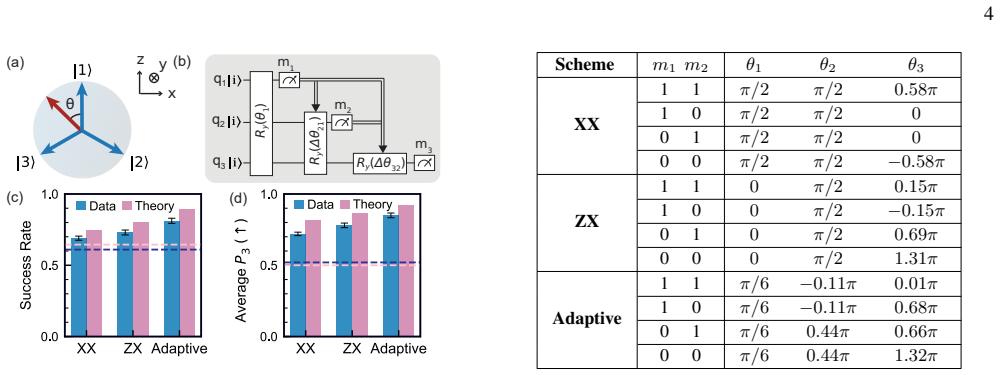
By coupling an array of atomic qubits to a high-finesse cavity and applying site-selective light shifts, the authors measure chosen qubits with Purcell-enhanced collection while keeping neighboring qubits off-resonance; this yields measurements of four qubits at sub-percent error that reduce coherence of an unmeasured fifth qubit by less than 2 percent, followed by real-time classical feedforward that both corrects measurement-induced phases and implements an adaptive circuit for state discrimination and conditional preparation, all within a cycle time below 100 μs.
What carries the argument
Site-selective light shifts that detune individual data qubits from cavity resonance, combined with Purcell-enhanced emission from a near-resonant probe on the target qubit.
If this is right
- Real-time feedforward becomes fast enough to support mid-circuit error correction in neutral-atom processors.
- Adaptive circuits for state discrimination and conditional preparation can run within the coherence time of the array.
- Measurement-induced phase shifts can be corrected in real time without halting the computation.
- The approach opens a path to larger-scale neutral-atom algorithms that rely on frequent mid-circuit operations.
Where Pith is reading between the lines
- The cavity method could be tested for compatibility with moving atoms or larger arrays by checking whether light-shift crosstalk grows with atom number.
- If the cycle time scales linearly with the number of measured qubits, the technique may still enable protocols that measure only a few sites at a time.
- Combining the cavity readout with existing Rydberg gates might allow full adaptive quantum circuits without external classical delays.
Load-bearing premise
Local light shifts can detune chosen qubits far enough from cavity resonance to protect their coherence while a probe still drives a selected qubit with enough Purcell enhancement and without unacceptable crosstalk or extra decoherence.
What would settle it
Observe more than 2 percent coherence loss on an unmeasured data qubit after four mid-circuit cavity measurements, or measure a full measurement-plus-feedforward cycle time exceeding 100 μs under the reported conditions.
Figures
read the original abstract
Measuring part of a quantum system in the midst of its evolution and acting on the result in real time is essential for numerous quantum information protocols. Neutral-atom arrays are a leading platform for quantum information processing, but their mid-circuit measurement-and-feedforward cycle times have remained slow, typically exceeding 1 ms. Here we demonstrate fast mid-circuit measurement and real-time feedforward in an array of atomic qubits coupled to a high-finesse optical cavity. Local light shifts tune individual data qubits out of resonance with the cavity, shielding their coherence, while a near-resonant probe drives a selected qubit whose emission is collected with Purcell enhancement. Mid-circuit measurements of four qubits with sub percent infidelity reduce the coherence of a fifth unmeasured data qubit by less than 2%. We implement real-time feedforward to correct measurement-induced phase shifts and to realize an adaptive circuit for optimal quantum state discrimination and conditional state preparation. Our approach reduces the measurement-and-feedforward cycle time to below 100 $\mu$s and establishes optical cavities as a route to fast control of neutral-atom quantum systems.
Editorial analysis
A structured set of objections, weighed in public.
Referee Report
Summary. The manuscript demonstrates cavity-enhanced mid-circuit measurement and real-time feedforward on neutral-atom qubits. Local light shifts are used to detune unmeasured data qubits from the cavity resonance while a near-resonant probe drives selected qubits with Purcell enhancement. The central experimental claims are sub-percent measurement infidelity on four qubits, less than 2% coherence reduction on a fifth unmeasured qubit, correction of measurement-induced phase shifts via feedforward, realization of an adaptive optimal state-discrimination circuit, and reduction of the full measurement-and-feedforward cycle time to below 100 μs.
Significance. If the reported performance numbers are substantiated, the work would establish optical cavities as a viable route to sub-100 μs mid-circuit operations in neutral-atom arrays, a substantial improvement over the >1 ms timescales typical of the platform. The combination of selective shielding, Purcell-enhanced readout, and real-time feedforward directly addresses a key bottleneck for measurement-based and adaptive quantum protocols.
major comments (2)
- [Abstract / Results] Abstract and Results: The headline performance figures (sub-percent infidelity on four qubits, <2% coherence loss on the fifth, <100 μs cycle time) are stated without error bars, raw datasets, or explicit exclusion criteria. This absence makes it impossible to evaluate the statistical robustness or reproducibility of the central claims from the provided text.
- [Methods / shielding protocol] Experimental methods / shielding protocol: The <2% coherence-loss claim rests on the assumption that local light shifts can be applied with sufficient strength and locality to suppress Purcell-enhanced decay on data qubits while producing negligible residual cavity coupling, AC-Stark dephasing, or probe-induced crosstalk on either the measured or unmeasured qubits. No quantitative bounds on these residual rates under the exact shift amplitudes used are supplied.
minor comments (1)
- [Notation] Notation for the local light-shift amplitudes and the resulting detunings should be defined consistently between the main text and any supplementary figures showing the shift spectrum.
Simulated Author's Rebuttal
We thank the referee for their careful reading of the manuscript and for highlighting the significance of cavity-enhanced mid-circuit operations. We address each major comment below and have prepared revisions to improve clarity and completeness.
read point-by-point responses
-
Referee: [Abstract / Results] Abstract and Results: The headline performance figures (sub-percent infidelity on four qubits, <2% coherence loss on the fifth, <100 μs cycle time) are stated without error bars, raw datasets, or explicit exclusion criteria. This absence makes it impossible to evaluate the statistical robustness or reproducibility of the central claims from the provided text.
Authors: We agree that the abstract and main Results text would benefit from additional statistical context. The underlying data in Figures 2–4 are derived from >1000 experimental repetitions per point with standard error bars shown in the figures; data exclusion was limited to <5% of shots due to technical faults (e.g., atom loss or laser drift) as stated in the Methods. In the revised manuscript we will (i) append approximate uncertainties to the headline numbers in the abstract and (ii) add an explicit sentence in the Results section summarizing repetition count and exclusion criteria. Raw datasets will be made available upon reasonable request, consistent with journal policy. revision: yes
-
Referee: [Methods / shielding protocol] Experimental methods / shielding protocol: The <2% coherence-loss claim rests on the assumption that local light shifts can be applied with sufficient strength and locality to suppress Purcell-enhanced decay on data qubits while producing negligible residual cavity coupling, AC-Stark dephasing, or probe-induced crosstalk on either the measured or unmeasured qubits. No quantitative bounds on these residual rates under the exact shift amplitudes used are supplied.
Authors: We acknowledge that explicit bounds strengthen the shielding-protocol description. The current Methods section and Supplementary Information already contain order-of-magnitude estimates (detuning >10 cavity linewidths yields Purcell suppression >100×; residual AC-Stark shift <1 kHz; probe crosstalk <0.1%), but these are not tabulated for the precise shift amplitudes used in the main experiment. In the revised version we will insert a short dedicated paragraph in Methods that tabulates the calculated residual rates (Purcell decay, AC-Stark dephasing, and crosstalk) evaluated at the exact light-shift values employed, together with the measured coherence-loss data that corroborate the bounds. revision: yes
Circularity Check
No circularity: experimental demonstration with direct measurements
full rationale
This is an experimental paper reporting measured performance of cavity-based mid-circuit measurements and feedforward in neutral-atom qubits. The central claims (sub-percent infidelity, <2% coherence loss, <100 μs cycle time) are empirical results obtained from direct observation, not quantities derived from equations that reduce by construction to fitted inputs or self-citations. No load-bearing derivation chain exists in the manuscript; the work is self-contained against external benchmarks.
Axiom & Free-Parameter Ledger
axioms (1)
- standard math Standard cavity quantum electrodynamics and atomic transition physics
Reference graph
Works this paper leans on
-
[1]
Shor, Fault-tolerant quantum computation, inProc
P. Shor, Fault-tolerant quantum computation, inProc. 37th Conf. F ound. Comput. Sci.(IEEE Comput. Soc. Press, 1996) pp. 56–65
1996
-
[2]
Dennis, A
E. Dennis, A. Kitaev, A. Landahl, and J. Preskill, Topological quantum memory, J. Math. Phys.43, 4452 (2002)
2002
-
[3]
Steane, Multiple-particle interference and quantum error correction, Proc
A. Steane, Multiple-particle interference and quantum error correction, Proc. R. Soc. London. Ser. A Math. Phys. Eng. Sci. 452, 2551 (1996)
1996
-
[4]
Bluvstein, A
D. Bluvstein, A. A. Geim, S. H. Li, S. J. Evered, J. P. Bonilla Ataides, G. Baranes, A. Gu, T. Manovitz, M. Xu, M. Kalinowski, S. Majidy, C. Kokail, N. Maskara, E. C. Trapp, L. M. Stewart, S. Hollerith, H. Zhou, M. J. Gullans, S. F. Yelin, M. Greiner, V . Vuleti´c, M. Cain, and M. D. Lukin, A fault- tolerant neutral-atom architecture for universal quantum...
2025
-
[5]
Katabarwa, K
A. Katabarwa, K. Gratsea, A. Caesura, and P. D. Johnson, Early fault-tolerant quantum computing, PRX Quantum5, 020101 (2024)
2024
-
[6]
Krinneret al., Realizing repeated quantum error correction in a distance-three surface code, Nature605, 669 (2022)
S. Krinneret al., Realizing repeated quantum error correction in a distance-three surface code, Nature605, 669 (2022)
2022
-
[7]
Raussendorf and H
R. Raussendorf and H. J. Briegel, A one-way quantum com- puter, Phys. Rev. Lett.86, 5188 (2001)
2001
-
[8]
M. Foss-Feig, A. Tikku, T.-C. Lu, K. Mayer, M. Iqbal, T. M. Gatterman, J. A. Gerber, K. Gilmore, D. Gresh, A. Hankin, N. Hewitt, C. V . Horst, M. Matheny, T. Mengle, B. Neyenhuis, H. Dreyer, D. Hayes, T. H. Hsieh, and I. H. Kim, Experimen- tal demonstration of the advantage of adaptive quantum circuits (2023), arXiv:2302.03029 [quant-ph]
arXiv 2023
-
[9]
R. B. Griffiths and C.-S. Niu, Semiclassical Fourier transform for quantum computation, Phys. Rev. Lett.76, 3228 (1996)
1996
-
[10]
Bäumer, V
E. Bäumer, V . Tripathi, A. Seif, D. Lidar, and D. S. Wang, Quantum Fourier transform using dynamic circuits, Phys. Rev. Lett.133, 150602 (2024)
2024
-
[11]
A. Lemelin, C. Pere, O. Landon-Cardinal, and C. Coti, Mid-circuit measurement as an algorithmic primitive (2025), arXiv:2506.00118 [quant-ph]
arXiv 2025
-
[12]
Peres and W
A. Peres and W. K. Wootters, Optimal detection of quantum information, Phys. Rev. Lett.66, 1119 (1991)
1991
-
[13]
L. O. Conlon, T. V ogl, C. D. Marciniak, I. Pogorelov, S. K. Yung, F. Eilenberger, D. W. Berry, F. S. Santana, R. Blatt, T. Monz,et al., Approaching optimal entangling collec- tive measurements on quantum computing platforms, Nature Physics19, 351 (2023)
2023
-
[14]
K. Zhou, C. Yi, W.-Z. Yan, Z. Hou, H. Zhu, G.-Y . Xiang, C.-F. Li, and G.-C. Guo, Experimental realization of genuine three- copy collective measurements for optimal information extrac- tion, Phys. Rev. Lett.134, 210201 (2025)
2025
-
[15]
T.-C. Lu, L. A. Lessa, I. H. Kim, and T. H. Hsieh, Measure- ment as a shortcut to long-range entangled quantum matter, PRX Quantum3, 040337 (2022)
2022
-
[16]
K. C. Smith, A. Khan, B. K. Clark, S. Girvin, and T.-C. Wei, Constant-depth preparation of matrix product states with adap- tive quantum circuits, PRX Quantum5, 030344 (2024)
2024
-
[17]
J. Feldmeier, Y .-J. Liu, M. D. Lukin, and S. Choi, Digital dis- sipative state preparation for frustration-free gapless quantum systems (2026), arXiv:2603.10119 [quant-ph]
arXiv 2026
-
[18]
Y . Li, X. Chen, and M. P. A. Fisher, Quantum Zeno effect and the many-body entanglement transition, Phys. Rev. B98, 205136 (2018)
2018
-
[19]
Skinner, J
B. Skinner, J. Ruhman, and A. Nahum, Measurement-induced phase transitions in the dynamics of entanglement, Phys. Rev. X9, 031009 (2019)
2019
-
[20]
A. Chan, R. M. Nandkishore, M. Pretko, and G. Smith, Unitary- projective entanglement dynamics, Phys. Rev. B99, 224307 6 (2019)
2019
-
[21]
A. M. Kaufman and K.-K. Ni, Quantum science with opti- cal tweezer arrays of ultracold atoms and molecules, Nature Physics17, 1324 (2021)
2021
-
[22]
Ðor ¯devi´c, P
T. Ðor ¯devi´c, P. Samutpraphoot, P. L. Ocola, H. Bernien, B. Grinkemeyer, I. Dimitrova, V . Vuleti´c, and M. D. Lukin, En- tanglement transport and a nanophotonic interface for atoms in optical tweezers, Science373, 1511 (2021)
2021
-
[23]
Deist, Y .-H
E. Deist, Y .-H. Lu, J. Ho, M. K. Pasha, J. Zeiher, Z. Yan, and D. M. Stamper-Kurn, Mid-circuit cavity measurement in a neu- tral atom array, Phys. Rev. Lett.129, 203602 (2022)
2022
-
[24]
T. M. Graham, L. Phuttitarn, R. Chinnarasu, Y . Song, C. Poole, K. Jooya, J. Scott, A. Scott, P. Eichler, and M. Saffman, Midcir- cuit measurements on a single-species neutral alkali atom quan- tum processor, Phys. Rev. X13, 041051 (2023)
2023
-
[25]
Singh, C
K. Singh, C. E. Bradley, S. Anand, V . Ramesh, R. White, and H. Bernien, Mid-circuit correction of correlated phase errors using an array of spectator qubits, Science380, 1265 (2023)
2023
-
[26]
M. A. Norcia, W. B. Cairncross, K. Barnes, P. Battaglino, A. Brown, M. O. Brown, K. Cassella, C.-A. Chen, R. Coxe, D. Crow, J. Epstein, C. Griger, A. M. W. Jones, H. Kim, J. M. Kindem, J. King, S. S. Kondov, K. Kotru, J. Lauigan, M. Li, M. Lu, E. Megidish, J. Marjanovic, M. McDonald, T. Mittiga, J. A. Muniz, S. Narayanaswami, C. Nishiguchi, R. Notermans, ...
2023
-
[27]
S. Ma, G. Liu, P. Peng, B. Zhang, S. Jandura, J. Claes, A. P. Burgers, G. Pupillo, S. Puri, and J. D. Thompson, High-fidelity gates and mid-circuit erasure conversion in an atomic qubit, Na- ture622, 279 (2023)
2023
-
[28]
J. W. Lis, A. Senoo, W. F. McGrew, F. Rönchen, A. Jenkins, and A. M. Kaufman, Midcircuit operations using the omg architec- ture in neutral atom arrays, Phys. Rev. X13, 041035 (2023)
2023
-
[29]
Bluvsteinet al., Logical quantum processor based on recon- figurable atom arrays, Nature626, 58 (2024)
D. Bluvsteinet al., Logical quantum processor based on recon- figurable atom arrays, Nature626, 58 (2024)
2024
-
[30]
Y . Wang, R. Cimmino, K. Wang, S. Lopez, J. Li, J. M. Koh, J. N. Hallén, A. Matthies, N. Y . Yao, and K.-K. Ni, Multi- qubit stabilizer readout on a dual-species Rydberg array (2026), arXiv:2605.10924 [quant-ph]
Pith/arXiv arXiv 2026
-
[31]
O. Lib, H. Timme, M. Ammenwerth, F. Gyger, R. Tao, S. Sun, I. Bloch, and J. Zeiher, Velocity-enabled quantum computing with neutral atoms (2026), arXiv:2603.15561 [quant-ph]
arXiv 2026
-
[32]
W. Huie, L. Li, N. Chen, X. Hu, Z. Jia, W. K. C. Sun, and J. P. Covey, Repetitive readout and real-time control of nuclear spin qubits in 171Ybatoms, PRX Quantum4, 030337 (2023)
2023
-
[33]
S. J. Evered, M. Kalinowski, A. A. Geim, T. Manovitz, D. Blu- vstein, S. H. Li, N. Maskara, H. Zhou, S. Ebadi, M. Xu, J. Campo, M. Cain, S. Ostermann, S. F. Yelin, S. Sachdev, M. Greiner, V . Vuleti´c, and M. D. Lukin, Probing the Kitaev honeycomb model on a neutral-atom quantum computer, Na- ture645, 341 (2025)
2025
-
[34]
B. Hu, J. Sinclair, E. Bytyqi, M. Chong, A. Rudelis, J. Ramette, Z. Vendeiro, and V . Vuleti´c, Site-selective cavity readout and classical error correction of a 5-bit atomic register, Phys. Rev. Lett.134, 120801 (2025)
2025
-
[35]
Bochmann, M
J. Bochmann, M. Mücke, C. Guhl, S. Ritter, G. Rempe, and D. L. Moehring, Lossless state detection of single neutral atoms, Phys. Rev. Lett.104, 2 (2010)
2010
-
[36]
J. Wang, D.-Y . Huang, X.-L. Zhou, Z.-M. Shen, S.-J. He, Q.-Y . Huang, Y .-J. Liu, C.-F. Li, and G.-C. Guo, Ultra- fast high-fidelity state readout of single neutral atom (2024), arXiv:2412.12584 [quant-ph]
arXiv 2024
-
[37]
Deist, J
E. Deist, J. A. Gerber, Y .-H. Lu, J. Zeiher, and D. M. Stamper-Kurn, Superresolution microscopy of optical fields us- ing tweezer-trapped single atoms, Phys. Rev. Lett.128, 083201 (2022)
2022
-
[38]
See the Supplemental Material for more details
-
[39]
M. N. H. Chow, B. J. Little, and Y .-Y . Jau, High-fidelity low- loss state detection of alkali-metal atoms in optical tweezer traps, Phys. Rev. A108, 032407 (2023)
2023
-
[40]
Jozsa, Fidelity for mixed quantum states, Journal of Modern Optics41, 2315 (1994)
R. Jozsa, Fidelity for mixed quantum states, Journal of Modern Optics41, 2315 (1994)
1994
-
[41]
Direct illumination by probe light focused onto measured atoms has no discernible effect on other atoms in the array; see Sup- plemental Material [38]
-
[42]
Chitambar and M.-H
E. Chitambar and M.-H. Hsieh, Revisiting the optimal detection of quantum information, Phys. Rev. A88, 020302(R) (2013)
2013
-
[43]
G. Weir, C. Hughes, S. M. Barnett, and S. Croke, Optimal mea- surement strategies for the trine states with arbitrary prior prob- abilities, Quantum Science and Technology3, 035003 (2018)
2018
-
[44]
Levine, D
H. Levine, D. Bluvstein, A. Keesling, T. T. Wang, S. Ebadi, G. Semeghini, A. Omran, M. Greiner, V . Vuleti ´c, and M. D. Lukin, Dispersive optical systems for scalable Raman driving of hyperfine qubits, Phys. Rev. A105, 032618 (2022)
2022
-
[45]
Aspuru-Guzik, A
A. Aspuru-Guzik, A. D. Dutoi, P. J. Love, and M. Head- Gordon, Simulated quantum computation of molecular ener- gies, Science309, 1704 (2005)
2005
-
[46]
B. P. Lanyon, J. D. Whitfield, G. G. Gillett, M. E. Goggin, M. P. Almeida, I. Kassal, J. D. Biamonte, M. Mohseni, B. J. Powell, M. Barbieri,et al., Towards quantum chemistry on a quantum computer, Nature Chemistry2, 106 (2010)
2010
-
[47]
J. P. Covey, H. Weinfurter, and H. Bernien, Quantum networks with neutral atom processing nodes, npj Quantum Information 9, 90 (2023)
2023
-
[48]
Ramette, J
J. Ramette, J. Sinclair, Z. Vendeiro, A. Rudelis, M. Cetina, and V . Vuleti´c, Any-to-any connected cavity-mediated architecture for quantum computing with trapped ions or Rydberg arrays, PRX Quantum3, 010344 (2022)
2022
-
[49]
Gottesman and H.-K
D. Gottesman and H.-K. Lo, Proof of security of quantum key distribution with two-way classical communications, IEEE Transactions on Information Theory49, 457 (2003)
2003
-
[50]
J. D. Santis, B. Dura-Kovács, M. Öncü, A. Bouscal, D. Vasileiadis, and J. Zeiher, Realization of a cavity-coupled Rydberg array (2026), arXiv:2602.12152 [quant-ph]. Supplemental Material for Rapid Cavity-Based Mid-Circuit Measurement and Feedforward in a Neutral Atom Array Tsai-Chen Lee, 1, 2 Jacquelyn Ho, 1, 2 Yue-Hui Lu,1, 2 Tai Xiang,1, 2 Nathaniel B. ...
arXiv 2026
-
[51]
∆ D at shielding powers of 0.1 mW and 1 mW per atom (assuming a 4.6 µm Gaussian beam waist)
(c) Energy eigenvalues of the 5P 3/2(F = 3,m F ) states vs. ∆ D at shielding powers of 0.1 mW and 1 mW per atom (assuming a 4.6 µm Gaussian beam waist). For comparison, the expected energies based on the scalar polarizability are shown as solid gray curves. (d) Energy eigenvalues of 5P3/2 hyperfine states (labeled on the left of the plot) vs. shielding be...
2022
discussion (0)
Sign in with ORCID, Apple, or X to comment. Anyone can read and Pith papers without signing in.