REVIEW 4 major objections 5 minor 26 references
Combined Task and Action Learning from Human Demonstrations for Mobile Manipulation Applications
T0 review · 4 major / 5 minor · reviewed 2026-08-14 · deepseek-v4-flash
Pith's one-line read A small number of markerless human demonstrations can teach a mobile robot both the goal of a multi-step task and the individual actions needed to execute it, allowing it to improvise new solutions in unseen settings.
desk verdict A competent integration of the authors' own prior work with a plausible but under-supported evaluation; the entropy-based goal weighting deserves a robustness check before the generalization claim can be taken at face value. read the letter →
The pith
A machine-rendered reading of the paper's core claim, the machinery that carries it, and where it could break.
The reading
What carries the argument
The central object is the intention likelihood $\Psi(s_T) = \eta \sum_{o_k \in O(s_T)} \sum_{o_l \in O(s_T), o_k \neq o_l} \omega(k,l)\, p(\mathbf{l}_{Tk}(T))$, a weighted mixture over pairwise spatial-relation likelihoods with weights $\omega(k,l) = 1/(\epsilon_H + H(k,l))$, where $H(k,l)$ is the entropy of that relation across demonstrations. Around it, the search machinery is a three-level Monte Carlo tree search whose action-selection nodes pick which object to move, template-selection nodes pick the reference object for the motion, and goal-selection nodes sample goal states from learned action goal distributions. The trajectory generation is carried by Gaussian mixture models of the robot's base and end-effector motion, allowing the planner to maximize $\Psi$ while checking that every proposed trajectory is collision-free and kinematically feasible.
What would settle it
Take a task where the teacher moves one object while another, task-irrelevant object happens to rest in the same corner in every demonstration; if the inverse-entropy weighting assigns that relation the highest weight and the planned goal state preserves the irrelevant object's position at the expense of the manipulated object, the entropy assumption is the cause. Repeating this with different scene layouts and checking whether the selected plan tracks the irrelevant relation would settle whether the weighting is reliable.
Extended reading notes
Core claim
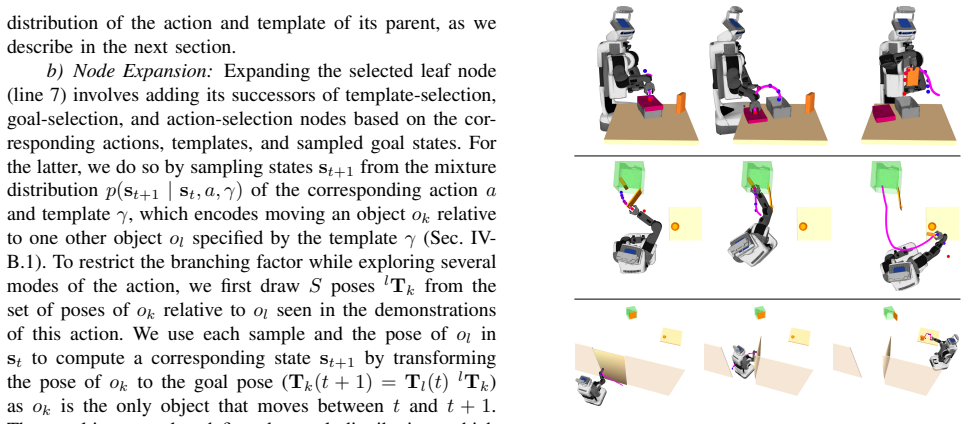
The central claim is that combined task-goal and action learning can be done from demonstrations without semantic priors. The task intention $\Psi(s_T)$ is modeled as a weighted sum over pairwise spatial-relation likelihoods, with weights inversely proportional to the entropy of each relation across demonstrations, and the action library is a set of trajectory-level Gaussian mixture models, each with multiple templates (reference frames). Solving a task is then an optimization: find a feasible action sequence maximizing $\Psi(s_T)$ minus action costs, using Monte Carlo tree search over action-selection, template-selection, and goal-selection nodes. The paper reports real-robot execution of three tasks, including opening a door and placing a box, showing that the same learned models generalize to new starting states and that actions learned in one context can be reused in another.
Load-bearing premise
The method assumes that the more a spatial relation varies across demonstrations, the less it matters to the teacher's goal; with only a handful of demonstrations, a relation that is consistent by accident can therefore dominate the task model and steer the plan.
Editorial extensions
If this is right
- A teacher can demonstrate a task without specifying a goal pose; the robot will commit to whichever final arrangement best matches the weighted spatial-relation model of the teacher's intention.
- Geometrically constrained actions such as opening a door can be included in a plan without a model of the articulated object, because feasibility is checked by generating trajectories from learned motion models.
- Actions learned in one task can be reused in a different task context, as demonstrated by using door-opening demonstrations for one task together with demonstrations of a different task's goal.
- When no full plan is feasible, the framework degrades gracefully by returning partial solutions that maximize the intention likelihood, such as opening a cabinet even when the box inside cannot be grasped.
- The same learned action and task models can be applied to new starting states without retraining, provided the objects and robot remain geometrically reachable.
Reading between the lines
- The inverse-entropy weighting implicitly assumes that the dispersion of a spatial relation across demonstrations is a reliable cue to its task relevance; with very few demonstrations, a relation that is constant purely because of scene layout could be upweighted and steer the plan away from the teacher's actual goal.
- A natural extension would be to estimate relation relevance by cross-validating on held-out demonstrations, or by measuring how changing a relation affects the feasibility of the demonstrated task, rather than relying on entropy alone.
- Because the action templates include moving an object relative to itself, the framework should also handle opening and closing actions on articulated objects, and could plausibly extend to tool use by treating the tool as the reference object.
- The MCTS formulation suggests that combining this learned intention likelihood with a learned cost model for actions, rather than a constant per-action cost, could produce plans that better balance effort against goal alignment.
Signed reviews
Editorial analysis
A structured set of objections, weighed in public.
Referee Report
Summary. This paper presents an integrated learning-from-demonstration system for sequential mobile manipulation. The authors learn a task intention likelihood Ψ(s_T) (Eq. 1) as a weighted sum of kernel-density estimates of pairwise spatial relations between objects, with inverse-entropy weights, and simultaneously learn per-action goal distributions and trajectory models from the same human demonstrations. A Monte Carlo tree search with action-selection, template-selection, and goal-selection nodes maximizes Ψ minus a constant action cost, using lazy feasibility checks during search and full inverse-kinematics and collision checks on the final plan. The approach is evaluated on three tasks (placing a box in a box, removing a cereal box from a cabinet, and a door-passage version of the cabinet task) in simulation and on a PR2 robot. The paper reports 43/50 and 41/50 feasible plans in the two simulated generalization experiments and successful execution in 5, 5, and 3 real-robot trials, while explicitly building on the authors' earlier works [2] and [3].
Significance. The problem addressed is relevant and timely: enabling a non-expert teacher to provide a few markerless demonstrations from which the robot learns both the geometric task intention and the underlying manipulation actions, without an explicit goal state or a semantic planning domain, would substantially improve the usability of learning-from-demonstration systems. The paper's main strengths are the integration of learned mobile-manipulation trajectory models into a task-level MCTS search, the use of continuous multi-modal spatial-relation distributions rather than a single committed goal, and the demonstration of real-robot executions including a constrained door-opening action. The paper also reports concrete simulation counts that are falsifiable. However, the empirical evidence is not yet strong enough to support the central generalization claim: there are no baselines or ablations, no repeated-trial statistics, and the entropy-based weighting in Eq. (1) is not validated against the obvious failure mode of chance-consistent but task-irrelevant relations. The claims are therefore plausible but not yet established.
major comments (4)
- [§IV-A, Eq. (1)] The weight ω(k,l) = 1/(ε_H + H(k,l)) is the only mechanism in Ψ that separates task-relevant from task-irrelevant pairwise relations, but the assumption that low entropy implies high relevance is not evaluated. With N=5 demonstrations, a relation that is consistent by chance in the teacher's fixed environment (for example, the small box always at the same pose relative to a table corner) will receive near-zero entropy and therefore dominate Ψ, potentially steering the search away from the true task relation. The failure analysis in §V-A attributes failures only to infeasible actions and never to mis-identified intentions, and no ablation with uniform weights, leave-one-out validation, or synthetic tasks with a known task-relevant relation is provided. Because Eq. (1) is the core of the claimed goal generalization, this confound needs to be addressed experimentally.
- [§V-A] The simulation evaluation reports 43/50 and 41/50 feasible plans, but these are single-pass counts without variance, confidence intervals, or per-trial details, and there is no comparison against any baseline. In particular, there is no comparison to the prior teach-and-improvise framework [3] with point-to-point actions, to a uniform-weighting variant of Ψ, or to an external learning-from-demonstration or task-and-motion-planning method. The central claim that the integrated system is effective at generalizing learned tasks in new settings is therefore not supported by the evidence as presented. Please add at least one control condition and repeated-trial statistics.
- [§V, Tasks 2 and 3] The abstract and Sec. I claim joint learning of task and action models from teacher demonstrations. However, in Task 2 the authors state that "we provided the robot with demonstrations of the actions independently of the demonstrations of the final task state," and Task 3 reuses those action demonstrations and adds only door-opening demonstrations. Consequently, only Task 1 provides direct evidence for the joint-learning contribution as stated. The manuscript should either present a version of Tasks 2 and 3 in which all actions and the task goal are learned from the same demonstrations, or explicitly scope the joint-learning claim to Task 1.
- [§V-B] The real-robot evaluation consists of only 5, 5, and 3 executions across the three tasks, with no per-trial success/failure breakdown, no quantitative success criteria, and no error analysis. For Tasks 2 and 3, the initial object poses were manually provided to the robot because of occlusions, which weakens the claim that the approach operates from raw teacher demonstrations in realistic settings. The paper should define explicit per-task success metrics and report the outcome of each trial, including failures and partial solutions.
minor comments (5)
- [§IV-A] The definition ε_H = 0.01 − min(0, H_min) appears to reduce to a constant 0.01 because entropies are nonnegative; please clarify whether a non-constant offset was intended.
- [§IV-A, Eq. (2)] The Gaussian kernel bandwidth for the KDE is not specified, and the numerical entropy estimation method referenced from [23] is not described in enough detail to be reproducible; please state the bandwidth selection rule and the sampling procedure.
- [§V-B] The statement that the approach operates "without requiring an existing motion planner" is slightly overstated because MoveIt! is still used for inverse-kinematics and collision checks; please clarify that only trajectory generation is replaced by the learned action models.
- [§IV-C.2] The values of the MCTS budget K, the number of goal samples S per expansion, and the constant action cost are not reported in the experiments; please provide the actual parameter values used in the evaluation.
- [Fig. 3] The right column of Fig. 3 is described as showing distributions from three demonstrations, while the evaluation of Task 1 uses five demonstrations; please reconcile the figure caption with the text.
Circularity Check
No significant circularity: the learned intention likelihood is the paper's declared task objective, not a hidden re-description of the reported results.
full rationale
The paper defines the task as maximizing an intention likelihood Ψ (Eq. 1) learned from demonstrations, then searches for feasible plans that maximize it. This is the stated problem formulation (Sec. III) and the optimization objective (Eq. 3), not a concealed reduction: the system's output is, by construction, a plan that optimizes a learned model, exactly as in any learning-from-demonstration setup. The reported generalization results are not mere restatements of that objective. Success in Sec. V-A is measured by whether CHECK_FEASIBILITY (Alg. 1, lines 12-16) can find a plan whose learned action trajectories satisfy inverse-kinematic and collision constraints from novel starting states, and Sec. V-B adds real-robot execution on a PR2. The entropy weighting ω(k,l) = 1 / (ε_H + H(k,l)) is an explicit inductive assumption about which spatial relations matter to the teacher, not a circular step. The action models from [2] and the teach-and-improvise MCTS framework from [3] are self-cited building blocks, but they are exercised in new integrated experiments with independent feasibility checks, so the self-citations are not load-bearing in the sense of replacing evidence. No equation or reported success metric reduces to its inputs by construction, and no fitted parameter or uniqueness theorem is relabeled as a prediction. The main limitations are empirical validity concerns: the entropy heuristic can be dominated by chance-consistent relations with only five demonstrations, and the experiments do not compare the maximized Ψ against an independent ground-truth judgment of teacher intention in new scenes. These are weaknesses in evidence, not circularity.
Assumptions & free parameters
free parameters (5)
- KDE kernel bandwidth =
not stated
- action cost constant cost(at) =
not stated
- MCTS search budget K =
not stated
- number of goal samples S per expansion =
not stated
- entropy offset epsilon_H =
0.01 - min(0, H_min)
assumptions (5)
- domain assumption Each manipulation action can be segmented into reach-grasp, manipulate, and release steps based on co-occurring motion of objects and the teacher's hand.
- domain assumption The teacher's task goal is fully captured by pairwise spatial relations between the involved objects.
- domain assumption The relevance of a pairwise relation is inversely proportional to its entropy across demonstrations.
- domain assumption Each task demonstration ends in a goal state that represents the teacher's intention.
- ad hoc to paper The action trajectory models and MCTS framework from the authors' prior works [2] and [3] are correct and reusable as described.
Cite this review
Pith. "Pith review of Combined Task and Action Learning from Human Demonstrations for Mobile Manipulation Applications." pith.science (2026). https://pith.science/paper/NJMPAUCE
@misc{pith2026190810184,
  author       = {Pith},
  title        = {Pith review of: Combined Task and Action Learning from Human Demonstrations for Mobile Manipulation Applications},
  year         = {2026},
  howpublished = {\url{https://pith.science/paper/NJMPAUCE}},
  note         = {Machine review of arXiv:1908.10184}
}
read the original abstract
Learning from demonstrations is a promising paradigm for transferring knowledge to robots. However, learning mobile manipulation tasks directly from a human teacher is a complex problem as it requires learning models of both the overall task goal and of the underlying actions. Additionally, learning from a small number of demonstrations often introduces ambiguity with respect to the intention of the teacher, making it challenging to commit to one model for generalizing the task to new settings. In this paper, we present an approach to learning flexible mobile manipulation action models and task goal representations from teacher demonstrations. Our action models enable the robot to consider different likely outcomes of each action and to generate feasible trajectories for achieving them. Accordingly, we leverage a probabilistic framework based on Monte Carlo tree search to compute sequences of feasible actions imitating the teacher intention in new settings without requiring the teacher to specify an explicit goal state. We demonstrate the effectiveness of our approach in complex tasks carried out in real-world settings.
Figures


Figures from the paper (3 more)


Reference graph
Works this paper leans on
-
[2]
Learning mobile manipulation actions from human demonstrations,
T. Welschehold, C. Dornhege, and W. Burgard, “Learning mobile manipulation actions from human demonstrations,” in Int. Conf. on Intelligent Robots and Systems (IROS) , 2017
work page 2017
-
[3]
N. Abdo, “Learning to solve manipulation tasks from non-expert users in human-centered environments, chapter 5,” Ph.D. dissertation, Albert-Ludwigs-Universit¨at Freiburg, 2017. [Online]. Available: https://freidok.uni-freiburg.de/data/12904
work page 2017
-
[1]
A survey of robot learning from demonstration,
B. Argall, S. Chernova, M. Veloso, and B. Browning, “A survey of robot learning from demonstration,” Robotics and Autonomous Systems, vol. 57, no. 5, pp. 469–483, 5 2009
work page 2009
-
[4]
Towards learning task intentions from human demonstrations,
T. Welschehold, N. Abdo, C. Dornhege, and W. Burgard, “Towards learning task intentions from human demonstrations,” in Workshop on Learning for Collaborative Robotics at the Int. Conf. on Intelligent Robots and Systems (IROS) , Vancouver, Canada, 2017
work page 2017
-
[5]
Learning and generalization of motor skills by learning from demonstration,
P. Pastor, H. Hoffmann, T. Asfour, and S. Schaal, “Learning and generalization of motor skills by learning from demonstration,” in Int. Conf. on Robotics & Automation (ICRA) , 2009
work page 2009
-
[6]
Statistical dynamical systems for skills acquisition in humanoids,
S. Calinon, Z. Li, T. Alizadeh, N. G. Tsagarakis, and D. G. Caldwell, “Statistical dynamical systems for skills acquisition in humanoids,” in Int. Conf. on Humanoid Robots (Humanoids) , 2012
work page 2012
-
[7]
S. Calinon, F. D’halluin, D. Caldwell, and A. Billard, “Handling of multiple constraints and motion alternatives in a robot programming by demonstration framework,” in Int. Conf. on Humanoid Robots (Humanoids), 2009
work page 2009
-
[8]
On learning, representing, and generalizing a task in a humanoid robot,
S. Calinon, F. Guenter, and A. Billard, “On learning, representing, and generalizing a task in a humanoid robot,” Systems, Man, and Cybernetics, vol. 37, pp. 286–298, April 2007
work page 2007
Show all 26 references
-
[9]
Automatic selection of task spaces for imitation learning,
M. Muhlig, M. Gienger, J. Steil, and C. Goerick, “Automatic selection of task spaces for imitation learning,” in Int. Conf. on Intelligent Robots and Systems (IROS) , 2009
2009
-
[10]
Learning grounded finite-state representations from unstructured demonstrations,
S. Niekum, S. Osentoski, G. Konidaris, S. Chitta, B. Marthi, and A. G. Barto, “Learning grounded finite-state representations from unstructured demonstrations,” The International Journal of Robotics Research, vol. 34, no. 2, pp. 131–157, 2015
2015
-
[11]
Coupled learning of action parameters and forward models for manipulation,
S. H ¨ofer and O. Brock, “Coupled learning of action parameters and forward models for manipulation,” Int. Conf. on Intelligent Robots and Systems (IROS), 2016
2016
-
[12]
Constructing symbolic representations for high-level planning,
G. Konidaris, L. P. Kaelbling, and T. Lozano-Perez, “Constructing symbolic representations for high-level planning,” in Proc. of the National Conference on Artificial Intelligence (AAAI) , 2014
2014
-
[13]
Learning symbolic mod- els of stochastic domains,
H. Pasula, L. Zettlemoyer, and L. Kaelbling, “Learning symbolic mod- els of stochastic domains,” Journal of Artificial Intelligence Research , vol. 29, pp. 309–352, 5 2007
2007
-
[14]
Do what i want, not what i did: Imitation of skills by planning sequences of actions,
C. Paxton, F. Jonathan, M. Kobilarov, and G. D. Hager, “Do what i want, not what i did: Imitation of skills by planning sequences of actions,” in Int. Conf. on Intelligent Robots and Systems (IROS) , 2016
2016
-
[15]
A survey of monte carlo tree search methods,
C. Browne, E. Powley, D. Whitehouse, S. Lucas, P. Cowling, P. Rohlf- shagen, S. Tavener, D. Perez, S. Samothrakis, and S. Colton, “A survey of monte carlo tree search methods,” IEEE Transactions on Computational Intelligence and AI in Games , vol. 4, pp. 1–43, 2012
2012
-
[16]
Trial-based heuristic tree search for finite horizon mdps,
T. Keller and M. Helmert, “Trial-based heuristic tree search for finite horizon mdps,” in Int. Conf. on Automated Planning and Scheduling (ICAPS), 2013
2013
-
[17]
Semantic attachments for domain-independent planning systems,
C. Dornhege, P. Eyerich, T. Keller, S. Tr ¨ug, M. Brenner, and B. Nebel, “Semantic attachments for domain-independent planning systems,” in Int. Conf. on Automated Planning and Scheduling (ICAPS) , 2009
2009
-
[18]
Combined task and motion planning for mobile manipulation,
J. Wolfe, B. Marthi, and S. J. Russell, “Combined task and motion planning for mobile manipulation,” in Int. Conf. on Automated Plan- ning and Scheduling (ICAPS) , 2010
2010
-
[19]
Extending knowledge-level con- tingent planning for robot task planning,
R. P. A. Petrick and A. Gaschler, “Extending knowledge-level con- tingent planning for robot task planning,” in ICAPS Workshop on Planning and Robotics , 2014
2014
-
[20]
Logic-geometric programming: An optimization-based approach to combined task and motion planning,
M. Toussaint, “Logic-geometric programming: An optimization-based approach to combined task and motion planning,” in Int. Conf. on Artificial Intelligence (IJCAI) , 2015
2015
-
[21]
Differentiable physics and stable modes for tool-use and manipulation planning,
M. Toussaint, K. R. Allen, K. A. Smith, and J. B. Tenenbaum, “Differentiable physics and stable modes for tool-use and manipulation planning,” in Proc. of Robotics: Science and Systems , 2018
2018
-
[22]
Learning stable task sequences from demonstration with linear parameter varying systems and hidden markov models,
J. R. Medina and A. Billard, “Learning stable task sequences from demonstration with linear parameter varying systems and hidden markov models,” in Proc. of the Int. Conf. on Robot Learning (CoRL) , vol. 78, 2017, pp. 175–184
2017
-
[23]
A nonparametric estimation of the entropy for absolutely continuous distributions (corresp.),
I. A. and, “A nonparametric estimation of the entropy for absolutely continuous distributions (corresp.),”IEEE Transactions on Information Theory, vol. 22, no. 3, pp. 372–375, May 1976
1976
-
[24]
Coupling mobile base and end-effector motion in task space,
T. Welschehold, C. Dornhege, F. Paus, T. Asfour, and W. Burgard, “Coupling mobile base and end-effector motion in task space,” in Int. Conf. on Intelligent Robots and Systems (IROS) , 2018
2018
-
[25]
3d human pose estimation in rgbd images for robotic task learning,
C. Zimmermann, T. Welschehold, C. Dornhege, T. Brox, and W. Bur- gard, “3d human pose estimation in rgbd images for robotic task learning,” in Int. Conf. on Robotics & Automation (ICRA) , 2018
2018
-
[26]
Simtrack: A simulation-based frame- work for scalable real-time object pose detection and tracking,
K. Pauwels and D. Kragic, “Simtrack: A simulation-based frame- work for scalable real-time object pose detection and tracking,” in Int. Conf. on Intelligent Robots and Systems (IROS) , 2015
2015
Reviewed August 14, 2026 · model on record in the stance chip above.
Discussion (0). Continue with ORCID to comment.