Localization region detection with directionality estimation in a two-dimensional hexagonal crystal lattice model
Pith reviewed 2026-06-26 11:22 UTC · model grok-4.3
The pith
SVM classifiers on quasi-one-dimensional wave data detect discrete breather localization and directionality in 2D hexagonal lattices.
A machine-rendered reading of the paper's core claim, the machinery that carries it, and where it could break.
Core claim
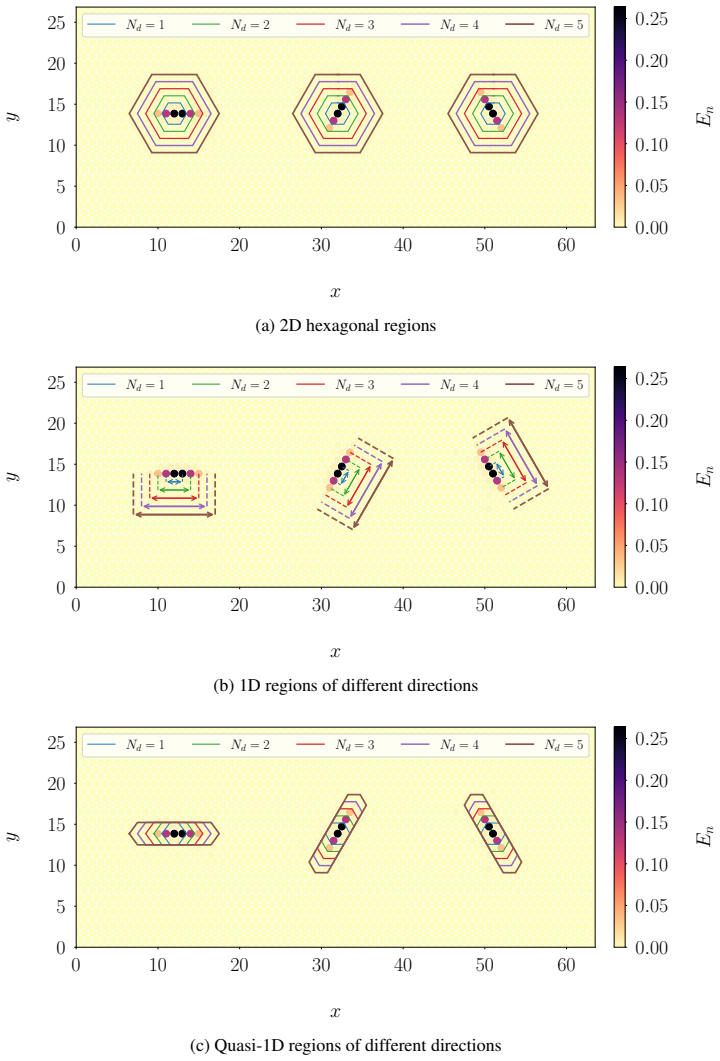
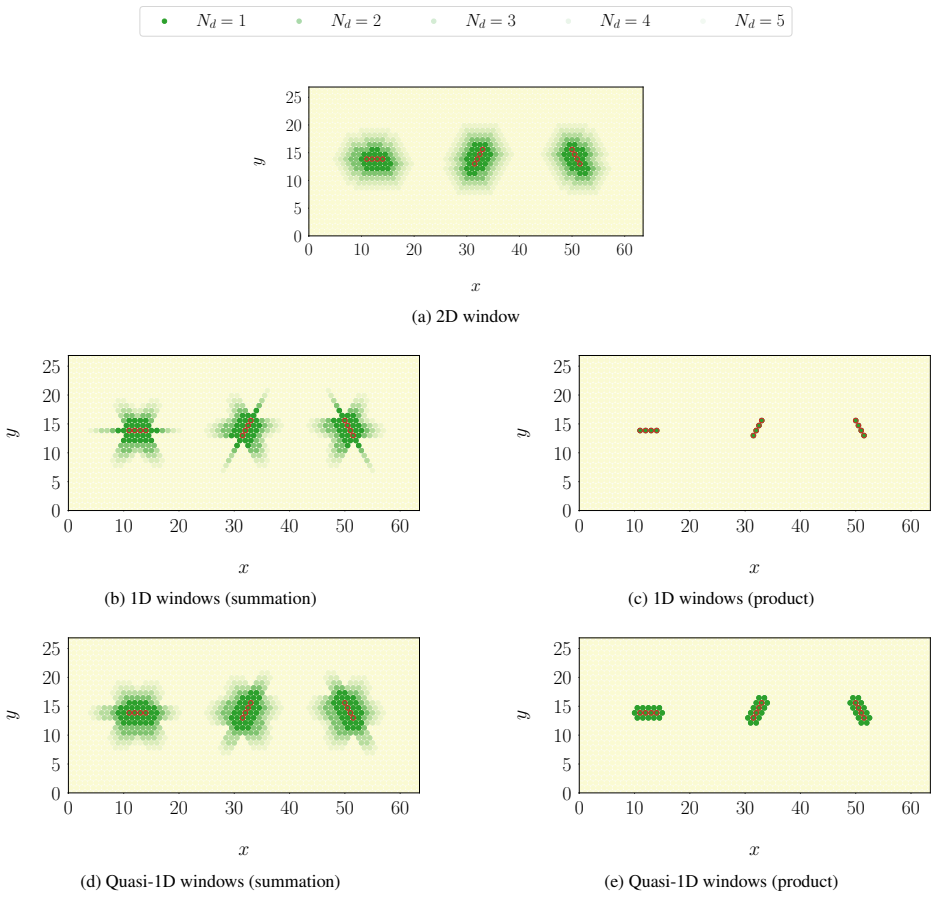
High-precision support vector machine classifiers, trained on principal-component-reduced wave data and combined with a sliding window, detect localization regions in two-dimensional hexagonal crystal lattice simulations. High-precision segmentation and directionality estimation algorithms are then applied inside those regions. Qualitatively better detection and estimation performance is obtained when the wave-data collection regions respect the quasi-one-dimensional nature of two-dimensional discrete breathers.
What carries the argument
Support vector machine classifiers trained on principal-component-reduced wave data sampled from quasi-one-dimensional lattice regions, applied through a sliding window for localization detection.
If this is right
- The classifiers combined with the sliding window locate both isolated localized waves and their collision zones.
- Directionality of the localized waves can be estimated inside each detected region with the proposed segmentation algorithms.
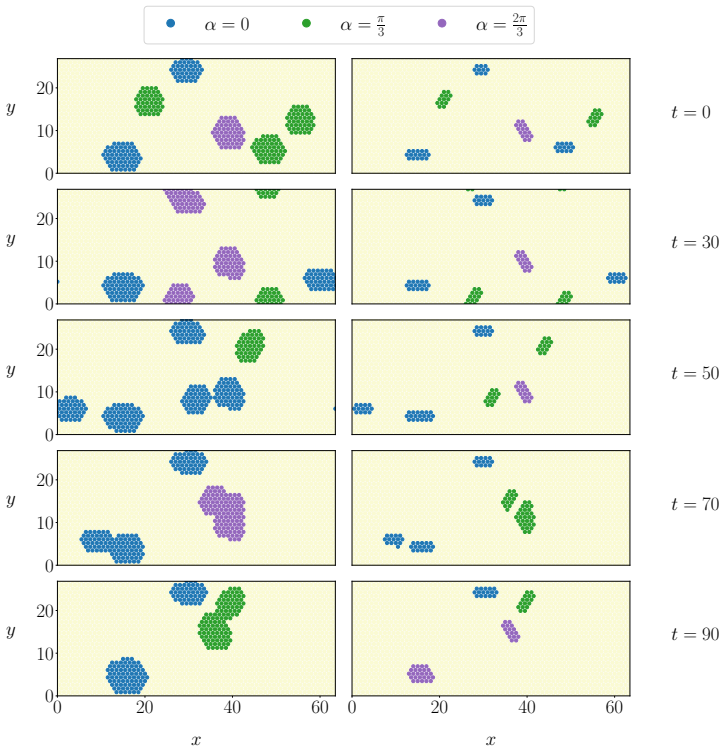
- The overall pipeline enables systematic numerical study of stationary and traveling two-dimensional discrete breather interactions.
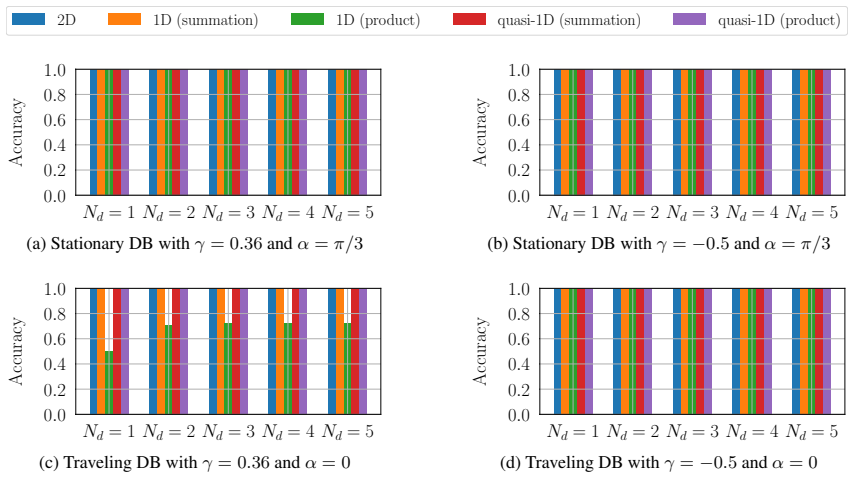
- Sampling wave data from quasi-one-dimensional rather than hexagonal regions yields measurably higher accuracy in both detection and directionality estimation.
Where Pith is reading between the lines
- The same sampling strategy could be tested on other two-dimensional lattices whose breathers also exhibit strong directional preference.
- If physical sensors can be placed along quasi-one-dimensional paths, the classifiers might transfer from simulation to laboratory measurements.
- Directionality estimates could be used to predict collision outcomes in multi-breather ensembles without solving the full lattice dynamics.
Load-bearing premise
The distinction between linear and nonlinear wave data learned from the chosen simulation datasets generalizes to reliably identify true discrete breather localization regions across varied lattice conditions and interaction scenarios.
What would settle it
Running the trained classifiers on new lattice simulations with different interaction potentials or initial conditions and finding that they systematically label known discrete breather sites as linear-wave regions would falsify the claim.
Figures
read the original abstract
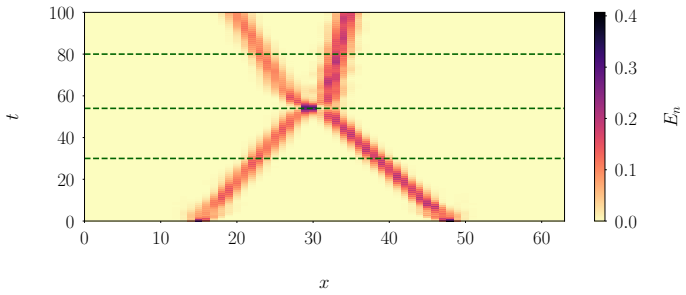
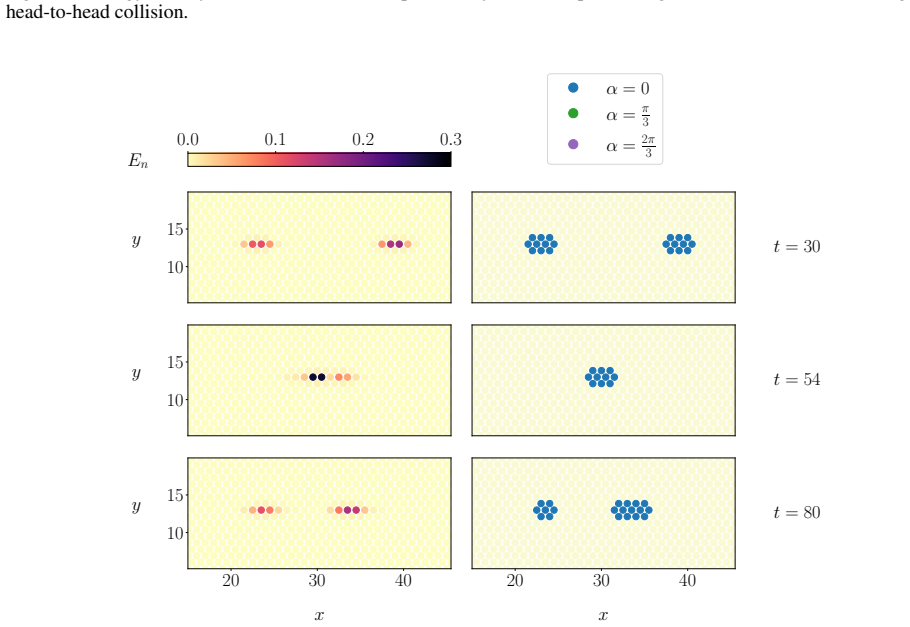
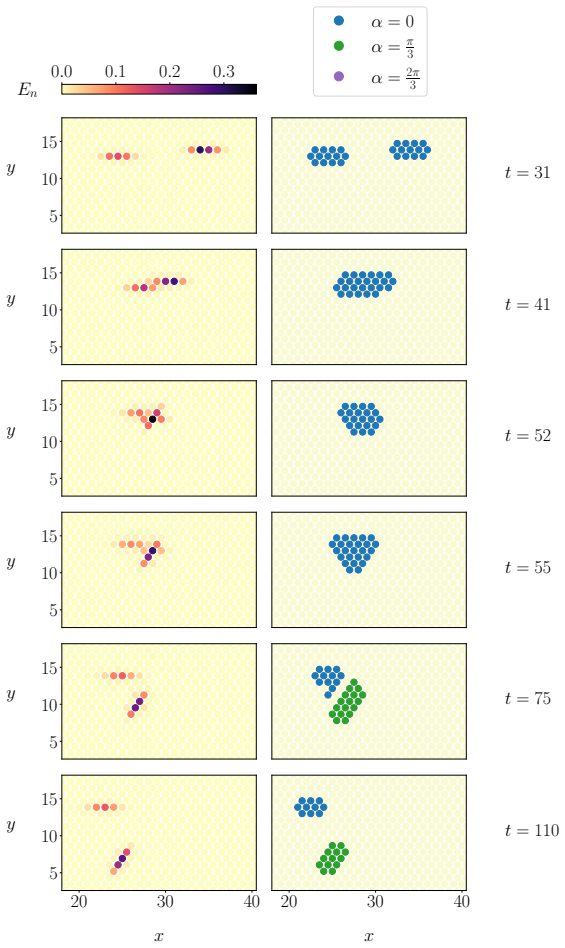
This work is devoted to data-driven identification of discrete breathers in numerical simulations of a two-dimensional crystal lattice using locally sampled wave data. Different lattice wave datasets are considered, with data collected from regions of different shapes and sizes defined by the lattice particles in mechanical equilibrium. Specifically, in addition to regions with a regular hexagonal shape, one- and quasi-one-dimensional regions reflecting the quasi-one-dimensionality of discrete breathers in two-dimensional hexagonal crystal lattices are proposed. To improve numerical efficiency, dataset dimensionality is reduced using Principal Component Analysis, and highly accurate Support Vector Machine classifiers are trained to distinguish between linear and nonlinear wave data. The obtained classifiers, together with the sliding window method, are applied to detect localization regions in two-dimensional hexagonal crystal lattice numerical simulations. High-precision algorithms for detected localization region segmentation and localized wave directionality estimation within the detected regions are further proposed, and their performance is evaluated. The presented methods are successfully applied to detect localized waves and their collision regions, as well as their directionality, performing a numerical study of stationary and traveling two-dimensional discrete breather interactions. Qualitatively better results are obtained when considering wave-data collection regions respecting the quasi-one-dimensional nature of two-dimensional discrete breathers in the hexagonal crystal lattice model.
Editorial analysis
A structured set of objections, weighed in public.
Referee Report
Summary. The paper develops a data-driven pipeline for identifying localization regions of discrete breathers in numerical simulations of a two-dimensional hexagonal crystal lattice. Wave data are collected from regions of varying shapes (regular hexagonal, one-dimensional, and quasi-one-dimensional), reduced via PCA, and used to train SVM classifiers that distinguish linear from nonlinear regimes. These classifiers are deployed with a sliding-window approach to detect localized regions in full simulations; additional algorithms are introduced for high-precision segmentation of detected regions and estimation of localized-wave directionality. The method is applied to stationary and traveling breather interactions and collisions, with the claim that quasi-one-dimensional collection regions yield qualitatively superior detection performance.
Significance. If the classifiers prove robust, the work supplies a practical, simulation-assisted tool for locating and characterizing discrete breathers without repeated full nonlinear integration. The explicit use of the quasi-one-dimensional character of breathers in the hexagonal lattice is a targeted modeling choice that could improve efficiency in related lattice studies. Reproducible application to both stationary and traveling cases, together with directionality estimation, adds concrete utility for analyzing breather collisions.
major comments (3)
- [Abstract and §3] Abstract and §3 (classification pipeline): the assertion of 'highly accurate' SVM classifiers and 'high-precision' segmentation/directionality algorithms is unsupported by any reported quantitative metrics (accuracy, precision-recall, confusion matrices, or error bars) or cross-validation procedure on held-out lattice parameters, breather amplitudes, or frequencies. This directly undermines the central claim that the sliding-window detector reliably identifies true localization regions.
- [§4] §4 (results on generalization): no held-out tests are described that vary spring constants, on-site potentials, or breather parameters outside the training set, nor is there comparison against ground-truth localization extracted directly from the governing ODEs. Without such checks the learned decision boundary cannot be assumed to remain reliable for the broader class of simulations invoked in the abstract.
- [§4] §4 (quasi-1D comparison): the statement that 'qualitatively better results' are obtained with quasi-one-dimensional regions lacks any quantitative metric (e.g., overlap with known breather support, false-positive rate, or directionality error) that would allow the reader to assess the claimed improvement over hexagonal regions.
minor comments (2)
- [§3] Notation for the sliding-window size and overlap parameters is introduced without an explicit equation or table; a compact definition would improve reproducibility.
- [Figures] Figure captions should state the lattice parameters, breather amplitude, and frequency used in each panel so that the visual results can be directly compared with the training conditions.
Simulated Author's Rebuttal
We thank the referee for their constructive feedback on our manuscript. We address each of the major comments below and will make the necessary revisions to strengthen the quantitative support for our claims.
read point-by-point responses
-
Referee: [Abstract and §3] Abstract and §3 (classification pipeline): the assertion of 'highly accurate' SVM classifiers and 'high-precision' segmentation/directionality algorithms is unsupported by any reported quantitative metrics (accuracy, precision-recall, confusion matrices, or error bars) or cross-validation procedure on held-out lattice parameters, breather amplitudes, or frequencies. This directly undermines the central claim that the sliding-window detector reliably identifies true localization regions.
Authors: We agree with this assessment. The current manuscript relies on qualitative descriptions without providing numerical performance metrics. In the revised version, we will include quantitative metrics such as classification accuracy, precision-recall curves, confusion matrices, and details of any cross-validation performed. We will also report error measures for the segmentation and directionality algorithms. revision: yes
-
Referee: [§4] §4 (results on generalization): no held-out tests are described that vary spring constants, on-site potentials, or breather parameters outside the training set, nor is there comparison against ground-truth localization extracted directly from the governing ODEs. Without such checks the learned decision boundary cannot be assumed to remain reliable for the broader class of simulations invoked in the abstract.
Authors: This is a valid concern. We will expand §4 to include held-out test results on simulations with varied spring constants, on-site potentials, and breather parameters not used in training. Where feasible, we will compare the detected localization regions against ground-truth information derived from the governing equations. revision: yes
-
Referee: [§4] §4 (quasi-1D comparison): the statement that 'qualitatively better results' are obtained with quasi-one-dimensional regions lacks any quantitative metric (e.g., overlap with known breather support, false-positive rate, or directionality error) that would allow the reader to assess the claimed improvement over hexagonal regions.
Authors: We concur that quantitative metrics are needed to substantiate the superiority of quasi-1D regions. The revised manuscript will incorporate quantitative comparisons, including measures of overlap with known breather support, false-positive rates, and directionality estimation errors for both region types. revision: yes
Circularity Check
No significant circularity; data-driven classification pipeline is self-contained
full rationale
The paper trains SVM classifiers on PCA-reduced wave data explicitly labeled as linear versus nonlinear from separate simulation runs, then applies the resulting decision boundary via sliding windows to label regions in other simulations. No quoted step equates a claimed prediction or detection output to a fitted parameter or self-citation by construction. The approach is an empirical supervised-learning pipeline whose central claim (successful detection on the chosen test simulations) rests on the external validity of the training labels rather than any definitional loop or renamed fit. No load-bearing uniqueness theorem, ansatz smuggling, or self-citation chain appears in the provided text.
Axiom & Free-Parameter Ledger
Reference graph
Works this paper leans on
-
[1]
F. J. Montáns, F. Chinesta, R. Gómez-Bombarelli, and J. N. Kutz. Data-driven modeling and learning in science and engineering.Comptes Rendus Mécanique, 347(11):845–855, 2019
2019
-
[2]
Baj ¯ars and F
J. Baj ¯ars and F. Kozirevs. Data-driven intrinsic localized mode detection and classification in one-dimensional crystal lattice model.Physics Letters A, 436:128071, 2022
2022
-
[3]
Dogkas, M
T. Dogkas, M. Eleftheriou, G. D. Barmparis, and G. P. Tsironis. Identifying discrete breathers using convolutional neural networks. InInternational Conference on Complex Systems and Applications Network Summer School, pages 213–220. Springer, 2022
2022
-
[4]
Tsironis
G. Tsironis. Discrete breathers. InArtificial Intelligence and Complex Dynamical Systems, pages 187–196. Springer Nature Switzerland, Cham, 2025
2025
-
[5]
Flach and A
S. Flach and A. V . Gorbach. Discrete breathers — Advances in theory and applications.Physics Reports, 467(1):1–116, 2008
2008
-
[6]
R. S. MacKay and S. Aubry. Proof of existence of breathers for time-reversible or Hamiltonian networks of weakly coupled oscillators.Nonlinearity, 7(6):1623, 1994
1994
-
[7]
S. Aubry. Discrete Breathers: Localization and transfer of energy in discrete Hamiltonian nonlinear systems. Physica D: Nonlinear Phenomena, 216(1):1–30, 2006
2006
-
[8]
Flach and K
S. Flach and K. Kladko. Moving discrete breathers?Physica D: Nonlinear Phenomena, 127(1):61–72, 1999
1999
-
[9]
Marín, J
J L. Marín, J. C. Eilbeck, and F. M. Russell. Localized moving breathers in a 2D hexagonal lattice.Phys. Lett. A, 248(2-4):225–229, 1998
1998
-
[10]
J. L. Marın, F. M. Russell, and J. C. Eilbeck. Breathers in cuprate-like lattices.Physics Letters A, 281(1):21–25, 2001
2001
-
[11]
Q. Dou, J. Cuevas, J. C. Eilbeck, and F. M. Russell. Breathers and kinks in a simulated crystal experiment. Discrete & Continuous Dynamical Systems-S, 4(5):1107–1118, 2011
2011
-
[12]
Bajars, J
J. Bajars, J. C. Eilbeck, and B. Leimkuhler. Nonlinear propagating localized modes in a 2D hexagonal crystal lattice.Physica D: Nonlinear Phenomena, 301:8–20, 2015
2015
-
[13]
Baj ¯ars, J
J. Baj ¯ars, J. C. Eilbeck, and B. Leimkuhler. Two-dimensional mobile breather scattering in a hexagonal crystal lattice.Physical Review E, 103(2):022212, 2021
2021
-
[14]
Duran, J
H. Duran, J. Cuevas-Maraver, P. G. Kevrekidis, and A. Vainchtein. Moving discrete breathers in aβ-FPU lattice revisited.Communications in Nonlinear Science and Numerical Simulation, 111:106435, 2022
2022
-
[15]
D. U. Abdullina, Y . V . Bebikhov, M. N. Semenova, and S. V . Dmitriev. Excitation of Moving Discrete Breathers in Squareβ-FPUT Lattice by External Driving.Physics of the Solid State, 67(11):977–982, 2025
2025
-
[16]
J. F. R. Archilla, J. Baj ¯ars, and S. Flach. Thermal lifetime of breathers.Physica D: Nonlinear Phenomena, 473:134551, 2025
2025
-
[17]
J. L. Marín and S. Aubry. Breathers in nonlinear lattices: Numerical calculation from the anticontinuous limit. Nonlinearity, 9:1501, 1996
1996
-
[18]
J. F. R. Archilla, Y . Doi, and M. Kimura. Pterobreathers in a model for a layered crystal with realistic potentials: Exact moving breathers in a moving frame.Phys. Rev. E, 100:022206, 2019
2019
-
[19]
Baj ¯ars and J
J. Baj ¯ars and J. F. R. Archilla. Frequency–momentum representation of moving breathers in a two dimensional hexagonal lattice.Physica D: Nonlinear Phenomena, 441:133497, 2022
2022
-
[20]
F. M. Russell, J. F. R. Archilla, F. Frutos, and S. Medina-Carrasco. Infinite charge mobility in muscovite at 300 K.Europhysics Letters, 120(4):46001, 2018
2018
-
[21]
F. M. Russell, M. W. Russell, and J. F. R. Archilla. Hyperconductivity in fluorphlogopite at 300 K and 1.1 T. Europhysics Letters, 127(1):16001, 2019
2019
-
[22]
F. M. Russell, J. F. R. Archilla, and S. Medina-Carrasco. Localized waves in silicates. What do we know from experiments? InChaotic Modeling and Simulation International Conference, pages 721–734. Springer, 2020. 18
2020
-
[23]
J. F. R. Archilla, N. Jiménez, V . J. Sánchez-Morcillo, and L. M. García-Raffi.Quodons in Mica: Nonlinear localized travelling excitations in crystals, volume 221. Springer, Switzerland, 2015
2015
-
[24]
M. I. Fakhretdinov and F. K. Zakir’yanov. Discrete breathers in the Peyrard-Bishop model of DNA.Technical Physics, 58(7):931–935, 2013
2013
-
[25]
C. L. Gninzanlong, F. T. Ndjomatchoua, and C. Tchawoua. Discrete breathers dynamic in a model for DNA chain with a finite stacking enthalpy.Chaos: An Interdisciplinary Journal of Nonlinear Science, 28(4):043105, 2018
2018
-
[26]
Nicolaï, P
A. Nicolaï, P. Delarue, and P. Senet. Intrinsic localized modes in proteins.Scientific Reports, 5(1):18128, 2015
2015
-
[27]
Piazza and Y .-H
F. Piazza and Y .-H. Sanejouand. Discrete breathers in protein structures.Physical biology, 5(2):026001, 2008
2008
-
[28]
J. J. Mazo and T. P. Orlando. Discrete breathers in Josephson arrays.Chaos: An Interdisciplinary Journal of Nonlinear Science, 13(2):733–743, 2003
2003
-
[29]
J. F. R. Archilla, J. Baj ¯ars, Y . Doi, and M. Kimura. A semiclassical model for charge transfer along ion chains in silicates.Journal of Physics: Conference Series, 2769(1):012015, 2024
2024
-
[30]
Kalosakas and S
G. Kalosakas and S. Aubry. Polarobreathers in a generalized Holstein model.Physica D: Nonlinear Phenomena, 113(2):228–232, 1998
1998
-
[31]
Cuevas, P
J. Cuevas, P. G. Kevrekidis, D. J. Frantzeskakis, and A. R. Bishop. Existence of bound states of a polaron with a breather in soft potentials.Phys. Rev. B, 74(6):064304, 2006
2006
-
[32]
O. G. Cantu Ros, L. Cruzeiro, M. G. Velarde, and W. Ebeling. On the possibility of electric transport mediated by long living intrinsic localized solectron modes.The European Physical Journal B, 80:545–554, 2011
2011
-
[33]
A. P. Chetverikov, W. Ebeling, and M. G. Velarde. Nonlinear soliton-like excitations in two-dimensional lattices and charge transport.Eur. Phys. J.-Spec. Top., 222(10):2531–2546, 2013
2013
-
[34]
J. F. R. Archilla and J. Baj ¯ars. Spectral properties of exact polarobreathers in semiclassical systems.Axioms, 12(5), 2023
2023
-
[35]
K. Hori. Wavelet analysis of anharmonic self-localized modes.Journal of the Physical Society of Japan, 62(6):1819–1822, 1993
1993
-
[36]
Forinash and W
K. Forinash and W. C. Lang. Frequency analysis of discrete breather modes using a continuous wavelet transform. Physica D: Nonlinear Phenomena, 123:437–447, 1998
1998
-
[37]
Rivière, S
A. Rivière, S. Lepri, D. Colognesi, and F. Piazza. Wavelet imaging of transient energy localization in nonlin- ear systems at thermal equilibrium: The case study of NaI crystals at high temperature.Physical Review B, 99:024307, 2019
2019
-
[38]
Yang, W.-S
Y . Yang, W.-S. Duan, L. Yang, J.-M. Chen, and M.-M. Lin. Rectification and phase locking in overdamped two-dimensional Frenkel-Kontorova model.Europhysics Letters, 93(1):16001, 2011
2011
-
[39]
J. B. Adams. Bonding energy models.Encyclopedia of materials: science and technology, pages 763–767, 2001
2001
-
[40]
Hairer, C
E. Hairer, C. Lubich, and G. Wanner. Geometric numerical integration illustrated by the Störmer–Verlet method. Acta numerica, 12:399–450, 2003
2003
-
[41]
C. R. Harris, K. J. Millman, S. J. van der Walt, R. Gommers, P. Virtanen, D. Cournapeau, E. Wieser, J. Taylor, S. Berg, N. J. Smith, R. Kern, M. Picus, S. Hoyer, M. H. van Kerkwijk, M. Brett, A. Haldane, J. Fernández del Río, M. Wiebe, P. Peterson, P. Gérard-Marchant, K. Sheppard, T. Reddy, W. Weckesser, H. Abbasi, C. Gohlke, and T.‘E. Oliphant. Array pro...
2020
-
[42]
Pedregosa, G
F. Pedregosa, G. Varoquaux, A. Gramfort, V . Michel, B. Thirion, O. Grisel, M. Blondel, P. Prettenhofer, R. Weiss, V . Dubourg, J. Vanderplas, A. Passos, D. Cournapeau, M. Brucher, M. Perrot, and E. Duchesnay. Scikit-learn: Machine learning in Python.Journal of Machine Learning Research, 12:2825–2830, 2011
2011
-
[43]
I. T. Jolliffe and J. Cadima. Principal component analysis: a review and recent developments.Philosophical transactions of the royal society A: Mathematical, Physical and Engineering Sciences, 374(2065):20150202, 2016
2065
-
[44]
Géron.Hands-On Machine Learning with Scikit-Learn, Keras, and TensorFlow: Concepts, Tools, and Tech- niques to Build Intelligent Systems
A. Géron.Hands-On Machine Learning with Scikit-Learn, Keras, and TensorFlow: Concepts, Tools, and Tech- niques to Build Intelligent Systems. O’Reilly Media, Inc., Sebastopol, 2019
2019
-
[45]
C. M. Bishop.Pattern recognition and machine learning. Springer, New York, 2006
2006
-
[46]
Chang and C.-J
C.-C. Chang and C.-J. Lin. LIBSVM: A library for support vector machines.ACM transactions on intelligent systems and technology (TIST), 2(3):1–27, 2011. 19
2011
discussion (0)
Sign in with ORCID, Apple, or X to comment. Anyone can read and Pith papers without signing in.