REVIEW 3 major objections 4 minor 60 references
GRACE: Estimating Geometry-level 3D Human-Scene Contact from 2D Images
T0 review · 3 major / 4 minor · reviewed 2026-08-15 · deepseek-v4-flash
Pith's one-line read GRACE claims that dense 3D human-scene contact can be estimated on arbitrary human point clouds by learning an implicit mapping from geometric features to per-vertex contact probabilities, instead of relying on fixed SMPL vertex sequences.
desk verdict A genuinely new point-cloud-native contact estimation architecture with solid benchmark gains, but the paper's headline generalization claim rests on a qualitative figure, and its new Geo.sum metric is undefined in the main text—worth reviewing, needs revision. read the letter →
The pith
A machine-rendered reading of the paper's core claim, the machinery that carries it, and where it could break.
The reading
What carries the argument
The load-bearing object is a point cloud encoder-decoder with hierarchical cross-modal fusion. A point cloud encoder produces raw geometric features from the unordered human body, an image encoder produces local and contextual image features, and a Hierarchical Feature Extraction Module projects both modalities into a shared 24-part semantic space while also producing global context vectors. A Multi-level Feature Fusion Module uses vertex-level and part-level cross-attention to let each 3D point query image evidence, concatenates the global features as an overarching scene constraint, and a symmetric point cloud decoder regresses a per-vertex contact probability without any predefined mesh topology or vertex order. The training objective combines focal loss and Dice loss for sparse contact regions with a part-segmentation loss, and the paper introduces a Total Geometric Error metric that accounts for false-positive and false-negative geometric error.
What would settle it
Build a test set of non-SMPL human point clouds, such as meshes from a generic 3D reconstruction pipeline or scans with missing limbs, paired with ground-truth contact annotations, then run the trained GRACE model and compute F1 and total geometric error. If performance drops to the level of sequence-based baselines rather than staying near the SMPL results, the geometric generalization claim fails.
Extended reading notes
Core claim
The paper establishes that sequence-free contact prediction is possible and useful. Existing methods map image features to an ordered sequence of SMPL vertices, so any change in vertex indexing breaks the correspondence. GRACE instead takes the human point cloud as an unordered geometric input, extracts hierarchical local and global features from both image and point cloud, fuses them with cross-attention, and decodes a dense per-vertex contact probability. As a result, the same trained model handles canonical SMPL meshes, permuted vertex orders, and point clouds without SMPL topology; benchmarks show the best F1 among compared methods on all four datasets, and a large reduction in the proposed total geometric error metric. The paper also reports that using GRACE-predicted contacts in place of manually annotated ones improves human pose and shape optimization on PROX.
Load-bearing premise
The training data and part segmentation come entirely from SMPL meshes, so the central claim assumes that a mapping learned on SMPL vertices transfers to point clouds with different topology, density, and missing parts; the paper demonstrates this only qualitatively and concedes degraded inference on point clouds that differ strongly from parametric human models.
Editorial extensions
If this is right
- Contact prediction can be applied directly to reconstructed human meshes and scans, since no fixed vertex indexing is required.
- The model remains accurate when the input point cloud's vertex order is randomly permuted, so it can consume point clouds with arbitrary sampling and resolution.
- Predicted dense contacts can replace manually annotated contacts in optimization-based human pose and shape fitting, reducing vertex-to-vertex error on PROX.
- A different human point cloud representation can be fed in at inference time without retraining on that representation.
- The total geometric error metric penalizes missed contacts as well as false alarms, giving a fuller account of contact quality than previous geometric error.
Reading between the lines
- If the implicit mapping transfers as claimed, contact supervision could be collected on arbitrary body scans or reconstructions, removing the current dependence on SMPL-family training data.
- The permutation robustness suggests the learned function behaves like a point-order-equivariant map, so an explicitly equivariant architecture might push generalization further and reduce sensitivity to density changes.
- A quantitative evaluation on non-SMPL point clouds with ground-truth contact labels would settle the generalization claim; the paper currently provides only qualitative support.
- The precision drop on the multi-object 3DIR dataset suggests an object-aware variant could extend the method to simultaneous contacts with several scene objects.
Signed reviews
Editorial analysis
A structured set of objections, weighed in public.
Referee Report
Summary. The paper proposes GRACE, a point-cloud encoder-decoder architecture with hierarchical image-point feature fusion that regresses dense per-vertex contact probabilities on a 3D human point cloud from a single RGB image. By replacing fixed SMPL vertex-sequence mappings with an implicit geometric-feature-to-contact mapping, the authors claim a new paradigm that generalizes to unstructured, non-SMPL human point clouds. Training uses SMPL-generated point clouds and SMPL-rendered part masks; experiments are reported on RICH, DAMON, BEHAVE, and 3DIR, with F1 and a newly proposed Geo.sum metric, plus auxiliary experiments on HPS refinement and vertex-order shuffling.
Significance. If substantiated, GRACE would be a genuinely different mechanism for dense human-scene contact estimation, avoiding the fixed-topology limitation of SMPL-sequence baselines, and the vertex-order permutation experiment provides a clean demonstration of permutation invariance. The reported quantitative gains on RICH and DAMON are consistent across F1 and Geo.sum, and the downstream HPS experiment shows that the predicted contacts can be used in optimization. However, the central claim of generalization to arbitrary or unstructured point clouds is currently supported only by a qualitative figure, and the paper's headline geometric metric is not defined in the text, so the significance of the quantitative results is conditional on missing evidence.
major comments (3)
- [Section 4.1, Evaluation Metrics] The new metric Geo.sum is not defined. The sentence 'This metric accounts for both false positive and false negative geometric errors' does not specify how the false-positive and false-negative geometric errors are measured, how the two terms are combined, or how the contact threshold is set. Because the paper's headline improvements include large Geo.sum reductions (Table 1: 19.2 vs 46.2 on RICH; Table 2: 24.5 vs 41.2 on 3DIR), the central numerical claims cannot be independently checked. Please provide the exact formula, units, threshold, and combination rule in the main text or in an included appendix.
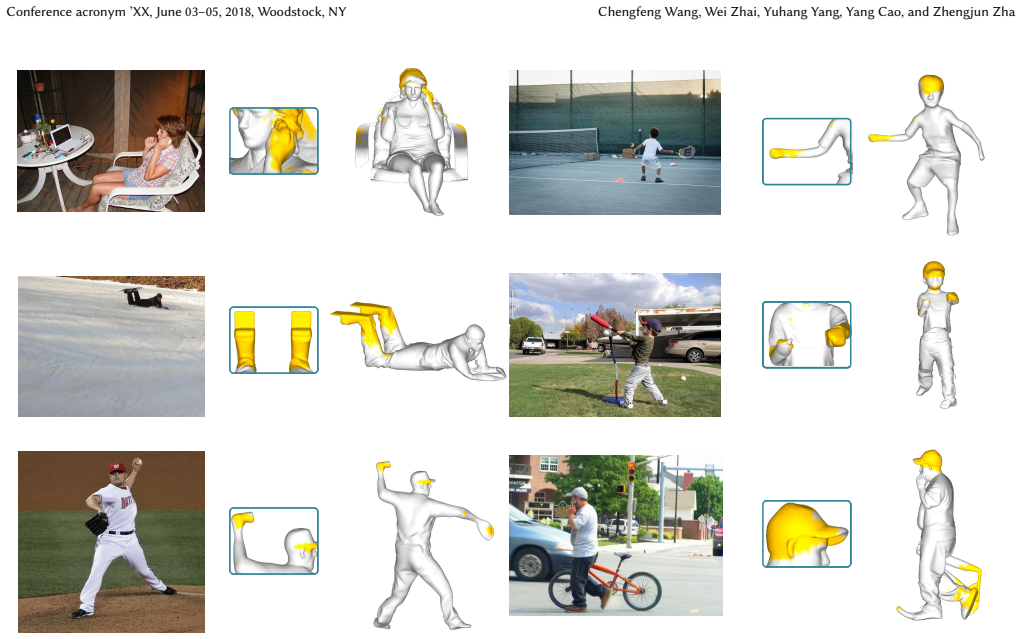
- [Section 4.4 and Limitations] The central claim of generalization to 'arbitrary' or 'unstructured' human point clouds is supported only by the qualitative visualization on Hunyuan 3D point clouds (Fig. 6), which has no contact ground truth, no evaluation metric, and no baseline comparison. The shuffling experiment (Fig. 7) varies only vertex order of an SMPL mesh, not density, topology, or spatial coverage, so it demonstrates permutation invariance rather than generalization to non-SMPL geometry. The Limitations paragraph states that 'current training is limited to SMPL-family datasets... resulting in reduced inference capability for point clouds significantly deviating from parametric human models,' which directly narrows the abstract's claim of 'strong generalization capability across diverse human geometries.' A quantitative out-of-distribution evaluation, for example on non-SMPL scans with manual contact labels or a controlled deformation benchmark, is needed to support the main advantage over sequence-based methods.
- [Section 4.2, Tables 1-2] The paper does not state what point cloud input GRACE receives at test time on RICH, DAMON, BEHAVE, and 3DIR. The table separately lists POSAGT for ground-truth bodies, but not for the 'Ours' row. If GRACE evaluates on ground-truth SMPL meshes while BSTRO and DECO receive estimated bodies, the F1 and Geo.sum gains could reflect input quality rather than architectural superiority. Please specify the body source for each dataset and add an 'Ours' variant that uses the same estimated bodies as the baselines to ensure a fair comparison.
minor comments (4)
- [Section 3.2, Eq. (2)] The image feature notation is inconsistent: the text lists F_i and F_p as outputs of the two HRNet encoders, but Eq. (2) and the surrounding text use F_p for the projected image feature and F_i for the scene-interaction feature. Please define all symbols in one consistent notation block.
- [Figure 2] Symbols Θ1/2 and F_g appear in the figure before they are formally introduced in Section 3.3. A short caption pointer to the equations would improve readability.
- [Table 3] The variant '✗ L_c' is described in the text as replacing the combined Focal + Dice loss with BCE loss, but the table caption labels it only as 'combination loss (L_c)' with ✗ meaning without. Please make the caption and row label consistent so the loss ablation is unambiguous.
- [Section 4.2, Table 2] The explanation for the small 3DIR F1 gain (0.63 vs 0.62 over DECO) is plausible but post hoc. A per-category breakdown by number of interacting objects, or an analysis of precision/recall on single-object vs multi-object scenes, would strengthen the claim that the lower precision is due to multi-object contact predictions.
Circularity Check
No circularity: GRACE's contact predictions are trained and evaluated against external ground-truth labels on held-out benchmarks, and no fitted parameter is recycled as a prediction.
full rationale
The paper's derivation chain is self-contained against external benchmarks. Training uses SMPL point clouds with external ground-truth contact labels from RICH, DAMON, BEHAVE and 3DIR, and evaluation is performed on the corresponding held-out test sets: 'For each dataset, we train our model independently on the training set and evaluate it on the corresponding test set.' The central prediction—dense per-vertex contact probabilities—is regressed from image and point-cloud features and compared with ground-truth contact, so no fitted parameter is renamed as a prediction. The newly proposed Geo.sum metric is a definitional evaluation proposal, not a fitted quantity, and it is reported alongside standard precision/recall/F1. The paper's generalization claim to non-SMPL point clouds is supported only qualitatively in Fig. 6, and the Limitations paragraph concedes 'reduced inference capability for point clouds significantly deviating from parametric human models'; this is an empirical support gap, not circularity. Self-citations to LEMON and IAG appear only as related-work context and are not load-bearing for GRACE's architecture or results. No equation reduces to its own input, and no uniqueness theorem or ansatz is imported from the authors' prior work. Thus the appropriate finding is no significant circularity.
Assumptions & free parameters
free parameters (2)
- loss weights ω1, ω2 =
unspecified
- body part count J =
24
assumptions (3)
- domain assumption A ground-truth 3D human point cloud is available at inference time
- domain assumption SMPL-derived part segmentation transfers to arbitrary point clouds
- standard math Standard deep learning components (attention, PointNeXt, HRNet) are taken as given
Cite this review
Pith. "Pith review of GRACE: Estimating Geometry-level 3D Human-Scene Contact from 2D Images." pith.science (2026). https://pith.science/paper/NKGS2YRG
@misc{pith2026250506575,
  author       = {Pith},
  title        = {Pith review of: GRACE: Estimating Geometry-level 3D Human-Scene Contact from 2D Images},
  year         = {2026},
  howpublished = {\url{https://pith.science/paper/NKGS2YRG}},
  note         = {Machine review of arXiv:2505.06575}
}
read the original abstract
Estimating the geometry level of human-scene contact aims to ground specific contact surface points at 3D human geometries, which provides a spatial prior and bridges the interaction between human and scene, supporting applications such as human behavior analysis, embodied AI, and AR/VR. To complete the task, existing approaches predominantly rely on parametric human models (e.g., SMPL), which establish correspondences between images and contact regions through fixed SMPL vertex sequences. This actually completes the mapping from image features to an ordered sequence. However, this approach lacks consideration of geometry, limiting its generalizability in distinct human geometries. In this paper, we introduce GRACE (Geometry-level Reasoning for 3D Human-scene Contact Estimation), a new paradigm for 3D human contact estimation. GRACE incorporates a point cloud encoder-decoder architecture along with a hierarchical feature extraction and fusion module, enabling the effective integration of 3D human geometric structures with 2D interaction semantics derived from images. Guided by visual cues, GRACE establishes an implicit mapping from geometric features to the vertex space of the 3D human mesh, thereby achieving accurate modeling of contact regions. This design ensures high prediction accuracy and endows the framework with strong generalization capability across diverse human geometries. Extensive experiments on multiple benchmark datasets demonstrate that GRACE achieves state-of-the-art performance in contact estimation, with additional results further validating its robust generalization to unstructured human point clouds.
Figures


Figures from the paper (4 more)



Reference graph
Works this paper leans on
-
[1]
Deep contextual attention for human-object interaction detection
2019. Deep contextual attention for human-object interaction detection. In Proceedings - 2019 International Conference on Computer Vision, ICCV 2019 (Proceedings of the IEEE International Conference on Computer Vision) . Insti- tute of Electrical and Electronics Engineers Inc., United States, 5693–5701. doi:10.1109/ICCV.2019.00579
-
[2]
Bharat Lal Bhatnagar, Xianghui Xie, Ilya Petrov, Cristian Sminchisescu, Christian Theobalt, and Gerard Pons-Moll. 2022. BEHAVE: Dataset and Method for Tracking Human Object Interactions. In IEEE Conference on Computer Vision and Pattern Recognition (CVPR). IEEE
work page 2022
- [3]
-
[4]
Zhe Cao, Ilija Radosavovic, Angjoo Kanazawa, and Jitendra Malik. 2020. Re- constructing Hand-Object Interactions in the Wild. 2021 IEEE/CVF Interna- tional Conference on Computer Vision (ICCV) (2020), 12397–12406. https: //api.semanticscholar.org/CorpusID:229297750
work page 2020
-
[5]
Angel X Chang, Thomas Funkhouser, Leonidas Guibas, Pat Hanrahan, Qixing Huang, Zimo Li, Silvio Savarese, Manolis Savva, Shuran Song, Hao Su, et al
-
[6]
Yixin Chen, Sai Kumar Dwivedi, Michael J. Black, and Dimitrios Tzionas. 2023. Detecting Human-Object Contact in Images. In Proceedings of the IEEE/CVF Conference on Computer Vision and Pattern Recognition (CVPR) . https://hot.is.tue. mpg.de
work page 2023
-
[7]
Kun-Hung Cheng and Chin-Chung Tsai. 2013. Affordances of augmented reality in science learning: Suggestions for future research. Journal of science education and technology 22 (2013), 449–462
work page 2013
-
[8]
Jia Deng, Wei Dong, Richard Socher, Li-Jia Li, Kai Li, and Li Fei-Fei. 2009. Imagenet: A large-scale hierarchical image database. In 2009 IEEE conference on computer vision and pattern recognition . Ieee, 248–255
2009
Show all 60 references
-
[9]
Jacob Devlin, Ming-Wei Chang, Kenton Lee, and Kristina Toutanova. 2019. BERT: Pre-training of Deep Bidirectional Transformers for Language Understanding. In Proceedings of the 2019 Conference of the North American Chapter of the Association for Computational Linguistics: Human...
2019
-
[10]
Yao Feng, Vasileios Choutas, Timo Bolkart, Dimitrios Tzionas, and Michael J Black. 2021. Collaborative regression of expressive bodies using moderation. In 2021 International Conference on 3D Vision (3DV) . IEEE, 792–804
2021
-
[11]
Yao Feng, Vasileios Choutas, Timo Bolkart, Dimitrios Tzionas, and Michael J. Black. 2021. Collaborative Regression of Expressive Bodies using Moderation. In International Conference on 3D Vision (3DV)
2021
-
[12]
Mihai Fieraru, Mihai Zanfir, Elisabeta Oneata, Alin-Ionut Popa, Vlad Olaru, and Cristian Sminchisescu. 2021. Learning complex 3d human self-contact. In Pro- ceedings of the AAAI Conference on Artificial Intelligence , Vol. 35. 1343–1351
2021
-
[13]
Mihai Fieraru, Mihai Zanfir, Teodor Szente, Eduard Bazavan, Vlad Olaru, and Cristian Sminchisescu. 2021. REMIPS: Physically Consistent 3D Re- construction of Multiple Interacting People under Weak Supervision. In Ad- vances in Neural Information Processing Systems , M. Ranzato...
2021
-
[14]
Twigg, Minh Vo, Samarth Brahmbhatt, and Charles C
Patrick Grady, Chengcheng Tang, Christopher D. Twigg, Minh Vo, Samarth Brahmbhatt, and Charles C. Kemp. 2021. ContactOpt: Optimizing Contact to Im- prove Grasps. In Conference on Computer Vision and Pattern Recognition (CVPR)
2021
-
[15]
Mohamed Hassan, Vasileios Choutas, Dimitrios Tzionas, and Michael J. Black
-
[16]
Mohamed Hassan, Partha Ghosh, Joachim Tesch, Dimitrios Tzionas, and Michael J. Black. 2021. Populating 3D Scenes by Learning Human-Scene Interaction. In Proceedings IEEE/CVF Conf. on Computer Vision and Pattern Recognition (CVPR)
2021
-
[17]
Black, Ivan Laptev, and Cordelia Schmid
Yana Hasson, Gül Varol, Dimitris Tzionas, Igor Kalevatykh, Michael J. Black, Ivan Laptev, and Cordelia Schmid. 2019. Learning joint reconstruction of hands and manipulated objects. In CVPR
2019
-
[18]
Huang, Hongwei Yi, Markus Höschle, Matvey Safroshkin, Tsvetelina Alexiadis, Senya Polikovsky, Daniel Scharstein, and Michael J
Chun-Hao P. Huang, Hongwei Yi, Markus Höschle, Matvey Safroshkin, Tsvetelina Alexiadis, Senya Polikovsky, Daniel Scharstein, and Michael J. Black. 2022. Cap- turing and Inferring Dense Full-Body Human-Scene Contact. In Proceedings IEEE/CVF Conf. on Computer Vision and Pattern ...
2022
-
[19]
Siyuan Huang, Zan Wang, Puhao Li, Baoxiong Jia, Tengyu Liu, Yixin Zhu, Wei Liang, and Song-Chun Zhu. 2023. Diffusion-based Generation, Optimization, and Planning in 3D Scenes. arXiv preprint arXiv:2301.06015 (2023)
2023 arXiv
-
[20]
Black, and Dimitrios Tzionas
Yinghao Huang, Omid Taheri, Michael J. Black, and Dimitrios Tzionas. 2022. InterCap: Joint Markerless 3D Tracking of Humans and Objects in Interaction. In German Conference on Pattern Recognition (GCPR) (Lecture Notes in Computer Science, Vol. 13485). Springer, 281–299
2022
-
[21]
Bumsoo Kim, Junhyun Lee, Jaewoo Kang, Eun-Sol Kim, and Hyunwoo J. Kim
-
[22]
Huang, Otmar Hilliges, and Michael J
Muhammed Kocabas, Chun-Hao P. Huang, Otmar Hilliges, and Michael J. Black
-
[23]
Nilesh Kulkarni, Davis Rempe, Kyle Genova, Abhijit Kundu, Justin Johnson, David Fouhey, and Leonidas Guibas. 2024. Nifty: Neural object interaction fields for guided human motion synthesis. In Proceedings of the IEEE/CVF Conference on Computer Vision and Pattern Recognition . 947–957
2024
-
[24]
Girshick, Kaiming He, and Piotr Dollár
Tsung-Yi Lin, Priya Goyal, Ross B. Girshick, Kaiming He, and Piotr Dollár. 2017. Focal Loss for Dense Object Detection.2017 IEEE International Conference on Com- puter Vision (ICCV) (2017), 2999–3007. http://openaccess.thecvf.com/content_ ICCV_2017/papers/Lin_Focal_Loss_for_IC...
2017
-
[25]
Matthew Loper, Naureen Mahmood, Javier Romero, Gerard Pons-Moll, and Michael J. Black. 2015. SMPL: A Skinned Multi-Person Linear Model. ACM Trans. Graphics (Proc. SIGGRAPH Asia) 34, 6 (Oct. 2015), 248:1–248:16
2015
-
[26]
PARE: Part Attention Regressor for 3D Human Body Estimation. In Proc. International Conference on Computer Vision (ICCV) . 11127–11137
-
[27]
Fausto Milletari, Nassir Navab, and Seyed-Ahmad Ahmadi. 2016. V-net: Fully convolutional neural networks for volumetric medical image segmentation. In 2016 fourth international conference on 3D vision (3DV) . IEEE, 565–571
2016
-
[28]
Lea Müller, Ahmed A. A. Osman, Siyu Tang, Chun-Hao P. Huang, and Michael J. Black. 2021. On Self-Contact and Human Pose. In Proceedings IEEE/CVF Conf. on Computer Vision and Pattern Recogßnition (CVPR)
2021
-
[29]
Hyeongjin Nam, Daniel Sungho Jung, Gyeongsik Moon, and Kyoung Mu Lee. 2024. Joint Reconstruction of 3D Human and Object via Contact-Based Refinement Transformer. In Proceedings of the IEEE/CVF Conference on Computer Vision and Pattern Recognition
2024
-
[30]
Priyanka Mandikal and Kristen Grauman. 2021. Learning Dexterous Grasping with Object-Centric Visual Affordances. In IEEE International Conference on Robotics and Automation (ICRA)
2021
-
[31]
Siyuan Qi, Wenguan Wang, Baoxiong Jia, Jianbing Shen, and Song-Chun Zhu
-
[32]
Guocheng Qian, Yuchen Li, Houwen Peng, Jinjie Mai, Hasan Hammoud, Mo- hamed Elhoseiny, and Bernard Ghanem. 2022. PointNeXt: Revisiting PointNet++ with Improved Training and Scaling Strategies. InAdvances in Neural Information Processing Systems (NeurIPS)
2022
-
[33]
Davis Rempe, Tolga Birdal, Aaron Hertzmann, Jimei Yang, Srinath Sridhar, and Leonidas J. Guibas. 2021. HuMoR: 3D Human Motion Model for Robust Pose Estimation. In International Conference on Computer Vision (ICCV)
2021
-
[34]
Georgios Pavlakos, Vasileios Choutas, Nima Ghorbani, Timo Bolkart, Ahmed A. A. Osman, Dimitrios Tzionas, and Michael J. Black. 2019. Expressive Body Capture: 3D Hands, Face, and Body from a Single Image. In Proceedings IEEE Conf. on Computer Vision and Pattern Recognition (CVPR)
2019
-
[35]
Javier Romero, Dimitrios Tzionas, and Michael J. Black. 2017. Embodied Hands: Modeling and Capturing Hands and Bodies Together. ACM Transactions on Graphics, (Proc. SIGGRAPH Asia) 36, 6 (Nov. 2017)
2017
-
[36]
Soshi Shimada, Vladislav Golyanik, Weipeng Xu, and Christian Theobalt. 2020. PhysCap: Physically Plausible Monocular 3D Motion Capture in Real Time. ACM Transactions on Graphics 39, 6, Article 235 (dec 2020)
2020
-
[37]
Ke Sun, Bin Xiao, Dong Liu, and Jingdong Wang. 2019. Deep High-Resolution Representation Learning for Human Pose Estimation. In CVPR
2019
-
[38]
Black, and Dimitrios Tzionas
Omid Taheri, Vasileios Choutas, Michael J. Black, and Dimitrios Tzionas. 2022. GOAL: Generating 4D Whole-Body Motion for Hand-Object Grasping. In Con- ference on Computer Vision and Pattern Recognition (CVPR) . https://goal.is.tue. Conference acronym ’XX, June 03–05, 2018, Woo...
2022
-
[39]
Guibas, Aaron Hertzmann, Bryan Russell, Ruben Ville- gas, and Jimei Yang
Davis Rempe, Leonidas J. Guibas, Aaron Hertzmann, Bryan Russell, Ruben Ville- gas, and Jimei Yang. 2020. Contact and Human Dynamics from Monocular Video. In Proceedings of the European Conference on Computer Vision (ECCV)
2020
-
[40]
Shashank Tripathi, Agniv Chatterjee, Jean-Claude Passy, Hongwei Yi, Dimitrios Tzionas, and Michael J. Black. 2023. DECO: Dense Estimation of 3D Human-Scene Contact In The Wild. In Proceedings of the IEEE/CVF International Conference on Computer Vision (ICCV). 8001–8013
2023
-
[41]
Ashish Vaswani, Noam Shazeer, Niki Parmar, Jakob Uszkoreit, Llion Jones, Aidan N Gomez, Ł ukasz Kaiser, and Illia Polosukhin. 2017. Attention is All you Need. In Advances in Neural Information Processing Systems , I. Guyon, U. Von Luxburg, S. Bengio, H. Wallach, R. Fergus, S. ...
2017
-
[42]
Xianghui Xie, Bharat Lal Bhatnagar, and Gerard Pons-Moll. 2022. CHORE: Contact, Human and Object REconstruction from a single RGB image. InEuropean Conference on Computer Vision (ECCV) . Springer
2022
-
[43]
Kankanhalli
Bingjie Xu, Yongkang Wong, Junnan Li, Qi Zhao, and Mohan S. Kankanhalli
-
[44]
Tencent Hunyuan3D Team. 2025. Hunyuan3D 2.0: Scaling Diffusion Models for High Resolution Textured 3D Assets Generation. arXiv:2501.12202 [cs.CV]
2025 arXiv
-
[45]
Xiang Xu, Hanbyul Joo, Greg Mori, and Manolis Savva. 2021. D3d-hoi: Dynamic 3d human-object interactions from videos.arXiv preprint arXiv:2108.08420 (2021)
2021 arXiv
-
[46]
Yamamoto and K
M. Yamamoto and K. Yagishita. 2000. Scene constraints-aided tracking of human body. In Proceedings IEEE Conference on Computer Vision and Pattern Recognition. CVPR 2000 (Cat. No.PR00662), Vol. 1. 151–156 vol.1. doi:10.1109/CVPR.2000.855813
2000
-
[47]
Yuhang Yang, Wei Zhai, Hongchen Luo, Yang Cao, Jiebo Luo, and Zheng-Jun Zha. 2023. Grounding 3D Object Affordance from 2D Interactions in Images. In Proceedings of the IEEE/CVF International Conference on Computer Vision (ICCV) . 10905–10915
2023
-
[48]
Yuhang Yang, Wei Zhai, Hongchen Luo, Yang Cao, and Zheng-Jun Zha. 2023. LEMON: Learning 3D Human-Object Interaction Relation from 2D Images. arXiv preprint arXiv:2312.08963 (2023)
2023 arXiv
-
[49]
In 2019 IEEE/CVF Conference on Computer Vision and Pattern Recognition (CVPR)
Learning to Detect Human-Object Interactions With Knowledge. In 2019 IEEE/CVF Conference on Computer Vision and Pattern Recognition (CVPR) . 2019–
2019
-
[50]
Zhao-Heng Yin, Binghao Huang, Yuzhe Qin, Qifeng Chen, and Xiaolong Wang
-
[51]
Sirui Xu, Zhengyuan Li, Yu-Xiong Wang, and Liang-Yan Gui. 2023. Interdiff: Generating 3d human-object interactions with physics-informed diffusion. In Proceedings of the IEEE/CVF International Conference on Computer Vision . 14928– 14940
2023
-
[52]
Cheng Zou, Bohan Wang, Yue Hu, Junqi Liu, Qian Wu, Yu Zhao, Boxun Li, Chenguang Zhang, Chi Zhang, Yichen Wei, and Jian Sun. 2021. End-to-End Human Object Interaction Detection with HOI Transformer. In CVPR
2021
-
[56]
Huang, Shashank Tripathi, Lea Hering, Justus Thies, and Michael J
Hongwei Yi, Chun-Hao P. Huang, Shashank Tripathi, Lea Hering, Justus Thies, and Michael J. Black. 2023. MIME: Human-Aware 3D Scene Generation. In IEEE Conference on Computer Vision and Pattern Recognition (CVPR)
2023
-
[59]
Siwei Zhang, Yan Zhang, Federica Bogo, Pollefeys Marc, and Siyu Tang. 2021. Learning Motion Priors for 4D Human Body Capture in 3D Scenes. InInternational Conference on Computer Vision (ICCV)
2021
-
[2015]
arXiv preprint arXiv:1512.03012 (2015)
Shapenet: An information-rich 3d model repository. arXiv preprint arXiv:1512.03012 (2015)
2015 arXiv
-
[2018]
In European Conference on Computer Vision
Learning Human-Object Interactions by Graph Parsing Neural Networks. In European Conference on Computer Vision . https://api.semanticscholar.org/ CorpusID:51992868
-
[2019]
In International Conference on Computer Vision
Resolving 3D Human Pose Ambiguities with 3D Scene Constraints. In International Conference on Computer Vision . 2282–2292. https://prox.is.tue.mpg. de
-
[2021]
HOTR: End-to-End Human-Object Interaction Detection with Transformers. In CVPR. IEEE
-
[2023]
arXiv:2303.10880 [cs.RO] https://arxiv.org/abs/2303.10880
Rotating without Seeing: Towards In-hand Dexterity through Touch. arXiv:2303.10880 [cs.RO] https://arxiv.org/abs/2303.10880
-
[2028]
doi:10.1109/CVPR.2019.00212
2019
Reviewed August 15, 2026 · model on record in the stance chip above.
Discussion (0). Continue with ORCID to comment.