Simulation-Based Prediction of Black Hole Fe Kα Line Profiles
Pith reviewed 2026-05-21 01:22 UTC · model grok-4.3
The pith
Most Fe Kα line flux comes from radii beyond 10 gravitational radii because the inner disk is fully ionized
A machine-rendered reading of the paper's core claim, the machinery that carries it, and where it could break.
Core claim
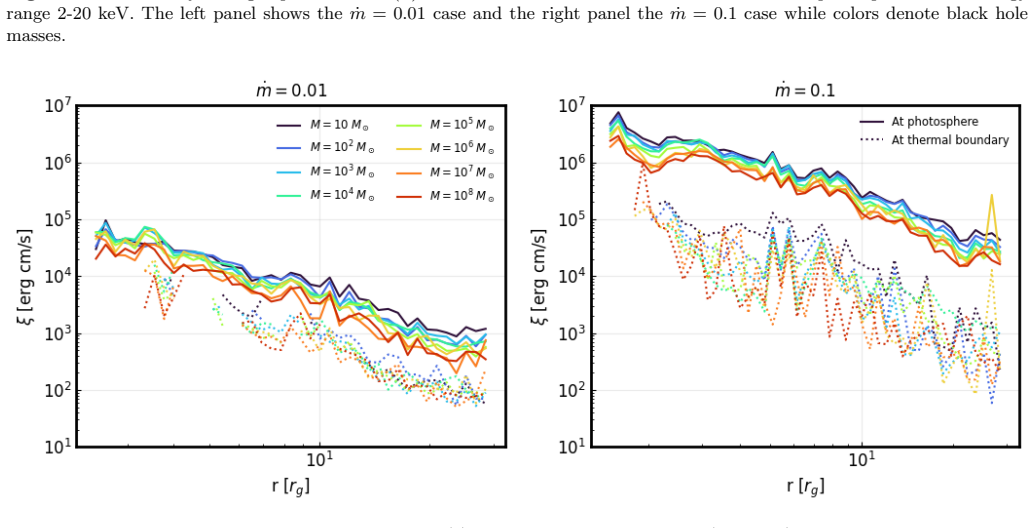
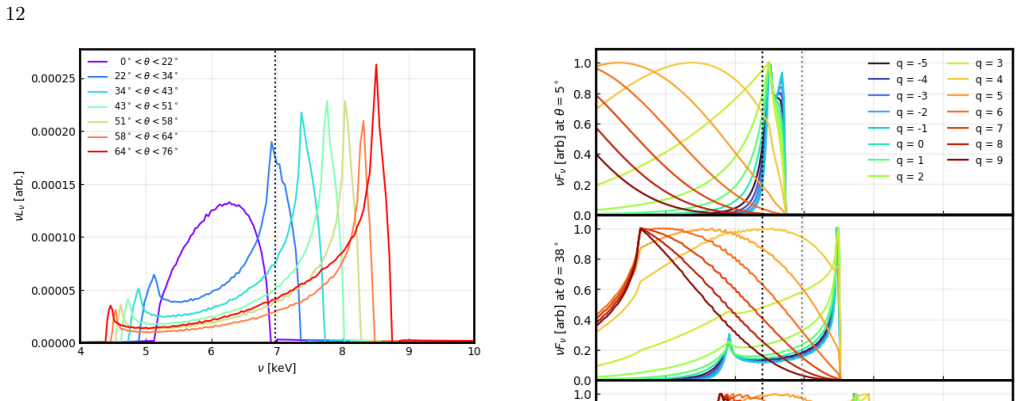
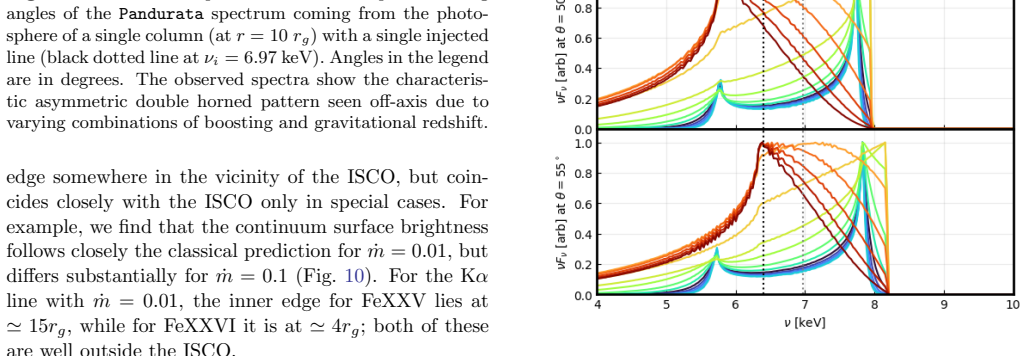
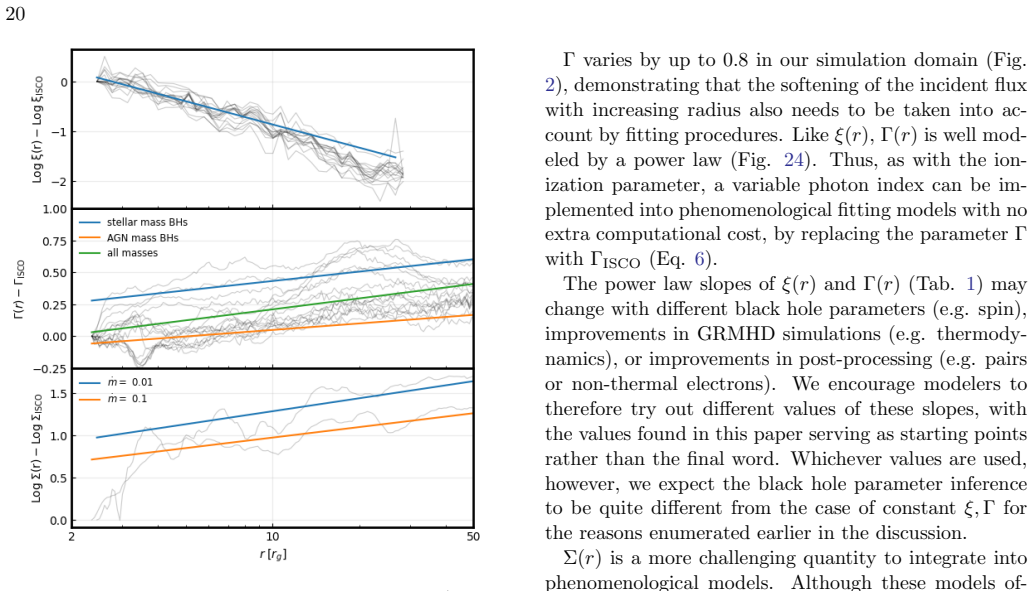
Contrary to common assumptions, the illuminating X-ray spectrum and ionization parameter can be strong functions of radius. Consequently, the region of the disk near the ISCO is completely ionized and contributes almost no Fe Kα photons; most of the flux is made at radii ≳ 10 r_g. The lines are broadened by a combination of relativistic Doppler shifts, Compton broadening in the disk atmosphere, and the differing line energies emitted by different Fe ions. These new mechanisms expand the parameter space of acceptable models, including the possibility of broad line profiles without large black hole spin.
What carries the argument
Radiation transfer solutions combined with local ionization and thermal balance calculations on GRMHD simulation data to determine the Fe Kα emissivity as a function of radius.
If this is right
- The equivalent width ranges from 25 to 225 eV depending mainly on viewing angle at 1% Eddington accretion rate.
- The ionization parameter ξ scales as r to the -1.5 power in this simulation.
- Broad Fe Kα profiles can be produced without requiring a rapidly spinning black hole.
- Fitting efforts should focus on the most relevant parts of parameter space based on physical trends from the simulations.
Where Pith is reading between the lines
- Traditional spin estimates that assume emission near the ISCO may overestimate black hole spins.
- Similar simulation-based approaches could be applied to other spectral lines or different accretion rates.
- The radial dependence of ionization could affect interpretations of additional X-ray features in black hole spectra.
Load-bearing premise
A single GRMHD simulation snapshot at 1 percent Eddington rate captures the three-dimensional structure needed to accurately compute ionization and line emission at each location.
What would settle it
An observation showing substantial Fe Kα line emission from within 5-10 gravitational radii in a low-accretion-rate black hole system would falsify the complete ionization of the inner disk.
Figures








read the original abstract
One of the most useful spectral diagnostics of accreting black hole systems is the Fe K$\alpha$ fluorescence line. Detected in many systems, it is often used to estimate the black hole spin, as its breadth is attributed to relativistic kinematics near the spin-dependent innermost stable circular orbit (ISCO). In a companion paper, we showed how continuum spectra emitted by accreting black holes can be derived from snapshots of general relativistic magnetohydrodynamics simulations by combining radiation transfer solutions for the disk body and the corona. In this paper, we focus on the Fe K$\alpha$ line, solving its transfer problem on the basis of local ionization and thermal balance. Its equivalent width is $\sim 25-225$ eV, depending mainly on viewing angle, for an accretion rate of 1$\%$ Eddington. Contrary to common assumptions, the illuminating X-ray spectrum and ionization parameter $\xi$ can be strong functions of radius; e.g. $\xi \propto r^{-1.5}$ in this simulation. Consequently, the region of the disk near the ISCO is completely ionized and contributes almost no Fe K$\alpha$ photons; most of the flux is made at radii $\gtrsim 10 r_g$. The lines are broadened by a combination of relativistic Doppler shifts, Compton broadening in the disk atmosphere, and the differing line energies emitted by different Fe ions. These new mechanisms expand the parameter space of acceptable models, including the possibility of broad line profiles without large black hole spin; physical trends revealed by the simulations can refocus fitting efforts on the most relevant sections of the parameter space.
Editorial analysis
A structured set of objections, weighed in public.
Referee Report
Summary. The manuscript develops a simulation-based method to predict Fe Kα line profiles from GRMHD snapshots of accreting black holes. It combines radiation-transfer solutions with local ionization and thermal balance calculations at 1% Eddington accretion rate, finding equivalent widths of ∼25-225 eV that depend mainly on viewing angle. The key result is that the ionization parameter ξ ∝ r^{-1.5} fully ionizes the disk near the ISCO, so that most Fe Kα flux originates at radii ≳10 r_g; line broadening arises from relativistic Doppler shifts, Compton scattering in the atmosphere, and emission from multiple Fe ions, allowing broad profiles without requiring high black-hole spin.
Significance. If the central results hold, the work provides a physically grounded alternative to phenomenological disk-line models, expanding the acceptable parameter space for spin inference and demonstrating that radial ionization gradients from simulations can produce broad lines from larger radii. Credit is due for performing the line calculations on independent GRMHD snapshots with separate radiation-transfer solutions rather than fitting directly to observations.
major comments (2)
- [Simulation setup and ionization-balance sections] The central claim that the ISCO region is completely ionized and contributes negligibly to Fe Kα (while most flux arises at ≳10 r_g) rests on the radial ionization structure obtained from the GRMHD density, temperature, and radiation field at 1% Eddington. The manuscript presents no resolution studies, variations in initial magnetic-field topology, or tests with radiation feedback that could change the inner density and flatten or invert the ξ profile, which would restore inner-disk line production and undermine the broadened-line-without-high-spin conclusion.
- [Abstract and results on equivalent widths] The reported equivalent-width range ∼25-225 eV and the quantitative statement that the inner disk contributes almost no photons lack associated uncertainties, convergence tests with respect to simulation resolution, or sensitivity to the precise accretion-rate value; these omissions make the load-bearing quantitative claims difficult to assess.
minor comments (2)
- [Abstract] Notation for the ionization parameter ξ and its radial scaling should be defined explicitly on first use with a reference to the local-balance equations.
- [Figure captions] Figure captions for line-profile plots should state the exact simulation snapshot time, viewing angles, and Fe-ion species included.
Simulated Author's Rebuttal
We thank the referee for the positive assessment of our work and for the constructive major comments. We address each point below and indicate the revisions planned for the next manuscript version.
read point-by-point responses
-
Referee: [Simulation setup and ionization-balance sections] The central claim that the ISCO region is completely ionized and contributes negligibly to Fe Kα (while most flux arises at ≳10 r_g) rests on the radial ionization structure obtained from the GRMHD density, temperature, and radiation field at 1% Eddington. The manuscript presents no resolution studies, variations in initial magnetic-field topology, or tests with radiation feedback that could change the inner density and flatten or invert the ξ profile, which would restore inner-disk line production and undermine the broadened-line-without-high-spin conclusion.
Authors: We agree that additional tests would strengthen the robustness of the ionization structure. The present study employs a single fiducial GRMHD snapshot with standard initial conditions and post-processes the radiation transfer and ionization balance. The ξ ∝ r^{-1.5} profile is a direct consequence of the density and radiation field in that snapshot. While dedicated resolution or topology variations are not included here, we will add a new subsection discussing the physical origin of the radial ionization gradient, citing existing GRMHD convergence studies for similar setups, and explicitly noting the limitations of the current single-snapshot approach. Full radiation-feedback simulations lie outside the scope of this post-processing paper but will be flagged for future work. revision: partial
-
Referee: [Abstract and results on equivalent widths] The reported equivalent-width range ∼25-225 eV and the quantitative statement that the inner disk contributes almost no photons lack associated uncertainties, convergence tests with respect to simulation resolution, or sensitivity to the precise accretion-rate value; these omissions make the load-bearing quantitative claims difficult to assess.
Authors: We accept that the equivalent-width range and inner-disk contribution statements would benefit from quantified uncertainties. The reported range arises from viewing-angle variations across the available snapshots. In the revision we will (i) report the standard deviation of the equivalent widths across snapshots and viewing angles, (ii) add a short paragraph on sensitivity to accretion rate by referencing companion simulations at nearby rates, and (iii) include a brief discussion of numerical convergence based on the properties of the underlying GRMHD run. These changes will be incorporated into the results and abstract sections. revision: yes
Circularity Check
No circularity: forward simulation of line profiles from GRMHD snapshots
full rationale
The derivation computes Fe Kα emissivity and line profiles by solving local ionization/thermal balance on GRMHD density, temperature, and radiation fields from an independent snapshot at 1% Eddington. The key result (ISCO region fully ionized, ξ ∝ r^{-1.5}, flux from ≳10 r_g) follows directly from those inputs without any parameter fitting to observed lines or reduction to self-defined quantities. Self-citation to the companion paper on continuum spectra is present but not load-bearing for the line calculation, which uses its own transfer solution. The model is a forward prediction self-contained against external benchmarks and does not match any enumerated circularity pattern.
Axiom & Free-Parameter Ledger
free parameters (1)
- accretion rate =
0.01 Eddington
axioms (2)
- domain assumption The GRMHD simulation snapshot accurately represents the three-dimensional density, velocity, and radiation field structure of the accretion disk and corona.
- domain assumption Local ionization and thermal balance can be solved independently at each location using the local illuminating spectrum.
Reference graph
Works this paper leans on
-
[1]
X-Ray Spectra of Black Hole X-Ray Binaries with Returning Radiation. , keywords =. doi:10.3847/1538-4357/ad8a63 , archivePrefix =. 2406.01226 , primaryClass =
-
[2]
Testing Relativistic Reflection Models with GRMHD Simulations of Accreting Black Holes. , keywords =. doi:10.3847/1538-4357/ac9128 , archivePrefix =. 2207.11526 , primaryClass =
-
[3]
Measuring black hole spins with x-ray reflection spectroscopy: A GRMHD outlook. , keywords =. doi:10.1103/4sth-rnwv , archivePrefix =. 2507.02583 , primaryClass =
-
[4]
A Reflection Model with a Radial Disk Density Profile. , keywords =. doi:10.3847/1538-4357/ac3237 , archivePrefix =. 2108.00375 , primaryClass =
-
[5]
Implementation of a radial disk ionization profile in the relxill\_nk model. , keywords =. doi:10.1103/PhysRevD.103.103023 , archivePrefix =. 2101.10100 , primaryClass =
-
[6]
Impact of ionization and electron density gradients in X-ray reflection spectroscopy measurements. , keywords =. doi:10.1093/mnras/stac3102 , archivePrefix =. 2206.03478 , primaryClass =
-
[7]
The density of the inner black hole accretion disc in AGN
High Density Reflection Spectroscopy - II. The density of the inner black hole accretion disc in AGN. , keywords =. doi:10.1093/mnras/stz2326 , archivePrefix =. 1908.07272 , primaryClass =
-
[8]
A clean broad iron line in GS 1354--64 as seen by XRISM. arXiv e-prints , keywords =. doi:10.48550/arXiv.2603.06883 , archivePrefix =. 2603.06883 , primaryClass =
-
[9]
Mapping of the accretion flow with Fe K emission lines
Delving into the depths of NGC 3783 with XRISM: IV. Mapping of the accretion flow with Fe K emission lines. , keywords =. doi:10.1051/0004-6361/202557710 , archivePrefix =. 2512.09207 , primaryClass =
-
[10]
Irradiation of an accretion disc by a jet: general properties and implications for spin measurements of black holes. , keywords =. doi:10.1093/mnras/sts710 , archivePrefix =. 1301.4922 , primaryClass =
work page internal anchor Pith review Pith/arXiv arXiv doi:10.1093/mnras/sts710
-
[11]
Estimating the Spin of Stellar-Mass Black Holes via Spectral Fitting of the X-ray Continuum
Estimating the Spin of Stellar-Mass Black Holes by Spectral Fitting of the X-Ray Continuum. , keywords =. doi:10.1086/498938 , archivePrefix =. astro-ph/0508302 , primaryClass =
work page internal anchor Pith review Pith/arXiv arXiv doi:10.1086/498938
-
[12]
Accurate Treatment of Comptonization in X-Ray Illuminated Accretion Disks. , keywords =. doi:10.3847/1538-4357/ab919b , archivePrefix =. 2005.04852 , primaryClass =
-
[13]
X-Ray Reflected Spectra from Accretion Disk Models. III. A Complete Grid of Ionized Reflection Calculations. , keywords =. doi:10.1088/0004-637X/768/2/146 , archivePrefix =. 1303.2112 , primaryClass =
work page internal anchor Pith review Pith/arXiv arXiv doi:10.1088/0004-637x/768/2/146
-
[14]
X-ray Reflected Spectra from Accretion Disk Models. I. Constant Density Atmospheres. , keywords =. doi:10.1088/0004-637X/718/2/695 , archivePrefix =. 1006.0485 , primaryClass =
work page internal anchor Pith review Pith/arXiv arXiv doi:10.1088/0004-637x/718/2/695
-
[15]
An absorption origin for the X-ray spectral variability of MCG-6-30-15
An absorption origin for the X-ray spectral variability of MCG-6-30-15. , keywords =. doi:10.1051/0004-6361:200809590 , archivePrefix =. 0803.2680 , primaryClass =
work page internal anchor Pith review Pith/arXiv arXiv doi:10.1051/0004-6361:200809590
-
[16]
Testing the accuracy of reflection-based supermassive black hole spin measurements in AGN
Testing the accuracy of reflection-based supermassive black hole spin measurements in AGN. , keywords =. doi:10.1051/0004-6361/201732377 , archivePrefix =. 1802.06800 , primaryClass =
work page internal anchor Pith review Pith/arXiv arXiv doi:10.1051/0004-6361/201732377
-
[17]
How well can we measure supermassive black hole spin?
How well can we measure supermassive black hole spin?. , keywords =. doi:10.1093/mnras/stw466 , archivePrefix =. 1602.09080 , primaryClass =
work page internal anchor Pith review Pith/arXiv arXiv doi:10.1093/mnras/stw466
-
[18]
Stronger Reflection from Black Hole Accretion Disks in Soft X-ray States
Stronger Reflection from Black Hole Accretion Disks in Soft X-Ray States. , keywords =. doi:10.3847/2041-8205/829/2/L22 , archivePrefix =. 1609.04592 , primaryClass =
work page internal anchor Pith review Pith/arXiv arXiv doi:10.3847/2041-8205/829/2/l22 2041
-
[19]
Resolved atomic lines reveal outflows in two ultraluminous X-ray sources
Resolved atomic lines reveal outflows in two ultraluminous X-ray sources. , keywords =. doi:10.1038/nature17417 , archivePrefix =. 1604.08593 , primaryClass =
work page internal anchor Pith review Pith/arXiv arXiv doi:10.1038/nature17417
-
[20]
High-energy Emission from Turbulent Electron-ion Coronae of Accreting Black Holes
High-energy Emission from Turbulent Electron-ion Coronae of Accreting Black Holes. arXiv e-prints , keywords =. doi:10.48550/arXiv.2601.00518 , archivePrefix =. 2601.00518 , primaryClass =
work page internal anchor Pith review Pith/arXiv arXiv doi:10.48550/arxiv.2601.00518
-
[21]
Photoionization Modeling and the K Lines of Iron
Photoionization Modeling and the K Lines of Iron. , keywords =. doi:10.1086/424039 , archivePrefix =. astro-ph/0405210 , primaryClass =
work page internal anchor Pith review Pith/arXiv arXiv doi:10.1086/424039
-
[22]
Journal of the Optical Society of America (1917-1983) , keywords =
The 1s-3p Kbeta -like X-ray spectrum of highly ionized iron. Journal of the Optical Society of America (1917-1983) , keywords =. doi:10.1364/JOSA.67.000148 , adsurl =
-
[23]
Broad Iron Line as a Relativistic Reflection from Warm Corona in AGN. arXiv e-prints , keywords =. doi:10.48550/arXiv.2511.03575 , archivePrefix =. 2511.03575 , primaryClass =
-
[24]
The strong Fe K line and spin of the black-hole X-ray binary MAXI J1631-479. arXiv e-prints , keywords =. doi:10.48550/arXiv.2511.03386 , archivePrefix =. 2511.03386 , primaryClass =
-
[25]
Radiation GRMHD Models of Accretion onto Stellar-mass Black Holes. I. Survey of Eddington Ratios. , keywords =. doi:10.3847/1538-4357/ae0f91 , archivePrefix =. 2506.02289 , primaryClass =
-
[26]
Where is the Inner Edge of an Accretion Disk Around a Black Hole?
Where Is the Inner Edge of an Accretion Disk around a Black Hole?. , keywords =. doi:10.1086/340760 , archivePrefix =. astro-ph/0203289 , primaryClass =
work page internal anchor Pith review Pith/arXiv arXiv doi:10.1086/340760
-
[27]
Polarized x-rays constrain the disk-jet geometry in the black hole x-ray binary Cygnus X-1. Science , keywords =. doi:10.1126/science.add5399 , archivePrefix =. 2206.09972 , primaryClass =
-
[28]
X-ray fluorescence from the inner disc in Cygnus X-1. , keywords =. doi:10.1093/mnras/238.3.729 , adsurl =
-
[29]
The population of merging compact binaries inferred using gravitational waves through GWTC-3
Population of Merging Compact Binaries Inferred Using Gravitational Waves through GWTC-3. Physical Review X , keywords =. doi:10.1103/PhysRevX.13.011048 , archivePrefix =. 2111.03634 , primaryClass =
work page internal anchor Pith review Pith/arXiv arXiv doi:10.1103/physrevx.13.011048
-
[30]
The Population of NuSTAR Black Hole X-Ray Binaries. , keywords =. doi:10.3847/1538-4357/adec85 , archivePrefix =. 2506.12121 , primaryClass =
-
[31]
Morphology of relativistically broadened line emission from axisymmetric equatorial accretion disks. , keywords =. doi:10.1103/PhysRevD.111.124004 , archivePrefix =. 2411.14338 , primaryClass =
-
[32]
Simulation-Based Prediction of Black Hole Spectra: From 10M_ to 10^8 M_. arXiv e-prints , keywords =. doi:10.48550/arXiv.2601.03349 , archivePrefix =. 2601.03349 , primaryClass =
-
[33]
Broad iron lines in Active Galactic Nuclei
Broad Iron Lines in Active Galactic Nuclei. , keywords =. doi:10.1086/316610 , archivePrefix =. astro-ph/0004366 , primaryClass =
work page internal anchor Pith review Pith/arXiv arXiv doi:10.1086/316610
-
[34]
Broad iron K-alpha emission lines as a diagnostic of black hole spin
Broad Iron-K Emission Lines as a Diagnostic of Black Hole Spin. , keywords =. doi:10.1086/527344 , archivePrefix =. 0711.4158 , primaryClass =
work page internal anchor Pith review Pith/arXiv arXiv doi:10.1086/527344
-
[35]
1998, MNRAS, 296, 77, doi: 10.1046/j.1365-8711.1998.01301.x
Iron line profiles including emission from within the innermost stable orbit of a black hole accretion disc. , keywords =. doi:10.1046/j.1365-8711.1998.02058.x , archivePrefix =. astro-ph/9808089 , primaryClass =
-
[36]
Iron fluorescence from within the innermost stable orbit of black hole accretion disks
Iron Fluorescence from within the Innermost Stable Orbit of Black Hole Accretion Disks. , keywords =. doi:10.1086/304703 , archivePrefix =. astro-ph/9705136 , primaryClass =
work page internal anchor Pith review Pith/arXiv arXiv doi:10.1086/304703
-
[37]
DAO: A New and Public Non-Relativistic Reflection Model. arXiv e-prints , keywords =. doi:10.48550/arXiv.2512.12728 , archivePrefix =. 2512.12728 , primaryClass =
-
[38]
A rapidly spinning supermassive black hole at the centre of NGC 1365
A rapidly spinning supermassive black hole at the centre of NGC 1365. , keywords =. doi:10.1038/nature11938 , archivePrefix =. 1302.7002 , primaryClass =
work page internal anchor Pith review Pith/arXiv arXiv doi:10.1038/nature11938
-
[39]
, year = 2009, month = may, volume =
Broad line emission from iron K- and L-shell transitions in the active galaxy 1H0707-495. , year = 2009, month = may, volume =. doi:10.1038/nature08007 , adsurl =
-
[40]
, year = 1995, month = jun, volume =
Gravitationally redshifted emission implying an accretion disk and massive black hole in the active galaxy MCG-6-30-15. , year = 1995, month = jun, volume =. doi:10.1038/375659a0 , adsurl =
-
[41]
The Spin of the Supermassive Black Hole in NGC 3783
The Spin of the Supermassive Black Hole in NGC 3783. , keywords =. doi:10.1088/0004-637X/736/2/103 , archivePrefix =. 1104.1172 , primaryClass =
work page internal anchor Pith review Pith/arXiv arXiv doi:10.1088/0004-637x/736/2/103
-
[42]
The Spin of a Newborn Black Hole: Swift J1728.9-3613. , keywords =. doi:10.3847/1538-4357/acc1c8 , archivePrefix =. 2303.04164 , primaryClass =
-
[43]
A Systematic View of Ten New Black Hole Spins. , keywords =. doi:10.3847/1538-4357/acafe7 , archivePrefix =. 2210.02479 , primaryClass =
-
[44]
Multistate observations of the Galactic black hole XTE J1752-223: evidence for an intermediate black hole spin. , keywords =. doi:10.1111/j.1365-2966.2010.17628.x , archivePrefix =. 1009.1154 , primaryClass =
-
[45]
Evidence of Spin and Energy Extraction in a Galactic Black Hole Candidate: The XMM-Newton/EPIC-pn Spectrum of XTE J1650-500. , keywords =. doi:10.1086/341099 , archivePrefix =. astro-ph/0202375 , primaryClass =
work page internal anchor Pith review Pith/arXiv arXiv doi:10.1086/341099
-
[46]
NuSTAR and XMM-NEWTON Observations of NGC 1365: Extreme Absorption Variability and a Constant Inner Accretion Disk. , keywords =. doi:10.1088/0004-637X/788/1/76 , archivePrefix =. 1404.5620 , primaryClass =
work page internal anchor Pith review Pith/arXiv arXiv doi:10.1088/0004-637x/788/1/76
-
[47]
XMM-Newton discovery of a sharp spectral feature at -0.5ex 7 keV in the narrow-line Seyfert 1 galaxy 1H 0707 - 49. , keywords =. doi:10.1046/j.1365-8711.2002.05040.x , archivePrefix =. astro-ph/0110367 , primaryClass =
-
[48]
A long hard look at MCG-6-30-15 with XMM-Newton- II. Detailed EPIC analysis and modelling. , keywords =. doi:10.1111/j.1365-2966.2004.07456.x , archivePrefix =. astro-ph/0311473 , primaryClass =
-
[49]
ASCA Observations of Seyfert 1 Galaxies. II. Relativistic Iron K Emission. , keywords =. doi:10.1086/303721 , archivePrefix =. astro-ph/9606169 , primaryClass =
work page internal anchor Pith review Pith/arXiv arXiv doi:10.1086/303721
-
[50]
Distinct Fe K Line Complexes in MAXI J1744 - 294 Revealed by XRISM High-resolution Spectroscopy. , keywords =. doi:10.3847/1538-4357/ae07d8 , archivePrefix =. 2506.22964 , primaryClass =
-
[51]
A Sharper View of the X-Ray Spectrum of MCG─6-30-15 with XRISM, XMM-Newton, and NuSTAR. , keywords =. doi:10.3847/1538-4357/ae1225 , archivePrefix =. 2510.08926 , primaryClass =
-
[52]
Detailed analysis on the reflection component for the black hole candidate MAXI J1348-630. , keywords =. doi:10.1093/mnras/stac121 , archivePrefix =. 2201.01207 , primaryClass =
-
[53]
Systematically Revisiting All NuSTAR Spins of Black Holes in X-Ray Binaries. , keywords =. doi:10.3847/1538-4357/ad43ea , archivePrefix =. 2311.16225 , primaryClass =
-
[54]
A XRISM View of Relativistic Reflection in Cygnus X-1. , keywords =. doi:10.3847/2041-8213/ae2276 , archivePrefix =. 2511.17338 , primaryClass =
-
[55]
Observational Constraints on Black Hole Spin. , keywords =. doi:10.1146/annurev-astro-112420-035022 , archivePrefix =. 2011.08948 , primaryClass =
-
[56]
Inferring the iron K emissivity profiles of accretion discs irradiated by extended coronae. , keywords =. doi:10.1093/mnras/stae1714 , archivePrefix =. 2407.08336 , primaryClass =
-
[57]
The similarity of broad iron lines in X-ray binaries and active galactic nuclei. , keywords =. doi:10.1111/j.1365-2966.2012.20809.x , archivePrefix =. 1202.5193 , primaryClass =
-
[58]
Broad Iron Lines in AGN and X-ray Binaries
Broad Iron Lines in AGN and X-Ray Binaries. , keywords =. doi:10.1007/s10509-005-1203-x , archivePrefix =. astro-ph/0412224 , primaryClass =
work page internal anchor Pith review Pith/arXiv arXiv doi:10.1007/s10509-005-1203-x
-
[59]
A rapid black hole spin or emission from the plunging region?. arXiv e-prints , keywords =. doi:10.48550/arXiv.2505.13119 , archivePrefix =. 2505.13119 , primaryClass =
-
[60]
Reflection Spectra of the Black Hole Binary Candidate MAXI J1535-571 in the Hard State Observed by NuSTAR. , keywords =. doi:10.3847/2041-8213/aaa4b2 , archivePrefix =. 1711.01346 , primaryClass =
work page internal anchor Pith review Pith/arXiv arXiv doi:10.3847/2041-8213/aaa4b2 2041
-
[61]
A deep X-ray view of the bare AGN Ark 120. IV. XMM-Newton and NuSTAR spectra dominated by two temperature (warm, hot) Comptonization processes. , keywords =. doi:10.1051/0004-6361/201731290 , archivePrefix =. 1707.08907 , primaryClass =
work page internal anchor Pith review Pith/arXiv arXiv doi:10.1051/0004-6361/201731290
-
[62]
Dynamical confirmation of a black hole in the X-ray transient Swift J1727.8‑1613. , keywords =. doi:10.1051/0004-6361/202451960 , archivePrefix =. 2408.13310 , primaryClass =
-
[63]
The Average Soft X-ray Spectra of eROSITA Active Galactic Nuclei. arXiv e-prints , keywords =. doi:10.48550/arXiv.2506.17150 , archivePrefix =. 2506.17150 , primaryClass =
-
[64]
The Soft State of Cygnus X-1 Observed with NuSTAR: A Variable Corona and a Stable Inner Disk
The Soft State of Cygnus X-1 Observed with NuSTAR: A Variable Corona and a Stable Inner Disk. , keywords =. doi:10.3847/0004-637X/826/1/87 , archivePrefix =. 1605.03966 , primaryClass =
work page internal anchor Pith review Pith/arXiv arXiv doi:10.3847/0004-637x/826/1/87
-
[65]
NuSTAR and Suzaku observations of the hard state in Cygnus X-1: locating the inner accretion disk
NuSTAR and Suzaku Observations of the Hard State in Cygnus X-1: Locating the Inner Accretion Disk. , keywords =. doi:10.1088/0004-637X/808/1/9 , archivePrefix =. 1506.00007 , primaryClass =
work page internal anchor Pith review Pith/arXiv arXiv doi:10.1088/0004-637x/808/1/9
-
[66]
The X-Ray Polarization View of Mrk 421 in an Average Flux State as Observed by the Imaging X-Ray Polarimetry Explorer. , keywords =. doi:10.3847/2041-8213/ac913a , archivePrefix =. 2209.07184 , primaryClass =
-
[67]
The Discovery of the First Changing Look Quasar: New Insights Into the Physics and Phenomenology of Active Galactic Nucleus. , keywords =. doi:10.1088/0004-637X/800/2/144 , archivePrefix =. 1412.2136 , primaryClass =
work page internal anchor Pith review Pith/arXiv arXiv doi:10.1088/0004-637x/800/2/144
-
[68]
Space Telescope and Optical Reverberation Mapping Project. II. Swift and HST Reverberation Mapping of the Accretion Disk of NGC 5548. , keywords =. doi:10.1088/0004-637X/806/1/129 , archivePrefix =. 1501.05951 , primaryClass =
work page internal anchor Pith review Pith/arXiv arXiv doi:10.1088/0004-637x/806/1/129
-
[69]
The Man behind the Curtain: X-Rays Drive the UV through NIR Variability in the 2013 Active Galactic Nucleus Outburst in NGC 2617. , keywords =. doi:10.1088/0004-637X/788/1/48 , archivePrefix =. 1310.2241 , primaryClass =
work page internal anchor Pith review Pith/arXiv arXiv doi:10.1088/0004-637x/788/1/48 2013
-
[70]
NuSTAR Hard X-Ray Survey of the Galactic Center Region. II. X-Ray Point Sources. , keywords =. doi:10.3847/0004-637X/825/2/132 , archivePrefix =. 1605.03882 , primaryClass =
work page internal anchor Pith review Pith/arXiv arXiv doi:10.3847/0004-637x/825/2/132
-
[71]
BAT AGN Spectroscopic Survey. V. X-Ray Properties of the Swift/BAT 70-month AGN Catalog. , keywords =. doi:10.3847/1538-4365/aa96ad , archivePrefix =. 1709.03989 , primaryClass =
work page internal anchor Pith review Pith/arXiv arXiv doi:10.3847/1538-4365/aa96ad
-
[72]
The Swift Gamma-Ray Burst Mission
The Swift Gamma-Ray Burst Mission. , keywords =. doi:10.1086/422091 , archivePrefix =. astro-ph/0405233 , primaryClass =
work page internal anchor Pith review Pith/arXiv arXiv doi:10.1086/422091
-
[73]
Science with the X-ray Imaging and Spectroscopy Mission (XRISM). arXiv e-prints , keywords =. doi:10.48550/arXiv.2003.04962 , archivePrefix =. 2003.04962 , primaryClass =
-
[74]
The Instrument of the Imaging X-Ray Polarimetry Explorer. , keywords =. doi:10.3847/1538-3881/ac19b0 , archivePrefix =. 2108.00284 , primaryClass =
-
[75]
The eROSITA X-ray telescope on SRG. , keywords =. doi:10.1051/0004-6361/202039313 , archivePrefix =. 2010.03477 , primaryClass =
-
[76]
Space Telescopes and Instrumentation 2016: Ultraviolet to Gamma Ray , year = 2016, editor =
The Neutron star Interior Composition Explorer (NICER): design and development. Space Telescopes and Instrumentation 2016: Ultraviolet to Gamma Ray , year = 2016, editor =. doi:10.1117/12.2231304 , adsurl =
-
[77]
The Nuclear Spectroscopic Telescope Array (NuSTAR) Mission
The Nuclear Spectroscopic Telescope Array (NuSTAR) High-energy X-Ray Mission. , keywords =. doi:10.1088/0004-637X/770/2/103 , archivePrefix =. 1301.7307 , primaryClass =
work page internal anchor Pith review Pith/arXiv arXiv doi:10.1088/0004-637x/770/2/103
-
[78]
The European Photon Imaging Camera on XMM-Newton: The pn-CCD camera. , keywords =. doi:10.1051/0004-6361:20000066 , adsurl =
-
[79]
Radiation and Magnetic Pressure Support in Accretion Disks around Supermassive Black Holes and The Physical Origin of the Extreme Ultraviolet to Soft X-ray Spectrum. arXiv e-prints , keywords =. doi:10.48550/arXiv.2505.09671 , archivePrefix =. 2505.09671 , primaryClass =
-
[80]
A Radiation Transfer Solver for Athena using Short Characteristics
A Radiation Transfer Solver for Athena Using Short Characteristics. , keywords =. doi:10.1088/0067-0049/199/1/9 , archivePrefix =. 1201.2222 , primaryClass =
work page internal anchor Pith review Pith/arXiv arXiv doi:10.1088/0067-0049/199/1/9
discussion (0)
Sign in with ORCID, Apple, or X to comment. Anyone can read and Pith papers without signing in.