Quantum-Limited Subdiffraction Telescopy Requires Genuine Multi-Telescope Interference
Pith reviewed 2026-06-26 03:57 UTC · model grok-4.3
The pith
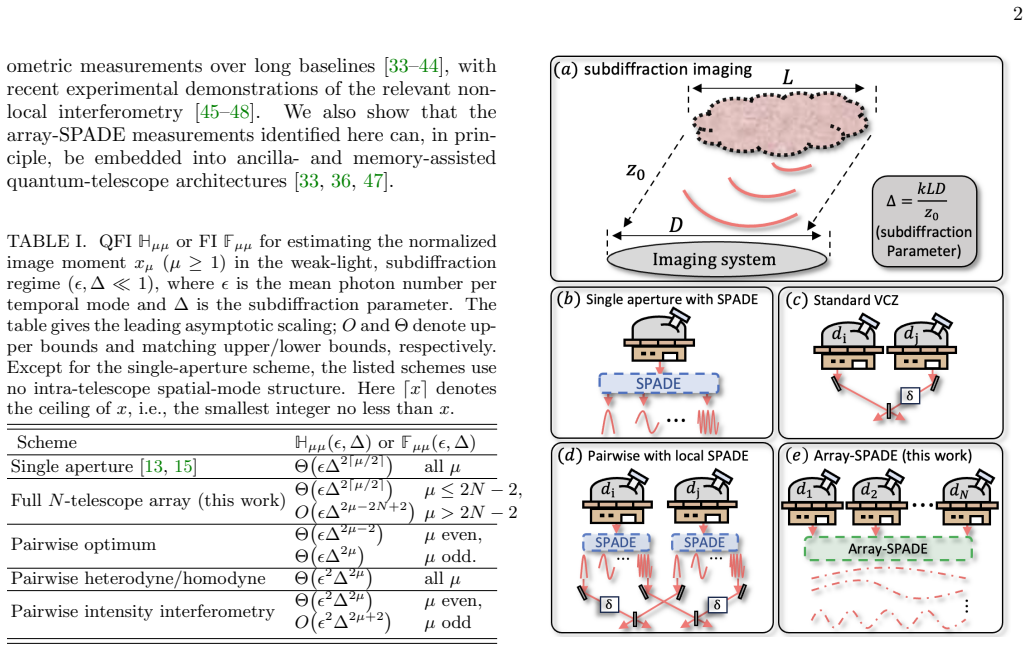
Pairwise telescope measurements attain full-array quantum Fisher information scaling only up to second order for image moments.
A machine-rendered reading of the paper's core claim, the machinery that carries it, and where it could break.
Core claim
For weak incoherent light from a generic extended source observed by an N-telescope array with one optical mode per telescope, arbitrary measurements restricted to telescope pairs attain the full-array QFI scaling of image moments only up to second order. Estimating higher-order moments at the quantum limit therefore requires genuinely multi-telescope interference. Array-SPADE measurements attain the optimal QFI scaling up to the cutoff 2N-2 and can be embedded in ancilla- and memory-assisted quantum-network architectures for long-baseline telescopy.
What carries the argument
Quantum Fisher information scaling of image moments up to order 2N-2, with array-SPADE as the protocol that saturates it.
If this is right
- Conventional stellar interferometry based on pairwise coherences is insufficient for quantum-limited estimation of image moments beyond second order.
- Array-SPADE measurements achieve the full quantum Fisher information scaling up to order 2N-2.
- Genuine multi-telescope interference is required to reach the quantum limit for higher-order moments.
- These optimal measurements can be embedded in ancilla- and memory-assisted quantum-network architectures.
Where Pith is reading between the lines
- Larger arrays would unlock estimation of correspondingly higher moments while still using the same class of multi-telescope measurements.
- Practical long-baseline telescopy of faint extended sources may need to incorporate multi-way beam combination or quantum memory elements rather than relying solely on pairwise links.
- The single-mode-per-telescope restriction suggests that spatial or temporal mode multiplexing could alter the scaling and possibly relax the need for multi-telescope interference.
Load-bearing premise
The derivation assumes weak incoherent light from a generic extended source where each telescope supports only a single optical mode.
What would settle it
An explicit calculation or experiment for a three-telescope array showing that some pairwise measurement achieves the full three-telescope QFI for the third-order image moment would falsify the central claim.
Figures
read the original abstract
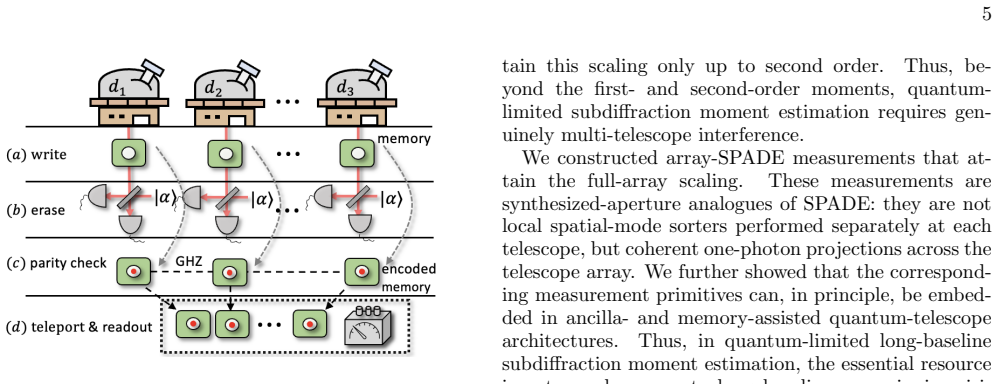
Conventional stellar interferometry reconstructs incoherent sources from pairwise mutual coherences between telescopes. Are such pairwise measurements sufficient for quantum-limited subdiffraction imaging with a telescope array? We show that for generic image-moment estimation, they are not. We consider weak incoherent light from a generic extended source observed by an array of telescopes, each supporting a single optical mode. For an N-telescope array, we derive the quantum Fisher information (QFI) scaling of image moments up to the cutoff 2N-2 and prove that arbitrary measurements restricted to telescope pairs attain the full-array QFI scaling only up to second order. Thus, estimating higher-order moments at the quantum limit requires genuinely multi-telescope interference. Inspired by spatial-mode demultiplexing (SPADE) from single-aperture subdiffraction imaging, we construct array-SPADE measurements that attain the optimal QFI scaling up to the finite-array cutoff. Finally, we show that these measurements can, in principle, be embedded in ancilla- and memory-assisted quantum-network architectures for long-baseline telescopy.
Editorial analysis
A structured set of objections, weighed in public.
Referee Report
Summary. The manuscript derives the quantum Fisher information scaling for estimating image moments of a weak incoherent extended source observed by an N-telescope array (each supporting a single optical mode), establishing a cutoff at order 2N-2. It proves that arbitrary measurements restricted to telescope pairs attain the full-array QFI scaling only up to second order, constructs array-SPADE measurements that saturate the optimal scaling up to the cutoff, and discusses embedding these in ancilla- and memory-assisted quantum-network architectures.
Significance. If the derivations hold, the result establishes a fundamental limitation of conventional pairwise stellar interferometry for quantum-limited subdiffraction imaging beyond the second moment and supplies an explicit saturating measurement scheme. The explicit QFI cutoff derivation, the pairwise-limitation proof, and the array-SPADE construction are concrete strengths that could guide development of multi-telescope quantum measurements for long-baseline telescopy.
minor comments (3)
- The precise definition of the image moments (including any truncation or weighting) should be stated explicitly in the main text near the QFI derivation to allow direct verification of the 2N-2 cutoff.
- Clarify whether the pairwise-limitation proof assumes a specific ordering of moments or holds for arbitrary linear combinations of moments up to the cutoff.
- The abstract states the single-mode-per-telescope assumption; ensure the main text repeats this limitation when discussing potential extensions to multi-mode telescopes.
Simulated Author's Rebuttal
We thank the referee for the positive assessment of the manuscript, the clear summary of its contributions, and the recommendation for minor revision. No specific major comments were raised in the report.
Circularity Check
No significant circularity detected
full rationale
The paper derives its central claims—the QFI scaling cutoff at 2N-2 for image moments and the restriction of pairwise measurements to second-order scaling—via explicit calculations on the stated quantum-optical model of weak incoherent single-mode light. These steps are presented as direct computations from the model assumptions rather than reductions to fitted parameters, self-definitions, or load-bearing prior results by the same authors. The array-SPADE construction follows from the QFI analysis to saturate the bound, and the overall argument remains self-contained within the single-mode weak-source regime without circular equivalence to its inputs.
Axiom & Free-Parameter Ledger
axioms (2)
- domain assumption Weak incoherent light from a generic extended source
- domain assumption Each telescope supports a single optical mode
Reference graph
Works this paper leans on
-
[1]
Tsang, R
M. Tsang, R. Nair, and X.-M. Lu, Quantum theory of superresolution for two incoherent optical point sources, Physical Review X6, 031033 (2016)
2016
-
[2]
Tsang, Resolving starlight: a quantum perspective, Contemporary Physics60, 279 (2019)
M. Tsang, Resolving starlight: a quantum perspective, Contemporary Physics60, 279 (2019)
2019
-
[3]
Pa´ ur, B
M. Pa´ ur, B. Stoklasa, Z. Hradil, L. L. S´ anchez-Soto, and J. Rehacek, Achieving the ultimate optical resolution, Optica3, 1144 (2016)
2016
-
[4]
Lupo and S
C. Lupo and S. Pirandola, Ultimate precision bound of quantum and subwavelength imaging, Phys. Rev. Lett. 117, 190802 (2016)
2016
-
[5]
Nair and M
R. Nair and M. Tsang, Far-field superresolution of ther- mal electromagnetic sources at the quantum limit, Phys- ical Review Letters117, 190801 (2016)
2016
-
[6]
S. Z. Ang, R. Nair, and M. Tsang, Quantum limit for two- dimensional resolution of two incoherent optical point sources, Phys. Rev. A95, 063847 (2017)
2017
-
[7]
W.-K. Tham, H. Ferretti, and A. M. Steinberg, Beat- ing rayleigh’s curse by imaging using phase information, Phys. Rev. Lett.118, 070801 (2017)
2017
-
[8]
Tsang, Subdiffraction incoherent optical imaging via spatial-mode demultiplexing, New Journal of Physics19, 023054 (2017)
M. Tsang, Subdiffraction incoherent optical imaging via spatial-mode demultiplexing, New Journal of Physics19, 023054 (2017)
2017
-
[9]
Tsang, Subdiffraction incoherent optical imaging via spatial-mode demultiplexing: Semiclassical treatment, Physical Review A97, 023830 (2018)
M. Tsang, Subdiffraction incoherent optical imaging via spatial-mode demultiplexing: Semiclassical treatment, Physical Review A97, 023830 (2018)
2018
-
[10]
Tsang, Conservative classical and quantum resolution limits for incoherent imaging, Journal of Modern Optics 65, 1385 (2018)
M. Tsang, Conservative classical and quantum resolution limits for incoherent imaging, Journal of Modern Optics 65, 1385 (2018)
2018
-
[11]
B. Wang, L. Xu, J. chi Li, and L. Zhang, Quantum- limited localization and resolution in three dimensions, Photon. Res.9, 1522 (2021)
2021
-
[12]
C. Oh, S. Zhou, Y. Wong, and L. Jiang, Quantum limits of superresolution in a noisy environment, Phys. Rev. Lett.126, 120502 (2021)
2021
-
[13]
Tsang, Quantum limit to subdiffraction incoherent 6 optical imaging, Phys
M. Tsang, Quantum limit to subdiffraction incoherent 6 optical imaging, Phys. Rev. A99, 012305 (2019)
2019
-
[14]
Tsang, Semiparametric estimation for incoherent optical imaging, Physical Review Research1, 033006 (2019)
M. Tsang, Semiparametric estimation for incoherent optical imaging, Physical Review Research1, 033006 (2019)
2019
-
[15]
Zhou and L
S. Zhou and L. Jiang, Modern description of rayleigh’s criterion, Physical Review A99, 013808 (2019)
2019
-
[16]
Tsang, Quantum limit to subdiffraction incoherent optical imaging
M. Tsang, Quantum limit to subdiffraction incoherent optical imaging. ii. a parametric-submodel approach, Phys. Rev. A104, 052411 (2021)
2021
-
[17]
Sorelli, M
G. Sorelli, M. Gessner, M. Walschaers, and N. Treps, Optimal observables and estimators for practical super- resolution imaging, Phys. Rev. Lett.127, 123604 (2021)
2021
-
[18]
Sorelli, M
G. Sorelli, M. Gessner, M. Walschaers, and N. Treps, Moment-based superresolution: Formalism and applica- tions, Phys. Rev. A104, 033515 (2021)
2021
-
[19]
Tan and M
X.-J. Tan and M. Tsang, Quantum limit to subdiffraction incoherent optical imaging. iii. numerical analysis, Phys. Rev. A108, 052416 (2023)
2023
-
[20]
Wang and V
Y. Wang and V. O. Lorenz, Fundamental limit of bandwidth-extrapolation-based superresolution, Phys. Rev. A108, 012602 (2023)
2023
-
[21]
L. Olmi, C. Migoni, M. Murgia, R. Nesti, and S. Poppi, First demonstration of super-resolution with a single- aperture radio telescope, Experimental Astronomy61, 5 (2026)
2026
-
[22]
Y. Wang, C. Oh, J. Liu, L. Jiang, and S. Zhou, Advanc- ing quantum imaging through learning theory, Nature Communications17, 1124 (2025)
2025
-
[23]
P. H. van Cittert, Die wahrscheinliche schwingungsverteilung in einer von einer lichtquelle direkt oder mittels einer linse beleuchteten ebene, Physica1, 201 (1934)
1934
-
[24]
Zernike, The concept of degree of coherence and its application to optical problems, Physica5, 785 (1938)
F. Zernike, The concept of degree of coherence and its application to optical problems, Physica5, 785 (1938)
1938
-
[25]
J. W. Goodman,Introduction to Fourier Optics, 4th ed. (W. H. Freeman, 2017)
2017
-
[26]
J. D. Monnier, Optical interferometry in astronomy, Re- ports on Progress in Physics66, 789 (2003)
2003
-
[27]
C. Lupo, Z. Huang, and P. Kok, Quantum limits to in- coherent imaging are achieved by linear interferometry, Phys. Rev. Lett.124, 080503 (2020)
2020
-
[28]
Y. Wang, Y. Zhang, and V. O. Lorenz, Superresolution in interferometric imaging of strong thermal sources, Phys. Rev. A104, 022613 (2021)
2021
-
[29]
C. Hu, B. Wang, J. Zhang, K. Wang, H. Liu, J. Zhou, and L. Zhang, Superresolution of unequal-brightness ther- mal sources for stellar interferometry, Phys. Rev. A112, 032609 (2025)
2025
-
[30]
Sajjad, M
A. Sajjad, M. R. Grace, and S. Guha, Quantum limits of parameter estimation in long-baseline imaging, Phys. Rev. Res.6, 013212 (2024)
2024
-
[31]
Padilla, A
I. Padilla, A. Sajjad, B. N. Saif, and S. Guha, Superres- olution imaging with entanglement-enhanced telescopy, Phys. Rev. Lett.136, 010803 (2026)
2026
-
[32]
Padilla, A
I. Padilla, A. Sajjad, B. N. Saif, and S. Guha, Quan- tum resolution limit of long-baseline imaging using dis- tributed entanglement, Phys. Rev. A113, 012608 (2026)
2026
-
[33]
Gottesman, T
D. Gottesman, T. Jennewein, and S. Croke, Longer- baseline telescopes using quantum repeaters, Physical Review Letters109, 070503 (2012)
2012
-
[34]
Tsang, Quantum nonlocality in weak-thermal-light interferometry, Phys
M. Tsang, Quantum nonlocality in weak-thermal-light interferometry, Phys. Rev. Lett.107, 270402 (2011)
2011
-
[35]
E. T. Khabiboulline, J. Borregaard, K. De Greve, and M. D. Lukin, Quantum-assisted telescope arrays, Physi- cal Review A100, 022316 (2019)
2019
-
[36]
E. T. Khabiboulline, J. Borregaard, K. De Greve, and M. D. Lukin, Optical interferometry with quantum net- works, Physical Review Letters123, 070504 (2019)
2019
-
[37]
Huang, G
Z. Huang, G. K. Brennen, and Y. Ouyang, Imaging stars with quantum error correction, Phys. Rev. Lett.129, 210502 (2022)
2022
-
[38]
Y. Wang, Y. Zhang, and V. O. Lorenz, Astronomical interferometry using continuous variable quantum tele- portation, Phys. Rev. Res.7, 023154 (2025)
2025
-
[39]
Huang, B
Z. Huang, B. Q. Baragiola, N. C. Menicucci, and M. M. Wilde, Limited quantum advantage for stellar interfer- ometry via continuous-variable teleportation, Phys. Rev. A109, 052434 (2024)
2024
-
[40]
Wang and S
Y. Wang and S. Zhou, Limitations of gaussian measure- ments in quantum imaging, Phys. Rev. Lett.135, 120201 (2025)
2025
-
[41]
Czupryniak, J
R. Czupryniak, J. Steinmetz, P. G. Kwiat, and A. N. Jor- dan, Optimal qubit circuits for quantum-enhanced tele- scopes, Phys. Rev. A108, 052408 (2023)
2023
-
[42]
M. M. Marchese and P. Kok, Large baseline optical imag- ing assisted by single photons and linear quantum optics, Phys. Rev. Lett.130, 160801 (2023)
2023
-
[43]
Zhang and T
Y. Zhang and T. Jennewein, Criteria for optimal entanglement-assisted long baseline telescopy, Phys. Rev. Res.7, 043278 (2025)
2025
-
[44]
Y. Wang, Y. Zhang, and V. O. Lorenz, Temporally lo- calized quantum operations on continuous-wave thermal light, Phys. Rev. Lett.135, 113602 (2025)
2025
-
[45]
M. R. Brown, M. Allgaier, V. Thiel, J. D. Monnier, M. G. Raymer, and B. J. Smith, Interferometric imaging us- ing shared quantum entanglement, Phys. Rev. Lett.131, 210801 (2023)
2023
-
[46]
D. Diaz, Y. Zhang, V. O. Lorenz, and P. G. Kwiat, Em- ulating quantum-enhanced long-baseline interferometric telescopy, inFrontiers in Optics+Laser Science 2021 (Optica Publishing Group, 2021) p. FTh6D.7
2021
-
[47]
Stas, Y.-C
P.-J. Stas, Y.-C. Wei, M. Sirotin, Y. Q. Huan, U. Yazlar, F. Abdo Arias, E. Knyazev, G. Baranes, B. Machielse, S. Grandi, D. Riedel, J. Borregaard, H. Park, M. Lonˇ car, A. Suleymanzade, and M. D. Lukin, Entanglement- assisted non-local optical interferometry in a quantum network, Nature651, 326 (2026)
2026
-
[48]
Wang, X.-Y
B. Wang, X.-Y. Luo, B.-F. Gao, J.-L. Liu, C.-Y. Wang, Z. Yan, Q.-M. Ke, D. Teng, M.-Y. Zheng, Y. Cao, J. Li, C.-Z. Peng, Q. Zhang, X.-H. Bao, and J.-W. Pan, Memory-assisted nonlocal interferometer toward long- baseline telescopes, Phys. Rev. Lett.136, 240801 (2026)
2026
-
[49]
(94) of Ref
For example, in the balanced two-point-source model, the leading QFI for the source-separation parameter is dom- inated by the long-baseline interferometric contribution rather than by intra-telescope mode sorting, e.g., Eq. (94) of Ref. [30]
-
[50]
Mandel and E
L. Mandel and E. Wolf, Optical coherence and quantum optics (1995)
1995
-
[51]
This condition differs from the usual VCZ nondegeneracy condition, which concerns distinct baselines rather than distinct telescope coordinates
-
[52]
Narayan and R
R. Narayan and R. Nityananda, Maximum entropy image restoration in astronomy, Annual Review of Astronomy and Astrophysics24, 127 (1986)
1986
-
[53]
Thi´ ebaut, Principles of image reconstruction in inter- ferometry, EAS Publications Series59, 157 (2013)
´E. Thi´ ebaut, Principles of image reconstruction in inter- ferometry, EAS Publications Series59, 157 (2013). 7 Appendix A: Proofs of Thm. 1 and Prop. 1 Let{|e a⟩}N−1 a=0 be the array-SPADE basis defined in Eq. (11). Since this basis is independent of ∆, ⟨ea|H m |ψ⟩= 0, m < a, Θ(1), m=a, O(1), m > a. (A1) It then follows directly from Eq. (7) tha...
2013
-
[54]
(S32) gives F hom ij,µµ = Θ(ϵ2∆2µ),(S33) for any fixed pair withc ij ̸= 0
Optimizing over the local-oscillator phase differenceθ i −θ j gives, one thus has F hom ij,µµ = 4ϵ2 N2 ∂xµ gij 2 +O(ϵ 3).(S32) Since∂ xµ gij =e i(ϕij) (−icij∆)µ µ! , substitution into Eq. (S32) gives F hom ij,µµ = Θ(ϵ2∆2µ),(S33) for any fixed pair withc ij ̸= 0. Maximizing over telescope pairs does not change the ∆-scaling. Thus the standard pairwise homo...
discussion (0)
Sign in with ORCID, Apple, or X to comment. Anyone can read and Pith papers without signing in.