REVIEW 4 major objections 4 minor 49 references
Edge Computing-Enabled Cell-Free Massive MIMO Systems
T0 review · 4 major / 4 minor · reviewed 2026-08-14 · deepseek-v4-flash
Pith's one-line read The paper claims that in edge-computing cell-free massive MIMO, more access points with fewer antennas is the energy-efficient way to hit any target success probability.
desk verdict A genuine modeling contribution combining stochastic geometry and M/G/1 queueing for cell-free massive MIMO MEC, but the SECP and energy claims are not reproducible until the network area |A| in Eq. (29) is specified. read the letter →
The pith
A machine-rendered reading of the paper's core claim, the machinery that carries it, and where it could break.
The reading
What carries the argument
The object that carries the argument is the SECP expression in Eq. (10), $$p_{\mathrm{secp}}(R,\vartheta,t)=\sum_{n=1}^{\infty}\frac{(\lambda_b\pi $R^{2}$)^n}{n!}$e^{{-\lambda_b\pi R^2}}$\mathbb{P}[T_{\mathrm{comp}}\le t\mid N=n]\{1-p_{o,\mathrm{ul}}^{(n)}(R)\}\{1-p_{o,\mathrm{dl}}(R)\}.$$ It joins the Poisson-distributed number $N$ of connected APs (mean $\lambda_b\pi R^2$), the uplink outage term $(1-p_0(R))^n$ for the event that all $n$ connected APs fail, the downlink outage term from the Gamma interference approximation, and the computation latency probability from the M/G/1 queue analysis. Theorems 1 and 2 supply the outage probabilities; Theorem 3 and Corollary 1 supply the computation latency tails; Proposition 3 feeds the arrival rates into the queues; and the energy model in Section VI attaches an energy cost to every $(R,\vartheta)$ choice. All of it exists to make Eq. (10) a function the paper can minimize under a SECP constraint.
What would settle it
At a fixed antenna density ($M\lambda_b = 1600$ per km$^2$), a Monte Carlo simulation with shortest-queue routing and a specified network area that finds a target SECP for which the high-AP-density design does not achieve the lower minimum energy would falsify the paper's design rule; reproducing Fig. 7 also requires the paper's unspecified $|A|$, so the simulation must fix it.
Extended reading notes
Core claim
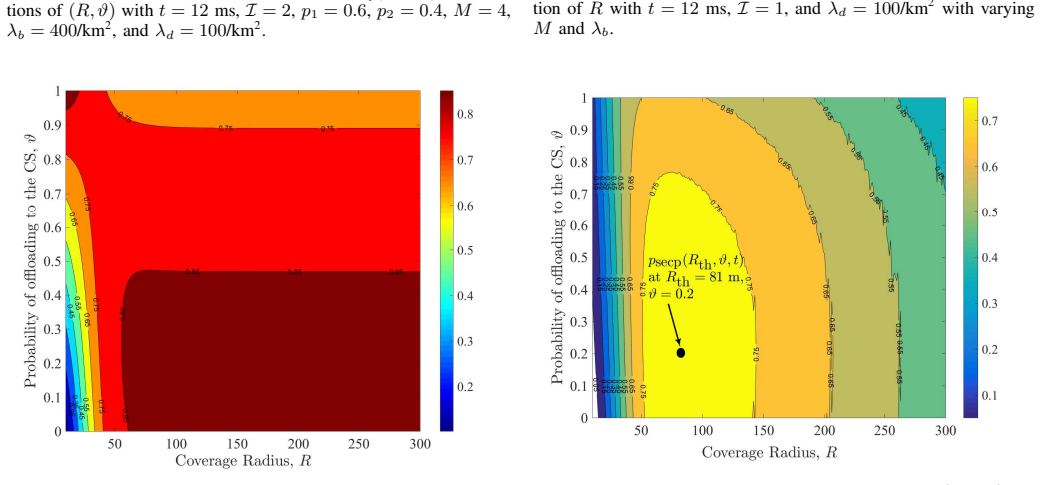
On the paper's own terms, the central discovery is a quantitative design rule for edge-computing-enabled cell-free massive MIMO. For a fixed total antenna density, replacing fewer high-antenna APs with more low-antenna APs lowers the minimum total energy needed to guarantee any given successful edge computing probability (SECP). This is shown by combining three pieces of analysis: an uplink outage probability in which transmission fails only if every connected AP fails (Theorem 1), a downlink outage probability based on a Gamma approximation of interference (Theorem 2), and a computation success probability obtained from M/G/1 queues with tasks routed to the least-loaded connected MEC server or to the central server with probability $\vartheta$ (Theorem 3). These feed into the SECP expression in Eq. (10), which averages over the Poisson-distributed number $N$ of APs within coverage radius $R$. The paper also finds that the SECP is quasi-concave in $R$, giving an optimal coverage radius $R_{th}$, and that the optimal offloading probability to the central server decreases as $R$ grows.
Load-bearing premise
The calculation treats each MEC server's queue as an independent M/G/1 queue fed by Poisson arrivals, even though tasks are routed to whichever connected server currently has the smallest queue.
Editorial extensions
If this is right
- For a fixed antenna density, communication success favors dense AP deployment only for small coverage radii; at large radii, fewer APs with more antennas give higher communication success.
- The SECP is quasi-concave in the coverage radius, so there is a unique optimal radius $R_{th}$ for given $\lambda_b$, $t$, and $\vartheta$.
- The optimal probability of offloading to the central server decreases as the AP coverage radius grows; offloading to the cloud helps when few MEC servers are in range and hurts when many are.
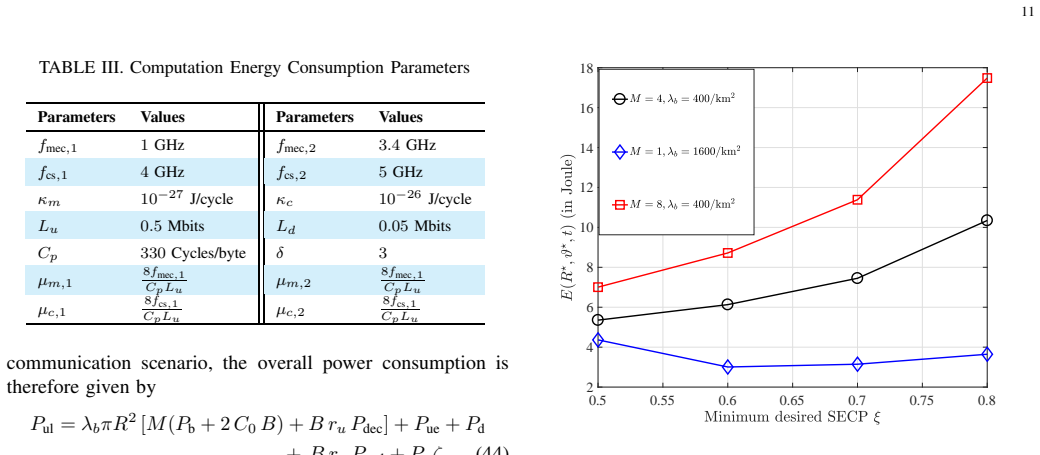
- The minimum energy needed to guarantee a target SECP first decreases and then increases with the target: computation energy dominates at low targets and communication energy at high targets.
- For every SECP target considered, the minimum energy configuration is higher AP density with fewer antennas per AP, not lower AP density with more antennas per AP.
Reading between the lines
- A natural extension the paper leaves implicit: the SECP decomposition should carry over to other combining schemes (for example, MMSE) by replacing the Gamma gain distributions, so the AP-density energy rule may be more general than MRC/MRT.
- The optimal-coverage-radius table suggests a deployment heuristic: choose the AP density first, then set $R$ and $\vartheta$ from the SECP contour; the reported $R_{th}$ shrinks as the latency target or AP density grows.
- A testable prediction of the energy model is that the energy gap between dense-AP and sparse-AP designs widens as the target SECP increases; a simulation or experimental campaign sweeping $\xi$ could check this directly.
Signed reviews
Editorial analysis
A structured set of objections, weighed in public.
Referee Report
Summary. The paper studies an edge-computing-enabled cell-free massive MIMO system in which access points (APs) are modeled as a Poisson point process, each AP carries a MEC server, and a central server (CS) provides additional cloud processing. Users offload tasks to either a connected MEC server or the CS with probability ϑ. The authors derive an uplink outage probability (Theorem 1), a downlink outage probability using a Gamma interference approximation (Theorem 2), and a computation-latency success probability based on M/G/1 queueing (Theorem 3). These are combined into a successful edge computing probability (SECP) in Eq. (10), which is subsequently used in an energy-minimization problem in Eq. (41). The central numerical claim, stated in the abstract and conclusion, is that for any desired SECP level it is more energy efficient to deploy more APs with fewer antennas per AP than fewer APs with more antennas per AP, at fixed antenna density.
Significance. If the analysis were fully rigorous, this would be a valuable contribution: it provides a tractable stochastic-geometry and queueing framework for a timely system model, includes a detailed energy-consumption model, and yields a concrete, falsifiable antenna/AP-density design rule. I found no evidence of parameter fitting or circularity: the SECP and energy expressions are computed from the model inputs, and the design tradeoff is read off the derived formulas. The paper also includes a simulation check for the successful communication probability in Fig. 2, which is a strength. However, the central numerical results are not currently reproducible because the CS arrival rate depends on an unspecified total network area, and several load-bearing independence/approximation steps are either unstated or not validated. The design rule may be correct, but the present manuscript does not establish it to the standard expected for a journal publication.
major comments (4)
- [§IV-A, Eq. (29)] The central-server arrival rate is λ_c = λ_d |A| ϑ (1 − p_o,ul(R)), but the total network area |A| is never specified in Table III or in the numerical section. Since λ_c enters ρ_c in Eq. (34), it controls the SCP in Eq. (33), the SECP in Eq. (10), the feasible set of the optimization in Eq. (41), the thresholds in Table I, and the energy curves in Fig. 7. The per-user task generation rate is also implicit rather than stated. With the parameters of Table III (μ_c ≈ 194 tasks/s for type-1 tasks) and λ_d = 100 users/km², stability ρ_c < 1 restricts |A| to roughly 10 km² for ϑ = 0.2 and even less for larger ϑ, so the choice of |A| is not innocuous. The authors must specify |A|, state the task-generation-rate model, verify stability, and either rerun Figs. 5–7 for the chosen area or reformulate λ_c as an independently specified parameter. As it stands, the abstract's design rule is not testable from the reported results.
- [§III-B, Theorem 2 and Eq. (25)] The downlink outage probability in Eq. (25) is not an exact expression but a floor/ceil bound on an approximation: the interference is modeled as Gamma with a non-integer shape parameter ζ(R), and Remark 1 explicitly states that equality holds only when ζ(R) is an integer. Yet the SECP in Eq. (10) and all subsequent numerical results treat p_o,dl(R) as a definite number. The paper should state whether the plots use the floor or the ceil version, whether the SECP is therefore a lower/upper bound, and should validate the downlink outage approximation against simulation, as was done for the uplink in Fig. 2. Without this, the numerical SECP and energy-optimal design conclusions rest on an uncontrolled approximation.
- [Appendix A, Eq. (49)] The uplink outage derivation assumes that the SIRs at different APs connected to the same user are independent and multiplies their outage probabilities in Eq. (49). These SIRs are statistically dependent because they share the same set of interfering users from the common Poisson process. This is an approximation that is not stated in the main model section. Since the uplink outage enters the SECP in Eq. (10) and the CS/MEC arrival rates in Eqs. (29)–(30), the error propagates to all performance and energy results. The authors should state this independence assumption explicitly and, ideally, provide a simulation-based check of Theorem 1 in the multi-AP setting.
- [§IV-A, Eqs. (68)–(69)] The MEC queueing analysis derives the marginal queue-length distribution of a single M/G/1 server and then, in Eq. (69), multiplies the individual tail probabilities as if the queue lengths at different MEC servers were independent. This contradicts the minimum-load computation model (MLCM) in Eq. (6), under which each arriving task is routed to the server with the minimum instantaneous load, introducing dependence among the queues. The i.i.d. assumption is unstated and is load-bearing for P[T_mec ≤ t | N = n] and hence for the SECP and the energy comparison. The authors should state this approximation and provide a queueing-level simulation of the MLCM routing to quantify its effect.
minor comments (4)
- [Table III] In Table III, the entries for μ_m,2 and μ_c,2 appear to repeat f_mec,1 and f_cs,1 respectively; they should presumably use f_mec,2 and f_cs,2. Please correct this and check the resulting numerical values.
- [Theorem 3 and Corollary 1] Equation numbers (37) and (38) are used twice: once in Theorem 3 and again in the proof of Corollary 1. Please renumber the equations in the corollary proof.
- [Eqs. (34)–(35)] The notation ∫_0^t L^{-1}_X[·] du is ambiguous: the inverse Laplace transform should be evaluated at the integration variable before integrating. Please make the argument of L^{-1} explicit.
- [§VI-B] The condition f_cs,i / f_mec,i > (κ_m/κ_c)^{1/(δ−1)} for E_comp to increase with ϑ is asserted without derivation; a short derivation showing how the averaged service times in Eq. (43) lead to this inequality would make the monotonicity claim easier to verify.
Circularity Check
No significant circularity: SECP and energy results are derived from explicit model inputs; the only self-citation is provenance, not load-bearing.
full rationale
The derivation chain is self-contained. The SECP in Eq. (10) is an explicit composition of the communication success factors {1 - p_oul^(n)(R)}{1 - p_odl(R)} and the computation success probability P[Tcomp <= t | N=n], where p_oul and p_odl are derived in Theorems 1 and 2 from PPP and Gamma-interference models, and P[Tcomp <= t] is derived in Theorem 3 from M/G/1 queueing analysis in Eqs. (33)-(35). The queue arrival rates in Proposition 3, lambda_c = lambda_d |A| theta (1 - p_oul(R)) and lambda_m = (lambda_d/lambda_b)(1 - theta)(1 - e^{-lambda_b pi R^2})(1 - p_oul(R)), are model inputs feeding the queueing analysis, not parameters fitted to the SECP target. The energy minimization problem in Eq. (41) minimizes E(R,theta,t) subject to psecp(R,theta,t) >= xi using the communication power models in Eqs. (44)-(46) and computation energy in Eq. (43); the optimal R* and theta* are read off the derived SECP surface, so the AP-density design rule in Fig. 7 is a numerical consequence of the model, not a construction. The only self-citation is [1], the conference precursor, used as provenance rather than as justification for any theorem or uniqueness claim. The unspecified network area |A| affecting lambda_c is a reproducibility or correctness concern, not a circularity. No step reduces by definition to its own inputs, so the circularity score is 0.
Assumptions & free parameters
free parameters (2)
- Network area |A|
- Per-user task generation rate =
implied 1 task per user per unit time
assumptions (8)
- domain assumption AP and user locations are independent homogeneous Poisson point processes with densities lambda_b and lambda_d.
- domain assumption Channels are independent Rayleigh faded, the system is TDD, and the analysis is interference-limited with no noise.
- domain assumption The pathloss function is non-singular, l(r) = max(r, d0)^{-alpha}.
- domain assumption Task arrivals at the CS and MEC servers form Poisson processes and service times are exponentially or hyperexponentially distributed.
- ad hoc to paper Queue lengths at different MEC servers are i.i.d. even though tasks are routed to the server with minimum instantaneous load.
- domain assumption The total downlink interference is approximated as a Gamma random variable.
- domain assumption All MEC servers have equal computation capacity.
- domain assumption Backhaul links between APs and the CS are reliable and introduce no delay.
Cite this review
Pith. "Pith review of Edge Computing-Enabled Cell-Free Massive MIMO Systems." pith.science (2026). https://pith.science/paper/NKZG6T2G
@misc{pith2026190805857,
  author       = {Pith},
  title        = {Pith review of: Edge Computing-Enabled Cell-Free Massive MIMO Systems},
  year         = {2026},
  howpublished = {\url{https://pith.science/paper/NKZG6T2G}},
  note         = {Machine review of arXiv:1908.05857}
}
read the original abstract
Mobile edge computing (MEC) has been introduced to provide additional computing capabilities at network edges in order to improve performance of latency critical applications. In this paper, we consider the cell-free (CF) massive MIMO framework with implementing MEC functionalities. We consider multiple types of users with different average time requirements for computing/processing the tasks, and consider access points (APs) with MEC servers and a central server (CS) with the cloud computing capability. After deriving successful communication and computing probabilities using stochastic geometry and queueing theory, we present the successful edge computing probability (SECP) for a target computation latency. Through numerical results, we also analyze the impact of the AP coverage and the offloading probability to the CS on the SECP. It is observed that the optimal probability of offloading to the CS in terms of the SECP decreases with the AP coverage. Finally, we numerically characterize the minimum required energy consumption for guaranteeing a desired level of SECP. It is observed that for any desired level of SECP, it is more energy efficient to have larger number of APs as compared to having more number of antennas at each AP with smaller AP density.
Figures


Figures from the paper (2 more)
Reference graph
Works this paper leans on
-
[1]
Offloading in edge computing-en abled cell- free massive mimo systems,
S. Mukherjee and J. Lee, “Offloading in edge computing-en abled cell- free massive mimo systems,” in Proc. IEEE Global Commun. Conf. W orkshops (GC Wkshps), Dec. 2018, pp. 1–6
work page 2018
-
[2]
“Recommendation ITU-R M.2083-0: IMT vision - framework and overall objectives of the future development of IMT for 2020 and beyond,” [Online]:http://www.itu.int/rec/R-REC-M. 2083-0-201509- I, September 2015
work page 2020
-
[3]
A sur vey on mobile edge computing: The communication perspective,
Y . Mao, C. Y ou, J. Zhang, K. Huang, and K. B. Letaief, “A sur vey on mobile edge computing: The communication perspective,” IEEE Commun. Surveys Tuts. , vol. 19, no. 4, pp. 2322–2358, Fourthquarter 2017
2017
-
[4]
Fog and iot: An overview of resear ch opportunities,
M. Chiang and T. Zhang, “Fog and iot: An overview of resear ch opportunities,” IEEE J. Internet of Things , vol. 3, no. 6, pp. 854–864, Dec. 2016
work page 2016
-
[5]
Colla borative mobile edge computing in 5G networks: New paradigms, scenar ios, and challenges,
T. X. Tran, A. Hajisami, P . Pandey, and D. Pompili, “Colla borative mobile edge computing in 5G networks: New paradigms, scenar ios, and challenges,” IEEE Commun. Mag. , vol. 55, no. 4, pp. 54–61, Apr. 2017
work page 2017
-
[6]
Power-del ay tradeoff in multi-user mobile-edge computing systems,
Y . Mao, J. Zhang, S. H. Song, and K. B. Letaief, “Power-del ay tradeoff in multi-user mobile-edge computing systems,” in Proc. IEEE Global Commun. Conf. , Dec. 2016, pp. 1–6
work page 2016
-
[7]
Offloading i n mobile edge computing: Task allocation and computational frequen cy scaling,
T. Q. Dinh, J. Tang, Q. D. La, and T. Q. S. Quek, “Offloading i n mobile edge computing: Task allocation and computational frequen cy scaling,” IEEE Trans. Wireless Commun. , vol. 65, no. 8, pp. 3571–3584, Aug. 2017
work page 2017
-
[8]
E nergy- optimal mobile cloud computing under stochastic wireless c hannel,
W. Zhang, Y . Wen, K. Guan, D. Kilper, H. Luo, and D. O. Wu, “E nergy- optimal mobile cloud computing under stochastic wireless c hannel,” IEEE Trans. Wireless Commun. , vol. 12, no. 9, pp. 4569–4581, Sep. 2013
work page 2013
Show all 49 references
-
[9]
Energy-efficient re source al- location for mobile-edge computation offloading,
C. Y ou, K. Huang, H. Chae, and B. Kim, “Energy-efficient re source al- location for mobile-edge computation offloading,” IEEE Trans. Wireless Commun., vol. 16, no. 3, pp. 1397–1411, Mar. 2017
2017
-
[10]
Energy-latency tradeoff for energy-aware offloadin g in mobile edge computing networks,
J. Zhang, X. Hu, Z. Ning, E. C. -Ngai, L. Zhou, J. Wei, J. Ch eng, and B. Hu, “Energy-latency tradeoff for energy-aware offloadin g in mobile edge computing networks,” IEEE J. Internet of Things , vol. 5, no. 4, pp. 2633–2645, Aug. 2018
2018
-
[11]
Joint energy m inimization and resource allocation in c-ran with mobile cloud,
K. Wang, K. Y ang, and C. S. Magurawalage, “Joint energy m inimization and resource allocation in c-ran with mobile cloud,” IEEE Trans. Cloud Comput., vol. 6, no. 3, pp. 760–770, Jul. 2018
2018
-
[12]
Energy-efficient d ynamic offloading and resource scheduling in mobile cloud computin g,
S. Guo, B. Xiao, Y . Y ang, and Y . Y ang, “Energy-efficient d ynamic offloading and resource scheduling in mobile cloud computin g,” in Proc. IEEE Conf. on Computer Commun. , Apr. 2016, pp. 1–9
2016
-
[13]
Tasks scheduling an d resource allocation in heterogeneous cloud for delay-bounded mobil e edge com- puting,
T. Zhao, S. Zhou, X. Guo, and Z. Niu, “Tasks scheduling an d resource allocation in heterogeneous cloud for delay-bounded mobil e edge com- puting,” in Proc. IEEE Int. Conf. Commun. , May 2017, pp. 1–7
2017
-
[14]
Wireless networks for mob ile edge computing: Spatial modeling and latency analysis,
S. W. Ko, K. Han, and K. Huang, “Wireless networks for mob ile edge computing: Spatial modeling and latency analysis,” IEEE Trans. Wireless Commun., vol. 17, no. 8, pp. 5225–5240, Aug. 2018
2018
-
[15]
Mobile edge computing-enabled hete rogeneous networks,
C. Park and J. Lee, “Mobile edge computing-enabled hete rogeneous networks,” IEEE Trans. Wireless Commun. , 2018, submitted
2018
-
[16]
What will 5g be?
J. Andrews, S. Buzzi, W. Choi, S. Hanly, A. Lozano, A. Soo ng, and J. Zhang, “What will 5g be?” IEEE J. Sel. Areas Commun. , vol. 32, no. 6, pp. 1065–1082, Jun. 2014. 15
2014
-
[17]
Low complexity power control with decentrali zed fog com- puting for distributed massive MIMO,
D. Chen, “Low complexity power control with decentrali zed fog com- puting for distributed massive MIMO,” in Proc. IEEE Wireless Commun. and Networking Conf. , Apr. 2018, pp. 1–6
2018
-
[18]
Fog massive MIMO: a user-centric seamless hot- spot architecture,
O. Y . Bursalioglu, G. Caire, R. K. Mungara, H. C. Papadop oulis, and C. Wang, “Fog massive MIMO: a user-centric seamless hot- spot architecture,” 2018, [Online]: https://arxiv.org/abs/1 803.07614
2018
-
[19]
Cell-free massive mimo: Uniformly great service for every one,
H. Q. Ngo, A. Ashikhmin, H. Y ang, E. G. Larsson, and T. L. M arzetta, “Cell-free massive mimo: Uniformly great service for every one,” in Proc. IEEE W orkshop on Signal Process. Advances in Wireless Commu n., Jun. 2015, pp. 201–205
2015
-
[20]
Channel hardening and favorab le propagation in cell-free massive MIMO with stochastic geometry,
Z. Chen and E. Björnson, “Channel hardening and favorab le propagation in cell-free massive MIMO with stochastic geometry,” IEEE Trans. Commun., vol. 66, no. 11, pp. 5205–5219, Nov. 2018
2018
-
[21]
Cell-free massive MIMO: User -centric approach,
S. Buzzi and C. D’Andrea, “Cell-free massive MIMO: User -centric approach,” IEEE Wireless Commun. Lett. , vol. 6, no. 6, pp. 706–709, Dec. 2017
2017
-
[22]
A tractable approach to coverage and rate in cellular networks,
J. G. Andrews, F. Baccelli, and R. K. Ganti, “A tractable approach to coverage and rate in cellular networks,” IEEE Trans. Commun. , vol. 59, no. 11, pp. 3122–3134, Nov. 2011
2011
-
[23]
Modeling and analysis of k-tier downlink heterogeneous cellular net works,
H. S. Dhillon, R. K. Ganti, F. Baccelli, and J. G. Andrews , “Modeling and analysis of k-tier downlink heterogeneous cellular net works,” vol. 30, no. 3, pp. 550–560, Apr. 2012
2012
-
[24]
Analytic al modeling of uplink cellular networks,
T. D. Novlan, H. S. Dhillon, and J. G. Andrews, “Analytic al modeling of uplink cellular networks,” IEEE Trans. Wireless Commun. , vol. 12, no. 6, pp. 2669–2679, Jun. 2013
2013
-
[25]
Coordinated multi point joint transmission in heterogeneous networks,
G. Nigam, P . Minero, and M. Haenggi, “Coordinated multi point joint transmission in heterogeneous networks,” vol. 62, no. 11, p p. 4134–4146, Nov. 2014
2014
-
[26]
A tractable model for noncoherent joint-transmission base station coo peration,
R. Tanbourgi, S. Singh, J. G. Andrews, and F. K. Jondral, “A tractable model for noncoherent joint-transmission base station coo peration,” IEEE Trans. Wireless Commun. , vol. 13, no. 9, pp. 4959–4973, Sep. 2014
2014
-
[27]
Hybrid full-/half-duplex syst em analysis in heterogeneous wireless networks,
J. Lee and T. Q. S. Quek, “Hybrid full-/half-duplex syst em analysis in heterogeneous wireless networks,” IEEE Trans. Wireless Commun. , vol. 14, no. 5, pp. 2883–2895, May 2015
2015
-
[28]
Modeling het erogeneous network interference using poisson point processes,
R. W. Heath Jr., M. Kountouris, and T. Bai, “Modeling het erogeneous network interference using poisson point processes,” IEEE Trans. Signal Process., vol. 61, no. 16, pp. 4114–4126, Aug. 2013
2013
-
[29]
Haenggi, Stochastic Geometry for Wireless Networks
M. Haenggi, Stochastic Geometry for Wireless Networks . Cambridge University Press, 2013
2013
-
[30]
Interference in large wirel ess networks,
M. Haenggi and R. K. Ganti, “Interference in large wirel ess networks,” F ound. Trends Netw., vol. 3, no. 2, pp. 127–248, Nov. 2009
2009
-
[31]
A queueing problem in which customer s have different service distributions,
T. W. R. Collings, “A queueing problem in which customer s have different service distributions,” J. Roy. Stat. Soc. Series C (Applied Statistics), vol. 23, no. 1, pp. 75–82, 1974
1974
-
[32]
Networks of queues with customers of diffe rent types,
F. P . Kelly, “Networks of queues with customers of diffe rent types,” J. Appl. Prob., vol. 12, no. 3, pp. 542–554, 1975
1975
-
[33]
Navigating heterog eneous processors with market mechanisms,
M. Guevara, B. Lubin, and B. C. Lee, “Navigating heterog eneous processors with market mechanisms,” in Proc. IEEE Int. Conf. High Perf. Comput. Architec. , Feb. 2013, pp. 95–106
2013
-
[34]
Dynamic provisionin g modeling for virtualized multi-tier applications in cloud data cent er,
J. Bi, Z. Zhu, R. Tian, and Q. Wang, “Dynamic provisionin g modeling for virtualized multi-tier applications in cloud data cent er,” in Proc. IEEE Int. Conf. Cloud. Comput. , Jul. 2010, pp. 370–377
2010
-
[35]
Stochast ic modeling and quality evaluation of infrastructure-as-a-service cl ouds,
Y . Xia, M. C. Zhou, X. Luo, Q. Zhu, and Y . Huang, “Stochast ic modeling and quality evaluation of infrastructure-as-a-service cl ouds,” IEEE Trans. Autom. Sci. Eng. , vol. 12, no. 1, pp. 162–170, Jan. 2015
2015
-
[36]
Virtual net work functions routing and placement for edge cloud latency minimization,
R. Gouareb, V . Friderikos, and A. Aghvami, “Virtual net work functions routing and placement for edge cloud latency minimization, ” vol. 36, no. 10, pp. 2346–2357, Oct. 2018
2018
-
[37]
Price competition in an oligop oly market with multiple iaas cloud providers,
Y . Feng, B. Li, and B. Li, “Price competition in an oligop oly market with multiple iaas cloud providers,” IEEE Trans. Comput., vol. 63, no. 1, pp. 59–73, Jan. 2014
2014
-
[38]
Response time characterization of microservice-based systems,
J. Correia, F. Ribeiro, R. Filipe, F. Arauio, and J. Card oso, “Response time characterization of microservice-based systems,” in Proc. IEEE Int. Symp. on Netw. Comput. and Appl. , Nov. 2018, pp. 1–5
2018
-
[39]
Kleinrock, Queueing Systems, Volume I: Theory
L. Kleinrock, Queueing Systems, Volume I: Theory . New Y ork, NY , USA: Wiley, 1975
1975
-
[40]
Boyd and L
S. Boyd and L. V andenberghe, Convex Optimization . Cambridge University Press, 2004
2004
-
[41]
On the inter play between global dvfs and scheduling tasks with precedence constrain ts,
M. E. T. Gerards, J. L. Hurink, and J. Kuper, “On the inter play between global dvfs and scheduling tasks with precedence constrain ts,” IEEE Trans. Comput., vol. 64, no. 6, pp. 1742–1754, Jun. 2015
2015
-
[42]
Impact of transceiver power consumpti on on the energy efficiency of zero-forcing detector in massive MIMO s ystems,
S. K. Mohammed, “Impact of transceiver power consumpti on on the energy efficiency of zero-forcing detector in massive MIMO s ystems,” IEEE Trans. Commun. , vol. 62, no. 11, pp. 3874–3890, Nov. 2014
2014
-
[43]
Optimal design of energy-efficient multi-user MIMO systems: Is massive MIM O the answer?
E. Björnson, L. Sanguinetti, J. Hoydis, and M. Debbah, “ Optimal design of energy-efficient multi-user MIMO systems: Is massive MIM O the answer?” IEEE Trans. Wireless Commun., vol. 14, no. 6, pp. 3059–3075, Jun. 2015
2015
-
[44]
G. Auer, O. Blume, V . Giannini, I. Godor, M. Imran, Y . Jad ing, E. Katranaras, M. Olsson, D. Sabella, P . Skillermark, and W. Wajda, D2.3: Energy Efficiency Analysis of the Reference Systems, A reas of Improvements and Target Breakdown . INFSO-ICT-247733 EARTH, 2012, [Online]...
2012
-
[45]
Energy- and cost -efficient ultra- high-capacity wireless access,
S. Tombaz, A. V astberg, and J. Zander, “Energy- and cost -efficient ultra- high-capacity wireless access,” IEEE Wireless Commun. , vol. 18, no. 5, pp. 18–24, Oct. 2011
2011
-
[46]
Boyd and L
S. Boyd and L. V andenberghe, Numerical Linear Algebra Background , [Online]. Available: http://www.ee.ucla.edu/ee236b/le ctures/num-lin- alg.pdf
-
[47]
Energy efficiency of mobile clients in cloud computing,
A. P . Miettinen and J. K. Nurminen, “Energy efficiency of mobile clients in cloud computing,” in Proc. 2nd USENIX Conf. Hot Topics Cloud Comput., Jun. 2010, pp. 4–11
2010
-
[48]
Stoyan, W
D. Stoyan, W. Kendall, and J. Mecke, Stochastic Geometry for Wireless Networks. New Jersey: John Wiley and Sons., 1995
1995
-
[49]
I. M. Ryzhik and I. S. Gradshteyn, Table of Integrals, Series and Products. New Jersey: Academic Press., 2007
2007
Reviewed August 14, 2026 · model on record in the stance chip above.
Discussion (0). Continue with ORCID to comment.