REVIEW 3 major objections 7 minor 1 cited by
Does HESS J1731-347 have a thick crust ?
T0 review · 3 major / 7 minor · reviewed 2026-08-06 · deepseek-v4-flash
Pith's one-line read Using thermodynamically consistent Gibbs conditions instead of the Maxwell construction in the CCT nuclear model pushes the crust-core boundary of HESS J1731-347 to roughly twice saturation density, making the crust about 50 percent…
desk verdict The Gibbs treatment is right and the two-phase region reaching the crust is genuinely new, but the thick-crust numbers are not yet substantiated because finite-size effects are neglected away from the splitting point. read the letter →
The pith
A machine-rendered reading of the paper's core claim, the machinery that carries it, and where it could break.
The reading
What carries the argument
The load-bearing object is the Gibbs construction for two-phase matter with two conserved charges (baryon number and electric charge), applied to the CCT relativistic mean-field Lagrangian that includes $\sigma$-$\delta$ and $\omega$-$\delta$ meson crossing terms. The paper requires $P^{(I)}=P^{(II)}$ and equality of chemical potentials $\mu^{(I)}_i = \mu^{(II)}_i$ for every species present in both phases; because protons cannot satisfy this, they are confined to the proton-rich phase (inequality (15)), while neutrons and leptons equilibrate across the phases. Global charge neutrality then fixes the volume fraction $w = V^{(I)}/V$ through Eq. (16), and the instability criterion $K_\mu = (\partial P/\partial n)_\mu < 0$ marks where the homogeneous phase must split. This machinery converts a single first-order transition into a broad mixed-phase band, and it is the reason the crust-core boundary moves up to about twice saturation density.
What would settle it
A calculation of the finite-size structured mixed phase (nuclear pasta) for the CCT equation of state over the density range 0.0025 to 0.30 fm$^{-3}$ would settle the quantitative claim: if inclusion of surface and Coulomb energies shifts the crust-core boundary below roughly 0.1 fm$^{-3}$, or changes the crustal moment-of-inertia fraction outside the predicted several-times-larger range, the thick-crust conclusion fails. Alternatively, a precise glitch measurement on a star with the mass of HESS J1731-347 that implies a crustal moment of inertia comparable to thin-crust models would contradict the prediction.
Extended reading notes
Core claim
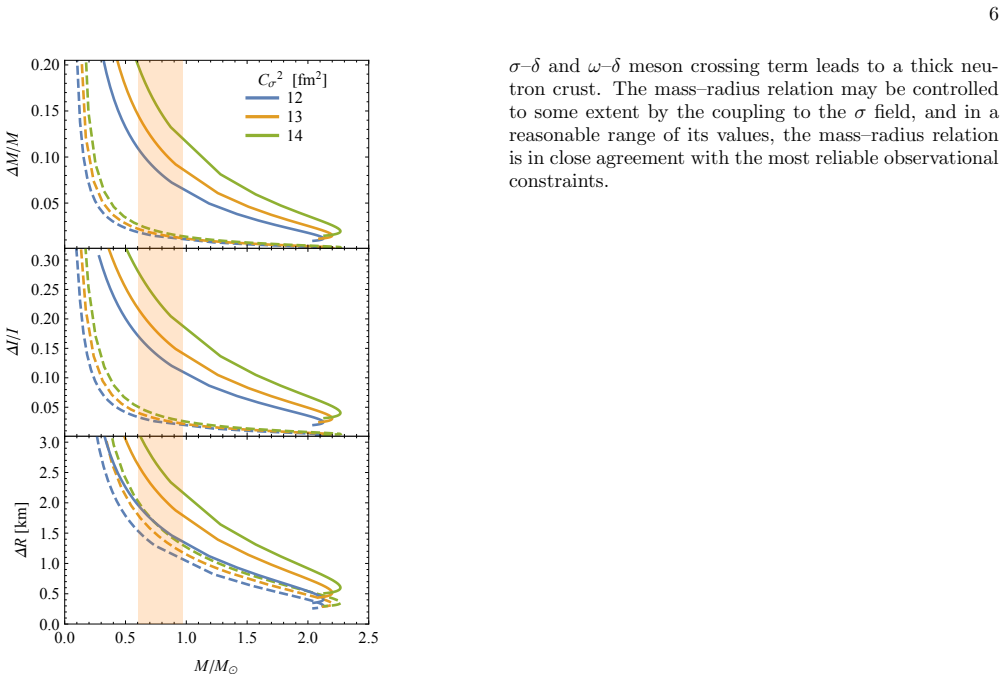
The central claim is that applying the proper Gibbs phase-equilibrium conditions to the CCT model changes where the neutron star crust ends. The authors find that $\beta$-equilibrated matter is unstable for charge fluctuations over a much broader density interval than previously thought: the two-phase system forms at $n_{2\mathrm{ph}} \simeq 0.26$ to $0.30\,\mathrm{fm}^{-3}$ and persists down to $n_{\mathrm{join}} \simeq 0.0025$ to $0.0656\,\mathrm{fm}^{-3}$, where it is joined to the SLy4 crust equation of state. The coexisting phases are a low-density neutron-lepton phase with no protons and a higher-density phase containing protons and leptons, with volume fraction fixed by global charge neutrality; the proton-free phase is described as quasi-nuclei embedded in a neutron fluid, the usual picture of inner-crust matter. Treating the entire two-phase region as the crust places the crust-core transition at roughly $2n_0$ instead of the standard $0.03$ to $0.08\,\mathrm{fm}^{-3}$, and for HESS J1731-347-like stars this makes the crust about 50 percent thicker and raises its mass and moment-of-inertia contributions by a factor of several.
Load-bearing premise
The whole thick-crust picture rests on neglecting the surface tension and electric (Coulomb) energy of the tiny mixed-phase structures; if those effects are sizable, the crust's mass, thickness, and moment of inertia would change even though the density where the mixed phase first appears would not.
Editorial extensions
If this is right
- For HESS J1731-347-like stars, the crust is about 50 percent thicker, and its mass and moment of inertia are several times larger than with the Maxwell construction or standard crust models.
- The crust-core transition density rises to about 0.26 to 0.30 fm$^{-3}$, roughly twice saturation density, instead of the usual 0.03 to 0.08 fm$^{-3}$.
- The mass-radius relation remains compatible with HESS J1731-347, NICER measurements of PSR J0740+6620, PSR J0030+0451 and PSR J0437-4715, GW170817 constraints, and the maximum-mass lower bound, with the $C_\sigma^2 = 14$ model in best agreement with the most massive pulsar constraint.
- In the mixed-phase region the speed of sound stays finite and positive, avoiding the density discontinuity of the Maxwell-construction EOS, and it satisfies the general relativistic kinetic-theory bound even though it exceeds $c/\sqrt{3}$.
- The enlarged crustal mass and moment of inertia would alter the star's thermal evolution and its rotational and glitch properties.
Reading between the lines
- If the same Gibbs construction is applied to other relativistic mean-field models with a low symmetry-energy slope, the charge-fluctuation instability may produce comparably thick crusts, so the result may be generic rather than specific to the CCT model.
- A concrete next step would be computing the finite-size structured mixed phase (nuclear pasta) over the two-phase density range; the paper argues the onset density is unaffected, but crustal mass and moment of inertia would shift if surface and Coulomb energies are significant.
- Observational discrimination could come from pulsar glitches: the predicted several-fold larger crustal moment of inertia would change the glitch-activity pattern, so a precise measurement on a compact low-mass pulsar could support or exclude the thick-crust identification.
Signed reviews
Editorial analysis
A structured set of objections, weighed in public.
Referee Report
Summary. The paper revisits the CCT relativistic mean-field model, previously used to explain the compact low-mass object HESS J1731-347, and replaces the Maxwell construction with a Gibbs construction for the phase transition in beta-equilibrated nucleon-lepton matter. The authors find that the system separates into a low-density neutron-lepton phase and a high-density neutron-proton-lepton phase over densities from about 0.0025 to 0.0656 fm^-3 up to about 0.26 to 0.30 fm^-3. Interpreting the entire two-phase region as the inner crust, they solve the Tolman-Oppenheimer-Volkoff equations and report that for HESS J1731-347-like masses the crust is about 50% thicker, several times more massive, and has a much larger moment of inertia than in standard crust models. Mass-radius relations for three parametrizations are compared with NICER, X-ray burst, and gravitational-wave constraints.
Significance. If the central claim were fully substantiated, the result would be interesting: it would connect a non-exotic, soft low-density equation of state with a qualitatively different prediction for crustal properties, and it would give a concrete interpretation of HESS J1731-347's compactness in terms of a mixed-phase region rather than exotic matter. The manuscript has clear strengths: the Gibbs construction is applied in a thermodynamically consistent way for a system with two conserved charges, the phase diagram and EOS are presented quantitatively in tables and figures, and the mass-radius curves are confronted with a wide set of observations. However, the central claim that this object has a thick crust is not yet established because the calculation neglects surface and Coulomb effects and because the identification of the homogeneous mixed phase with a crustal microstructure is an interpretive step rather than a derived result.
major comments (3)
- [Section III, Eqs. (17)-(18) and Fig. 5] The central quantitative claims—crust thickness, crustal mass fraction, and moment-of-inertia fraction—are computed from the Gibbs mixed-phase EOS without surface or Coulomb terms. The paper's justification that finite-size effects do not change "the density reached by the two-phase system" protects only the upper endpoint n2ph, where the densities of the two phases merge; in the lower-density part of the mixed phase, down to njoin ~ 0.0025-0.0656 fm^-3, the phase densities differ substantially, so surface and Coulomb energies are not negligible and would alter the pressure-density relation used in the TOV integration. The authors should either include a finite-size (pasta) treatment or demonstrate quantitatively that the neglected terms leave the crustal properties in Fig. 5 unchanged.
- [Section III, inner-crust interpretation] The statement that the residual proton-neutron phase "may be interpreted as quasi-nuclei sparsely placed in the region dominated by neutron fluid; such a system corresponds to the inner crust structure" is not derived from the calculation. In the absence of finite-size effects, the two-phase system is a homogeneous mixture of a positively charged npl phase and a negatively charged nl phase; it is not a lattice of quasi-nuclei embedded in a neutron gas. The negatively charged phase is not the standard inner-crust neutron gas, and the charge-separated microstructure (droplets, rods, slabs) that defines a crust is precisely what the neglected surface and Coulomb terms would produce. The title's claim that HESS J1731-347 has a thick crust therefore requires either a finite-size calculation or a more careful restatement that the model predicts a mixed-phase region, not a crust in the usual sense.
- [Section II, Table I, and Section IV] The model parameters, in particular the symmetry-energy slope L = 40 MeV, are chosen to reproduce the compactness of HESS J1731-347, and the three C_sigma^2 values vary only the stiffness at fixed L. No sensitivity study over L or the other couplings is presented, and no uncertainties from the HESS J1731-347 measurement are propagated. Since the existence and density range of the two-phase region depend on the low-density symmetry energy, the answer to the title's question is model-dependent. The authors should show how the crustal properties change when L is varied within its experimentally allowed range, or at least identify the range of L for which the thick-crust phenomenon persists.
minor comments (7)
- [Section IV] The text gives "ncc = 0.056 fm2"; the units should be fm^-3.
- [Section III] The SLy4 EOS is spelled "Sly4" in one place; please use a consistent spelling.
- [Table II] The njoin values for C_sigma^2 = 13 and 14 are identical to four significant digits (0.0656 fm^-3); please clarify whether this is a coincidence or a typographical error.
- [Figure 2] The caption says "energy difference" while the text says "energy of the two-phase system and that of homogeneous, beta-equilibrated matter"; please clarify the quantity and sign convention shown in the lower panel.
- [Figure 3] The speed-of-sound panel would benefit from a legend distinguishing the Gibbs and Maxwell curves, and from an explicit check that the plotted values satisfy the inequality in Eq. (19) over the entire density range.
- [Figure 5] The curves for the three C_sigma^2 values are not labelled directly in the figure; adding labels or a legend would improve readability.
- [Section V] The conclusion that a thick crust "should significantly alter the thermal evolution and rotational properties" is not accompanied by any quantitative estimate; a benchmark calculation (for example, of the crustal moment of inertia or a cooling indicator) would make the observational consequences more concrete.
Circularity Check
No significant circularity: the thick-crust result is a derived consequence of the Gibbs construction applied to a previously parameterized model, not a re-fitted input.
full rationale
The paper's central derivation is self-contained: the CCT model parameters are fixed by saturation properties plus the adopted value L = 40 MeV, taken from the authors' earlier work [11], and the two-phase Gibbs construction is then solved explicitly (Eqs. 1, 15-18) to obtain the mixed-phase region and the crustal properties. The crust thickness, mass, and moment of inertia in Fig. 5 are computed outputs, not quantities used in any fit. The identification of the two-phase region as 'inner crust structure' is an interpretive step, but it is not definitionally circular: the density n2ph at which the homogeneous phase disappears is a genuine model output, and the subsequent assignment of that boundary as the crust-core transition is a physical interpretation rather than a tautology. Self-citations to [11], [16], and [17] provide context and prior parametrization, but the load-bearing phase-coexistence calculation is performed in this paper using standard thermodynamic conditions. The model was indeed previously tuned to reproduce the compactness of HESS J1731-347 via a low symmetry-energy slope, so the object-specific conclusions inherit model-selection dependence; however, this is a matter of model validation and prior dependence, not circular reduction of the derivation to its inputs. No equation is defined in terms of the claimed result, and no fitted parameter is renamed as a prediction. Therefore, no specific circular step can be exhibited under the required standard.
Assumptions & free parameters
free parameters (3)
- L (symmetry energy slope) =
40 MeV
- C_sigma^2 =
12, 13, 14 fm^2
- C_omega^2, b, c, C_rho^2, C_delta^2 =
Values in Table I
assumptions (4)
- domain assumption The CCT Lagrangian with sigma-delta and omega-delta crossing terms is a valid effective nuclear interaction.
- standard math The Gibbs conditions (equality of pressure and chemical potentials for species present in both phases) are the correct treatment for two-phase equilibrium in charge-neutral baryonic matter.
- ad hoc to paper Finite-size (surface and Coulomb) effects can be neglected for determining the density range of the mixed phase.
- domain assumption The outer crust can be described by the SLy4 EOS joined at a pressure-equality point.
Cite this review
Pith. "Pith review of Does HESS J1731-347 have a thick crust ?." pith.science (2026). https://pith.science/paper/NLHRIJJR
@misc{pith2026250706837,
  author       = {Pith},
  title        = {Pith review of: Does HESS J1731-347 have a thick crust ?},
  year         = {2026},
  howpublished = {\url{https://pith.science/paper/NLHRIJJR}},
  note         = {Machine review of arXiv:2507.06837}
}
read the original abstract
A relativistic mean-field model with a crossing term of isovector-scalar and isoscalar mesons, the Cracow crossing terms (CCT) model, has previously been shown to be capable of explaining the light and compact object HESS J1731-347. Here, the model is supplemented with a correct treatment of the phase transition. Applying the thermodynamically consistent Gibbs conditions shows that a mixed-phase system occurs in the core of the neutron star over a wide range of densities, extending up to the neutron star crust, leading to an intriguing stellar structure with a thick and massive crust.
Figures


Figures from the paper (2 more)

Forward citations
Cited by 1 Pith paper
-
Impact of Kaon Condensation on the Thermal Evolution of the CCO in HESS J1731--347 Supernova Remnant
Kaon-condensed equations of state that fit HESS J1731–347’s mass and radius overcool the star, so they cannot also match its high surface temperature.
Reference graph
Works this paper leans on
- [17]
-
[1]
2.×10 14 4.×10 14 6.×10 14 0.0 0.1 0.2 0.3 0.4 0.5 0.6 0.7 ρ[g/cm 3] vs/c Cσ2 [fm2] 12 13 14 FIG. 3. Plots of EOSs for three models. The dashed lines represent EOSs based on the Maxwell construction. 5 9 10 11 12 13 14 15 16 R [km] 0,0 1,0 2,0M[MO. ] PSR J0030+0451 GW190814 PSR 0437-4715 PSR J1231-1411 GW170817 PSR J0740+6620 GW170817 excluded GW170817 ex...
-
[2]
V. Doroshenko, V. Suleimanov, G. P¨ uhlhofer, and A. Santangelo, Nat. Astron. 6, 1444 (2022)
work page 2022
-
[3]
M. Veselsky, P. S. Koliogiannis, V. Petousis, J. Leja, and C. C. Moustakidis, Phys. Lett. B 860, 139185 (2025)
work page 2025
-
[4]
E. Fonseca, H. T. Cromartie, T. T. Pennucci, P. S. Ray, A. Y. Kirichenko, S. M. Ransom, P. B. Demorest, I. H. Stairs, Z. Arzoumanian, L. Guillemot, et al. As- trophys. J. Lett. 915 (1), L12 (2021)
work page 2021
-
[5]
P. Laskos-Patkos, P. S. Koliogiannis, and C. C. Mous- takidis, Phys. Rev. D 109 (6), 063017 (2024)
work page 2024
-
[6]
P. Laskos-Patkos, G. A. Lalazissis, S. Wang, J. Meng, P. Ring, and C. C. Moustakidis, Phys. Rev. C 111 (2), 025801 (2025)
work page 2025
- [7]
Show all 33 references
-
[8]
Miyatsu, M
T. Miyatsu, M. K. Cheoun, and K. Saito, Astrophys. J. 929, 82 (2022)
2022
-
[9]
C. J. Xia, W. J. Xie, and M. Bakhiet, Phys. Rev. D 110 (11), 114009 (2024)
2024
-
[10]
F. Li, B. J. Cai, Y. Zhou, W. Z. Jiang, and L. W. Chen, Astrophys. J. 929 (2), 183 (2022)
2022
-
[11]
Miyatsu, M
T. Miyatsu, M. K. Cheoun, K. Kim, and K. Saito, Front. Phys. 12, 1531475 (2024)
2024
-
[12]
Kubis, W
S. Kubis, W. W´ ojcik, D. A. Castillo, and N. Zabari, Phys. Rev. C 108 (4), 045803 (2023)
2023
-
[13]
Hong and Z
B. Hong and Z. Ren, Phys. Rev. D 109 (2), 023002 (2024)
2024
-
[14]
Lope-Oter and A
E. Lope-Oter and A. Wojnar, J. Cosmol. Astropart. Phys. 01, 054 (2025)
2025
-
[15]
N. K. Glendenning, Compact Stars: Nuclear Physics, Particle Physics, and General Relativity (Springer- Verlag, New York, 1997)
1997
-
[16]
Douchin and P
F. Douchin and P. Haensel, Astron. Astrophys. 380, 151 (2001)
2001
-
[18]
Kubis, W
S. Kubis, W. W´ ojcik, and N. Zabari, Phys. Rev. C 102, 065803 (2020)
2020
-
[19]
Bedaque and A
P. Bedaque and A. W. Steiner, Phys. Rev. Lett. 114 (3), 031103 (2015)
2015
-
[20]
T. S. Olson, Phys. Rev. C 63, 015802 (2000)
2000
-
[21]
Akmal, V
A. Akmal, V. R. Pandharipande, and D. G. Ravenhall, Phys. Rev. C 58, 1804 (1998)
1998
-
[22]
Typel, Phys
S. Typel, Phys. Rev. C 89, 064321 (2014)
2014
-
[23]
Chamel, A
N. Chamel, A. F. Fantina, J. M. Pearson, and S. Goriely, Phys. Rev. C 84, 062802(R) (2011)
2011
-
[24]
F. J. Fattoyev, C. J. Horowitz, J. Piekarewicz, and B. Reed, Phys. Rev. C 102 (6), 065805 (2020). 7
2020
-
[25]
M. C. Miller, F. K. Lamb, A. J. Dittmann, S. Bog- danov, Z. Arzoumanian, K. C. Gendreau, S. Guillot, W. C. G. Ho, J. M. Lattimer, M. Loewenstein, et al. Astrophys. J. Lett. 918, L28 (2021)
2021
-
[26]
M. C. Miller, F. K. Lamb, A. J. Dittmann, S. Bogdanov, Z. Arzoumanian, K. C. Gendreau, S. Guillot, A. K. Hard- ing, W. C. G. Ho, J. M. Lattimer, et al. Astrophys. J. Lett. 887, L24 (2019)
2019
-
[27]
Choudhury, T
D. Choudhury, T. Salmi, S. Vinciguerra, T. E. Riley, Y. Kini, A. L. Watts, B. Dorsman, S. Bogdanov, S. Guil- lot, P. S. Ray, et al. Astrophys. J. Lett. 971 (1), L20 (2024)
2024
-
[28]
L. Qi, S. Zheng, J. Zhang, M. Ge, A. Li, S. N. Zhang, F. Lu, F. J. Lu, H. Peng, H. L. Peng, et al. Astrophys. J. 981 (2), 99 (2025)
2025
-
[29]
Salmi, J
T. Salmi, J. S. Deneva, P. S. Ray, A. L. Watts, D. Choudhury, Y. Kini, S. Vinciguerra, H. T. Cromartie, M. T. Wolff, Z. Arzoumanian, et al. Astrophys. J. 976 (1), 58 (2024)
2024
-
[30]
N¨ attil¨ a, M
J. N¨ attil¨ a, M. C. Miller, A. W. Steiner, J. J. E. Kajava, V. F. Suleimanov, and J. Poutanen, Astron. Astrophys. 608, A31 (2017)
2017
-
[31]
E. R. Most, L. J. Papenfort, L. R. Weih, and L. Rezzolla, Mon. Not. Roy. Astron. Soc. 499, L82 (2020)
2020
-
[32]
Bauswein, O
A. Bauswein, O. Just, H. T. Janka, and N. Stergioulas, Astrophys. J. Lett. 850, L34 (2017)
2017
-
[33]
Annala, T
E. Annala, T. Gorda, A. Kurkela, and A. Vuorinen, Phys. Rev. Lett. 120, 172703 (2018)
2018
Reviewed August 6, 2026 · model on record in the stance chip above.
Discussion (0). Continue with ORCID to comment.