REVIEW 3 major objections 5 minor 38 references
Higher-order topological insulators in a crisscross antiferromagnetic model
T0 review · 3 major / 5 minor · reviewed 2026-08-14 · deepseek-v4-flash
Pith's one-line read The crisscross antiferromagnetic model realizes second-order topological insulator phases with quantized corner charges and chiral hinge states.
desk verdict Solid 2D magnetic HOTI model with quantized MQM; the 3D chiral hinge claim needs a caveat about an extra Zeeman term that the abstract omits. read the letter →
The pith
A machine-rendered reading of the paper's core claim, the machinery that carries it, and where it could break.
The reading
What carries the argument
The machinery is a four-site square-lattice tight-binding Hamiltonian whose spin configuration and hopping phases are fixed by the magnetic point group $4'/m'$; the two independent real parameters $\lambda_1$ and $\lambda_3$ control intra- and intercell hopping, and the dispersion $E(\mathbf{k})=\pm 2\sqrt{\lambda_1^2+\lambda_3^2+\lambda_1\lambda_3(\cos k_x+\cos k_y)}$ has doubly degenerate bands throughout the Brillouin zone. The classification runs through the unitary rotoinversion $\mathcal{S}_4=\mathcal{P}\mathcal{C}_{4z}$: its eigenvalues at $\Gamma$ and $M$ fix each occupied band's Wannier-center coordinate via $P_{x/y}=\frac e2(\eta_M/\eta_\Gamma \bmod 2)$, so the transition at $|\lambda_1|=|\lambda_3|$ is exactly the Wannier centers moving from the cell center to its corners. The same $\mathcal{S}_4$ eigenvalue data at the four $\mathcal{S}_4$-invariant momenta $\Gamma$, $M$, $Z$, and $R$ enters the $\mathbb{Z}_2$ invariant $(-1)^v=\xi_R\xi_M/\xi_Z\xi_\Gamma$ for the 3D stack, and the mirror-time-reversal symmetry $\mathcal{M}_z\mathcal{T}$ confines all moments to the $xy$-plane to produce the quantized magnetic quadrupole moment.
What would settle it
In the tight-binding model, the decisive calculation is to add a symmetry-breaking term that tilts the spins out of the $xy$-plane and track the four corner states: if they split or move off zero energy before the bulk gap closes, the claimed $\mathbb{Z}_2$ protection fails. Experimentally, neutron diffraction or torque magnetometry showing ordered moments canted out of the plane would falsify the model's magnetic premise.
Extended reading notes
Core claim
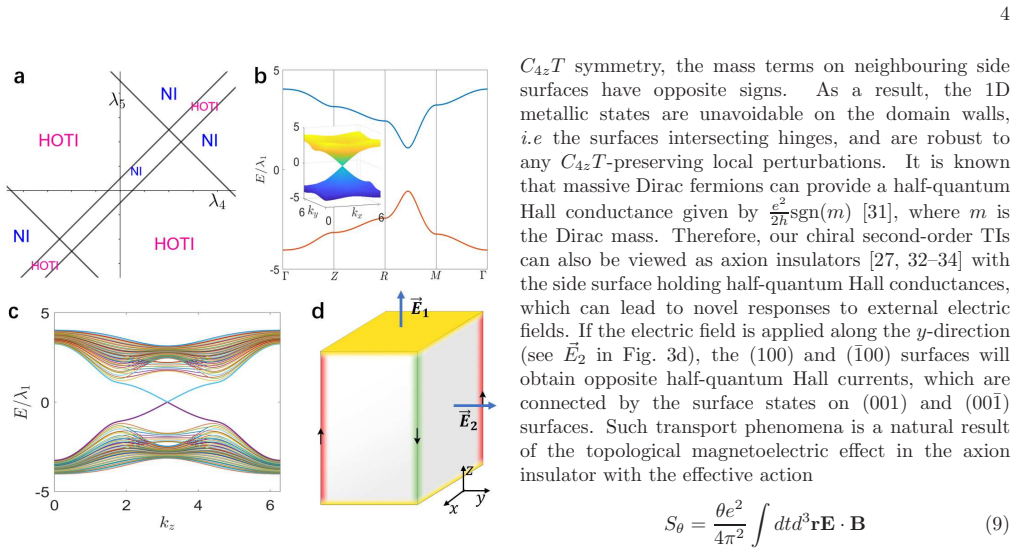
The central discovery is that a single symmetry-enforced crisscross antiferromagnetic lattice realizes higher-order topological insulating phases in both two and three dimensions. In 2D, the $4'/m'$ symmetries force the Wannier centers of the occupied bands to sit at the unit-cell center in the trivial phase and at the unit-cell corners in the nontrivial phase; the corner phase has $q_{xy}=e/2$, four corner states each with fractional charge $e/2$, and the quantized magnetic quadrupole tensor $\varrho_{ij}$ of Eq. (5). In 3D, the paper shows that placing the $k_z=0$ and $k_z=\pi$ planes in opposite 2D phases produces chiral one-dimensional hinge states connecting valence and conduction bands, with a $\mathbb{Z}_2$ invariant $v$ determined by $\mathcal{S}_4$ eigenvalues at $\Gamma$, $M$, $Z$, and $R$. Side surfaces remain insulating but carry massive Dirac cones of opposite mass on neighboring faces, which is exactly what forces the hinge modes to exist; the resulting axion-type response gives half-quantum surface Hall conductances and the proposed spin-flop pumping.
Load-bearing premise
Everything rests on the magnetic moments staying exactly in the $xy$-plane in the crisscross pattern of Fig. 1; any canting, domain formation, or extra Heisenberg term that breaks the combined mirror-time-reversal symmetry $\mathcal{M}_z\mathcal{T}$ removes the quantization of the Wannier centers and with it the charge and magnetic quadrupole moments.
Editorial extensions
If this is right
- In the 2D nontrivial phase, cutting a finite square leaves four zero-energy corner states that share two electrons at half filling, so each corner carries an $e/2$ charge exponentially localized at the corner.
- Because the magnetic quadrupole moment is quantized whenever the Wannier centers sit at the cell corners, the corner phase is not only a charge quadrupole insulator but also a magnetic quadrupole insulator, a combination absent from prior charge-only quadrupole models.
- The 3D model is a chiral second-order topological insulator whenever condition (8) holds, and its $\mathbb{Z}_2$ invariant distinguishes it from the $\mathbb{Z}_4$ classification of $\mathrm{EuIn}_2\mathrm{As}_2$.
- An electric field along $y$ induces opposite half-quantum Hall currents on the two $x$-normal side surfaces, connected by the surface states on the top and bottom faces, a manifestation of the topological magnetoelectric effect with axion angle $\theta=\pi$.
- An electric field along $z$ pumps charge from two diagonal hinges to the other two; because the hinge spins are pinned in the $xy$-plane by $\mathcal{M}_z\mathcal{T}$, the spin direction flips on each side surface, giving the half-quantum spin-flop pumping signature.
Reading between the lines
- The paper leaves implicit that any material with the same magnetic point group and a band inversion at an $\mathcal{S}_4$-invariant momentum should show identical corner charges and magnetic-quadrupole quantization, regardless of the microscopic hopping details.
- A direct test of the model's rigidity is to add a small canting angle $\delta$ that tilts the moments out of the $xy$-plane; if the four corner states split before the bulk gap closes, the topological phase is destroyed by spin fluctuations at finite temperature, which the paper does not analyze.
- The same Wannier-center bookkeeping likely extends to other magnetic point groups combining time reversal with fourfold rotation, in which case a quantized magnetic quadrupole moment would be a general feature of such antiferromagnetic higher-order topological insulators rather than a crisscross-lattice speciality.
Signed reviews
Editorial analysis
A structured set of objections, weighed in public.
Referee Report
Summary. The manuscript introduces a two-dimensional (2D) and a three-dimensional (3D) tight-binding model with a crisscross antiferromagnetic order on a square lattice, designed to respect the magnetic point group 4'/m' generated by C4zT and PT. In 2D, the authors find that for |λ1| < |λ3| the system is a second-order topological insulator (HOTI) with Wannier centers at the unit-cell corners, four zero-energy corner states carrying fractional charge e/2, a quantized charge quadrupole moment qxy = e/2, and a quantized magnetic quadrupole moment given by Eq. (5). The 3D model stacks such layers with kz-dependent hoppings, and the authors claim that when condition (8) holds, the system realizes a 3D HOTI with chiral hinge states, characterized by a Z2 invariant v defined through S4 eigenvalues. They also discuss axion-insulator-like transport, including half-quantized Hall conductance on side surfaces and half-quantum spin-flop pumping.
Significance. If the claims hold, this is a valuable minimal model of a magnetic HOTI with simultaneous quantized charge and magnetic quadrupole moments, and a concrete tight-binding setting for chiral hinge transport. The 2D part is well supported: the phase boundary follows from the analytic dispersion, the S4 eigenvalue counting is explicit, and the corner states and e/2 corner charges are confirmed by direct diagonalization of a 20×20 sample. The transport discussion is standard axion-insulator physics applied to the model. The main weakness is the overstatement of the 3D HOTI phase; the bare 3D model has a gapless (001) surface, so the chiral hinge phase is conditional on an additional Zeeman term not present in Eq. (6).
major comments (3)
- [Abstract and 3D Model (Eq. (6), Fig. 3b inset)] The abstract claims that the 3D system 'possesses the HOTI phase holding chiral 1D metallic states on the hinge,' but the bare Hamiltonian (6) is not a second-order topological insulator by the definition given in the introduction, which requires all (D−1)-dimensional boundaries to be gapped. The 3D Model section explicitly states that with open boundary in z the (001) surface 'is not gapped but exhibit a Dirac cone' (inset of Fig. 3b), protected by PT, and that only after applying a magnetic field along z, which breaks C4zT but preserves S4, do connected hinge states appear in a hexahedron sample. This is a load-bearing mismatch: the central 3D result is true only for a modified model not given in Eq. (6). Please qualify the claim, give the Zeeman term explicitly, and recompute (or state the invariance of) the v=1 invariant in that setting.
- [3D Model (Eq. (7), condition (8))] The invariant v defined in Eq. (7) is computed from S4 eigenvalues of the 4'/m' Hamiltonian and is used to label the 'HOTI phase' via condition (8). However, a bulk S4 eigenvalue invariant by itself does not certify that all surfaces are gapped, and indeed the (001) surface is gapless here. The hinge-state calculation in Fig. 3c uses open boundaries only in x and y (with z periodic), so it does not probe the gapless z-normal surfaces. Please clarify what exactly v=1 classifies for the bare Hamiltonian, and how the classification changes after the S4-preserving Zeeman term is added: which high-symmetry points remain S4-invariant and whether the eigenvalue ratios entering Eq. (7) are unchanged.
- [2D Model (Eq. (5))] The magnetic quadrupole moment tensor in Eq. (5) is a central advertised result, described as 'a unique feature compared with previous studies,' but the derivation is only sketched in one paragraph. Please show explicitly how the entries of the 3×3 matrix follow from the Wannier-center coordinates (0 or 1/2) and the local moment directions on the four sites, including the sign pattern, and state the units and factors clearly. Without this, a reader cannot verify the claimed quantization.
minor comments (5)
- [Title] The title contains a typo: 'antif erromagnetic' should be 'antiferromagnetic'.
- [Introduction, first paragraph] The phrase '1/4 quantum magnetic quadrupole moment' in the introduction is inconsistent with the abstract's 'quantized magnetic quadrupole moment'; if the entries of Eq. (5) are meant, specify that the tensor components have magnitude g μB/4.
- [Eq. (4)] Equation (4) is dimensionally ambiguous: ηM/ηΓ is a phase, so 'modulo 2' likely means taking the phase modulo 2π and dividing by π; please rewrite the formula as P^n_{x/y} = (e/2π) arg(η^n_M/η^n_Γ) or the equivalent used in Ref. [17].
- [Fig. 3b inset text] The sentence 'Two Dirac cone come from up and down surface degenerate at Fermi level' should be reworded for grammar and to indicate which surfaces the two cones belong to.
- [References] Reference [28] is cited as a proposed chiral HOTI (EuIn2As2); please check the journal/volume data and ensure the classification Z4 statement matches that reference.
Circularity Check
No significant circularity: the topological invariants and corner/hinge states are computed from the explicit model Hamiltonian using established formulas, not fitted or defined into existence.
full rationale
The paper's central claims are derived self-contained from the symmetry-constrained tight-binding Hamiltonian H(k) in Eq. (2) and H3D(k) in Eq. (6). The 2D phase distinction |lambda1| < |lambda3| follows from the explicit dispersion E(k) = ±2*sqrt(lambda1^2 + lambda3^2 + lambda1*lambda3(cos kx + cos ky)); the charge quadrupole moment in Eq. (3) is computed with the standard S4-eigenvalue formula of Eq. (4) from the explicitly listed representations eta_M and eta_Gamma, not imposed as an input. The magnetic quadrupole moment in Eq. (5) is derived from the symmetry-forced Wannier-center positions (0 or 1/2) and the pinned spin pattern, which are model inputs, but the quantized tensor is a consequence, not a restatement of those inputs. The 3D HOTI invariant in Eq. (7) is the standard S4-eigenvalue formula, and the condition Eq. (8) follows from requiring opposite 2D phases at kz=0 and kz=pi, again derived from the explicit dispersion. No fitted parameter is renamed as a prediction, and no load-bearing step relies on a self-citation; the cited references (Benalcazar et al., Schindler et al., Ezawa) are external established results. The paper's disclosure that the (001) surface hosts a PT-protected Dirac cone and that an additional S4-preserving magnetic field is needed for connected hinge states is a physical limitation of the bare 3D Hamiltonian, not a circularity; it affects correctness or scope of the 3D claim but does not reduce the derivation to its inputs.
Assumptions & free parameters
assumptions (4)
- domain assumption The 4'/m' symmetry action in Eq. (1) captures the magnetic order and fixes all allowed nearest-neighbor hoppings in Eq. (2).
- standard math Eq. (4) expressing polarization through S4 eigenvalues at Gamma and M is valid for this band structure.
- standard math The 3D invariant formula (-1)^v = xi_R xi_M / (xi_Z xi_Gamma) (Eq. 7) correctly classifies the phase under 4'/m'.
- standard math Massive Dirac fermions contribute half-quantized Hall conductance and the axion action S_theta = theta e^2/(4 pi^2) integral E dot B with theta = pi applies to this 3D phase.
Cite this review
Pith. "Pith review of Higher-order topological insulators in a crisscross antiferromagnetic model." pith.science (2026). https://pith.science/paper/NLW5VXSR
@misc{pith2026190809309,
  author       = {Pith},
  title        = {Pith review of: Higher-order topological insulators in a crisscross antiferromagnetic model},
  year         = {2026},
  howpublished = {\url{https://pith.science/paper/NLW5VXSR}},
  note         = {Machine review of arXiv:1908.09309}
}
abstract
We present a $4'/m'$-respecting crisscross AFM model in 2D and 3D, both belonging to the $Z_2$ classification and exhibiting interesting magnetic high-order topological insulating (HOTI) phases. The topologically nontrivial phase in the 2D model is characterized by the fractional charge localized around the corners and the quantized charge quadrupole moment. Moreover, our 2D model also exhibits the quantized magnetic quadrupole moment, which is a unique feature compared with previous studies. The 3D system stacked from layers of the 2D model possesses the HOTI phase holding chiral 1D metallic states on the hinge, which corresponds to the Wannier center flow between the valence and conduction bands. The novel transport properties such as the half-quantum spin-flop pumping phenomena on the side surfaces of the HOTI phase is also discussed.
Figures


Reference graph
Works this paper leans on
-
[1]
We note that the intracell next-nearest-neighbor hopping t2 is zero due to the P T symmetry
Such constraint also applies to the intercell nearest-neighbor hopping t3, which can be written as t3 = √ 2λ3 e−iπ/ 4 with λ3 being real. We note that the intracell next-nearest-neighbor hopping t2 is zero due to the P T symmetry. By setting the lattice constants |a1| = |a2| to be unity, the Hamiltonian under the constraints of the MPG 4 ′/m′ in the momen...
-
[2]
Then P T and C4zT act on these basis states as: P T c† α (P T)−1 = (i)α +2c† α +2, C4zT c† α (C4zT )−1 = e−i π 4 (i)α +2c† α +1. (1) Yielding to the constrain of 4 ′/m′ symmetries, the intra- cell nearest-neighbor hopping from site 2 to site 1 can be defined as t1 = √ 2λ1 e−iπ/ 4, with λ1 being real, then the C4zT symmetry immediately requires the hopping ...
-
[3]
C. L. Kane and E. J. Mele, Phys. Rev. Lett. 95, 146802 (2005)
2005
-
[4]
surfaces will obtain opposite half-quantum Hall currents, which are connected by the surface states on (001) and (00 ¯ 1) surfaces. Such transport phenomena is a natural result of the topological magnetoelectric effect in the axion insulator with the effective action Sθ = θe2 4π2 ∫ dtd3rE · B (9) where the axion angle θ = π [33]. More interestingly, if the ...
-
[5]
M. Z. Hasan and C. L. Kane, Rev. Mod. Phys. 82, 3045 (2010)
2010
-
[6]
Qi and S.-C
X.-L. Qi and S.-C. Zhang, Rev. Mod. Phys. 83, 1057 (2011)
2011
-
[7]
Fu, Phys
L. Fu, Phys. Rev. Lett. 106, 106802 (2011)
2011
-
[8]
B. A. Bernevig, T. L. Hughes, and S.-C. Zhang, Science 314, 1757 (2006)
2006
Show all 38 references
-
[9]
L. Fu, C. L. Kane, and E. J. Mele, Phys. Rev. Lett. 98, 106803 (2007)
2007
-
[10]
Zhang, C.-X
H. Zhang, C.-X. Liu, X.-L. Qi, X. Dai, Z. Fang, and S.-C. Zhang, Nature Physics 5, 438 (2009)
2009
-
[11]
Topo- logical crystalline insulators,
T. Neupert and F. Schindler, “Topo- logical crystalline insulators,” in Topological Matter: Lectures from the Topological Matter S chool 2017 , edited by D. Bercioux, J. Cayssol, M. G. Vergniory, and M. Reyes Calvo (Springer International Publishing, Cham, 2018) pp. 31–61
2017
-
[12]
T. H. Hsieh, H. Lin, J. Liu, W. Duan, A. Bansil, and L. Fu, Nature Communications 3, 982 (2012). 5
2012
-
[13]
C.-K. Chiu, J. C. Y. Teo, A. P. Schnyder, and S. Ryu, Rev. Mod. Phys. 88, 035005 (2016)
2016
-
[14]
Zhang and C.-X
R.-X. Zhang and C.-X. Liu, Phys. Rev. B 91, 115317 (2015)
2015
-
[15]
Z. Song, Z. Fang, and C. Fang, Phys. Rev. Lett. 119, 246402 (2017)
2017
-
[16]
Z. Song, T. Zhang, Z. Fang, and C. Fang, Nature Communications 9, 3530 (2018)
2018
-
[17]
W. A. Benalcazar, B. A. Bernevig, and T. L. Hughes, Science 357, 61 (2017)
2017
-
[18]
W. A. Benalcazar, B. A. Bernevig, and T. L. Hughes, Phys. Rev. B 96, 245115 (2017)
2017
-
[19]
Z. Wang, B. J. Wieder, J. Li, B. Yan, and B. A. Bernevig, (2018), http://arxiv.org/abs/1806.11116v1
2018 arXiv
-
[20]
Langbehn, Y
J. Langbehn, Y. Peng, L. Trifunovic, F. von Oppen, and P. W. Brouwer, Phys. Rev. Lett. 119, 246401 (2017)
2017
-
[21]
Schindler, A
F. Schindler, A. M. Cook, M. G. Vergniory, Z. Wang, S. S. P. Parkin, B. A. Bernevig, and T. Neupert, Science Advances 4 (2018)
2018
-
[22]
Schindler, Z
F. Schindler, Z. Wang, M. G. Vergniory, A. M. Cook, A. Murani, S. Sengupta, A. Y. Kasumov, R. De- block, S. Jeon, I. Drozdov, H. Bouchiat, S. Guron, A. Yazdani, B. A. Bernevig, and T. Neupert, Nature Physics 14, 918 (2018)
2018
-
[23]
F. Tang, H. C. Po, A. Vishwanath, and X. Wan, Nature 566, 486 (2019)
2019
-
[24]
Bradlyn, L
B. Bradlyn, L. Elcoro, J. Cano, M. G. Vergniory, Z. Wang, C. Felser, M. I. Aroyo, and B. A. Bernevig, Nature 547, 298 (2017)
2017
-
[25]
H. C. Po, A. Vishwanath, and H. Watanabe, Nature Communications 8, 50 (2017)
2017
-
[26]
Zhang, Y
T. Zhang, Y. Jiang, Z. Song, H. Huang, Y. He, Z. Fang, H. Weng, and C. Fang, Nature 566, 475 (2019)
2019
-
[27]
C. Yue, Y. Xu, Z. Song, H. Weng, Y.-M. Lu, C. Fang, and X. Dai, Nature Physics (2019)
2019
-
[28]
van Miert and C
G. van Miert and C. Ortix, Phys. Rev. B 98, 081110 (2018)
2018
-
[29]
S. H. Kooi, G. van Miert, and C. Ortix, Phys. Rev. B 98, 245102 (2018)
2018
-
[30]
Ezawa, Phys
M. Ezawa, Phys. Rev. B 97, 155305 (2018)
2018
-
[31]
B. A. Bernevig and T. L. Hughes, Topological Insulators and Topological Superconductors (Princeton university press, 2013)
2013
-
[32]
Y. Xu, Z. Song, Z. Wang, H. Weng, and X. Dai, Phys. Rev. Lett. 122, 256402 (2019)
2019
-
[33]
Okuma, M
N. Okuma, M. Sato, and K. Shiozaki, Phys. Rev. B 99, 085127 (2019)
2019
-
[34]
Liu, H.-Y
F. Liu, H.-Y. Deng, and K. Wakabayashi, Phys. Rev. Lett. 122, 086804 (2019)
2019
-
[36]
B. J. Wieder and B. A. Bernevig, http://arxiv.org/abs/1810.02373v1
-
[37]
A. M. Essin, J. E. Moore, and D. Vanderbilt, Phys. Rev. Lett. 102, 146805 (2009)
2009
-
[38]
R. S. K. Mong, A. M. Essin, and J. E. Moore, Phys. Rev. B 81, 245209 (2010)
2010
-
[100]
Due to the C4zT symmetry, the mass terms on neighbouring side surfaces have opposite signs
are all gapped by mass terms, resulting in the massive Dirac fermion behavior. Due to the C4zT symmetry, the mass terms on neighbouring side surfaces have opposite signs. As a result, the 1D metallic states are unavoidable on the domain walls, i.e the surfaces intersecting hin...
Reviewed August 14, 2026 · model on record in the stance chip above.
Discussion (0). Continue with ORCID to comment.