REVIEW 3 major objections 6 minor 44 references
Constrained Optimization via Constraint-Induced Geometry: Implicit Feasible Dynamics and Optimality from Stationarity
T0 review · 3 major / 6 minor · reviewed 2026-08-05 · deepseek-v4-flash
Pith's one-line read Stationary flows satisfy KKT with feasibility built in
desk verdict Useful synthesis with a real gap: continuous-time KKT from stationarity works, but the discrete-time simplex/box KKT claim is unproven as written. read the letter →
The pith
A machine-rendered reading of the paper's core claim, the machinery that carries it, and where it could break.
The reading
What carries the argument
The central object is the constraint-induced geometry: the Jacobian-induced metric $G(u)=J_g(u)$ on vector domains (chosen over the pullback metric to keep the u-dynamics simple and to let the Jacobian vanish exactly at active faces), the Fisher-Shahshahani operator $G(x)=\operatorname{diag}(x)-xx^T$ on the simplex, and the canonical metric with skew field $A(X)=\nabla\Phi(X)X^T-X\nabla\Phi(X)^T$ on the Stiefel manifold. This object does three jobs: it keeps every continuous and discrete trajectory feasible by construction; it turns stationarity into KKT through null-speed and rank-deficiency arguments; and it makes implicit discretizations (backward Euler, KL-prox, Cayley update) into Bregman-proximal or resolv
What would settle it
On a small NNLS problem, run the orthant method with a deliberately loose inner tolerance for many outer iterations and monitor the KKT residual: if it stalls above zero while the exact-update version drives it to zero, the transfer of the KKT characterization to inexact solvers is false. Separately, build a convex problem with a rapidly oscillating metric (large drift) and check whether iterates converge to a non-stationary point, which would show the drift condition in the variable-metric theorem is genuinely necessary.
Extended reading notes
Core claim
At the center is the 'kinematic slackness' mechanism. Feasibility is built into the flow by $x=g(u)$; with the Jacobian-induced metric, the primal velocity is $\dot{x}=-J_g(u)\nabla f(x)$. Since $J_g$ vanishes on active faces or has rank n-1 with kernel $\operatorname{span}\{1\}$ on the simplex, vanishing velocity forces the normal component of the gradient to vanish at the limit: for the exponential map this is written as the identity $x_i \nabla_i f(x) = -\dot{x}_i$, i.e., complementary slackness is a kinematic statement. The paper proves that the same conclusion holds for convergent implicit sequences whose stepsizes are bounded away from zero; on the orthant the discrete update is exactly the multiplicative update
Load-bearing premise
The discrete-time KKT result assumes the inner equations are solved exactly; when they are only solved approximately, the paper shows rates are preserved but does not prove the limit still satisfies KKT, and the variable-metric proof needs the coordinate system to change slowly, a condition it assumes without checking.
Editorial extensions
If this is right
- On orthant and box domains, backward Euler in the reparameterized variable is a Bregman-prox step, so convex objectives decrease monotonically and converge at O(1/k) with no restriction on step size.
- On the simplex, the implicit KL-prox step avoids the rank-deficient Jacobian in the inner solve; the Newton-KKT system is SPD, and convergent interior sequences satisfy the simplex KKT conditions.
- On the Stiefel manifold, the implicit Cayley update preserves X^T X=I exactly, and a zero Riemannian-gradient limit satisfies the first-order optimality condition for orthogonality constraints.
- When inner solves are inexact but residuals are summable, the convex and nonconvex rates of the exact implicit scheme survive.
- For nonconvex objectives satisfying Kurdyka-Lojasiewicz, the Bregman scheme converges to a critical point with the standard finite/linear/sublinear rate trichotomy; under a Bregman-PL condition it is linearly convergent for any positive step size.
Reading between the lines
- The null-speed mechanism should transfer to any smooth reparameterization whose Jacobian loses rank exactly on the active set; a testable extension is to cones or product sets built from smooth inequality constraints.
- The variable-metric theorem's drift condition suggests a practical safeguard: growth of the step size should be gated by the ratio ||G_{k+1}-G_k|| / ||x_{k+1}-x_k||, giving a computable certificate for the no-stepsize-cap regime.
- The implicit multiplicative update on the orthant identifies the KKT mechanism of classical multiplicative updates and may extend their convergence theory beyond nonnegative least squares to general smooth objectives.
- Viewing the Stiefel Cayley step as a trapezoidal discretization points toward higher-order implicit integrators (BDF-type) as a route to accelerated feasible manifold methods; the paper itself lists inertial and accelerated variants as open directions.
Editorial analysis
A structured set of objections, weighed in public.
Referee Report
Summary. The paper proposes a unified geometry-based framework for constrained optimization: feasible sets are encoded via reparameterizations whose Jacobians vanish at the boundary (orthant, box), via the Fisher–Shahshahani/KL geometry (simplex), or via the canonical Riemannian structure (Stiefel). The continuous-time dynamics are shown to be gradient-like, and the paper argues that stationarity of these dynamics implies KKT conditions. Implicit (backward-Euler/Bregman-prox/Cayley) discretizations are introduced, with convergence results in convex, strongly convex, and nonconvex (KL) settings, and numerical experiments compare the resulting algorithms against standard baselines. The paper also states that convergent implicit sequences generated from the interior recover KKT when stepsizes are bounded away from zero.
Significance. If the main claims hold, the paper would provide a useful unifying perspective: a single kinematic mechanism (vanishing Jacobian or rank-deficient Fisher operator) explains complementary slackness across four constraint geometries, and the implicit schemes have strong stability and convergence properties. The Bregman-proximal convergence theory in Sections 7.2–7.5 is standard and appears correct; the continuous-time KKT derivations are elegant, and the Stiefel Cayley construction is a clean implicit-flow interpretation of existing feasible methods. The paper also provides openly available code and reproducible experiments, which is a notable strength. However, two load-bearing parts of the paper are not yet supported: the discrete-time KKT recovery for simplex/box and the variable-metric convergence theorem as stated. These are fixable but require nontrivial additional analysis or explicit conditions.
major comments (3)
- [§5.2 B and C] The discrete-time KKT claim for the simplex and box is not proven. For the KL-prox step (17)–(18), all finite iterates are strictly interior, so the nonnegativity multipliers λ_{k+1} in the stated KKT system are identically zero. The paper asserts that the limit 'reproduces the continuous-time conditions above' (Eq. 18 and following text), but no argument is given for the limiting inequalities ∇f_i(x*) ≥ τ when x*_i = 0. This requires controlling limsup (log x_{k+1,i} − log x_{k,i})/η_k, which need not tend to 0 and whose sign determines the limiting multiplier. The same gap appears in §5.2 C for the two-sided entropy on a box. Since the algorithms in §6 use exactly these strict-interior prox steps, the claimed KKT recovery for convergent implicit sequences is unsupported for the simplex and box.
- [Theorem 7.8, Eq. (32)] The summed variable-metric inequality contains a positive metric-drift term +(Bτ/2η) Σ ||x_{k+1}−x_k||² that must be dominated by the negative term −(m/2η̄) Σ ||x_{k+1}−x_k||² for the conclusion to yield convergence. No such dominance condition is stated or verified; the theorem only assumes m, M, τ and bounded stepsizes. Without e.g. m η > B τ η̄, Eq. (32) is compatible with divergent increments, and the 'o(1)' in Corollary 7.10 does not rescue the argument because summability of ||x_{k+1}−x_k||² is part of what needs to be proved. This gap affects the claimed global convergence guarantees for the variable-metric (reparameterized orthant/box) constructions.
- [§7.5 and §6 inner solvers] Proposition 7.2 transfers convergence rates to inexact inner solves under a summable-residual condition, but it does not establish that limit points of the inexact implicit updates satisfy KKT. The implemented algorithms in §6 (MGN for orthant/box, Newton–KKT with tolerance for the simplex, Newton–Krylov for Stiefel) compute approximate solves. Even if their residuals are summable, the KKT characterization is a limit statement about the discrete scheme, and no theorem connects the inexact iterates to the KKT system. Thus the practical algorithms, as implemented, do not inherit the KKT guarantee stated in the abstract without an additional argument.
minor comments (6)
- [Title/abstract] The arXiv abstract describes 'Gravidy' while the full-text title and abstract describe a different framing; the two versions should be harmonized before publication.
- [Appendix references] Internal references to 'Appendix 8', 'Appendix 14', 'Appendix 7', and 'Appendix 9' do not match the labeled appendices (A–F) in the compiled text.
- [§2.3.2] The displayed linearization '˙δ = −G ⋆−1H⋆ [G] δ' is garbled; the intended generator/metric structure should be written clearly.
- [Appendix A] In the 1D KKT check for c<0, the paper states 'choose λ⋆ = ab'; with the paper's convention ∇f(x*) − λ* = 0, the correct multiplier is λ* = −ab > 0. This is a sign error in the example.
- [Table 1] Table 1(a) reports a final KKT residual of 5.86e-05 for Gravidy-Pos (MGN), yet Table 1(b) reports a time to tolerance ≤ 1e-8 for the same method. The inconsistency should be resolved or explained.
- [§5.2 D] The Stiefel discrete-time statement says 'if the inner Newton solve drives the residual to zero' the limit satisfies KKT; this quantifier is informal and should be replaced by a precise statement about finite inexact solves.
Circularity Check
No circular reduction found; stationarity-to-KKT is derived from explicitly stated reparameterizations and independently benchmarked. One minor non-load-bearing self-citation and two non-circular proof gaps noted.
full rationale
The paper's central claim, that stationarity of the constructed flows and implicit sequences implies KKT, is a direct mathematical consequence of the explicitly defined reparameterizations rather than a fitted input or a renamed prediction. For the orthant and box, the flow is defined as ẋ = −Jg(u)∇Φ(x) (Eq. 10), so stationarity gives Jg(u⋆)∇Φ(x⋆) = 0; with diagonal Jg positive in the interior and vanishing on active faces, complementarity follows by construction. The discrete orthant result (Eq. 15) is then proven from the exact multiplicative update, and convergence to KKT is argued from the sign of the exponential factor. The simplex continuous-time result (Eq. 16) is the standard Fisher–Shahshahani/replicator flow, and stationarity equalizes active gradients, which is exactly simplex KKT. The Stiefel result uses the standard Riemannian-gradient stationarity characterization from external references [17, 1, 11]. No parameter is fitted and then called a prediction, and no load-bearing uniqueness theorem is imported from the author's prior work. The only self-citation, [25] Leplat et al., appears in related work on β-divergence geometries and is not load-bearing. Two non-circular correctness gaps should be flagged: (i) in Section 5.2 B, the finite-step simplex KL-prox KKT system (Eq. 18) has nonnegativity multipliers identically zero at every finite interior iterate, and the statement 'which in the limit reproduces the continuous-time conditions above' is asserted without a proof constructing limiting multipliers or controlling log-ratio terms; (ii) in Theorem 7.8, Eq. (32) contains a positive metric-drift term +(Bτ/2η)Σ||x_{k+1}−x_k||² that must be dominated by the negative term −(m/2η̄)Σ||x_{k+1}−x_k||² for the claimed convergence to follow, but no such condition is stated or verified. These are omitted-proof/robustness issues, not circularity, and do not raise the circularity score above 2.
Assumptions & free parameters
assumptions (5)
- domain assumption Φ ∈ C^1 on an open set containing C; ∇Φ is L-Lipschitz on compact subsets (Assumptions A1, A2)
- domain assumption Legendre generator h with σh-strong convexity and Lh-smoothness on relevant level sets
- domain assumption Kurdyka-Lojasiewicz property on bounded level sets (Assumption A6)
- domain assumption Reparameterization maps g are C^2 with Jg continuous; g'_i → 0 on active faces for orthant/box; softmax has rank n-1 Jacobian
- domain assumption Relative strong convexity of f with respect to h (Assumption 7.2)
Cite this review
Pith. "Pith review of Constrained Optimization via Constraint-Induced Geometry: Implicit Feasible Dynamics and Optimality from Stationarity." pith.science (2026). https://pith.science/paper/NM5OBTDY
@misc{pith2026250818764,
  author       = {Pith},
  title        = {Pith review of: Constrained Optimization via Constraint-Induced Geometry: Implicit Feasible Dynamics and Optimality from Stationarity},
  year         = {2026},
  howpublished = {\url{https://pith.science/paper/NM5OBTDY}},
  note         = {Machine review of arXiv:2508.18764}
}
read the original abstract
We introduce Gravidy, a geometry-aware framework for constrained optimization in which constraints are encoded directly into the dynamics, so the motion remains feasible by construction. The geometric mechanism depends on the feasible set: componentwise reparameterizations and induced Hessian geometries for the nonnegative orthant and box constraints, Fisher-Shahshahani and KL geometry for the simplex, and canonical Riemannian geometry for the Stiefel manifold. We derive feasible continuous-time flows and implicit discretizations adapted to each geometry. On the vector domains, the implicit updates admit exact Bregman-proximal interpretations, yielding monotone descent and convergence guarantees for convex objectives, linear contraction under relative strong convexity, and a Kurdyka-Lojasiewicz analysis for nonconvex problems under compact-interiority, decrease, and relative-error assumptions. We also show that convergent trajectories generated from the interior recover the Karush-Kuhn-Tucker conditions on the orthant, simplex, and box. The same holds for convergent implicit sequences generated from the interior when their stepsizes are bounded away from zero. On the Stiefel manifold, stationarity of the canonical Riemannian gradient is equivalent to the usual first-order optimality condition. The algorithms combine large implicit outer steps with problem-adapted Newton, modified Gauss-Newton, Newton-KKT, and Newton-Krylov inner solvers. Numerical experiments on nonnegative, simplex-constrained, box-constrained, and orthogonality-constrained problems show rapid convergence to high accuracy in a small number of outer iterations while preserving feasibility of accepted iterates. A sparse elastic-obstacle experiment further shows that the orthant construction can exploit large structured systems directly. This illustrates their accuracy and ability to exploit sparsity in sparse settings.
Figures


Figures from the paper (1 more)

Reference graph
Works this paper leans on
-
[1]
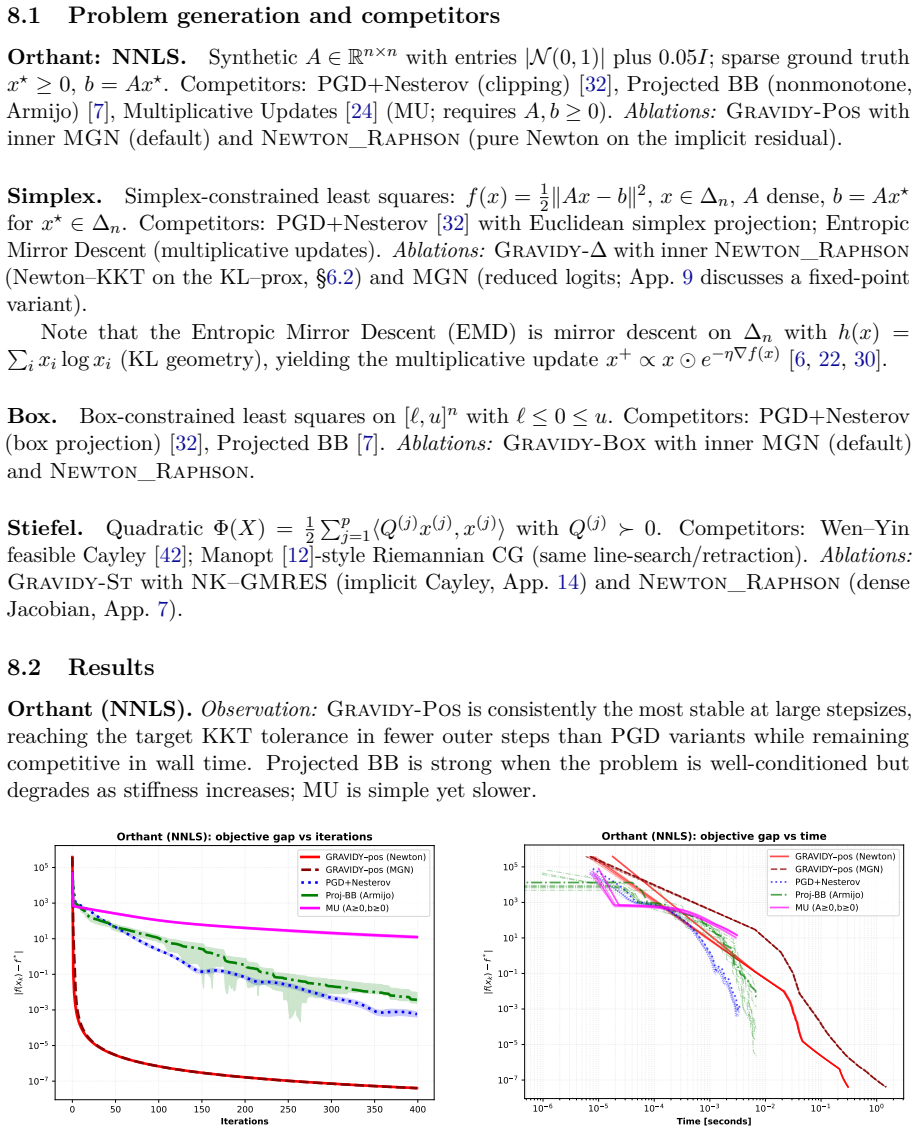
P.-A. Absil, R. Mahony, and R. Sepulchre.Optimization Algorithms on Matrix Manifolds. Princeton University Press, 2008. 27 Table 1: Summary across geometries (lower is better). Boldface marks the best (median) among Gravidyvariants within each geometry. (a) Final KKT residual (Stiefel:∥ grad Φ(X)∥F). Method Orthant Simplex Box Stiefel Gravidy-Pos(MGN) 5.8...
work page 2008
-
[2]
Hedy Attouch, Jérôme Bolte, and Benar F. Svaiter. Convergence of descent methods for semi-algebraic and tame problems: Proximal algorithms, forward–backward splitting, and regularized gauss–seidel methods.Mathematical Programming, 137(1–2):91–129, 2013
work page 2013
-
[3]
Hedy Attouch and Roberto Cominetti. A dynamical approach to convex minimization coupling approximation with the steepest descent method.Journal of Differential Equations, 128(2):519–540, 1996
work page 1996
-
[4]
Hédy Attouch, Juan Peypouquet, and Patrick Redont. A dynamical approach to an inertial forward-backward algorithm for convex minimization.SIAM Journal on Optimization, 24(1):232–256, 2014. 28
work page 2014
-
[5]
Hedy Attouch and Benar Fux Svaiter. A continuous dynamical newton-like approach to solving monotone inclusions.SIAM Journal on Control and Optimization, 49(2):574–598, 2011
work page 2011
-
[6]
Mirror descent and nonlinear projected subgradient methods for convex optimization.Operations Research Letters, 31(3):167–175, 2003
Amir Beck and Marc Teboulle. Mirror descent and nonlinear projected subgradient methods for convex optimization.Operations Research Letters, 31(3):167–175, 2003
2003
-
[7]
Birgin, José Mario Martínez, and Marcos Raydan
Ernesto G. Birgin, José Mario Martínez, and Marcos Raydan. Nonmonotone spectral projected gradient methods on convex sets.SIAM Journal on Optimization, 10(4):1196– 1211, 2000
work page 2000
-
[8]
An algorithm, based on singular perturbation theory, for ill-conditioned minimization problems
Paul T Boggs. An algorithm, based on singular perturbation theory, for ill-conditioned minimization problems. SIAM Journal on Numerical Analysis, 14(5):830–843, 1977
work page 1977
Show all 44 references
-
[9]
The łojasiewicz inequality for nonsmooth subanalytic functions with applications to subgradient dynamical systems.SIAM Journal on Optimization, 17(4):1205–1223, 2007
Jérôme Bolte, Aris Daniilidis, and Adrian Lewis. The łojasiewicz inequality for nonsmooth subanalytic functions with applications to subgradient dynamical systems.SIAM Journal on Optimization, 17(4):1205–1223, 2007
2007
-
[10]
Proximal alternating linearized minimiza- tion for nonconvex and nonsmooth problems.SIAM Journal on Optimization, 24(3):137–164, 2014
Jérôme Bolte, Shoham Sabach, and Marc Teboulle. Proximal alternating linearized minimiza- tion for nonconvex and nonsmooth problems.SIAM Journal on Optimization, 24(3):137–164, 2014
2014
-
[11]
N. Boumal. An Introduction to Optimization on Smooth Manifolds. Cambridge University Press, 2023
2023
-
[12]
Absil, and Rodolphe Sepulchre
Nicolas Boumal, Bamdev Mishra, P.-A. Absil, and Rodolphe Sepulchre. Manopt, a matlab toolbox for optimization on manifolds.Journal of Machine Learning Research, 15(1):1455– 1459, 2014
2014
-
[13]
A fast non-negativity-constrained least squares algorithm
Rasmus Bro and Sijmen De Jong. A fast non-negativity-constrained least squares algorithm. Journal of Chemometrics: A Journal of the Chemometrics Society, 11(5):393–401, 1997
1997
-
[14]
Some effective methods for uncon- strained optimization based on the solution of systems of ordinary differential equations
Andrew A Brown and Michael C Bartholomew-Biggs. Some effective methods for uncon- strained optimization based on the solution of systems of ordinary differential equations. Journal of Optimization Theory and Applications, 62:211–224, 1989
1989
-
[15]
Byrd, Peihuang Lu, Jorge Nocedal, and Ciyou Zhu
Richard H. Byrd, Peihuang Lu, Jorge Nocedal, and Ciyou Zhu. A limited memory algorithm for bound constrained optimization.SIAM Journal on Scientific Computing, 16(5):1190– 1208, 1995
1995
-
[16]
A special stability problem for linear multistep methods.BIT Numerical Mathematics, 3(1):27–43, 1963
Germund G Dahlquist. A special stability problem for linear multistep methods.BIT Numerical Mathematics, 3(1):27–43, 1963
1963
-
[17]
Edelman, T.A
A. Edelman, T.A. Arias, and S.T. Smith. The geometry of algorithms with orthogonality constraints. SIAM J. MATRIX ANAL. APPL., 20:303–353, 1998
1998
-
[18]
Févotte and J
C. Févotte and J. Idier. Algorithms for nonnegative matrix factorization with theβ- divergence. Neural computation, 23(9):2421–2456, 2011
2011
-
[19]
Admm and accelerated admm as continuous dynamical systems
Guilherme Franca, Daniel Robinson, and Rene Vidal. Admm and accelerated admm as continuous dynamical systems. InInternational Conference on Machine Learning, pages 1559–1567. PMLR, 2018
2018
-
[20]
Proximal gradient flow and douglas– rachford splitting dynamics: Global exponential stability via integral quadratic constraints
Sepideh Hassan-Moghaddam and Mihailo R Jovanović. Proximal gradient flow and douglas– rachford splitting dynamics: Global exponential stability via integral quadratic constraints. Automatica, 123:109311, 2021. 29
2021
-
[21]
Trust region algorithms and timestep selection.SIAM Journal on Numerical Analysis, 37(1):194–210, 1999
Desmond J Higham. Trust region algorithms and timestep selection.SIAM Journal on Numerical Analysis, 37(1):194–210, 1999
1999
-
[22]
Jyrki Kivinen and Manfred K. Warmuth. Additive versus exponentiated gradient updates for linear prediction.Information and Computation, 132(1):1–63, 1997
1997
-
[23]
Lawson and R.J
C.L. Lawson and R.J. Hanson. Solving Least Squares Problems. Classics in Applied Mathematics. Society for Industrial and Applied Mathematics, 1995
1995
-
[24]
Lee and H
Daniel D. Lee and H. Sebastian Seung. Learning the parts of objects by non-negative matrix factorization. Nature, 401(6755):788–791, 1999
1999
-
[25]
Leplat, N
V. Leplat, N. Gillis, and C. Févotte. Multi-resolution beta-divergence nmf for blind spectral unmixing. Signal Processing, 2021
2021
-
[26]
Understanding and accelerating particle-based variational inference
Chang Liu, Jingwei Zhuo, Pengyu Cheng, Ruiyi Zhang, and Jun Zhu. Understanding and accelerating particle-based variational inference. In Kamalika Chaudhuri and Ruslan Salakhutdinov, editors, Proceedings of the 36th International Conference on Machine Learning, volume 97 ofProc...
2019
-
[27]
From differential equation solvers to accelerated first-order methods for convex optimization.Mathematical Programming, pages 1–47, 2021
Hao Luo and Long Chen. From differential equation solvers to accelerated first-order methods for convex optimization.Mathematical Programming, pages 1–47, 2021
2021
-
[28]
From differential equation solvers to accelerated first-order methods for convex optimization.Mathematical Programming, 195(1-2):735–781, 2022
Hao Luo and Long Chen. From differential equation solvers to accelerated first-order methods for convex optimization.Mathematical Programming, 195(1-2):735–781, 2022
2022
-
[29]
Ronan M. T. Fleming Masoud Ahookhosh and Phan T. Vuong. Finding zeros of hölder metrically subregular mappings via globally convergent levenberg–marquardt methods. Optimization Methods and Software, 37(1):113–149, 2022
2022
-
[30]
Nemirovsky and David B
Arkadi S. Nemirovsky and David B. Yudin.Problem Complexity and Method Efficiency in Optimization. Wiley, New York, 1983
1983
-
[31]
Modified gauss–newton scheme with worst-case guarantees for its global performance
Yurii Nesterov. Modified gauss–newton scheme with worst-case guarantees for its global performance. Technical Report CORE Discussion Paper 2003/xx, CORE, Université catholique de Louvain, 2003
2003
-
[32]
Springer, Cham, 2 edition, 2018
Yurii Nesterov.Lectures on Convex Optimization, volume 137 ofSpringer Optimization and Its Applications. Springer, Cham, 2 edition, 2018
2018
-
[33]
Portugal, Joaquim J
Luís F. Portugal, Joaquim J. Júdice, and Luís N. Vicente. A comparison of block pivoting and interior-point algorithms for linear least squares problems with nonnegative variables. Math. Comput., 63(208):625–643, oct 1994
1994
-
[34]
Monotone operators and the proximal point algorithm.SIAM journal on control and optimization, 14(5):877–898, 1976
R Tyrrell Rockafellar. Monotone operators and the proximal point algorithm.SIAM journal on control and optimization, 14(5):877–898, 1976
1976
-
[35]
Integration methods and optimization algorithms.Advances in Neural Information Processing Systems, 30, 2017
Damien Scieur, Vincent Roulet, Francis Bach, and Alexandre d’Aspremont. Integration methods and optimization algorithms.Advances in Neural Information Processing Systems, 30, 2017
2017
-
[36]
Understanding the acceleration phenomenon via high-resolution differential equations.Mathematical Programming, pages 1–70, 2021
Bin Shi, Simon S Du, Michael I Jordan, and Weijie J Su. Understanding the acceleration phenomenon via high-resolution differential equations.Mathematical Programming, pages 1–70, 2021. 30
2021
-
[37]
A differential equation for modeling nesterov’s accelerated gradient method: theory and insights.Advances in neural information processing systems, 27, 2014
Weijie Su, Stephen Boyd, and Emmanuel Candes. A differential equation for modeling nesterov’s accelerated gradient method: theory and insights.Advances in neural information processing systems, 27, 2014
2014
-
[38]
Continuous-time analysis of accelerated gradient methods via conservation laws in dilated coordinate systems
Jaewook J Suh, Gyumin Roh, and Ernest K Ryu. Continuous-time analysis of accelerated gradient methods via conservation laws in dilated coordinate systems. InInternational Conference on Machine Learning, pages 20640–20667. PMLR, 2022
2022
-
[39]
Taghvaei and P.-G
A. Taghvaei and P.-G. Mehta. Accelerated flow for probability distributions.arXiv preprint arXiv:1901.03317, 2019
1901 arXiv
-
[40]
The exponentially convergent trapezoidal rule
Lloyd N Trefethen and JAC Weideman. The exponentially convergent trapezoidal rule. SIAM review, 56(3):385–458, 2014
2014
-
[41]
Wang and W Li
Y. Wang and W Li. Accelerated information gradient flow.arXiv preprint arXiv:1909.02102, 2020
1909 arXiv
-
[42]
Wen and W
Z. Wen and W. Yin. A feasible method for optimization with orthogonality constraints. Mathematical Programming, 142:397–434, 2013
2013
-
[43]
A variational perspective on accelerated methods in optimization
Andre Wibisono, Ashia C Wilson, and Michael I Jordan. A variational perspective on accelerated methods in optimization. proceedings of the National Academy of Sciences, 113(47):E7351–E7358, 2016
2016
-
[44]
null speed / constant speed
Abbas K Zghier.The use of differential equations in optimization. PhD thesis, Loughborough University, 1981. Appendix A — 1D exponential map: exact solution, descent, and limits We illustrate, in one dimension, the behavior of the exponential reparameterization for the NNLS mo...
1981
Reviewed August 5, 2026 · model on record in the stance chip above.
Discussion (0). Continue with ORCID to comment.