Reasonable Motion: A General ASP Foundation for Environment Constrained Movement Trajectory Computation
Pith reviewed 2026-06-25 20:40 UTC · model grok-4.3
The pith
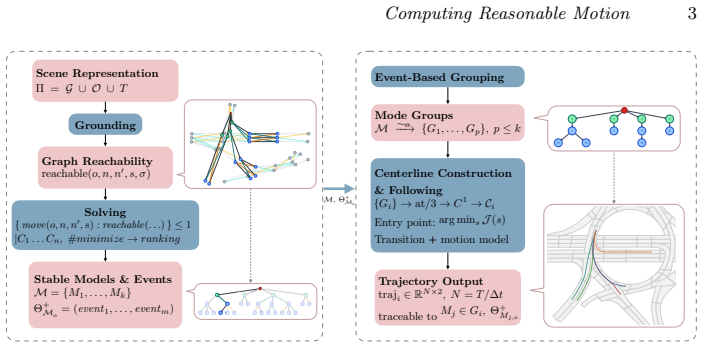
Answer set programming encodes geometric and domain constraints as rules whose stable models represent admissible motion trajectories.
A machine-rendered reading of the paper's core claim, the machinery that carries it, and where it could break.
Core claim
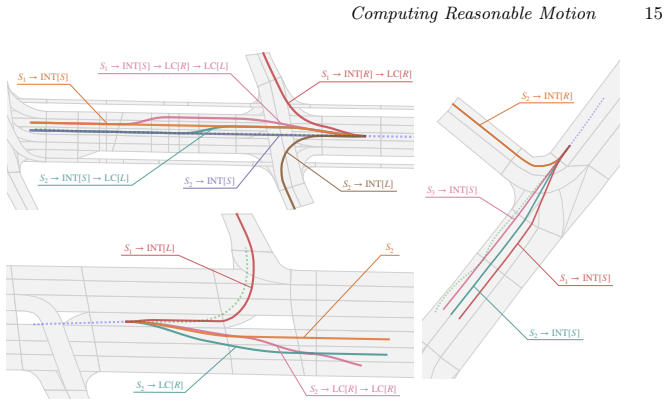
The method performs constrained traversal of an environment graph, enumerating geometrically admissible motion behaviours as stable models, each constituting a distinct trajectory mode characterised by both domain-dependent and independent factors such as derived event sequence, map topology, and domain norms. The hybrid trajectory computation method is generally applicable across motion characteristics typically encountered in diverse dynamic domains with moving objects.
What carries the argument
Encoding of geometric constraints, map topology, and domain norms as ASP rules so that stable models correspond to admissible trajectory modes during graph traversal.
If this is right
- Trajectories remain traceable to the specific stable model that generated them.
- The same encoding framework applies to motion patterns in domains beyond autonomous driving.
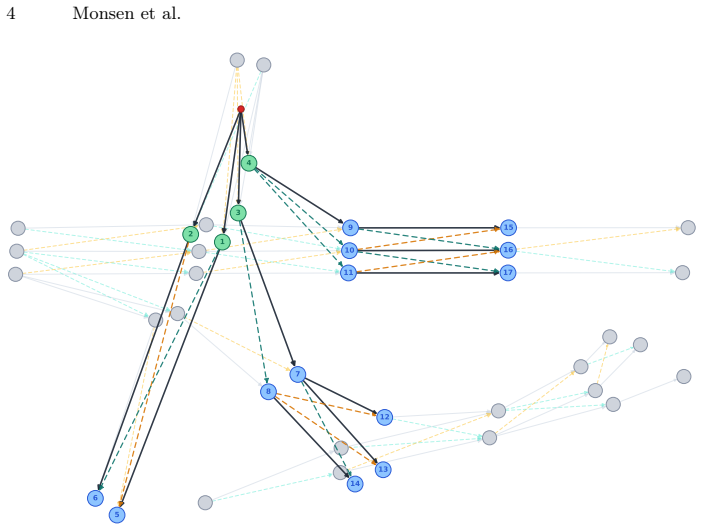
- Branching modes arise naturally from the enumeration of stable models.
- The approach supplies verifiable compliance with both geometry and domain norms.
Where Pith is reading between the lines
- The rule-based encoding could be extended to verify safety invariants before execution.
- Dynamic updates to the ASP program might support online replanning when new sensor information arrives.
- Multi-object interactions could be added by introducing additional rules that couple separate trajectory programs.
Load-bearing premise
Domain norms, geometric constraints, and map topology can be effectively encoded as ASP rules such that stable models correspond to geometrically admissible and norm-compliant trajectory modes.
What would settle it
A concrete case in the Argoverse 2 dataset where an observed valid trajectory has no corresponding stable model under the encoding, or where a generated stable model yields a geometrically invalid path.
Figures
read the original abstract
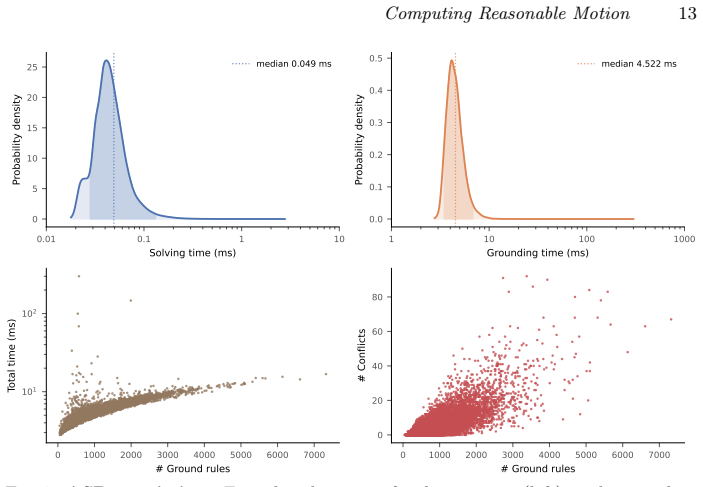
We present a general answer set programming based hybrid quantitative-qualitative method for computing constrained branching trajectory modes for moving objects in real-world settings. The method performs constrained traversal of an environment graph, enumerating geometrically admissible motion behaviours as stable models, each constituting a distinct trajectory mode characterised by both domain-dependent and independent factors such as derived event sequence, map topology, and domain norms. The hybrid trajectory computation method is generally applicable across motion characteristics typically encountered in diverse dynamic domains with moving objects, e.g., autonomous driving. We demonstrate applicability and highlight how computed trajectories are traceable to their underlying stable model, thereby affording verifiable interpretability that purely learned approaches cannot provide. We also perform an empirical evaluation with Argoverse 2, a large-scale real-world autonomous driving benchmark representative of the class of dynamic domains within the scope of the proposed method.
Editorial analysis
A structured set of objections, weighed in public.
Referee Report
Summary. The paper presents a hybrid answer set programming (ASP) method for computing constrained branching trajectory modes of moving objects. It encodes geometric constraints, map topology, and domain norms as ASP rules whose stable models correspond to admissible trajectory modes characterized by event sequences and other factors. The method is positioned as generally applicable to diverse dynamic domains (e.g., autonomous driving) and is evaluated on the Argoverse 2 benchmark, with emphasis on traceability to stable models for interpretability.
Significance. If the central claims hold, the work would provide a verifiable symbolic foundation for motion planning that integrates qualitative norms with quantitative geometry, offering advantages in safety-critical settings over black-box learned methods. The explicit use of stable models for traceability is a notable strength for explainability.
major comments (2)
- [Abstract] Abstract: The claim that the hybrid method 'is generally applicable across motion characteristics typically encountered in diverse dynamic domains' is not supported by the reported evaluation, which is confined to the Argoverse 2 autonomous-driving benchmark. No results or encodings are shown for other domains (e.g., non-planar topology or continuous-time norms), so the transferability of the ASP rules cannot be assessed.
- [Evaluation] Evaluation section: The paper states that Argoverse 2 is 'representative of the class of dynamic domains within the scope,' yet provides no cross-domain experiments, encoding-effort metrics, or solver-performance comparisons outside driving. This leaves the load-bearing generality assumption untested.
minor comments (1)
- [Abstract] The abstract and introduction would benefit from a clearer statement of the precise scope limitations (e.g., planarity assumptions) to avoid overgeneralization.
Simulated Author's Rebuttal
We thank the referee for the detailed comments on the generality claims. We address each point below and indicate where revisions will be made to better align the manuscript with the reported evaluation.
read point-by-point responses
-
Referee: [Abstract] Abstract: The claim that the hybrid method 'is generally applicable across motion characteristics typically encountered in diverse dynamic domains' is not supported by the reported evaluation, which is confined to the Argoverse 2 autonomous-driving benchmark. No results or encodings are shown for other domains (e.g., non-planar topology or continuous-time norms), so the transferability of the ASP rules cannot be assessed.
Authors: We agree that the empirical support is limited to Argoverse 2 and that explicit encodings or results for other domains are absent. The manuscript's generality claim rests on the modular structure of the ASP encoding (geometric constraints, topology, and norms as separate rule sets) rather than cross-domain experiments. To avoid overstatement, we will revise the abstract to state that the method is designed for adaptability across domains with the provided Argoverse 2 evaluation serving as an initial demonstration on a representative large-scale benchmark. revision: yes
-
Referee: [Evaluation] Evaluation section: The paper states that Argoverse 2 is 'representative of the class of dynamic domains within the scope,' yet provides no cross-domain experiments, encoding-effort metrics, or solver-performance comparisons outside driving. This leaves the load-bearing generality assumption untested.
Authors: The evaluation section justifies Argoverse 2 on the basis of its scale and coverage of complex motion patterns, but we accept that this does not constitute a test of transferability. We will add a short discussion subsection clarifying that the ASP rules are intended to be reusable by substituting domain-specific predicates, while noting that quantitative transferability metrics remain future work. This revision will temper the representative claim without altering the core technical contribution. revision: yes
Circularity Check
No circularity detected; derivation self-contained
full rationale
The paper presents an ASP-based hybrid method where constraints are encoded as rules and stable models are taken to represent admissible trajectories by the semantics of answer-set programming. No equations, fitted parameters, or self-citations are exhibited that reduce any claimed prediction or generality result to the inputs by construction. The central claim rests on the expressiveness of ASP encodings for domain norms and geometry, which is an independent modeling choice rather than a definitional loop or renamed fit. Evaluation on Argoverse 2 is presented as demonstration, not as the source of the generality assertion.
Axiom & Free-Parameter Ledger
axioms (1)
- domain assumption The environment can be represented as a graph for constrained traversal where stable models correspond to admissible trajectories
Reference graph
Works this paper leans on
-
[1]
Bhatt, M., Suchan, J.: Artificial visual intelligence: Perceptual commonsense for human-centred cognitive technologies. In: ACAI. LNCS, vol. 13500, pp. 216–242. Springer (2021). https://doi.org/10.1007/978-3-031-24349-3_12
-
[2]
https://doi.org/10.1145/2043174
Brewka,G.,Eiter,T.,Truszczyński,M.:Answersetprogrammingataglance.Com- munications of the ACM54(12), 92–103 (2011). https://doi.org/10.1145/2043174. 2043195
-
[3]
In: 2019 IEEE/CVF Conference on Computer Vision and Pattern Recognition (CVPR)
Chang, M.F., Lambert, J., Sangkloy, P., Singh, J., Bak, S., Hartnett, A., Wang, D., Carr, P., Lucey, S., Ramanan, D., Hays, J.: Argoverse: 3d tracking and forecasting with rich maps. In: 2019 IEEE/CVF Conference on Computer Vision and Pattern Recognition (CVPR). pp. 8740–8749 (2019)
2019
-
[4]
12 Compositional Behavioral Semantics Moody, J., Wu, L., Liao, Y ., and Saffell, M
Davis, E.: Logical formalizations of commonsense reasoning: A survey. Journal of Artificial Intelligence Research59, 651–723 (2017). https://doi.org/10.1613/jair. 5339
-
[5]
Communications of the ACM58(9), 92–103 (2015)
Davis, E., Marcus, G.: Commonsense reasoning and commonsense knowledge in artificial intelligence. Communications of the ACM58(9), 92–103 (2015). https: //doi.org/10.1145/2701413 Computing Reasonable Motion17
-
[6]
European Commission: Proposal for a regulation laying down harmonised rules on artificial intelligence (artificial intelligence act) (2021)
2021
-
[7]
Gebser, M., Kaminski, R., Kaufmann, B., Schaub, T.: Clingo = ASP + control: Preliminary report. CoRRabs/1405.3694(2014)
Pith/arXiv arXiv 2014
-
[8]
Khandelwal, S., Qi, W., Singh, J., Hartnett, A., Ramanan, D.: What-if motion prediction for autonomous driving (2020), https://arxiv.org/abs/2008.10587
arXiv 2020
-
[9]
In: Proceedings of the IEEE/CVF International Conference on Computer Vision (ICCV)
Knoche, M., de Geus, D., Leibe, B.: DONUT: A decoder-only model for trajec- tory prediction. In: Proceedings of the IEEE/CVF International Conference on Computer Vision (ICCV). pp. 28903–28912 (2025)
2025
-
[10]
Springer (2019)
Lifschitz, V.: Answer Set Programming. Springer (2019). https://doi.org/10.1007/ 978-3-030-24658-7
2019
-
[11]
Mangalam, K., An, Y., Girase, H., Malik, J.: From goals, waypoints & paths to long term human trajectory forecasting. In: ICCV. pp. 15213–15222 (2021). https: //doi.org/10.1109/ICCV48922.2021.01495
-
[12]
Monsen, J., Suchan, J., Bhatt, M.: Probabilistic answer set programming driven ranking of dynamic space-time belief models. In: Rules and Reasoning: 9th International Joint Conference, RuleML+RR 2025, Istanbul, Turkey, Septem- ber 22–24, 2025, Proceedings. p. 156–175. Springer-Verlag, Berlin, Heidelberg (2025). https://doi.org/10.1007/978-3-032-08887-1_10...
-
[13]
Shi, J., Chen, J., Wang, Y., Sun, L., Liu, C., Xiong, W., Wo, T.: Motion forecasting for autonomous vehicles: A survey (2025), https://arxiv.org/abs/2502.08664
arXiv 2025
-
[14]
Siméoni, O., Vo, H.V., Seitzer, M., Baldassarre, F., Oquab, M., Jose, C., Khalidov, V., Szafraniec, M., Yi, S., Ramamonjisoa, M., Massa, F., Haziza, D., Wehrstedt, L., Wang, J., Darcet, T., Moutakanni, T., Sentana, L., Roberts, C., Vedaldi, A., Tolan, J., Brandt, J., Couprie, C., Mairal, J., Jégou, H., Labatut, P., Bojanowski, P.: Dinov3 (2025), https://a...
Pith/arXiv arXiv 2025
-
[15]
Suchan, J., Baloch, S., Bhatt, M.: Towards a VLM-based foundation for generalised neurosymbolic visual commonsense. In: Foundations of Information and Knowl- edge Systems: 14th International Symposium, FoIKS 2026, Hanover, Germany, March 23–26, 2026, Proceedings. p. 359–365. Springer-Verlag, Berlin, Heidelberg (2026). https://doi.org/10.1007/978-3-032-215...
-
[16]
Suchan, J., Bhatt, M., Monsen, J.: ASP-driven visual commonsense: a general framework for reasoning about embodied interaction in the wild. In: Proceedings of the 22nd International Conference on Principles of Knowledge Representation and Reasoning. KR ’25 (2025). https://doi.org/10.24963/kr.2025/61, https://doi. org/10.24963/kr.2025/61
-
[17]
Suchan, J., Bhatt, M., Varadarajan, S.: Commonsense visual sensemaking for au- tonomous driving - on generalised neurosymbolic online abduction integrating vi- sion and semantics. Artif. Intell.299, 103522 (2021). https://doi.org/10.1016/J. ARTINT.2021.103522
work page doi:10.1016/j 2021
-
[18]
ImmFusion: Robust mmWave-RGB Fusion for 3D Human Body Reconstruction in All Weather Conditions,
Wang, M., Zhu, X., Yu, C., Li, W., Ma, Y., Jin, R., Ren, X., Ren, D., Wang, M., Yang, W.: Ganet: Goal area network for motion forecasting. In: ICRA. pp. 1609–1615 (2023). https://doi.org/10.1109/ICRA48891.2023.10160468
-
[19]
In: NeurIPS Datasets and Benchmarks (2021) 18 Monsen et al
Wilson, B., Qi, W., Agarwal, T., Lambert, J., Singh, J., Khandelwal, S., Pan, B., Kumar, R., Hartnett, A., Pontes, J.K., Ramanan, D., Carr, P., Hays, J.: Argoverse 2: Next generation datasets for self-driving perception and forecasting. In: NeurIPS Datasets and Benchmarks (2021) 18 Monsen et al
2021
-
[20]
IEEE Transactions on Intelligent Transportation Systems25(7), 6770–6779 (2024)
Yao, Z., Li, X., Lang, B., Chuah, M.C.: Goal-lbp: Goal-based local behavior guided trajectory prediction for autonomous driving. IEEE Transactions on Intelligent Transportation Systems25(7), 6770–6779 (2024)
2024
-
[21]
In: The Thirty-Eighth Annual Conference on Neural Information Processing Systems (NeurIPS) (2024)
Zhang, B., Song, N., Zhang, L.: DeMo: Decoupling motion forecasting into direc- tional intentions and dynamic states. In: The Thirty-Eighth Annual Conference on Neural Information Processing Systems (NeurIPS) (2024)
2024
-
[22]
In: Proceedings of the IEEE/CVF Conference on Computer Vision and Pattern Recognition (CVPR)
Zhou, Z., Wang, J., Li, Y.H., Huang, Y.K.: Query-centric trajectory prediction. In: Proceedings of the IEEE/CVF Conference on Computer Vision and Pattern Recognition (CVPR). pp. 17863–17873 (2023)
2023
discussion (0)
Sign in with ORCID, Apple, or X to comment. Anyone can read and Pith papers without signing in.