REVIEW 3 major objections 5 minor 69 references
Analytical results for the distribution of shortest path lengths in directed random networks that grow by node duplication
T0 review · 3 major / 5 minor · reviewed 2026-08-14 · deepseek-v4-flash
Pith's one-line read Directed duplication networks have an exact shortest-path law: distances among connected pairs grow logarithmically while almost all pairs are disconnected.
desk verdict A solid continuation of the authors' DSPL program, but the 'exact' claim is overstated and the constant-η approximation needs a caveat near p→1. read the letter →
The pith
A machine-rendered reading of the paper's core claim, the machinery that carries it, and where it could break.
The reading
What carries the argument
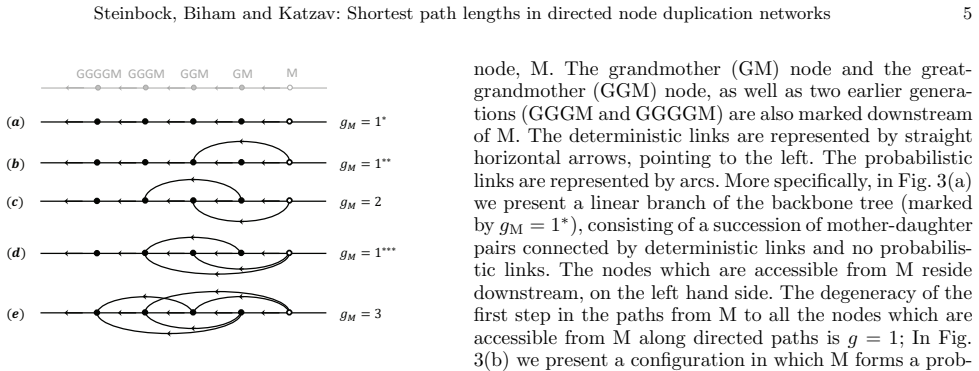
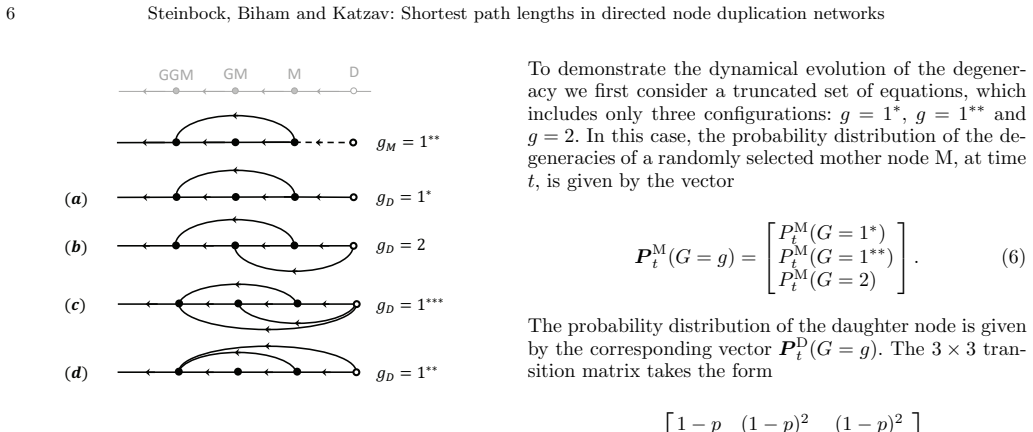
The engine of the calculation is a linear master equation for the probability masses $P_t(L=\ell)$, obtained by counting what happens to every ordered pair when a random mother node $M$ is duplicated into a daughter $D$. A target at distance $\ell$ from $M$ sits at distance $\ell$ from $D$ if at least one edge on a shortest path from $M$ is copied, otherwise at distance $\ell+1$. The paper encodes this by a single effective probability $\eta$, defined by the degeneracy sum in Eq. (18), that a shortest-path length is preserved; $\eta$ is computed from the steady-state distribution of the degeneracy $g$ of first steps on shortest paths, with the hierarchy truncated at $g=3$. Replacing $p$ by $\eta$ in the $\ell=1$ and $\ell=2$ equations turns the hierarchy into a solvable system whose solution is the Poisson-convolution formula. The logarithmic terms enter because each generation of the deterministic backbone tree advances the relevant time scale by a factor captured by $\ln t_s$.
What would settle it
Simulate the corded DND model with $p=0.9$ from a two-node seed and measure the full distribution $P_t(L=\ell)$ at network sizes $10^2$, $10^3$, and $10^4$; if the closed form with steady-state $\eta$ visibly misses the early-time distribution while the exact Appendix C equations with a time-dependent effective probability match it, the constant-$\eta$ solution is only asymptotic rather than the finite-time law claimed.
Extended reading notes
Core claim
The paper's central claim is that the master equation for $P_t(L=\ell)$ admits a closed-form solution. For $\ell\ge 2$, with $t_s=(t+s+1)/(s+1)$ and $\Delta_0$ the seed diameter, the solution is $$P_t(L=\ell) = \frac{1}{$t_s^{{2-\eta}}$} \sum_{\ell'=1}^{\min\{\ell,\Delta_0\}} \frac{(1-\eta)^{\ell-\ell'}}{(\ell-\ell')!} (\ln t_s)^{\ell-\ell'} P_0(L=\ell') + \frac{1}{(1-\eta)(s+1)$t_s^{{2-\eta}}$} \sum_{\ell'=\ell}^{\infty} \frac{(1-\eta)^{\ell'}}{\ell'!} (\ln t_s)^{\ell'}.$$ The first term propagates the seed network's own shortest-path distribution into the growing network as a Poisson convolution in $\ln t_s$; the second term is a seed-independent Poisson sum describing paths formed entirely during growth. Companion closed forms for $P_t(L=1)$ and $P_t(L=\infty)$ complete the distribution. From these the paper obtains $P_t(L<\infty)\sim(\ln N_t)/N_t$ and $\mathbb{E}_t[L|L<\infty]\sim((1-\eta)/2)\ln N_t$, so among the vanishing fraction of connected ordered pairs distances are logarithmically short, yet the directed network as a whole is not small-world.
Load-bearing premise
The load-bearing assumption is that the effective probability $\eta$ that a duplicated link preserves a shortest-path length is constant and equal to its steady-state value throughout the growth, even though the true $\eta(t)$ converges to that value only as a power law, and very slowly when $p$ is close to 1.
Editorial extensions
If this is right
- At any finite time, the full shortest-path-length distribution is fixed by the seed DSPL, the duplication probability $p$, and the degeneracy parameter $\eta$; no other microstructural detail of the growth history enters.
- Among connected ordered pairs, the mean distance tends to $\frac{1-\eta}{2}\ln N_t$, and the variance tends to $\frac{(1-\eta)^2}{12}(\ln N_t)^2$, so the connected subpopulation has a widening logarithmic distance profile.
- The connected fraction tends to $(\ln N_t)/N_t$, so almost all ordered pairs are disconnected in the large-network limit even though the underlying undirected network is a single component.
- As a minimal citation-network model, the result predicts that citation chains connect only a shrinking fraction of paper pairs, and that the chains among connected pairs are logarithmically long.
- The exact formula applies from the seed onward, not merely asymptotically, so it can be compared with finite-time simulation or empirical data at any network size.
Reading between the lines
- The formula's stated validity for any acyclic seed means the same Poisson-convolution form should hold for richer seeds than the two-node chain used in the figures; this is an extrapolation the paper does not test numerically.
- The slow power-law relaxation of $\eta(t)$ for $p$ close to 1 suggests that real growing systems with strong duplication would spend a long time in a transient regime where the exact Appendix C master equation, rather than the steady-state closed form, is the better description.
- For citation data, the model predicts a measurable signature: the fraction of ordered paper pairs connected by citation chains should decline roughly as the corpus grows, while the mean chain length among connected pairs climbs only logarithmically; fitting both curves would estimate $\eta$ from data.
Signed reviews
Editorial analysis
A structured set of objections, weighed in public.
Referee Report
Summary. The paper studies the distribution of shortest directed path lengths (DSPL) in the corded directed node duplication (DND) network model. It derives a master equation for the time evolution of Pt(L=ℓ), solves it in closed form, and obtains Eq. (42), expressing the DSPL as a convolution of the seed DSPL with Poisson terms plus a growth term. The paper further derives the connected fraction Pt(L<∞) ~ ln N_t / N_t and the conditional mean distance Et[L|L<∞] ~ (1−η)/2 ln N_t. The parameter η is computed from a steady-state degeneracy distribution truncated at g=3, and the derivation replaces p by η in the ℓ=1 and ℓ=2 source terms. Simulations for p up to 0.8 support the analytical formulas.
Significance. If the closed-form results are correct, this is a valuable analytical contribution to the DSPL literature for a simple directed growing-network model with applications to gene regulatory and citation networks. The paper's strengths include a transparent master-equation formulation, an explicit closed-form solution, and a parameter η that is computed from the model's own degeneracy statistics rather than fit to the DSPL, so the central result is not circular in the fitting sense. The Poisson convolution structure and the logarithmic scaling of the conditional mean distance are nontrivial and are supported by simulation agreement in the tested regime. The main caveat is that the time-independent steady-state η and the truncation at g=3 mean the word 'exact' in the abstract and summary overstates the status of Eq. (42), particularly for p close to 1.
major comments (3)
- [§5, Eq. (42) and Appendix B] The Summary states that Eq. (42) is 'valid at all times', but the derivation solves Eq. (41) with a time-independent η taken from the steady-state degeneracy distribution (Eq. (20)). Appendix B shows that the degeneracy distribution converges to steady state only as a power law with exponent α_min = min{1−p+p^2, 1+p−2p^2}, and that α_min → 0 as p → 1 (Eqs. B.5–B.7). Thus for p close to 1, replacing η_t by its steady-state value mis-specifies the coefficient (1−η) in Eq. (41) throughout the growth period, and Eq. (42) is at best an asymptotic result for p bounded away from 1 rather than an exact finite-time solution. The authors should either solve the master equation with a time-dependent η(t), or explicitly restrict the validity claim and quantify the error in the p→1 regime.
- [§5, Eqs. (31)–(32) and Appendix C] The replacement of p by η in the ℓ=1 and ℓ=2 equations is acknowledged in Section 5, but Appendix C, which is presented as the exact form, restores p only in the source terms while still treating η as time-independent. The 'exact' wording in the abstract and summary therefore overstates the status of the closed form: the exactness applies to the master-equation framework and to the solution conditional on a fixed η, not to Eq. (42) for the actual growing network. Please qualify the claims and specify the range of p and t for which the approximation is controlled.
- [§3, Eq. (13) and §6, Fig. 7] The degeneracy distribution is truncated at g=3, and the closeness of the g=2 and g=3 results in Fig. 5 is reassuring but does not provide an error bound for the neglected g≥4 states. In addition, the numerical validation of the DSPL and the logarithmic law is reported only for p ≤ 0.8, whereas the slow convergence identified by Eq. (B.7) becomes severe for p > 0.8 (for example, α_2 = 0.28 at p = 0.9). The finite-time claims near p = 1 are therefore untested. Please add numerical tests in the p > 0.8 regime or explicitly restrict the stated domain of validity.
minor comments (5)
- [Abstract and Summary] The phrases 'exact analytical results' and 'valid at all times' should be harmonized with the acknowledged approximations used in Section 5; 'closed-form analytical results' would be a more accurate description.
- [Appendix B heading] The word 'congergence' in the appendix heading should be corrected to 'convergence'.
- [Fig. 7 and Fig. 8 captions] These captions do not state the number of simulated network realizations, unlike the caption of Fig. 6; please include this information for reproducibility.
- [Eq. (42)] The notation t_s is defined in Eq. (43) but is used already in Eq. (42); consider defining it immediately before Eq. (42) to avoid confusion.
- [Appendix A] The phrase 'betweeness centrality' should be corrected to 'betweenness centrality'.
Circularity Check
No significant circularity: the closed-form DSPL is a genuine solution of the paper's own master equation, with eta computed from the model's degeneracy statistics rather than fitted to DSPL data.
full rationale
The derivation chain is self-contained. Eq. (41) is a master equation for Pt(L = ell); Eq. (42) is its explicit solution, and Eqs. (47)-(48) follow by summing that solution. The parameter eta is not fitted to shortest-path data: it is defined in Eq. (18) from the degeneracy distribution P(G = g), which is solved separately in Sec. 3 (Eqs. (8)-(13)) and compared with simulations in Fig. 5. The replacements of p by eta in Eqs. (31)-(32) are acknowledged approximations, with the exact version supplied in Appendix C; this affects accuracy at finite times but does not make the result circular. Self-citations to Refs. [56] and [66] provide model context and earlier degree-distribution results, but the DSPL calculation does not depend on any unverified claim imported from those papers. The only real limitation is that eta is the time-independent steady-state value, so near p = 1 the finite-time accuracy is questionable (Appendix B, Eqs. (B.5)-(B.7)); that is a correctness and regime concern, not a circularity.
Assumptions & free parameters
free parameters (3)
- p (duplication probability) =
input in (0,1)
- g_max (degeneracy truncation) =
3
- Seed network size and DSPL =
s=2 linear chain used in figures
assumptions (4)
- domain assumption The degeneracy distribution reaches steady state and can be replaced by its asymptotic value η in the DSPL master equation.
- ad hoc to paper Truncation of the degeneracy transition matrix at g=3 captures the relevant degeneracy statistics for computing η.
- ad hoc to paper The replacement of p by η in the master equations for ℓ=1 and ℓ=2 is a good approximation.
- domain assumption Seed networks are restricted to acyclic oriented graphs with a single sink node.
Cite this review
Pith. "Pith review of Analytical results for the distribution of shortest path lengths in directed random networks that grow by node duplication." pith.science (2026). https://pith.science/paper/NNB7IFSR
@misc{pith2026190807376,
  author       = {Pith},
  title        = {Pith review of: Analytical results for the distribution of shortest path lengths in directed random networks that grow by node duplication},
  year         = {2026},
  howpublished = {\url{https://pith.science/paper/NNB7IFSR}},
  note         = {Machine review of arXiv:1908.07376}
}
abstract
We present exact analytical results for the distribution of shortest path lengths (DSPL) in a directed network model that grows by node duplication. Such models are useful in the study of the structure and growth dynamics of gene regulatory networks and scientific citation networks. Starting from an initial seed network, at each time step a random node, referred to as a mother node, is selected for duplication. Its daughter node is added to the network and duplicates each outgoing link of the mother node with probability $p$. In addition, the daughter node forms a directed link to the mother node itself. Thus, the model is referred to as the corded directed-node-duplication (DND) model. In this network not all pairs of nodes are connected by directed paths, in spite of the fact that the corresponding undirected network consists of a single connected component. More specifically, in the large network limit only a diminishing fraction of pairs of nodes are connected by directed paths. To calculate the DSPL between those pairs of nodes that are connected by directed paths we derive a master equation for the time evolution of the probability $P_t(L=\ell)$, $\ell=1,2,\dots$, where $\ell$ is the length of the shortest directed path. Solving the master equation, we obtain a closed form expression for $P_t(L=\ell)$. It is found that the DSPL at time $t$ consists of a convolution of the initial DSPL $P_0(L=\ell)$, with a Poisson distribution and a sum of Poisson distributions. The mean distance ${\mathbb E}_t[L|L<\infty]$ between pairs of nodes which are connected by directed paths is found to depend logarithmically on the network size $N_t$. However, since in the large network limit the fraction of pairs of nodes that are connected by directed paths is diminishingly small, the corded DND network is not a small-world network, unlike the corresponding undirected network.
Figures


Figures from the paper (6 more)


Reference graph
Works this paper leans on
- [1]
-
[2]
G. Caldarelli, Scale free networks: complex webs in nature and technology (Oxford University Press, 2007)
work page 2007
- [3]
-
[4]
Newman, Networks: an Introduction (Oxford Uni- versity Press, 2010)
M.E.J. Newman, Networks: an Introduction (Oxford Uni- versity Press, 2010)
work page 2010
-
[5]
Estrada, The Structure of Complex Networks: Theory and Applications (Oxford University Press, 2011)
E. Estrada, The Structure of Complex Networks: Theory and Applications (Oxford University Press, 2011)
work page 2011
- [6]
- [7]
- [8]
Show all 69 references
-
[9]
Chung, L
F. Chung, L. Lu, Proc. Nat. Acad. Sci. USA 99, 15879 (2002) 16 Steinbock, Biham and Katzav: Shortest path lengths in dir ected node duplication networks
2002
-
[10]
Chung, L
F. Chung, L. Lu, Internet Mathematics 1, 91 (2003)
2003
-
[11]
Barab´ asi, R
A.-L. Barab´ asi, R. Albert, Science 286, 509 (1999)
1999
-
[12]
Jeong, B
H. Jeong, B. Tombor, R. Albert, Z.N. Oltvai, A.-L. Barab´ asi,Nature 407, 651 (2000)
2000
-
[13]
Krapivsky, S
P.L. Krapivsky, S. Redner, F. Leyvraz, Phys. Rev. Lett. 85, 4629 (2000)
2000
-
[14]
Krapivsky, S
P.L. Krapivsky, S. Redner, Phys. Rev. E 63, 066123 (2001)
2001
-
[15]
V´ azquez, Phys
A. V´ azquez, Phys. Rev. E 67, 056104 (2003)
2003
-
[16]
Cohen, S
R. Cohen, S. Havlin, Phys. Rev. Lett. 90, 058701 (2003)
2003
-
[17]
Giot et al., Science 302 1727 (2003)
L. Giot et al., Science 302 1727 (2003)
2003
-
[18]
Ma´ ayan, S.L
A. Ma´ ayan, S.L. Jenkins, S. Neves, A. Hasseldine, E. Grace, B. Dubin-Thaler, N.J. Eungdamrong, G. Weng, P.T. Ram, J.J. Rice, A. Kershenbaum, G.A. Stolovitzky, R.D. Blitzer, R. Iyengar, Science 309, 1078 (2005)
2005
-
[19]
Dijkstra, Numerische Mathematik 1, 269 (1959)
E.W. Dijkstra, Numerische Mathematik 1, 269 (1959)
1959
-
[20]
Delling, P
D. Delling, P. Sanders, D. Schultes, D. Wagner, Engineer - ing route planning algorithms, in Algorithmics of large and complex networks: design, analysis, and simulation , J. Lerner, D. Wagner, and K.A. Zweig (Eds.), p. 117 (2009)
2009
-
[21]
Pastor-Satorras, C
R. Pastor-Satorras, C. Castellano, P. Van Mieghem, A. Vespignani, Rev. Mod. Phys. 87, 925 (2015)
2015
-
[22]
Bollobas, Random Graphs, Second Edition (Academic Press, London, 2001)
B. Bollobas, Random Graphs, Second Edition (Academic Press, London, 2001)
2001
-
[23]
Durrett, Random Graph Dynamics (Cambridge Univer- sity Press, Cambridge, 2007)
R. Durrett, Random Graph Dynamics (Cambridge Univer- sity Press, Cambridge, 2007)
2007
-
[24]
Fronczak, P
A. Fronczak, P. Fronczak, J.A. Holyst, Phys. Rev. E 70, 056110 (2004)
2004
-
[25]
Newman, Proc
M.E.J. Newman, Proc. Natl. Acad. Sci. USA 98, 404 (2001)
2001
-
[26]
Hartmann, M
A.K. Hartmann, M. M´ ezard, Phys. Rev. E 97, 032128 (2017)
2017
-
[27]
Newman, S.H
M.E.J. Newman, S.H. Strogatz, D.J. Watts, Phys. Rev. E 64, 026118 (2001)
2001
-
[28]
Dorogotsev, J.F.F
S.N. Dorogotsev, J.F.F. Mendes, A.N. Samukhin, Nuclear Physics B 653, 307 (2003)
2003
-
[29]
Blondel, J.-L
V.D. Blondel, J.-L. Guillaume, J.M. Hendrickx, R.M. Jungers, Phys. Rev. E 76, 066101 (2007)
2007
-
[30]
van der Hofstad, G
R. van der Hofstad, G. Hooghiemstra, D. Znamenski, Elec- tronic Journal of Probability 12, 703 (2007)
2007
-
[31]
van der Esker, R
H. van der Esker, R. van der Hofstad, G. Hooghiemstra, J. Stat. Phys. 133, 169 (2008)
2008
-
[32]
J. Shao, S. V. Buldyrev, R. Cohen, M. Kitsak, S. Havlin, H. E. Stanley, Europhys. Lett. 84, 48004 (2008)
2008
-
[33]
Shao, S.V
J. Shao, S.V. Buldyrev, L.A. Braunstein, S. Havlin, H.E. Stanley, Phys. Rev. E 80, 036105 (2009)
2009
-
[34]
Katzav, M
E. Katzav, M. Nitzan, D. ben-Avraham, P.L. Krapivsky, R. K¨ uhn, N. Ross, O. Biham, EPL 111, 26006 (2015)
2015
-
[35]
Erd˝ os, A
P. Erd˝ os, A. R´ enyi,Publicationes Mathematicae (Debre- cen) 6, 290 (1959)
1959
-
[36]
Erd˝ os, A
P. Erd˝ os, A. R´ enyi,Publ. Math. Inst. Hung. Acad. Sci. 5, 17 (1960)
1960
-
[37]
Erd˝ os, A
P. Erd˝ os, A. R´ enyi,Bull. Inst. Int. Stat. 38, 343 (1961)
1961
-
[38]
Nitzan, E
M. Nitzan, E. Katzav, R. K¨ uhn, O. Biham, Phys. Rev. E 93, 062309 (2016)
2016
- [39]
-
[40]
Molloy, B
M. Molloy, B. Reed, Random Struct. Algorithms 6, 161 (1995)
1995
-
[41]
Molloy, B
M. Molloy, B. Reed, Combinatorics, Probability and Com- puting 7 , 295 (1998)
1998
-
[42]
Bhan, D.J
A. Bhan, D.J. Galas, T.G. Dewey, Bioinformatics 18, 1486 (2002)
2002
-
[43]
Kim, P.L
J. Kim, P.L. Krapivsky, B. Kahng, S. Redner, Phys. Rev. E 66, 055101 (2002)
2002
-
[44]
Chung, L
F. Chung, L. Lu, T.G. Dewey, D.J. Galas, J. Comput. Biol. 10, 677 (2003)
2003
-
[45]
Krapivsky, S
P.L. Krapivsky, S. Redner, Phys. Rev. E 71, 036118 (2005)
2005
-
[46]
Ispolatov, P.L
I. Ispolatov, P.L. Krapivsky, A. Yuryev, Phys. Rev. E 71, 061911 (2005)
2005
-
[47]
Ispolatov, P.L
I. Ispolatov, P.L. Krapivsky, I. Mazo, A. Yuryev, New J. Phys. 7, 145 (2005)
2005
-
[48]
Bebek, P
G. Bebek, P. Berenbrink, C. Cooper, T. Friedetzky, J. Nadeau, S.C. Sahinalp, Theor. Comput. Sci. 369, 239 (2006)
2006
-
[49]
S. Li, K.P. Choi, T. Wu, Theor. Comput. Sci. 476, 94 (2013)
2013
-
[50]
Lambiotte, P.L
R. Lambiotte, P.L. Krapivsky, U. Bhat, S. Redner, Phys. Rev. Lett. 117, 218301 (2016)
2016
-
[51]
Bhat, P.L
U. Bhat, P.L. Krapivsky, R. Lambiotte, S. Redner, Phys. Rev. E. 94, 062302 (2016)
2016
-
[52]
Toivonen, L
R. Toivonen, L. Kovanen, M. Kivel¨ a, J.-P. Onnela, J. Saram¨ aki, K. Kaski,Social Networks 31, 240 (2009)
2009
-
[53]
Granovetter, American Journal of Sociology 78, 1360 (1973)
M. Granovetter, American Journal of Sociology 78, 1360 (1973)
1973
-
[54]
R. Milo, S. Shen-Orr, S. Itzkovitz, N. Kashtan, D. Chklovskii, U. Alon, Science 298, 824 (2002)
2002
-
[55]
Alon, An Introduction to Systems Biology: Design Prin- ciples of Biological Circuits (Chapman and Hall/CRC, 2006)
U. Alon, An Introduction to Systems Biology: Design Prin- ciples of Biological Circuits (Chapman and Hall/CRC, 2006)
2006
-
[56]
Steinbock, O
C. Steinbock, O. Biham, E. Katzav, Phys. Rev. E 96, 032301 (2017)
2017
-
[57]
Ohno, Evolution by Gene Duplication (Springer-Verlag, New York, 1970)
S. Ohno, Evolution by Gene Duplication (Springer-Verlag, New York, 1970)
1970
-
[58]
Teichmann, M.M
S.A. Teichmann, M.M. Babu, Nature Genetics 36, 492 (2004)
2004
-
[59]
Redner, Eur
S. Redner, Eur. Phys. J. B 4, 131 (1998)
1998
-
[60]
Redner, Physics Today 58, 49 (2005)
S. Redner, Physics Today 58, 49 (2005)
2005
-
[61]
Radicchi, S
F. Radicchi, S. Fortunato, C. Castellano, Proc. Natl. Acad. Sci. USA 105, 17268 (2008)
2008
-
[62]
Golosovsky, S
M. Golosovsky, S. Solomon, Phys. Rev. Lett. 109, 098701 (2012)
2012
-
[63]
Golosovsky and S
M. Golosovsky and S. Solomon, Phys. Rev. E 95, 012324 (2017)
2017
-
[64]
Golosovsky, Phys
M. Golosovsky, Phys. Rev. E 96, 032306 (2017)
2017
-
[65]
Peterson, Steve Press´ e, K.A
G.J. Peterson, Steve Press´ e, K.A. Dill, Proc. Natl. Acad. Sci. USA 107 , 16023 (2010)
2010
-
[66]
Steinbock, O
C. Steinbock, O. Biham, E. Katzav, J. Stat. Mech. 083403 (2019)
2019
-
[67]
Smythe, H
R.T. Smythe, H. Mahmoud, Theory Probab. Math. Statist. 51, 1 (1995)
1995
-
[68]
Drmota, B
M. Drmota, B. Gittenberger, Random Struct. Alg. 10, 421 (1997)
1997
-
[69]
Drmota, H.-K
M. Drmota, H.-K. Hwang, Adv. Appl Probab. 37, 321 (2005)
2005
Reviewed August 14, 2026 · model on record in the stance chip above.
Discussion (0). Continue with ORCID to comment.