Approximate full-conformal multi-task regression with reproducing kernels
Pith reviewed 2026-07-02 04:47 UTC · model grok-4.3
The pith
An approximating prediction region for multi-task regression contains the full-conformal one and admits a volume upper bound when the inter-task covariance matrix is known.
A machine-rendered reading of the paper's core claim, the machinery that carries it, and where it could break.
Core claim
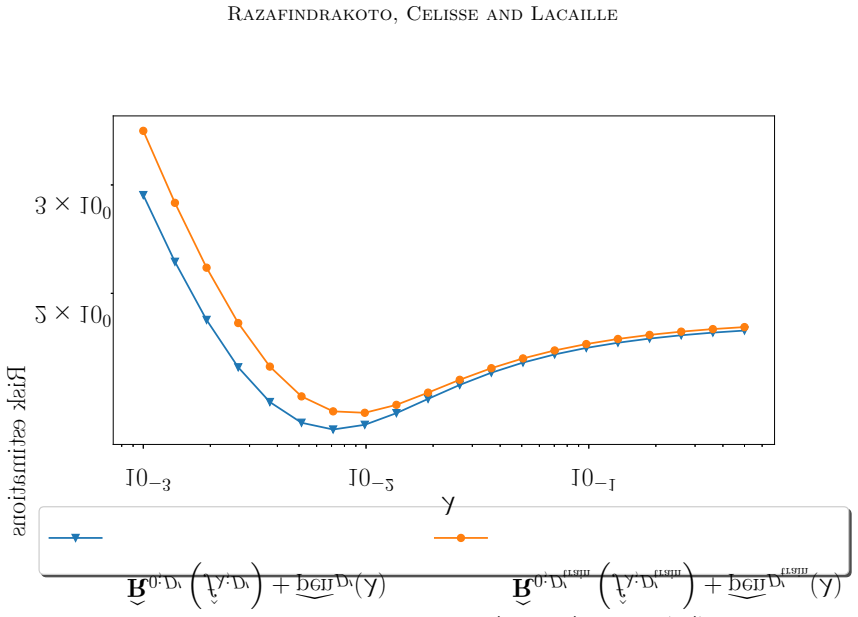
The authors design an approximating prediction region that contains the full-conformal prediction region for multi-task regression in an RKHS setting. This is done for both known and estimated inter-task covariance matrices. When the covariance is known, the volume of this approximation is bounded above by a derived quantity. Empirically, it improves upon split-conformal prediction on synthetic data.
What carries the argument
The approximating prediction region constructed to contain the full-conformal one, based on the reproducing kernel Hilbert space of vector-valued functions and the inter-task covariance matrix.
If this is right
- The construction ensures the same finite-sample coverage guarantee as the full-conformal method since the region contains it.
- When the inter-task covariance matrix is known, the volume of the approximating region is bounded above by a specific quantity derived from the method.
- In both known and estimated covariance cases, the approximating region improves upon split-conformal prediction on synthetic data.
- The approach allows practical computation of a prediction region while maintaining the theoretical guarantees of full-conformal prediction.
Where Pith is reading between the lines
- The volume bound could be used to compare the efficiency of this method against other conformal approaches in settings with many tasks.
- If covariance estimation error remains moderate, the same approximation might apply directly to real multi-output problems with correlated responses.
- The containment property suggests the method could serve as a conservative starting point for developing faster conformal procedures in kernel spaces.
Load-bearing premise
The vector-valued functions belong to a reproducing kernel Hilbert space and the data satisfy the exchangeability condition required for conformal coverage guarantees.
What would settle it
A dataset or calculation showing that the constructed approximating region fails to contain the full-conformal prediction region, or that its volume exceeds the derived upper bound when the covariance matrix is known.
Figures
read the original abstract
Multi-task regression aims at jointly solving multiple regression problems, called tasks. Compared to solving each task separately, better performances can be achieved as long as the tasks are sufficiently related. Full-conformal prediction is a framework that formulates a data-dependent prediction-region containing the unknown output-vector at any prescribed confidence level. However, explicit computation of this prediction-region is intractable in general since it requires training infinitely many predictors. The present work focuses on multi-task regression in a Reproducing Kernel Hilbert Space (RKHS) of vector-valued functions. This computational issue is addressed by designing an approximating predictionregion containing the full-conformal one. This construction is carried out in two scenarios: piq when the inter-task covariance-matrix is known, and piiq when this matrix is estimated. In terms of volume, the tightness of this approximation is assessed theoretically by means of an upper-bound in the first scenario. It is also empirically proved to improve upon the split-conformal prediction on synthetic data in both scenarios.
Editorial analysis
A structured set of objections, weighed in public.
Referee Report
Summary. The paper constructs an approximating prediction region for full-conformal multi-task regression in a vector-valued RKHS that contains the exact full-conformal region by design. It derives a theoretical upper bound on the volume of this approximation when the inter-task covariance matrix is known, and reports empirical improvements over split-conformal prediction on synthetic data for both known and estimated covariance cases, under exchangeability.
Significance. If the containment and volume bound hold, the work makes full-conformal prediction computationally tractable for multi-task vector-valued regression while preserving coverage guarantees. The RKHS setting and explicit construction when covariance is known or estimated are standard in the field; the synthetic experiments provide supporting evidence of practical benefit over split-conformal baselines. The design choice to enforce containment is a clear strength.
minor comments (2)
- Notation for the vector-valued RKHS and the inter-task covariance matrix should be introduced with explicit definitions in §2 before use in the approximation construction.
- The synthetic data generation protocol (including how tasks are correlated and sample sizes) needs to be stated more precisely to allow reproduction of the reported volume and coverage results.
Simulated Author's Rebuttal
We thank the referee for the positive summary, significance assessment, and recommendation of minor revision. The referee's description accurately captures the paper's contributions on the approximating prediction region for full-conformal multi-task kernel regression, the volume bound when covariance is known, and the empirical comparisons.
Circularity Check
No significant circularity
full rationale
The paper explicitly designs an approximating prediction region to contain the full-conformal region (by construction of the approximation), then derives a volume upper bound for the known-covariance case and demonstrates empirical improvement over split-conformal on synthetic data. No step reduces a claimed independent derivation or prediction to a fitted parameter, self-citation chain, or input by definition; the containment, bound, and comparisons are presented as direct consequences of the RKHS modeling choice and exchangeability assumption without hidden reductions. The derivation chain is self-contained.
Axiom & Free-Parameter Ledger
free parameters (1)
- inter-task covariance matrix
axioms (2)
- domain assumption Data points are exchangeable
- domain assumption Regression functions lie in a vector-valued RKHS
Reference graph
Works this paper leans on
-
[1]
URL https://scikit-learn.org/stable/modules/generated/sklearn.metrics.pairwise.laplacian\_kernel.html
Laplacian\_kernel. URL https://scikit-learn.org/stable/modules/generated/sklearn.metrics.pairwise.laplacian\_kernel.html
-
[2]
URL https://docs.scipy.org/doc/scipy/reference/optimize.minimize-newtoncg.html
Minimize(method=' Newton-CG ') --- SciPy v1.18.0 Manual . URL https://docs.scipy.org/doc/scipy/reference/optimize.minimize-newtoncg.html
-
[3]
Optimization in infinite-dimensional Hilbert spaces
Alen Alexanderian. Optimization in infinite-dimensional Hilbert spaces. North Carolina State University, Raleigh, NC, USA, 2019
2019
-
[4]
\'A lvarez, Lorenzo Rosasco, and Neil D
Mauricio A. \'A lvarez, Lorenzo Rosasco, and Neil D. Lawrence. Kernels for Vector-Valued Functions : A Review . Foundations and Trends in Machine Learning , 4 0 (3): 0 195--266, 2012. ISSN 1935-8237, 1935-8245. doi:10.1561/2200000036
-
[5]
Theory of reproducing kernels
Nachman Aronszajn. Theory of reproducing kernels. Transactions of the American mathematical society, 68 0 (3): 0 337--404, 1950
1950
-
[6]
Stability of multi-task kernel regression algorithms
Julien Audiffren and Hachem Kadri. Stability of multi-task kernel regression algorithms. In Asian Conference on Machine Learning , pages 1--16. PMLR, 2013
2013
-
[7]
Learning Theory from First Principles
Francis Bach. Learning Theory from First Principles . 2024
2024
-
[8]
Peter L. Bartlett, Philip M. Long, G \'a bor Lugosi, and Alexander Tsigler. Benign overfitting in linear regression. Proceedings of the National Academy of Sciences, 117 0 (48): 0 30063--30070, December 2020. ISSN 0027-8424, 1091-6490. doi:10.1073/pnas.1907378117
-
[9]
Stability and generalization
Olivier Bousquet and Andr \'e Elisseeff. Stability and generalization. Journal of machine learning research, 2 0 (Mar): 0 499--526, 2002
2002
-
[10]
Sacha Braun, Liviu Aolaritei, Michael I. Jordan, and Francis Bach. Minimum volume conformal sets for multivariate regression. arXiv preprint arXiv:2503.19068, 2025
-
[11]
Jordan, and Francis Bach
Sacha Braun, Eug \`e ne Berta, Michael I. Jordan, and Francis Bach. Multivariate Standardized Residuals for Conformal Prediction , May 2026
2026
-
[12]
Micchelli, Massimiliano Pontil, and Yiming Ying
Andrea Caponnetto, Charles A. Micchelli, Massimiliano Pontil, and Yiming Ying. Universal multi-task kernels. The Journal of Machine Learning Research, 9: 0 1615--1646, 2008
2008
-
[13]
Two deterministic half-quadratic regularization algorithms for computed imaging
Pierre Charbonnier, Laure Blanc-Feraud, Gilles Aubert, and Michel Barlaud. Two deterministic half-quadratic regularization algorithms for computed imaging. In Proceedings of 1st international conference on image processing, volume 2, pages 168--172. IEEE, 1994
1994
-
[14]
A Unified Comparative Study with Generalized Conformity Scores for Multi-Output Conformal Regression , February 2025
Victor Dheur, Matteo Fontana, Yorick Estievenart, Naomi Desobry, and Souhaib Ben Taieb. A Unified Comparative Study with Generalized Conformity Scores for Multi-Output Conformal Regression , February 2025
2025
-
[15]
Micchelli, Massimiliano Pontil, and John Shawe-Taylor
Theodoros Evgeniou, Charles A. Micchelli, Massimiliano Pontil, and John Shawe-Taylor . Learning multiple tasks with kernel methods. Journal of machine learning research, 6 0 (4), 2005
2005
-
[16]
Exact and Approximate Conformal Inference for Multi-Output Regression , June 2024
Chancellor Johnstone and Eugene Ndiaye. Exact and Approximate Conformal Inference for Multi-Output Regression , June 2024
2024
-
[17]
Leave- One-Out Stable Conformal Prediction , April 2025
Kiljae Lee and Yuan Zhang. Leave- One-Out Stable Conformal Prediction , April 2025
2025
-
[18]
Optimal rates for regularized conditional mean embedding learning
Zhu Li, Dimitri Meunier, Mattes Mollenhauer, and Arthur Gretton. Optimal rates for regularized conditional mean embedding learning. Advances in Neural Information Processing Systems, 35: 0 4433--4445, 2022
2022
-
[19]
Towards optimal sobolev norm rates for the vector-valued regularized least-squares algorithm
Zhu Li, Dimitri Meunier, Mattes Mollenhauer, and Arthur Gretton. Towards optimal sobolev norm rates for the vector-valued regularized least-squares algorithm. Journal of Machine Learning Research, 25 0 (181): 0 1--51, 2024
2024
-
[20]
A vector-contraction inequality for Rademacher complexities, May 2016
Andreas Maurer. A vector-contraction inequality for Rademacher complexities, May 2016
2016
-
[21]
Copula-based conformal prediction for multi-target regression
Soundouss Messoudi, S \'e bastien Destercke, and Sylvain Rousseau. Copula-based conformal prediction for multi-target regression. Pattern Recognition, 120: 0 108101, 2021
2021
-
[22]
Ellipsoidal conformal inference for multi-target regression
Soundouss Messoudi, S \'e bastien Destercke, and Sylvain Rousseau. Ellipsoidal conformal inference for multi-target regression. In Conformal and Probabilistic Prediction with Applications , pages 294--306. PMLR, 2022
2022
-
[23]
Kernels for Multi --task Learning
Charles Micchelli and Massimiliano Pontil. Kernels for Multi --task Learning . Advances in neural information processing systems, 17, 2004
2004
-
[24]
Micchelli and Massimiliano Pontil
Charles A. Micchelli and Massimiliano Pontil. On learning vector-valued functions. Neural computation, 17 0 (1): 0 177--204, 2005
2005
-
[25]
Stable conformal prediction sets
Eugene Ndiaye. Stable conformal prediction sets. In International Conference on Machine Learning , pages 16462--16479. PMLR, 2022
2022
-
[26]
Inductive Conformal Prediction: Theory and Application to Neural Networks
Harris Papadopoulos. Inductive Conformal Prediction: Theory and Application to Neural Networks . INTECH Open Access Publisher Rijeka, 2008
2008
-
[27]
Approximate full conformal prediction in an RKHS , January 2026
Davidson Lova Razafindrakoto, Alain Celisse, and J \'e r \^o me Lacaille. Approximate full conformal prediction in an RKHS , January 2026
2026
-
[28]
Resve A. Saleh and A. K. Saleh. Statistical properties of the log-cosh loss function used in machine learning. arXiv preprint arXiv:2208.04564, 2022
-
[29]
Learning theory estimates via integral operators and their approximations
Steve Smale and Ding-Xuan Zhou. Learning theory estimates via integral operators and their approximations. Constructive approximation, 26 0 (2): 0 153--172, 2007
2007
-
[30]
Multi-task regression using minimal penalties
Matthieu Solnon, Sylvain Arlot, and Francis Bach. Multi-task regression using minimal penalties. The Journal of Machine Learning Research, 13 0 (1): 0 2773--2812, 2012
2012
-
[31]
Hush, and Clint Scovel
Ingo Steinwart, Don R. Hush, and Clint Scovel. Optimal Rates for Regularized Least Squares Regression . In COLT , pages 79--93, 2009
2009
-
[32]
Algorithmic Learning in a Random World
Vladimir Vovk, Alexander Gammerman, and Glenn Shafer. Algorithmic Learning in a Random World . Springer Science & Business Media, 2005
2005
-
[33]
Algorithmic Learning in a Random World
Vladimir Vovk, Alexander Gammerman, and Glenn Shafer. Algorithmic Learning in a Random World. 2 edition, December 2022. ISBN 978-3-031-06648-1. doi:10.10007/978-3-031-06649-8
-
[34]
A survey on multi-task learning
Yu Zhang and Qiang Yang. A survey on multi-task learning. IEEE transactions on knowledge and data engineering, 34 0 (12): 0 5586--5609, 2021
2021
-
[35]
Gradient descent algorithms for quantile regression with smooth approximation
Songfeng Zheng. Gradient descent algorithms for quantile regression with smooth approximation. International Journal of Machine Learning and Cybernetics, 2: 0 191--207, 2011
2011
discussion (0)
Sign in with ORCID, Apple, or X to comment. Anyone can read and Pith papers without signing in.