REVIEW 5 major objections 8 minor 1 cited by
PP-SSL : Priority-Perception Self-Supervised Learning for Fine-Grained Recognition
T0 review · 5 major / 8 minor · reviewed 2026-08-12 · deepseek-v4-flash
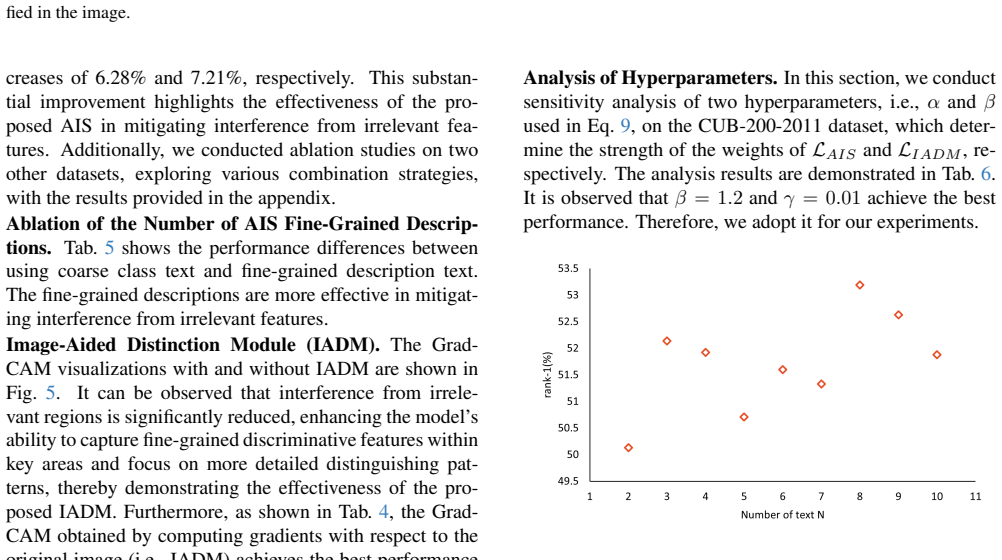
Pith's one-line read A self-supervised learning method that filters irrelevant features and focuses on subtle cues lifts fine-grained retrieval, with rank-1 accuracy on CUB-200-2011 rising from 44.41% to 53.19% and linear-probe Top-1 rising from 66.17% to…
desk verdict A plausible fine-grained SSL method with consistent gains, but the CLIP-teacher comparison lacks the control needed to attribute the improvements to the proposed modules. read the letter →
The pith
A machine-rendered reading of the paper's core claim, the machinery that carries it, and where it could break.
The reading
What carries the argument
Two modules carry the argument. The Anti-Interference Strategy (AIS) is a knowledge-distillation loss, $L_{\text{AIS}} = \tau^2 \text{KL}(\sigma(l_t/\tau), \sigma(l_s/\tau))$, where $l_t$ and $l_s$ are logits from a frozen CLIP teacher and the trainable student over a preset text corpus of eight fine-grained attribute descriptions; this teaches the encoder to prioritize category-relevant semantics. The Image-Aided Distinction Module (IADM) computes a GradCAM-style map, $\text{Grad-Img} = \text{ReLU}((\partial L_{\text{CL}}/\partial x)^\top \odot x)$, and applies a KL loss to align the encoder's own attention map $w$ to it, forcing the model to focus on subtle discriminative regions in the original image rather than on intermediate-layer features.
What would settle it
Compare the GradCAM pseudo-labels from Eqs. 5–6 with ground-truth part annotations on CUB-200-2011; if the maps barely overlap the annotated parts while the full model still improves, then IADM's gain does not come from localizing the claimed subtle regions and the explanation would need revision.
Extended reading notes
Core claim
The central claim is that a self-supervised contrastive learner, when augmented with the Anti-Interference Strategy and the Image-Aided Distinction Module, produces embeddings that significantly outperform existing self-supervised methods on fine-grained visual recognition. AIS aligns the student image encoder's predictions over an eight-item fine-grained text corpus with a frozen CLIP teacher's logits, using a knowledge-distillation KL divergence loss, which filters out irrelevant features. IADM generates GradCAM maps by differentiating the contrastive loss with respect to the raw image and then trains the encoder to match these maps, focusing attention on subtle parts that distinguish fine-grained classes. The combined loss is $L_{\text{total}} = L_{\text{CL}} + 1.2 L_{\text{AIS}} + 0.01 L_{\text{IADM}}$, and during inference only the image encoder is used, so the added machinery carries no extra computational cost at test time.
Load-bearing premise
The load-bearing premise is that the GradCAM maps produced by differentiating the contrastive loss with respect to the original image (Eqs. 5–6) are trustworthy pseudo-labels for the subtle regions that distinguish fine-grained classes; the paper does not validate these maps against ground-truth part annotations or saliency benchmarks.
Editorial extensions
If this is right
- Fine-grained self-supervised features improve when the model is explicitly guided by a small, manually curated text corpus, even if the text is not class-specific.
- Extracting gradient-based attention from the original image yields better localization pseudo-labels for fine-grained SSL than using intermediate or output layer features, as the ablation in Table 4 shows.
- The method transfers across seven diverse fine-grained datasets (birds, cars, aircraft, flowers, butterflies, dogs), suggesting it is dataset-agnostic.
- Because the extra modules are removed at inference, the downstream model is identical in cost and complexity to the base MoCo v2 encoder, making the gains essentially free at deployment.
- The gains on CUB-200-2011 are large enough to narrow the gap toward supervised fine-grained classifiers trained on the same backbone.
Reading between the lines
- The IADM recipe could likely be applied to other contrastive losses (e.g., SimCLR or BYOL) without requiring MoCo's queue, potentially extending the gains to non-momentum frameworks.
- The preset text corpus is hand-designed and small; automatically generating attribute descriptions with a large vision-language model might remove the manual design step and improve generalization to new domains.
- Because AIS relies on a frozen CLIP teacher, the method inherits CLIP's notion of what is category-relevant; on domains far from CLIP's pretraining distribution, the text corpus would need to be re-designed for the method to retain its benefit.
- The paper does not ablate the quality of the GradCAM pseudo-labels against ground-truth part annotations, so it remains open whether the IADM gains stem from accurate localization or from a more indirect regularizing effect of the extra loss.
Signed reviews
Editorial analysis
A structured set of objections, weighed in public.
Referee Report
Summary. The manuscript proposes PP-SSL, a fine-grained self-supervised learning framework with two main components: the Anti-Interference Strategy (AIS), which distills semantic logits from a fixed CLIP image/text teacher into a MoCo v2-style student using an eight-prompt text corpus, and the Image-Aided Distinction Module (IADM), which computes gradient-based saliency maps with respect to the original image from the contrastive loss and trains the encoder to match them. The model is evaluated on seven fine-grained datasets using a ResNet-50 initialized with ImageNet weights, reporting retrieval (rank-1, rank-5, mAP) and linear-probing results. The authors report consistent gains over LCR, OLDFS, and other SSL baselines, with the largest improvement on CUB-200-2011 rank-1 retrieval (53.19 vs. 44.41 for LCR).
Significance. If the results hold, AIS and IADM could provide a practical recipe for improving self-supervised fine-grained recognition, and the paper's strength is its breadth of evaluation across seven datasets plus ablation studies on CUB. The central claim, however, is not yet established: AIS relies on a CLIP teacher trained with explicit image-text supervision and on a hand-written text corpus, so without a CLIP-distillation control the reported gains cannot be attributed to the proposed modules. The IADM mechanism is also insufficiently specified and unvalidated. The contribution is plausible but needs substantial revisions in experimental control and formal correctness before the results can be used.
major comments (5)
- [§3.2, Eq. (4); Tables 1–3] The AIS component distills from a frozen CLIP image encoder and text encoder, which were trained on hundreds of millions of image-text pairs with explicit semantic supervision. All SSL baselines (MoCo v2, LCR, OLDFS, etc.) use only ImageNet-initialized ResNet-50 and no external text knowledge, so the consistent gains in Tables 1–3 could come from the CLIP teacher rather than from the anti-interference mechanism. The paper lacks the load-bearing control: train the same MoCo v2 student with the same CLIP logit distillation but without AIS's text-corpus filtering and without IADM, and compare. I also recommend replacing the CLIP teacher with a purely self-supervised teacher (e.g., DINO or a MoCo model pretrained on ImageNet) to test whether the benefit is specific to CLIP. Without these controls, the central claim that AIS/IADM improve SSL for fine-grained recognition is not supported.
- [§3.3, Eqs. (5)–(6) and (8)] The proposed IADM is not standard GradCAM. Standard GradCAM computes a weighted combination of the last feature maps using gradients of a class score with respect to those maps; Eq. (5) instead uses the gradient of the contrastive loss with respect to the input image, and Eq. (6) multiplies that gradient by the input, which is closer to a Gradient×Input saliency map. Moreover, Eq. (8) is not a KL divergence: it lacks the summation over spatial locations and the normalization of Grad-Img into a probability distribution. Since this unvalidated pseudo-label is used to supervise the encoder via LIADM, the method needs either a corrected derivation, an explicit description of the normalization, or an empirical validation of the maps against part annotations or saliency benchmarks before the IADM gains can be interpreted.
- [§3.3, Eqs. (5)–(8)] The Grad-Img pseudo-labels are produced by differentiating LCL (Eq. 1), which is the same loss the encoder is being trained to optimize. This creates a self-referential guidance loop: the 'ground truth' attention maps are a function of the current encoder state and will shift as training proceeds. The paper provides no analysis of the stability of this loop and no evidence that the maps are not simply reflecting the encoder's existing biases. An experiment with fixed or EMA-generated maps, or with maps computed from a detached or earlier copy of the encoder, would clarify whether IADM adds information rather than reinforcing the current attention.
- [§4.5, Table 6; Tables 1–3] Hyperparameters α and β in Eq. (9) are selected on CUB-200-2011 (Table 6), and the same dataset is then used to report the headline results in Tables 1–3. This selection procedure can inflate the apparent improvement on CUB and does not tell us how the method behaves on the other six datasets under fixed hyperparameters. I ask the authors to report results for the other datasets using the CUB-chosen values and also to run each configuration with at least three seeds and report means and standard deviations; several reported gains are small (for example, Table 3 NABirds classification top-1 is 57.80 vs. 55.24 for LCR, and Table 1 shows OLDFS within 0.3–0.5 points on Aircraft classification), so without variance estimates the improvements are not fully convincing.
- [§3.2, Table 5] The paper states that the text corpus contains eight descriptions, seven unrelated and one relevant, but it does not provide the full list of prompts or explain how the relevant prompt is selected for each dataset. The single example prompt ('an animal characterized by feathers, wings...') is bird-specific and cannot be the relevant prompt for Stanford Cars or FGVC-Aircraft, so it is unclear whether the same corpus is reused naively across datasets or whether dataset-specific corpora are constructed, which affects the reproducibility and the no-label-leakage assumption. The authors should publish the complete corpus and specify the relevance criterion; as written, the AIS design is underspecified.
minor comments (8)
- [§3.1, Eq. (1)] The denominator in Eq. (1) contains a typo: exp((1·ki/τ) should be exp(q·ki/τ), and the symbol k is used both for the negative-sample embedding and for the number of negatives in the queue; please disambiguate.
- [§3.2, Eqs. (2)–(3) and §4.3, Eq. (10)] The dimensions of z', fθ(x), and the projector output are not defined; in particular, it is unclear how a feature map from ψ(fθ(x)) is combined via Hadamard product with the embedding fθ(x). Please specify tensor shapes.
- [§4.2 and Table 1] The linear-probing protocol for the 100%/50%/20% label proportions is not fully described (e.g., how the label subset is sampled and whether results are averaged over multiple splits); please add details.
- [§4.5, Table 6] The sentence 'β = 1.2 and γ = 0.01 achieve the best performance' uses the wrong variable names; the hyperparameters are α and β.
- [Table 4] The ablation table's column headers are ambiguous; the checkmarks under 'layer0'–'layer4' do not make clear which configuration corresponds to each column, and the first column appears to be a baseline without AIS. Please restructure the table with explicit configuration labels.
- [References and typos] There are several typos and reference mismatches: 'SwA V' (Sec. 2), 'Simsiam' (Table 2), and in Table 3 the DINO row is cited as [52] while [52] is DiLo; the DINO citation should point to Caron et al. (2021). Please proofread.
- [Figure 3 caption] The caption says 'input images are all of the Cars category' but the prompt example in the text concerns birds; please make the figure and text consistent.
- [Supplement and reproducibility] The paper promises code release only 'upon publication'; for a method whose main component (the text corpus and the IADM normalization) is not fully specified in the text, I recommend including the complete prompt list and pseudo-code in the supplementary material.
Circularity Check
No significant circularity: IADM is a bootstrap regularizer and the reported gains are external benchmark results.
full rationale
PP-SSL's derivation chain is self-contained in the sense relevant to circularity. The central claim, outperforming SSL baselines on fine-grained benchmarks, is an empirical result obtained by training with a composite loss and evaluating on held-out test splits; no reported number is obtained by substituting a fitted constant back into itself. AIS uses a frozen CLIP teacher and a hand-authored text corpus; whatever fairness concerns this raises about privileged external supervision are not circularity, because the teacher and text are external inputs, not outputs of the student. IADM's GradCAM-like map is computed from the contrastive loss of the student (Eqs. 5-6) and then used as a matching target (Eq. 8); this is a self-distillation/bootstrap regularizer, not a prediction equivalent to its input by construction, since the loss term is an additional objective and the pseudo-label is a nonlinear function of the current encoder and input, not a pre-fitted parameter. Hyperparameters alpha, beta, N, and the text prompt are tuned on CUB, but they are not disguised as predictions. No load-bearing premise is justified solely by the authors' prior works: LCR, SAM, and OLDFS are used as baselines, not as authority for the method's correctness. Hence no circular step under the specified patterns; score 0.
Assumptions & free parameters
free parameters (3)
- alpha (AIS loss weight) =
1.2
- beta (IADM loss weight) =
0.01
- N (number of text prompts) =
8
assumptions (3)
- domain assumption CLIP text and image encoders provide a reliable semantic bridge for fine-grained categories.
- domain assumption Gradients of the contrastive loss with respect to the input image localize discriminative fine-grained regions.
- ad hoc to paper The eight hand-written text descriptions are relevant to all seven datasets and do not introduce label leakage.
Cite this review
Pith. "Pith review of PP-SSL : Priority-Perception Self-Supervised Learning for Fine-Grained Recognition." pith.science (2026). https://pith.science/paper/NNGJIY5X
@misc{pith2026241200134,
  author       = {Pith},
  title        = {Pith review of: PP-SSL : Priority-Perception Self-Supervised Learning for Fine-Grained Recognition},
  year         = {2026},
  howpublished = {\url{https://pith.science/paper/NNGJIY5X}},
  note         = {Machine review of arXiv:2412.00134}
}
read the original abstract
Self-supervised learning is emerging in fine-grained visual recognition with promising results. However, existing self-supervised learning methods are often susceptible to irrelevant patterns in self-supervised tasks and lack the capability to represent the subtle differences inherent in fine-grained visual recognition (FGVR), resulting in generally poorer performance. To address this, we propose a novel Priority-Perception Self-Supervised Learning framework, denoted as PP-SSL, which can effectively filter out irrelevant feature interference and extract more subtle discriminative features throughout the training process. Specifically, it composes of two main parts: the Anti-Interference Strategy (AIS) and the Image-Aided Distinction Module (IADM). In AIS, a fine-grained textual description corpus is established, and a knowledge distillation strategy is devised to guide the model in eliminating irrelevant features while enhancing the learning of more discriminative and high-quality features. IADM reveals that extracting GradCAM from the original image effectively reveals subtle differences between fine-grained categories. Compared to features extracted from intermediate or output layers, the original image retains more detail, allowing for a deeper exploration of the subtle distinctions among fine-grained classes. Extensive experimental results indicate that the PP-SSL significantly outperforms existing methods across various datasets, highlighting its effectiveness in fine-grained recognition tasks. Our code will be made publicly available upon publication.
Figures


Figures from the paper (3 more)


Forward citations
Cited by 1 Pith paper
-
SGTC: Semantic-Guided Triplet Co-training for Sparsely Annotated Semi-Supervised Medical Image Segmentation
SGTC uses CLIP semantic guidance and three-view co-training to segment medical volumes from just three annotated slices per volume, with gains over baselines mainly driven by the extra label.
Reference graph
Works this paper leans on
-
[1]
Vicreg: Vriance- invariance-covariance regularization for self-supervised learning
Adrien Bardes and Yann LeCun. Vicreg: Vriance- invariance-covariance regularization for self-supervised learning. arXiv preprint arXiv:2105.04906, 2021. 2
arXiv 2021
-
[2]
Bird- snap: Large-scale fine-grained visual categorization of birds
Thomas Berg, Jiongxin Liu, Seung Woo Lee, Michelle L Alexander, David W Jacobs, and Peter N Belhumeur. Bird- snap: Large-scale fine-grained visual categorization of birds. In Proceedings of the IEEE Conference on Computer Vision and Pattern Recognition, pages 2011–2018, 2014. 2
work page 2011
-
[3]
Deep clustering for unsupervised learning of visual features
Mathilde Caron, Piotr Bojanowski, Armand Joulin, and Matthijs Douze. Deep clustering for unsupervised learning of visual features. In Proceedings of the European Confer- ence on Computer Vision, pages 132–149, 2018. 2
work page 2018
-
[4]
Unsupervised learning of visual features by contrasting cluster assignments
Mathilde Caron, Ishan Misra, Julien Mairal, Priya Goyal, Pi- otr Bojanowski, and Armand Joulin. Unsupervised learning of visual features by contrasting cluster assignments. Ad- vances in Neural Information Processing Systems, 33:9912– 9924, 2020. 2
work page 2020
-
[5]
Emerg- ing properties in self-supervised vision transformers
Mathilde Caron, Hugo Touvron, Ishan Misra, Herv ´e J´egou, Julien Mairal, Piotr Bojanowski, and Armand Joulin. Emerg- ing properties in self-supervised vision transformers. In Proceedings of the IEEE/CVF International Conference on Computer Vision, pages 9650–9660, 2021. 2
work page 2021
-
[6]
Deep adaptive image cluster- ing
Jianlong Chang, Lingfeng Wang, Gaofeng Meng, Shiming Xiang, and Chunhong Pan. Deep adaptive image cluster- ing. In Proceedings of the IEEE International Conference on Computer vision, pages 5879–5887, 2017. 2
work page 2017
-
[7]
Fine-grained representation learning and recognition by exploiting hierarchical semantic embed- ding
Tianshui Chen, Wenxi Wu, Yuefang Gao, Le Dong, Xiaonan Luo, and Liang Lin. Fine-grained representation learning and recognition by exploiting hierarchical semantic embed- ding. In Proceedings of the 26th ACM International Confer- ence on Multimedia, pages 2023–2031, 2018. 5
work page 2023
-
[8]
A simple framework for contrastive learn- ing of visual representations
Ting Chen, Simon Kornblith, Mohammad Norouzi, and Ge- offrey Hinton. A simple framework for contrastive learn- ing of visual representations. In International Conference on Machine Learning, pages 1597–1607. PMLR, 2020. 2, 6
work page 2020
Show all 51 references
-
[9]
Exploring simple siamese rep- resentation learning
Xinlei Chen and Kaiming He. Exploring simple siamese rep- resentation learning. In Proceedings of the IEEE/CVF Con- ference on Computer Vision and Pattern Recognition, pages 15750–15758, 2021. 6, 7
2021
-
[10]
Improved baselines with momentum contrastive learning
Xinlei Chen, Haoqi Fan, Ross Girshick, and Kaiming He. Improved baselines with momentum contrastive learning. arXiv preprint arXiv:2003.04297, 2020. 4, 5, 6, 7
2003 arXiv
-
[11]
When does contrastive visual representation learning work? In Proceedings of the IEEE/CVF Conference on Computer Vision and Pattern Recognition, pages 14755–14764, 2022
Elijah Cole, Xuan Yang, Kimberly Wilber, Oisin Mac Aodha, and Serge Belongie. When does contrastive visual representation learning work? In Proceedings of the IEEE/CVF Conference on Computer Vision and Pattern Recognition, pages 14755–14764, 2022. 2, 3
2022
-
[12]
Imagenet: A large-scale hierarchical image database
Jia Deng, Wei Dong, Richard Socher, Li-Jia Li, Kai Li, and Li Fei-Fei. Imagenet: A large-scale hierarchical image database. In 2009 IEEE Conference on Computer Vision and Pattern Recognition, pages 248–255. Ieee, 2009. 2
2009
-
[13]
Insclr: Improving instance retrieval with self-supervision
Zelu Deng, Yujie Zhong, Sheng Guo, and Weilin Huang. Insclr: Improving instance retrieval with self-supervision. In Proceedings of the AAAI Conference on Artificial Intel- ligence, pages 516–524, 2022. 2
2022
-
[15]
Unsuper- vised visual representation learning by context prediction
Carl Doersch, Abhinav Gupta, and Alexei A Efros. Unsuper- vised visual representation learning by context prediction. In Proceedings of the IEEE International Conference on Com- puter Vision, pages 1422–1430, 2015. 2
2015
-
[16]
Bootstrap your own latent-a new approach to self-supervised learning
Jean-Bastien Grill, Florian Strub, Florent Altch ´e, Corentin Tallec, Pierre Richemond, Elena Buchatskaya, Carl Doersch, Bernardo Avila Pires, Zhaohan Guo, Mohammad Ghesh- laghi Azar, et al. Bootstrap your own latent-a new approach to self-supervised learning. Advances in Neur...
2020
-
[17]
Deep embedded clustering with data augmentation
Xifeng Guo, En Zhu, Xinwang Liu, and Jianping Yin. Deep embedded clustering with data augmentation. In Asian Con- ference on Machine Learning, pages 550–565, 2018. 2
2018
-
[18]
Dimension- ality reduction by learning an invariant mapping
Raia Hadsell, Sumit Chopra, and Yann LeCun. Dimension- ality reduction by learning an invariant mapping. In 2006 IEEE Computer Society Conference on Computer Vision and Pattern Recognition, pages 1735–1742. IEEE, 2006. 2
2006
-
[19]
Deep residual learning for image recognition
Kaiming He, Xiangyu Zhang, Shaoqing Ren, and Jian Sun. Deep residual learning for image recognition. In Proceed- ings of the IEEE Conference on Computer Vision and Pattern Recognition, pages 770–778, 2016. 5
2016
-
[20]
Mocov1: Momentum contrast for unsupervised visual representation learning
Kaiming He, Haoqi Fan, Yuxin Wu, Saining Xie, and Ross Girshick. Mocov1: Momentum contrast for unsupervised visual representation learning. 2020. 2
2020
-
[21]
Masked autoencoders are scalable vision learners
Kaiming He, Xinlei Chen, Saining Xie, Yanghao Li, Piotr Doll´ar, and Ross Girshick. Masked autoencoders are scalable vision learners. In Proceedings of the IEEE/CVF Conference on Computer Vision and Pattern Recognition, pages 16000– 16009, 2022. 2
2022
-
[22]
Distill- ing the knowledge in a neural network
Geoffrey Hinton, Oriol Vinyals, and Jeff Dean. Distill- ing the knowledge in a neural network. arXiv preprint arXiv:1503.02531, 2015. 4
2015 arXiv
-
[23]
Learning where to learn in cross-view self-supervised learning
Lang Huang, Shan You, Mingkai Zheng, Fei Wang, Chen Qian, and Toshihiko Yamasaki. Learning where to learn in cross-view self-supervised learning. In Proceedings of the IEEE/CVF Conference on Computer Vision and Pattern Recognition, pages 14451–14460, 2022. 6
2022
-
[24]
Batch normalization: Accelerating deep network training by reducing internal co- variate shift
Sergey Ioffe and Christian Szegedy. Batch normalization: Accelerating deep network training by reducing internal co- variate shift. In International Conference on Machine Learn- ing, pages 448–456. pmlr, 2015. 5
2015
-
[25]
A survey on contrastive self-supervised learning
Ashish Jaiswal, Ashwin Ramesh Babu, Mohammad Zaki Zadeh, Debapriya Banerjee, and Fillia Makedon. A survey on contrastive self-supervised learning. Technologies, 9(1): 2, 2020. 2
2020
-
[26]
Novel dataset for fine-grained image categorization: Stanford dogs
Aditya Khosla, Nityananda Jayadevaprakash, Bangpeng Yao, and Fei-Fei Li. Novel dataset for fine-grained image categorization: Stanford dogs. In Proc. CVPR Workshop on Fine-grained Visual Categorization, 2011. 5
2011
-
[27]
Core- set sampling from open-set for fine-grained self-supervised learning
Sungnyun Kim, Sangmin Bae, and Se-Young Yun. Core- set sampling from open-set for fine-grained self-supervised learning. In Proceedings of the IEEE/CVF Conference on Computer Vision and Pattern Recognition , pages 7537– 7547, 2023. 2, 3
2023
-
[28]
3d object representations for fine-grained categorization
Jonathan Krause, Michael Stark, Jia Deng, and Li Fei-Fei. 3d object representations for fine-grained categorization. In Proceedings of the IEEE International Conference on Com- puter Vision Workshops, pages 554–561, 2013. 2, 5
2013
-
[29]
On information and sufficiency
Solomon Kullback and Richard A Leibler. On information and sufficiency. The Annals of Mathematical Statistics , 22 (1):79–86, 1951. 4
1951
-
[30]
Un- derstanding collapse in non-contrastive siamese representa- tion learning
Alexander C Li, Alexei A Efros, and Deepak Pathak. Un- derstanding collapse in non-contrastive siamese representa- tion learning. In European Conference on Computer Vision, pages 490–505. Springer, 2022. 6
2022
-
[31]
Self-supervised learning: Generative or contrastive
Xiao Liu, Fanjin Zhang, Zhenyu Hou, Li Mian, Zhaoyu Wang, Jing Zhang, and Jie Tang. Self-supervised learning: Generative or contrastive. IEEE Transactions on Knowledge and Data Engineering, 35(1):857–876, 2021. 2
2021
-
[32]
Fine-grained visual classification of aircraft
Subhransu Maji, Esa Rahtu, Juho Kannala, and Andrea Vedaldi. Fine-grained visual classification of aircraft. arXiv preprint arXiv:1306.5151, 2013. 2, 5
2013 arXiv
-
[33]
Automated flower classification over a large number of classes
Maria-Elena Nilsback and Andrew Zisserman. Automated flower classification over a large number of classes. In 2008 Sixth Indian Conference on Computer Vision, Graphics & Image Processing, pages 722–729. IEEE, 2008. 5
2008
-
[34]
Unsupervised learning of visual representations by solving jigsaw puzzles
Mehdi Noroozi and Paolo Favaro. Unsupervised learning of visual representations by solving jigsaw puzzles. In European Conference on Computer Vision , pages 69–84. Springer, 2016. 2
2016
-
[35]
Crafting better contrastive views for siamese rep- resentation learning
Xiangyu Peng, Kai Wang, Zheng Zhu, Mang Wang, and Yang You. Crafting better contrastive views for siamese rep- resentation learning. In Proceedings of the IEEE/CVF Con- ference on Computer Vision and Pattern Recognition, pages 16031–16040, 2022. 3, 6
2022
-
[36]
Learn- ing transferable visual models from natural language super- vision
Alec Radford, Jong Wook Kim, Chris Hallacy, Aditya Ramesh, Gabriel Goh, Sandhini Agarwal, Girish Sastry, Amanda Askell, Pamela Mishkin, Jack Clark, et al. Learn- ing transferable visual models from natural language super- vision. In International Conference on Machine Learning...
2021
-
[37]
Imagenet large scale visual recognition challenge
Olga Russakovsky, Jia Deng, Hao Su, Jonathan Krause, San- jeev Satheesh, Sean Ma, Zhiheng Huang, Andrej Karpathy, Aditya Khosla, Michael Bernstein, et al. Imagenet large scale visual recognition challenge. International Journal of Computer Vision, 115:211–252, 2015. 2
2015
-
[38]
Grad-cam: Visual explanations from deep networks via gradient-based local- ization
Ramprasaath R Selvaraju, Michael Cogswell, Ramakrishna Vedantam, Devi Parikh, and Dhruv Batra. Grad-cam: Visual explanations from deep networks via gradient-based local- ization. In Proceedings of the IEEE International Confer- ence on Computer Vision, pages 618–626, 2017. 2
2017
-
[39]
Casting your model: Learning to localize im- proves self-supervised representations
Ramprasaath R Selvaraju, Karan Desai, Justin Johnson, and Nikhil Naik. Casting your model: Learning to localize im- proves self-supervised representations. In Proceedings of the IEEE/CVF Conference on Computer Vision and Pattern Recognition, pages 11058–11067, 2021. 3
2021
-
[40]
Improving fine-grained visual recognition in low data regimes via self-boosting attention mechanism
Yangyang Shu, Baosheng Yu, Haiming Xu, and Lingqiao Liu. Improving fine-grained visual recognition in low data regimes via self-boosting attention mechanism. In European Conference on Computer Vision , pages 449–465. Springer,
-
[41]
Learning common rationale to improve self-supervised rep- resentation for fine-grained visual recognition problems
Yangyang Shu, Anton Van den Hengel, and Lingqiao Liu. Learning common rationale to improve self-supervised rep- resentation for fine-grained visual recognition problems. In Proceedings of the IEEE/CVF Conference on Computer Vi- sion and Pattern Recognition, pages 11392–11401, ...
2023
-
[42]
Yfcc100m: The new data in multimedia research
Bart Thomee, David A Shamma, Gerald Friedland, Ben- jamin Elizalde, Karl Ni, Douglas Poland, Damian Borth, and Li-Jia Li. Yfcc100m: The new data in multimedia research. Communications of the ACM, 59(2):64–73, 2016. 2
2016
-
[43]
Building a bird recognition app and large scale dataset with citizen scientists: The fine print in fine-grained dataset collection
Grant Van Horn, Steve Branson, Ryan Farrell, Scott Haber, Jessie Barry, Panos Ipeirotis, Pietro Perona, and Serge Be- longie. Building a bird recognition app and large scale dataset with citizen scientists: The fine print in fine-grained dataset collection. In Proceedings of t...
-
[44]
The caltech-ucsd birds-200-2011 dataset
Catherine Wah, Steve Branson, Peter Welinder, Pietro Per- ona, and Serge Belongie. The caltech-ucsd birds-200-2011 dataset. 2011. 2, 5
2011
-
[45]
Dense contrastive learning for self-supervised visual pre-training
Xinlong Wang, Rufeng Zhang, Chunhua Shen, Tao Kong, and Lei Li. Dense contrastive learning for self-supervised visual pre-training. In Proceedings of the IEEE/CVF Con- ference on Computer Vision and Pattern Recognition, pages 3024–3033, 2021. 2
2021
-
[46]
On learning discriminative features from syn- thesized data for self-supervised fine-grained visual recogni- tion
Zihu Wang, Lingqiao Liu, Scott Ricardo Figueroa Weston, and Peng Li. On learning discriminative features from syn- thesized data for self-supervised fine-grained visual recogni- tion. arXiv preprint arXiv:2407.14676, 2024. 3, 6
2024 arXiv
-
[47]
Can semantic labels assist self-supervised visual representation learning? In Proceedings of the AAAI Conference on Artificial Intelligence , pages 2642– 2650, 2022
Longhui Wei, Lingxi Xie, Jianzhong He, Xiaopeng Zhang, and Qi Tian. Can semantic labels assist self-supervised visual representation learning? In Proceedings of the AAAI Conference on Artificial Intelligence , pages 2642– 2650, 2022. 2
2022
-
[48]
Exploring lo- calization for self-supervised fine-grained contrastive learn- ing
Di Wu, Siyuan Li, Zelin Zang, and Stan Z Li. Exploring lo- calization for self-supervised fine-grained contrastive learn- ing. arXiv preprint arXiv:2106.15788, 2021. 6
2021 arXiv
-
[49]
Joint unsuper- vised learning of deep representations and image clusters
Jianwei Yang, Devi Parikh, and Dhruv Batra. Joint unsuper- vised learning of deep representations and image clusters. In Proceedings of the IEEE Conference on Computer Vision and Pattern Recognition, pages 5147–5156, 2016. 2
2016
-
[50]
Barlow twins: Self-supervised learning via redundancy reduction
Jure Zbontar, Li Jing, Ishan Misra, Yann LeCun, and St´ephane Deny. Barlow twins: Self-supervised learning via redundancy reduction. In International Conference on Ma- chine Learning, pages 12310–12320. PMLR, 2021. 2
2021
-
[51]
Self-supervised learning for time series analysis: Taxonomy, progress, and prospects
Kexin Zhang, Qingsong Wen, Chaoli Zhang, Rongyao Cai, Ming Jin, Yong Liu, James Y Zhang, Yuxuan Liang, Guan- song Pang, Dongjin Song, et al. Self-supervised learning for time series analysis: Taxonomy, progress, and prospects. IEEE Transactions on Pattern Analysis and Machine ...
2024
-
[52]
Distilling localization for self-supervised representation learning
Nanxuan Zhao, Zhirong Wu, Rynson WH Lau, and Stephen Lin. Distilling localization for self-supervised representation learning. In Proceedings of the AAAI Conference on Artifi- cial Intelligence, pages 10990–10998, 2021. 3, 6, 7
2021
Reviewed August 12, 2026 · model on record in the stance chip above.
Discussion (0). Continue with ORCID to comment.