Worker Utility as Hysteresis: A Preisach Model of Transaction Acceptance in Gig Labour Markets
Pith reviewed 2026-06-28 07:31 UTC · model grok-4.3
The pith
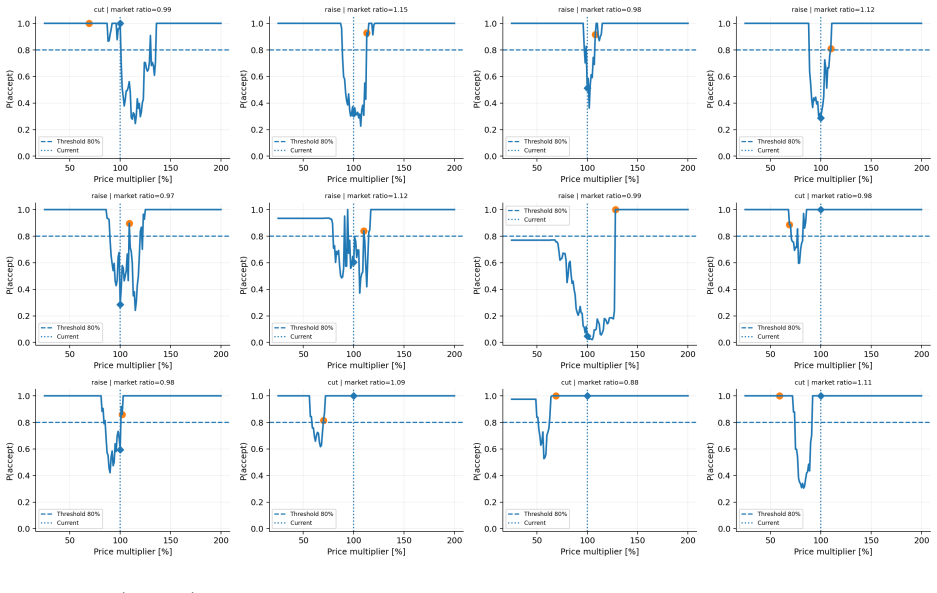
Gig worker acceptance follows Preisach hysteresis, letting platforms cut total wages 21 percent while raising fill rates nearly 10 points.
A machine-rendered reading of the paper's core claim, the machinery that carries it, and where it could break.
Core claim
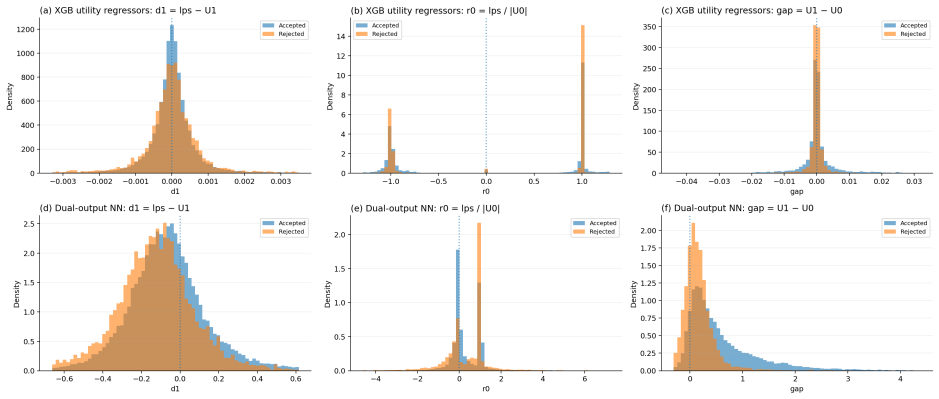
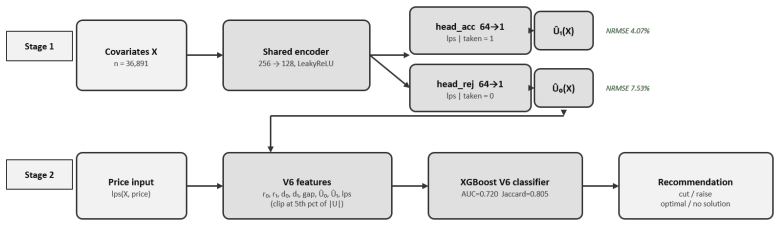
Worker utility surfaces are recovered from binary labels alone by a dual-output network whose difference U1(X) minus U0(X) is passed, with clip-stabilised price encodings, to XGBoost; the resulting classifier reproduces the directional asymmetry of the Preisach operator and yields recommendations that reduce aggregate wage cost 21.3 percent while increasing expected completion rate 9.7 percentage points on 36,891 real transactions.
What carries the argument
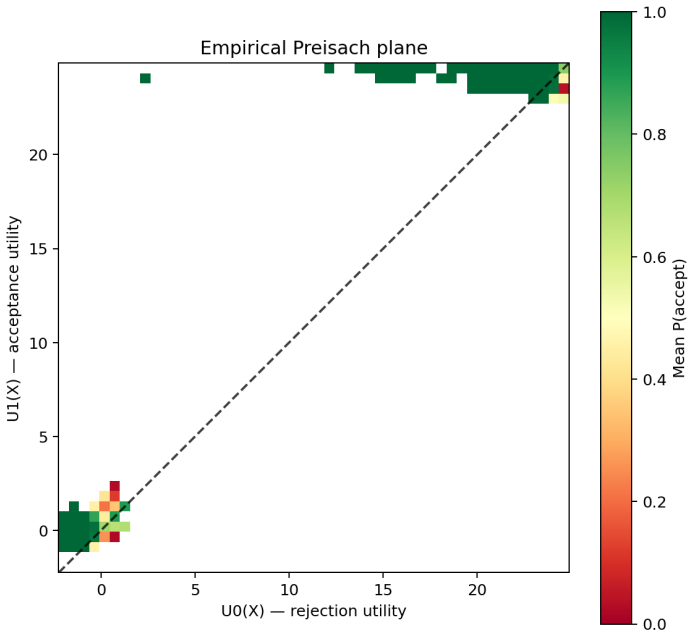
The Preisach operator, which produces aggregate accept/reject output as an integral over a population of binary threshold elements whose individual switching thresholds encode private acceptance wages.
If this is right
- Price-to-threshold encodings add 11 points of AUC over raw utility features.
- The fitted model confirms that price decreases depress completion rates more than equivalent increases raise them.
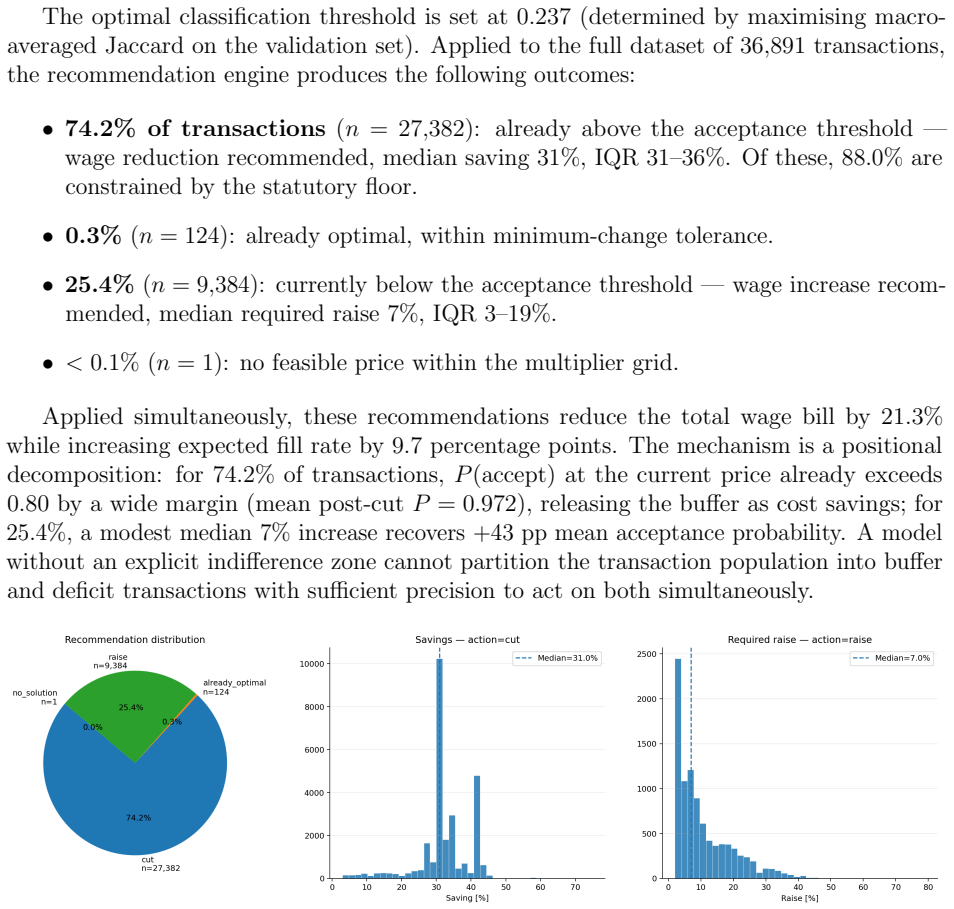
- For 74 percent of transactions a wage cut keeps acceptance probability above 0.80 while releasing a median 31 percent cost saving.
- For the remaining 25 percent a median 7 percent wage increase recovers 43 points of acceptance probability.
- A symmetric model without an explicit indifference zone cannot perform both the cost-reducing and the acceptance-recovering moves at once.
Where Pith is reading between the lines
- The same threshold-ensemble logic could be tested on consumer price-stickiness data where purchase or non-purchase is the only observed bit.
- Dynamic wage offers could be generated by tracking the current state of each worker's thresholds rather than treating each transaction independently.
- If the recovered surfaces U1 and U0 prove stable across platforms, they could serve as transferable priors for new markets with sparse labels.
Load-bearing premise
The population of gig workers behaves exactly as an ensemble of independent binary threshold elements whose collective output is captured by the Preisach operator and can be recovered from accept/reject labels by the margin-trained network.
What would settle it
A controlled experiment in which identical price increases and decreases produce symmetric changes in acceptance probability would falsify the directional-asymmetry claim.
Figures
read the original abstract
Worker utility is not observed -- only its consequence is. Each gig transaction produces a single bit: accepted or rejected. We argue this structure points directly to the Preisach hysteresis model as the natural representation of latent worker preferences. The Preisach operator models aggregate output as an integral over a population of binary threshold elements -- precisely the structure that emerges when heterogeneous workers each carry a private acceptance wage. We estimate two latent utility surfaces: acceptance utility U_1(X) and rejection utility U_0(X), via a dual-output neural network (shared layers 256->128, margin loss enforcing U_1 >= U_0). Classification reduces to the Preisach gap U_1(X) - U_0(X), passed into an XGBoost classifier alongside clip-stabilised price-to-threshold encodings. On 36,891 gig transactions, this pipeline achieves Jaccard = 0.827 and ROC AUC = 0.799. The price-to-threshold encoding accounts for +11.0 pp AUC over raw utility features. The model confirms the directional asymmetry hysteresis predicts: price decreases depress completion rates more than equivalent increases raise them. Applied to the full dataset, the model's recommendations simultaneously reduce the total wage bill by 21.3% and increase expected fill rate by 9.7 pp. For 74.2% of transactions, P(accept) already exceeds 0.80; reducing the wage keeps it above threshold (mean post-cut P = 0.972), releasing cost savings (median 31%). For the remaining 25.4%, a median 7% wage increase recovers +43 pp acceptance. A model without an explicit indifference zone cannot execute both moves simultaneously.
Editorial analysis
A structured set of objections, weighed in public.
Referee Report
Summary. The paper claims that gig worker acceptance/rejection decisions can be represented via the Preisach hysteresis model, with a dual-output neural network (shared layers 256→128, margin loss) recovering latent utilities U₁(X) and U₀(X) from binary labels. The gap U₁(X)−U₀(X) together with clip-stabilised price-to-threshold encodings is passed to XGBoost, yielding Jaccard 0.827 and ROC AUC 0.799 on the 36,891-transaction dataset. The fitted model is then used to recommend wage adjustments that simultaneously cut the total wage bill by 21.3 % and raise expected fill rate by 9.7 pp while respecting the directional asymmetry predicted by hysteresis.
Significance. If the Preisach representation and out-of-sample validity hold, the work supplies a principled, economically interpretable framework for wage optimisation in gig markets that explicitly encodes asymmetric responses to price changes. The directional-asymmetry verification and the dual-move optimisation (cuts for high-probability transactions, increases for low-probability ones) are concrete strengths that distinguish the approach from standard classifiers.
major comments (4)
- [Abstract / Methods] Abstract / Methods: the pipeline feeds the learned gap into XGBoost rather than computing the Preisach integral or memory operator over the recovered threshold measure; the reported Jaccard/AUC and 21.3 % / 9.7 pp deltas therefore rest on an unverified equivalence between the NN gap and the Preisach operator.
- [Results] Results: all performance figures and the economic deltas are produced by models fitted and evaluated on the identical 36,891-transaction dataset; no hold-out set, cross-validation, or external validation is reported, so the claims remain in-sample evaluations.
- [Methods] Methods: the margin loss enforces only U₁ ≥ U₀; it supplies no further identification for the distribution of thresholds required by the Preisach model, and the subsequent XGBoost step bypasses explicit Preisach computation.
- [Results] Results: no ablation is presented that isolates the contribution of the Preisach/hysteresis component versus a plain classifier or versus the price-to-threshold encodings alone.
minor comments (2)
- [Abstract] Abstract: performance numbers and economic deltas are stated without error bars, confidence intervals, or statistical significance tests.
- [Methods] Notation: the distinction between the true Preisach operator and its neural-network approximation should be made explicit in the methods section.
Simulated Author's Rebuttal
We thank the referee for the detailed and constructive comments. We address each major point below and indicate the revisions we will undertake.
read point-by-point responses
-
Referee: [Abstract / Methods] Abstract / Methods: the pipeline feeds the learned gap into XGBoost rather than computing the Preisach integral or memory operator over the recovered threshold measure; the reported Jaccard/AUC and 21.3 % / 9.7 pp deltas therefore rest on an unverified equivalence between the NN gap and the Preisach operator.
Authors: We acknowledge that the pipeline employs the learned utility gap U₁(X) − U₀(X) as input to XGBoost rather than explicitly evaluating the Preisach integral or memory operator over an estimated threshold measure. This design choice treats the gap as a sufficient statistic for the aggregate hysteresis effect recovered from binary labels. We will revise the Abstract and Methods sections to state this modeling decision explicitly and to discuss its relation to the full Preisach operator, including any limitations of the approximation. revision: partial
-
Referee: [Results] Results: all performance figures and the economic deltas are produced by models fitted and evaluated on the identical 36,891-transaction dataset; no hold-out set, cross-validation, or external validation is reported, so the claims remain in-sample evaluations.
Authors: The referee is correct that all reported metrics and economic deltas are obtained from models trained and evaluated on the same 36,891-transaction dataset. We will revise the Results section to include 5-fold cross-validation performance estimates for both the classification metrics and the wage-optimisation deltas. revision: yes
-
Referee: [Methods] Methods: the margin loss enforces only U₁ ≥ U₀; it supplies no further identification for the distribution of thresholds required by the Preisach model, and the subsequent XGBoost step bypasses explicit Preisach computation.
Authors: The margin loss is used solely to enforce the ordering required by the hysteresis model. The subsequent XGBoost step operates on the gap together with price-to-threshold encodings rather than on an explicit threshold distribution or memory operator. We will expand the Methods section to clarify how the dual-network plus classifier pipeline approximates the Preisach representation and to note the identification assumptions involved. revision: partial
-
Referee: [Results] Results: no ablation is presented that isolates the contribution of the Preisach/hysteresis component versus a plain classifier or versus the price-to-threshold encodings alone.
Authors: While the manuscript already reports the incremental AUC contribution of the price-to-threshold encodings, we agree that a systematic ablation isolating the hysteresis framing would strengthen the results. We will add an ablation study in the revised Results section comparing the full pipeline against (i) a plain classifier on the utility features alone and (ii) the same classifier without the price-to-threshold encodings. revision: yes
Circularity Check
In-sample performance metrics and economic outcomes presented as model predictions on the fitted dataset
specific steps
-
fitted input called prediction
[Abstract]
"On 36,891 gig transactions, this pipeline achieves Jaccard = 0.827 and ROC AUC = 0.799. [...] Applied to the full dataset, the model's recommendations simultaneously reduce the total wage bill by 21.3% and increase expected fill rate by 9.7 pp. For 74.2% of transactions, P(accept) already exceeds 0.80; reducing the wage keeps it above threshold (mean post-cut P = 0.972), releasing cost savings (median 31%). For the remaining 25.4%, a median 7% wage increase recovers +43 pp acceptance."
The dual NN + XGBoost pipeline parameters are estimated from the 36,891-transaction dataset. The classification metrics and the wage-bill/fill-rate deltas are computed by feeding the fitted U1-U0 gap (plus encodings) back into the same dataset, so the reported 'predictions' and optimization outcomes are in-sample evaluations of the fitted utility surfaces rather than out-of-sample forecasts or parameter-free results derived from the Preisach operator.
full rationale
The paper fits a dual-output NN (with margin loss) and subsequent XGBoost on the 36,891-transaction dataset to recover U1(X) and U0(X) and classify acceptance. All reported figures (Jaccard 0.827, AUC 0.799, 21.3% wage bill reduction, 9.7 pp fill rate increase) are obtained by applying the fitted surfaces and gap feature to the identical dataset (explicitly called the 'full dataset' for the economic deltas). This matches the fitted_input_called_prediction pattern: the 'predictions' after wage adjustment are direct evaluations of the fitted model outputs on the training inputs rather than independent or out-of-sample results. No train/test split, external benchmark, or parameter-free derivation is described. The Preisach operator claim is asserted via the gap but the pipeline substitutes XGBoost on the gap without implementing the integral/memory operator; however this is an unverified modeling assertion rather than an explicit equation reducing to its input by construction, so it does not trigger an additional circularity flag under the strict quote-and-reduction rule.
Axiom & Free-Parameter Ledger
free parameters (2)
- neural-network weights and biases
- XGBoost hyperparameters
axioms (1)
- domain assumption Worker acceptance decisions are generated by an ensemble of independent binary threshold elements whose aggregate output is exactly the Preisach operator
Reference graph
Works this paper leans on
-
[1]
doi: 10.1145/2939672.2939785. R. Chetty, J. N. Friedman, T. Olsen, and L. Pistaferri. Adjustment costs, firm responses, and micro vs. macro labor supply elasticities: Evidence from Danish tax records.Quarterly Journal of Economics, 126(2):749–804,
-
[2]
doi: 10.1093/qje/qjr013. V. P. Crawford and J. Meng. New York City cab drivers’ labor supply revisited: Reference- dependent preferences with rational-expectations targets for hours and income.American Economic Review, 101(5):1912–1932,
-
[3]
doi: 10.1257/aer.101.5.1912. R. Cross. On the foundations of hysteresis in economic systems.Economics & Philosophy, 9 (1):53–74,
-
[4]
doi: 10.1017/S0266267100005113. R. Cross, M. Grinfeld, and H. Lamba. Hysteresis and economics.IEEE Control Systems Magazine, 29(1):30–43,
-
[5]
doi: 10.1109/MCS.2008.930445. 16 A. Dube, A. Lindner, B. Zipperer, et al. Monopsony in online labour markets.American Economic Review: Insights, 2(1):33–46,
-
[6]
doi: 10.1257/aeri.20180150. W. Franz. Hysteresis in economic relationships: An overview.Empirical Economics, 15(2): 109–125,
-
[7]
doi: 10.1007/BF01973454. M. G¨ ocke. Various concepts of hysteresis applied in economics.Journal of Economic Surveys, 16(2):167–188,
-
[8]
doi: 10.1111/1467-6419.00163. J. V. Hall and A. B. Krueger. An analysis of the labor market for Uber’s driver-partners in the United States.American Economic Review, 108(3):309–328,
-
[9]
doi: 10.1257/aer. 20161122. J. J. Heckman and B. E. Honor´ e. The empirical content of the Roy model.Econometrica, 58 (5):1121–1149,
-
[10]
doi: 10.2307/2938303. D. Kahneman and A. Tversky. Prospect theory: An analysis of decision under risk.Econo- metrica, 47(2):263–291,
-
[11]
doi: 10.2307/1914185. A. Mas and E. Moretti. Peers at work.American Economic Review, 99(1):112–145,
-
[12]
doi: 10.1257/aer.99.1.112. I. D. Mayergoyz.Mathematical Models of Hysteresis. Springer-Verlag,
-
[13]
doi: 10.2307/1879403. D. McFadden. Conditional logit analysis of qualitative choice behavior. In P. Zarembka, editor,Frontiers in Econometrics. Academic Press,
-
[14]
doi: 10.2307/2297896. P. Mui and B. Schoefer. Reservation raises: The aggregate labor supply curve at the firm level. Working Paper 28770, National Bureau of Economic Research,
-
[15]
doi: 10.1007/BF01349418. S. Rosen. Hedonic prices and implicit markets: Product differentiation in pure competition. Journal of Political Economy, 82(1):34–55,
-
[16]
doi: 10.1086/260169. R. Roussel et al. Differentiable preisach modeling for particle accelerator systems.Physical Review Letters, 128:204801,
-
[17]
doi: 10.1103/PhysRevLett.128.204801. A. D. Roy. Some thoughts on the distribution of earnings.Oxford Economic Papers, 3(2): 135–146,
-
[18]
doi: 10.1093/oxfordjournals.oep.a041827. W. Samuelson and R. Zeckhauser. Status quo bias in decision making.Journal of Risk and Uncertainty, 1(1):7–59,
-
[19]
doi: 10.1007/BF00055564. 17 R. Shimer and L. Smith. Assortative matching and search.Econometrica, 68(2):343–369,
-
[20]
doi: 10.1111/1468-0262.00108. 18
discussion (0)
Sign in with ORCID, Apple, or X to comment. Anyone can read and Pith papers without signing in.