REVIEW 3 major objections 6 minor 33 references
A highly scalable numerical framework for reservoir simulation on UG4 platform
T0 review · 3 major / 6 minor · reviewed 2026-08-07 · deepseek-v4-flash
Pith's one-line read A fully coupled, fully implicit reservoir simulator with LIMEX adaptive time stepping and geometric-multigrid preconditioning accurately reproduces benchmark two-phase flows and scales to 4096 processors with billions of unknowns.
desk verdict Solid engineering paper: the LIMEX adaptation and the pdmin interface condition are new, the scaling data are credible, but the promised equivalence proof is missing and the capillary-barrier case is not quantitatively validated. read the letter →
The pith
A machine-rendered reading of the paper's core claim, the machinery that carries it, and where it could break.
The reading
What carries the argument
The argument is carried by four tightly coupled pieces. Spatial discretization is the vertex-centered finite volume method with upwind relative permeabilities evaluated from the $v_\alpha$ velocities, so that capillary diffusion is never upwinded. Heterogeneous interfaces are treated by a saturation reconstruction (Equations 21--22) using the vertex-wise constant minimum entry pressure $p_{d,\min,i}$ and the Leverett-J function for Brooks-Corey capillary pressure, replacing the exact but expensive minimum-capillary-pressure condition (Equation 19). Time stepping is the LIMEX W-method with an error estimator based on the scaled norm $\|\!|u\|\!|^2 = \alpha\|\nabla p_n\|^2 + \beta\|S_w\|^2$, with the order fixed to $q=2$; each accepted step needs only one linear solve rather than Newton iterations. The linear systems are solved by BiCGSTAB preconditioned with geometric multigrid, which is the component that keeps the fully implicit system scalable across processors.
What would settle it
Run the two-layer or four-layer heterogeneous benchmarks on three successively refined grids, solving once with the cheap interface rule (Equations 21–22) and once with the exact capillary-pressure rule (Equation 19), and compare the saturation jump at the permeability interface (for example, the 0.52-to-0.48 jump at x = 150 m in Case-2); if the difference between the two interface conditions fails to vanish at a consistent rate as $h\to0$, the asserted equivalence is false.
Extended reading notes
Core claim
The author aims to establish that the linearly implicit extrapolation method, adapted here for the first time to multiphase flow, can drive a fully coupled, fully implicit simulation of two-phase flow in heterogeneous media with gravity and capillary effects while preserving parallel scalability. The key substantive result is that saturation profiles converge to the analytic solution for the Buckley-Leverett and extended Buckley-Leverett problems and to the quasi-analytic solution for the McWhorter problem, with no visible oscillation and with the expected order of convergence as the mesh is refined. The layer-wise heterogeneity test shows the non-wetting phase being trapped and released layer by layer according to the entry-pressure threshold, and the scaling tests show roughly linear speedup in the strong-scaling ranges tested and modest total-time growth in weak scaling up to 2.15 billion degrees of freedom on 4096 processors.
Load-bearing premise
The load-bearing premise is that the computationally cheap rule used to set saturations at permeability interfaces (Equations 21–22) agrees with the exact capillary-barrier rule (Equation 19) in the limit of fine grids; the paper says this can be proved but does not show the proof.
Editorial extensions
If this is right
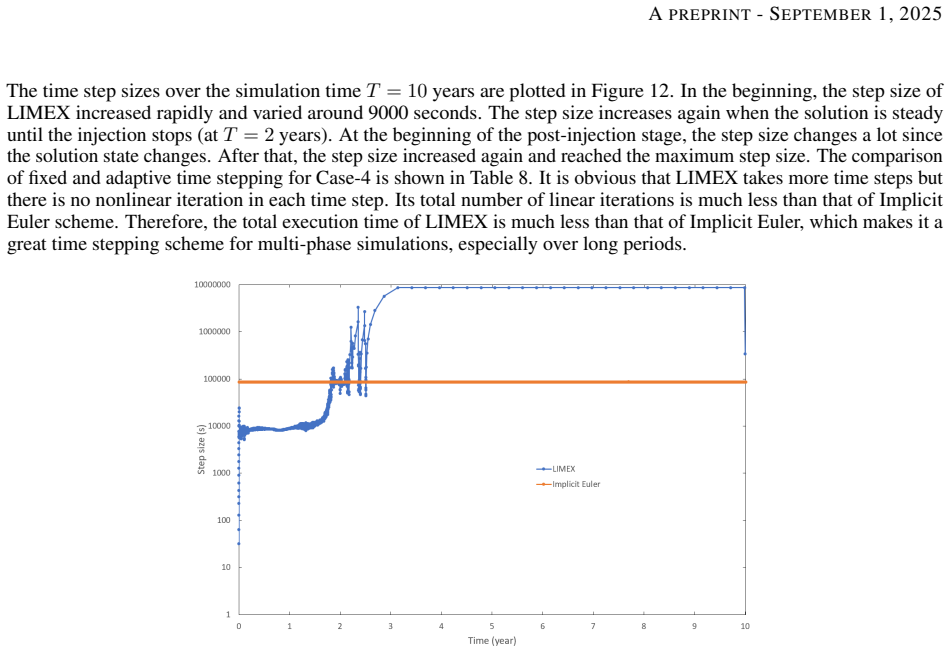
- The 10-year heterogeneous Case-4 simulation runs in 275.28 seconds with 58,093 linear iterations under LIMEX, versus 3,938.76 seconds and 375,093 linear iterations under implicit Euler with the same grid.
- Saturation profiles approach the analytic solution for Buckley-Leverett and extended Buckley-Leverett flows and the quasi-analytic solution for McWhorter flow; the reported $L^2$ convergence rates are close to the theoretical value $1/2$ for the Buckley-Leverett case and remain stable for the other cases.
- The interface condition reproduces the saturation jump at a permeability discontinuity (0.52 to 0.48 at the 150 m interface in Case-2) and produces the trap-and-release sequence of non-wetting phase across layers in Case-4.
- Strong scaling is nearly linear across the tested ranges: doubling the processor count from 64 to 512 on a 4,096 x 2,048 mesh gives speedups of 1.857 to 2.045 for the two time-stepping schemes, and in 3D, 256 to 1024 cores gives speedups of 1.719 to 1.847.
- Weak scaling in 3D from 64 to 4096 processors with 63 times more unknowns increases total time from 3,606.7 to 5,587.0 seconds, indicating communication and grid-complexity overhead are mostly absorbed.
Reading between the lines
- A generalization the paper does not test: if the $p_{d,\min}$--$p_{c,\min}$ equivalence holds as $h\to0$, the same vertex-constant reconstruction should transfer to other entry-pressure capillary closures such as van Genuchten curves, giving a cheap interface treatment for a wider class of heterogeneous media.
- A stress test the paper leaves implicit: run LIMEX on compressible or near-miscible systems, where pressure and saturation couple on very different time scales; the error-estimator weights $\alpha$ and $\beta$ would likely need to become time-dependent.
- A plausible extension for compositional flow: since LIMEX removes Newton iterations, applying the same fully coupled adaptive stepping to three-phase or compositional models, with the scaled error norm enlarged to include composition unknowns, could cut the dominant nonlinear cost.
Editorial analysis
A structured set of objections, weighed in public.
Referee Report
Summary. The paper presents a fully coupled, fully implicit numerical framework for two-phase flow in heterogeneous porous media, built on the UG4 platform, with vertex-centered finite volume spatial discretization, LIMEX adaptive time stepping, and GMG-preconditioned BiCGSTAB linear solvers. The novel contributions claimed are an efficient interface condition for heterogeneous media based on a pdmin reconstruction, the first adaptation of LIMEX with an error estimator to multiphase flow, and demonstration of scalability to thousands of processors with billions of degrees of freedom. Validation is carried out against analytic or quasi-analytic solutions for Buckley-Leverett, extended Buckley-Leverett, and McWhorter problems, plus a qualitative layer-wise heterogeneity case and strong/weak scaling tests in 2D and 3D.
Significance. If the interface-condition equivalence and the error-estimator design are correct, the framework is a useful contribution: the scaling results (Tables 9-10, 12-13) extend to 4096 processors and 2.15 billion DoFs in weak scaling, and the LIMEX implementation reduces total runtime substantially compared with implicit Euler (Table 8). The main strengths are the thorough numerical convergence studies against external analytic solutions (Cases 1 and 3), the reproducible parameter settings, and the explicit reporting of time-step counts, nonlinear iterations, and linear iterations. The claims about heterogeneous-media capillary barriers are central but rest on an asserted equivalence that is neither proved nor quantitatively validated for the saturation-discontinuity regime, reducing the confidence in that part of the contribution.
major comments (3)
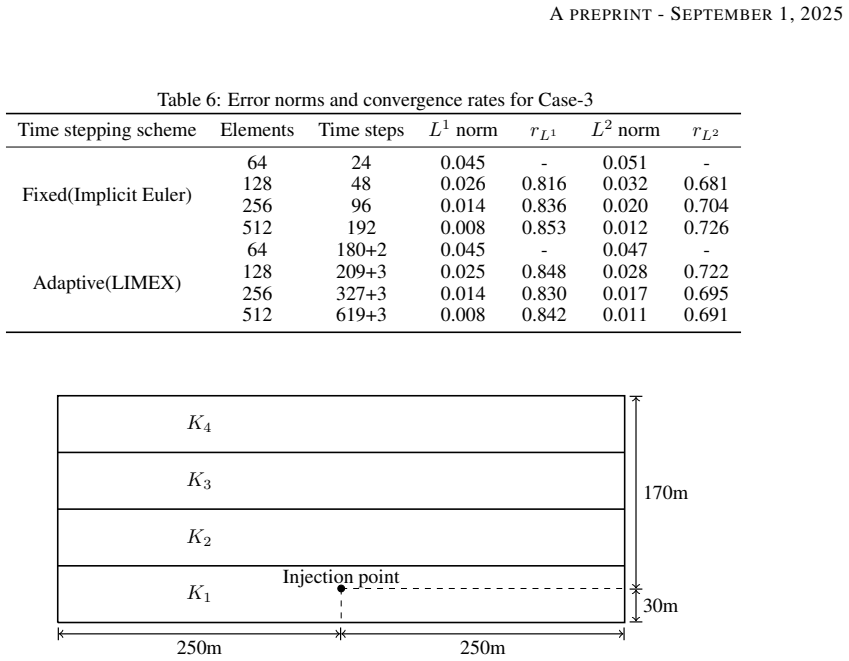
- [Section 3.3, Eqs. (21)-(22)] The statement 'One can prove that, for Sw ∈ C0, Equation (21) is equivalent to Equation (19) when grid size h approaches 0' is not supported by a proof or a reference. More importantly, the hypothesis Sw ∈ C0 excludes the setting where the condition is actually applied: at media discontinuities the saturation is discontinuous, as the paper's own Figures 7-8 and Case-4 show. Since Eq. (22) is the mechanism that enables the heterogeneous-media treatment, the correctness of Cases 2 and 4 relies on an unverified asymptotic equivalence. The authors should either supply the proof for discontinuous saturation (or provide carefully justified assumptions) or replace the assertion with a quantitative validation against an independent solution for a case with nonzero capillary pressure and a saturation jump.
- [Section 5.2, Table 3 and Case-2] The extended Buckley-Leverett test is configured with pc ≡ 0, so the capillary barrier condition (Eqs. 19-22) is never activated. The saturation jump from 0.52 to 0.48 at the permeability interface in Figures 7-8 arises from the discontinuity in relative permeability curves, not from entry-pressure effects. Consequently, Case-2 cannot validate the pdmin-based interface condition. Case-4 (Section 5.4) is only qualitative, with no reference solution or error norm. A quantitative heterogeneous test with pc ≠ 0 and an independent or analytical solution is needed to support the claim that the interface condition correctly captures capillary barriers.
- [Section 4, Eq. (30) and adaptive step size] The error estimator norm |||u|||^2 = α ||∇pn||^2 + β ||Sw||^2 uses weights α and β that are 'selected adaptively,' but the paper gives no algorithm, initial values, or update rule for their selection. Since the LIMEX step-size selection (Eq. 27) and the adaptive behavior in Tables 4, 6, and 8 depend on this estimator, the numerical results are not fully reproducible. The drop in the L2 convergence rate for LIMEX in Case-2 at 512 elements (rL2 = 0.220, Table 4) suggests that the adaptive error control is not robust, which is a concrete symptom of this unspecified weight tuning. The authors should specify how α and β are chosen and show sensitivity of the results to these choices.
minor comments (6)
- [Table 5] In the boundary conditions for Case-3, the domain is 1.6 m × 1.6 m, but the top boundary is written as 'ϕw(x, 75, t) = ϕn(x, 75, t) = 0'; this should be 1.6, not 75.
- [Table 11] In Case-5 boundary conditions, the line 'ϕw(200, y, t) = ϕn(200, y, z, t) = 0' mixes 2D and 3D notation; it should be 'ϕw(200, y, z, t) = ϕn(200, y, z, t) = 0'.
- [Eq. (22)] The notation in the third line of Eq. (22) is unclear: the subscript 'r' in '1 − Sn,r' is never defined, and the phrase 'S where S solves pd(N)J(S) = pdmin,i J(Sw,i)' should be presented as a properly defined implicit function, e.g., S = S*(N, i), to avoid ambiguity.
- [Eq. (30)] The norm notation '∥|u(t)∥|' is inconsistent (missing an extra bar on the right side); it should be written as '|||u(t)|||' for clarity.
- [Section 5.1, Figure 4-5 caption] The phrase 'The shock fronts are described in the numerical solutions without oscillation' could be replaced by 'the shock fronts are captured without visible oscillation' to avoid ambiguity about what 'described' means.
- [Abstract and Section 5.5] The abstract says scalability is shown up to 4096 processors with 2 billion DoFs, but the strong-scaling results in Table 12 only go to 1024 processors; the 4096-processor claim comes from the weak-scaling test (Table 13). Please clarify this distinction in the text.
Circularity Check
No circularity found: the central validation is against external analytic solutions, and the proposed interface condition is an implementation of the standard capillary-pressure continuity condition rather than a re-labeling of the result.
full rationale
I walked the derivation chain and found no load-bearing step that reduces to its own inputs. The accuracy claims are anchored by external references: Case-1 (Buckley-Leverett), Case-2 (extended Buckley-Leverett of Wu, Pruess and Chen), and Case-3 (McWhorter) are compared with analytic or quasi-analytic solutions, and the L^p error norms in Tables 2, 4, and 6 are defined independently of the scheme's own parameters. The pdmin-based interface condition (Equations 21-22) is an algebraic restatement of capillary-pressure continuity through the Leverett J-function: Equation (22) solves pd(N)J(S) = pdmin,i J(Sw,i), which is exactly the discrete form of the standard extended capillary pressure condition, so it is not a definition of the phenomenon it is used to predict. The LIMEX adaptive time stepping is a standard W-method with external theoretical support, and the error estimator weights alpha and beta are adaptively chosen heuristics; they do not enter the error norms used for validation, which are computed against external reference solutions. The equivalence claim between Equation (21) and Equation (19) is asserted for Sw in C^0 without proof and is used at saturation discontinuities, but that is an unsupported correctness assumption, not circularity. The paper cites UG4 as open-source platform software, and the present author is not an author of the cited UG4 papers, so the UG4 citations are not self-citations. No fitted parameter is renamed as a prediction, and no uniqueness or existence theorem is imported from the author's own prior work. The derivation is therefore self-contained with respect to external benchmarks; the appropriate circularity score is 0.
Assumptions & free parameters
free parameters (4)
- Error norm weights alpha and beta =
not reported (selected adaptively)
- LIMEX error tolerance TOL =
5e-2 (Case-1), 1e-2 (Case-2), 8e-2 (Case-3), 5e-3 (Case-4)
- LIMEX safety factor rho =
0.25 (Case-1), 0.75 (Case-4)
- Maximum time step Delta_t_max =
100 days in most LIMEX cases
assumptions (3)
- domain assumption The two-phase flow model (Darcy's law, mass conservation, saturation constraint, and capillary pressure relation) is the correct governing system.
- ad hoc to paper The pdmin-based saturation reconstruction (Equations 21-22) is asymptotically equivalent to the exact pcmin-based capillary barrier condition as h approaches 0.
- ad hoc to paper The weighted norm |||u||| = alpha||nabla pn|| + beta||Sw|| is a valid basis for the LIMEX error estimator.
Cite this review
Pith. "Pith review of A highly scalable numerical framework for reservoir simulation on UG4 platform." pith.science (2026). https://pith.science/paper/NODMYIC3
@misc{pith2026250604763,
  author       = {Pith},
  title        = {Pith review of: A highly scalable numerical framework for reservoir simulation on UG4 platform},
  year         = {2026},
  howpublished = {\url{https://pith.science/paper/NODMYIC3}},
  note         = {Machine review of arXiv:2506.04763}
}
read the original abstract
The modeling and simulation of multiphase fluid flow receive significant attention in reservoir engineering. Many time discretization schemes for multiphase flow equations are either explicit or semi-implicit, relying on the decoupling between the saturation equation and the pressure equation. In this study, we delve into a fully coupled and fully implicit framework for simulating multiphase flow in heterogeneous porous media, considering gravity and capillary effects. We utilize the Vertex-Centered Finite Volume Method for spatial discretization and propose an efficient implementation of interface conditions for heterogeneous porous media within the current scheme. Notably, we introduce the Linearly Implicit Extrapolation Method (LIMEX) with an error estimator, adapted for the first time to multiphase flow problems. To solve the resulting linear system, we employ the BiCGSTAB method with the Geometric Multigrid (GMG) preconditioner. The implementations of models and methods are based on the open-source software: UG4. The results from parallel computations on the supercomputer demonstrate that the scalability of our proposed framework is sufficient, supporting a scale of thousands of processors with Degrees of Freedom (DoF) extending up to billions.
Figures


Figures from the paper (11 more)




Reference graph
Works this paper leans on
-
[1]
H Kazemi, CR Vestal, and Deane G Shank. An efficient multicomponent numerical simulator.Society of Petroleum Engineers Journal, 18(05):355–368, 1978
work page 1978
-
[2]
An equation of state compositional model
Keith H Coats. An equation of state compositional model. Society of Petroleum Engineers Journal, 20(05):363– 376, 1980
work page 1980
-
[3]
Rainer Helmig et al. Multiphase flow and transport processes in the subsurface: a contribution to the modeling of hydrosystems, volume 1. Springer, 1997
work page 1997
-
[4]
Development of techniques for general purpose simulators
Hui Cao. Development of techniques for general purpose simulators. Stanford University, 2002
work page 2002
-
[5]
Compositional modeling of three-phase flow with gravity using higher-order finite element methods
Joachim Moortgat, Shuyu Sun, and Abbas Firoozabadi. Compositional modeling of three-phase flow with gravity using higher-order finite element methods. Water Resources Research, 47(5), 2011
work page 2011
-
[6]
Qi Shao, Stephan Matthai, Thomas Driesner, and Lutz Gross. Predicting plume spreading during co 2 geo- sequestration: benchmarking a new hybrid finite element–finite volume compositional simulator with asynchronous time marching. Computational Geosciences, 25:299–323, 2021
work page 2021
-
[7]
Peter Bastian, Klaus Birken, Klaus Johannsen, Stefan Lang, V olker Reichenberger, Christian Wieners, Gabriel Wittum, and Christian Wrobel. A parallel software-platform for solving problems of partial differential equations using unstructured grids and adaptive multigrid methods. In High Performance Computing in Science and Engineering’98: Transactions of ...
work page 1998
-
[8]
Reservoir simulations: Machine learning and modeling
Shuyu Sun and Tao Zhang. Reservoir simulations: Machine learning and modeling. Gulf Professional Publishing, 2020
work page 2020
Show all 33 references
-
[9]
Fundamentals of numerical reservoir simulation
Donald W Peaceman. Fundamentals of numerical reservoir simulation. Elsevier, 2000
2000
-
[10]
A finite volume scheme for two-phase immiscible flow in porous media
Anthony Michel. A finite volume scheme for two-phase immiscible flow in porous media. SIAM Journal on Numerical Analysis, 41(4):1301–1317, 2003
2003
-
[11]
A mixed-dimensional finite volume method for two-phase flow in fractured porous media
V olker Reichenberger, Hartmut Jakobs, Peter Bastian, and Rainer Helmig. A mixed-dimensional finite volume method for two-phase flow in fractured porous media. Advances in water resources, 29(7):1020–1036, 2006
2006
-
[12]
Node-centered finite volume discretizations for the numerical simulation of multiphase flow in heterogeneous porous media
Ralf Huber and Rainer Helmig. Node-centered finite volume discretizations for the numerical simulation of multiphase flow in heterogeneous porous media. Computational Geosciences, 4(2):141–164, 2000
2000
-
[13]
Multiphase flow in heterogeneous porous media: A classical finite element method versus an implicit pressure–explicit saturation-based mixed finite element–finite volume approach
R Huber and R Helmig. Multiphase flow in heterogeneous porous media: A classical finite element method versus an implicit pressure–explicit saturation-based mixed finite element–finite volume approach. International Journal for Numerical Methods in Fluids, 29(8):899–920, 1999
1999
-
[14]
A method for calculating multi-dimensional immiscible displacement
Jim Douglas Jr, Donald W Peaceman, and HH Rachford Jr. A method for calculating multi-dimensional immiscible displacement. Transactions of the AIME, 216(01):297–308, 1959
1959
-
[15]
One-dimensional, incompressible, noncapillary, two-phase fluid flow in a porous medium
JW Sheldon and WT Cardwell Jr. One-dimensional, incompressible, noncapillary, two-phase fluid flow in a porous medium. Transactions of the AIME, 216(01):290–296, 1959
1959
-
[16]
Analysis of gas-cap or dissolved-gas drive reservoirs.Society of Petroleum Engineers Journal, 1(02):92–104, 1961
HL Stone and AO Garder Jr. Analysis of gas-cap or dissolved-gas drive reservoirs.Society of Petroleum Engineers Journal, 1(02):92–104, 1961
1961
-
[17]
Impes stability: the cfl limit
KH Coats. Impes stability: the cfl limit. Spe Journal, 8(03):291–297, 2003
2003
-
[18]
Numerical computation of multiphase flows in porous media
Peter Bastian. Numerical computation of multiphase flows in porous media . PhD thesis, habilitationsschrift Univeristät Kiel, 1999
1999
-
[19]
A parallel, implicit, cell-centered method for two-phase flow with a preconditioned newton–krylov solver
Clint N Dawson, Héctor Klíe, Mary F Wheeler, and Carol S Woodward. A parallel, implicit, cell-centered method for two-phase flow with a preconditioned newton–krylov solver. Computational Geosciences, 1:215–249, 1997. 17 A PREPRINT - SEPTEMBER 1, 2025
1997
-
[20]
Fully implicit hybrid two-level domain decomposition algorithms for two-phase flows in porous media on 3d unstructured grids
Li Luo, Lulu Liu, Xiao-Chuan Cai, and David E Keyes. Fully implicit hybrid two-level domain decomposition algorithms for two-phase flows in porous media on 3d unstructured grids. Journal of Computational Physics, 409:109312, 2020
2020
-
[21]
A scalable fully implicit framework for reservoir simulation on parallel computers
Haijian Yang, Shuyu Sun, Yiteng Li, and Chao Yang. A scalable fully implicit framework for reservoir simulation on parallel computers. Computer Methods in Applied Mechanics and Engineering, 330:334–350, 2018
2018
-
[22]
Order and stepsize control in extrapolation methods
Peter Deuflhard. Order and stepsize control in extrapolation methods. Numerische Mathematik, 41:399–422, 1983
1983
-
[23]
Recent progress in extrapolation methods for ordinary differential equations
Peter Deuflhard. Recent progress in extrapolation methods for ordinary differential equations. SIAM review, 27(4):505–535, 1985
1985
-
[24]
Extrapolation integrators for quasilinear implicit odes
Peter Deuflhard and Ulrich Nowak. Extrapolation integrators for quasilinear implicit odes. In Large Scale Scientific Computing, pages 37–50. Springer, 1987
1987
-
[25]
Adaptive numerical solution of PDEs
Peter Deuflhard and Martin Weiser. Adaptive numerical solution of PDEs. Walter de Gruyter, 2012
2012
-
[26]
Efficient stiff integration of density driven flow problems
Arne Nägel, Peter Deuflhard, and Gabriel Wittum. Efficient stiff integration of density driven flow problems. 2018
2018
-
[27]
The effect of capillary forces on immiscible two-phase flow in heterogeneous porous media
Cornelis J Van Duijn, Johannes Molenaar, and MJ De Neef. The effect of capillary forces on immiscible two-phase flow in heterogeneous porous media. Transport in porous media, 21:71–93, 1995
1995
-
[28]
Capillary behavior in porous solids
MoC Leverett. Capillary behavior in porous solids. Transactions of the AIME, 142(01):152–169, 1941
1941
-
[29]
Linearly implicit time discretization of non-linear parabolic equations
Ch Lubich and Alexander Ostermann. Linearly implicit time discretization of non-linear parabolic equations. IMA journal of numerical analysis, 15(4):555–583, 1995
1995
-
[30]
Ug 4: A novel flexible software system for simulating pde based models on high performance computers
Andreas V ogel, Sebastian Reiter, Martin Rupp, Arne Nägel, and Gabriel Wittum. Ug 4: A novel flexible software system for simulating pde based models on high performance computers. Computing and Visualization in Science, 16(4):165–179, 2013
2013
-
[31]
A massively parallel geometric multigrid solver on hierarchically distributed grids
Sebastian Reiter, Andreas V ogel, Ingo Heppner, Martin Rupp, and Gabriel Wittum. A massively parallel geometric multigrid solver on hierarchically distributed grids. Computing and Visualization in Science, 16(4):151–164, 2013
2013
-
[32]
Buckley-leverett flow in composite porous media
Yu-Shu Wu, Karsten Pruess, and ZX Chen. Buckley-leverett flow in composite porous media. SPE Advanced Technology Series, 1(02):36–42, 1993
1993
-
[33]
Exact integral solutions for two-phase flow.Water Resources Research, 26(3):399–413, 1990
David B McWhorter and Daniel K Sunada. Exact integral solutions for two-phase flow.Water Resources Research, 26(3):399–413, 1990. 18
1990
Reviewed August 7, 2026 · model on record in the stance chip above.
Discussion (0). Sign in to comment.