REVIEW 5 major objections 7 minor 12 references
Graph Fourier Transformer with Structure-Frequency Information
T0 review · 5 major / 7 minor · reviewed 2026-08-16 · deepseek-v4-flash
Pith's one-line read A structure–frequency mask built from Laplacian eigenvalues and node spectral energies, multiplied into attention logits, lets a graph transformer outperform GNN and transformer baselines on graph and node classification, with the largest…
desk verdict A reimplementable spectral-frequency attention mask for graph transformers; the fixed λ=1 split is the load-bearing assumption and the abstract overstates the leaderboard. read the letter →
The pith
A machine-rendered reading of the paper's core claim, the machinery that carries it, and where it could break.
The reading
What carries the argument
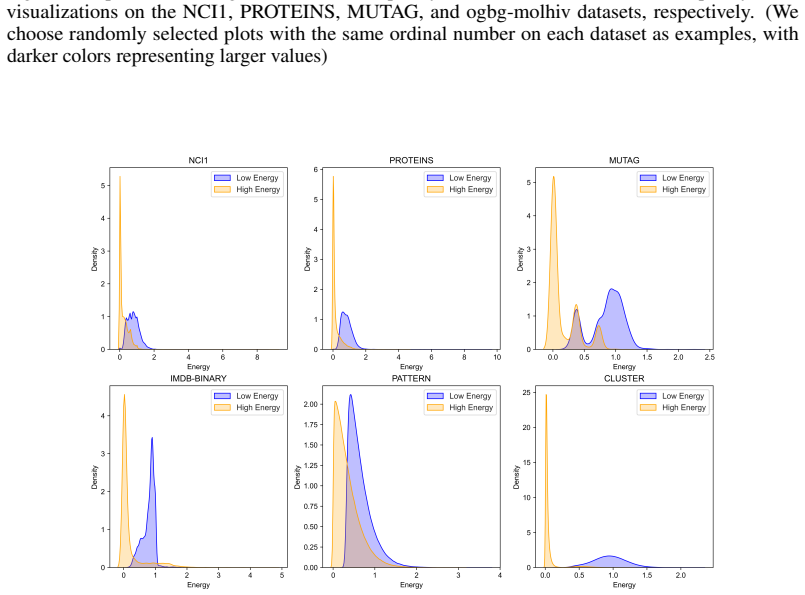
The load-bearing object is the Structure-Frequency Mask $M=\mathrm{ReLU}(S\odot F)$, a matrix built from two pieces. The eigenvalue mask $S_{ij}=\lambda_i+\lambda_j$ encodes pairwise structural relations through the normalized Laplacian spectrum, where $\lambda_i$ and $\lambda_j$ are eigenvalues associated with nodes $i$ and $j$ via the eigenvector matrix $U$; the energy filter $F_{ij}=(e_{\mathrm{low},i}+e_{\mathrm{high},j})/E$ reweights that structure by how much low-frequency energy node $i$ carries versus how much high-frequency energy node $j$ carries. The elementwise product is passed through ReLU and multiplied into $QK^T/\sqrt{d_l}$ before softmax, so attention scores are scaled by both spectral position and spectral content of the two nodes. The graph Fourier transform $f*_G v = U g_\theta U^T v$ provides the vocabulary: eigenvectors of $L$ act as Fourier basis, and the inverse transform (Equation 7) produces the low- and high-frequency node features that feed the energy computation.
What would settle it
Re-run the NCI1 5% training experiment replacing the energy filter $F_{ij}=(e_{\mathrm{low},i}+e_{\mathrm{high},j})/E$ with a constant matrix of ones while keeping the eigenvalue mask $S_{ij}=\lambda_i+\lambda_j$; if the reported 72.33% accuracy does not drop, the frequency-energy filter is not responsible for the gain. Shifting the eigenvalue cutoff from $\lambda=1$ to the per-graph median eigenvalue and re-running would similarly separate the threshold assumption from the rest of the mask.
Extended reading notes
Core claim
The central claim is that graph transformers underuse the graph's spectral structure, and that a mask formed by combining Laplacian eigenvalues with frequency energies of node features fixes this. Specifically, the paper computes the normalized graph Laplacian $L=I_n-D^{-1/2}AD^{-1/2}$, takes its eigenvalues $\lambda_1,\dots,\lambda_n\in[0,2]$, and builds a structural matrix $S_{ij}=\lambda_i+\lambda_j$. An inverse graph Fourier transform decomposes node features into low-frequency and high-frequency parts $v_{\mathrm{low}}$ and $v_{\mathrm{high}}$, whose squared feature sums define energies $e_{\mathrm{low}}$ and $e_{\mathrm{high}}$; normalizing by total energy $E$ gives a filter matrix $F_{ij}=(e_{\mathrm{low},i}+e_{\mathrm{high},j})/E$. The final refinement matrix $M=\mathrm{ReLU}(S\odot F)$ is multiplied elementwise into the attention logits before softmax (Equation 10). The paper argues that this structure-frequency mask suppresses redundant high-frequency interference while preserving local details, and the experiments are used to support that claim.
Load-bearing premise
The method assumes that splitting the Laplacian spectrum at eigenvalue 1 reliably separates useful global/trend signals from redundant local-detail signals across different graphs and datasets, so that the mask always suppresses noise rather than useful attention.
Editorial extensions
If this is right
- Graph transformers can absorb a spectral inductive bias by multiplying a mask into attention logits, without replacing the backbone or adding extra positional encodings.
- The gains concentrate in low-resource settings: on NCI1 with 5% training data, Grafourierformer reaches 72.33% accuracy versus 71.20% for the best baseline, indicating the spectral prior substitutes for some labeled data.
- Ablation results attribute a substantial part of the improvement to the frequency-energy filter, with removal causing up to a 9.01% accuracy drop (on MUTAG).
- On the large-scale benchmarks PATTERN, CLUSTER, and OGBG-MOLHIV, the model is competitive but not consistently best, which the paper reads as the structure-frequency bias mattering most where data is scarce or structure is informative.
Reading between the lines
- The paper fixes the low/high-frequency split at $\lambda=1$; a natural extension is to learn this threshold per dataset or per layer, which would test whether the universal cutoff or the mask's nonlinear reweighting carries the gain.
- The same structure-frequency decomposition could be dropped into other attention architectures, such as node-level or spatiotemporal transformers, by replacing only the mask construction; the energy-filter formulation suggests a lightweight way to inject spectral content without recomputing full eigendecompositions on every forward pass.
- The paper's statement that small eigenvalues correspond to sparsely connected components is not generally true in spectral graph theory, so readers should treat the eigenvalue mask as an empirical reweighting whose success may depend on the energy filter more than on that interpretation.
Signed reviews
Editorial analysis
A structured set of objections, weighed in public.
Referee Report
Summary. The paper proposes Grafourierformer, a graph transformer that injects a structure-frequency inductive bias into self-attention. The method constructs a Laplacian-eigenvalue-based structural mask and a node frequency-energy filter, combines them into a structure-frequency mask M = ReLU(S ⊙ F), and multiplies this into the attention logits (Eq. (10)). Experiments on eight benchmarks (NCI1, PROTEINS, MUTAG, COLLAB, IMDB-BINARY, PATTERN, CLUSTER, MOLHIV) report 10-run means and standard deviations, including a low-resource study on NCI1, ablations over MPNN/PE/frequency-filter components, and visualizations of masks and energy distributions. The central claim is that Grafourierformer consistently outperforms GNN and GT baselines, with the largest gains on small TU datasets and in low-resource settings.
Significance. If the reported results hold, the method is a simple spectral inductive bias that improves graph transformer accuracy on small-scale graph classification, particularly under limited training data. The paper's strengths are the use of 10-run statistics, an ablation that isolates the contributions of MPNN, PE, and the frequency filter, and the claimed public release of code. However, the load-bearing mask construction is ambiguously specified, the fixed λ=1 frequency split is not justified, and the numerical gains are presented with a misleading relative-change basis. The contribution is a potentially useful architectural variant rather than a fundamental theoretical advance; its significance depends on resolving the implementation ambiguity and validating the spectral assumptions.
major comments (5)
- [Section 2.2, Eqs. (5) and (10)] The manuscript defines two different matrices under the same symbol M. Eq. (5) gives a binary matrix M_ij = 1 if λ_i ≤ 1 else 0, while Eq. (10) uses M = ReLU(S ⊙ F) with S_ij = λ_i + λ_j and F_ij = (e_low,i + e_high,j)/E. These are not the same object; the text nevertheless refers to both as the 'Laplacian eigenvalue mask' and the 'Fourier attention refinement matrix.' The authors must state precisely which matrix is multiplied into the attention logits, and if both are used, how the binary mask from Eq. (5) is combined with the soft mask. This is necessary for reproducibility and for interpreting the ablation results.
- [Section 2.2, Eqs. (5)–(6), and Table 4] The split of Laplacian eigenvalues at λ=1 into low- and high-frequency components is asserted without derivation, sensitivity analysis, or validation against the spectral distributions of the datasets. The text's justification—that small eigenvalues correspond to sparsely connected components and λ≤1 captures global trends—is not a theorem of spectral graph theory; eigenvalues of the normalized Laplacian lie in [0,2], with zero multiplicity equal to the number of connected components, but there is no general semantic threshold at 1. Since Table 4 shows that removing the frequency filter degrades accuracy by up to 9.01% (MUTAG), the reported gains are attributed to this mechanism. The authors should provide a sensitivity study over the cutoff (e.g., λ=0.5, 1, 1.5) and justify the choice from the eigenvalue histograms of the benchmark graphs.
- [Abstract and Section 3.3, Table 1] The abstract claims Grafourierformer 'consistently outperforms GNN and GT-based models,' but Table 1 shows lower accuracy than DeepGraph on PATTERN (86.69 vs 90.66), lower accuracy than EGT on CLUSTER (77.26 vs 79.23), and lower AUROC than EGT on MOLHIV (80.28 vs 80.51). Section 3.3 itself concedes that performance is 'slightly lower than the optimal results' on large-scale datasets. The abstract and conclusion should be revised to state accurately that the method is competitive on large-scale datasets and state-of-the-art on the TU benchmarks.
- [Section 3.4 and Table 2] The claimed improvements are relative percentage increases, not absolute percentage-point gains as stated. For 5% training data, Ours is 72.33 vs Gradformer 71.20, an absolute difference of 1.13 points (relative 1.59%); for 10%, 76.94 vs 76.38 gives 0.56 points (relative 0.73%); for 25%, 79.34 vs 77.98 gives 1.36 points (relative 1.74%). The text reports these as 'accuracy improvement' without specifying relative basis, which overstates the absolute gains. Please report both absolute and relative differences clearly.
- [Section 3.2] The experimental setup lacks key hyperparameters needed to reproduce the proposed architecture: number of layers, hidden dimensions, number of attention heads, dropout, learning rate, weight decay, batch size, and number of epochs. In addition, the text does not specify whether TU datasets are evaluated with the standard 10-fold cross-validation from Morris et al. or with the fixed splits from Ying et al., and how the 10 runs are constructed (different seeds on the same split, or different folds). These details are essential because the method's advantage is numerical and the baseline comparisons depend on the evaluation protocol.
minor comments (7)
- [Abstract] The phrase 'generalization bias of graphs' is nonstandard; the intended meaning appears to be 'inductive bias,' and the terminology should be corrected.
- [Section 2.2] The statement that 'smaller eigenvalues correspond to relatively sparsely connected components or isolated subgraphs' is imprecise for the normalized Laplacian; the zero-eigenvalue multiplicity counts connected components, and small nonzero eigenvalues relate to nearly disconnected clusters. The authors should cite appropriate spectral graph theory results.
- [Figure 2 caption] 'Figure Fourier filtering mechanism' should read 'Graph Fourier filtering mechanism.'
- [Sections 2.2 and 3.6] The text contains references to 'Appendix ??' that are unresolved; the appendices should either be included or the references removed.
- [Section 3.2] The setup states that the evaluation covers 'graph classification and regression tasks,' but the paper reports only classification accuracy and AUROC; no regression experiments are presented.
- [Table 3 caption] The caption 'GraphGPS, Graformer, and our model do not have the MPNN and PE modules on the NCI1 dataset, respectively' is confusing; it should say that the MPNN and PE modules are removed from each model.
- [Section 5] The opening sentence 'datasets demonstrate that...' is missing its subject; the sentence is incomplete as printed.
Circularity Check
No significant circularity: the structure-frequency mask is built from the graph Laplacian and node-feature energies without labels, and the reported gains are measured on held-out test splits; the unvalidated lambda=1 split is a design assumption, not a fitted input.
full rationale
The paper's central mechanism, M = ReLU(S⊙F) in Eq. (10), is constructed only from the eigendecomposition of the normalized Laplacian (Eq. (3)) and from the energies of projected input features (Eqs. (7)-(9)); no training label or test outcome enters the mask construction. The accuracy results in Tables 1-2 and the ablations in Tables 3-4 are measured on standardized test splits, so the experimental claim is not forced by construction. The fixed cutoff lambda=1 in Eqs. (5)-(6) is an asserted design choice; the paper provides no sensitivity analysis or derivation, and the accompanying spectral interpretation is loose, but this is a validity/robustness concern, not circularity. The paper also has notation inconsistencies (Eq. (5) defines a binary mask M while Eq. (10) redefines M as ReLU(S⊙F)) and two unresolved references to 'Appendix ??', but these do not make any prediction equivalent to its inputs. There are no load-bearing self-citations: references to Shuman et al. and Chung supply standard spectral graph theory background, not the paper's own prior claims. Hence no step in the derivation reduces by definition to its input, and the score is 0.
Assumptions & free parameters
free parameters (2)
- Frequency split threshold θ=1 =
1
- Mask construction form S_ij=λ_i+λ_j =
n/a (hand-chosen form)
assumptions (3)
- domain assumption Eigenvalues of the normalized Laplacian with λ≤1 represent low-frequency (global) signals and λ>1 represent high-frequency (local or redundant) signals.
- domain assumption Node feature columns can be treated as graph signals on the Laplacian such that GFT energy is a meaningful attention prior.
- standard math The eigendecomposition L=UΛU^T of the normalized Laplacian is standard spectral graph theory.
Cite this review
Pith. "Pith review of Graph Fourier Transformer with Structure-Frequency Information." pith.science (2026). https://pith.science/paper/NOPWWTVT
@misc{pith2026250419740,
  author       = {Pith},
  title        = {Pith review of: Graph Fourier Transformer with Structure-Frequency Information},
  year         = {2026},
  howpublished = {\url{https://pith.science/paper/NOPWWTVT}},
  note         = {Machine review of arXiv:2504.19740}
}
read the original abstract
Graph Transformers (GTs) have shown advantages in numerous graph structure tasks but their self-attention mechanism ignores the generalization bias of graphs, with existing methods mainly compensating for this bias from aspects like position encoding, attention bias and relative distance yet still having sub-optimal performance and being insufficient by only considering the structural perspective of generalization bias. To address this, this paper proposes Grafourierformer, which innovatively combines GT with inductive bias containing Frequency-Structure information by applying Graph Fourier Transform to the Attention Matrix: specifically, eigenvalues from the Graph Laplacian matrix are used to construct an Eigenvalue matrix mask (reflecting node positions and structural relationships with neighboring nodes to enable consideration of node range structural characteristics and focus on local graph details), and inverse Fourier transform is employed to extract node high-frequency and low-frequency features, calculate low-frequency and high-frequency energy, and construct a node frequency-energy matrix to filter the eigenvalue matrix mask, allowing attention heads to incorporate both graph structural information and node frequency information optimization, adaptively distinguish global trends from local details, and effectively suppress redundant information interference. Extensive experiments on various benchmarks show Grafourierformer consistently outperforms GNN and GT-based models in graph classification and node classification tasks, with ablation experiments further validating the effectiveness and necessity of the method. Codes are available at https://github.com/Arichibald/Grafourierformer.git
Figures


Figures from the paper (1 more)
Reference graph
Works this paper leans on
-
[1]
A generalization of transformer networks to graphs
Vijay Prakash Dwivedi and Xavier Bresson. A generalization of transformer networks to graphs. arXiv preprint arXiv:2012.09699,
arXiv 2012
-
[7]
Are More Layers Beneficial to Graph Transformers?
10 Yi Wu, Yanyang Xu, Wenhao Zhu, Guojie Song, Zhouchen Lin, Liang Wang, and Shaoguo Liu. Kdlgt: A linear graph transformer framework via kernel decomposition approach. In IJCAI, pages 2370–2378, 2023a. Haiteng Zhao, Shuming Ma, Dongdong Zhang, Zhi-Hong Deng, and Furu Wei. Are more layers beneficial to graph transformers? arXiv preprint arXiv:2303.00579,
-
[8]
Learning Attributed Graph Representations with Communicative Message Passing Transformer
Jianwen Chen, Shuangjia Zheng, Ying Song, Jiahua Rao, and Yuedong Yang. Learning at- tributed graph representations with communicative message passing transformer. arXiv preprint arXiv:2107.08773,
-
[10]
Self-Attention with Cross-Lingual Position Representation
Liang Ding, Longyue Wang, and Dacheng Tao. Self-attention with cross-lingual position representa- tion. arXiv preprint arXiv:2004.13310,
work page Pith review arXiv 2004
-
[12]
Dif- former: Scalable (graph) transformers induced by energy constrained diffusion
Qitian Wu, Chenxiao Yang, Wentao Zhao, Yixuan He, David Wipf, and Junchi Yan. Dif- former: Scalable (graph) transformers induced by energy constrained diffusion. arXiv preprint arXiv:2301.09474, 2023b. Qitian Wu, Wentao Zhao, Zenan Li, David Wipf, and Junchi Yan. Nodeformer: A scalable graph struc- ture learning transformer for node classification. In Adv...
-
[2016]
Petar Veliˇckovi´c, Guillem Cucurull, Arantxa Casanova, Adriana Romero, Pietro Lio, and Yoshua Bengio. Graph attention networks. arXiv preprint arXiv:1710.10903,
-
[2017]
How powerful are graph neural networks? arXiv preprint arXiv:1810.00826,
Keyulu Xu, Weihua Hu, Jure Leskovec, and Stefanie Jegelka. How powerful are graph neural networks? arXiv preprint arXiv:1810.00826,
-
[2018]
Gated graph sequence neural networks
Yujia Li, Daniel Tarlow, Marc Brockschmidt, and Richard Zemel. Gated graph sequence neural networks. arXiv preprint arXiv:1511.05493,
Show all 12 references
-
[2020]
Entity alignment with reliable path reasoning and relation-aware heterogeneous graph transformer
Weishan Cai, Wenjun Ma, Jieyu Zhan, and Yuncheng Jiang. Entity alignment with reliable path reasoning and relation-aware heterogeneous graph transformer. arXiv preprint arXiv:2205.08806,
-
[2021]
Gradformer: Graph transformer with exponential decay
Chuang Liu, Zelin Yao, Yibing Zhan, Xueqi Ma, Shirui Pan, and Wenbin Hu. Gradformer: Graph transformer with exponential decay. arXiv preprint arXiv:2404.15729, 2024a. David I Shuman, Sunil K Narang, Pascal Frossard, Antonio Ortega, and Pierre Vandergheynst. The emerging field ...
-
[2022]
Exploring sparsity in graph transformers
Chuang Liu, Yibing Zhan, Xueqi Ma, Liang Ding, Dapeng Tao, Jia Wu, Wenbin Hu, and Bo Du. Exploring sparsity in graph transformers. Neural Networks, 174:106265, 2024b. Yutao Sun, Li Dong, Shaohan Huang, Shuming Ma, Yuqing Xia, Jilong Xue, Jianyong Wang, and Furu Wei. Retentive ...
-
[2023]
Tudataset: A collection of benchmark datasets for learning with graphs
Christopher Morris, Nils M Kriege, Franka Bause, Kristian Kersting, Petra Mutzel, and Marion Neumann. Tudataset: A collection of benchmark datasets for learning with graphs. arXiv preprint arXiv:2007.08663,
2007 arXiv
Reviewed August 16, 2026 · model on record in the stance chip above.
Discussion (0). Continue with ORCID to comment.