REVIEW 2 major objections 1 minor 62 references
Snapshot Polarimetric Display Inverse Rendering
T0 review · 2 major / 1 minor · reviewed 2026-06-29 · grok-4.3
Pith's one-line read A single linearly polarized RGB binary pattern projected by an LCD and captured by a polarization camera with a quarter-wave plate supplies spectro-polarimetric data that a feed-forward transformer converts to per-pixel normals, albedo, rou
desk verdict Single-shot polarimetric capture via LCD and camera is the concrete step forward, but the generative manifold for training data lacks any shown validation. read the letter →
The pith
A machine-rendered reading of the paper's core claim, the machinery that carries it, and where it could break.
The reading
What carries the argument
The feed-forward transformer that maps single-shot spectro-polarimetric measurements to per-pixel material properties, trained on data expanded by the generative manifold from measured polarimetric BRDFs.
What would settle it
If the recovered properties on a test scene containing a material whose polarimetric response lies outside the generative manifold's expansion deviate substantially from ground-truth measurements obtained with a multi-shot reference method, the central claim would be falsified.
Extended reading notes
Core claim
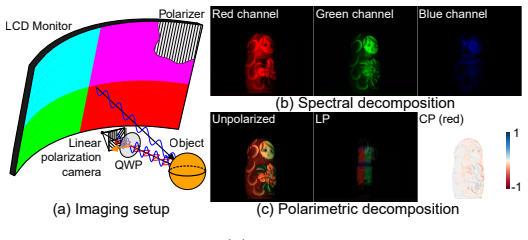
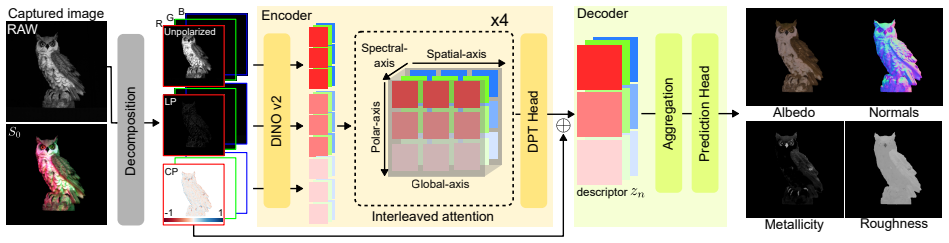
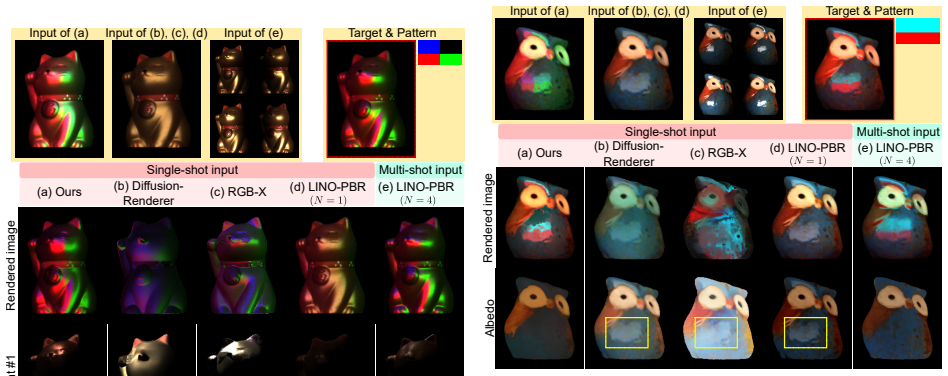
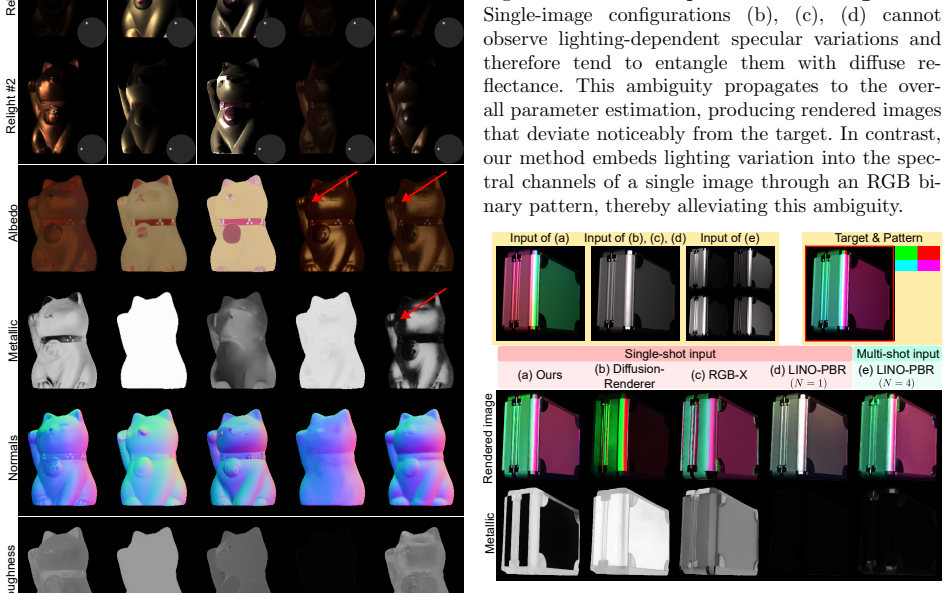
By projecting a linearly polarized RGB binary pattern from an LCD and acquiring measurements with an RGB polarization camera plus quarter-wave plate, the system obtains single-shot spectro-polarimetric observations that a feed-forward transformer directly maps to per-pixel normal, albedo, roughness, and metallicity estimates; the transformer is trained on polarimetric BRDFs expanded from a small measured set via a generative manifold, and real desktop experiments confirm accurate recovery that exceeds existing methods.
Load-bearing premise
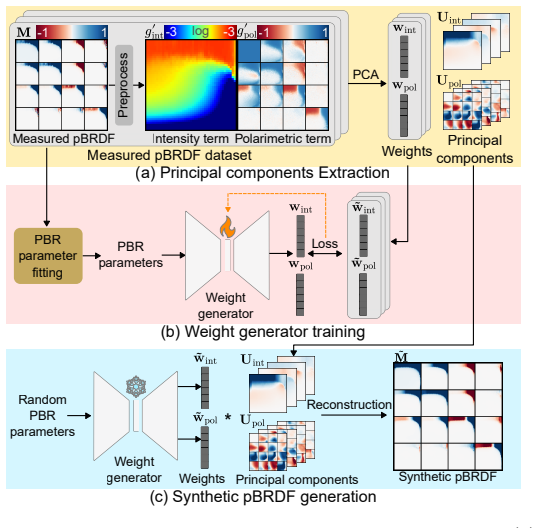
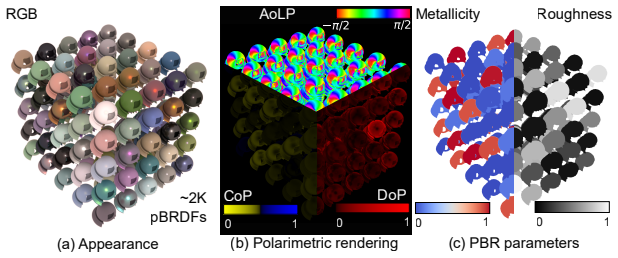
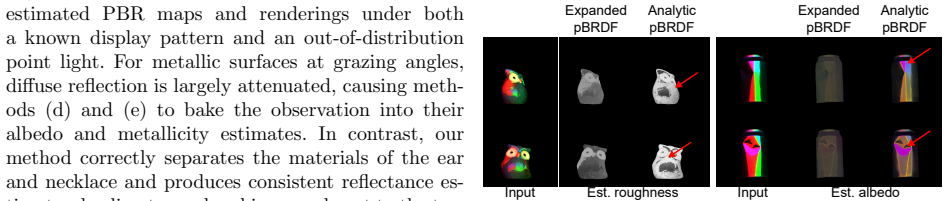
The generative manifold can accurately expand a limited set of measured polarimetric BRDFs to create sufficient and realistic training data for the feed-forward transformer to generalize to real-world scenes.
Signed reviews
Editorial analysis
A structured set of objections, weighed in public.
Referee Report
Summary. The paper introduces polarimetric display inverse rendering for single-shot capture: an LCD projects linearly polarized RGB binary patterns while an RGB polarization camera augmented with a quarter-wave plate acquires spectro-polarimetric measurements. A feed-forward transformer maps these measurements to per-pixel normal, albedo, roughness, and metallicity. Training data scarcity is addressed by expanding a limited set of measured polarimetric BRDFs via a generative manifold. Real desktop evaluations are claimed to demonstrate accurate inverse rendering across diverse scenes, outperforming existing approaches.
Significance. If the central claim holds, the combination of polarization encoding with generative manifold data expansion could enable practical lightweight single-shot inverse rendering for desktop graphics and vision workflows, reducing reliance on multi-shot or lower-accuracy methods.
major comments (2)
- [Abstract] Abstract: the claim of 'accurate inverse rendering across diverse scenes, outperforming existing approaches' is presented without any validation metrics, error analysis, comparison tables, or quantitative results, which is load-bearing for assessing whether the feed-forward transformer generalizes from manifold-generated data to real captures.
- [Evaluation section] Evaluation section (implied by abstract claims): no held-out real BRDF reconstruction error, distribution distances (e.g., between manifold samples and real polarimetric statistics), or ablation removing the generative manifold is reported to test whether the manifold expansion avoids domain gap in cross-talk between linear polarization, quarter-wave plate effects, and RGB channels; this assumption is the least secure link for the real-world accuracy claim.
minor comments (1)
- [Abstract] Abstract: the term 'spectro-polarimetric measurements' is used without clarifying the exact spectral sampling or polarization state encoding, which could be clarified for readers.
Simulated Author's Rebuttal
We thank the referee for the constructive feedback. We agree that strengthening the quantitative support in the abstract and evaluation sections will improve the manuscript, and we will revise accordingly to address the concerns about validation metrics and ablations.
read point-by-point responses
-
Referee: [Abstract] Abstract: the claim of 'accurate inverse rendering across diverse scenes, outperforming existing approaches' is presented without any validation metrics, error analysis, comparison tables, or quantitative results, which is load-bearing for assessing whether the feed-forward transformer generalizes from manifold-generated data to real captures.
Authors: We acknowledge that the abstract as written summarizes results without embedding specific metrics. In the revised version we will add concise quantitative results (e.g., mean angular error, albedo RMSE, and comparison deltas versus baselines) directly into the abstract to make the generalization claim verifiable from the abstract alone. revision: yes
-
Referee: [Evaluation section] Evaluation section (implied by abstract claims): no held-out real BRDF reconstruction error, distribution distances (e.g., between manifold samples and real polarimetric statistics), or ablation removing the generative manifold is reported to test whether the manifold expansion avoids domain gap in cross-talk between linear polarization, quarter-wave plate effects, and RGB channels; this assumption is the least secure link for the real-world accuracy claim.
Authors: We agree these specific analyses are missing and constitute the weakest link in the current evidence. The revised evaluation section will include (1) held-out real BRDF reconstruction errors, (2) distribution-distance statistics between manifold-augmented and measured polarimetric data, and (3) an ablation that removes the generative manifold, with explicit discussion of polarization cross-talk and quarter-wave-plate effects. revision: yes
Circularity Check
No circularity in derivation chain
full rationale
The paper presents a pipeline that acquires real spectro-polarimetric measurements via LCD projection and polarization camera, expands a limited set of measured polarimetric BRDFs using a generative manifold to create training data, and trains a feed-forward transformer to regress per-pixel material parameters. No equations, derivations, or self-citations are described that reduce any claimed prediction or output to an input by construction. The evaluations on real desktop captures provide an external benchmark independent of the training data generation process. The generative manifold step is an empirical data-augmentation technique whose validity is testable against held-out real measurements rather than being tautological.
Assumptions & free parameters
assumptions (2)
- domain assumption Polarimetric BRDFs measured from limited real samples can be expanded via generative manifold to produce realistic training data
- domain assumption Single-shot spectro-polarimetric measurements contain sufficient information to recover per-pixel normal, albedo, roughness, and metallicity
invented entities (1)
-
generative manifold for polarimetric BRDFs
Cite this review
Pith. "Pith review of Snapshot Polarimetric Display Inverse Rendering." pith.science (2026). https://pith.science/paper/NOYVOU2K
@misc{pith2026260524915,
  author       = {Pith},
  title        = {Pith review of: Snapshot Polarimetric Display Inverse Rendering},
  year         = {2026},
  howpublished = {\url{https://pith.science/paper/NOYVOU2K}},
  note         = {Machine review of arXiv:2605.24915}
}
read the original abstract
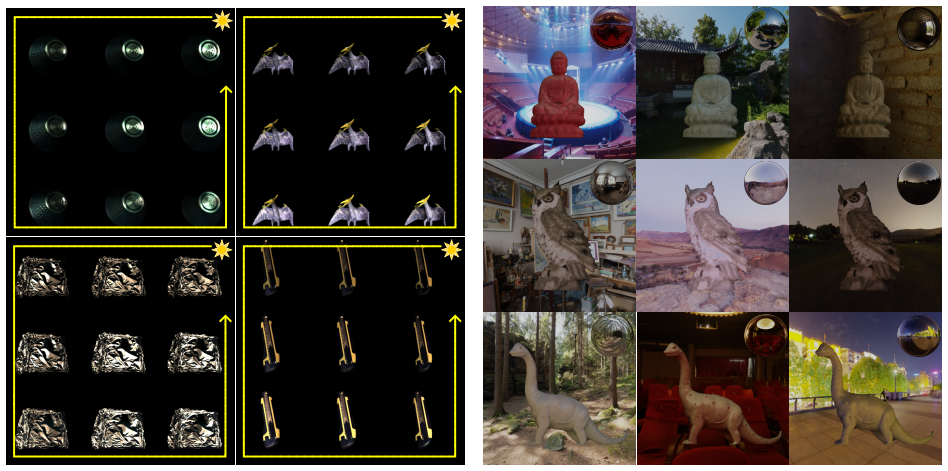
Inverse rendering remains a core challenge in graphics and vision, especially in the snapshot configurations required for lightweight desktop workflows, where the per-frame information budget is highly constrained. Previous inverse rendering work explores various available dimensions for enriching the per-shot information, including temporal modulation, spectral encoding, and polarization. In this work, we introduce polarimetric display inverse rendering, using an LCD to project a linearly polarized RGB binary pattern and an RGB polarization camera augmented with a quarter-wave plate to acquire spectro-polarimetric measurements in a single shot. A feed-forward transformer maps these measurements to per-pixel normal, albedo, roughness, and metallicity. To overcome training data scarcity, we expand a limited set of measured polarimetric bidirectional reflectance distribution functions via a generative manifold. Evaluations on a real desktop setup demonstrate accurate inverse rendering across diverse scenes, outperforming existing approaches.
Figures
Figures from the paper (6 more)
Reference graph
Works this paper leans on
-
[1]
Practical svbrdf capture in the frequency domain
Miika Aittala, Tim Weyrich, and Jaakko Lehtinen. Practical svbrdf capture in the frequency domain. ACM Trans. Graph., 32 0 (4): 0 110--1, 2013
2013
-
[2]
Polarimetric spatio-temporal light transport probing
Seung-Hwan Baek and Felix Heide. Polarimetric spatio-temporal light transport probing. ACM Transactions on Graphics (TOG), 40 0 (6): 0 1--18, 2021
2021
-
[3]
Simultaneous acquisition of polarimetric svbrdf and normals
Seung-Hwan Baek, Daniel S Jeon, Xin Tong, and Min H Kim. Simultaneous acquisition of polarimetric svbrdf and normals. ACM Trans. Graph., 37 0 (6): 0 268, 2018
2018
-
[4]
Image-based acquisition and modeling of polarimetric reflectance
Seung-Hwan Baek, Tizian Zeltner, Hyunjin Ku, Inseung Hwang, Xin Tong, Wenzel Jakob, and Min H Kim. Image-based acquisition and modeling of polarimetric reflectance. ACM Trans. Graph., 39 0 (4): 0 139, 2020
2020
-
[5]
Physically-based shading at disney
Brent Burley. Physically-based shading at disney. In Acm siggraph, volume 2012, pages 1--7. vol. 2012, 2012
2012
-
[6]
Pisr: Polarimetric neural implicit surface reconstruction for textureless and specular objects
Guangcheng Chen, Yicheng He, Li He, and Hong Zhang. Pisr: Polarimetric neural implicit surface reconstruction for textureless and specular objects. In European Conference on Computer Vision, pages 205--222. Springer, 2024
2024
-
[7]
Intrinsicanything: Learning diffusion priors for inverse rendering under unknown illumination
Xi Chen, Sida Peng, Dongchen Yang, Yuan Liu, Bowen Pan, Chengfei Lv, and Xiaowei Zhou. Intrinsicanything: Learning diffusion priors for inverse rendering under unknown illumination. In European Conference on Computer Vision, pages 450--467. Springer, 2025 a
2025
-
[8]
Uni-renderer: Unifying rendering and inverse rendering via dual stream diffusion
Zhifei Chen, Tianshuo Xu, Wenhang Ge, Leyi Wu, Dongyu Yan, Jing He, Luozhou Wang, Lu Zeng, Shunsi Zhang, and Ying-Cong Chen. Uni-renderer: Unifying rendering and inverse rendering via dual stream diffusion. In Proceedings of the Computer Vision and Pattern Recognition Conference, pages 26504--26513, 2025 b
2025
Show all 62 references
-
[9]
Differentiable display photometric stereo
Seokjun Choi, Seungwoo Yoon, Giljoo Nam, Seungyong Lee, and Seung-Hwan Baek. Differentiable display photometric stereo. In Proceedings of the IEEE/CVF Conference on Computer Vision and Pattern Recognition, pages 11831--11840, 2024
2024
-
[10]
A real-world display inverse rendering dataset
Seokjun Choi, Hoon-Gyu Chung, Yujin Jeon, Giljoo Nam, and Seung-Hwan Baek. A real-world display inverse rendering dataset. In Proceedings of the IEEE/CVF International Conference on Computer Vision, pages 25272--25283, 2025
2025
-
[11]
Differentiable point-based inverse rendering
Hoon-Gyu Chung, Seokjun Choi, and Seung-Hwan Baek. Differentiable point-based inverse rendering. In Proceedings of the IEEE/CVF Conference on Computer Vision and Pattern Recognition (CVPR), 2024
2024
-
[12]
Differentiable inverse rendering with interpretable basis brdfs
Hoon-Gyu Chung, Seokjun Choi, and Seung-Hwan Baek. Differentiable inverse rendering with interpretable basis brdfs. In Proceedings of the Computer Vision and Pattern Recognition Conference, pages 475--484, 2025
2025
-
[13]
Conditions for the physical realisability of matrix operators in polarimetry
Shane R Cloude. Conditions for the physical realisability of matrix operators in polarimetry. In Polarization Considerations for Optical Systems II, volume 1166, pages 177--187. SPIE, 1990
1990
-
[14]
Field guide to polarization, volume 15
Edward Collett. Field guide to polarization, volume 15. SPIE press Bellingham, Washington, 2005
2005
-
[15]
Objaverse: A universe of annotated 3d objects
Matt Deitke, Dustin Schwenk, Jordi Salvador, Luca Weihs, Oscar Michel, Eli VanderBilt, Ludwig Schmidt, Kiana Ehsani, Aniruddha Kembhavi, and Ali Farhadi. Objaverse: A universe of annotated 3d objects. In Proceedings of the IEEE/CVF conference on computer vision and pattern rec...
2023
-
[16]
Deep polarization imaging for 3d shape and svbrdf acquisition
Valentin Deschaintre, Yiming Lin, and Abhijeet Ghosh. Deep polarization imaging for 3d shape and svbrdf acquisition. In Proceedings of the IEEE/CVF Conference on Computer Vision and Pattern Recognition, pages 15567--15576, 2021
2021
-
[17]
Single-shot reflectance measurement from polarized color gradient illumination
Graham Fyffe and Paul Debevec. Single-shot reflectance measurement from polarized color gradient illumination. In 2015 IEEE International Conference on Computational Photography (ICCP), pages 1--10. IEEE, 2015
2015
-
[18]
Estimating specular roughness and anisotropy from second order spherical gradient illumination
Abhijeet Ghosh, Tongbo Chen, Pieter Peers, Cyrus A Wilson, and Paul Debevec. Estimating specular roughness and anisotropy from second order spherical gradient illumination. In Computer Graphics Forum, volume 28, pages 1161--1170. Wiley Online Library, 2009
2009
-
[19]
Circularly polarized spherical illumination reflectometry
Abhijeet Ghosh, Tongbo Chen, Pieter Peers, Cyrus A Wilson, and Paul Debevec. Circularly polarized spherical illumination reflectometry. In ACM SIGGRAPH Asia 2010 Papers, pages 1--12. ACM, 2010
2010
-
[20]
A simple necessary and sufficient condition on physically realizable mueller matrices
Clark R Givens and Alexander B Kostinski. A simple necessary and sufficient condition on physically realizable mueller matrices. Journal of Modern Optics, 40 0 (3): 0 471--481, 1993
1993
-
[21]
Neural lightrig: Unlocking accurate object normal and material estimation with multi-light diffusion
Zexin He, Tengfei Wang, Xin Huang, Xingang Pan, and Ziwei Liu. Neural lightrig: Unlocking accurate object normal and material estimation with multi-light diffusion. arXiv preprint arXiv:2412.09593, 2024
2024
-
[22]
guest-host interactions in nematic liquid crystals
George H Heilmeier and LA Zanoni. guest-host interactions in nematic liquid crystals. a new electro-optic effect. Applied Physics Letters, 13 0 (3): 0 91--92, 1968
1968
-
[23]
Spiders: Structured polarization for invisible depth and reflectance sensing
Tomoki Ichikawa, Shohei Nobuhara, and Ko Nishino. Spiders: Structured polarization for invisible depth and reflectance sensing. In Proceedings of the IEEE/CVF Conference on Computer Vision and Pattern Recognition, 2024
2024
-
[24]
Scalable, detailed and mask-free universal photometric stereo
Satoshi Ikehata. Scalable, detailed and mask-free universal photometric stereo. In Proceedings of the IEEE/CVF Conference on Computer Vision and Pattern Recognition, pages 13198--13207, 2023
2023
-
[25]
Physics-free spectrally multiplexed photometric stereo under unknown spectral composition
Satoshi Ikehata and Yuta Asano. Physics-free spectrally multiplexed photometric stereo under unknown spectral composition. arXiv preprint arXiv:2410.20716, 2024
2024
-
[26]
Mitsuba 3 renderer, 2022
Wenzel Jakob, Sébastien Speierer, Nicolas Roussel, Merlin Nimier-David, Delio Vicini, Tizian Zeltner, Baptiste Nicolet, Miguel Crespo, Vincent Leroy, and Ziyi Zhang. Mitsuba 3 renderer, 2022. https://mitsuba-renderer.org
2022
-
[27]
Tensoir: Tensorial inverse rendering
Haian Jin, Isabella Liu, Peijia Xu, Xiaoshuai Zhang, Songfang Han, Sai Bi, Xiaowei Zhou, Zexiang Xu, and Hao Su. Tensoir: Tensorial inverse rendering. In Proceedings of the IEEE/CVF Conference on Computer Vision and Pattern Recognition, pages 165--174, 2023
2023
-
[28]
Diffuse-specular separation using binary spherical gradient illumination
Christos Kampouris, Stefanos Zafeiriou, and Abhijeet Ghosh. Diffuse-specular separation using binary spherical gradient illumination. EGSR (EI&I), 1 0 (10), 2018
2018
-
[29]
Learning efficient illumination multiplexing for joint capture of reflectance and shape
Kaizhang Kang, Cihui Xie, Chengan He, Mingqi Yi, Minyi Gu, Zimin Chen, Kun Zhou, and Hongzhi Wu. Learning efficient illumination multiplexing for joint capture of reflectance and shape. ACM Trans. Graph., 38 0 (6): 0 165--1, 2019
2019
-
[30]
Neural reflectance capture in the view-illumination domain
Kaizhang Kang, Minyi Gu, Cihui Xie, Xuanda Yang, Hongzhi Wu, and Kun Zhou. Neural reflectance capture in the view-illumination domain. IEEE Transactions on Visualization and Computer Graphics, 29 0 (2): 0 1450--1462, 2021
2021
-
[31]
3d gaussian splatting for real-time radiance field rendering
Bernhard Kerbl, Georgios Kopanas, Thomas Leimk \"u hler, and George Drettakis. 3d gaussian splatting for real-time radiance field rendering. ACM Trans. Graph., 42 0 (4): 0 139--1, 2023
2023
-
[32]
Practical and scalable desktop-based high-quality facial capture
Alexandros Lattas, Yiming Lin, Jayanth Kannan, Ekin Ozturk, Luca Filipi, Giuseppe Claudio Guarnera, Gaurav Chawla, and Abhijeet Ghosh. Practical and scalable desktop-based high-quality facial capture. In European Conference on Computer Vision, pages 522--537. Springer, 2022
2022
-
[33]
Neisf: Neural incident stokes field for geometry and material estimation
Chenhao Li, Taishi Ono, Takeshi Uemori, Hajime Mihara, Alexander Gatto, Hajime Nagahara, and Yusuke Moriuchi. Neisf: Neural incident stokes field for geometry and material estimation. In Proceedings of the IEEE/CVF Conference on Computer Vision and Pattern Recognition, pages 2...
2024
-
[34]
Neisf++: Neural incident stokes field for polarized inverse rendering of conductors and dielectrics
Chenhao Li, Taishi Ono, Takeshi Uemori, Sho Nitta, Hajime Mihara, Alexander Gatto, Hajime Nagahara, and Yusuke Moriuchi. Neisf++: Neural incident stokes field for polarized inverse rendering of conductors and dielectrics. In Proceedings of the Computer Vision and Pattern Recog...
2025
-
[35]
Light of normals: Unified feature representation for universal photometric stereo
Hong Li, Houyuan Chen, Chongjie Ye, Zhaoxi Chen, Bohan Li, Shaocong Xu, Xianda Guo, Xuhui Liu, Yikai Wang, Baochang Zhang, et al. Light of normals: Unified feature representation for universal photometric stereo. 2026
2026
-
[36]
Neural reflectance for shape recovery with shadow handling
Junxuan Li and Hongdong Li. Neural reflectance for shape recovery with shadow handling. In Proceedings of the IEEE/CVF conference on computer vision and pattern recognition, pages 16221--16230, 2022
2022
-
[37]
Lirm: Large inverse rendering model for progressive reconstruction of shape, materials and view-dependent radiance fields
Zhengqin Li, Dilin Wang, Ka Chen, Zhaoyang Lv, Thu Nguyen-Phuoc, Milim Lee, Jia-Bin Huang, Lei Xiao, Yufeng Zhu, Carl S Marshall, et al. Lirm: Large inverse rendering model for progressive reconstruction of shape, materials and view-dependent radiance fields. In Proceedings of...
2025
-
[38]
Diffusion renderer: Neural inverse and forward rendering with video diffusion models
Ruofan Liang, Zan Gojcic, Huan Ling, Jacob Munkberg, Jon Hasselgren, Chih-Hao Lin, Jun Gao, Alexander Keller, Nandita Vijaykumar, Sanja Fidler, et al. Diffusion renderer: Neural inverse and forward rendering with video diffusion models. In Proceedings of the Computer Vision an...
2025
-
[39]
Shape and material capture at home
Daniel Lichy, Jiaye Wu, Soumyadip Sengupta, and David W Jacobs. Shape and material capture at home. In Proceedings of the IEEE/CVF Conference on Computer Vision and Pattern Recognition, pages 6123--6133, 2021
2021
-
[40]
Single-shot facial capture using polarized rgb sinusoidal illumination
Arvin Lin and Abhijeet Ghosh. Single-shot facial capture using polarized rgb sinusoidal illumination. In Proceedings of the SIGGRAPH Asia 2025 Conference Papers, pages 1--11, 2025
2025
-
[41]
o fer, Thomas Leimk \
Linjie Lyu, Ayush Tewari, Marc Habermann, Shunsuke Saito, Michael Zollh \"o fer, Thomas Leimk \"u hler, and Christian Theobalt. Diffusion posterior illumination for ambiguity-aware inverse rendering. ACM Transactions on Graphics (TOG), 42 0 (6): 0 1--14, 2023
2023
-
[42]
Sfpuel: Shape from polarization under unknown environment light
Youwei Lyu, Heng Guo, Kailong Zhang, Si Li, and Boxin Shi. Sfpuel: Shape from polarization under unknown environment light. Advances in Neural Information Processing Systems, 37: 0 97184--97202, 2024
2024
-
[43]
Rapid acquisition of specular and diffuse normal maps from polarized spherical gradient illumination
Wan-Chun Ma, Tim Hawkins, Pieter Peers, Charles-Felix Chabert, Malte Weiss, Paul E Debevec, et al. Rapid acquisition of specular and diffuse normal maps from polarized spherical gradient illumination. Rendering Techniques, 9 0 (10): 0 2, 2007
2007
-
[44]
Free-form scanning of non-planar appearance with neural trace photography
Xiaohe Ma, Kaizhang Kang, Ruisheng Zhu, Hongzhi Wu, and Kun Zhou. Free-form scanning of non-planar appearance with neural trace photography. ACM Transactions on Graphics (TOG), 40 0 (4): 0 1--13, 2021
2021
-
[45]
Nerf: Representing scenes as neural radiance fields for view synthesis
Ben Mildenhall, Pratul P Srinivasan, Matthew Tancik, Jonathan T Barron, Ravi Ramamoorthi, and Ren Ng. Nerf: Representing scenes as neural radiance fields for view synthesis. Communications of the ACM, 65 0 (1): 0 99--106, 2021
2021
-
[46]
Hyperspectral polarimetric brdfs of real-world materials
Yunseong Moon, Ryota Maeda, Suhyun Shin, Inseung Hwang, Youngchan Kim, Min H Kim, and Seung-Hwan Baek. Hyperspectral polarimetric brdfs of real-world materials. In Proceedings of the SIGGRAPH Asia 2025 Conference Papers, pages 1--11, 2025
2025
-
[47]
On optimal, minimal brdf sampling for reflectance acquisition
Jannik Boll Nielsen, Henrik Wann Jensen, and Ravi Ramamoorthi. On optimal, minimal brdf sampling for reflectance acquisition. ACM Transactions on Graphics (TOG), 34 0 (6): 0 1--11, 2015
2015
-
[48]
Dinov2: Learning robust visual features without supervision
Maxime Oquab, Timoth \'e e Darcet, Th \'e o Moutakanni, Huy Vo, Marc Szafraniec, Vasil Khalidov, Pierre Fernandez, Daniel Haziza, Francisco Massa, Alaaeldin El-Nouby, et al. Dinov2: Learning robust visual features without supervision. arXiv preprint arXiv:2304.07193, 2023
2023 arXiv
-
[49]
Vision transformers for dense prediction
Ren \'e Ranftl, Alexey Bochkovskiy, and Vladlen Koltun. Vision transformers for dense prediction. In Proceedings of the IEEE/CVF international conference on computer vision, pages 12179--12188, 2021
2021
-
[50]
A versatile parameterization for measured material manifolds
Cyril Soler, Kartic Subr, and Derek Nowrouzezahrai. A versatile parameterization for measured material manifolds. In Computer graphics forum, volume 37, pages 135--144. Wiley Online Library, 2018
2018
-
[51]
Connecting measured brdfs to analytic brdfs by data-driven diffuse-specular separation
Tiancheng Sun, Henrik Wann Jensen, and Ravi Ramamoorthi. Connecting measured brdfs to analytic brdfs by data-driven diffuse-specular separation. ACM Transactions on Graphics (TOG), 37 0 (6): 0 1--15, 2018
2018
-
[52]
Light stage super-resolution: continuous high-frequency relighting
Tiancheng Sun, Zexiang Xu, Xiuming Zhang, Sean Fanello, Christoph Rhemann, Paul Debevec, Yun-Ta Tsai, Jonathan T Barron, and Ravi Ramamoorthi. Light stage super-resolution: continuous high-frequency relighting. ACM Transactions on Graphics (TOG), 39 0 (6): 0 1--12, 2020
2020
-
[53]
Microfacet models for refraction through rough surfaces
Bruce Walter, Stephen R Marschner, Hongsong Li, and Kenneth E Torrance. Microfacet models for refraction through rough surfaces. Rendering techniques, 2007: 0 18th, 2007
2007
-
[54]
Performance relighting and reflectance transformation with time-multiplexed illumination
Andreas Wenger, Andrew Gardner, Chris Tchou, Jonas Unger, Tim Hawkins, and Paul Debevec. Performance relighting and reflectance transformation with time-multiplexed illumination. ACM Transactions on Graphics (TOG), 24 0 (3): 0 756--764, 2005
2005
-
[55]
Ps-nerf: Neural inverse rendering for multi-view photometric stereo
Wenqi Yang, Guanying Chen, Chaofeng Chen, Zhenfang Chen, and Kwan-Yee K Wong. Ps-nerf: Neural inverse rendering for multi-view photometric stereo. In European Conference on Computer Vision, pages 266--284. Springer, 2022
2022
-
[56]
Rgb↔x: Image decomposition and synthesis using material- and lighting-aware diffusion models
Zheng Zeng, Valentin Deschaintre, Iliyan Georgiev, Yannick Hold-Geoffroy, Yiwei Hu, Fujun Luan, Ling-Qi Yan, and Milo s Ha s an. Rgb↔x: Image decomposition and synthesis using material- and lighting-aware diffusion models. In ACM SIGGRAPH 2024 Conference Papers, SIGGRAPH '24, ...
2024 doi
-
[57]
Physg: Inverse rendering with spherical gaussians for physics-based material editing and relighting
Kai Zhang, Fujun Luan, Qianqian Wang, Kavita Bala, and Noah Snavely. Physg: Inverse rendering with spherical gaussians for physics-based material editing and relighting. In Proceedings of the IEEE/CVF Conference on Computer Vision and Pattern Recognition, pages 5453--5462, 2021 a
2021
-
[58]
Iron: Inverse rendering by optimizing neural sdfs and materials from photometric images
Kai Zhang, Fujun Luan, Zhengqi Li, and Noah Snavely. Iron: Inverse rendering by optimizing neural sdfs and materials from photometric images. In Proceedings of the IEEE/CVF conference on computer vision and pattern recognition, pages 5565--5574, 2022 a
2022
-
[59]
Deep svbrdf estimation from single image under learned planar lighting
Lianghao Zhang, Fangzhou Gao, Li Wang, Minjing Yu, Jiamin Cheng, and Jiawan Zhang. Deep svbrdf estimation from single image under learned planar lighting. In ACM SIGGRAPH 2023 conference proceedings, pages 1--11, 2023
2023
-
[60]
Sparse svbrdf acquisition via importance-aware illumination multiplexing
Lianghao Zhang, Zixuan Wang, Li Wang, Fangzhou Gao, Ruya Sun, and Jiawan Zhang. Sparse svbrdf acquisition via importance-aware illumination multiplexing. ACM Transactions on Graphics (TOG), 44 0 (6): 0 1--13, 2025
2025
-
[61]
Nerfactor: Neural factorization of shape and reflectance under an unknown illumination
Xiuming Zhang, Pratul P Srinivasan, Boyang Deng, Paul Debevec, William T Freeman, and Jonathan T Barron. Nerfactor: Neural factorization of shape and reflectance under an unknown illumination. ACM Transactions on Graphics (ToG), 40 0 (6): 0 1--18, 2021 b
2021
-
[62]
Modeling indirect illumination for inverse rendering
Yuanqing Zhang, Jiaming Sun, Xingyi He, Huan Fu, Rongfei Jia, and Xiaowei Zhou. Modeling indirect illumination for inverse rendering. In Proceedings of the IEEE/CVF Conference on Computer Vision and Pattern Recognition, pages 18643--18652, 2022 b
2022
Reviewed June 29, 2026 · model on record in the stance chip above.
Discussion (0). Continue with ORCID to comment.