REVIEW 4 major objections 4 minor 1 cited by
A generic dynamical system formulation for Bianchi-I cosmology with isotropic fluid in $f(Q)$ gravity
T0 review · 4 major / 4 minor · reviewed 2026-08-16 · deepseek-v4-flash
Pith's one-line read This paper provides a generic dynamical-system recipe for Bianchi-I f(Q) cosmologies and shows that Kasner solutions violate f_Q > 0 while stable de Sitter attractors are generic.
desk verdict Useful generic framework for Bianchi-I f(Q) cosmology, but the Kasner stability classifications and the headline f_Q>0 conclusion are not supported by the paper's own quadratic model. read the letter →
The pith
A machine-rendered reading of the paper's core claim, the machinery that carries it, and where it could break.
The reading
What carries the argument
The load-bearing object is the Hubble-normalized dimensionless phase space. For $\Gamma_1$ the variables are $x_1=\kappa\rho/(6f_Q H^2)$ and $x_3=\sigma^2/(6H^2)$, with the Friedmann constraint fixing the remaining variable; for $\Gamma_2$ a larger set ($x_2,\ldots,x_6$) is used. The identity that makes the construction generic is $Q f_Q/f=(1-x_3)/(2(1-x_1-x_3))$, which, together with $\Gamma=f_Q/(Q f_{QQ})$, converts a chosen $f(Q)$ into a closed autonomous system once it is inverted for $Q$; an analogous inversion is supplied for $\Gamma_2$. The anisotropy variable obeys $\sigma\sim 1/(a^3 f_Q)$, so the sign of $f_Q$ controls whether shear decays or grows; this is why the physical-viability requirement $f_Q>0$ plays a central role in identifying allowed regions of the phase space.
What would settle it
Choose a smooth $f(Q)$ for which $Q f_Q/f$ is not one-to-one on the relevant range—for instance $f(Q)=Q^3-3Q+2$ near a stationary point of $Q f_Q/f$—and attempt to construct the $\Gamma_1$ dynamical system by the paper's prescription; if the system cannot be closed, the unconditional 'given any $f(Q)$' claim is falsified.
Extended reading notes
Core claim
The central claim is that Bianchi-I cosmology with an isotropic fluid in $f(Q)$ gravity admits a generic dynamical-system formulation, in both the coincident gauge connection $\Gamma_1$ and one non-coincident branch $\Gamma_2$, without invoking an effective scalar-field description. The construction reduces to a single algebraic step: in $\Gamma_1$, the combination $Q f_Q/f$ equals $(1-x_3)/(2(1-x_1-x_3))$, where $x_1$ and $x_3$ are Hubble-normalized fluid and anisotropy variables; if this relation is inverted to write $Q(x_1,x_3)$, the system closes autonomously, and the analogous step is provided for $\Gamma_2$. Applying this prescription to four representative models—$f(Q)=\alpha(-Q)^n$, $Q+\alpha Q^2$, $Q+\alpha\sqrt{-Q}+\Lambda$, and $Q e^{\lambda Q_0/Q}$—the authors find that the Kasner fixed point falls in the region $f_Q\le 0$ in every model and branch, that a physically viable stable de Sitter attractor appears in all examined cases except the monomial model in $\Gamma_1$, and that in the coincident gauge inflation generically isotropizes a homogeneously perturbed FLRW geometry, while pre-bounce ekpyrotic contraction isotropizes under likely but not fully generic conditions.
Load-bearing premise
The load-bearing premise is that the algebraic relation $Q f_Q/f=(1-x_3)/(2(1-x_1-x_3))$—and its $\Gamma_2$ analogue—can be inverted to express $Q$ as a function of the Hubble-normalized variables for the chosen $f(Q)$; the paper states this as a condition but does not prove it holds for all $f(Q)$.
Editorial extensions
If this is right
- For any $f(Q)$ satisfying the inversion condition, the Bianchi-I field equations with an isotropic fluid reduce to an autonomous system directly, without passing through an effective scalar-field description.
- In all four models and both connection branches, the Kasner fixed point sits in the $f_Q\le 0$ region, so the classical Kasner vacuum is not a physically viable asymptotic state of these theories.
- A stable de Sitter attractor is the generic late-time outcome, with $f(Q)\propto (-Q)^n$ in the coincident gauge as the only examined exception.
- In the coincident gauge, homogeneously perturbed inflating FLRW geometries isotropize independently of the form of $f(Q)$.
- In the non-coincident gauge $\Gamma_2$, isotropization during inflation and pre-bounce contraction depends on the model through $x_3=-(1/\Gamma)\,\dot{Q}/(QH)$, but a slow enough ekpyrotic contraction isotropizes generically.
Reading between the lines
- Inference: the promised 'given any $f(Q)$' recipe is conditional on the inversion of $Q f_Q/f=(1-x_3)/(2(1-x_1-x_3))$; for functions where this combination is not one-to-one, the construction needs branch choices or extra variables, a case the paper leaves open.
- Inference: because $f_Q$ appears in the denominator of the anisotropy law $\sigma\sim 1/(a^3 f_Q)$, the marginal $f_Q=0$ at Kasner points suggests that approach to Kasner is a singular or divergent-coupling phase rather than a smooth asymptotic state; the paper does not analyze that singular flow.
- Inference: the model-independent isotropization during inflation in $\Gamma_1$ offers a clean discriminator—if future observations of late-time isotropy are interpreted in $f(Q)$ gravity, they constrain the connection branch more than the functional form of $f(Q)$.
- Inference: for $\Gamma_2$, the dependence on $x_3$ means one could deliberately engineer $f(Q)$ to suppress or enhance anisotropy decay during bouncing scenarios, turning the generic construction into a design tool for nonsingular cosmologies.
Signed reviews
Editorial analysis
A structured set of objections, weighed in public.
Referee Report
Summary. The paper develops a generic autonomous dynamical system for Bianchi-I cosmology in f(Q) gravity with an isotropic fluid, for the coincident-gauge connection branch Γ1 and one non-coincident branch Γ2. The construction is applied to four f(Q) models (monomial, quadratic, square-root-plus-cosmological-constant, and exponential), with fixed-point tables, physical-viability regions based on f_Q>0, phase portraits, early-universe isotropization arguments, and a comparison with f(T) gravity. The headline findings are that Kasner solutions marginally violate f_Q>0 in all models, that a stable de Sitter attractor is generic except for the monomial model in the coincident gauge, and that inflationary isotropization in the coincident gauge is model independent.
Significance. If correct, this would be a useful reference for f(Q) Bianchi-I dynamics: it gives a stepwise prescription for building phase spaces, analyzes four concrete models, and emphasizes physically viable regions rather than merely listing formal fixed points. The early-universe isotropization discussion also raises questions that are rarely addressed in f(Q) literature. However, the paper's central stability statements about Kasner fixed points and the claim that Kasner solutions violate f_Q>0 are not supported by the equations as written; these are headline conclusions, so the significance is substantially reduced until they are repaired.
major comments (4)
- [§V.B, Tables III–IV] The fixed point S=(0,1) lies on the singular surface x3=1 of the reduced system (44)–(45), where the vector field contains denominators (x3−1)(8x1+3x3−3). Standard Jacobian linearization is not valid at a point where the vector field is undefined, so the quoted eigenvalues (−6, −3(1+ω)) for S are not obtained by a legitimate limiting procedure. The unreduced anisotropy equation (31) gives ∂x3′/∂x3 = 6 at (0,1), indicating an unstable direction with eigenvalue +6, not −6. The stability classification of S and the f(T) comparison in Section IX that relies on it therefore need to be re-derived, either by desingularizing the system (e.g., by a suitable time reparametrization or blow-up) or by restricting statements to the domain where the vector field is regular.
- [§X (Conclusion) and Abstract] The claim that Kasner solutions 'marginally violate the f_Q>0 condition' is internally contradicted by Model-II in the coincident gauge. At S=(0,1), Eq. (15) gives Q=−6H^2+σ^2=0, so for f(Q)=Q+αQ^2 one has f_Q=1+2αQ=1>0 directly. The phase-space expression (42), f_Q=(1−x3)/(3−4x1−3x3), is 0/0 at S and its limit is path-dependent, so it cannot be used to infer a marginal violation. The conclusion should be revised to state the actual status of f_Q for each model, evaluated from Q rather than from the singular phase-space coordinate expression.
- [§VI, Eq. (74)] The advertised 'given any f(Q)' construction for Γ2 is not closed. The autonomous system (76)–(80) still contains Γ=f_Q/(Q f_QQ), which must be expressed in terms of the phase-space variables by inverting Eq. (74), Q f_Q/f = x2/(x2+x3x4+x5+x6−1). Unlike the Γ1 construction around Eq. (34), no invertibility condition is stated and no general prescription for obtaining Q(x_i) is provided. As written, the system becomes autonomous only after a specific f(Q) is chosen and the inversion is performed case by case. The authors should add the analogous invertibility condition and show how the generic Γ2 system closes in principle.
- [§V.B, Eq. (46) and Table IV] The physical viability region (46) for Model-II is defined by strict inequalities that exclude x3=1, yet the text and Table IV classify S=(0,1) as a physically viable Kasner point. The domain of the dynamical system and the status of boundary points such as x3=1 need to be clarified; either the viability region should be extended to include such boundary points with a separate argument, or S should be treated as lying outside the domain and its physical interpretation adjusted accordingly.
minor comments (4)
- [§IV, Eq. (28)] The symbol Γ is used both for the connection class (Section II) and for the auxiliary quantity f_Q/(Q f_QQ) in Eq. (28). This is confusing; using a different symbol, such as G, for the latter would improve readability.
- [Throughout] There are several typographical and grammatical errors: 'spactime' in the footnote of Section IX, 'does not flare well' in Section V.B, and 'the analysis has been studied in [88]' in Section V.A. These should be corrected.
- [§VIII] The early-universe isotropization discussion for the non-coincident gauge is presented as a condition on x3 (e.g., Eq. (121) depends on whether x3<3 or x3>3), but the paper does not provide a fixed-point or stability analysis of x3 itself. A short analysis of the x3 dynamics would strengthen this section.
- [§IX] The sentence 'the non-metricity theory with connection class I yields identical dynamics as the metric teleparallel gravity' is a nontrivial equivalence claim that needs a derivation or a reference; as written it appears as an assumption.
Circularity Check
No significant circularity: the dynamical system construction and the four-model fixed-point analyses are derived from the field equations, and the self-citations are contextual rather than load-bearing.
full rationale
The paper's central derivation is self-contained. The generic Γ1 and Γ2 dynamical systems are constructed directly from the Bianchi-I field equations (18)-(20) and (65)-(71), with the phase-space variables defined in (23); no fitted parameter is subsequently renamed as a prediction. The invertibility requirement on Eq. (34) and Eq. (74) is stated explicitly as a condition ('Provided the above equation is invertible to get Q = Q(x1, x3)'), so the advertised 'given any f(Q)' prescription is conditional rather than circular. The four worked models are substituted into the same field equations, and the resulting fixed points, eigenvalues, and cosmologies are computed from those equations rather than assumed. The cited works, including self-citations such as [83], [91], [93], and [100], are used for comparison, context, or as statements of previously known results; the load-bearing steps are re-derived in the text, and the comparisons with [52], [86], and [88] are made after the analysis. The final claims about de Sitter attractors, Kasner points, and isotropization follow from the paper's own phase-space equations, such as x3' = 6x3(x3-1) on the vacuum submanifold for Γ1, which is model-independent by inspection and not by an imported ansatz. There are technical concerns noted in the literature review, notably the evaluation of f_Q at the Kasner fixed point S=(0,1) for Model II where Q=0 makes Eq. (42) indeterminate, but that is a correctness or singularity-handling issue, not circularity. No step in the derivation reduces to its own input by construction, and no prediction is statistically forced from fitted data. A minor non-zero score reflects only the presence of several self-citations used as background support; none of them carries the derivation.
Assumptions & free parameters
free parameters (5)
- n
- alpha (Model I)
- alpha (Model II)
- alpha, Lambda (Model III)
- lambda, Q0 (Model IV)
assumptions (6)
- standard math Standard linear stability analysis applies to the autonomous systems on the physically viable phase space.
- domain assumption Physical viability requires f_Q>0, the positive effective gravitational coupling condition.
- domain assumption A Bianchi-I geometry with an isotropic fluid is a physically consistent homogeneous perturbation of FLRW.
- domain assumption The algebraic relations (34) and (74) are invertible so that Q can be expressed in terms of phase-space variables.
- domain assumption For the Gamma2 branch, gamma is nonzero, so the connection field equation implies dot_f_Q ~ a^{-3}.
- standard math Power-law scale factors identify fixed points as Kasner or de Sitter cosmologies.
Cite this review
Pith. "Pith review of A generic dynamical system formulation for Bianchi-I cosmology with isotropic fluid in $f(Q)$ gravity." pith.science (2026). https://pith.science/paper/NP3ISGNA
@misc{pith2026250421757,
  author       = {Pith},
  title        = {Pith review of: A generic dynamical system formulation for Bianchi-I cosmology with isotropic fluid in $f(Q)$ gravity},
  year         = {2026},
  howpublished = {\url{https://pith.science/paper/NP3ISGNA}},
  note         = {Machine review of arXiv:2504.21757}
}
abstract
In this article, we present a generic dynamical system formulation for Bianchi-I cosmology in the presence of an isotropic fluid within the coincident gauge connection branch and one of the non-coincident gauge connection branches of $f(Q)$ gravity theory. For both the connection branches under consideration, we start from the generic Bianchi-I cosmological field equations in $f(Q)$ and present a prescription of how one can construct an autonomous dynamical system in terms of the standard Hubble-normalized dimensionless dynamical variables once an $f(Q)$ theory is provided. Particular care has been taken to single out the physically viable regions in the phase space for each of the models under consideration. This results in the finding that, for both of the connection branches under consideration, the Kasner solution marginally violates the key physical viability condition of positive effective gravitational coupling ($f_Q>0$) for all the models considered, whereas a physically viable de-Sitter future attractor appears in all the models, except for the very special case of the monomial model within the coincident gauge connection. In the context of the early universe cosmology, we find that isotropization of a homogeneously perturbed inflating FLRW universe is a generic model-independent feature in the coincident gauge, whereas the isotropization of a homogeneously perturbed pre-bounce ekpyrotically contracting FLRW universe is, although not completely generic, but a likely scenario.
Figures


Forward citations
Cited by 1 Pith paper
-
Averaging Dynamics of Scalar Field-Matter Interacting Models in Anisotropic Universes: The Locally Rotationally Symmetric Bianchi I Spacetime
The authors apply averaging methods to classify late-time attractors for nine interacting dark sector models in Bianchi I cosmology, but the general interaction formula does not match the specific models analyzed.
Reference graph
Works this paper leans on
-
[52]
Paliathanasis, A. (2024). Dipole cosmology in f Q-gravity. Physics of the Dark Universe, 46, 101585
work page 2024
-
[88]
Rathore, S., & Singh, S. S. (2024). Stability aspects of an LRS Bianchi type-I cosmological model in f (Q) gravity. General Relativity and Gravitation, 56(2), 25
work page 2024
-
[1]
Di Valentino, E., et al. (2021). In the realm of the Hubble tension-a review of solutions. Classical and Quantum Gravity, 38(15), 153001
2021
-
[2]
Akrami, Y., et al. (2020). Planck 2018 results-VII. Isotropy and statistics of the CMB. Astronomy & Astrophysics, 641, A7
2020
-
[3]
N., & Krasi´nski, A
Bolejko, K., C ´el´erier, M. N., & Krasi´nski, A. (2011). Inhomogeneous cosmological models: exact solutions and their applica- tions. Classical and Quantum Gravity, 28(16), 164002
2011
-
[4]
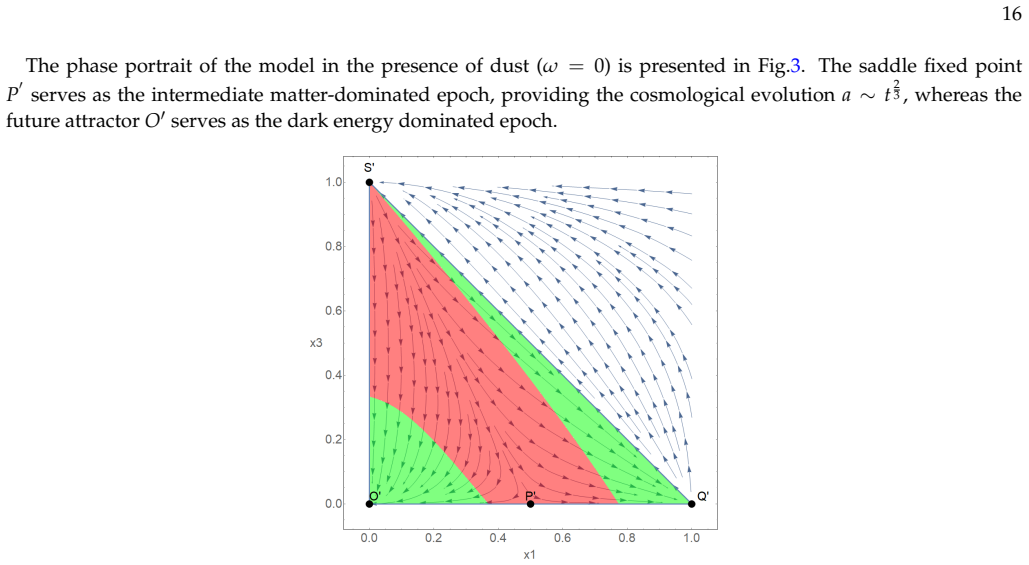
The anisotropic fixed point S1 gives a Kasner-like solution. For this model, the future attractor O1 serves as the dark energy dominated epoch whereas P1 is the only saddle point showing the matter-dominated epoch for ω = 0 e.g a∼ t 2 3 , implies the same evolution of the universe as in GR. This model gives asymptotic isotropization in late time cosmology...
-
[5]
D., & Dabrowski, M
Barrow, J. D., & Dabrowski, M. P . (1997). Kantowski-Sachs string cosmologies. Physical Review D, 55(2), 630
1997
-
[6]
Szekeres, P . (1975). Quasispherical gravitational collapse. Physical Review D, 12(10), 2941
1975
Show all 110 references
-
[7]
Adhav, K. S. (2012). LRS Bianchi type-I cosmological model in f (R, T) theory of gravity. Astrophysics and space science, 339, 365-369
2012
-
[9]
Farasat Shamir, M. (2016). Anisotropic cosmological models in f (G) gravity. Astrophysics and Space Science, 361(4), 147
2016
-
[10]
Campanelli, L., Cea, P ., & Tedesco, L. (2007). Cosmic microwave background quadrupole and ellipsoidal universe. Physical Review D-Particles, Fields, Gravitation, and Cosmology, 76(6), 063007
2007
-
[11]
R., et al
Jaffe, T. R., et al. (2005). Evidence of vorticity and shear at large angular scales in the WMAP data: a violation of cosmological isotropy?. The Astrophysical Journal, 629(1), L1
2005
-
[12]
R., et al
Jaffe, T. R., et al. (2006). Fast and efficient template fitting of deterministic anisotropic cosmological models applied to WMAP data. The Astrophysical Journal, 643(2), 616
2006
-
[13]
R., et al
Jaffe, T. R., et al. (2006). Bianchi type VIIh models and the WMAP 3-year data. Astronomy & Astrophysics, 460(2), 393-396
2006
-
[14]
Sarmah, P ., & Goswami, U. D. (2022). Bianchi Type I model of universe with customized scale factors. Modern Physics Letters A, 37(21), 2250134. 8 γ = 0 reduces this to the formulation of connection class ΓI 29
2022
-
[15]
Amirhashchi, H., & Amirhashchi, S. (2020). Constraining Bianchi type I universe with type Ia supernova and H(z) data. Physics of the Dark Universe, 29, 100557
2020
-
[16]
Amirhashchi, H. (2017). Viscous dark energy in Bianchi type V spacetime. Physical Review D, 96(12), 123507
2017
-
[17]
Amirhashchi, H. (2018). Probing dark energy in the scope of a Bianchi type I spacetime. Physical Review D, 97(6), 063515
2018
-
[18]
Amirhashchi, H., & Amirhashchi, S. (2019). Current constraints on anisotropic and isotropic dark energy models. Physical Review D, 99(2), 023516
2019
-
[19]
G., et al
Riess, A. G., et al. (1998). Observational evidence from supernovae for an accelerating universe and a cosmological constant. The astronomical journal, 116(3), 1009
1998
-
[20]
Perlmutter, S., et al. (1999). Measurements of Ω and Λ from 42 high-redshift supernovae. The Astrophysical Journal, 517(2), 565
1999
-
[21]
Buchert, T., et al. (2016). Observational challenges for the standard FLRW model. International Journal of Modern Physics D, 25(03), 1630007
2016
-
[22]
Socas-Navarro, H. (2019). Can a negative-mass cosmology explain dark matter and dark energy?. Astronomy & Astro- physics, 626, A5
2019
-
[23]
Helbig, P . (2020). The flatness problem and the age of the Universe. Monthly Notices of the Royal Astronomical Society, 495(4), 3571-3575
2020
-
[24]
Rajantie, A. (2012). Magnetic monopoles in field theory and cosmology. Philosophical Transactions of the Royal Society A: Mathematical, Physical and Engineering Sciences, 370(1981), 5705-5717
2012
-
[25]
Hawking, S. W. (1966). The occurrence of singularities in cosmology. Proceedings of the Royal Society of London. Series A. Mathematical and Physical Sciences, 294(1439), 511-521
1966
-
[26]
Aghanim, N., et al. (2020). Planck 2018 results-VI. Cosmological parameters. Astronomy & Astrophysics, 641, A6
2020
-
[27]
L., Kovetz, E
Poulin, V ., Bernal, J. L., Kovetz, E. D., & Kamionkowski, M. (2023). Sigma-8 tension is a drag. Physical Review D, 107(12), 123538
2023
-
[28]
Chudaykin, A., Gorbunov, D., & Nedelko, N. (2021). Exploring an early dark energy solution to the Hubble tension with Planck and SPTPol data. Physical Review D, 103(4), 043529
2021
-
[29]
E., Vom Marttens, R
Velten, H. E., Vom Marttens, R. F., & Zimdahl, W. (2014). Aspects of the cosmological ”coincidence problem”. The European Physical Journal C, 74, 1-8
2014
-
[30]
Zheng, J., Chen, Y., Xu, T., & Zhu, Z. H. (2021). Diagnosing the cosmic coincidence problem and its evolution with recent observations. arXiv preprint arXiv:2107.08916
2021 arXiv
-
[31]
J., & Goswami, U
Gogoi, D. J., & Goswami, U. D. (2022). Cosmology with a new f (R) gravity model in Palatini formalism. International Journal of Modern Physics D, 31(06), 2250048
2022
-
[32]
Stachowski, A. (2017). M. Szyd lowski, and A. Borowiec. European Physical Journal C, 77, 406
2017
-
[33]
Li, B., & Barrow, J. D. (2007). Cosmology of f (R) gravity in the metric variational approach. Physical Review D-Particles, Fields, Gravitation, and Cosmology, 75(8), 084010
2007
-
[34]
Bahamonde, S., et al. (2023). Teleparallel gravity: from theory to cosmology. Reports on Progress in Physics, 86(2), 026901
2023
-
[35]
Heisenberg, L. (2024). Review on f (Q) gravity. Physics Reports, 1066, 1-78
2024
-
[36]
Lu, J., Zhao, X., & Chee, G. (2019). Cosmology in symmetric teleparallel gravity and its dynamical system. The European Physical Journal C, 79, 1-8
2019
-
[37]
Khyllep, W., Paliathanasis, A., & Dutta, J. (2021). Cosmological solutions and growth index of matter perturbations in f (Q) gravity. Physical Review D, 103(10), 103521
2021
-
[38]
Mandal, S., Wang, D., & Sahoo, P . K. (2020). Cosmography in f (Q) gravity. Physical Review D, 102(12), 124029
2020
-
[39]
Hassan, Z., Mandal, S., & Sahoo, P . K. (2021). Traversable wormhole geometries in gravity. Fortschritte der Physik, 69(6), 2100023
2021
-
[40]
J., Barreiro, T., Koivisto, T., & Nunes, N
Barros, B. J., Barreiro, T., Koivisto, T., & Nunes, N. J. (2020). Testing F(Q) gravity with redshift space distortions. Physics of the Dark Universe, 30, 100616
2020
-
[41]
K., Basilakos, S., & Saridakis, E
Anagnostopoulos, F. K., Basilakos, S., & Saridakis, E. N. (2021). First evidence that non-metricity f (Q) gravity could chal- lenge ΛCDM. Physics Letters B, 822, 136634
2021
-
[42]
Atayde, L., & Frusciante, N. (2021). Can f (Q) gravity challenge ΛCDM?. Physical Review D, 104(6), 064052
2021
-
[43]
Koussour, M., & De, A. (2023). Observational constraints on two cosmological models of f (Q) theory. The European Physi- cal Journal C, 83(5), 400
2023
-
[44]
K., & Santos, J
Mandal, S., Sahoo, P . K., & Santos, J. R. (2020). Energy conditions in f (Q) gravity. Physical Review D, 102(2), 024057
2020
-
[45]
De, A., & How, L. T. (2022). Comment on ”Energy conditions in f (Q) gravity”. Physical Review D, 106(4), 048501
2022
-
[46]
H., & Goh, Y
Subramaniam, G., De, A., Loo, T. H., & Goh, Y. K. (2023). How Different Connections in Flat FLRW Geometry Impact Energy Conditions in f (Q) f (Q) Theory?. Fortschritte der Physik, 71(8-9), 2300038
2023
-
[47]
H., & Goh, Y
Subramaniam, G., De, A., Loo, T. H., & Goh, Y. K. (2023). Energy condition bounds on f (Q) model parameters in a curved FLRW Universe. Physics of the Dark Universe, 41, 101243. 30
2023
-
[48]
S., & Frusciante, N
Albuquerque, I. S., & Frusciante, N. (2022). A designer approach to f (Q) gravity and cosmological implications. Physics of the Dark Universe, 35, 100980
2022
-
[49]
Esposito, F., Carloni, S., Cianci, R., & Vignolo, S. (2022). Reconstructing isotropic and anisotropicf (Q) cosmologies. Physical Review D, 105(8), 084061
2022
-
[50]
De, A., et al. (2022). Isotropization of locally rotationally symmetric Bianchi-I universe in f (Q)-gravity. The European Phys- ical Journal C, 82(1), 72
2022
-
[51]
Sarmah, P ., De, A., & Goswami, U. D. (2023). Anisotropic LRS-BI Universe with f (Q) gravity theory. Physics of the Dark Universe, 40, 101209
2023
-
[53]
Paliathanasis, A., & Leon, G. (2024). Bianchi I spacetimes in f (Q)-gravity. arXiv preprint arXiv:2406.04563
2024
-
[54]
Sharif, M., & Rani, S. (2011). F(T) models within bianchi type-i universe. Modern Physics Letters A, 26(22), 1657-1671
2011
-
[55]
Aslam, A., Jamil, M., & Myrzakulov, R. (2013). Noether gauge symmetry for the Bianchi type I model in f (T) gravity. Physica Scripta, 88(2), 025003
2013
-
[56]
E., Salako, I
Rodrigues, M. E., Salako, I. G., Houndjo, M. J. S., & Tossa, J. (2014). Locally rotationally symmetric Bianchi type-I cosmo- logical model in f (T) gravity: from early to dark energy dominated universe. International Journal of Modern Physics D, 23(01), 1450004
2014
-
[57]
Tretyakov, P . V . (2022). Bianchi I cosmological solutions in teleparallel gravity. Modern Physics Letters A, 37(08), 2250046
2022
-
[58]
A., & van den Hoogen, R
Coley, A. A., & van den Hoogen, R. J. (2023). Spatially homogeneous teleparallel gravity: Bianchi I. Journal of Mathematical Physics, 64(10)
2023
-
[59]
Aguiar Gomes, D., Beltran Jimenez, J., Jimenez Cano, A., & Koivisto, T. S. (2024). Pathological character of modifications to coincident general relativity: cosmological strong coupling and ghosts in f (Q) theories. Physical Review Letters, 132(14), 141401
2024
-
[60]
I., & Qiu, T
Hu, K., Yamakoshi, M., Katsuragawa, T., Nojiri, S. I., & Qiu, T. (2023). Nonpropagating ghost in covariant f (Q) gravity. Physical Review D, 108(12), 124030
2023
-
[61]
Wainwright, J., & Ellis, G. F. R. (1997). Dynamical systems in cosmology
1997
-
[62]
Coley, A. A. (2013). Dynamical systems and cosmology (Vol. 291). Springer Science & Business Media
2013
-
[63]
Bahamonde, S., et al. (2018). Dynamical systems applied to cosmology: dark energy and modified gravity. Physics Reports, 775, 1-122
2018
-
[64]
D., & Oikonomou, V
Odintsov, S. D., & Oikonomou, V . K. (2017). Autonomous dynamical system approach forf (R) gravity. Physical Review D, 96(10), 104049
2017
-
[65]
Shah, P ., & Samanta, G. C. (2019). Stability analysis for cosmological models in f (R) gravity using dynamical system anal- ysis. The European Physical Journal C, 79, 1-9
2019
-
[66]
D., & Oikonomou, V
Odintsov, S. D., & Oikonomou, V . K. (2018). Dynamical systems perspective of cosmological finite-time singularities inf (R) gravity and interacting multifluid cosmology. Physical Review D, 98(2), 024013
2018
-
[67]
K., & Macdevette, K
Chakraborty, S., Dunsby, P . K., & Macdevette, K. (2022). A note on the dynamical system formulations in f (R) gravity. International Journal of Geometric Methods in Modern Physics, 19(08), 2230003
2022
-
[68]
K., Lohakare, S
Duchaniya, L. K., Lohakare, S. V ., Mishra, B., & Tripathy, S. K. (2022). Dynamical stability analysis of accelerating f (T) gravity models. The European Physical Journal C, 82(5), 448
2022
-
[69]
K., Kadam, S
Duchaniya, L. K., Kadam, S. A., Said, J. L., & Mishra, B. (2023). Dynamical systems analysis inf (T, ϕ) gravity. The European Physical Journal C, 83(1), 27
2023
-
[70]
Mirza, B., & Oboudiat, F. (2017). Constraining f (T) gravity by dynamical system analysis. Journal of Cosmology and As- troparticle Physics, 2017(11), 011
2017
-
[71]
B ¨ohmer, C., Jensko, E., & Lazkoz, R. (2023). Dynamical systems analysis of f (Q) gravity. Universe, 9(4), 166
2023
-
[72]
N., & Yesmakhanova, K
Khyllep, W., Dutta, J., Saridakis, E. N., & Yesmakhanova, K. (2023). Cosmology in f (Q) gravity: A unified dynamical systems analysis of the background and perturbations. Physical Review D, 107(4), 044022
2023
-
[73]
Vishwakarma, P ., & Shah, P . (2023). Stability analysis off (Q) gravity models using dynamical systems. International Journal of Modern Physics D, 32(11), 2350071
2023
-
[74]
Ghosh, S., Solanki, R., & Sahoo, P . K. (2024). Dynamical system analysis of scalar field cosmology in coincidentf (Q) gravity. Physica Scripta, 99(5), 055021
2024
-
[75]
N., Arora, S., Channuie, P ., & Sahoo, P
Gadbail, G. N., Arora, S., Channuie, P ., & Sahoo, P . K. (2024). Cosmological Dynamics of Interacting Dark Energy and Dark Matter in f (Q) Gravity. Fortschritte der Physik, 2400205
2024
-
[76]
Ghosh, S., Solanki, R., & Sahoo, P . K. (2024). Dynamical system analysis of Dirac-Born-Infeld scalar field cosmology in coincident f (Q) gravity. Chinese Physics C, 48(9), 095102
2024
-
[77]
Das, S., Mahata, N., & Ray, P . (2024). Cosmological implications of non-minimally coupled f (Q) gravity. Modern Physics Letters A, 39(12), 2450017
2024
-
[78]
A., Singh, S
Narawade, S. A., Singh, S. P ., & Mishra, B. (2023). Accelerating cosmological models in f (Q) gravity and the phase space analysis. Physics of the Dark Universe, 42, 101282. 31
2023
-
[79]
S., Solanki, R., & Sahoo, P
Rana, D. S., Solanki, R., & Sahoo, P . K. (2024). Phase-space analysis of the viscous fluid cosmological models in the coincident f (Q) gravity. Physics of the Dark Universe, 43, 101421
2024
-
[80]
S., & Alam, M
Samaddar, A., Singh, S. S., & Alam, M. K. (2023). Dynamical system approach of interacting dark energy models with minimally coupled scalar field. International Journal of Modern Physics D, 32(09), 2350062
2023
-
[81]
Hohmann, M. (2021). General covariant symmetric teleparallel cosmology. Physical Review D, 104(12), 124077
2021
-
[82]
G., Jensko, E., & Lazkoz, R
B ¨ohmer, C. G., Jensko, E., & Lazkoz, R. (2022). Cosmological dynamical systems in modified gravity. The European Physical Journal C, 82(6), 500
2022
-
[83]
Paliathanasis, A. (2023). Dynamical analysis of fQ-cosmology. Physics of the Dark Universe, 41, 101255
2023
-
[84]
Shabani, H., De, A., & Loo, T. H. (2023). Phase-space analysis of a novel cosmological model in f (Q) theory. The European Physical Journal C, 83(6), 1-12
2023
-
[85]
H., & Saridakis, E
Shabani, H., De, A., Loo, T. H., & Saridakis, E. N. (2024). Cosmology of f (Q) gravity in non-flat Universe. The European Physical Journal C, 84(3), 285
2024
-
[86]
Paliathanasis, A. (2025). Testing Non-Coincident f (Q)-gravity with DESI DR2 BAO and GRBs. Physics of the Dark Universe, 101993
2025
-
[87]
Sarmah, P ., & Goswami, U. D. (2024). Dynamical system analysis of LRS-BI Universe with f (Q) gravity theory. Physics of the Dark Universe, 101556
2024
-
[89]
Fabrizio, E., Sante, C., & Stefano, V . (2022). Bianchi type-I cosmological dynamics in f (Q) gravity: a covariant approach. Class. Quant. Grav., 39
2022
-
[90]
Dimakis, N., Roumeliotis, M., Paliathanasis, A., & Christodoulakis, T. (2023). Anisotropic solutions in symmetric teleparallel f (Q) theory: Kantowski–Sachs and Bianchi III LRS cosmologies. The European Physical Journal C, 83(9), 794
2023
-
[91]
D., Dialektopoulos, K., Dimakis, N., Giacomini, A., Shababi, H., Halder, A., & Paliathanasis, A
Millano, A. D., Dialektopoulos, K., Dimakis, N., Giacomini, A., Shababi, H., Halder, A., & Paliathanasis, A. (2024). Kantowski-Sachs and Bianchi III dynamics in f (Q) gravity. Physical Review D, 109(12), 124044
2024
-
[92]
Chakraborty, S., Bamba, K., & Saa, A. (2019). Dynamical properties of Bianchi-I spacetimes in f (R) gravity. Physical Review D, 99(6), 064048
2019
-
[93]
B., Heisenberg, L., & Koivisto, T
Jim ´enez, J. B., Heisenberg, L., & Koivisto, T. (2018). Coincident general relativity. Physical Review D, 98(4), 044048
2018
-
[94]
Arora, S., Mandal, S., Chakraborty, S., Leon, G., & Sahoo, P . K. (2022). Canf (R) gravity isotropise a pre-bounce contracting universe?. Journal of Cosmology and Astroparticle Physics, 2022(09), 042
2022
-
[95]
Bhattacharya, K., & Chakraborty, S. (2019). Nonlinear anisotropy growth in Bianchi-I spacetime in metric f (R) cosmology. Physical Review D, 99(2), 023520
2019
-
[96]
J., J¨arv, L., & Pati, L
Guzm ´an, M. J., J¨arv, L., & Pati, L. (2024). Exploring the stability off (Q) cosmology near general relativity limit with different connections. Physical Review D, 110(12), 124013
2024
-
[97]
Paliathanasis, A. (2023). The impact of the non-coincidence gauge on the dark energy dynamics in f (Q)-gravity. General Relativity and Gravitation, 55(11), 130
2023
-
[98]
B., Heisenberg, L., Koivisto, T., & Pekar, S
Jim ´enez, J. B., Heisenberg, L., Koivisto, T., & Pekar, S. (2020). Cosmology in f (Q) geometry. Physical Review D, 101(10), 103507
2020
-
[99]
K., & Myrzakulov, R
Mandal, S., Myrzakulov, N., Sahoo, P . K., & Myrzakulov, R. (2021). Cosmological bouncing scenarios in symmetric telepar- allel gravity. The European Physical Journal Plus, 136(7), 1-13
2021
-
[100]
N., Mandal, S., & Sahoo, P
Gadbail, G. N., Mandal, S., & Sahoo, P . K. (2022). Reconstruction ofΛCDM universe in f (Q) gravity. Physics Letters B, 835, 137509
2022
-
[101]
Chakraborty, S., Dutta, J., Gregoris, D., Karwan, K., & Khyllep, W. (2025). Reproducing Λ CDM-like Solutions in f (Q) Gravity: A Comprehensive Study Across All Connection Branches. arXiv preprint arXiv:2501.15159
2025 arXiv
-
[102]
K., Wesley, D
Erickson, J. K., Wesley, D. H., Steinhardt, P . J., & Turok, N. (2004). Kasner and mixmaster behavior in universes with equation of state ω≥ 1. Physical Review D, 69(6), 063514
2004
-
[103]
I. S. Albuquerque and N. Frusciante. A designer approach to f(Q) gravity and cosmological implications. Phys. Dark Univ. 35, 100980 (2022)
2022
-
[104]
D., & Ganguly, C
Barrow, J. D., & Ganguly, C. (2016). Evolution of initially contracting Bianchi Class A models in the presence of an ultra-stiff anisotropic pressure fluid. Classical and Quantum Gravity, 33(12), 125004
2016
-
[105]
D., & Hervik, S
Barrow, J. D., & Hervik, S. (2006). Evolution of universes in quadratic theories of gravity. Physical Review D-Particles, Fields, Gravitation, and Cosmology, 74(12), 124017
2006
-
[106]
Koussour, M., & Myrzakulov, N. (2024). Bouncing cosmologies and stability analysis in symmetric teleparallelf (Q) gravity. The European Physical Journal Plus, 139(9), 799
2024
-
[107]
Bajardi, F., Vernieri, D., & Capozziello, S. (2020). Bouncing cosmology in f (Q) symmetric teleparallel gravity. The European Physical Journal Plus, 135, 1-14
2020
-
[108]
Linder, E. V . (2010). Einstein’s other gravity and the acceleration of the universe. Physical Review D-Particles, Fields, Grav- itation, and Cosmology, 81(12), 127301. 32
2010
-
[109]
L., & Barrow, J
Paliathanasis, A., Said, J. L., & Barrow, J. D. (2018). Stability of the Kasner Universe in f (T) Gravity. Physical Review D, 97(4), 044008
2018
-
[110]
A., & Toporensky, A
Skugoreva, M. A., & Toporensky, A. V . (2018). On Kasner solution in Bianchi I f (T) cosmology. The European Physical Journal C, 78, 1-7
2018
-
[111]
De, A., & Loo, T. H. (2023). On the viability of f (Q) gravity models. Classical and Quantum Gravity, 40(11), 115007
2023
Reviewed August 16, 2026 · model on record in the stance chip above.
Discussion (0). Continue with ORCID to comment.