RolloutPipe: Overlapping Pipelined Rollout and Training in Disaggregated On-Policy LLM Reinforcement Learning
Pith reviewed 2026-06-26 02:53 UTC · model grok-4.3
The pith
RolloutPipe pipelines complete rollout groups to the trainer as soon as they form, allowing training to begin before the full rollout finishes while keeping the data on-policy.
A machine-rendered reading of the paper's core claim, the machinery that carries it, and where it could break.
Core claim
RolloutPipe turns the fixed-weight rollout into a complete-group pipeline where trainable groups move to the trainer while later groups are still being generated, achieved through complete-group pipelining that dispatches each trainable complete group to the trainer as soon as group materialization finishes and frontier-group dispatch that admits requests for the frontier groups needed to form the next training batch first.
What carries the argument
complete-group pipelining (CGP) together with frontier-group dispatch (FGD), which together move finished groups to training while rollout continues and keep the trainer supplied with on-policy batches
If this is right
- Training GPUs begin useful work while later rollout groups are still being generated under the current policy.
- The trainer waiting ratio drops because groups arrive steadily rather than in one large batch after rollout ends.
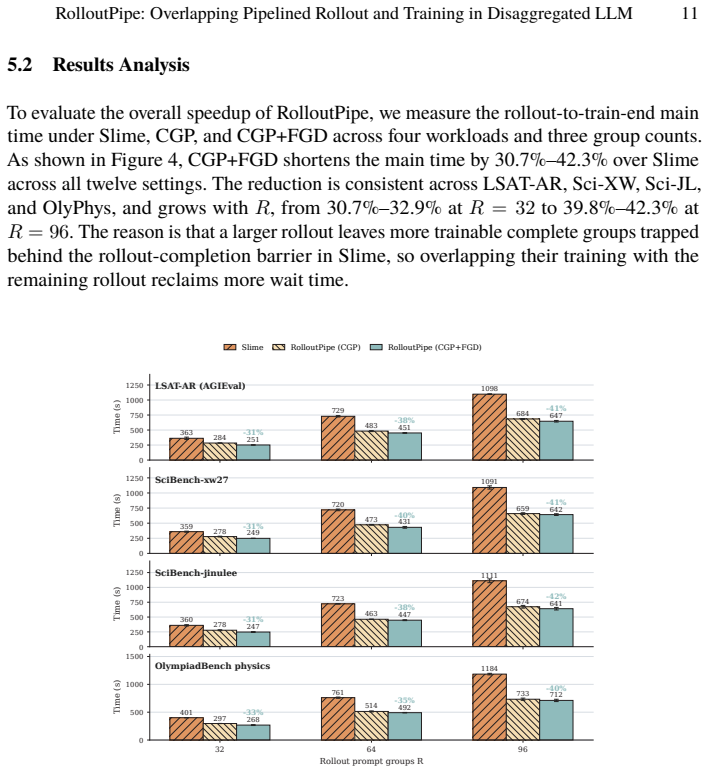
- The overall rollout-to-train-end latency decreases by the measured 30.7 to 42.3 percent range on the tested models and benchmarks.
- On-policy properties hold because only fully materialized groups enter the training batch and all groups in a batch share the same policy weights.
Where Pith is reading between the lines
- The same CGP and FGD logic could be applied to other group-based on-policy algorithms beyond GRPO if the group size remains fixed.
- If rollout variance across groups is high, FGD admission ordering may need additional tuning to keep batch arrival times stable.
- Extending the pipeline to allow partial overlap within a single group would require new mechanisms to restore on-policy guarantees.
Load-bearing premise
Dispatching each complete group as soon as it finishes preserves on-policy correctness without bias from timing differences or partial data.
What would settle it
A direct comparison of the final policy weights or per-group advantage statistics produced by RolloutPipe versus a non-pipelined baseline on the same prompt set and random seeds would show whether any systematic shift appears.
Figures



read the original abstract
Large language model (LLM) post-training for reasoning increasingly relies on reinforcement learning with verifiable rewards (RLVR), where models learn from ground-truth feedback on mathematical, logical, and scientific tasks. To enable flexible resource allocation and support heterogeneous training setups, modern RLVR systems adopt disaggregated architectures that decouple rollout generation and policy training across independent GPU pools. However, existing synchronous on-policy GRPO (Group Relative Policy Optimization) RLVR systems finish an entire rollout before starting training, leaving the trainer GPU pool idle while rollout is still ongoing. Asynchronous RL pipelines overlap the two stages, but at the cost of training on stale data. To address these challenges, we propose RolloutPipe, a post-training framework for disaggregated RLVR systems, which turns the fixed-weight rollout into a complete-group pipeline where trainable groups move to the trainer while later groups are still being generated. RolloutPipe achieves this through two techniques including complete-group pipelining (CGP) and frontier-group dispatch (FGD). CGP dispatches each trainable complete group to the trainer FIFO as soon as group materialization finishes, and FGD is an admission policy on the Rollout node that first admits requests for the frontier groups needed to form the next training batch, so that trainer-ready groups arrive earlier and more steadily. The design starts training before the rollout completes while maintaining on-policy correctness. Evaluated on Qwen3-1.7B across four reasoning and science benchmarks and twelve rollout settings, RolloutPipe shortens the rollout-to-train-end time by 30.7%-42.3%, and lowers the trainer waiting ratio by 37%-76% compared to Slime, a state-of-the-art rollout and training system.
Editorial analysis
A structured set of objections, weighed in public.
Referee Report
Summary. The paper introduces RolloutPipe for disaggregated on-policy GRPO-based RLVR systems. It uses complete-group pipelining (CGP) to dispatch finished groups to the trainer FIFO as soon as they materialize and frontier-group dispatch (FGD) to prioritize admission of groups needed for the next training batch. The central claim is that this overlap shortens rollout-to-train-end time by 30.7%-42.3% and reduces trainer waiting ratio by 37%-76% versus Slime while preserving exact on-policy correctness, demonstrated on Qwen3-1.7B across four benchmarks and twelve rollout settings.
Significance. If the on-policy invariance holds, the work would meaningfully improve GPU utilization in disaggregated RLVR pipelines without requiring changes to the underlying GRPO objective or introducing staleness. The evaluation across multiple benchmarks and rollout configurations provides concrete empirical grounding; the absence of machine-checked invariants or open reproducible code for the dispatch logic is a missed opportunity to strengthen the contribution.
major comments (2)
- [§3] §3 (CGP and FGD description): the manuscript asserts that dispatching complete groups FIFO via CGP and admitting frontier groups first via FGD yields data whose distribution and gradient statistics are identical to the synchronous non-pipelined case, yet supplies neither an invariant, a proof sketch, nor an ablation that compares per-group reward statistics, batch composition, or final policy gradient norms between the pipelined and baseline executions. This is load-bearing for the central on-policy claim.
- [§5] §5 (experimental results): the reported 30.7%-42.3% and 37%-76% improvements are presented without error bars, number of random seeds, or explicit data-exclusion rules; given that the performance numbers rest on the correctness guarantee in §3, the lack of statistical characterization weakens the ability to assess whether the gains are robust.
minor comments (2)
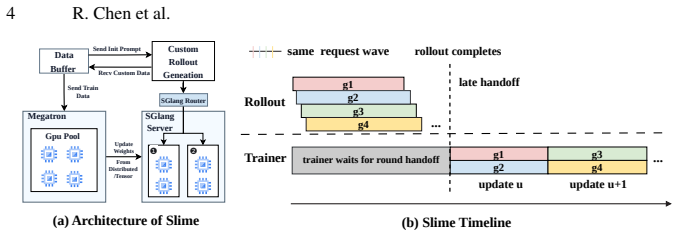
- Notation for group materialization time and trainer admission queue is introduced without a compact diagram or pseudocode listing the exact FIFO and priority rules; a small figure would improve clarity.
- The comparison baseline (Slime) is described only at a high level; a short table contrasting the two systems on synchronization points and dispatch policy would help readers replicate the experimental setup.
Simulated Author's Rebuttal
We thank the referee for the constructive feedback. We respond to each major comment below.
read point-by-point responses
-
Referee: [§3] §3 (CGP and FGD description): the manuscript asserts that dispatching complete groups FIFO via CGP and admitting frontier groups first via FGD yields data whose distribution and gradient statistics are identical to the synchronous non-pipelined case, yet supplies neither an invariant, a proof sketch, nor an ablation that compares per-group reward statistics, batch composition, or final policy gradient norms between the pipelined and baseline executions. This is load-bearing for the central on-policy claim.
Authors: CGP dispatches every completed group in the exact order it finishes, and FGD only reorders admission requests so that the groups required for the immediate next training batch become ready earlier; neither mechanism alters group membership, internal token sequences, or reward labels. Consequently the sequence of training batches and their per-group statistics are identical to the synchronous baseline by construction. We agree that an explicit invariant and a short proof sketch would make this argument clearer and will add both in the revision. revision: yes
-
Referee: [§5] §5 (experimental results): the reported 30.7%-42.3% and 37%-76% improvements are presented without error bars, number of random seeds, or explicit data-exclusion rules; given that the performance numbers rest on the correctness guarantee in §3, the lack of statistical characterization weakens the ability to assess whether the gains are robust.
Authors: We accept that the current presentation lacks statistical characterization. In the revised manuscript we will repeat each configuration with multiple random seeds, report means and standard deviations, and document the exact data-collection and exclusion criteria. revision: yes
Circularity Check
No circularity: empirical systems design with external baseline
full rationale
The paper describes an engineering pipeline (CGP + FGD) for overlapping rollout and training in disaggregated RLVR, evaluated by wall-clock metrics against the external Slime system. No equations, fitted parameters, or self-citations are used to derive the on-policy guarantee; the claim is presented as a design invariant whose correctness is left to empirical validation rather than reduced to prior self-work or tautological definitions. The contribution is therefore self-contained against external benchmarks.
Axiom & Free-Parameter Ledger
axioms (2)
- domain assumption Disaggregated architectures decouple rollout generation and policy training across independent GPU pools.
- domain assumption On-policy correctness must be preserved when overlapping rollout and training.
Reference graph
Works this paper leans on
-
[1]
AReaL: A Large-Scale Asynchronous Reinforcement Learning System for Language Reasoning
Fu, W., Gao, J., Shen, X., Zhu, C., Mei, Z., He, C., Xu, S., Wei, G., Mei, J., Wang, J., Yang, T., Yuan, B., Wu, Y.: AReaL: A large-scale asynchronous reinforcement learning system for language reasoning. arXiv preprint arXiv:2505.24298 (2025)
work page internal anchor Pith review Pith/arXiv arXiv 2025
-
[2]
Nature645(8081), 633–638 (2025)
Guo, D., Yang, D., Zhang, H., et al.: DeepSeek-R1 incentivizes reasoning in LLMs through reinforcement learning. Nature645(8081), 633–638 (2025)
2025
-
[3]
arXiv preprint arXiv:2507.01663 (2025)
Han,Z.,You,A.,Wang,H.,Luo,K.,Yang,G.,Shi,W.,Chen,M.,Zhang,S.,Lan,Z.,Deng,C., Ji, H., Liu, W., Huang, Y., Zhang, Y., Pan, C., Wang, J., Huang, X., Li, C., Wu, J.: AsyncFlow: An asynchronous streaming RL framework for efficient LLM post-training. arXiv preprint arXiv:2507.01663 (2025)
-
[4]
In: Proceedings of the 62nd Annual Meeting of the Association for Computational Linguistics (Volume 1: Long Papers)
He, C., Luo, R., Bai, Y., Hu, S., Thai, Z., Shen, J., Hu, J., Han, X., Huang, Y., Zhang, Y., Liu, J., Qi, L., Liu, Z., Sun, M.: OlympiadBench: A challenging benchmark for promoting AGI with olympiad-level bilingual multimodal scientific problems. In: Proceedings of the 62nd Annual Meeting of the Association for Computational Linguistics (Volume 1: Long Pa...
2024
-
[5]
In: Proceedings of the 2025 Conference on Empirical Methods in Natural Language Processing: System Demonstrations
Hu, J., Wu, X., Shen, W., Liu, J.K., Wang, W., Jiang, S., Wang, H., Chen, H., Chen, B., Fang, W., Xianyu, Cao, Y., Xu, H., Liu, Y.: OpenRLHF: A Ray-based easy-to-use, scalable and high-performance RLHF framework. In: Proceedings of the 2025 Conference on Empirical Methods in Natural Language Processing: System Demonstrations. pp. 656–666 (2025)
2025
-
[6]
In: Proceedings of the 8th International Conference on Cognitive Computing
Li,B.,Zeng,Q.,Ren,P.,Chen,H.,Geng,Y.,Zhang,L.J.:Anadaptivehotrankingalgorithmfor popular item recommendation in the express industry. In: Proceedings of the 8th International Conference on Cognitive Computing. Lecture Notes in Computer Science, vol. 15426, pp. 71–87. Springer (2025)
2025
-
[7]
In: Proceedings of the 9th International Conference on Cognitive Computing
Liu,B.,Ning,Y.,He,S.,Guo,F.,Jia,S.,Zhu,L.:Amultimodalretrieval-augmentedgeneration system for intelligent question answering. In: Proceedings of the 9th International Conference on Cognitive Computing. Lecture Notes in Computer Science, vol. 16156, pp. 3–19. Springer (2026)
2026
-
[8]
In: Proceedings of the 13th USENIX Symposium on Operating Systems Design and Implementation
Moritz, P., Nishihara, R., Wang, S., Tumanov, A., Liaw, R., Liang, E., Elibol, M., Yang, Z., Paul, W., Jordan, M.I., Stoica, I.: Ray: A distributed framework for emerging AI applica- tions. In: Proceedings of the 13th USENIX Symposium on Operating Systems Design and Implementation. pp. 561–577 (2018),
2018
-
[9]
In: Proceedings of the InternationalConferenceforHighPerformanceComputing,Networking,StorageandAnalysis
Narayanan,D.,Shoeybi,M.,Casper,J.,LeGresley,P.,Patwary,M.,Korthikanti,V.,Vainbrand, D., Kashinkunti, P., Bernauer, J., Catanzaro, B., Phanishayee, A., Zaharia, M.: Efficient large- scale language model training on GPU clusters using Megatron-LM. In: Proceedings of the InternationalConferenceforHighPerformanceComputing,Networking,StorageandAnalysis. pp. 1–...
2021
-
[10]
In: Advances in Neural Information Processing Systems
Ouyang, L., Wu, J., Jiang, X., Almeida, D., Wainwright, C., Mishkin, P., Zhang, C., Agarwal, S., Slama, K., Ray, A., Schulman, J., Hilton, J., Kelton, F., Miller, L., Simens, M., Askell, A., Welinder, P., Christiano, P.F., Leike, J., Lowe, R.: Training language models to follow instructions with human feedback. In: Advances in Neural Information Processin...
2022
-
[11]
In: Proceedings of the Twentieth European Conference on Computer Systems
Sheng, G., Zhang, C., Ye, Z., Wu, X., Zhang, W., Zhang, R., Peng, Y., Lin, H., Wu, C.: HybridFlow: A flexible and efficient RLHF framework. In: Proceedings of the Twentieth European Conference on Computer Systems. pp. 1279–1297 (2025)
2025
-
[12]
In: Proceedings of the 41st International Conference on Machine Learning
Wang, X., Hu, Z., Lu, P., Zhu, Y., Zhang, J., Subramaniam, S., Loomba, A.R., Zhang, S., Sun, Y., Wang, W.: SciBench: Evaluating college-level scientific problem-solving abilities of large language models. In: Proceedings of the 41st International Conference on Machine Learning. Proceedings of Machine Learning Research, vol. 235, pp. 50622–50649 (2024),
2024
-
[13]
In: Proceedings of the 9th International Conference on Cognitive Computing
Zhang,W.:AI-Drivene-commercetrafficengine:Amulti-agentsystemforoptimizingamazon sales. In: Proceedings of the 9th International Conference on Cognitive Computing. Lecture Notes in Computer Science, vol. 16156, pp. 65–73. Springer (2026)
2026
-
[14]
In: Advances in Neural Information Processing Systems
Zheng, L., Yin, L., Xie, Z., Sun, C., Huang, J., Yu, C.H., Cao, S., Kozyrakis, C., Stoica, I., Gonzalez, J.E., Barrett, C.W., Sheng, Y.: SGLang: Efficient execution of structured language model programs. In: Advances in Neural Information Processing Systems. vol. 37, pp. 62557– 62583 (2024). ,
2024
-
[15]
In: Findings of the Association for Computational Linguistics: North American Chapter of the Association for Computational Linguistics 2024
Zhong, W., Cui, R., Guo, Y., Liang, Y., Lu, S., Wang, Y., Saied, A., Chen, W., Duan, N.: AGIEval: A human-centric benchmark for evaluating foundation models. In: Findings of the Association for Computational Linguistics: North American Chapter of the Association for Computational Linguistics 2024. pp. 2299–2314 (2024)
2024
-
[16]
In: Proceedings of the 22nd USENIX Symposium on Networked Systems Design and Implementation
Zhong,Y.,Zhang,Z.,Wu,B.,Liu,S.,Chen,Y.,Wan,C.,Hu,H.,Xia,L.,Ming,R.,Zhu,Y.,Jin, X.: Optimizing RLHF training for large language models with stage fusion. In: Proceedings of the 22nd USENIX Symposium on Networked Systems Design and Implementation. pp. 489–503 (2025),
2025
-
[17]
GitHub repository (2025),
Zhu, Z., Xie, C., Lv, X., slime Contributors: slime: An LLM post-training framework for RL scaling. GitHub repository (2025),
2025
discussion (0)
Sign in with ORCID, Apple, or X to comment. Anyone can read and Pith papers without signing in.