Teaching LLMs String Matching, Backtracking, and Error Recovery to Deduce Bases and Truth Tables for the Combinatorially Exploding Bit Manipulation Puzzles
Pith reviewed 2026-07-01 06:34 UTC · model grok-4.3
The pith
String similarity via minimal bit flips lets LLMs isolate primitive bases and deduce truth tables for hidden bit rules without simulating operations.
A machine-rendered reading of the paper's core claim, the machinery that carries it, and where it could break.
Core claim
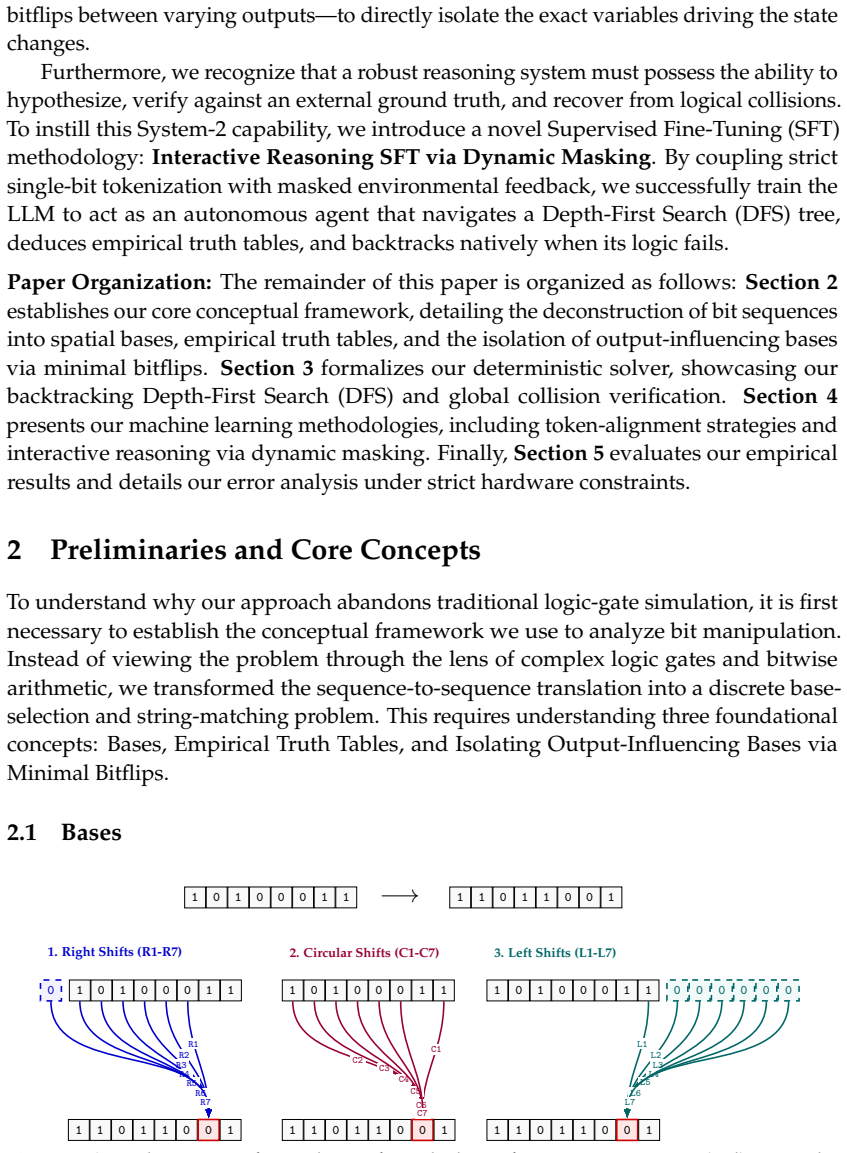
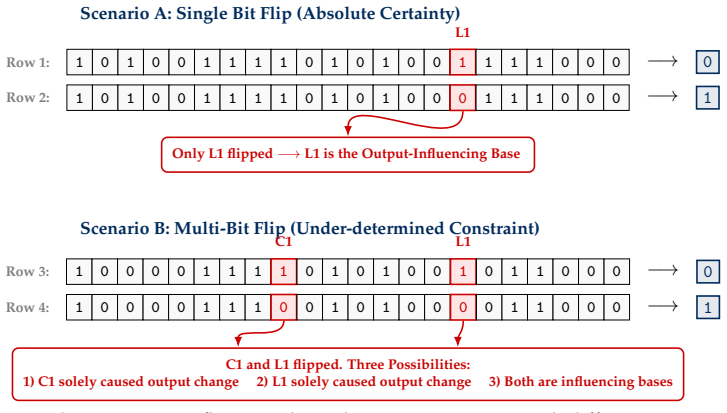
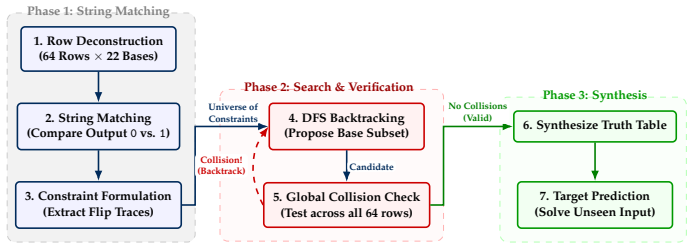
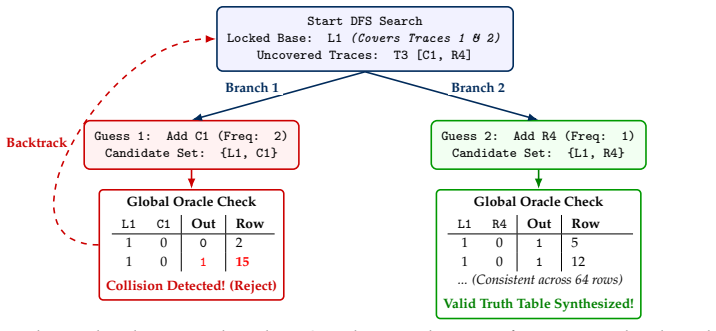
By treating the hidden rule as a selection among candidate bases (primitive string transformations) whose effects are compared to observed input-output pairs via Hamming distance, the approach deduces the minimal set of bases and assembles the truth table that reproduces all given examples; backtracking DFS then ensures consistency by retracting any base that produces collisions on later examples.
What carries the argument
Base-selection task that isolates primitive transformations by minimal bit-flip distance and assembles them into a truth table without enumerating boolean operations.
If this is right
- The method reaches over 96 percent validation accuracy on the contest's bit-manipulation puzzles.
- Backtracking on detected logical collisions supplies autonomous error recovery without external supervision.
- Bit-tokenization plus dynamic masking trains the model to generate, evaluate, and retract hypotheses in a single forward pass.
- The same string-similarity reduction applies whenever the search space of arithmetic or logical operations grows combinatorially.
Where Pith is reading between the lines
- The same minimal-distance base selection could be tested on non-bit string-rewriting tasks such as simple program synthesis or cellular-automaton rule inference.
- If the assumption holds, explicit logical simulators become unnecessary for many pattern-based reasoning benchmarks, shifting emphasis to distance metrics and search control.
- The backtracking component might be replaced by learned policies that predict collision likelihood directly from partial base sets.
Load-bearing premise
Measuring similarity only by the number of bit flips between strings is enough to identify which primitive transformations generate the hidden rule.
What would settle it
A collection of bit-manipulation puzzles in which two distinct sets of bases produce identical minimal-flip distances on all training examples but diverge on held-out inputs, causing the method to select the wrong base set.
Figures
read the original abstract
This paper presents our algorithmic innovations for the NVIDIA Nemotron Model Reasoning Challenge, focusing on Bit Manipulation Puzzles. In this task, the objective is to discover a hidden logical rule transforming input binary strings to outputs, then apply it to unseen inputs. Large Language Models (LLMs) notoriously struggle here; traditional methods force them to simulate complex boolean logic and arithmetic, leading to hallucinations. Furthermore, the search space of bitwise operations (combinations of shifts, rotations, and logic gates) suffers from a severe combinatorial explosion. To overcome this computational intractability, we present a novel approach that abandons arithmetic logic entirely in favor of string similarity, structured search, and autonomous error recovery. Our core contributions are: 1. Bases and Truth Table Formulation: We reframe logic-gate deduction into a base-selection task, leveraging string similarity (minimal bit flips) to isolate primitive transformations ("bases") and deduce truth tables without complex arithmetic. 2. Backtracking DFS and Error Recovery: We formalize a search process that tests candidate bases, detects logical collisions across examples, and backtracks upon failure to perform robust error recovery. 3. Bit Tokenization and Interactive Reasoning SFT: We force the tokenizer to encode binary strings as individual single-bit tokens. We use dynamic masking to simulate external oracle feedback, training the model to hypothesize, self-evaluate, and backtrack natively. Evaluated on bit manipulation puzzles, our approach achieved over 96% validation accuracy. This represents the highest performance in this category, driving our 7th Place overall finish in the contest.
Editorial analysis
A structured set of objections, weighed in public.
Referee Report
Summary. The paper presents algorithmic innovations for the NVIDIA Nemotron Model Reasoning Challenge on Bit Manipulation Puzzles. It reframes deduction of hidden logical rules as a base-selection task that uses string similarity (minimal bit flips) to isolate primitive transformations ('bases') and deduce truth tables without simulating boolean operations. The method adds backtracking DFS with logical-collision detection for error recovery, plus bit-level tokenization and interactive-reasoning SFT that trains the LLM to hypothesize, self-evaluate, and backtrack. The approach is reported to reach over 96% validation accuracy—the highest in its category—and 7th place overall.
Significance. If the empirical result holds under the stated assumptions, the work would demonstrate a practical route around the combinatorial explosion of bitwise-operation search by substituting distance-based base selection and autonomous backtracking for direct arithmetic simulation. The contest placement supplies external corroboration that the pipeline can be deployed successfully on the target task distribution.
major comments (2)
- [Abstract] Abstract: the central claim that 'minimal bit flips' isolate the true primitive transformations without recovering the underlying boolean operations is load-bearing for the 96% accuracy result, yet the manuscript supplies neither a formal argument nor any concrete example showing that the distance metric yields a unique (or correctly recoverable) minimizer; the possibility that distinct operation sets induce identical flip distances on the observed examples but diverge on unseen inputs is not addressed.
- [Abstract] Abstract: the reported 'over 96% validation accuracy' is presented with no data tables, ablation studies, error analysis, or description of the validation split, so it is impossible to determine whether the accuracy actually supports the claim that the string-similarity-plus-backtracking method overcomes the combinatorial explosion and LLM hallucinations.
minor comments (1)
- [Abstract] Abstract: the phrase 'dynamic masking to simulate external oracle feedback' is introduced without any description of the masking schedule, loss formulation, or how oracle signals are generated during training.
Simulated Author's Rebuttal
We thank the referee for the constructive feedback on our manuscript. We address each major comment below and describe the revisions planned for the next version.
read point-by-point responses
-
Referee: [Abstract] Abstract: the central claim that 'minimal bit flips' isolate the true primitive transformations without recovering the underlying boolean operations is load-bearing for the 96% accuracy result, yet the manuscript supplies neither a formal argument nor any concrete example showing that the distance metric yields a unique (or correctly recoverable) minimizer; the possibility that distinct operation sets induce identical flip distances on the observed examples but diverge on unseen inputs is not addressed.
Authors: We agree that the manuscript lacks both a formal uniqueness argument and a worked example for the minimal bit-flip distance. The approach is empirical: in the contest distribution the true bases are the minimal-distance matches, and backtracking resolves collisions by enforcing consistency across examples. We will add a concrete numerical example (with input/output pairs, distance calculations, and backtrack steps) to Section 3. A general formal proof of uniqueness does not hold for arbitrary operation sets, so we will instead state the empirical conditions under which the metric succeeds on the target task. revision: partial
-
Referee: [Abstract] Abstract: the reported 'over 96% validation accuracy' is presented with no data tables, ablation studies, error analysis, or description of the validation split, so it is impossible to determine whether the accuracy actually supports the claim that the string-similarity-plus-backtracking method overcomes the combinatorial explosion and LLM hallucinations.
Authors: We acknowledge that the current presentation of results is insufficiently detailed. The full manuscript contains a validation-split description, but we will expand the evaluation section with: (1) a results table broken down by puzzle type, (2) ablation tables isolating backtracking and bit-level tokenization, (3) error analysis of the remaining failure cases, and (4) explicit confirmation that the 96% figure is measured on held-out contest examples. These additions will directly link the reported accuracy to the claimed mitigation of combinatorial search and hallucinations. revision: yes
Circularity Check
No circularity: empirical method with independent validation
full rationale
The paper presents an algorithmic approach using string similarity via minimal bit flips for base selection, backtracking search, and LLM fine-tuning with bit tokenization. It reports an empirical validation accuracy of over 96% on contest puzzles. No derivation chain, equations, or self-citations are shown that reduce the claimed result to a fitted parameter, self-defined quantity, or prior author result by construction. The central performance number is an external benchmark outcome, not a statistical artifact of the method's inputs. The approach is self-contained against the contest data.
Axiom & Free-Parameter Ledger
Reference graph
Works this paper leans on
-
[1]
Semaan, Jean-Francois Puget, Christof Henkel, Yi Dong, Addison Howard, Ashley Oldacre, Ryan Holbrook, Chris Alexiuk, and Rebecca Kao
Jamil C. Semaan, Jean-Francois Puget, Christof Henkel, Yi Dong, Addison Howard, Ashley Oldacre, Ryan Holbrook, Chris Alexiuk, and Rebecca Kao. NVIDIA Nemotron Model Reasoning Challenge, 2026. https://kaggle.com/competitions/ nvidia-nemotron-model-reasoning-challenge. Kaggle
2026
-
[2]
NVIDIA Nemotron Model Reasoning Chal- lenge — Writeup, 2026
Tong Hui Kang. NVIDIA Nemotron Model Reasoning Chal- lenge — Writeup, 2026. https://www.kaggle.com/competitions/ nvidia-nemotron-model-reasoning-challenge/discussion/689915 . Kaggle Discussion. 15 Appendix A: Full Chain-of-Thought (CoT) Traces This appendix provides two complete, unedited examples of the synthetic Chain-of- Thought (CoT) traces used to tr...
2026
-
[3]
1 10 01 10 1 -> 00 000 00 0
-
[4]
1 00 10 11 1 -> 00 000 00 0
-
[5]
1 10 00 11 1 -> 00 000 00 0
-
[6]
1 10 10 11 1 -> 00 000 01 0
-
[7]
1 11 10 01 1 -> 00 000 11 0
-
[8]
1 11 01 11 1 -> 00 000 10 1
-
[9]
Target O =0
1 01 00 10 0 -> 00 000 10 0 Row Cr ea ti on Trace : Input : 11 00 110 1 -> Target Output : 00 00 00 00 Bit 7 ( MSB ) : O ri gi nal bit x =1. Target O =0. R [1 -7]: Shift input right by 1 -7 , extract Bit 7. Result : 0000000 C [1 -7]: Rotate input left by 1 -7 , extract Bit 7. Result : 1001101 L [1 -7]: Shift input left by 1 -7 , extract Bit 7. Result : 10...
-
[11]
** Greedy B r a n c h i n g :** For r e m a i n i n g traces , i t e r a t i v e l y select the feature with the highest i n t e r s e c t i o n f r e q u e n c y
-
[12]
If i d e n t i c a l inputs yield d i f f e r e n t outputs ( a c o l l i s i o n ) , the set is invalid
** C o l l i s i o n V e r i f i c a t i o n & B a c k t r a c k i n g :** When all traces are covered , ge ne ra te a Truth Table across all 64 rows . If i d e n t i c a l inputs yield d i f f e r e n t outputs ( a c o l l i s i o n ) , the set is invalid . We b a c k t r a c k and try the next c a n d i d a t e . < deduction > Bases : {} 17 U n c o v e ...
-
[13]
** M a n d a t o r y Bases :** Any feature in a 1 - bit flip trace is an ab sol ut e c o n s t r a i n t and is i m m e d i a t e l y locked
-
[14]
** Greedy B r a n c h i n g :** For r e m a i n i n g traces , i t e r a t i v e l y select the feature with the highest i n t e r s e c t i o n f r e q u e n c y . 19
-
[15]
If i d e n t i c a l inputs yield d i f f e r e n t outputs ( a c o l l i s i o n ) , the set is invalid
** C o l l i s i o n V e r i f i c a t i o n & B a c k t r a c k i n g :** When all traces are covered , ge ne ra te a Truth Table across all 64 rows . If i d e n t i c a l inputs yield d i f f e r e n t outputs ( a c o l l i s i o n ) , the set is invalid . We b a c k t r a c k and try the next c a n d i d a t e . < deduction > Bases : {} U n c o v e r e...
discussion (0)
Sign in with ORCID, Apple, or X to comment. Anyone can read and Pith papers without signing in.