Quasi-normal modes as probes of black hole reentrant phase transitions
Pith reviewed 2026-06-30 08:14 UTC · model grok-4.3
The pith
Quasi-normal modes serve as dynamical probes of reentrant thermodynamic phase transitions in charged AdS black holes.
A machine-rendered reading of the paper's core claim, the machinery that carries it, and where it could break.
Core claim
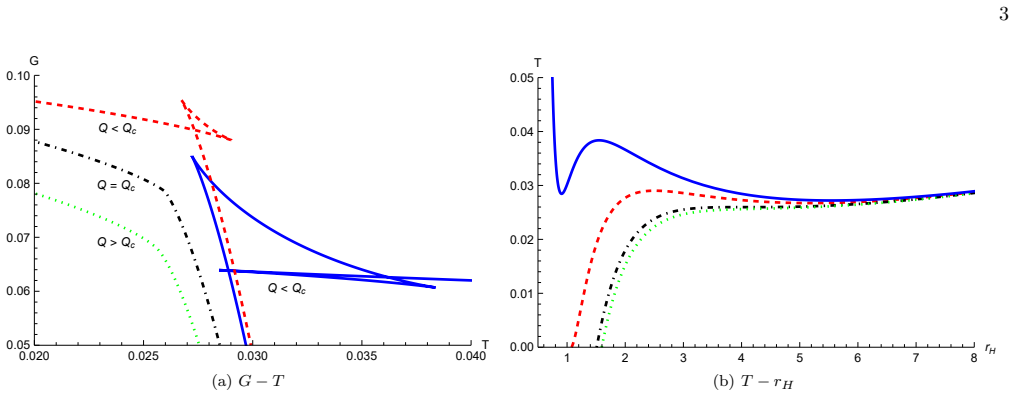
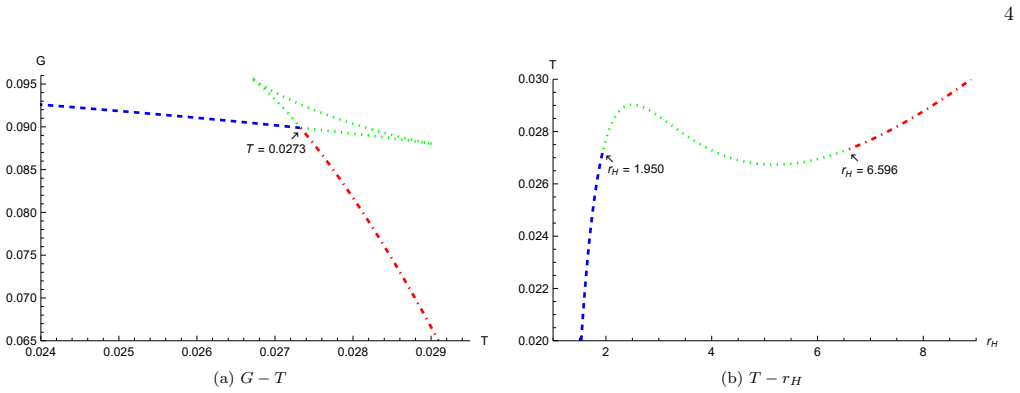
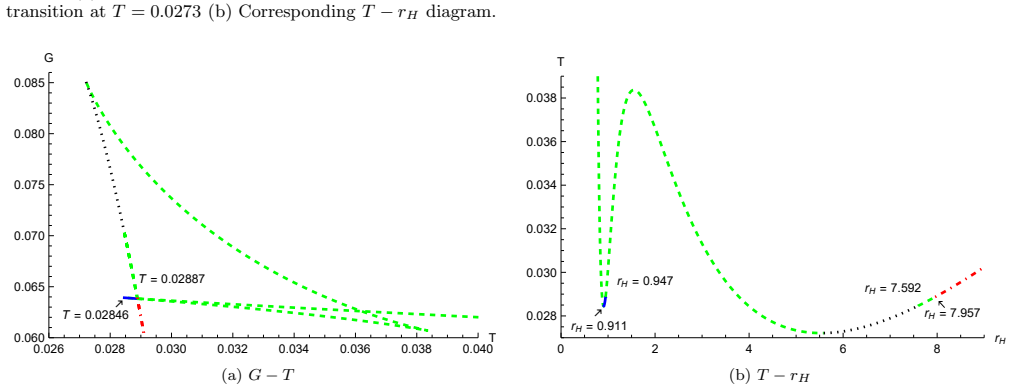
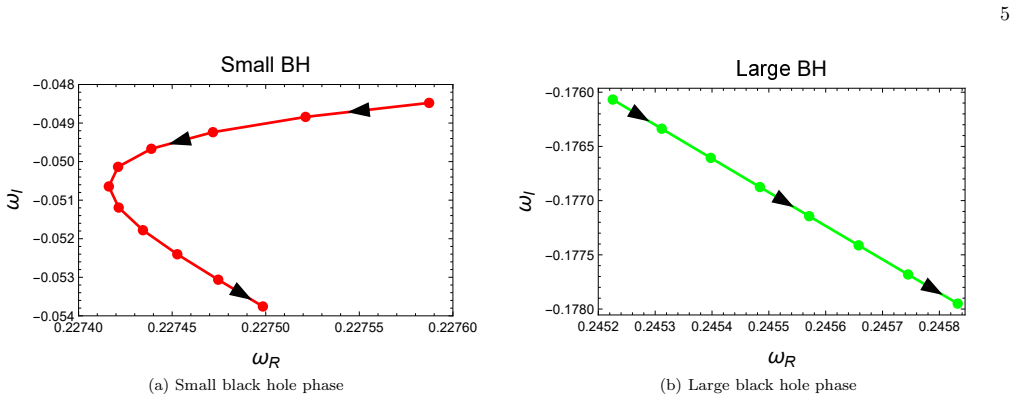
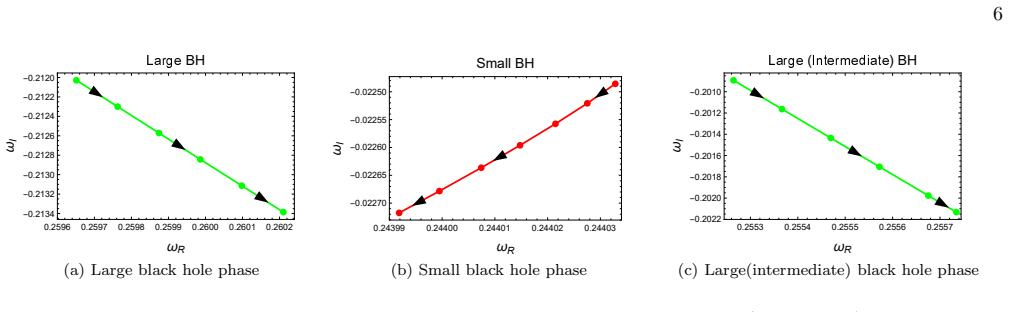
In these black holes, a reentrant large-small-large (intermediate) phase transition is present. Computing QNM frequencies for a massless scalar field across the phases reveals distinct behaviors, marking the first use of QNMs as probes for such reentrant transitions including zeroth and first-order ones.
What carries the argument
Quasi-normal modes obtained by solving the Klein-Gordon equation for a massless scalar field using the shooting method.
If this is right
- QNMs exhibit different frequencies in the large, small, and intermediate phases during the reentrant transition.
- These modes can detect both zeroth-order and first-order phase transitions dynamically.
- This establishes a link between thermodynamic phase structure and dynamical perturbations in nonlinear charged black holes.
Where Pith is reading between the lines
- Similar QNM analysis could be applied to other black hole systems with reentrant transitions to test the generality of this probe.
- If QNMs reliably signal phases, they might offer an observational handle on black hole thermodynamics in astrophysical contexts.
- Extensions to rotating or higher-dimensional cases could reveal whether the probe is universal.
Load-bearing premise
The observed differences in QNM frequencies stem from the thermodynamic phase structure and not from numerical methods, boundary conditions, or other uncontrolled factors.
What would settle it
Computing QNM frequencies with alternative numerical techniques or different boundary conditions and finding no consistent variation tied to the identified phases would challenge the claim.
Figures
read the original abstract
We investigate the interplay between thermodynamic phase transitions and the dynamical behavior of quasi-normal modes (QNMs) in weakly nonlinear charged anti-de Sitter black holes. In a non-extended phase space, we identify a reentrant large-small-large(intermediate) phase transition for these black holes. Employing the shooting method to solve the Klein-Gordon equation for a massless scalar field, we compute QNM frequencies across these phases, revealing distinct behaviors in different phases. Specifically, to our knowledge, this is the first report of utilizing QNMs as dynamical probes of thermodynamic phases during reentrant phase transitions including zeroth and first-order transitions. These findings establish QNMs as a powerful dynamical probe for thermodynamic phase transitions, providing new insights into the thermodynamic and dynamical properties of nonlinear charged black holes as well.
Editorial analysis
A structured set of objections, weighed in public.
Referee Report
Summary. The manuscript investigates the interplay between thermodynamic reentrant phase transitions (large-small-large/intermediate) in weakly nonlinear charged AdS black holes in non-extended phase space and the quasi-normal modes of a massless scalar field. Using the shooting method on the Klein-Gordon equation with standard ingoing/outgoing boundary conditions, the authors compute QNM frequencies across the phases and report distinct behaviors that track the thermodynamic phase boundaries from free-energy analysis, claiming this as the first use of QNMs as dynamical probes for such transitions including zeroth- and first-order cases.
Significance. If the reported QNM distinctions hold, the work establishes a dynamical probe complementary to thermodynamic analysis for black hole reentrant transitions. The consistent numerical treatment and alignment of frequency shifts with phase boundaries provide a concrete link between dynamics and thermodynamics in this model.
minor comments (3)
- [§3] §3 (numerics): the shooting-method implementation would benefit from explicit statement of the convergence criterion or tolerance used for the QNM frequencies to allow reproducibility of the reported phase-dependent shifts.
- [Figure 5] Figure 5 (QNM plots): axis labels and phase annotations should explicitly reference the thermodynamic quantities (e.g., temperature or pressure values) at the transition points shown in §2 to strengthen the claimed tracking.
- [Abstract, §1] Abstract and §1: the claim of being 'the first report' would be strengthened by a brief comparison to prior QNM studies of first-order transitions in similar AdS models.
Simulated Author's Rebuttal
We thank the referee for the positive assessment of our manuscript and the recommendation of minor revision. We note that no specific major comments were raised in the report.
Circularity Check
No significant circularity
full rationale
The paper computes black-hole thermodynamics (free energy, phase boundaries for reentrant transitions) independently of the QNM analysis. QNM frequencies are obtained by solving the Klein-Gordon equation via the shooting method with standard ingoing/outgoing boundary conditions; the resulting spectra are then compared to the separately derived phase diagram. No equation defines a QNM quantity in terms of the thermodynamic phases or vice versa, no fitted parameter is relabeled as a prediction, and no load-bearing step reduces to a self-citation chain. The central claim—that distinct QNM behaviors track the thermodynamic phases—rests on two independent numerical pipelines whose outputs are compared after the fact, satisfying the criterion for a self-contained derivation.
Axiom & Free-Parameter Ledger
Reference graph
Works this paper leans on
-
[1]
The large-small phase transition is a first-order phase tran- sition
0715 < Qc, where the system experiences reentrant large-small-large(intermediate) phase transition. The large-small phase transition is a first-order phase tran- sition. The zeroth-order phase transition, evidenced by a discontinuity in the Gibbs free energy at T = 0. 02846, is a relatively rare phenomenon in black hole thermody- namics. It involves an abr...
-
[2]
S. W. Hawking, Gravitational radiation from colliding black holes, Phys. Rev. Lett. 26, 1344-1346 (1971)
1971
-
[3]
J. D. Bekenstein, Black holes and entropy, Phys. Rev. D 7, 2333-2346 (1973)
1973
-
[4]
J. M. Bardeen, B. Carter and S. W. Hawk- ing, The Four laws of black hole mechanics, Commun. Math. Phys. 31, 161-170 (1973)
1973
-
[5]
S. W. Hawking, Particle Creation by Black Holes, Commun. Math. Phys. 43, 199-220 (1975) [erratum: Commun. Math. Phys. 46, 206 (1976)]
1975
-
[6]
S. W. Hawking and D. N. Page, Thermody- namics of Black Holes in anti-De Sitter Space, Commun. Math. Phys. 87, 577-588 (1983)
1983
-
[7]
Anti-de Sitter Space, Thermal Phase Transition, And Confinement In Gauge Theories
E. Witten, Anti-de Sitter space, thermal phase transition, and confinement in gauge theo- ries, Adv. Theor. Math. Phys. 2, 505-532 (1998) , [arXiv:hep-th/9803131]
work page internal anchor Pith review Pith/arXiv arXiv 1998
-
[8]
Charged AdS Black Holes and Catastrophic Holography
A. Chamblin, R. Emparan, C. V. Johnson and R. C. Myers, Charged AdS black holes and catas- trophic holography, Phys. Rev. D 60, 064018 (1999) , [arXiv:hep-th/9902170]
work page internal anchor Pith review Pith/arXiv arXiv 1999
-
[9]
B. P. Dolan, The cosmological con- stant and the black hole equation of state, Class. Quant. Grav. 28, 125020 (2011) , 8 [arXiv:1008.5023]
work page internal anchor Pith review Pith/arXiv arXiv 2011
-
[10]
P-V criticality of charged AdS black holes
D. Kubiznak and R. B. Mann, P-V criticality of charged AdS black holes, JHEP 07, 033 (2012) , [arXiv:1205.0559]
work page internal anchor Pith review Pith/arXiv arXiv 2012
-
[11]
S. Gunasekaran, R. B. Mann and D. Kubiznak, Ex- tended phase space thermodynamics for charged and ro- tating black holes and Born-Infeld vacuum polarization, JHEP 11, 110 (2012) , [ arXiv:1208.6251]
work page internal anchor Pith review Pith/arXiv arXiv 2012
-
[12]
A. Dehyadegari, A. Sheykhi and A. Montakhab, Crit- ical behavior and microscopic structure of charged AdS black holes via an alternative phase space, Phys. Lett. B 768, 235-240 (2017) , [ arXiv:1607.05333]
work page internal anchor Pith review Pith/arXiv arXiv 2017
-
[13]
Reentrant phase transition of Born-Infeld-AdS black holes
A. Dehyadegari and A. Sheykhi, Reentrant phase transition of Born-Infeld-AdS black holes, Phys. Rev. D 98, no. 2, 024011 (2018) , [arXiv:1711.01151]
work page internal anchor Pith review Pith/arXiv arXiv 2018
-
[14]
Born, On the quantum the- ory of the electromagnetic field, Proc
M. Born, On the quantum the- ory of the electromagnetic field, Proc. Roy. Soc. Lond. A 143, no. 849, 410-437 (1934)
1934
-
[15]
Born and L
M. Born and L. Infeld, Foun- dations of the new field theory, Proc. Roy. Soc. Lond. A 144, no. 852, 425-451 (1934)
1934
-
[16]
Non-Singular Charged Black Hole Solution for Non-Linear Source
E. Ayon-Beato and A. Garcia, Non-singular charged black hole solution for non-linear source, Gen. Rel. Grav. 31, no. 5, 629-633 (1999) , [arXiv:gr-qc/9911084]
work page internal anchor Pith review Pith/arXiv arXiv 1999
-
[17]
New Regular Black Hole Solution from Nonlinear Electrodynamics
E. Ayon-Beato and A. Garcia, New regu- lar black hole solution from nonlinear elec- trodynamics, Phys. Lett. B 464, 25-29 (1999) , [arXiv:hep-th/9911174]
work page internal anchor Pith review Pith/arXiv arXiv 1999
-
[18]
V. A. De Lorenci, R. Klippert, M. Novello and J. M. Salim, Nonlinear electrodynamics and FR W cos- mology, Phys. Rev. D 65, 063501 (2002)
2002
-
[19]
Regular electrically charged structures in Nonlinear Electrodynamics coupled to General Relativity
I. Dymnikova, Regular electrically charged struc- tures in nonlinear electrodynamics coupled to general relativity, Class. Quant. Grav. 21, 4417-4429 (2004) , [arXiv:gr-qc/0407072]
work page internal anchor Pith review Pith/arXiv arXiv 2004
-
[20]
Removing black-hole singularities with nonlinear electrodynamics
C. Corda and H. J. Mosquera Cuesta, Removing black-hole singularities with nonlinear electrody- namics, Mod. Phys. Lett. A 25, 2423-2429 (2010) , [arXiv:0905.3298]
work page internal anchor Pith review Pith/arXiv arXiv 2010
-
[21]
Inflation from R^2 gravity: a new approach using nonlinear electrodynamics
C. Corda and H. J. Mosquera Cuesta, Inflation from R2 gravity: a new approach using nonlinear electrodynamics, Astropart. Phys. 34, 587-590 (2011) , [arXiv:1011.4801]
work page internal anchor Pith review Pith/arXiv arXiv 2011
-
[22]
H. H. Soleng, Charged black points in general rel- ativity coupled to the logarithmic U(1) gauge theory, Phys. Rev. D 52, no. 10, 6178-6181 (1995) , [arXiv:hep-th/9509033]
work page internal anchor Pith review Pith/arXiv arXiv 1995
-
[23]
Higher-dimensional black holes with a conformally invariant Maxwell source
M. Hassaine and C. Martinez, Higher-dimensional black holes with a conformally invariant Maxwell source, Phys. Rev. D 75, no. 2, 027502 (2007) , [arXiv:hep-th/0701058]
work page internal anchor Pith review Pith/arXiv arXiv 2007
-
[24]
S. H. Hendi, Asymptotic charged BTZ black hole solu- tions, JHEP 1203, 065 (2012) , [ arXiv:1405.4941]
work page internal anchor Pith review Pith/arXiv arXiv 2012
-
[25]
S. H. Hendi and M. Momennia, Thermodynamic instability of topological black holes with non- linear source, Eur. Phys. J. C 75, no. 2, 54 (2015) , [arXiv:1501.04863]
work page internal anchor Pith review Pith/arXiv arXiv 2015
-
[26]
C. S. Hudson, Die gegenseitige L¨ oslichkeit von Nikotin in Wasser, Zeitschrift f¨ ur Physikalische Chemie47, no. 1, 113-115 (1904)
1904
-
[27]
Narayanan and A
T. Narayanan and A. Kumar, Reentrant phase transitions in multicomponent liquid mixtures, Physics Reports 249, no. 3, 135-218 (1994)
1994
-
[28]
Reentrant Phase Transitions in Rotating AdS Black Holes
N. Altamirano, D. Kubiznak and R. B. Mann, Reentrant phase transitions in rotating anti-de Sit- ter black holes, Phys. Rev. D 88, no.10, 101502 (2013) , [arXiv:1306.5756]
work page internal anchor Pith review Pith/arXiv arXiv 2013
-
[29]
A. M. Frassino, D. Kubiznak, R. B. Mann and F. Simovic, Multiple reentrant phase transitions and triple points in Lovelock thermodynamics, JHEP 1409, 080 (2014) , [arXiv:1406.7015]
work page internal anchor Pith review Pith/arXiv arXiv 2014
-
[30]
R. A. Hennigar and R. B. Mann, Reentrant phase transi- tions and van der Waals behaviour for hairy black holes, Entropy 17, 8056 (2015) , [ arXiv:1509.06798]
work page internal anchor Pith review Pith/arXiv arXiv 2015
-
[31]
Thermodynamics of horizons: de Sitter black holes and reentrant phase transitions
D. Kubiznak and F. Simovic, Thermodynamics of horizons: de Sitter black holes and reentrant phase tran- sitions, Class. Quant. Grav. 33, no.24, 245001 (2016) , [arXiv:1507.08630]
work page internal anchor Pith review Pith/arXiv arXiv 2016
-
[32]
D. C. Zou, R. Yue and M. Zhang, Reentrant phase tran- sitions of higher-dimensional AdS black holes in dRGT massive gravity, Eur. Phys. J. C 77, no.4, 256 (2017) , [arXiv:1612.08056]
work page internal anchor Pith review Pith/arXiv arXiv 2017
-
[33]
Microscopic Origin of Black Hole Reentrant Phase Transitions
M. Kord Zangeneh, A. Dehyadegari, A. Sheykhi and R. B. Mann, Microscopic origin of black hole reentrant phase transitions, Phys. Rev. D 97, no.8, 084054 (2018) , [arXiv:1709.04432]
work page internal anchor Pith review Pith/arXiv arXiv 2018
-
[34]
A. Dehghani, S. H. Hendi and R. B. Mann, Range of novel black hole phase transitions via massive gravity: Triple points and N -fold reentrant phase transitions, Phys. Rev. D 101, no.8, 084026 (2020) , [arXiv:2009.07980]
-
[35]
Y. P. Liu, H. M. Cao and W. Xu, Reentrant phase tran- sition with a single critical point of the Hayward-AdS black hole, Gen. Rel. Grav. 54, no.1, 5 (2022)
2022
- [36]
- [37]
-
[38]
C. V. Vishveshwara, Scattering of gravita- tional radiation by a Schwarzschild black-hole, Nature 227, 936–938 (1970)
1970
-
[39]
W. H. Press, Long wave trains of gravita- tional waves from a vibrating black hole, Astrophys. J. Lett. 170, L105-L108 (1971)
1971
-
[40]
Chandrasekhar and S
S. Chandrasekhar and S. L. Detweiler, The quasi- normal modes of the Schwarzschild black hole, Proc. Roy. Soc. Lond. A 344, 441-452 (1975)
1975
-
[41]
H. P. Nollert, Quasinormal modes: the charac- teristic sound of black holes and neutron stars, Classical and Quantum Gravity 16, 159-216 (1999)
1999
-
[42]
K. D. Kokkotas and B. G. Schmidt, Quasinormal modes of stars and black holes, Living Rev. Rel. 2, 2 (1999) , [arXiv:gr-qc/9909058]
work page internal anchor Pith review Pith/arXiv arXiv 1999
-
[43]
Perturbations around black holes
B. Wang, Perturbations around black holes, Braz. J. Phys. 35, 1029-1037 (2005) , [arXiv:gr-qc/0511133]
work page internal anchor Pith review Pith/arXiv arXiv 2005
-
[44]
Stability and quasi-normal modes of charged black holes in Born-Infeld gravity
S. Fernando and C. Holbrook, Stability and quasi normal modes of charged black holes in Born-Infeld gravity, Int. J. Theor. Phys. 45, 1630-1645 (2006) , [arXiv:hep-th/0501138]
work page internal anchor Pith review Pith/arXiv arXiv 2006
-
[45]
R. A. Konoplya and A. Zhidenko, Quasinormal modes of black holes: from astrophysics to string theory, 9 Rev. Mod. Phys. 83, 793-836 (2011) , [ arXiv:1102.4014]
work page internal anchor Pith review Pith/arXiv arXiv 2011
-
[46]
Y. Liu, D. C. Zou and B. Wang, Signature of the Van der Waals like small-large charged AdS black hole phase transition in quasinormal modes, JHEP 09, 179 (2014) , [arXiv:1405.2644]
work page internal anchor Pith review Pith/arXiv arXiv 2014
-
[47]
S. Priyadarshinee, Quasinormal mode of dyonic hairy black hole and its interplay with phase tran- sitions, Eur. Phys. J. Plus 139, no. 3, 258 (2024) , [arXiv:2308.05719]
- [48]
- [49]
-
[50]
Roshan Bakhsh, M
F. Roshan Bakhsh, M. Kord Zangeneh and D. Afshar, The isocharge phase transition signature in quasi- normal modes of charged anti-de Sitter black holes, Journal of Research on Many-body Systems 14, no. 3, 54-65 (2025)
2025
-
[51]
Quasinormal modes of black holes and black branes
E. Berti, V. Cardoso and A. O. Starinets, Quasinormal modes of black holes and black branes, Class. Quant. Grav. 26, 163001 (2009) , [arXiv:0905.2975]
work page internal anchor Pith review Pith/arXiv arXiv 2009
- [52]
discussion (0)
Sign in with ORCID, Apple, or X to comment. Anyone can read and Pith papers without signing in.