REVIEW 4 major objections 4 minor 62 references
Destructive Interference of Inertial Noise in Matter-wave Interferometry
T0 review · 4 major / 4 minor · reviewed 2026-08-06 · deepseek-v4-flash
Pith's one-line read Coupling two vibration directions makes inertial noise interfere destructively, cutting matter-wave interferometer dephasing by roughly the noise Q-factor.
desk verdict A nice idea with a broken central derivation: the residue-pair cancellation in Appendix A has the wrong sign, so the Q² suppression claim is not established. read the letter →
The pith
A machine-rendered reading of the paper's core claim, the machinery that carries it, and where it could break.
The reading
What carries the argument
The central object is the phase-variance spectral integral $\sigma^2_{\phi_{\rm diff}} = \frac{m^2}{\hbar^2}\int [\cos^2\theta S_{a_xa_x}(\omega)+\sin^2\theta S_{a_ya_y}(\omega)+\sin 2\theta \bar{S}_{a_xa_y}(\omega)]F_0(\omega)\,d\omega$, with the transfer function $F_0(\omega) = \left|\int_0^{2\pi/\omega_0}(1-\cos\omega_0 t)e^{i\omega t}dt\right|^2$, which acts like a sum of delta functions $4\pi^2[\delta(\omega-\omega_0)+2\delta(\omega)]/\omega_0$ for the harmonic interferometer trajectories. The decisive mechanism is the coupling term $H_{\rm int}=kXY$ in the apparatus dynamics, which diagonalises into normal modes $U$ and $V$ with shifted frequencies and produces a real in-phase cross-spectrum $\bar{S}_{a_xa_y}(\omega)$; this real part enters the variance with sign $\sin 2\theta$, enabling destructive interference. Optimising the Bloch angle $\theta$ and the sign of $k$ pushes the noise resonance away from $\omega_0$, yielding Eq. (47) and the $Q^2$ variance suppression.
What would settle it
Measure the phase variance $\sigma^2_{\phi_{\rm diff}}$ of a two-dimensional matter-wave interferometer as a function of $\omega_0$ with the coupling device engaged. If the resonance peak does not shift from $\Omega_0$ to $\sqrt{\Omega_0^2\pm k}$, or if the off-resonance variance does not drop by roughly $Q^2$ relative to the uncoupled one-dimensional prediction, the destructive-interference mechanism described by Eq. (47) is falsified.
Extended reading notes
Core claim
The paper claims that dephasing of a two-dimensional matter-wave interferometer by inertial acceleration noise can be suppressed by engineering a cross-correlation between the noise components along the $x$ and $y$ axes. For an apparatus whose vibrations obey coupled Langevin equations with the coupling term $H_{\rm int}=kXY$, the phase variance becomes a sum of two Lorentzians peaked at the normal modes $U=(X+Y)/\sqrt{2}$ and $V=(X-Y)/\sqrt{2}$. By choosing the sign of $k$ so that either $\Omega_0^2-k$ or $\Omega_0^2+k$ moves the resonance away from $\omega_0$, and by orienting the internal-state Bloch vector at $\theta$ to project onto the lighter-damped mode, the variance is minimized at $\sigma^2_{\phi_{\rm diff}} = \frac{8\pi^2 m^2 A_0^2}{\hbar^2} S_0 \frac{\omega_0^3}{(\Omega_0^2 - k - \omega_0^2)^2 + \omega_0^2\gamma^2}$. Compared with the uncoupled one-dimensional case at resonance $\omega_0\approx\Omega_0$, this suppresses the phase standard deviation by approximately the Q-factor $Q=\sqrt{\Omega_0^2\pm k}/\gamma$ of the noise, i.e. a $Q^2$ suppression in variance. The physical mechanism is destructive interference: the real part of the cross-spectrum $\bar{S}_{a_x a_y}(\omega)$ contributes a negative term to the phase variance, with the Cauchy-Schwarz bound preventing the variance from becoming negative.
Load-bearing premise
The argument assumes that the device coupling the two vibration directions behaves as a clean harmonic coupling $kXY$ and adds no extra dynamics, but the authors explicitly refrain from analysing the device's own internal motion.
Editorial extensions
If this is right
- For a gravimeter based on an NV-centre driven interferometer, the signal-to-noise ratio $\mathrm{SNR}=\phi_{\rm diff}/\sigma_{\phi_{\rm diff}}$ improves by a factor approximately equal to the Q-factor of the inertial noise when $\omega_0\approx\Omega_0$ and $k$ is tuned appropriately.
- The coupling does not change the peak shape or height of the power spectral density; it only translates the peak position from $\Omega_0$ to $\sqrt{\Omega_0^2\pm k}$, so the suppression relies on resonance shifting rather than on altering the noise spectral profile.
- When the superposition direction is aligned with the diagonal of the $x$-$y$ plane ($\theta=\pi/4$), the cross-correlation term contributes maximally with sign $\sin 2\theta$, so orienting the internal-state axis controls whether the two noise components interfere constructively or destructively.
- A Coriolis-type coupling produces a purely imaginary cross-spectrum and therefore cannot suppress dephasing; only a real in-phase coupling such as $kXY$ works.
- Extending the cross-correlation strategy to two adjacent interferometers, which the authors suggest would help test entanglement mediated by gravity, requires a new analysis because common-mode correlations between interferometers enter differently.
Reading between the lines
- An implication the authors leave implicit is that measuring $\sigma^2_{\phi_{\rm diff}}$ as a function of $\omega_0$ with fixed $k$ would directly reveal the normal-mode frequencies $\sqrt{\Omega_0^2\pm k}$ of the apparatus, effectively turning the interferometer into a spectrum analyser for the coupled vibration modes.
- The same resonance-shifting logic could apply to other linearly coupled noise sources, such as magnetic-field or Coulomb fluctuations, whenever two noise channels can be coupled harmonically with an opposite-sign response.
- If the vibration direction converter is realised with an elastic shear-mode device, its internal modes will add poles to the susceptibility beyond the two normal modes; however, the Appendix A residue argument shows that off-axis poles do not contribute to the real part of the variance integral, suggesting the suppression is insensitive to the converter's internal dynamics as long as the low-frequ
- A testable extension would be to modulate $k$ in time: the delta-function structure of $F_0(\omega)$ implies the variance only samples the co-spectrum at $\omega_0$ and at zero frequency, so a slowly modulated coupling should preserve the $Q^2$ suppression as long as the in-phase cross-spectrum remains real.
Editorial analysis
A structured set of objections, weighed in public.
Referee Report
Summary. The paper proposes a mechanism to suppress inertial-noise dephasing in matter-wave interferometers by coupling the two spatial vibration directions of the apparatus with a term kXY. It derives the cross-correlated noise PSD from coupled Langevin equations, evaluates the phase variance through a residue-theorem formula, and claims that near resonance (ω0 ≈ Ω0) the phase standard deviation can be reduced by roughly the Q-factor of the noise. The paper also outlines applications to gravimetry and presents numerical PSD simulations.
Significance. If the mechanism worked quantitatively as claimed, it would give a practical route to improving cold-atom and nanoparticle interferometers in vibrational environments, with applications to gravity sensing. The formal framework in Sections II-III is clear, the PSD expressions in Eq. (41) are useful, and the paper includes a numerical simulation. However, the central analytical result depends on a residue identity that has the wrong sign, so the Q² suppression claim is not currently established; the idea is promising but requires a corrected derivation.
major comments (4)
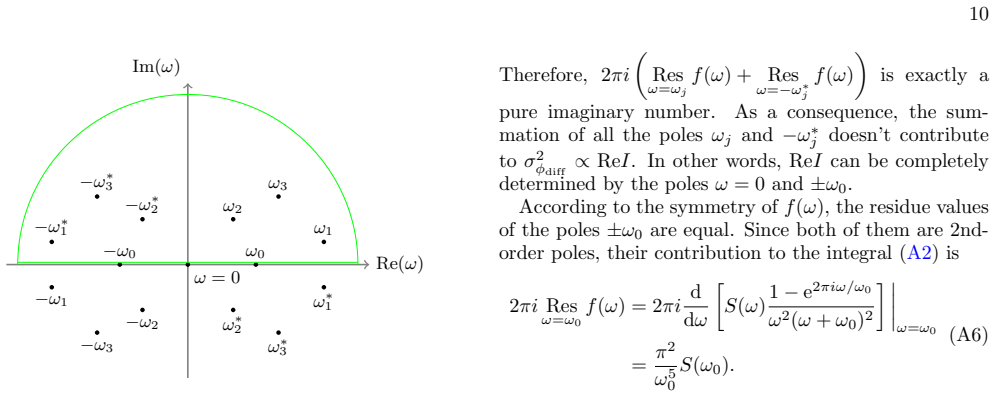
- [Appendix A, Eq. (A5)] The residue-conjugation identity used in Eq. (A5) has the wrong sign. For a meromorphic function satisfying f(−ω*) = [f(ω)]*, the Laurent expansion gives Res_{ω=−ω_j*} f = −[Res_{ω=ω_j} f]^*, not the plus sign stated in the paper. The paired contribution is therefore 2πi(A − A*) = −4π Im A, which is real and contributes to Re I. The conclusion that the poles of S(ω) do not affect σ², and hence Eq. (28), is not established. Since Eqs. (45)–(47) are obtained by substituting the model PSD into Eq. (28), the central Q² suppression claim currently lacks a valid derivation.
- [Eqs. (27)–(28) and Section V] The claimed formula (28) fails even for a simple test PSD. For S(ω) = δ(ω − Ω) with Ω neither 0 nor ω0, the exact variance is proportional to F0(Ω) > 0, whereas Eq. (28) gives zero. This shows that the noise-pole contributions cannot be discarded in general. The authors should evaluate Eq. (27) numerically for the PSD in Eq. (41) and compare the result with Eq. (45) before the suppression claim can be accepted.
- [Appendix C, Eq. (C1)] The first-order equations displayed in Appendix C contain Coriolis terms ±2Ω_r v_{Y,X}, which are the equations of Appendix B, not the kXY coupling of Eq. (34) used in the main text. If these equations were actually simulated, the computed cross-PSD would be purely imaginary (Appendix B), incompatible with the real co-spectra shown in Fig. 4. The authors need to clarify which equations were simulated and correct either the appendix or the figure.
- [Section IV, Eq. (33)] The entire mechanism relies on the assumption that a vibration direction converter realizes an ideal harmonic coupling Hint = kXY with |k| < Ω0² and no additional dynamics. The paper explicitly refrains from analyzing this device. Because any extra modes or nonlinearities would change Saxay(ω) and hence the suppression factor, the experimental feasibility of the central mechanism is not yet supported; the authors should provide evidence or a detailed argument for the validity of the quadratic coupling.
minor comments (4)
- [Abstract and Fig. 4] The abstract states that the coupling shifts the resonance peak but does not change the shape of the PSD, which is in tension with Fig. 4, where the coupled spectrum has two normal-mode peaks (or no peak in the overdamped regime). This sentence should be reworded.
- [Notation, Eq. (39)] The symbol T is used both for the transfer matrix in Eq. (39) and for the total interferometer duration in Section III; this should be disambiguated.
- [Throughout] There are numerous typographical errors, including 'insdie', 'Consiquently', 'resonantes', 'intimates', and 'inequility'; a careful proofread is needed.
- [Appendix A, Eq. (A11)] The assertion that F0 behaves like a sum of delta functions is not a limiting identity. Since Eq. (28) is the main quantitative use of this heuristic, the exact evaluation must stand on its own once the residue issue is fixed.
Circularity Check
No circularity found: the Q-factor suppression is derived algebraically from the stated Langevin model, with no fitted inputs or self-citation load-bearing steps.
full rationale
The paper's central claim—that coupling the two vibration directions can suppress the inertial-noise dephasing by roughly the noise Q-factor—is obtained by solving the coupled Langevin equations (34), computing the resulting power spectral densities (41), inserting them into the general phase-variance integral (27), and evaluating the integral via residues (28) to obtain the Lorentzian structure (45)-(47). Each step is a self-contained model calculation rather than a restatement of an input. The parameters γ and k are free model parameters, not fitted to data, and the claimed Q² suppression follows from evaluating the Lorentzian denominator at the resonance condition with k ∼ Ω₀², which is pure algebra. The paper does cite prior work by the same authors, notably [25], [33], and [40], for the standard phase-path-integral formalism and transfer-function framework, but those results are also supported by external citations (e.g., Storey and Cohen-Tannoudji [39]) and are not used to enforce the new conclusion. No uniqueness theorem is invoked, and the phenomenological coupling Hint = kXY is explicitly introduced as an ansatz with the caveat that its detailed dynamics are not analyzed; that is a realizability limitation, not circular reasoning. The skeptic's concern that Appendix A may contain a sign error in the residue-pair cancellation is a mathematical correctness challenge to Eq. (28), not evidence that the conclusion is equivalent to its inputs. Even if Eq. (28) were incorrect, the derivation would be wrong rather than circular. The result is therefore not circular: the suppression factor is a consequence of the model equations, not an input to them.
Assumptions & free parameters
free parameters (4)
- γ (damping rate of apparatus modes)
- k (coupling strength between X and Y)
- θ (Bloch-sphere angle of the internal-state coupling)
- S0 (white noise PSD amplitude)
assumptions (6)
- domain assumption The interferometer phase fluctuation is given by the path integral of the noise along unperturbed trajectories (Eq. 19), inherited from [25,39].
- domain assumption The apparatus vibrations X,Y obey 2D Langevin equations with isotropic damping γ and white noise drives (Eqs. 31,34).
- ad hoc to paper A vibration direction converter can realize a pure harmonic coupling Hint = kXY with |k| < Ω0² (Eq. 33).
- domain assumption The internal state Hamiltonian dominates the spin-motion coupling, so the internal states remain fixed eigenstates (Section II).
- domain assumption The n-axis of the internal-state coupling lies in the x-y plane (Eq. 3).
- standard math The PSD S(ω) is real and even on the real axis, and its poles are symmetric about both axes (Appendix A).
invented entities (1)
-
Vibration direction converter (device realizing Hint = kXY)
Cite this review
Pith. "Pith review of Destructive Interference of Inertial Noise in Matter-wave Interferometry." pith.science (2026). https://pith.science/paper/NRNVK7PK
@misc{pith2026250700280,
  author       = {Pith},
  title        = {Pith review of: Destructive Interference of Inertial Noise in Matter-wave Interferometry},
  year         = {2026},
  howpublished = {\url{https://pith.science/paper/NRNVK7PK}},
  note         = {Machine review of arXiv:2507.00280}
}
read the original abstract
Matter-wave interferometry is highly susceptible to inertial acceleration noises arising from the vibration of the experimental apparatus. There are various methods for noise suppression. In this paper, we propose leveraging the cross-correlation of multi-directional vibration noises to mitigate their dephasing effect in matter-wave interferometers. Specifically, we analyse an interferometer driven by its internal state under an external field and examine the dephasing caused by a two-dimensional random inertial force. As we will demonstrate, the coupling between the two-dimensional inertial force noise components will shift the resonance peak but not change the shape of the power spectral density. Moreover, when the noise approximately resonates with the intrinsic frequency of the test mass, we find that the standard deviation of the phase can be suppressed by a factor roughly equal to the Q-factor of the noise. This technique holds significant potential for future gravity experiments utilising quantum sensors, such as measuring gravitational acceleration and exploring quantum entanglement induced by gravity.
Figures


Figures from the paper (4 more)



Reference graph
Works this paper leans on
-
[1]
is the oscillation amplitude due to the driven force. Thus, the differential trajectories are x+(t) − x−(t) = 2A0 cos θ(1 − cos ω0t), y+(t) − y−(t) = 2A0 sin θ(1 − cos ω0t). (14) The 2-dimensional superposition size is shown in Fig. 1. The values of parameters remain symbolic, as they vary across different experiment setups. For instance, ω0 is set to ∼ 1...
-
[2]
On the other hand, γ is not able to influence σ2 ϕdiff in small and large ω0 limits
As is shown, the damping rate can suppress the height of the peak with a ratio (γ/Ω0)2, which is exactly Q2. On the other hand, γ is not able to influence σ2 ϕdiff in small and large ω0 limits. So if ω0 is far from Ω 0, it is useless to change γ. Fig. 5b shows σϕdiff under different coupling k with a fixed damping rate γ = 0.1 Ω0. As is shown, the couplin...
-
[3]
= 2πi X j Res ω=ωj f (ω) + Res ω=−ω∗ j f (ω) + πi Res ω=0 f (ω) + Res ω=ω0 f (ω) + Res ω=−ω0 f (ω) . (A3) In order to evaluate the constribution of the poles ωj and −ω∗ j , we firstly verify that f (−ω∗) = [ f (ω)]∗. In particular, one can directly write f (−ω∗) = S(−ω∗) 1 − e−2πiω ∗/ω0 ω∗2(ω∗2 − ω2 0)2 . (A4) It is obvious that 1 − e−2πiω ∗/ω0 = (...
- [4]
-
[5]
J. B. Fixler, G. T. Foster, J. M. McGuirk, and M. A. Kasevich, Science 315, 74 (2007), https://www.science.org/doi/pdf/10.1126/science.1135459, URL https://www.science.org/doi/abs/10.1126/ science.1135459
-
[6]
B. Stray, A. Lamb, A. Kaushik, J. Vovrosh, A. Rodgers, J. Winch, F. Hayati, D. Boddice, A. Stabrawa, A. Nigge- baum, et al., Nature 602, 590 (2022), ISSN 1476-4687, URL https://doi.org/10.1038/s41586-021-04315-3
-
[7]
C. Overstreet, P. Asenbaum, T. Kovachy, R. Notermans, J. M. Hogan, and M. A. Kasevich, Phys. Rev. Lett. 120, 183604 (2018), URL https://link.aps.org/doi/ 10.1103/PhysRevLett.120.183604
-
[9]
S. Bose, A. Mazumdar, M. Schut, and M. Toroˇ s, Entropy 25, 448 (2023)
work page 2023
Show all 62 references
-
[10]
Canuel, B., Amand, L., Bertoldi, A., Chaibi, W., Geiger, R., Gillot, J., Landragin, A., Merzougui, M., Riou, I., Schmid, S.P., et al., E3S Web of Confer- ences 4, 01004 (2014), URL https://doi.org/10.1051/ e3sconf/20140401004
2014
-
[11]
R. J. Marshman, A. Mazumdar, G. W. Morley, P. F. 13 Barker, S. Hoekstra, and S. Bose, New J. Phys. 22, 083012 (2020), 1807.10830
2020 arXiv
-
[12]
Junca, A
J. Junca, A. Bertoldi, D. Sabulsky, G. Lef` evre, X. Zou, J.- B. Decitre, R. Geiger, A. Landragin, S. Gaffet, P. Bouyer, et al., Physical Review D 99 (2019), ISSN 2470- 0029, URL http://dx.doi.org/10.1103/PhysRevD.99. 104026
2019 doi
-
[13]
M. Abe, P. Adamson, M. Borcean, D. Bortoletto, K. Bridges, S. P. Carman, S. Chattopadhyay, J. Cole- man, N. M. Curfman, K. DeRose, et al., Quantum Sci- ence and Technology 6, 044003 (2021), URL https: //dx.doi.org/10.1088/2058-9565/abf719
2021 doi
-
[14]
J. T. Mitchell, T. Kovachy, S. Hahn, P. Adamson, and S. Chattopadhyay, JINST 17, P01007 (2022), [Erratum: JINST 17, E02001 (2022)], 2202.04763
2022 arXiv
-
[15]
S. Bose, A. Mazumdar, G. W. Morley, H. Ulbricht, M. Toroˇ s, M. Paternostro, A. A. Geraci, P. F. Barker, M. S. Kim, and G. Milburn, Phys. Rev. Lett. 119, 240401 (2017), URL https://link.aps.org/doi/10. 1103/PhysRevLett.119.240401
2017
-
[16]
Bose, https://www.youtube.com/watch?v= 0Fv-0k13s_k (2016), accessed 1/11/22
S. Bose, https://www.youtube.com/watch?v= 0Fv-0k13s_k (2016), accessed 1/11/22
2016
-
[17]
Marletto and V
C. Marletto and V. Vedral, Phys. Rev. Lett. 119, 240402 (2017), URL https://link.aps.org/doi/10. 1103/PhysRevLett.119.240402
2017
-
[18]
Biswas, S
D. Biswas, S. Bose, A. Mazumdar, and M. Toroˇ s, Phys. Rev. D 108, 064023 (2023), 2209.09273
2023 arXiv
-
[19]
Hanif, D
F. Hanif, D. Das, J. Halliwell, D. Home, A. Mazumdar, H. Ulbricht, and S. Bose, Phys. Rev. Lett. 133, 180201 (2024), 2307.08133
2024 arXiv
-
[20]
Joos and H
E. Joos and H. D. Zeh, European Physical Journal B 59, 223–243 (1985), URL https://link.springer.com/ article/10.1007%2FBF01725541
1985
-
[21]
H. D. Zeh, Found. Phys. 1, 69 (1970)
1970
-
[22]
Schlosshauer, The Frontiers Collection (Springer- Verlag, 2007) (2007)
M. Schlosshauer, The Frontiers Collection (Springer- Verlag, 2007) (2007)
2007
-
[23]
Schut, P
M. Schut, P. Andriolo, M. Toroˇ s, S. Bose, and A. Mazum- dar, Phys. Rev. A 111, 042211 (2025), 2410.20910
2025 arXiv
-
[24]
Klaus Hornberger, Reviews of Modern Physics 84, 157 (2012), URL https://doi.org/10.1103%2Frevmodphys
e. Klaus Hornberger, Reviews of Modern Physics 84, 157 (2012), URL https://doi.org/10.1103%2Frevmodphys. 84.157
2012
-
[25]
Krantz, M
P. Krantz, M. Kjaergaard, F. Yan, T. P. Or- lando, S. Gustavsson, and W. D. Oliver, Ap- plied Physics Reviews 6, 021318 (2019), ISSN 1931-9401, https://pubs.aip.org/aip/apr/article- pdf/doi/10.1063/1.5089550/16667201/021318 1 online.pdf, URL https://doi.org/10.1063/1.5089550
2019 doi
-
[26]
Chirolli and G
L. Chirolli and G. Burkard, Advances in Physics 57, 225 (2008), URL https://doi.org/10.1080/ 00018730802218067
2008
-
[27]
Bouten, M
L. Bouten, M. Guta, and H. Maassen, Journal of Physics A: Mathematical and General 37, 3189 (2004), URL https://dx.doi.org/10.1088/0305-4470/37/9/010
2004 doi
- [28]
-
[29]
Bowen and G
W. Bowen and G. Milburn, Quantum Optomechanics (Taylor & Francis, 2015), ISBN 9781482259155, URL https://books.google.nl/books?id=xqlcrgEACAAJ
2015
-
[31]
Romero-Isart, A
O. Romero-Isart, A. C. Pflanzer, F. Blaser, R. Kaltenbaek, N. Kiesel, M. Aspelmeyer, and J. I. Cirac, Physical review letters 107 2, 020405 (2011)
2011
-
[32]
Riera-Campeny, M
A. Riera-Campeny, M. Roda-Llordes, P. T. Gro- chowski, and O. Romero-Isart, Quantum 8, 1393 (2024), ISSN 2521-327X, URL https://doi.org/10. 22331/q-2024-07-02-1393
2024
-
[33]
Englert, J
B.-G. Englert, J. Schwinger, and M. O. Scully, Founda- tions of Physics 18, 1045 (1988), ISSN 1572-9516, URL https://doi.org/10.1007/BF01909939
1988 doi
-
[34]
Schwinger, M
J. Schwinger, M. O. Scully, and B.-G. Englert, Zeitschrift f¨ ur Physik D Atoms, Molecules and Clusters 10, 135 (1988), ISSN 1431-5866, URL https://doi.org/10. 1007/BF01384847
1988
-
[35]
M. O. Scully, B.-G. Englert, and J. Schwinger, Phys. Rev. A 40, 1775 (1989), URL https://link.aps.org/doi/ 10.1103/PhysRevA.40.1775
1989 doi
-
[36]
M.-Z. Wu, M. Toroˇ s, S. Bose, and A. Mazumdar, Phys. Rev. D 111, 064004 (2025), URL https://link.aps. org/doi/10.1103/PhysRevD.111.064004
2025 doi
-
[37]
Schut, H
M. Schut, H. Bosma, M. Wu, M. Toroˇ s, S. Bose, and A. Mazumdar, Phys. Rev. A 110, 022412 (2024), URL https://link.aps.org/doi/10.1103/PhysRevA. 110.022412
2024 doi
-
[38]
Fragolino, M
P. Fragolino, M. Schut, M. Toroˇ s, S. Bose, and A. Mazumdar, Phys. Rev. A 109, 033301 (2024), 2307.07001
2024 arXiv
-
[39]
S. N. Moorthy, A. Geraci, S. Bose, and A. Mazumdar (2025), 2504.13252
2025 arXiv
-
[40]
Toroˇ s, T
M. Toroˇ s, T. W. van de Kamp, R. J. Marshman, M. S. Kim, A. Mazumdar, and S. Bose, Phys. Rev. Research 3, 023178 (2021), URL https://link.aps.org/doi/10. 1103/PhysRevResearch.3.023178
2021
-
[41]
Schut, A
M. Schut, A. Grinin, A. Dana, S. Bose, A. Geraci, and A. Mazumdar, Phys. Rev. Res. 5, 043170 (2023), 2307.07536
2023 arXiv
-
[42]
Storey and C
P. Storey and C. cohen tannoudji, Journal De Physique Ii 4, 1999 (1994), URL https://api.semanticscholar. org/CorpusID:27725354
1994
-
[43]
M.-Z. Wu, M. Toroˇ s, S. Bose, and A. Mazumdar, Phys. Rev. D 107, 104053 (2023), URL https://link.aps. org/doi/10.1103/PhysRevD.107.104053
2023 doi
-
[45]
J.-M. Cai, B. Naydenov, R. Pfeiffer, L. P. McGuinness, K. D. Jahnke, F. Jelezko, M. B. Plenio, and A. Retzker, New Journal of Physics 14, 113023 (2012), URL https: //dx.doi.org/10.1088/1367-2630/14/11/113023
2012 doi
-
[46]
Stark, N
A. Stark, N. Aharon, T. Unden, D. Louzon, A. Huck, A. Retzker, U. L. Andersen, and F. Jelezko, Nature Communications 8, 1105 (2017), ISSN 2041-1723, URL https://doi.org/10.1038/s41467-017-01159-2
2017 doi
-
[47]
Cohen, N
I. Cohen, N. Aharon, and A. Retzker, Fortschritte der Physik 65, 1600071 (2017), https://onlinelibrary.wiley.com/doi/pdf/10.1002/prop.201600071, URL https://onlinelibrary.wiley.com/doi/abs/10. 1002/prop.201600071
2017 doi
-
[48]
Ito and E
K. Ito and E. Mori, The Journal of the Acoustical Society of Japan 28, 127 (1972), URL https://api. semanticscholar.org/CorpusID:210805967
1972
-
[49]
L. XU, J. ZHOU, Y. CHANG, F. LI, and W. LI, ACTA ACUSTICA 43, 786 (2018)
2018
-
[50]
Japha and R
Y. Japha and R. Folman, Phys. Rev. Lett. 130, 113602 (2023), URL https://link.aps.org/doi/10. 1103/PhysRevLett.130.113602
2023
-
[51]
T. Zhou, S. Bose, and A. Mazumdar (2024), 2407.15813. 14
2024 arXiv
- [52]
-
[53]
Y. Xu, Y. Chen, and X. Chen, Phys. Rev. A 109, 063310 (2024), URL https://link.aps.org/doi/10. 1103/PhysRevA.109.063310
2024
-
[54]
Yoneda, K
J. Yoneda, K. Takeda, T. Otsuka, T. Nakajima, M. R. Delbecq, G. Allison, T. Honda, T. Kodera, S. Oda, Y. Hoshi, et al., Nature Nanotechnology 13, 102 (2018), ISSN 1748-3395, URL https://doi.org/10. 1038/s41565-017-0014-x
2018
-
[55]
M. T. Johnsson, G. K. Brennen, and J. Twamley, Sci- entific Reports 6, 37495 (2016), ISSN 2045-2322, URL https://doi.org/10.1038/srep37495
2016 doi
-
[56]
Scala, M
M. Scala, M. S. Kim, G. W. Morley, P. F. Barker, and S. Bose, Phys. Rev. Lett. 111, 180403 (2013), URL https://link.aps.org/doi/10.1103/PhysRevLett. 111.180403
2013 doi
-
[57]
J. S. Pedernales, G. W. Morley, and M. B. Plenio, Phys. Rev. Lett. 125, 023602 (2020), URL https://link.aps. org/doi/10.1103/PhysRevLett.125.023602
2020 doi
-
[58]
R. J. Marshman, A. Mazumdar, R. Folman, and S. Bose, Phys. Rev. Res. 4, 023087 (2022), URL https://link. aps.org/doi/10.1103/PhysRevResearch.4.023087
2022 doi
-
[59]
Khintchine, Mathematische Annalen 109, 604 (1934), URL http://eudml.org/doc/159698
A. Khintchine, Mathematische Annalen 109, 604 (1934), URL http://eudml.org/doc/159698
1934
-
[60]
Wiener, Acta Mathematica 55, 117 (1930), URL https://doi.org/10.1007/BF02546511
N. Wiener, Acta Mathematica 55, 117 (1930), URL https://doi.org/10.1007/BF02546511
1930 doi
-
[61]
Giacomini, E
F. Giacomini, E. Castro-Ruiz, and ˇC. Brukner, Nature Communications 10, 494 (2019), ISSN 2041-1723, URL https://doi.org/10.1038/s41467-018-08155-0
2019 doi
-
[62]
M. C. Wang and G. E. Uhlenbeck, Rev. Mod. Phys. 17, 323 (1945), URL https://link.aps.org/doi/10.1103/ RevModPhys.17.323
1945
-
[63]
D. T. Gillespie, Phys. Rev. E 54, 2084 (1996), URL https://link.aps.org/doi/10.1103/PhysRevE. 54.2084
1996 doi
-
[64]
D. T. Gillespie, American Journal of Physics 64, 225 (1996), ISSN 0002- 9505, https://pubs.aip.org/aapt/ajp/article- pdf/64/3/225/11851228/225 1 online.pdf, URL https://doi.org/10.1119/1.18210
1996 doi
-
[65]
Z.-Q. Y. Xing-Yan Chen, High-precision gravimeter based on a nano-mechanical resonator hybrid with an electron spin (2018)
2018
Reviewed August 6, 2026 · model on record in the stance chip above.
Discussion (0). Sign in to comment.