REVIEW 3 major objections 6 minor 73 references
Super-Earth ingestion can explain the anomalously high metal abundances of M67 Y2235
T0 review · 3 major / 6 minor · reviewed 2026-08-14 · deepseek-v4-flash
Pith's one-line read A single ingested super-Earth of roughly five Earth masses explains the anomalously high metal abundances of the turn-off star M67 Y2235.
desk verdict A credible quantitative case that a ~5 Mearth super-Earth ingested by M67 Y2235 on a grazing orbit explains its 0.128 dex metal offset; the main weakness is the undertested CH coefficient, but the argument is worth engaging. read the letter →
The pith
A machine-rendered reading of the paper's core claim, the machinery that carries it, and where it could break.
The reading
What carries the argument
The central object is the fractional radial velocity at first stellar contact, $\tilde v_\perp = v_\perp/v_0$, equivalently the impact parameter $b = v_\parallel/v_0$; the key identity is the dissolution boundary $\tilde v_\perp \lesssim 0.4$ ($b\gtrsim 0.9$). It is obtained from a numerical model in which a spherical iron-density planet loses mass at the rate $\dot M_p = C_H F_D v /(\epsilon_{\rm bind,p}+L_{\rm vap})$ under gas drag $F_D=\frac12 C_D\pi R_p^2 \rho_\star v^2$ while its orbit decays. This boundary does the central work of the paper: it turns the abundance anomaly into an orbital-geometry question, and the paper's N-body simulations then show that both delivery channels produce the required grazing geometry.
What would settle it
Measure the heat-transfer coefficient $C_H$ for iron-rich bodies at Mach numbers near 50 in tenuous gas through meteor-ablation observations or shock-tube experiments: if $C_H$ is much smaller than 0.005, the dissolution boundary shifts from $\tilde v_\perp\lesssim0.4$ toward far more grazing orbits, so typical scattering and Kozai impacts would no longer dissolve in the convective zone and the explanation for Y2235 would fail.
Extended reading notes
Core claim
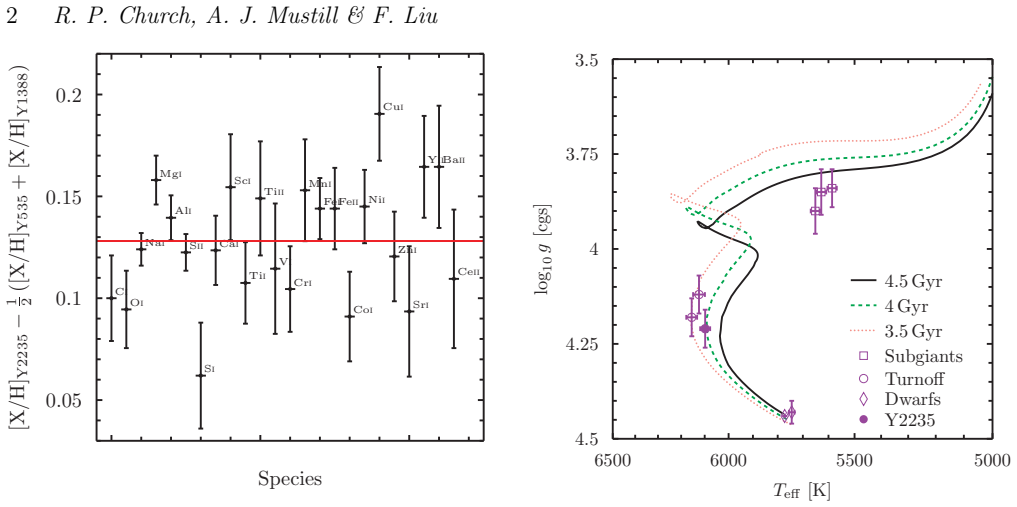
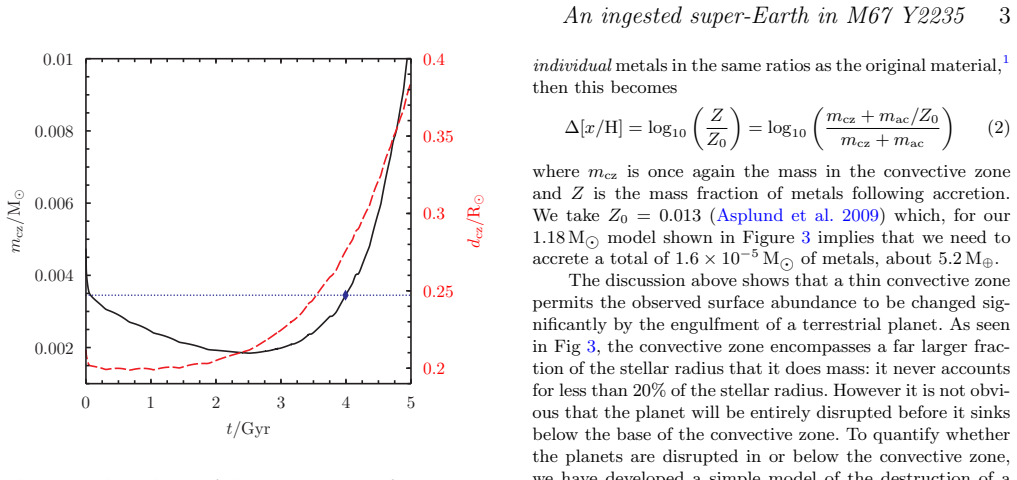
The paper's central claim is that the anomalously high metal abundances of the M67 turn-off star Y2235—a constant 0.128 dex offset in every measured species relative to two sibling turn-off stars—can be explained by the late ingestion of a single super-Earth. For its fiducial 4 Gyr, 1.18 solar-mass model of Y2235, the surface convective envelope contains only $3.45\times10^{-3}\,M_\odot$, so the required metal mass is about $5.2\,M_\oplus$. The paper's dissolution model then shows that a rocky planet of up to about $30\,M_\oplus$ is fully vaporized inside this convective layer provided it enters on a grazing orbit, $\tilde v_\perp = v_\perp/v_0 \lesssim 0.4$, i.e. impact parameter $b\gtrsim0.9$. Planets that plunge more steeply deposit most of their mass below the convective zone and leave no photospheric signature. Since N-body simulations of both planet-planet scattering and Lidov-Kozai oscillations deliver planets with median $\tilde v_\perp$ of 0.12 and 0.05–0.29 respectively, essentially all ingested planets dissolve where their metals are observable. The paper therefore concludes that super-Earth ingestion is a viable explanation and suggests M67-like clusters as testbeds for late planetary-system instability.
Load-bearing premise
The whole dissolution criterion assumes that one percent of the drag energy goes into vaporizing the planet (C_H = 0.01); if the true fraction is much smaller, a grazing planet could survive passage through the convective zone and deposit its metals deeper, where they would not be observed.
Editorial extensions
If this is right
- A total of about 5 Earth masses of rock, delivered as one super-Earth, is sufficient to raise the photospheric metal abundance of a turn-off star such as Y2235 by 0.128 dex.
- Most planets ingested after dynamical instability arrive with $\tilde v_\perp$ well below 0.4 (medians 0.05–0.29 in the paper's simulations), so full dissolution in the convective envelope is the typical outcome.
- The species-independent enhancement observed in Y2235 points to an icy/water-rich super-Earth rather than an Earth-like dry body, because carbon and oxygen are not depleted relative to other metals.
- Late ingestion introduces abundance scatter among coeval stars, limiting the precision of chemical tagging and potentially biasing abundance-based inferences about exoplanet compositions.
- A high-resolution spectroscopic survey of M67 turn-off and upper-main-sequence stars could measure how often late dynamical instability destroys planetary systems.
Reading between the lines
- If ingestion is common, abundance scatter among coeval turn-off stars should grow with stellar mass, because the surface convective envelope shrinks for higher-mass stars; a cluster survey could test this gradient.
- The dissolution criterion implies that stars with essentially radiative envelopes would show no photospheric pollution even after ingesting planets, so the absence of metal offsets in warmer stars would not rule out ingestion.
- The $\tilde v_\perp\lesssim0.4$ boundary is a sharp prediction: any polluted star should show evidence of a dynamical delivery channel, such as an eccentric outer giant planet or a binary companion, which radial-velocity monitoring could check.
Editorial analysis
A structured set of objections, weighed in public.
Referee Report
Summary. This paper proposes that the 0.128 dex enhancement in the photospheric metal abundances of the M67 turn-off star Y2235, relative to two sibling turn-off stars, is due to the late ingestion of a ~5.2 M_earth rocky or icy planet. The authors construct a stellar model of Y2235 and find a surface convective envelope of mass 3.45e-3 M_sun at 4 Gyr, so that Eq. (2) yields 5.2 M_earth of accreted metals for the observed offset. They then develop a simple drag-plus-vaporization model (Eqs. 3-7) in which a planet dissolves in the convective envelope if its radial velocity at first contact is less than about 40% of the total velocity (impact parameter b > 0.9). N-body simulations of planet-planet scattering and Lidov-Kozai cycles show that most delivered planets arrive on grazing orbits. The paper concludes that super-Earth ingestion is a good explanation and suggests a high-resolution spectroscopic survey of M67 to test the frequency of such events.
Significance. If the result holds, the paper provides a concrete, physically motivated explanation for a striking abundance anomaly in a cluster member, with a testable observational prediction. The calculation of the required planet mass is transparent and parameter-free once the convective envelope mass is accepted, and the delivery simulations are a useful first exploration of the orbital phase space of ingested planets. The paper's main strengths are its clarity, the explicit treatment of the dissolution criterion, and the fact that the proposed survey is falsifiable. However, the central quantitative claim rests on the value of the heat-transfer coefficient C_H, which is acknowledged to be highly uncertain and is tested over only a factor of two; this weakens the robustness of the v_tilde < 0.4 dissolution boundary.
major comments (3)
- [Sec. 3.1, Eq. (7); Sec. 3.3.5, Fig. 8] The mass-loss rate in Eq. (7) is proportional to C_H, the fraction of frictional energy deposited in the planet, yet the paper sets C_H = 0.01 after noting that meteor-ablation formulae give values between about 3% and 30%, and then varies C_H only by a factor of two (0.005 and 0.02). This does not bracket the order-of-magnitude uncertainty the authors themselves identify. If C_H were as low as 0.001, the ablation rate would be ten times slower and a grazing impactor could survive long enough to sink below the base of the convective zone before fully dissolving, moving the critical v_tilde threshold to lower values. Because the scenario requires essentially all 5.2 M_earth of metals to remain in the thin convective envelope, the paper should either map the dissolution boundary as a function of C_H over the plausible range (e.g., 0.001-0.3) or provide a first-principles argument that C_H cannot be much smaller than 0.01. As written, the clean separation in Fig. 7 and the 40% threshold are not yet robust.
- [Sec. 3.3.1 and Sec. 3.3.3] The treatment of differential settling and of ingestion time is a hand-wave. The present-day abundance is compared with the stellar model at 4 Gyr, but ingestion could occur at earlier times when the convective envelope was smaller (Fig. 3), and subsequent settling/levitation could alter the surface pattern. The manuscript states that the 'only likely effect is to slightly increase the mass of planet' (Sec. 3.3.1), but no calculation is shown. A simple time-dependent model--add the planet's metals at time t_ing, then evolve the convective mass and surface abundances using the same diffusion treatment that fits the comparison stars--is needed to demonstrate that the 5.2 M_earth estimate and the flat abundance pattern survive. This is load-bearing because the quantitative claim is the 0.128 dex offset at the current age.
- [Sec. 4.3, Fig. 9] The N-body delivery statistics are reported without uncertainties. The scattering sample yields 49 impactors from 100 systems, with a median tilde-v_perp of 0.12 and 'only three' impactors that would penetrate below the convective zone; the Poisson uncertainty on that number is large, and the fraction of impactors above the critical threshold (which itself depends on C_H, see comment 1) is not quantified. Since the paper's conclusion is that 'almost all planets that are ingested arrive at the star on grazing orbits,' the authors should report the full distribution or at least a confidence interval on the fraction of grazing impacts. This is especially important because the scattering tail lies near tilde-v_perp ~ 0.4 and could cross the threshold if C_H is lower.
minor comments (6)
- [Sec. 3.3.4] The units 'g cm-2' for density should be 'g cm-3'; this appears for rho_p = 7.9, 5.5, and 10 g cm-2.
- [Sec. 3.3.3] The phrase 'between 0.02 and 0.035 M_sun from the stellar surface' should presumably read 'between 0.02 and 0.035 R_sun from the stellar surface' (or a mass coordinate), as the units are inconsistent with the context of Fig. 3.
- [Sec. 3.3.4] The term 'entropy of vaporisation of 5 kJ g-1' should be 'latent heat of vaporisation' or 'specific energy of vaporisation,' since entropy has units of energy per temperature, not per mass.
- [Sec. 3.2] The text gives 'ten Earth masses (3e-5 M_sun)'; using 3.003e-5 M_sun would be more precise.
- [Sec. 3.3.5 and Fig. 8] The results of the C_H sensitivity runs appear only in the caption of Fig. 8; the text should explicitly state that changing C_H from 0.01 to 0.005 and 0.02 has a small effect on the mass deposited, and should comment on the direction of the effect.
- [Sec. 5] The statement that the flat abundance pattern 'likely represents the ingestion of an icy/water-rich super-Earth' is a strong inference; the paper should acknowledge that a planet with exactly stellar metal ratios (except H/He) is a non-trivial compositional requirement and discuss its plausibility in more detail, or soften the claim.
Circularity Check
No circularity: the required planet mass, dissolution criterion, and delivery simulations are independently derived; self-citations are background, not load-bearing.
full rationale
The central chain is not circular. The 5.2 Mearth requirement is not a fitted prediction: it follows from Equation (2), the adopted Z0=0.013, and the stellar-model convective-envelope mass m_cz=3.45e-3 Msun, with the observed 0.128 dex offset serving as an input from Liu et al. (2019), not as an output of the model. The dissolution criterion v_tilde<0.4 is obtained by numerically integrating Equations (3)-(7), with the uncertain coefficient CH set to 0.01 from the external meteor-ablation literature (Brykina 2018); CH is not tuned to reproduce the abundance offset, and the paper includes robustness tests around this value. The delivery simulations in Section 4 are independent N-body experiments with stated initial conditions; their result that impacts are mostly grazing is a genuinely derived outcome, and the comparison with the v_tilde=0.4 line is a consistency check rather than a re-use of the conclusion. Prior work sharing authors (Liu et al. 2019 observations; Mustill et al. 2017 scattering statistics) is either observational input or independent simulation evidence and does not carry the central derivation. The admitted uncertainty in CH is a model-robustness concern, not a circularity, so no circular step is present.
Assumptions & free parameters
free parameters (6)
- CH (radiative heat transfer coefficient) =
0.01 fiducial; 0.005-0.02 tested
- CD (drag coefficient) =
1
- Planet bulk density rho_p =
7.9 g/cm3 fiducial; 5.5 and 10 g/cm3 tested
- Latent heat of vaporization L_vap =
6 kJ/g (iron); 5 kJ/g (silicate)
- Stellar mass and age of Y2235 model =
1.18 Msun, 4 Gyr
- Convective overshooting parameter delta_os =
0.12
assumptions (6)
- domain assumption M67 stars formed from gas of identical initial chemical composition.
- domain assumption Accreted planetary material has total metal fraction Z=1 with the same relative metal ratios as the original stellar material.
- domain assumption The stars stellar evolution code gives an accurate surface convective-zone mass for Y2235 (3.45e-3 Msun).
- domain assumption Differential gravitational settling between the polluted and unpolluted stars does not erase the 0.128 dex offset.
- domain assumption The chosen N-body initial conditions represent plausible late-time delivery channels.
- domain assumption Gas drag and vaporization physics (Eqs 3-7) dominate planet disruption; dynamical friction and accretion drag are negligible.
Cite this review
Pith. "Pith review of Super-Earth ingestion can explain the anomalously high metal abundances of M67 Y2235." pith.science (2026). https://pith.science/paper/NRSMQO2X
@misc{pith2026190806988,
  author       = {Pith},
  title        = {Pith review of: Super-Earth ingestion can explain the anomalously high metal abundances of M67 Y2235},
  year         = {2026},
  howpublished = {\url{https://pith.science/paper/NRSMQO2X}},
  note         = {Machine review of arXiv:1908.06988}
}
abstract
We investigate the hypothesis that ingestion of a terrestrial or super-Earth planet could cause the anomalously high metal abundances seen in a turn-off star in the open cluster M67, when compared to other turn-off stars in the same cluster. We show that the mass in convective envelope of the star is likely only $3.45\,\times 10^{-3}\,{\rm M}_\odot$, and hence $5.2\,{\rm M}_\oplus$ of rock is required to obtain the observed 0.128 dex metal enhancement. Rocky planets dissolve entirely in the convective envelope if they enter it with sufficiently tangential orbits: we find that the critical condition for dissolution is that the planet's radial speed must be less than 40% of its total velocity at the stellar surface; or, equivalently, the impact parameter must be greater than about 0.9. We model the delivery of rocky planets to the stellar surface both by planet-planet scattering in a realistic multi-planet system, and by Lidov-Kozai cycles driven by a more massive planetary or stellar companion. In both cases almost all planets that are ingested arrive at the star on grazing orbits and hence will dissolve in the surface convection zone. We conclude that super-Earth ingestion is a good explanation for the metal enhancement in M67 Y2235, and that a high-resolution spectroscopic survey of stellar abundances around the turn-off and main sequence of M67 has the potential to constrain the frequency of late-time dynamical instability in planetary systems.
Figures

Figures from the paper (5 more)


Reference graph
Works this paper leans on
-
[1]
Ahrens T. J., O'Keefe J. D., 1972, @doi [Moon] 10.1007/BF00562927 , https://ui.adsabs.harvard.edu/abs/1972Moon....4..214A 4, 214
-
[2]
Asplund M., Grevesse N., Sauval A. J., Scott P., 2009, @doi [ ] 10.1146/annurev.astro.46.060407.145222 , https://ui.adsabs.harvard.edu/abs/2009ARA
arXiv 2009
-
[3]
Princeton University Press
Binney J., Tremaine S., 2008, Galactic Dynamics: Second Edition . Princeton University Press
2008
-
[4]
Brykina I. G., 2018, @doi [Solar System Research] 10.1134/S0038094618050027 , http://adsabs.harvard.edu/abs/2018SoSyR..52..426B 52, 426
-
[5]
Chambers J. E., 1999, @doi [ ] 10.1046/j.1365-8711.1999.02379.x , https://ui.adsabs.harvard.edu/abs/1999MNRAS.304..793C 304, 793
arXiv 1999
-
[6]
Chambers J. E., 2010, @doi [ ] 10.1088/0004-637X/724/1/92 , https://ui.adsabs.harvard.edu/abs/2010ApJ...724...92C 724, 92
-
[7]
Chambers J. E., Wetherill G. W., Boss A. P., 1996, @doi [ ] 10.1006/icar.1996.0019 , https://ui.adsabs.harvard.edu/abs/1996Icar..119..261C 119, 261
arXiv 1996
-
[8]
Dawson R. I., Fabrycky D. C., 2010, @doi [ ] 10.1088/0004-637X/722/1/937 , https://ui.adsabs.harvard.edu/abs/2010ApJ...722..937D 722, 937
Show all 73 references
-
[9]
Demory B.-O., et al., 2016, @doi [ ] 10.1038/nature17169 , https://ui.adsabs.harvard.edu/abs/2016Natur.532..207D 532, 207
2016 doi
-
[10]
R., Venturini J., 2017, @doi [ ] 10.1051/0004-6361/201628749 , https://ui.adsabs.harvard.edu/abs/2017A&A...597A..38D 597, A38
Dorn C., Hinkel N. R., Venturini J., 2017, @doi [ ] 10.1051/0004-6361/201628749 , https://ui.adsabs.harvard.edu/abs/2017A&A...597A..38D 597, A38
2017 doi
-
[11]
L., Alibert Y., 2018, @doi [ ] 10.3847/1538-4357/aad95d , https://ui.adsabs.harvard.edu/abs/2018ApJ...865...20D 865, 20
Dorn C., Mosegaard K., Grimm S. L., Alibert Y., 2018, @doi [ ] 10.3847/1538-4357/aad95d , https://ui.adsabs.harvard.edu/abs/2018ApJ...865...20D 865, 20
2018 doi
-
[12]
Dotter A., Conroy C., Cargile P., Asplund M., 2017, @doi [ ] 10.3847/1538-4357/aa6d10 , http://adsabs.harvard.edu/abs/2017ApJ...840...99D 840, 99
2017 doi
-
[13]
P., 1971, , http://ukads.nottingham.ac.uk/cgi-bin/nph-bib_query?bibcode=1971MNRAS.151..351E&db_key=AST 151, 351
Eggleton P. P., 1971, , http://ukads.nottingham.ac.uk/cgi-bin/nph-bib_query?bibcode=1971MNRAS.151..351E&db_key=AST 151, 351
1971
-
[14]
Freeman K., Bland-Hawthorn J., 2002, @doi [ ] 10.1146/annurev.astro.40.060401.093840 , https://ui.adsabs.harvard.edu/abs/2002ARA
2002
-
[15]
Fressin F., et al., 2013, @doi [ ] 10.1088/0004-637X/766/2/81 , https://ui.adsabs.harvard.edu/abs/2013ApJ...766...81F 766, 81
2013 doi
-
[16]
Gaia Collaboration et al., 2018, @doi [ ] 10.1051/0004-6361/201833051 , https://ui.adsabs.harvard.edu/abs/2018A&A...616A...1G 616, A1
2018 doi
-
[17]
Gao X., et al., 2018, @doi [ ] 10.1093/mnras/sty2414 , https://ui.adsabs.harvard.edu/abs/2018MNRAS.481.2666G 481, 2666
2018 doi
-
[18]
M., Latham D
Geller A. M., Latham D. W., Mathieu R. D., 2015, @doi [ ] 10.1088/0004-6256/150/3/97 , https://ui.adsabs.harvard.edu/abs/2015AJ....150...97G 150, 97
2015 doi
-
[19]
Hansen B. M. S., 2017, @doi [ ] 10.1093/mnras/stx182 , https://ui.adsabs.harvard.edu/abs/2017MNRAS.467.1531H 467, 1531
2017 doi
-
[20]
C., Ford E
Hsu D. C., Ford E. B., Ragozzine D., Morehead R. C., 2018, @doi [ ] 10.3847/1538-3881/aab9a8 , https://ui.adsabs.harvard.edu/abs/2018AJ....155..205H 155, 205
2018 doi
-
[21]
C., Ford E
Hsu D. C., Ford E. B., Ragozzine D., Ashby K., 2019, arXiv e-prints, https://ui.adsabs.harvard.edu/abs/2019arXiv190201417H p. arXiv:1902.01417
2019 arXiv
-
[22]
N., Morbidelli A., Pierens A., Bitsch B., Cossou C., Hersant F., 2017, @doi [ ] 10.1093/mnras/stx1232 , https://ui.adsabs.harvard.edu/abs/2017MNRAS.470.1750I 470, 1750
Izidoro A., Ogihara M., Raymond S. N., Morbidelli A., Pierens A., Bitsch B., Cossou C., Hersant F., 2017, @doi [ ] 10.1093/mnras/stx1232 , https://ui.adsabs.harvard.edu/abs/2017MNRAS.470.1750I 470, 1750
2017 doi
-
[23]
N., Johansen A., Morbidelli A., Lambrechts M., Jacobson S
Izidoro A., Bitsch B., Raymond S. N., Johansen A., Morbidelli A., Lambrechts M., Jacobson S. A., 2019, arXiv e-prints, https://ui.adsabs.harvard.edu/abs/2019arXiv190208772I p. arXiv:1902.08772
2019 arXiv
-
[24]
Jackson B., Greenberg R., Barnes R., 2008, @doi [ ] 10.1086/529187 , https://ui.adsabs.harvard.edu/abs/2008ApJ...678.1396J 678, 1396
2008 doi
-
[25]
B., Church R
Johansen A., Davies M. B., Church R. P., Holmelin V., 2012, @doi [ ] 10.1088/0004-637X/758/1/39 , https://ui.adsabs.harvard.edu/abs/2012ApJ...758...39J 758, 39
2012 doi
-
[26]
Juri \'c M., Tremaine S., 2008, @doi [ ] 10.1086/590047 , https://ui.adsabs.harvard.edu/abs/2008ApJ...686..603J 686, 603
2008 doi
-
[27]
Kozai Y., 1962, @doi [ ] 10.1086/108790 , https://ui.adsabs.harvard.edu/abs/1962AJ.....67..591K 67, 591
1962 doi
-
[28]
A., Johansen A., Bitsch B., Izidoro A., Raymond S
Lambrechts M., Morbidelli A., Jacobson S. A., Johansen A., Bitsch B., Izidoro A., Raymond S. N., 2019, arXiv e-prints, https://ui.adsabs.harvard.edu/abs/2019arXiv190208694L p. arXiv:1902.08694
2019 arXiv
-
[29]
J., Davies M
Li D., Mustill A. J., Davies M. B., 2019, @doi [ ] 10.1093/mnras/stz1794 , https://ui.adsabs.harvard.edu/abs/2019MNRAS.488.1366L 488, 1366
2019 doi
-
[30]
L., 1962, @doi [ ] 10.1016/0032-0633(62)90129-0 , https://ui.adsabs.harvard.edu/abs/1962P&SS....9..719L 9, 719
Lidov M. L., 1962, @doi [ ] 10.1016/0032-0633(62)90129-0 , https://ui.adsabs.harvard.edu/abs/1962P&SS....9..719L 9, 719
1962 doi
-
[31]
Liu F., Asplund M., Ramirez I., Yong D., Melendez J., 2014, @doi [ ] 10.1093/mnrasl/slu055 , https://ui.adsabs.harvard.edu/abs/2014MNRAS.442L..51L 442, L51
2014 doi
-
[32]
I., Carlos M., Marino A
Liu F., Asplund M., Yong D., Mel \'e ndez J., Ram \' rez I., Karakas A. I., Carlos M., Marino A. F., 2016, @doi [ ] 10.1093/mnras/stw2045 , https://ui.adsabs.harvard.edu/abs/2016MNRAS.463..696L 463, 696
2016 doi
-
[33]
J., Mel \'e ndez J., Ram \' rez I., Lin J., 2018, @doi [ ] 10.1051/0004-6361/201832701 , https://ui.adsabs.harvard.edu/abs/2018A&A...614A.138L 614, A138
Liu F., Yong D., Asplund M., Feltzing S., Mustill A. J., Mel \'e ndez J., Ram \' rez I., Lin J., 2018, @doi [ ] 10.1051/0004-6361/201832701 , https://ui.adsabs.harvard.edu/abs/2018A&A...614A.138L 614, A138
2018 doi
-
[34]
Liu F., Asplund M., Yong D., Feltzing S., Dotter A., Mel \'e ndez J., Ram \' rez I., 2019, @doi [ ] 10.1051/0004-6361/201935306 , https://ui.adsabs.harvard.edu/abs/2019A
2019 doi
-
[35]
E., Schuler S
Mack III C. E., Schuler S. C., Stassun K. G., Norris J., 2014, @doi [ ] 10.1088/0004-637X/787/2/98 , https://ui.adsabs.harvard.edu/abs/2014ApJ...787...98M 787, 98
2014 doi
-
[36]
B., Chambers J
Malmberg D., Davies M. B., Chambers J. E., 2007, @doi [ ] 10.1111/j.1745-3933.2007.00291.x , https://ui.adsabs.harvard.edu/abs/2007MNRAS.377L...1M 377, L1
2007
-
[37]
B., Heggie D
Malmberg D., Davies M. B., Heggie D. C., 2011, @doi [ ] 10.1111/j.1365-2966.2010.17730.x , https://ui.adsabs.harvard.edu/abs/2011MNRAS.411..859M 411, 859
2011
-
[38]
Marzari F., 2014, @doi [ ] 10.1093/mnras/stu929 , https://ui.adsabs.harvard.edu/abs/2014MNRAS.442.1110M 442, 1110
2014 doi
-
[39]
arXiv:1109.2497
Mayor M., et al., 2011, arXiv e-prints, https://ui.adsabs.harvard.edu/abs/2011arXiv1109.2497M p. arXiv:1109.2497
2011 arXiv
-
[40]
Mel \'e ndez J., Asplund M., Gustafsson B., Yong D., 2009, @doi [ ] 10.1088/0004-637X/704/1/L66 , https://ui.adsabs.harvard.edu/abs/2009ApJ...704L..66M 704, L66
2009 doi
-
[41]
Mel \'e ndez J., et al., 2017, @doi [ ] 10.1051/0004-6361/201527775 , https://ui.adsabs.harvard.edu/abs/2017A&A...597A..34M 597, A34
2017 doi
-
[42]
D., Giannios D., Spiegel D
Metzger B. D., Giannios D., Spiegel D. S., 2012, @doi [ ] 10.1111/j.1365-2966.2012.21444.x , https://ui.adsabs.harvard.edu/abs/2012MNRAS.425.2778M 425, 2778
2012
-
[43]
J., Davies M
Mustill A. J., Davies M. B., Johansen A., 2015, @doi [ ] 10.1088/0004-637X/808/1/14 , https://ui.adsabs.harvard.edu/abs/2015ApJ...808...14M 808, 14
2015 doi
-
[44]
J., Davies M
Mustill A. J., Davies M. B., Johansen A., 2017, @doi [ ] 10.1093/mnras/stx693 , https://ui.adsabs.harvard.edu/abs/2017MNRAS.468.3000M 468, 3000
2017 doi
-
[45]
J., Davies M
Mustill A. J., Davies M. B., Johansen A., 2018, @doi [ ] 10.1093/mnras/sty1273 , https://ui.adsabs.harvard.edu/abs/2018MNRAS.478.2896M 478, 2896
2018 doi
-
[46]
Naoz S., 2016, @doi [ ] 10.1146/annurev-astro-081915-023315 , https://ui.adsabs.harvard.edu/abs/2016ARA&A..54..441N 54, 441
2016 doi
-
[47]
Neuh \"a user R., Mugrauer M., Fukagawa M., Torres G., Schmidt T., 2007, @doi [ ] 10.1051/0004-6361:20066581 , https://ui.adsabs.harvard.edu/abs/2007A&A...462..777N 462, 777
2007 doi
-
[48]
A., 2011, @doi [ ] 10.1051/0004-6361/201015138 , https://ui.adsabs.harvard.edu/abs/2011A
\"O nehag A., Korn A., Gustafsson B., Stempels E., Vandenberg D. A., 2011, @doi [ ] 10.1051/0004-6361/201015138 , https://ui.adsabs.harvard.edu/abs/2011A
2011 doi
-
[49]
\"O nehag A., Gustafsson B., Korn A., 2014, @doi [ ] 10.1051/0004-6361/201322663 , https://ui.adsabs.harvard.edu/abs/2014A&A...562A.102O 562, A102
2014 doi
-
[50]
E., Wu Y., 2017, @doi [ ] 10.3847/1538-4357/aa890a , https://ui.adsabs.harvard.edu/abs/2017ApJ...847...29O 847, 29
Owen J. E., Wu Y., 2017, @doi [ ] 10.3847/1538-4357/aa890a , https://ui.adsabs.harvard.edu/abs/2017ApJ...847...29O 847, 29
2017 doi
-
[51]
Pace G., Pasquini L., Fran c ois P., 2008, @doi [ ] 10.1051/0004-6361:200809969 , https://ui.adsabs.harvard.edu/abs/2008A&A...489..403P 489, 403
2008 doi
-
[52]
R., Tout C
Pols O. R., Tout C. A., Eggleton P. P., Han Z., 1995, , http://ukads.nottingham.ac.uk/cgi-bin/nph-bib_query?bibcode=1995MNRAS.274..964P&db_key=AST 274, 964
1995
-
[53]
C., 2011, @doi [ ] 10.1111/j.1365-2966.2011.19555.x , https://ui.adsabs.harvard.edu/abs/2011MNRAS.418.1043Q 418, 1043
Quillen A. C., 2011, @doi [ ] 10.1111/j.1365-2966.2011.19555.x , https://ui.adsabs.harvard.edu/abs/2011MNRAS.418.1043Q 418, 1043
2011
-
[54]
D., Tout C
Railton A. D., Tout C. A., Aarseth S. J., 2014, @doi [ ] 10.1017/pasa.2014.10 , https://ui.adsabs.harvard.edu/abs/2014PASA...31...17R 31, e017
2014 doi
-
[55]
U., Fish J
Ram \' rez I., Mel \'e ndez J., Cornejo D., Roederer I. U., Fish J. R., 2011, @doi [ ] 10.1088/0004-637X/740/2/76 , https://ui.adsabs.harvard.edu/abs/2011ApJ...740...76R 740, 76
2011 doi
-
[56]
Ram \' rez I., et al., 2015, @doi [ ] 10.1088/0004-637X/808/1/13 , https://ui.adsabs.harvard.edu/abs/2015ApJ...808...13R 808, 13
2015 doi
-
[57]
Randich S., Sestito P., Primas F., Pallavicini R., Pasquini L., 2006, @doi [ ] 10.1051/0004-6361:20054291 , https://ui.adsabs.harvard.edu/abs/2006A&A...450..557R 450, 557
2006 doi
-
[58]
A., Ford E
Rasio F. A., Ford E. B., 1996, @doi [Science] 10.1126/science.274.5289.954 , https://ui.adsabs.harvard.edu/abs/1996Sci...274..954R 274, 954
1996 doi
-
[59]
N., et al., 2011, @doi [ ] 10.1051/0004-6361/201116456 , https://ui.adsabs.harvard.edu/abs/2011A&A...530A..62R 530, A62
Raymond S. N., et al., 2011, @doi [ ] 10.1051/0004-6361/201116456 , https://ui.adsabs.harvard.edu/abs/2011A&A...530A..62R 530, A62
2011 doi
-
[60]
L., Dokter J
Sandquist E. L., Dokter J. J., Lin D. N. C., Mardling R. A., 2002, @doi [ ] 10.1086/340452 , https://ui.adsabs.harvard.edu/abs/2002ApJ...572.1012S 572, 1012
2002 doi
-
[61]
R., Eggleton P
Schroder K.-P., Pols O. R., Eggleton P. P., 1997, @doi [ ] 10.1093/mnras/285.4.696 , https://ui.adsabs.harvard.edu/abs/1997MNRAS.285..696S 285, 696
1997 doi
-
[62]
Souto D., et al., 2019, @doi [ ] 10.3847/1538-4357/ab0b43 , https://ui.adsabs.harvard.edu/abs/2019ApJ...874...97S 874, 97
2019 doi
-
[63]
J., Fossati L., Passy J.-C., Schneider F
Stancliffe R. J., Fossati L., Passy J.-C., Schneider F. R. N., 2015, @doi [ ] 10.1051/0004-6361/201425126 , https://ui.adsabs.harvard.edu/abs/2015A
2015 doi
-
[64]
K., Shectman S
Teske J. K., Shectman S. A., Vogt S. S., D \' az M., Butler R. P., Crane J. D., Thompson I. B., Arriagada P., 2016a, @doi [ ] 10.3847/0004-6256/152/6/167 , https://ui.adsabs.harvard.edu/abs/2016AJ....152..167T 152, 167
-
[65]
K., Khanal S., Ram \' rez I., 2016b, @doi [ ] 10.3847/0004-637X/819/1/19 , https://ui.adsabs.harvard.edu/abs/2016ApJ...819...19T 819, 19
Teske J. K., Khanal S., Ram \' rez I., 2016b, @doi [ ] 10.3847/0004-637X/819/1/19 , https://ui.adsabs.harvard.edu/abs/2016ApJ...819...19T 819, 19
-
[66]
Tucci Maia M., Mel \'e ndez J., Ram \' rez I., 2014, @doi [ ] 10.1088/2041-8205/790/2/L25 , https://ui.adsabs.harvard.edu/abs/2014ApJ...790L..25T 790, L25
2014 doi
-
[67]
J., Marzari F., 1996, @doi [ ] 10.1038/384619a0 , https://ui.adsabs.harvard.edu/abs/1996Natur.384..619W 384, 619
Weidenschilling S. J., Marzari F., 1996, @doi [ ] 10.1038/384619a0 , https://ui.adsabs.harvard.edu/abs/1996Natur.384..619W 384, 619
1996 doi
-
[68]
D., Jacobsen S
Zeng L., Sasselov D. D., Jacobsen S. B., 2016, @doi [ ] 10.3847/0004-637X/819/2/127 , https://ui.adsabs.harvard.edu/abs/2016ApJ...819..127Z 819, 127
2016 doi
-
[69]
R., Yang S., 2011, Journal of Chemical & Engineering Data, 56, 328
Zhang Y., Evans J. R., Yang S., 2011, Journal of Chemical & Engineering Data, 56, 328
2011
-
[70]
Zhu W., Petrovich C., Wu Y., Dong S., Xie J., 2018, @doi [ ] 10.3847/1538-4357/aac6d5 , https://ui.adsabs.harvard.edu/abs/2018ApJ...860..101Z 860, 101
2018 doi
-
[71]
K., Christiansen J
Zink J. K., Christiansen J. L., Hansen B. M. S., 2019, @doi [ ] 10.1093/mnras/sty3463 , https://ui.adsabs.harvard.edu/abs/2019MNRAS.483.4479Z 483, 4479
2019 doi
-
[72]
write newline
" write newline "" before.all 'output.state := FUNCTION fin.entry write newline FUNCTION new.block output.state before.all = 'skip after.block 'output.state := if FUNCTION new.sentence output.state after.block = 'skip output.state before.all = 'skip after.sentence 'output.stat...
-
[73]
write newline
" write newline "" before.all 'output.state := FUNCTION fin.entry write newline FUNCTION new.block output.state before.all = 'skip after.block 'output.state := if FUNCTION new.sentence output.state after.block = 'skip output.state before.all = 'skip after.sentence 'output.stat...
Reviewed August 14, 2026 · model on record in the stance chip above.
Discussion (0). Continue with ORCID to comment.