REVIEW 4 major objections 4 minor 72 references
TextSR: Diffusion Super-Resolution with Multilingual OCR Guidance
T0 review · 4 major / 4 minor · reviewed 2026-08-07 · deepseek-v4-flash
Pith's one-line read A single diffusion model conditioned on OCR-recognized text characters, encoded as UTF-8 bytes, outperforms general and text-specific super-resolution methods on multilingual scene text restoration.
desk verdict Solid multilingual STISR engineering undercut by overstated benchmark claims. read the letter →
The pith
A machine-rendered reading of the paper's core claim, the machinery that carries it, and where it could break.
The reading
What carries the argument
The central object is the UTF-8 character sequence used as a multimodal condition. Text is converted to UTF-8 bytes, tokenized into a compact vocabulary of 259 tokens (256 byte values plus PAD, EOS, and UNK), embedded, and passed through the first two layers of a frozen byte-level transformer to produce per-character features. These features enter the denoising U-Net through cross-attention at two feature scales, letting the model compare image features against character features and draw letter shapes accordingly. Training uses residual images (high-resolution minus low-resolution) as prediction targets and randomly drops either the image or the text condition, which enables classifier-free guidance at inference through the weight $\omega$. The second mechanism, iterative OCR conditioning, alternates restoration with re-recognition: the image-only model produces an intermediate restoration, OCR reads it, and the new transcript conditions a second restoration.
What would settle it
Run the same comparison on the full TextVQA validation set rather than the selected 641 images and report OCR accuracy with confidence intervals; if TextSR's gains over the best baseline on small and medium text do not reproduce, the benchmark claim fails. A second check is to feed deliberately wrong text prompts into TextSR and see whether the output degrades, since a model that truly relies on the text condition should be sensitive to its content.
Extended reading notes
Core claim
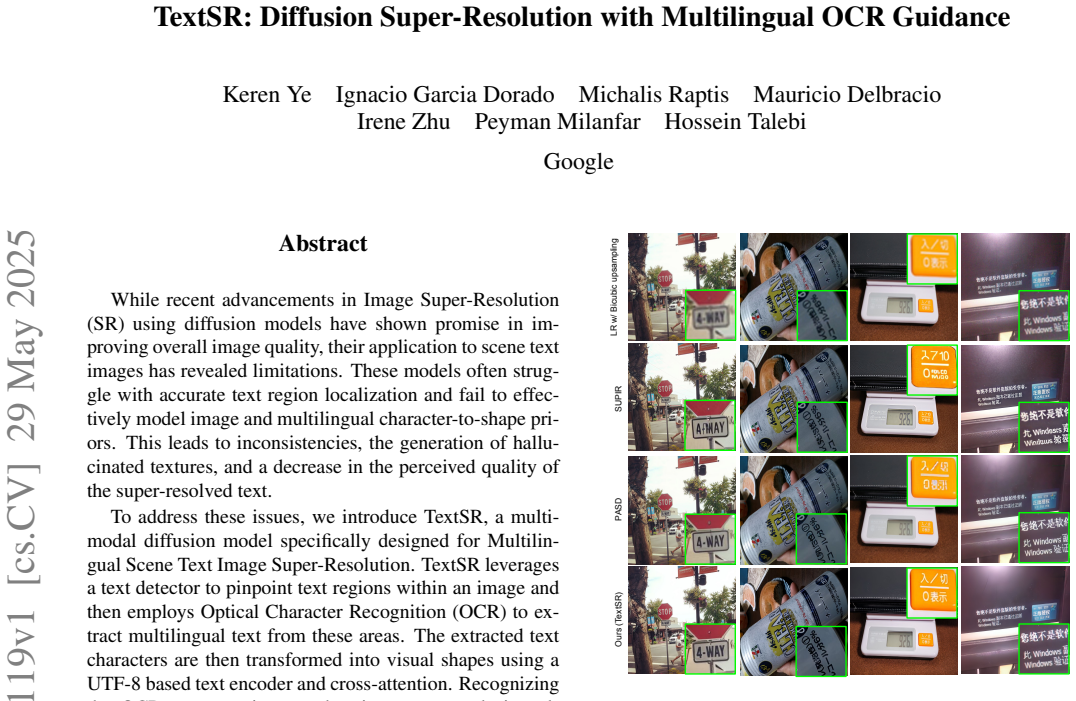
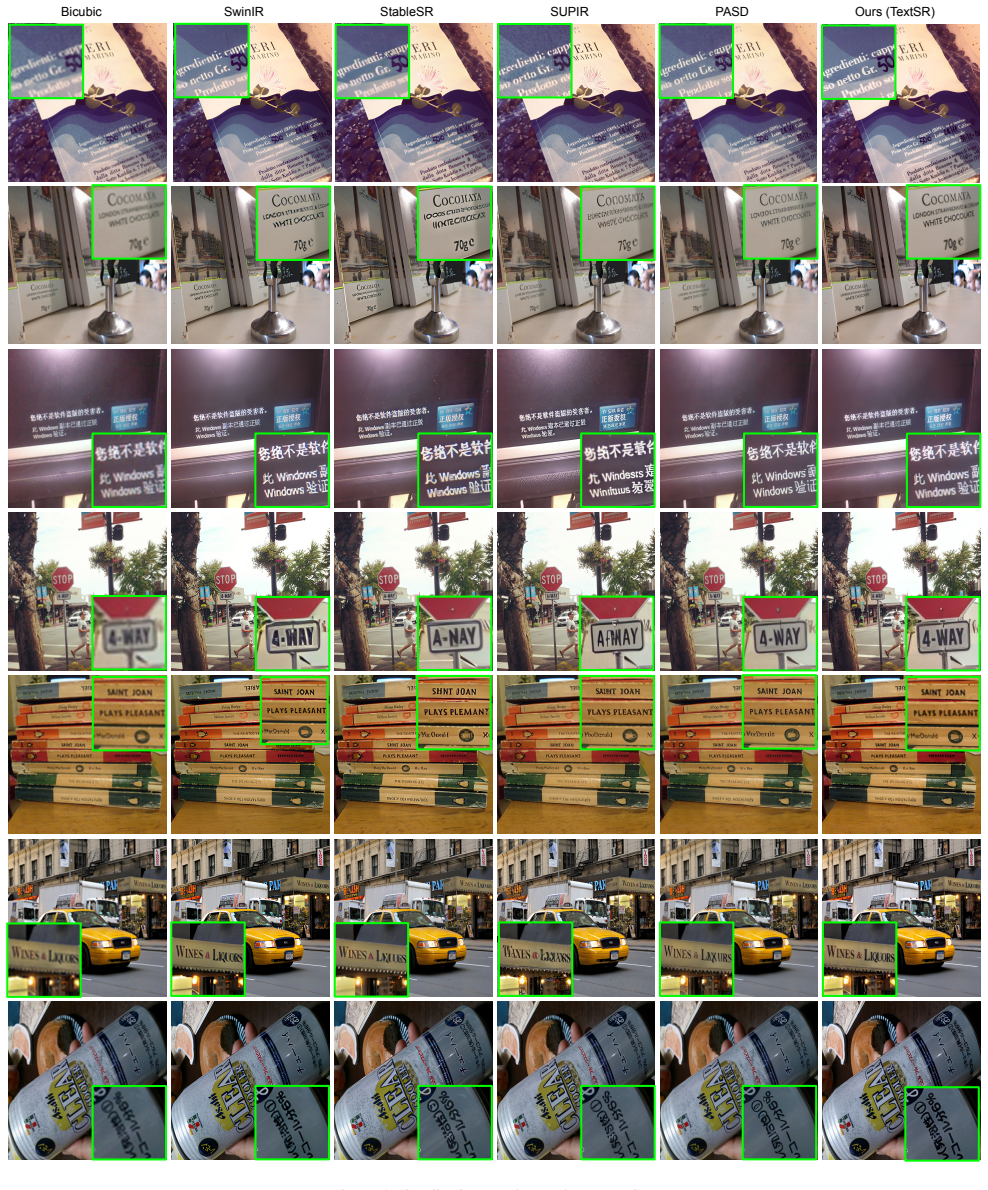
TextSR establishes that character-level OCR text is a powerful condition for diffusion-based scene text super-resolution. The model is trained on more than 18 million text crops drawn from seven detection-and-transcription datasets, with degradations synthesized through the Real-ESRGAN pipeline, and it learns what the authors call multilingual character-to-shape priors: given a character sequence, the diffusion model can draw plausible letterforms even without a usable image. At inference the text condition comes from an OCR recognizer, and two mechanisms handle OCR noise. Classifier-free guidance interpolates between image-only denoising and OCR-guided denoising through a weight $\omega$, and iterative OCR conditioning runs OCR on an intermediate image-only restoration to produce a better text prompt. On TextZoom the model surpasses all compared non-oracle methods when OCR text is supplied, and with ground-truth text it surpasses the ground-truth high-resolution image baseline; on TextVQA it reports OCR accuracy gains of 2.6 points on small text and 7.5 points on medium text over the best compared baseline.
Load-bearing premise
The evaluation rests on the premise that OCR recognition accuracy and a VQA model's answer accuracy are valid measures of restored-text legibility, and that the 641-image TextVQA subset used in the experiments is representative enough to support a general state-of-the-art claim.
Editorial extensions
If this is right
- A single TextSR model restores Latin, Chinese, Japanese, and Hindi text without language-specific branches, because UTF-8 bytes give scripts a shared character codebook.
- When OCR is unreliable, lowering the guidance weight $\omega$ or running one iteration of OCR on an intermediate restoration keeps performance close to the image-only model, limiting the damage from bad text prompts.
- On TextZoom, giving the model ground-truth text instead of OCR text pushes restored-text OCR accuracy above the ground-truth high-resolution image, showing the text prior carries information that pixels alone do not supply.
- On holistic TextVQA images, blending TextSR text-region outputs with a general Real-ESRGAN restoration improves OCR accuracy on small and medium text over all compared baselines.
- Because the pipeline starts with a text detector, non-text image areas can be restored by a general model while text areas receive character-aware restoration, so the approach composes with existing super-resolution systems.
Reading between the lines
- Beyond the paper: if OCR accuracy is the real downstream goal, TextSR can serve as a pre-processor inside recognition pipelines, where the same OCR model that supplies the prompt also consumes the restored image.
- Beyond the paper: the compact 259-token UTF-8 vocabulary suggests the method may extend to additional scripts with almost no architecture change, since bytes rather than language-specific character sets are shared.
- Beyond the paper: the iterative OCR loop hints at a self-training recipe for unlabeled data: restore, re-OCR, and use the improved transcript as a pseudo-label for further training.
- Beyond the paper: the $\omega$ trade-off between pixel fidelity and text guidance could be exposed as a user-facing control in image-editing tools, letting users decide how much to trust an OCR prompt.
Editorial analysis
A structured set of objections, weighed in public.
Referee Report
Summary. The paper proposes TextSR, a diffusion-based scene text image super-resolution (STISR) model that conditions a latent diffusion U-Net on both the low-resolution image and OCR-recognized text characters represented as UTF-8 bytes. The text prior is encoded with the first two ByT5 layers and injected through cross-attention; during inference the model uses classifier-free guidance with a weight omega and an iterative OCR-conditioning loop with R iterations to handle imperfect OCR. The model is trained on about 18 million text crops from seven text detection and transcription datasets and evaluated on TextZoom and on a newly defined TextVQA-based protocol. The authors claim a new state of the art on both benchmarks and emphasize the value of a single multilingual STISR model.
Significance. If the empirical claims were fully supported, this would be a solid contribution: a single multilingual STISR model, a compact 259-token UTF-8 character vocabulary, large-scale multilingual training data, and a practical noise-robust inference procedure. The character-to-shape diffusion prior idea is appealing and the scale of training data is substantially larger than in prior STISR work. However, the two headline SOTA claims are not supported by the paper's own tables, and the TextVQA evaluation is a self-defined protocol on a subsample of the validation set. The method may still be valuable for targeted text-region restoration, but the paper needs to correct the overclaims and provide a more rigorous, less coupled evaluation. No code or data release is mentioned, which further limits verification of the benchmark claims.
major comments (4)
- [4.2, Table 1] The abstract and Section 4.2 claim a new benchmark on TextVQA, but the paper's own primary downstream metric, VQA accuracy with GIT, does not support this. In Table 1, at 4x, Ours(+TextSR) achieves 32.3% VQA accuracy, below Bicubic (33.2%) and below the authors' own Real-ESRGAN baseline (33.9%); at 2x, Ours(+TextSR) ties Bicubic (35.4%) and is below Ours(Real-ESRGAN) (35.6%). The advantage appears only in CRNN OCR accuracy on small and medium crops, not in the holistic metric the paper itself proposes. The SOTA claim must be reframed or replaced with evidence on the full evaluation set.
- [4.2] The TextVQA evaluation uses 641 images selected from the first 1,000 questions of the TextVQA validation set, but the paper gives no rationale for this subset, no confidence intervals, and no analysis of selection bias. VQA accuracy over 641 images can vary substantially, and the paper does not state whether this subset was fixed before running the comparison methods. The authors should report results on the full TextVQA validation set, or justify the subset with a principled criterion, and provide confidence intervals or significance tests for both OCR and VQA metrics.
- [4.3, Table 2] The claim in Section 4.3 that Ours(+ITER. ASTER) 'surpasses all methods except HR and OURS(+GT)' is contradicted by Table 2. On the ASTER recognizer, Ours(+ITER. ASTER) achieves 65.8%, below TextDiff's 66.4% and tied with DCDM's 65.8%. Thus the TextZoom SOTA claim is not universally true across the three reported recognizers; it holds for CRNN and MORAN but not for ASTER. The text should be corrected to state precisely which metrics and comparisons support the claim.
- [3.3, 4.3, Table 3] The evaluation is coupled to the conditioning signal. In TextZoom, the +ITER. ASTER variant uses ASTER as the OCR model that supplies the text condition, and then ASTER accuracy is also reported as the success metric; the model may be drawing characters that match the recognizer's own (possibly incorrect) transcription rather than improving true legibility. Table 3 illustrates the coupling: with CRNN conditioning, no configuration exceeds the image-only model (57.8% on CRNN), while with ASTER conditioning the CRNN accuracy rises to 60.0%; the reported numbers track the recognizer used for conditioning. The VQA metric is the most independent evidence in the paper, and it does not favor Ours(+TextSR) as shown in Table 1. The authors should add a human reading study or evaluate with recognizers that are not used to generate the conditioning text, and report the independent VQA result on the full set.
minor comments (4)
- [4.2] The names 'Ours (Real-ESRGAN)' and 'Ours (+TextSR)' are confusing because both rows include the same Real-ESRGAN holistic model; the text should state explicitly that '+TextSR' is a blend of the Real-ESRGAN output with region-level TextSR outputs.
- [3.3, 4.2] The TextVQA experiments do not report the inference hyperparameters omega, R, or DDIM steps, even though Section 3.3 explains that omega should be tuned to OCR quality; the same level of detail as in Table 3 is needed for reproducibility.
- [1, 4.1] The abstract and introduction say the model handles 'over five languages,' but the qualitative and quantitative results show English, Chinese, Japanese, and Hindi; the paper should state the exact language coverage in the training data and in the evaluation sets.
- [1] The name 'TextSR' is the same as the earlier method TextSR [53]; this naming overlap may create confusion in the literature and should be acknowledged or disambiguated.
Circularity Check
No derivation-level circularity: the diffusion loss and OCR-conditioned cross-attention are not fitted to the evaluation metric, and the self-citations are not load-bearing; the unsupported SOTA claims are correctness issues, not circularity.
full rationale
The claimed derivation chain is self-contained. TextSR is trained with the standard DDPM denoising objective (Eq. 1) on LR/HR/text triplets, with a frozen ByT5 encoder and cross-attention following [36, 50]; no parameter is fitted to the CRNN/MORAN/ASTER/GIT metrics. The OCR text used at inference is an input, not a fitted parameter, so the OCR-accuracy results are empirical measurements rather than predictions forced by construction. The self-citations (e.g., SPIRE [32] and prior restoration works [4, 35, 59]) are contextual and not load-bearing; classifier-free guidance is also attributed to the standard sources [2, 11]. The paper does contain evidence problems that should be flagged separately: the abstract's claim of a 'new benchmark' is contradicted by its own Table 1 (Ours(+TextSR) achieves 32.3% VQA accuracy at 4x, below Bicubic's 33.2% and below Ours(Real-ESRGAN)'s 33.9%), and Table 2 shows TextDiff with 66.4% ASTER accuracy versus Ours(+ITER. ASTER) at 65.8%, contradicting the Sec. 4.3 statement that performance 'surpasses all methods'. Additionally, evaluation via OCR recognizers is coupled with the OCR conditioning signal, which weakens the legibility measure as an independent test, but this is an evaluation-validity concern, not a circular derivation. Overall, no circular step meeting the quoted-equation or fitted-parameter standard is present.
Assumptions & free parameters
free parameters (5)
- classifier-free guidance weight ω =
0.5, 1.0, 3.0 selected per OCR model
- iterative OCR conditioning steps R =
0, 1, 2; R=1 used for final results
- Gaussian low-pass sigma for blending =
3.0
- text crop normalization height =
48 px training, 32 px TextZoom fine-tune
- DDIM inference steps =
5
assumptions (6)
- domain assumption OCR-transcribed text is a valid guide for reconstructing character shapes
- domain assumption Real-ESRGAN high-order degradation approximates real-world text image degradation
- domain assumption CRNN/MORAN/ASTER OCR accuracy is a valid proxy for text legibility
- domain assumption The text detector localizes all text instances correctly
- domain assumption Frozen ByT5 first two layers provide useful character-to-shape features
- standard math Standard diffusion and classifier-free guidance mathematics
Cite this review
Pith. "Pith review of TextSR: Diffusion Super-Resolution with Multilingual OCR Guidance." pith.science (2026). https://pith.science/paper/NRUQVL7Y
@misc{pith2026250523119,
  author       = {Pith},
  title        = {Pith review of: TextSR: Diffusion Super-Resolution with Multilingual OCR Guidance},
  year         = {2026},
  howpublished = {\url{https://pith.science/paper/NRUQVL7Y}},
  note         = {Machine review of arXiv:2505.23119}
}
read the original abstract
While recent advancements in Image Super-Resolution (SR) using diffusion models have shown promise in improving overall image quality, their application to scene text images has revealed limitations. These models often struggle with accurate text region localization and fail to effectively model image and multilingual character-to-shape priors. This leads to inconsistencies, the generation of hallucinated textures, and a decrease in the perceived quality of the super-resolved text. To address these issues, we introduce TextSR, a multimodal diffusion model specifically designed for Multilingual Scene Text Image Super-Resolution. TextSR leverages a text detector to pinpoint text regions within an image and then employs Optical Character Recognition (OCR) to extract multilingual text from these areas. The extracted text characters are then transformed into visual shapes using a UTF-8 based text encoder and cross-attention. Recognizing that OCR may sometimes produce inaccurate results in real-world scenarios, we have developed two innovative methods to enhance the robustness of our model. By integrating text character priors with the low-resolution text images, our model effectively guides the super-resolution process, enhancing fine details within the text and improving overall legibility. The superior performance of our model on both the TextZoom and TextVQA datasets sets a new benchmark for STISR, underscoring the efficacy of our approach.
Figures


Figures from the paper (7 more)




Reference graph
Works this paper leans on
-
[1]
JAX: composable transformations of Python+NumPy programs, 2018
James Bradbury, Roy Frostig, Peter Hawkins, Matthew James Johnson, Chris Leary, Dougal Maclau- rin, George Necula, Adam Paszke, Jake VanderPlas, Skye Wanderman-Milne, and Qiao Zhang. JAX: composable transformations of Python+NumPy programs, 2018. 6
2018
-
[2]
Tim Brooks, Aleksander Holynski, and Alexei A. Efros. Instructpix2pix: Learning to follow image editing instruc- tions. InProceedings of the IEEE/CVF Conference on Com- puter Vision and Pattern Recognition (CVPR), pages 18392– 18402, 2023. 5
work page 2023
-
[3]
Total-text: A com- prehensive dataset for scene text detection and recognition
Chee Kheng Ch’ng and Chee Seng Chan. Total-text: A com- prehensive dataset for scene text detection and recognition. In2017 14th IAPR international conference on document analysis and recognition (ICDAR), pages 935–942. IEEE,
-
[4]
Mauricio Delbracio and Peyman Milanfar. Inversion by di- rect iteration: An alternative to denoising diffusion for image restoration.Transactions on Machine Learning Research,
-
[5]
Projected distribution loss for image enhancement
Mauricio Delbracio, Hossein Talebei, and Pevman Milanfar. Projected distribution loss for image enhancement. In2021 IEEE International Conference on Computational Photogra- phy (ICCP), pages 1–12. IEEE, 2021. 1
work page 2021
-
[6]
Diffusion models beat gans on image synthesis.Advances in neural informa- tion processing systems, 34:8780–8794, 2021
Prafulla Dhariwal and Alexander Nichol. Diffusion models beat gans on image synthesis.Advances in neural informa- tion processing systems, 34:8780–8794, 2021. 4
2021
-
[7]
Learning a deep convolutional network for image super-resolution
Chao Dong, Chen Change Loy, Kaiming He, and Xiaoou Tang. Learning a deep convolutional network for image super-resolution. InComputer Vision–ECCV 2014: 13th European Conference, Zurich, Switzerland, September 6-12, 2014, Proceedings, Part IV 13, pages 184–199. Springer,
2014
-
[8]
Chao Dong, Chen Change Loy, Kaiming He, and Xiaoou Tang. Image super-resolution using deep convolutional net- works.IEEE transactions on pattern analysis and machine intelligence, 38(2):295–307, 2015. 1
work page 2015
Show all 72 references
-
[9]
Image super-resolution using deep convolutional net- works.IEEE Trans
Chao Dong, Chen Change Loy, Kaiming He, and Xiaoou Tang. Image super-resolution using deep convolutional net- works.IEEE Trans. Pattern Anal. Mach. Intell., 38(2):295– 307, 2016. 2
2016
-
[10]
Synthetic data for text localisation in natural images
Ankush Gupta, Andrea Vedaldi, and Andrew Zisserman. Synthetic data for text localisation in natural images. InPro- ceedings of the IEEE conference on computer vision and pat- tern recognition, pages 2315–2324, 2016. 3
2016
-
[11]
Classifier-free diffusion guidance, 2022
Jonathan Ho and Tim Salimans. Classifier-free diffusion guidance, 2022. 5
2022
-
[12]
Denoising dif- fusion probabilistic models
Jonathan Ho, Ajay Jain, and Pieter Abbeel. Denoising dif- fusion probabilistic models. InAdvances in Neural Infor- mation Processing Systems, pages 6840–6851. Curran Asso- ciates, Inc., 2020. 2
2020
-
[13]
Denoising dif- fusion probabilistic models.Advances in neural information processing systems, 33:6840–6851, 2020
Jonathan Ho, Ajay Jain, and Pieter Abbeel. Denoising dif- fusion probabilistic models.Advances in neural information processing systems, 33:6840–6851, 2020. 3
2020
-
[14]
Accurate image super-resolution using very deep convolutional net- works
Jiwon Kim, Jung Kwon Lee, and Kyoung Mu Lee. Accurate image super-resolution using very deep convolutional net- works. InProceedings of the IEEE Conference on Computer Vision and Pattern Recognition (CVPR), 2016. 1
2016
-
[15]
Srdiff: Single image super-resolution with diffusion probabilistic models
Haoying Li, Yifan Yang, Meng Chang, Shiqi Chen, Huajun Feng, Zhihai Xu, Qi Li, and Yueting Chen. Srdiff: Single image super-resolution with diffusion probabilistic models. Neurocomputing, 479:47–59, 2022. 2
2022
-
[16]
Blip-2: Bootstrapping language-image pre-training with frozen image encoders and large language models
Junnan Li, Dongxu Li, Silvio Savarese, and Steven Hoi. Blip-2: Bootstrapping language-image pre-training with frozen image encoders and large language models. InIn- ternational conference on machine learning, pages 19730– 19742. PMLR, 2023. 2
2023
-
[17]
Learning generative structure prior for blind text image super-resolution
Xiaoming Li, Wangmeng Zuo, and Chen Change Loy. Learning generative structure prior for blind text image super-resolution. InProceedings of the IEEE/CVF Confer- ence on Computer Vision and Pattern Recognition (CVPR), pages 10103–10113, 2023. 2, 3
2023
-
[18]
Lsdir: A large scale dataset for image restoration
Yawei Li, Kai Zhang, Jingyun Liang, Jiezhang Cao, Ce Liu, Rui Gong, Yulun Zhang, Hao Tang, Yun Liu, Denis Deman- dolx, et al. Lsdir: A large scale dataset for image restoration. InProceedings of the IEEE/CVF Conference on Computer Vision and Pattern Recognition, pages 1775–178...
2023
-
[19]
Swinir: Image restoration us- ing swin transformer
Jingyun Liang, Jiezhang Cao, Guolei Sun, Kai Zhang, Luc Van Gool, and Radu Timofte. Swinir: Image restoration us- ing swin transformer. InProceedings of the IEEE/CVF inter- national conference on computer vision, pages 1833–1844,
-
[20]
Enhanced deep residual networks for single image super-resolution
Bee Lim, Sanghyun Son, Heewon Kim, Seungjun Nah, and Kyoung Mu Lee. Enhanced deep residual networks for single image super-resolution. InProceedings of CVPR Workshops,
-
[21]
Textdiff: Mask-guided residual diffusion models for scene text image super-resolution.arXiv preprint arXiv:2308.06743, 2023
Baolin Liu, Zongyuan Yang, Pengfei Wang, Junjie Zhou, Ziqi Liu, Ziyi Song, Yan Liu, and Yongping Xiong. Textdiff: Mask-guided residual diffusion models for scene text image super-resolution.arXiv preprint arXiv:2308.06743, 2023. 2, 3, 7, 8
2023 arXiv
-
[22]
Improved baselines with visual instruction tuning
Haotian Liu, Chunyuan Li, Yuheng Li, and Yong Jae Lee. Improved baselines with visual instruction tuning. InPro- ceedings of the IEEE/CVF Conference on Computer Vision and Pattern Recognition (CVPR), pages 26296–26306, 2024. 2, 3
2024
-
[23]
Towards end-to-end unified scene text detection and layout analysis
Shangbang Long, Siyang Qin, Dmitry Panteleev, Alessan- dro Bissacco, Yasuhisa Fujii, and Michalis Raptis. Towards end-to-end unified scene text detection and layout analysis. InProceedings of the IEEE/CVF Conference on Computer Vision and Pattern Recognition (CVPR), pages 1049–1059,
-
[24]
Moran: A multi- object rectified attention network for scene text recognition
Canjie Luo, Lianwen Jin, and Zenghui Sun. Moran: A multi- object rectified attention network for scene text recognition. Pattern Recognition, 90:109–118, 2019. 7, 8
2019
-
[25]
A text atten- tion network for spatial deformation robust scene text image super-resolution
Jianqi Ma, Zhetong Liang, and Lei Zhang. A text atten- tion network for spatial deformation robust scene text image super-resolution. InProceedings of the IEEE/CVF Confer- ence on Computer Vision and Pattern Recognition (CVPR), pages 5911–5920, 2022. 2, 3, 7, 8
2022
-
[26]
Text prior guided scene text image super-resolution.IEEE Transactions on Image Processing, 32:1341–1353, 2023
Jianqi Ma, Shi Guo, and Lei Zhang. Text prior guided scene text image super-resolution.IEEE Transactions on Image Processing, 32:1341–1353, 2023. 2, 3, 5
2023
-
[27]
A benchmark for chinese-english scene text im- age super-resolution
Jianqi Ma, Zhetong Liang, Wangmeng Xiang, Xi Yang, and Lei Zhang. A benchmark for chinese-english scene text im- age super-resolution. InProceedings of the IEEE/CVF In- ternational Conference on Computer Vision (ICCV), pages 19452–19461, 2023. 2
2023
-
[28]
Icdar2019 robust reading challenge on multi- lingual scene text detection and recognition – rrc-mlt-2019,
Nibal Nayef, Yash Patel, Michal Busta, Pinaki Nath Chowd- hury, Dimosthenis Karatzas, Wafa Khlif, Jiri Matas, Uma- pada Pal, Jean-Christophe Burie, Cheng lin Liu, and Jean- Marc Ogier. Icdar2019 robust reading challenge on multi- lingual scene text detection and recognition – ...
2019
-
[29]
Dictionary-guided scene text recognition
Nguyen Nguyen, Thu Nguyen, Vinh Tran, Minh-Triet Tran, Thanh Duc Ngo, Thien Huu Nguyen, and Minh Hoai. Dictionary-guided scene text recognition. InProceedings of the IEEE/CVF Conference on Computer Vision and Pattern Recognition (CVPR), pages 7383–7392, 2021. 5
2021
-
[30]
Improved denoising diffusion probabilistic models
Alexander Quinn Nichol and Prafulla Dhariwal. Improved denoising diffusion probabilistic models. InInternational conference on machine learning, pages 8162–8171. PMLR,
-
[31]
Scene text image super-resolution based on text-conditional diffusion models
Chihiro Noguchi, Shun Fukuda, and Masao Yamanaka. Scene text image super-resolution based on text-conditional diffusion models. InProceedings of the IEEE/CVF Win- ter Conference on Applications of Computer Vision, pages 1485–1495, 2024. 2, 3, 7, 8
2024
-
[32]
Spire: Semantic prompt-driven image restoration
Chenyang Qi, Zhengzhong Tu, Keren Ye, Mauricio Del- bracio, Peyman Milanfar, Qifeng Chen, and Hossein Talebi. Spire: Semantic prompt-driven image restoration. arXiv:2312.11595, 2023. 2, 5
2023 arXiv
-
[33]
Collaborative deep learning for super-resolving blurry text images.IEEE Transactions on Computational Imaging, 6: 778–790, 2020
Yuhui Quan, Jieting Yang, Yixin Chen, Yong Xu, and Hui Ji. Collaborative deep learning for super-resolving blurry text images.IEEE Transactions on Computational Imaging, 6: 778–790, 2020. 2, 3
2020
-
[34]
You only look once: Unified, real-time object de- tection
Joseph Redmon, Santosh Divvala, Ross Girshick, and Ali Farhadi. You only look once: Unified, real-time object de- tection. InProceedings of the IEEE Conference on Computer Vision and Pattern Recognition (CVPR), 2016. 2
2016
-
[35]
Multiscale structure guided diffusion for image deblurring
Mengwei Ren, Mauricio Delbracio, Hossein Talebi, Guido Gerig, and Peyman Milanfar. Multiscale structure guided diffusion for image deblurring. InICCV, pages 10721– 10733, 2023. 2
2023
-
[36]
High-resolution image synthesis with latent diffusion models
Robin Rombach, Andreas Blattmann, Dominik Lorenz, Patrick Esser, and Bj ¨orn Ommer. High-resolution image synthesis with latent diffusion models. InProceedings of the IEEE/CVF Conference on Computer Vision and Pattern Recognition (CVPR), pages 10684–10695, 2022. 2, 3, 4
2022
-
[37]
U- net: Convolutional networks for biomedical image segmen- tation
Olaf Ronneberger, Philipp Fischer, and Thomas Brox. U- net: Convolutional networks for biomedical image segmen- tation. InMedical image computing and computer-assisted intervention–MICCAI 2015: 18th international conference, Munich, Germany, October 5-9, 2015, proceedings, par...
2015
-
[38]
Palette: Image-to-image diffusion models
Chitwan Saharia, William Chan, Huiwen Chang, Chris Lee, Jonathan Ho, Tim Salimans, David Fleet, and Mohammad Norouzi. Palette: Image-to-image diffusion models. In ACM SIGGRAPH 2022 Conference Proceedings, pages 1– 10, 2022. 2
2022
-
[39]
Image super-resolution via iterative refinement.IEEE Transactions on Pattern Analysis and Machine Intelligence, 45(4):4713– 4726, 2022
Chitwan Saharia, Jonathan Ho, William Chan, Tim Sal- imans, David J Fleet, and Mohammad Norouzi. Image super-resolution via iterative refinement.IEEE Transactions on Pattern Analysis and Machine Intelligence, 45(4):4713– 4726, 2022. 1, 2
2022
-
[40]
Baoguang Shi, Xiang Bai, and Cong Yao. An end-to-end trainable neural network for image-based sequence recog- nition and its application to scene text recognition.IEEE transactions on pattern analysis and machine intelligence, 39(11):2298–2304, 2016. 6, 7, 8
2016
-
[41]
Aster: An attentional scene text recognizer with flexible rectification.IEEE transactions on pattern analysis and machine intelligence, 41(9):2035– 2048, 2018
Baoguang Shi, Mingkun Yang, Xinggang Wang, Pengyuan Lyu, Cong Yao, and Xiang Bai. Aster: An attentional scene text recognizer with flexible rectification.IEEE transactions on pattern analysis and machine intelligence, 41(9):2035– 2048, 2018. 7, 8
2018
-
[42]
Towards vqa models that can read
Amanpreet Singh, Vivek Natarajan, Meet Shah, Yu Jiang, Xinlei Chen, Dhruv Batra, Devi Parikh, and Marcus Rohrbach. Towards vqa models that can read. InProceed- ings of the IEEE/CVF Conference on Computer Vision and Pattern Recognition (CVPR), 2019. 2, 5, 6
2019
-
[43]
TextOCR: Towards large- scale end-to-end reasoning for arbitrary-shaped scene text
Amanpreet Singh, Guan Pang, Mandy Toh, Jing Huang, Wo- jciech Galuba, and Tal Hassner. TextOCR: Towards large- scale end-to-end reasoning for arbitrary-shaped scene text. InProceedings of the IEEE/CVF Conference on Computer Vision and Pattern Recognition (CVPR), 2021. 5
2021
-
[44]
Dcdm: Diffusion-conditioned-diffusion model for scene text image super-resolution
Shrey Singh, Prateek Keserwani, Masakazu Iwamura, and Partha Pratim Roy. Dcdm: Diffusion-conditioned-diffusion model for scene text image super-resolution. InEuropean Conference on Computer Vision, pages 303–320. Springer,
-
[45]
Denoising diffusion implicit models.arXiv preprint arXiv:2010.02502, 2020
Jiaming Song, Chenlin Meng, and Stefano Ermon. Denoising diffusion implicit models.arXiv preprint arXiv:2010.02502, 2020. 4, 6
2010 arXiv
-
[46]
Icdar 2019 competition on large-scale street view text with partial labeling-rrc-lsvt
Yipeng Sun, Zihan Ni, Chee-Kheng Chng, Yuliang Liu, Can- jie Luo, Chun Chet Ng, Junyu Han, Errui Ding, Jingtuo Liu, Dimosthenis Karatzas, et al. Icdar 2019 competition on large-scale street view text with partial labeling-rrc-lsvt. In2019 International Conference on Document A...
2019
-
[47]
Image super- resolution via deep recursive residual network
Ying Tai, Jian Yang, and Xiaoming Liu. Image super- resolution via deep recursive residual network. InProceed- ings of the IEEE Conference on Computer Vision and Pattern Recognition (CVPR), 2017. 1
2017
-
[48]
Dense arbitrary shaped text dataset, 2019
Alibaba Duguang OCR team. Dense arbitrary shaped text dataset, 2019. 5
2019
-
[49]
Maxim: Multi-axis mlp for image processing
Zhengzhong Tu, Hossein Talebi, Han Zhang, Feng Yang, Peyman Milanfar, Alan Bovik, and Yinxiao Li. Maxim: Multi-axis mlp for image processing. InProceedings of the IEEE/CVF Conference on Computer Vision and Pattern Recognition (CVPR), pages 5769–5780, 2022. 2
2022
-
[50]
Attention is all you need
Ashish Vaswani, Noam Shazeer, Niki Parmar, Jakob Uszko- reit, Llion Jones, Aidan N Gomez, Ł ukasz Kaiser, and Illia Polosukhin. Attention is all you need. InAdvances in Neu- ral Information Processing Systems. Curran Associates, Inc.,
-
[51]
Git: A generative image-to-text transformer for vision and language.arXiv preprint arXiv:2205.14100, 2022
Jianfeng Wang, Zhengyuan Yang, Xiaowei Hu, Linjie Li, Kevin Lin, Zhe Gan, Zicheng Liu, Ce Liu, and Lijuan Wang. Git: A generative image-to-text transformer for vision and language.arXiv preprint arXiv:2205.14100, 2022. 6
2022 arXiv
-
[52]
Exploiting diffusion prior for real-world image super-resolution.International Journal of Computer Vision, 132(12):5929–5949, 2024
Jianyi Wang, Zongsheng Yue, Shangchen Zhou, Kelvin CK Chan, and Chen Change Loy. Exploiting diffusion prior for real-world image super-resolution.International Journal of Computer Vision, 132(12):5929–5949, 2024. 1, 3, 6, 7
2024
-
[53]
Textsr: Content-aware text super-resolution guided by recognition.arXiv preprint arXiv:1909.07113, 2019
Wenjia Wang, Enze Xie, Peize Sun, Wenhai Wang, Lixun Tian, Chunhua Shen, and Ping Luo. Textsr: Content-aware text super-resolution guided by recognition.arXiv preprint arXiv:1909.07113, 2019. 2, 3
1909 arXiv
-
[54]
Scene text image super-resolution in the wild
Wenjia Wang, Enze Xie, Xuebo Liu, Wenhai Wang, Ding Liang, Chunhua Shen, and Xiang Bai. Scene text image super-resolution in the wild. InComputer Vision – ECCV 2020, pages 650–666, Cham, 2020. Springer International Publishing. 2, 3, 5, 6, 7, 8
2020
-
[55]
Esrgan: En- hanced super-resolution generative adversarial networks
Xintao Wang, Ke Yu, Shixiang Wu, Jinjin Gu, Yihao Liu, Chao Dong, Yu Qiao, and Chen Change Loy. Esrgan: En- hanced super-resolution generative adversarial networks. In Proceedings of the European conference on computer vision (ECCV) workshops, pages 0–0, 2018. 1
2018
-
[56]
Real-esrgan: Training real-world blind super-resolution with pure synthetic data
Xintao Wang, Liangbin Xie, Chao Dong, and Ying Shan. Real-esrgan: Training real-world blind super-resolution with pure synthetic data. InProceedings of the IEEE/CVF inter- national conference on computer vision, pages 1905–1914,
1905
-
[57]
Real-esrgan: Training real-world blind super-resolution with pure synthetic data, 2021
Xintao Wang, Liangbin Xie, Chao Dong, and Ying Shan. Real-esrgan: Training real-world blind super-resolution with pure synthetic data, 2021. 2, 5, 6
2021
-
[58]
Uformer: A general u-shaped transformer for image restoration
Zhendong Wang, Xiaodong Cun, Jianmin Bao, Wengang Zhou, Jianzhuang Liu, and Houqiang Li. Uformer: A general u-shaped transformer for image restoration. InProceedings of the IEEE/CVF Conference on Computer Vision and Pat- tern Recognition (CVPR), pages 17683–17693, 2022. 2
2022
-
[59]
De- blurring via stochastic refinement
Jay Whang, Mauricio Delbracio, Hossein Talebi, Chitwan Saharia, Alexandros G Dimakis, and Peyman Milanfar. De- blurring via stochastic refinement. InCVPR, pages 16293– 16303, 2022. 2
2022
-
[60]
Seesr: Towards semantics- aware real-world image super-resolution
Rongyuan Wu, Tao Yang, Lingchen Sun, Zhengqiang Zhang, Shuai Li, and Lei Zhang. Seesr: Towards semantics- aware real-world image super-resolution. InProceedings of the IEEE/CVF Conference on Computer Vision and Pattern Recognition (CVPR), pages 25456–25467, 2024. 1, 2
2024
-
[61]
Learning to super- resolve blurry face and text images
Xiangyu Xu, Deqing Sun, Jinshan Pan, Yujin Zhang, Hanspeter Pfister, and Ming-Hsuan Yang. Learning to super- resolve blurry face and text images. InProceedings of the IEEE international conference on computer vision, pages 251–260, 2017. 2, 3
2017
-
[62]
ByT5: Towards a token-free future with pre-trained byte- to-byte models.Transactions of the Association for Compu- tational Linguistics, 10:291–306, 2022
Linting Xue, Aditya Barua, Noah Constant, Rami Al-Rfou, Sharan Narang, Mihir Kale, Adam Roberts, and Colin Raf- fel. ByT5: Towards a token-free future with pre-trained byte- to-byte models.Transactions of the Association for Compu- tational Linguistics, 10:291–306, 2022. 3, 4, 5
2022
-
[63]
Pixel-aware stable diffusion for realistic image super-resolution and personalized stylization.arXiv preprint arXiv:2308.14469, 2023
Tao Yang, Rongyuan Wu, Peiran Ren, Xuansong Xie, and Lei Zhang. Pixel-aware stable diffusion for realistic image super-resolution and personalized stylization.arXiv preprint arXiv:2308.14469, 2023. 1, 2, 3, 6, 7
2023 arXiv
-
[64]
Scaling up to excellence: Practicing model scaling for photo- realistic image restoration in the wild
Fanghua Yu, Jinjin Gu, Zheyuan Li, Jinfan Hu, Xiangtao Kong, Xintao Wang, Jingwen He, Yu Qiao, and Chao Dong. Scaling up to excellence: Practicing model scaling for photo- realistic image restoration in the wild. InProceedings of the IEEE/CVF Conference on Computer Vision and ...
2024
-
[65]
Designing a practical degradation model for deep blind image super-resolution
Kai Zhang, Jingyun Liang, Luc Van Gool, and Radu Timo- fte. Designing a practical degradation model for deep blind image super-resolution. InProceedings of the IEEE/CVF In- ternational Conference on Computer Vision (ICCV), pages 4791–4800, 2021. 1, 2, 6, 7
2021
-
[66]
Residual dense network for image super-resolution
Yulun Zhang, Yapeng Tian, Yu Kong, Bineng Zhong, and Yun Fu. Residual dense network for image super-resolution. InProceedings of the IEEE Conference on Computer Vision and Pattern Recognition (CVPR), 2018. 1
2018
-
[67]
Diffusion-based blind text image super-resolution
Yuzhe Zhang, Jiawei Zhang, Hao Li, Zhouxia Wang, Luwei Hou, Dongqing Zou, and Liheng Bian. Diffusion-based blind text image super-resolution. InProceedings of the IEEE/CVF Conference on Computer Vision and Pattern Recognition (CVPR), pages 25827–25836, 2024. 2, 3
2024
-
[68]
Scene text image super-resolution via parallelly contextual atten- tion network
Cairong Zhao, Shuyang Feng, Brian Nlong Zhao, Zhijun Ding, Jun Wu, Fumin Shen, and Heng Tao Shen. Scene text image super-resolution via parallelly contextual atten- tion network. InProceedings of the 29th ACM International Conference on Multimedia, pages 2908–2917, 2021. 2, 3
2021
-
[69]
C3-stisr: Scene text image super-resolution with triple clues, 2022
Minyi Zhao, Miao Wang, Fan Bai, Bingjia Li, Jie Wang, and Shuigeng Zhou. C3-stisr: Scene text image super-resolution with triple clues, 2022. 2, 3
2022
-
[70]
Improving scene text image super-resolution via dual prior modulation network.Proceedings of the AAAI Conference on Artificial Intelligence, 37(3):3843–3851, 2023
Shipeng Zhu, Zuoyan Zhao, Pengfei Fang, and Hui Xue. Improving scene text image super-resolution via dual prior modulation network.Proceedings of the AAAI Conference on Artificial Intelligence, 37(3):3843–3851, 2023. 2, 3, 7, 8 TextSR: Diffusion Super-Resolution with Multiling...
2023
-
[72]
exceptions
This emphasizes the importance of using both image and text data together. Second, we introduced more ambiguity into the visual input by applying a Gaussian blur withσval- ues of 3 and 7 to the input image. This forced the model to rely less on the LR image details. Fig. 6 sho...
-
[2023]
Featured Certification. 1, 2
Reviewed August 7, 2026 · model on record in the stance chip above.
Discussion (0). Sign in to comment.