REVIEW 3 major objections 7 minor 39 references
Observation of the resonance frequencies of a stable torus of fluid
T0 review · 3 major / 7 minor · reviewed 2026-08-14 · deepseek-v4-flash
Pith's one-line read A vibrated mercury torus develops azimuthal lobes whose resonance frequencies follow a hollow-cylinder adaptation of Rayleigh's drop model, with an added flattening mode, matching modes n=5 to 25 over two decades with no fitting parameter.
desk verdict A clean first measurement of torus resonance frequencies that deserves referee time, but the low-n agreement rests on an under-supported axisymmetric correction. read the letter →
The pith
A machine-rendered reading of the paper's core claim, the machinery that carries it, and where it could break.
The reading
What carries the argument
The load-bearing object is Eq. (1), the thin-hollow-cylinder eigenfrequency obtained by adapting Rayleigh's puddle model to a torus of outer radius $R$ and inner radius $R_i$; the geometric factor $(1-(R_i/R)^{2n})/(1+(R_i/R)^{2n})$ encodes the suppression of modes that feel the inner hole. The forcing is parametric: vertical vibration enters as a Mathieu equation for $\eta_n(t)$, so each resonance appears as an instability tongue whose minimum sits at twice the eigenfrequency. A second ingredient is the axisymmetric flattening (breathing) mode of Eq. (2), $\omega_1^2 = \frac{\gamma}{\rho h R^2}\, 2(R^2-R_i^2)\left(\frac{R^2-3R_i^2}{4}+\frac{R_i^4}{R^2-R_i^2}\ln\frac{R}{R_i}\right)$, whose frequency is added in quadrature to explain the low-frequency end of the comparison. The experimental mechanism is a horizontally confined mercury ring in a Hele-Shaw cell: a solid central cylinder prevents the Rayleigh-Plateau breakup that destroys free tori, making stable arbitrary-aspect-ratio rings possible for the first quantitative study.
What would settle it
Sweep the forcing frequency up and down through one mode and record both edges of the instability region; if the two lowest points differ appreciably, the inferred $f_n = f_{\min,n}/2$ is biased. More decisively, change the inner radius so that $(R_i/R)^{2n}$ in Eq. (1) is no longer close to 1 and check whether the measured frequencies shift by the predicted hollow-cylinder factor.
Extended reading notes
Core claim
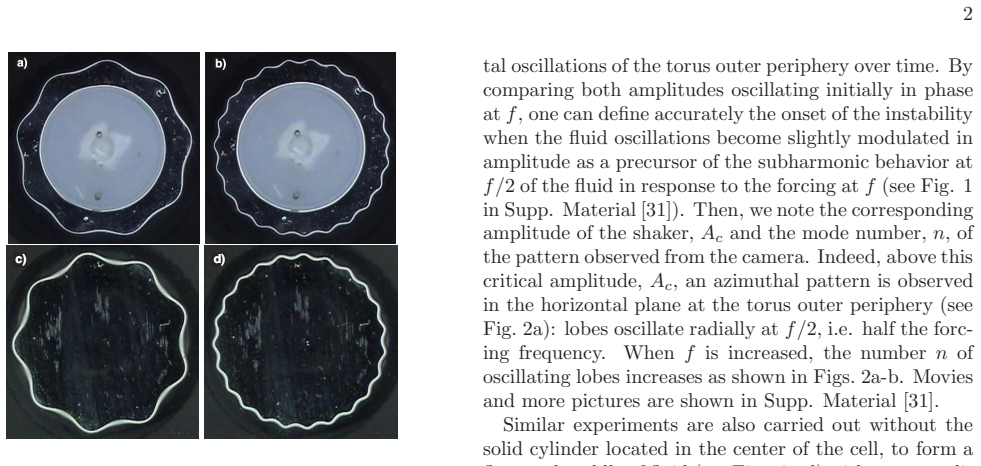
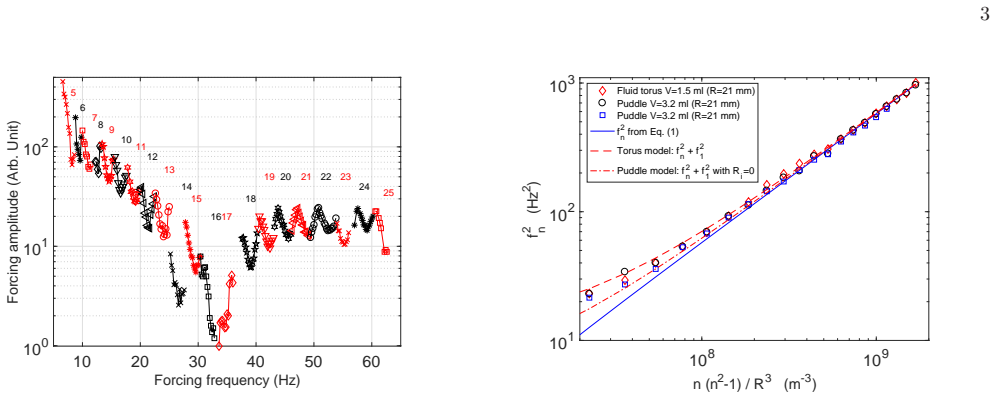
The central claim is that the azimuthal patterns observed on a vibrated torus of mercury are the eigenmodes of a thin hollow cylinder, not of a full three-dimensional ring. Small radial deformations $r(\theta,t)=R+\eta_n(t)\cos(n\theta)$ obey a harmonic-oscillator equation whose eigenfrequency is $$ \$omega_n^{2}$ = \frac{\gamma}{\rho $R^{3}$}\, n($n^{2}$-1)\, \frac{1-(R_i/R)^{2n}}{1+(R_i/R)^{2n}} \quad (n>1), $$ the Rayleigh drop formula multiplied by a geometric factor that accounts for the solid inner boundary. The instability tongues observed up to n=25 have their minima at forcing frequencies $f_{\min,n}$; identifying each mode's resonance as $f_n=f_{\min,n}/2$ and adding the axisymmetric flattening mode $f_1$ in quadrature, $f_n^2+f_1^2$, gives agreement with experiment over two decades of frequency with no fitting parameter. The same law holds for a flat puddle when $R_i=0$, and for a torus the inner-rim undulations are absent: the instability lives at the outer periphery, so for mode numbers large compared with the aspect ratio the torus and puddle behave identically.
Load-bearing premise
The whole frequency comparison rests on assuming that the forcing frequency at the lowest point of each wedge-shaped instability region is exactly twice the mode's natural frequency, and that the slight hysteresis the authors mention does not shift that point.
Editorial extensions
If this is right
- For mode numbers $n$ much larger than the torus aspect ratio, the predicted resonance frequencies become indistinguishable from those of a flat puddle, so the inner boundary matters only at low $n$.
- Because the solid cylinder suppresses Rayleigh-Plateau breakup, the same setup can produce stable fluid rings of tunable aspect ratio, opening the way to systematic studies of annular surface-tension eigenmodes.
- The model's identification of $\omega_n^2$ with a hollow-cylinder eigenfrequency should carry over to transient large-scale azimuthal structures in vortex rings, where similar lobe patterns appear.
- Replacing the solid inner confinement by a toroidal potential or adding a Lorentz force to the liquid metal could produce a stable ring with poloidal vorticity, allowing controlled tests of vortex-ring instability mechanisms.
Reading between the lines
- The inner-radius dependence of Eq. (1) is a prediction the current geometry barely exercises: at $R_i/R = 15/21$ the correction differs from the puddle formula by only about 1% at $n=2$, so a decisive check would use thicker rings where the factor deviates strongly from unity.
- The quadrature combination $f_n^2+f_1^2$ suggests a general rule for confined drops: any resonance in a thin cell should be corrected by adding the confinement-induced breathing mode in quadrature, a pattern that could be probed by varying $h$ across a wider range.
- If the reported tongue hysteresis is systematic, then $f_n=f_{\min,n}/2$ carries a bias; a direct measurement of the subharmonic phase or a free-decay ringdown would settle whether the two-decade agreement is as clean as claimed.
- The same experimental geometry could measure damping of azimuthal modes from the tongue width near onset, connecting surface-tension eigenmode frequencies to viscous dissipation without changing the setup.
Signed reviews
Editorial analysis
A structured set of objections, weighed in public.
Referee Report
Summary. The manuscript reports experiments on a torus of mercury confined in a horizontal Hele-Shaw cell, formed by injecting the liquid around a solid cylinder on a coated, liquid-repelling substrate. Vertical vibrations drive a parametric instability that excites azimuthal standing-wave patterns at the outer periphery with mode numbers n = 5-25, and the same patterns are observed on a flattened puddle. From the minima of the instability tongues the authors infer the resonance frequencies f_n = f_min,n/2 and compare them with a Rayleigh-type model adapted to a thin hollow cylinder, Eq. (1), whose only inputs are the measured surface tension, density, radii and cell height. Adding an axisymmetric flattening mode f_1 from Eq. (2) in quadrature (f_n^2 + f_1^2) is claimed to give excellent, parameter-free agreement over two decades in f_n^2 for both torus and puddle geometries. A secondary analysis of a confined poloidal mode yields f_0^2 ~ h^-3 and an indirect estimate of the torus cross-section ellipticity through a fitted shape parameter alpha.
Significance. If the central comparison holds, this is the first quantitative measurement of the resonance frequencies of a stable fluid torus and provides a simple analytical model that collapses data over two decades with no fitted parameter; that is a real strength. It creates a falsifiable prediction (f_n^2 proportional to n(n^2-1)/R^3) that also appears to hold when R and the cell configuration are varied, and the suggestion of a connection to azimuthal structures in vortex rings is plausible and testable. The authors are commendably explicit about caveats: the measured surface tension is 32% below the reference value, a slight hysteresis in the tongues is reported, and the poloidal-mode analysis uses an adjustable alpha. The downside is that the advertised no-free-parameter agreement is not fully verifiable from this version: Eq. (2) as printed is dimensionally inconsistent, its derivation is confined to the supplementary material, and the quadrature combination used in Fig. 4 is acknowledged by the authors themselves as an unexplained 'nontrivial coupling'. The paper is promising and should be considered seriously after the load-bearing points below are addressed.
major comments (3)
- [Eq. (2)] As printed, Eq. (2) is dimensionally inconsistent: gamma/rho has units L^3/T^2, so the prefactor gamma/(rho h R^2) has units 1/T^2, whereas the bracket 2(R^2-R_i^2)(R^2-3R_i^2/4 + R_i^4/(R^2-R_i^2) ln(R/R_i)) has units L^4; the right-hand side therefore has units L^4/T^2 and cannot produce the quoted f_1 ≈ 3.6 Hz (which requires f_1^2 ≈ 512 s^-2). The derivation is delegated to supplementary material [31], and for the puddle case the Fig. 4 caption sets R_i = 0 in Eq. (2), where the printed expression contains ln(R/R_i) and is singular without a stated limiting procedure. Since the dashed and dash-dotted curves in Fig. 4 are f_n^2 + f_1^2 and this quadrature (called a 'nontrivial coupling' on p. 3) changes the predicted frequencies by tens of percent for n = 5 to about 10, the claim of excellent agreement 'with no fitting parameter' rests on material that is not checkable in this version of the manuscript. Please provide a corrected, dimensionally consistent Eq. (2), its derivation, the numerical evaluation giving f_1 = 3.6 and 2.1 Hz, and a derivation or explicit justification of the quadrature combination rule.
- [p. 2, sentence after Eq. (1)] The sentence 'For our torus aspect ratio, both models are almost similar (1.3% difference for n = 2 and 0.2% for n = 3)' is inconsistent with Eq. (1) for the stated geometry R_i/R = 15/21. The factor (1-(R_i/R)^{2n})/(1+(R_i/R)^{2n}) equals 0.587 for n = 2 and 0.766 for n = 3, i.e., differences from the puddle formula of about 41% and 23% in omega^2, not 1.3% and 0.2%. Either the sentence or the formula is wrong; please correct the text and state the actual deviation over the measured range (the factor is about 0.93 at n = 5, so the torus-specific correction is a few percent at the lowest measured modes).
- [Fig. 4 and p. 3 (inference of f_n)] Fig. 4 shows no error bars on the experimental f_n, and the text reports only 'a slight hysteresis of the tongues'. The inference f_n = f_min,n/2 is exact for the tongue tips of the undamped Mathieu equation, but the measured tongue minima can be biased by finite-amplitude effects, by the hysteresis mentioned in the text, and by the onset-detection procedure (the precursor modulation) described on p. 2. Please give an estimate of the systematic and statistical uncertainty in f_n - frequency step of the f-sweep, tongue width, and hysteresis - and plot it in Fig. 4. The model lines scale linearly with gamma, whose measured value is 32% below the reference value, so the uncertainty in gamma (and any effect of contamination on the dynamics) should also be propagated. This is needed to substantiate the quantitative 'excellent agreement' claim, which at low n relies on the f_1 quadrature correction.
minor comments (7)
- [Fig. 4 caption] The legend entry 'Puddle V=3.2 ml (R=21 mm)' appears twice; the duplicate should be removed.
- [References] Reference [8] lists the year as 1958; Helmholtz's paper is from 1858. Reference [25] gives the year as '(210)' and should read '(2010)'.
- [Ref. [36]] The phrase 'tore/puddle' should read 'torus/puddle'.
- [Abstract and p. 2] Please define the term 'unwetting' at first use (mercury does not wet the coated substrate), since it is not a standard term in this context.
- [Fig. 4, solid line] Please state explicitly whether the solid line is Eq. (1) with the torus factor or with R_i = 0; the two differ by up to roughly 7% in omega^2 over the plotted range, which matters for the low-n data.
- [p. 3, reproducibility] A table of the measured f_min,n (or f_n) values with uncertainties would make the central comparison reproducible; if journal length is a constraint, this would fit naturally in the supplementary material.
- [Fig. 3 caption] The caption interleaves the axis descriptions; please ensure the axes are printed as 'Forcing frequency (Hz)' and 'Forcing amplitude (arb. units)'.
Circularity Check
No significant circularity: the torus dispersion relation is a parameter-free Rayleigh-type prediction checked against measured tongue minima; the f1 quadrature is unverifiable in this version and the poloidal f0 fit is peripheral, but neither reduces to its own inputs.
full rationale
The central claim, Eq. (1), is an adaptation of the classical Rayleigh drop model to a thin hollow cylinder, with the correction factor (1-(Ri/R)^(2n))/(1+(Ri/R)^(2n)) obtained from the inner-boundary condition. Its inputs are independently measured quantities: R = 21 mm, Ri = 15 mm, rho = 13500 kg/m^3, and gamma = 330 mN/m. The measured resonance frequencies are inferred from the minima of parametric instability tongues using the standard Mathieu property f_n = f_min,n/2; this is not fitted to Eq. (1). The comparisons in Fig. 4 are made against externally measured geometry and material parameters, so the central dispersion law is not equivalent to its inputs by construction. The self-citation to the group's earlier Mathieu work, Ref. [33], is used only to justify the parametric forcing model and is also supported by the external Refs. [32,34]; it is not load-bearing for the eigenfrequency prediction. Two non-circular concerns remain. First, Eq. (2), as typeset, is dimensionally inconsistent, and the f1 values 3.6 Hz and 2.1 Hz are said to follow from it but the derivation is only in the supplement; this makes the no-fitting-parameter f1 quadrature hard to verify, but it is not shown to be a fitted input. Second, the poloidal mode analysis uses an explicitly adjustable alpha = 1.9; that is an acknowledged fit to f0 data and is peripheral to the azimuthal resonance claim. Neither qualifies as circular under the requirement of exhibiting an equation that reduces to its own input. The overall score reflects only a minor, non-load-bearing self-citation and the unverifiable status of Eq. (2), not any demonstrated circularity in the main derivation.
Assumptions & free parameters
free parameters (1)
- alpha (alpha) for the poloidal mode =
1.71 when the top plate is fixed; 1.9 when both plates are fixed together
assumptions (4)
- domain assumption The fluid is inviscid and incompressible, and the torus is approximated as a thin hollow cylinder because 2R >> h.
- domain assumption Vertical plate vibrations excite the fluid parametrically, so the mode amplitude follows a Mathieu equation with instability-tongue minima at f = 2 f_n.
- standard math The radial perturbation is small, eta_n << R, and obeys a harmonic oscillator equation.
- domain assumption The capillary wave dispersion relation omega^2 = (gamma/rho) k^3 applies to the confined poloidal mode.
Cite this review
Pith. "Pith review of Observation of the resonance frequencies of a stable torus of fluid." pith.science (2026). https://pith.science/paper/NSB5LPQH
@misc{pith2026190801507,
  author       = {Pith},
  title        = {Pith review of: Observation of the resonance frequencies of a stable torus of fluid},
  year         = {2026},
  howpublished = {\url{https://pith.science/paper/NSB5LPQH}},
  note         = {Machine review of arXiv:1908.01507}
}
read the original abstract
We report the first quantitative measurements of the resonance frequencies of a torus of fluid confined in a horizontal Hele-Shaw cell. By using the unwetting property of a metal liquid, we are able to generate a stable torus of fluid with an arbitrary aspect ratio. When subjected to vibrations, the torus displays azimuthal patterns at its outer periphery. These lobes oscillate radially, and their number n depends on the forcing frequency. We report the instability ''tongues'' of the patterns up to n = 25. These resonance frequencies are well explained by adapting to a fluid torus the usual drop model of Lord Rayleigh. This approach could be applied to the modeling of large-scale structures arisen transiently in vortex rings in various domains.
Figures

Figures from the paper (1 more)

Reference graph
Works this paper leans on
-
[31]
See Supplemental Material [url] for experimental deta ils, movies, pictures, further data analyses and derivation de- tails, which includes Refs. [36–39]
-
[1]
T. J. Maxworthy, J. Fluid Mech. 51, 15 (1972)
work page 1972
- [2]
-
[3]
C. D. Cothran, M. R. Brown, T. Gray, M. J. Schaffer, and G. Marklin, Phys. Rev. Lett. 103, 215002 (2009)
work page 2009
-
[4]
J. Taddeucci, M. A. Alatorre-Ibarguengoitia, D. M. Pal- ladino, P. Scarlato, and C. Camaldo, Geophys. Res. Lett. 42, 6253 (2015)
work page 2015
-
[5]
M. A. Abramowicz, O. M. Blaes, J. Hor´ ak, W. Klu´ zniak, 5 and P. Rebusco, Classical and Quantum Gravity 23, 1689 (2006)
work page 2006
- [6]
- [7]
Show all 39 references
-
[8]
von Helmholtz, J
H. von Helmholtz, J. f¨ ur die reine und angewandte Math- ematik 55, 22 (1958)
1958
-
[9]
G. K. Batchelor, An Introduction to Fluid Dynamics (Cambridge University Press, London, 1967)
1967
-
[10]
P. G. Saffman, Vortex Dynamics (Cambridge University Press, Cambridge, 1992)
1992
-
[11]
T. T. Lim and T. B. Nickels, Nature 357, 225 (1992)
1992
-
[12]
J. D. A. Walker, C. R. Smith, A. W. Cerra, and T. L. Doligalski, J. Fluid Mech. 181, 99 (1987)
1987
-
[13]
P. G. Saffman, J. Fluid Mech. 84, 625 (1978)
1978
-
[14]
J. Deng, J. Xue, X. Mao, and C. P. Caulfield, Phys. Rev. F 2, 022701(R) (2017)
2017
-
[15]
Renardy, S
Y. Renardy, S. Popinet, L. Duchemin, M. Renardy, S. Za- leski, C. Josserand, M. A. Drumright-Clarke, D. Richard, C. Clanet, and D. Qu´ er´ e, J. Fluid Mech.484, 69 (2003)
2003
-
[16]
Baumann, D
N. Baumann, D. D. Joseph, P. Mohr, and Y. Renardy, Phys. Fluids 4, 567 (1992)
1992
-
[17]
M. C. Sostarecz and A. Belmonte, J. Fluid Mech. 497, 03 (2003)
2003
-
[18]
Zoueshtiagh, H
F. Zoueshtiagh, H. Caps, F. Legendre, N. Vandewalle, P. Petitjeans, and P. Kurowski, Eur. Phys. J. E 20, 317 (2006)
2006
-
[19]
M. A. Worthington, Proc. R. Soc. Lond. 30, 49 (1880)
-
[20]
Pairam and A
E. Pairam and A. Fernandez-Nieves, Phys. Rev. Lett. 102, 234501 (2009)
2009
-
[21]
J. C. Bird, R. de Ruiter, L. Courbin, and H. A. Stone, Nature 465, 759 (2010)
2010
-
[22]
J. D. McGraw, J. Li, D. L. Tran, A.-C. Shia, and K. Dalnoki-Veress, Soft Matter 6, 1258 (2010)
2010
-
[23]
A. A. Fragkopoulos and A. Fernandez-Nieves, Phys. Rev. E 95, 033122 (2017)
2017
-
[24]
Orlandi and R
P. Orlandi and R. Verzicco, J. Fluid Mech. 256, 615 (1993)
1993
-
[25]
Cheng, J
M. Cheng, J. Lou, and L.-S. Luo, J. Fluid Mech. 660, 430 (210)
-
[26]
Perrard, Y
S. Perrard, Y. Couder, E. Fort, and L. Limat, EPL (Eu- rophysics Letters) 100, 54006 (2012)
2012
-
[27]
Pairam, J
E. Pairam, J. Vallamkondu, V. Koning, B. C. van Zuiden, P. W. Ellis, M. A. Bates, V. Vitelli, and A. Fernandez- Nieves, Proc. Nat. Acad. Sci. 110, 9295 (2013)
2013
-
[28]
Lamb, Hydrodynamics (Dover, New York, 1932), 6th ed
H. Lamb, Hydrodynamics (Dover, New York, 1932), 6th ed
1932
-
[29]
Rayleigh, Proc
L. Rayleigh, Proc. R. Soc. London 29, 71 (1879)
-
[30]
Ultra Ever Dry c© spray – See http://ultraeverdry- tap.com/index.html
-
[32]
Yoshiyasu, K
N. Yoshiyasu, K. Matsuda, and R. Takaki, J. Phys. Soc. Jpn. 65, 2068 (1996)
1996
-
[33]
Jamin, Y
T. Jamin, Y. Djama, J.-C. Bacri, and E. Falcon, Phys. Rev. Fluids 1, 021901(R) (2016)
2016
-
[34]
Mathews and R
J. Mathews and R. L. Walker, Mathematical Methods of Physics (Addison-Wesley Pub., New York, 1969), 2nd ed
1969
-
[35]
Ma and J
X. Ma and J. C. Burton, J. Fluid Mech. 846, 263 (2018)
2018
-
[36]
For the bottom conical plate, the depth between the two plates is 2.4 mm at the center, and 1.5 mm at the tore/puddle periphery ( R = 21 mm)
-
[37]
Celestini and R
F. Celestini and R. Kofman, Phys. Rev. E 73, 041602 (2006)
2006
-
[38]
Chang, J
C.-T. Chang, J. B. Bostwick, P. H. Steen, and S. Daniel, Phys. Rev. E 88, 023015 (2013)
2013
-
[39]
Noblin, A
X. Noblin, A. Buguin, and F. Brochard-Wyart, Phys. Rev. Lett. 94, 166102 (2005)
2005
Reviewed August 14, 2026 · model on record in the stance chip above.
Discussion (0). Continue with ORCID to comment.