REVIEW 4 major objections 6 minor 28 references
Adaptive Human-Robot Collaborative Painting Combining Preference-Based Optimization and Dynamic Motion Primitives
T0 review · 4 major / 6 minor · reviewed 2026-08-04 · deepseek-v4-flash
Pith's one-line read This paper claims that a preference-based optimization loop, wrapped around modified dynamic movement primitives, lets a robot hold and rotate a painting workpiece to match each operator's hand, cutting hand motion and boosting comfort with
desk verdict A plausible integration of PBO and modified DMPs for collaborative painting, but the two-condition experiment can't tell you what PBO adds, and the paper overclaims process optimization without a coverage baseline. read the letter →
The pith
A machine-rendered reading of the paper's core claim, the machinery that carries it, and where it could break.
The reading
What carries the argument
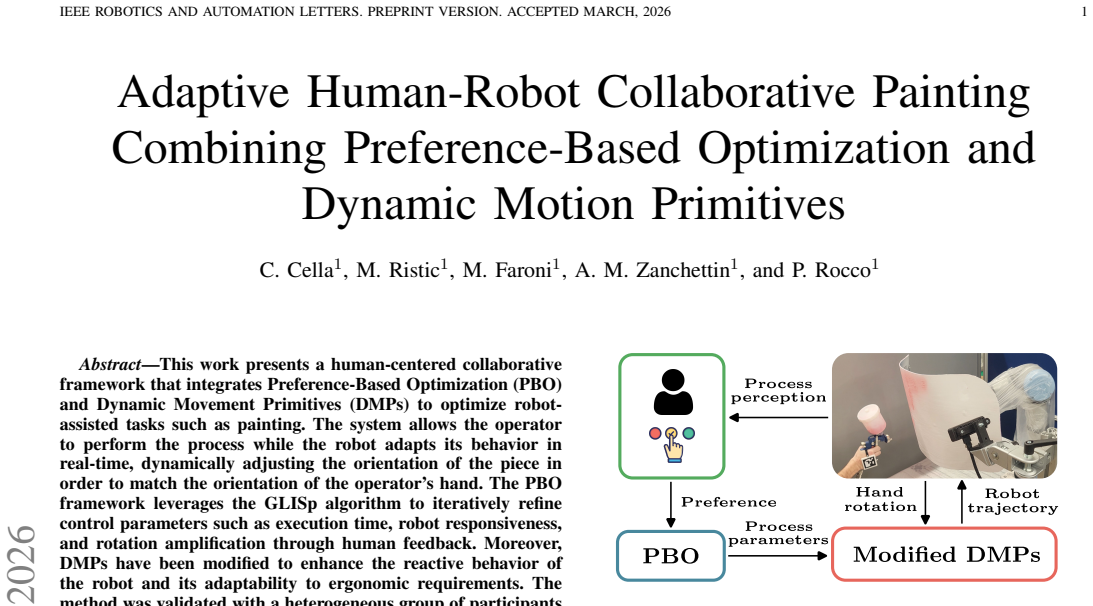
The load-bearing mechanism is a modified DMP system with three tunable parameters: tau-bar (time scaling), k_m (maximum rotation amplification), and k_s (responsiveness gain). The orientation part of the DMP uses a quaternion logarithm to convert the camera-tracked hand rotation into a Rodrigues vector, multiplies it by a sigmoidal factor sigma_r that ranges from k_m to 1, and feeds the scaled rotation back as the orientation goal g_bar_o; a second sigmoid sigma_s computes the goal-robot orientation distance and adds the term gamma_s = alpha_z * k_s * sigma_s * eta to make the robot react quickly when it falls behind. GLISp treats [tau-bar, k_s, k_m] as design variables, learns an inverse-qu
What would settle it
Run the same fifteen-trial preference loop multiple times with the same participant (or against a synthetic preference function with a known optimum) and compare the returned theta-star across repetitions; if the parameters vary widely or consistently miss the known optimum, the claim that PBO is finding per-operator optima is false. In parallel, replace the visual painted-surface inspection with quantitative coverage or paint-thickness measurement; if the optimized trials show a coverage drop relative to the static baseline, the claim of maintaining process quality fails.
Extended reading notes
Core claim
The central claim is that combining preference-based optimization with a modified dynamic-movement-primitive formulation turns a fixed painting robot into an adaptive assistant that reduces operator effort while preserving process quality. Concretely, the robot's orientation goal is not the raw orientation of the operator's hand but a sigmoid-scaled version of it: small hand rotations are amplified by a factor up to k_m, so the operator can paint a large workpiece with a small hand motion, and when the robot lags behind, an extra coupling term with gain k_s temporarily removes damping to catch up. The time scaling tau-bar sets the overall speed. These three parameters are optimized per opera
Load-bearing premise
The entire optimization rests on the assumption that fifteen pairwise preference queries per participant are enough for GLISp to converge to the operator's true preferred parameter set; the paper provides no convergence certificate, no repeated runs, and no distance to the latent optimum, so the 'optimized' parameters could be merely the best of a short sample.
Editorial extensions
If this is right
- If the central claim is right, the same preference loop can be applied to other non-contact assistive tasks in which the robot holds a workpiece (sealing, sanding, inspection), since the modified DMPs and the three-parameter tuning do not depend on paint-specific mechanics.
- Per-operator optimization matters: participants with similar heights chose similar rotation gains, while time scaling converged to individual paces (roughly 14-50 s), so a one-size-fits-all parameter set would not capture the same comfort.
- The increasing questionnaire scores across active-learning iterations indicate that the exploration phase is uncomfortable but converges; therefore the final settings are the ones operators prefer, not just the ones that reduce measured motion.
- The reported stability is good: only one of fifteen experiments was infeasible (too-high joint velocities), suggesting the chosen parameter bounds keep the robot within safe dynamics.
Reading between the lines
- One testable extension is to replace the visual painted-surface check with thickness or coverage measurement; the current claim of maintained process quality would then be verified against a quantitative standard rather than inspection.
- Because 15 preference queries have no convergence certificate, a rigorous validation would rerun the loop multiple times per participant or use a simulated preference function with a known optimum to measure how far the returned theta-star lies from the true optimum.
- The framework's ergonomic benefit is measured through range of motion, not physiological load; an EMG or joint-angle-based study could reveal whether reduced hand motion actually translates into reduced muscular effort.
- The paper's own future-work suggestion of adding the trajectory endpoints p_A and p_C to the design variables could eliminate the initial hand-workpiece mismatch that forced some participants to choose high k_m and k_s, potentially improving outcomes for outliers such as P5.
Editorial analysis
A structured set of objections, weighed in public.
Referee Report
Summary. The paper presents a human-robot collaborative painting framework in which a UR5e holds a workpiece and adapts its orientation to the operator's hand, using a modified Dynamic Movement Primitives (DMP) formulation and a GLISp preference-based optimization (PBO) loop. The system has three design parameters (time scale τ̄, responsiveness k_s, rotation amplification k_m) tuned per operator. In a user study with 15 participants, each operator painted a workpiece in two conditions: robot static and full Algorithm 1. The paper reports a 29-73% reduction in lateral hand-motion range, a mean 31% reduction in overhead range, increasing questionnaire scores, and acceptable painted-surface percentage A%.
Significance. If the causal claims were supported, the framework would be a useful integration of preference learning and DMP-based reactive motion for non-contact assistive tasks. The real-robot implementation with 15 participants and the custom quantitative metrics are commendable, and the equations for orientation scaling (Eq. 3) and responsiveness (Eq. 4) are clearly motivated. However, the experimental design lacks a control that isolates the PBO contribution, the overhead-success criterion is applied post hoc, and no inferential statistics are reported. The evidence is therefore suggestive rather than conclusive; the contribution claim needs a stronger experimental design.
major comments (4)
- [Section V, experimental conditions] The comparison is only between a static-robot baseline and the full Algorithm 1. There is no condition with the modified DMPs active at fixed (non-optimized) θ, so the reported reductions in λx and λz (Figs. 5-6) and the questionnaire trends (Fig. 8) cannot be attributed to the PBO loop; they may be produced entirely by the modified DMP terms in Eqs. (3)-(4). The abstract's claim 'effectively reduces operator effort while optimizing process outcomes' is thus not secured for the combined PBO+DMP method.
- [Section V-B, Eq. (11), Fig. 6] The success criterion is stated as ξ_i<1 AND λz>0. For P2 and P7, where λz is negative (increased variability), the paper counts them as successes because ξ_opt<1. This is a post-hoc redefinition of the criterion. P5 is described as a failure despite λz>0 because ξ is not <1. The rule is therefore applied inconsistently, making the overhead-ergonomics claim non-falsifiable. Please pre-specify a single success rule and apply it uniformly.
- [Section V-B and V-E] No statistical tests are reported. For n=15, mean reductions and ranges are given without confidence intervals or effect sizes, and the questionnaire 'increasing trend' rests on visual inspection. Painted-surface percentage A% is reported only for the final optimized test (Fig. 7); no A% is given for the static condition or for non-optimized parameter sets, so the claim of 'optimizing process outcomes' lacks a reference point. Formal inference and a coverage baseline are needed.
- [Section IV-C, Table I] N=15 is adopted for a 3D parameter space with the statement that the number 'guarantees convergence,' but no convergence certificate, replication, or sensitivity analysis is provided. Without evidence that the GLISp loop has approached the latent optimum, θ* may be no more than the best of a short sample, and the specific benefit of preference-based optimization over fixed-parameter adaptive DMPs is unsupported.
minor comments (6)
- [Section V-E] The formula for the average questionnaire score appears corrupted: '¯q_i,k = (PNp=6 j=1 qj i,k)/Np' should be written with clear indices and summation limits.
- [Equation (8)] The floor expressions are ambiguous; add braces to clarify that the denominators apply to the full differences, e.g., ⌊(N−N̄)/4⌋.
- [Section IV-B] a_d and a_s are negative in Table I, but the text describes σ_r and σ_s as decreasing/increasing sigmoids without stating the sign convention; make the intended behavior explicit.
- [Section IV-C] The recalibration sequence α is defined in the text but not included in Table I; please list its values or refer explicitly to the formula.
- [Figures 5 and 6] The captions use 'curves' for shaded regions and 'red and blue curves for optimal case,' which is confusing; use 'shaded areas' and describe what is plotted.
- [Section V, participants] The participant sample is described as 'heterogeneous,' but it consists of students aged 25.2±0.98 years; please temper the wording or justify representativeness.
Circularity Check
No significant circularity: kinematic effort metrics are independent of the preference surrogate, and the GLISp algorithm is external.
full rationale
The paper's derivation chain is self-contained. The modified DMPs (Eqs. 1,3,4) define a forward mapping from operator hand orientation to robot reference orientation, with tunable parameters θ=[τ̄,k_s,k_m]. GLISp [5] is an external, previously published preference-learning algorithm used to select θ from pairwise comparisons, not derived in this paper. The quantitative validation metrics λ_x and λ_z (Eqs. 11-12) are computed from measured hand-position data and are not inputs to the preference surrogate, so the headline 'reduces operator effort' is externally grounded. The painted-surface percentage A% is likewise an independent process measurement. The questionnaire data are explicitly described by the authors as 'not meant to be an exhaustive evaluation' (Sec. V-D) and serve as a secondary, contextual signal; although the comfort questions are related to the same subjective signal GLISp uses, the central quantitative claims do not reduce to that signal by construction. Self-citations [4] and [15] are contextual references to prior work on ergonomic manipulation and PBO applications, not load-bearing uniqueness or ansatz justifications. The absence of an ablation condition (modified DMPs with fixed, non-optimized θ) is a real experimental limitation but concerns attribution of the effect to PBO versus DMPs, not circularity.
Assumptions & free parameters
free parameters (7)
- θ = [τ̄, k_s, k_m] =
per-participant values; e.g., τ̄ converges to times around 14-50 s, k_m and k_s vary by participant (Fig. 7)
- sigmoid parameters a_d, δ_d =
a_d=-10, δ_d=0.35 rad
- sigmoid parameters a_s, δ_s =
a_s=-10, δ_s=0.35 rad
- PBO hyperparameters N̄, N, δ_E, ϵ =
N̄=6, N=15, δ_E=0.5, ϵ=1 (initial)
- head-height offset δ_H =
0.3 m
- number of clusters k=2 in k-means =
2
- DMP forcing-term weights w_p, w_o =
learned via LWR from the teleoperated demonstration
assumptions (6)
- domain assumption GLISp with N=15 preference queries converges close enough to the true optimum of the latent preference function in a 3D parameter space.
- domain assumption The single teleoperated demonstration trajectory is an adequate human-like reference for all participants, and Cartesian position is not adapted to participant height.
- domain assumption The camera-based estimate of the operator's hand orientation is accurate, and the initial hand frame h0 is suitably aligned with the robot reference hR(t0).
- ad hoc to paper The modified DMP dynamics remain stable when the responsiveness term γ_s approaches the damping-removal limit.
- standard math Standard DMP and quaternion algebra results: critical damping coefficients, phase dynamics, logarithmic map, and rotation distance metric from refs [16,17,21,22].
- domain assumption The k-means two-cluster partition of optimized hand x-positions is the correct model for lateral effort.
Cite this review
Pith. "Pith review of Adaptive Human-Robot Collaborative Painting Combining Preference-Based Optimization and Dynamic Motion Primitives." pith.science (2026). https://pith.science/paper/NSB7BZGA
@misc{pith2026260801981,
  author       = {Pith},
  title        = {Pith review of: Adaptive Human-Robot Collaborative Painting Combining Preference-Based Optimization and Dynamic Motion Primitives},
  year         = {2026},
  howpublished = {\url{https://pith.science/paper/NSB7BZGA}},
  note         = {Machine review of arXiv:2608.01981}
}
read the original abstract
This work presents a human-centered collaborative framework that integrates Preference-Based Optimization (PBO) and Dynamic Movement Primitives (DMPs) to optimize robot-assisted tasks such as painting. The system allows the operator to perform the process while the robot adapts its behavior in real-time, dynamically adjusting the orientation of the piece in order to match the orientation of the operator's hand. The PBO framework leverages the GLISp algorithm to iteratively refine control parameters such as execution time, robot responsiveness, and rotation amplification through human feedback. Moreover, DMPs have been modified to enhance the reactive behavior of the robot and its adaptability to ergonomic requirements. The method was validated with a heterogeneous group of participants executing \rev{painting tasks}. The results show that our strategy effectively reduces operator effort while optimizing process outcomes.
Figures


Figures from the paper (5 more)


Reference graph
Works this paper leans on
-
[1]
Recent developments regarding painting robots for research in automatic painting, artificial creativity, and machine learning
J. M. Gülzow, P. Paetzold, and O. Deussen. “Recent developments regarding painting robots for research in automatic painting, artificial creativity, and machine learning”. In:Applied Sciences10.10 (2020), p. 3396
2020
-
[2]
Adaptive leader-follower behavior in human-robot collaboration
E. M. Van Zoelen, E. I. Barakova, and M. Rauterberg. “Adaptive leader-follower behavior in human-robot collaboration”. In:2020 29th IEEE International Conference on Robot and Human Interactive Communication (RO-MAN). IEEE. 2020, pp. 1259–1265
2020
-
[3]
Implementation of industrial robot for painting applications
I. W. Muzan, T. Faisal, H. Al-Assadi, and M. Iwan. “Implementation of industrial robot for painting applications”. In:Procedia engineering 41 (2012), pp. 1329–1335
2012
-
[4]
Collaborative robot assistant for the ergonomic manipulation of cumbersome objects
A. M. Zanchettin, E. Lotano, and P. Rocco. “Collaborative robot assistant for the ergonomic manipulation of cumbersome objects”. In: 2019 IEEE/RSJ International Conference on Intelligent Robots and Systems (IROS). IEEE. 2019, pp. 6729–6734
2019
-
[5]
Global optimization based on active preference learning with radial basis functions
A. Bemporad and D. Piga. “Global optimization based on active preference learning with radial basis functions”. In:Machine Learning 110.2 (2021), pp. 417–448
2021
-
[6]
Learning dynamic robot-to-human object handover from human feedback
A. Kupcsik, D. Hsu, and W. S. Lee. “Learning dynamic robot-to-human object handover from human feedback”. In:Robotics Research: Volume 1(2018), pp. 161–176
2018
-
[7]
Control techniques for safe, ergonomic, and efficient human-robot collaboration in the digital industry: A survey
S. Proia, R. Carli, G. Cavone, and M. Dotoli. “Control techniques for safe, ergonomic, and efficient human-robot collaboration in the digital industry: A survey”. In:IEEE Transactions on Automation Science and Engineering19.3 (2021), pp. 1798–1819
2021
-
[8]
Ergonomic human-robot collaboration in industry: A re- view
M. Lorenzini, M. Lagomarsino, L. Fortini, S. Gholami, and A. Ajoudani. “Ergonomic human-robot collaboration in industry: A re- view”. In:Frontiers in Robotics and AI9 (2023), p. 813907
2023
Show all 28 references
-
[9]
Trends of human-robot collabora- tion in industry contexts: Handover, learning, and metrics
A. Castro, F. Silva, and V . Santos. “Trends of human-robot collabora- tion in industry contexts: Handover, learning, and metrics”. In:Sensors 21.12 (2021), p. 4113
2021
-
[10]
Automatic Optimal Robotic Base Placement for Collaborative Industrial Robotic Car Painting
K. Zbiss, A. Kacem, M. Santillo, and A. Mohammadi. “Automatic Optimal Robotic Base Placement for Collaborative Industrial Robotic Car Painting”. In:Applied Sciences14.19 (2024), p. 8614
2024
-
[11]
Cofrida: Self-supervised fine-tuning for human-robot co-painting
P. Schaldenbrand, G. Parmar, J.-Y . Zhu, J. McCann, and J. Oh. “Cofrida: Self-supervised fine-tuning for human-robot co-painting”. In:2024 IEEE International Conference on Robotics and Automation (ICRA). IEEE. 2024, pp. 2296–2302
2024
-
[12]
Preference-based optimization of a human-robot collabora- tive controller
M. Maccarini, F. Pura, D. Piga, L. Roveda, L. Mantovani, and F. Braghin. “Preference-based optimization of a human-robot collabora- tive controller”. In:IFAC-PapersOnLine55.38 (2022), pp. 7–12
2022
-
[13]
Promoting Trust in Industrial Human- Robot Collaboration through Preference-Based Optimization
G. Campagna, M. Lagomarsino, M. Lorenzini, D. Chrysostomou, M. Rehm, and A. Ajoudani. “Promoting Trust in Industrial Human- Robot Collaboration through Preference-Based Optimization”. In: IEEE Robotics and Automation Letters(2024)
2024
-
[14]
A framework for human–robot collaboration enhanced by preference learning and ergonomics
M. M. Falerni, V . Pomponi, H. R. Karimi, M. L. Nicora, M. Malosio, L. Roveda, et al. “A framework for human–robot collaboration enhanced by preference learning and ergonomics”. In:Robotics and Computer- Integrated Manufacturing89 (2024), p. 102781
2024
-
[15]
Pairwise preferences-based optimiza- tion of a path-based velocity planner in robotic sealing tasks
L. Roveda, B. Maggioni, E. Marescotti, A. A. Shahid, A. M. Zanchet- tin, A. Bemporad, and D. Piga. “Pairwise preferences-based optimiza- tion of a path-based velocity planner in robotic sealing tasks”. In:IEEE Robotics and Automation Letters6.4 (2021), pp. 6632–6639
2021
-
[16]
Movement imitation with nonlinear dynamical systems in humanoid robots
A. J. Ijspeert, J. Nakanishi, and S. Schaal. “Movement imitation with nonlinear dynamical systems in humanoid robots”. In:Proceedings 2002 IEEE International Conference on Robotics and Automation (Cat. No. 02CH37292). V ol. 2. IEEE. 2002, pp. 1398–1403
2002
-
[17]
Dynamic movement primitives in robotics: A tutorial survey
M. Saveriano, F. J. Abu-Dakka, A. Kramberger, and L. Peternel. “Dynamic movement primitives in robotics: A tutorial survey”. In:The International Journal of Robotics Research42.13 (2023), pp. 1133– 1184
2023
-
[18]
DMP-based reactive robot-to-human handover in perturbed scenarios
F. Iori, G. Perovic, F. Cini, A. Mazzeo, E. Falotico, and M. Con- trozzi. “DMP-based reactive robot-to-human handover in perturbed scenarios”. In:International Journal of Social Robotics15.2 (2023), pp. 233–248
2023
-
[19]
Adaptive Robot-Human Handovers with Preference Learning
G. Perovic, F. Iori, A. Mazzeo, M. Controzzi, and E. Falotico. “Adaptive Robot-Human Handovers with Preference Learning”. In: IEEE Robotics and Automation Letters(2023)
2023
-
[20]
Auto- matic collision-free trajectory generation for collaborative robotic car- painting
K. Zbiss, A. Kacem, M. Santillo, and A. Mohammadi. “Auto- matic collision-free trajectory generation for collaborative robotic car- painting”. In:IEEE Access10 (2022), pp. 9950–9959
2022
-
[21]
Orientation in cartesian space dynamic movement primitives
A. Ude, B. Nemec, T. Petri ´c, and J. Morimoto. “Orientation in cartesian space dynamic movement primitives”. In:2014 IEEE Inter- national Conference on Robotics and Automation (ICRA). IEEE. 2014, pp. 2997–3004
2014
-
[22]
Bruno, S
S. Bruno, S. Lorenzo, V . Luigi, and O. Giuseppe.Robotics: modelling, planning and control. 2010
2010
-
[23]
A radial basis function method for global optimiza- tion
H.-M. Gutmann. “A radial basis function method for global optimiza- tion”. In:Journal of global optimization19.3 (2001), pp. 201–227
2001
-
[24]
C-GLISp: Preference-based global optimization under unknown constraints with applications to controller calibration
M. Zhu, D. Piga, and A. Bemporad. “C-GLISp: Preference-based global optimization under unknown constraints with applications to controller calibration”. In:IEEE Transactions on Control Systems Technology30.5 (2021), pp. 2176–2187
2021
-
[25]
Quest2ros: An app to facilitate teleoperating robots
M. C. Welle, N. Ingelhag, M. Lippi, M. Wozniak, A. Gasparri, and D. Kragic. “Quest2ros: An app to facilitate teleoperating robots”. In: 7th International Workshop on Virtual, Augmented, and Mixed-Reality for Human-Robot Interactions. 2024
2024
-
[26]
Uniform coverage of automotive surface patches
P. N. Atkar, A. Greenfield, D. C. Conner, H. Choset, and A. A. Rizzi. “Uniform coverage of automotive surface patches”. In:The International Journal of Robotics Research24.11 (2005), pp. 883–898
2005
-
[27]
Systematic comparison of OW AS, RULA, and REBA based on a literature review
D. Kee. “Systematic comparison of OW AS, RULA, and REBA based on a literature review”. In:International Journal of Environmental Research and Public Health19.1 (2022), p. 595
2022
-
[28]
Analyzing the effects of human-aware motion planning on close-proximity human–robot collaboration
P. A. Lasota and J. A. Shah. “Analyzing the effects of human-aware motion planning on close-proximity human–robot collaboration”. In: Human factors57.1 (2015), pp. 21–33
2015
Reviewed August 4, 2026 · model on record in the stance chip above.
Discussion (0). Sign in to comment.