REVIEW 4 major objections 6 minor 100 references
Resurgence of CO in a warm bubble around accreting protoplanets and its observability
T0 review · 4 major / 6 minor · reviewed 2026-08-06 · deepseek-v4-flash
Pith's one-line read A luminous accreting protoplanet outside the CO snowline keeps a warm bubble of gas-phase CO around itself, and the bubble shows up as a 9-sigma residual in synthetic ALMA C18O channel maps.
desk verdict A solid simulation-based proof of concept for a new protoplanet detection channel, with the headline 9-sigma claim resting on an unpublished subtraction pipeline and a parametric luminosity. read the letter →
The pith
A machine-rendered reading of the paper's core claim, the machinery that carries it, and where it could break.
The reading
What carries the argument
The load-bearing object is the warm CO bubble, whose size is set by the balance between the planet's accretion luminosity $L = G M_p^2/(R_p t_{\rm acc})$ and radiative cooling through two-population dust opacities: small submicron grains set the irradiation surface, while large millimeter grains regulate cooling. The bubble becomes observable through a freeze-out scaling: wherever $T \le 21$ K the CO abundance is multiplied by $f_{\rm freeze} = 10^{-5}$, so the $T > 21$ K region stands out against the frozen midplane. The detection pipeline is the subtraction of an axially symmetric kinematic model of the disk from the data cube, followed by median filtering, which turns the bubble into a point-source residual between the dragonfly wings.
What would settle it
Look for the bubble in a real disk with an independently confirmed accreting giant planet near 100 au: a C18O(2-1) observation at about 70 mas resolution, 0.2 km/s channels, and a deep integration should show a point-source residual above roughly 6$\sigma$ at the planet's position after subtraction of the axisymmetric disk flow. A clean non-detection that cannot be blamed on viewing geometry or deblending would refute the claim that the accretion-heated bubble is observable.
Extended reading notes
Core claim
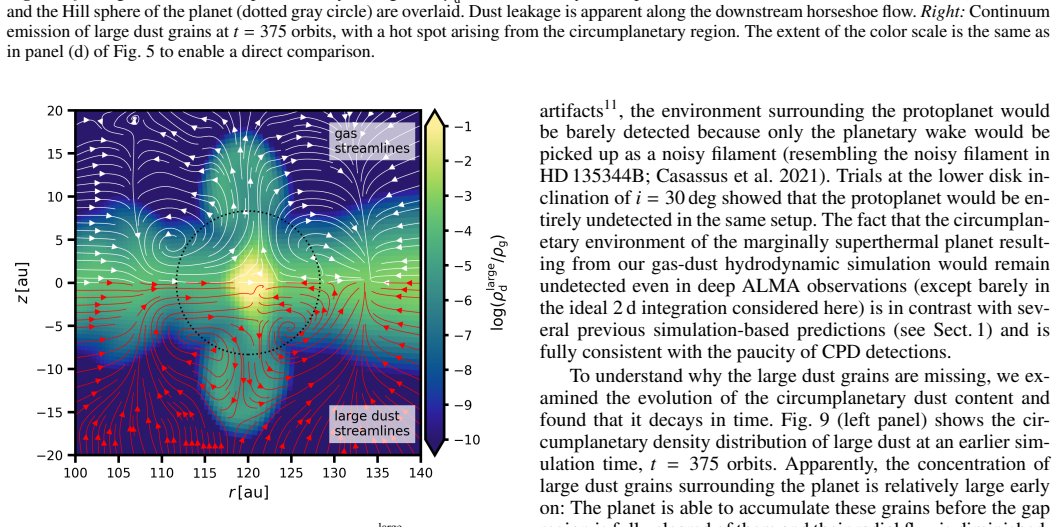
In the nominal 3D radiation-hydrodynamic run, a Jupiter-mass planet at 120 au outside the CO snowline, with accretion luminosity $L_p = 2.8 \times 10^{-3}\,L_\odot$ (mass-doubling time 0.1 Myr and effective temperature about 4000 K), maintains a warm bubble in which the temperature stays above the 21 K freeze-out threshold out to slightly beyond the Hill radius. Because the model resets the CO abundance by a factor of $1/f_{\rm freeze} = 10^5$ wherever $T > 21$ K, the bubble contains far more gas-phase CO than the surrounding frozen interior. Monte Carlo radiative-transfer post-processing of the same grid predicts that in C18O(2-1) channel maps this bubble is a low-intensity optically thick spot sitting in the void between the dragonfly wings; its emission intensity is nearly independent of isotopolog because unity optical depth is reached at the bubble's cool outskirts. After degrading to a 70 mas beam, adding ALMA-style thermal noise, and subtracting an axially symmetric kinematic disk model, the peak point-source residual reaches 9$\sigma$ at +1.6 km/s (6$\sigma$ at +1.2 and +1.4 km/s), so the planet would be detectable without a continuum counterpart. The same model shows the horseshoe flow removes millimeter-sized grains from the circumplanetary region, so the thermal continuum there is essentially absent, explaining the rarity of ALMA circumplanetary-disk detections.
Load-bearing premise
The entire bubble rests on how much energy the planet actually releases while swallowing gas: the luminosity is put in by hand as a 0.1 Myr mass-doubling time, not computed self-consistently, and the paper's own sensitivity test shows that a five-times-weaker release shrinks the bubble to 45% of its nominal size.
Editorial extensions
If this is right
- In the nominal model the bubble is detectable in C18O(2-1) at 9$\sigma$ peak after subtracting the axisymmetric disk flow, so CO channel maps can reveal an embedded giant planet even where the millimeter continuum and velocity kinks show nothing.
- Because the bubble is optically thick, its brightness is almost independent of isotopolog; any CO isotopolog that is optically thin or weakly stratified across the gap, especially C18O, can serve as the tracer.
- The model reproduces the observed scarcity of ALMA continuum detections of circumplanetary disks: horseshoe-flow depletion removes large dust within roughly 450 orbits, so the circumplanetary continuum fades with time.
- Weaker accretion changes the picture: with a five-times-longer mass-doubling time the bubble shrinks to 45% of its nominal size, and a 20-Earth-mass planet with the same mass-doubling time yields a 30%-size bubble that is not detectable even in roughly 7-day integrations.
- The bubble's size also depends on the dust opacity law; using uniform opacities recovers 73% of the nominal diameter for the same reduced luminosity, so the same observable can be produced by different combinations of luminosity and opacity.
Reading between the lines
- Editorial inference: a bubble-size measurement would not translate directly into an accretion rate, because the bubble diameter also depends on the dust opacity law; surveys that use bubble size to rank accretion rates would need independent opacity constraints.
- Editorial inference: the model implies young embedded giants should be continuum-bright early in their gap-clearing phase and then fade as horseshoe flows drain dust, so multi-epoch millimeter monitoring could distinguish newly formed planets from older ones.
- Editorial inference: the quoted 9-sigma detection assumes roughly two days of integration under ideal calibration; realistic long-baseline observations with phase noise will likely need the median-filtered residual technique and favorable geometry, with inclination near 45 degrees and the planet off the disk minor axis, to reproduce the signal.
- Editorial inference: if accretion luminosities near the assumed value are common during giant-planet formation, the same procedure could turn existing deep CO surveys of disks beyond roughly 70 au into automated protoplanet searches that do not wait for continuum or H-alpha detections.
Editorial analysis
A structured set of objections, weighed in public.
Referee Report
Summary. The paper presents 3D two-fluid radiation-hydrodynamic simulations (FARGO3D with a two-population dust model and frequency-averaged radiation transport) of a protoplanetary disk hosting a Jupiter-mass planet at 120 au, embedded in the CO freeze-out region beyond the snowline. The planet's accretion luminosity, parameterized by a mass-doubling time t_acc = 0.1 Myr (L_p = 2.8e-3 L_sun, T_p,e ~ 4000 K), maintains a warm bubble with T > 21 K extending slightly beyond the Hill sphere, so gas-phase CO survives locally despite the cold background. Post-processing with RADMC-3D and an instantaneous freeze-out prescription (ffreeze = 1e-5) yields synthetic C18O(2-1) channel maps in which the bubble appears as a low-intensity spot between the dragonfly wings of the line-forming surfaces. After adding thermal noise and subtracting an axially symmetric kinematic disk model computed with the unpublished disckin package, the point-source residual peaks at 9 sigma at +1.6 km/s. A companion result is that large dust grains are evacuated from the circumplanetary region by the horseshoe flow, making the planet nearly invisible in 1 mm continuum, consistent with the scarcity of ALMA circumplanetary detections. Appendix B reports sensitivity runs: a fivefold lower luminosity (S1) shrinks the bubble to 45% of the nominal diameter, an altered opacity law (S2) partly compensates, a planet at 85 au (S3) gives a similar bubble, and a 20 M_Earth planet (S4) produces a bubble that is not detectable.
Significance. Taken at face value, the paper offers a new, falsifiable observable channel for embedded accreting protoplanets outside the CO snowline: a thermally revived CO bubble that is visible even when the circumplanetary continuum is not. The mechanism is an emergent property of the forward RHD model rather than a fit to any target observation, so the circularity concern does not land; the audibility concern does, because the quantitative 9 sigma claim rests on a subtraction pipeline whose validation is deferred and on thermal-noise-only synthetic data. The paper deserves credit for its transparency: the parameter set is fully tabulated, the simulation codes are public, the noise calibration and median-filter steps are described in enough detail to reproduce, and the Appendix B sensitivity suite brackets the detectability in luminosity and planet mass. The continuum-depletion result (horseshoe-flow removal of large grains) is a clean mechanistic prediction that directly addresses a known observational tension.
major comments (4)
- [§4.2, disckin subtraction and the 9 sigma claim] The abstract's quantitative headline ("the peak PS residual is at 9 sigma at +1.6 km/s") is produced by the disckin package, cited as "Casassus et al. in prep", whose underlying model "will be benchmarked against the input hydrodynamics in an upcoming article." The manuscript itself reports that at disk velocities the disckin model fits part of the bubble into the axisymmetric background, so the surviving residual is exactly the portion that the model cannot absorb. Since the subtraction depends on tunable choices (the free parameter Rfreeze, the 5-beam median kernel, and the 3 sigma pixel selection), the reported significance cannot be independently audited until either a full algorithmic description of disckin is supplied or a benchmark is shown, for example a null test on a planet-free control simulation or a comparison of the disckin model surfaces with the actual hydrodynamics. I request that this validation be added to the paper, or that the detection claim in the abstract be demoted to the raw channel-map identification of Fig. 5a, which does not depend on disckin.
- [§5 and Appendix B, parametric luminosity] The authors state in §5 that "the accretion luminosity, which is of critical importance for the formation of the bubble, is parametric and was not obtained in a self-consistent manner." The sensitivity runs quantify the stakes: with L_p reduced by a factor of about 5 (S1), the bubble shrinks to 45% of its nominal diameter, and a 20 M_Earth planet with the same t_acc (S4) gives a bubble of 30% nominal size that "cannot be localized as a significant point source residual" even in a ~7 d integration. Because the true accretion luminosities of embedded planets at ~100 au span a wide and poorly constrained range, the observability claim holds only for a subset of that range. The abstract's unconditional phrasing ("enabling new automatic detections of forming protoplanets") should therefore be qualified by the luminosity and planet-mass conditions established in Appendix B.
- [§4.2, synthetic observation setup and detection statistics] The 9 sigma significance refers to a peak pixel in residuals that are thermal-noise-limited by construction: the text states that "systematic errors due to sparse uv-plane sampling" are neglected and perfect calibration is assumed. Real ALMA data contain correlated nonthermal residuals, and the 5-beam median filter correlates the noise in the residual maps, so a peak-over-rms ratio is not a matched-filter detection significance. I ask the authors to report a PSF-weighted or matched-filter S/N for the bubble and to state the number of independent beams searched, so that a trials-corrected significance can be evaluated; this can be done with the existing residual cubes and does not require new hydrodynamics.
- [§B.3, simulation S4] The nondetection around a 20 M_Earth planet rests on a main-stage run of only 25 orbits (Table B.1), i.e., about 20 kyr at 85 au, during which large dust is artificially removed from the planet's vicinity to keep the dust-to-gas ratio below 90%. It is not demonstrated that the bubble structure has converged on this timescale or that the dust-removal procedure does not alter the local thermal balance. A longer integration or an explicit convergence check for the S4 bubble would make the conclusion that subthermal-mass planets are undetectable more robust.
minor comments (6)
- [§2.4] The freeze-out treatment (T <= 21 K, ffreeze = 1e-5) and the neglect of photodissociation and microturbulence are acknowledged, but a sentence assessing their effect on the bubble contrast specifically (as distinct from the dragonfly wings) would help; the claim that the bubble is optically thick suggests the intensity is set by temperature rather than by ffreeze, and this robustness could be stated explicitly.
- [§Abstract] The phrase "very rich observable chemistry" goes beyond what is modeled: the simulations cover only CO and its isotopologs with an identical LTE excitation treatment. Suggest rephrasing, for example, "the bubble is visible in multiple CO isotopologs."
- [§4.2 and Fig. 6] The caption's "Symmetric velocity channels" should be defined; presumably these are channels symmetric about the systemic velocity (v and -v), which is not stated.
- [§4.2] The description of the noise calibration (rms "amplified by a factor close to sqrt(N), where N is the number of pixels in the solid angle covered by the Gaussian beam") is hard to follow; please state directly what noise level applies to the beam-smoothed cubes, and the assumed integration time and array configuration.
- [§3.1 and Fig. 4] The convergence information is given only for Sigma_g (change of 5% per 100 orbits); a corresponding check on the size of the T = 21 K bubble (for example, its azimuthally averaged extent during the last few hundred orbits) would strengthen the nominal case.
- [§2.3.3] The minimum dust density of 10^{-180} g cm^{-3} mentioned in the discussion of the high-altitude damping zones is a striking numerical value; please state the actual floor value imposed in the code and confirm that the midplane dust evolution is unaffected by it.
Circularity Check
No circular derivation: the CO bubble emerges from forward radiation-hydrodynamics; the main caveats are a parametric accretion luminosity and an unvalidated, self-cited disckin subtraction pipeline, which affect robustness but do not reduce the prediction to its inputs.
full rationale
The central prediction, a warm CO bubble around a luminous planet outside the snowline, is an emergent output of a 3D two-fluid radiation-hydrodynamics simulation, not a quantity fitted to target observations. The CO abundance enhancement is prescribed as a physical freeze-out law (ffreeze = 1e-5 for T <= 21 K, Sect. 2.4), and the bubble's existence follows from the computed temperature field exceeding 21 K; while this abundance law is an input, the temperature structure, bubble size, and emission morphology are simulation outputs, and Appendix B explicitly varies the luminosity and opacity to show sensitivity. The accretion luminosity is stated as a parametric input (Eq. 16, t_acc = 0.1 Myr), and the paper itself flags it as 'not obtained in a self-consistent manner' (Sect. 5), which is parameter sensitivity rather than circularity. The headline 'peak PS residual ... at 9 sigma' (Sect. 4.2) is produced after subtracting an axisymmetric model from the synthetic cubes with the package disckin (Casassus et al. in prep), and the paper states the model 'will be benchmarked against the input hydrodynamics in an upcoming article'; this is a self-citation to unpublished, unvalidated software that limits independent auditability of the automatic-detection claim, but it does not make the bubble signal equivalent to the subtraction input, since the bubble is already visually conspicuous in the unsubtracted synthetic channel maps (Fig. 5a) and the paper explicitly notes disckin can partly absorb the bubble, so the surviving residual is not a fit renamed as a prediction. No step in the derivation chain reduces an equation to itself or a fitted parameter to a predicted observable; the limitations are robustness and validation concerns, not circularity. Score 2 reflects the mild self-citation and validation burden rather than a circular derivation.
Assumptions & free parameters
free parameters (5)
- Planet mass-doubling time t_acc =
0.1 Myr (Lp = 2.8e-3 Lsun, Tp,e about 4000 K)
- Initial large-grain mass fraction X0 =
0.9
- Kinematic viscosity parameter alpha =
5e-4
- Initial dust-to-gas ratio Z0 =
0.01
- Rfreeze in the disckin model =
not quoted (free parameter)
assumptions (8)
- domain assumption Ideal gas equation of state with gamma = 1.43 and gas-dust thermal equilibrium
- domain assumption Small dust grains are perfectly coupled to the gas and trace the gas distribution (Eq. 2)
- ad hoc to paper CO chemistry is reduced to instantaneous freeze-out and sublimation with T <= 21 K and abundance scaling by ffreeze = 1e-5, with no photodissociation or microturbulence
- ad hoc to paper Accretion luminosity is parameterized as L = G Mp^2 / (Rp tacc) with tacc = 0.1 Myr and is not obtained self-consistently
- domain assumption Dust opacities come from two fixed grain sizes (0.1 micron and 1 mm) with DSHARP composition and 50% porosity, mixed via Eq. (24)
- domain assumption Large grains are treated as a pressureless fluid with Stokes number capped at 0.5
- domain assumption The disckin axisymmetric line-forming surfaces in LTE with meridional flows and free parameter Rfreeze reproduce the disk background
- domain assumption The planet orbit is fixed and circular, with boundary damping near the disk surfaces and dust reintroduced at the outer edge
Cite this review
Pith. "Pith review of Resurgence of CO in a warm bubble around accreting protoplanets and its observability." pith.science (2026). https://pith.science/paper/NSEAZK3Q
@misc{pith2026250703370,
  author       = {Pith},
  title        = {Pith review of: Resurgence of CO in a warm bubble around accreting protoplanets and its observability},
  year         = {2026},
  howpublished = {\url{https://pith.science/paper/NSEAZK3Q}},
  note         = {Machine review of arXiv:2507.03370}
}
abstract
The cold outer regions of protoplanetary disks are expected to contain a midplane-centered layer where gas-phase CO molecules freeze out and their overall abundance is low. The layer then manifests itself as a void in the channel maps of CO rotational emission lines. We explore whether the frozen-out layer can expose the circumplanetary environment of embedded accreting protoplanets to observations. To this end, we performed 3D radiative gas-dust hydrodynamic simulations with opacities determined by the redistribution of submicron- and millimeter-sized dust grains. A Jupiter-mass planet with an accretion luminosity of $\sim$$10^{-3}\,L_{\odot}$ was considered as the nominal case. The accretion heating sustains a warm bubble around the planet, which locally increases the abundance of gas-phase CO molecules. Radiative transfer predictions of the emergent sky images show that the bubble becomes a conspicuous CO emission source in channel maps. It appears as a low-intensity optically thick spot located in between the so-called dragonfly wings that trace the fore- and backside line-forming surfaces. The emission intensity of the bubble is nearly independent of the tracing isotopolog, suggesting a very rich observable chemistry, as long as its signal can be deblended from the extended disk emission. This can be achieved with isotopologs that are optically thin or weakly thermally stratified across the planet-induced gap, such as C$^{18}$O. For these, the bubble stands out as the brightest residual in synthetic ALMA observations after subtraction of axially averaged channel maps inferred from the disk kinematics, enabling new automatic detections of forming protoplanets. By contrast, the horseshoe flow steadily depletes large dust grains from the circumplanetary environment, which becomes unobservable in the submillimeter continuum, in accordance with the scarcity of ALMA detections.
Figures


Figures from the paper (8 more)


Reference graph
Works this paper leans on
-
[1]
Andrews , S. M. 2020, , 58, 483
2020
-
[2]
Ayliffe , B. A. & Bate , M. R. 2009, , 397, 657
2009
-
[3]
2023, in Astronomical Society of the Pacific Conference Series, Vol
Bae , J., Isella , A., Zhu , Z., et al. 2023, in Astronomical Society of the Pacific Conference Series, Vol. 534, Protostars and Planets VII, ed. S. Inutsuka , Y. Aikawa , T. Muto , K. Tomida , & M. Tamura , 423
2023
-
[4]
M., et al
Bae , J., Teague , R., Andrews , S. M., et al. 2022, , 934, L20
2022
-
[5]
2024, , 683, A16
Barraza-Alfaro , M., Flock , M., & Henning , T. 2024, , 683, A16
2024
-
[6]
2021, , 916, L2
Benisty , M., Bae , J., Facchini , S., et al. 2021, , 916, L2
2021
-
[7]
2023, in Astronomical Society of the Pacific Conference Series, Vol
Benisty , M., Dominik , C., Follette , K., et al. 2023, in Astronomical Society of the Pacific Conference Series, Vol. 534, Protostars and Planets VII, ed. S. Inutsuka , Y. Aikawa , T. Muto , K. Tomida , & M. Tamura , 605
2023
-
[8]
Ben \' tez-Llambay , P., Krapp , L., & Pessah , M. E. 2019, , 241, 25
2019
Show all 100 references
-
[9]
2015, , 520, 63
Ben \' tez-Llambay , P., Masset , F., Koenigsberger , G., & Szul \'a gyi , J. 2015, , 520, 63
2015
-
[10]
& Masset , F
Ben \' tez-Llambay , P. & Masset , F. S. 2016, , 223, 11
2016
-
[11]
P., Zhu , Z., et al
Birnstiel , T., Dullemond , C. P., Zhu , Z., et al. 2018, , 869, L45
2018
-
[12]
2013, , 549, A124
Bitsch , B., Crida , A., Morbidelli , A., Kley , W., & Dobbs-Dixon , I. 2013, , 549, A124
2013
-
[13]
2018, , 612, A30
Bitsch , B., Morbidelli , A., Johansen , A., et al. 2018, , 612, A30
2018
-
[14]
& C \'a rcamo , M
Casassus , S. & C \'a rcamo , M. 2022, , 513, 5790
2022
-
[15]
2021, , 507, 3789
Casassus , S., Christiaens , V., C \'a rcamo , M., et al. 2021, , 507, 3789
2021
-
[16]
& P \'e rez , S
Casassus , S. & P \'e rez , S. 2019, , 883, L41
2019
-
[17]
& Dong , R
Chen , K. & Dong , R. 2024, , 976, 49
2024
-
[18]
Chiang , E. I. & Goldreich , P. 1997, , 490, 368
1997
-
[19]
& Chametla , R
Chrenko , O. & Chametla , R. O. 2023, , 524, 2705
2023
-
[20]
O., Masset , F
Chrenko , O., Chametla , R. O., Masset , F. S., Baruteau , C., & Bro z , M. 2024 a , , 690, A41
2024
-
[21]
2024 b , , 167, 124
Chrenko , O., Flock , M., Ueda , T., et al. 2024 b , , 167, 124
2024
-
[22]
& Lambrechts , M
Chrenko , O. & Lambrechts , M. 2019, , 626, A109
2019
-
[23]
& Nesvorn \'y , D
Chrenko , O. & Nesvorn \'y , D. 2020, , 642, A219
2020
-
[24]
2024, , 685, L1
Christiaens , V., Samland , M., Henning , T., et al. 2024, , 685, L1
2024
-
[25]
I., Bergin , E
Cleeves , L. I., Bergin , E. A., & Harries , T. J. 2015, , 807, 2
2015
-
[26]
2011, , 529, A35
Commer c on , B., Teyssier , R., Audit , E., Hennebelle , P., & Chabrier , G. 2011, , 529, A35
2011
-
[27]
2022, Nature Astronomy, 6, 751
Currie , T., Lawson , K., Schneider , G., et al. 2022, Nature Astronomy, 6, 751
2022
-
[28]
N., Dobrovolskis , A
Cuzzi , J. N., Dobrovolskis , A. R., & Champney , J. M. 1993, , 106, 102
1993
-
[29]
G., Artymowicz , P., et al
de Val-Borro , M., Edgar , R. G., Artymowicz , P., et al. 2006, , 370, 529
2006
-
[30]
J., & Lodato , G
Dipierro , G., Laibe , G., Price , D. J., & Lodato , G. 2016, , 459, L1
2016
-
[31]
2021, Astrophysics Source Code Library, ascl:2104.010
Dominik , C., Min , M., & Tazaki , R. 2021, Astrophysics Source Code Library, ascl:2104.010
2021
-
[32]
1995, , 114, 237
Dubrulle , B., Morfill , G., & Sterzik , M. 1995, , 114, 237
1995
-
[33]
P., Birnstiel , T., Huang , J., et al
Dullemond , C. P., Birnstiel , T., Huang , J., et al. 2018, , 869, L46
2018
-
[34]
P., Isella , A., Andrews , S
Dullemond , C. P., Isella , A., Andrews , S. M., Skobleva , I., & Dzyurkevich , N. 2020, , 633, A137
2020
-
[35]
P., Juhasz , A., Pohl , A., et al
Dullemond , C. P., Juhasz , A., Pohl , A., et al. 2012, RADMC-3D: A multi-purpose radiative transfer tool
2012
-
[36]
2023, , 672, A125
Fedele , D., Bollati , F., & Lodato , G. 2023, , 672, A125
2023
-
[37]
2013, , 560, A43
Flock , M., Fromang , S., Gonz \'a lez , M., & Commer c on , B. 2013, , 560, A43
2013
-
[38]
J., & Benisty , M
Flock , M., Fromang , S., Turner , N. J., & Benisty , M. 2016, , 827, 144
2016
-
[39]
& Rafikov , R
Goodman , J. & Rafikov , R. R. 2001, , 552, 793
2001
-
[40]
Y., Bohn , A
Haffert , S. Y., Bohn , A. J., de Boer , J., et al. 2019, Nature Astronomy, 3, 749
2019
-
[41]
J., et al
Hammond , I., Christiaens , V., Price , D. J., et al. 2023, , 522, L51
2023
-
[42]
R., Millman, K
Harris, C. R., Millman, K. J., van der Walt, S. J., et al. 2020, Nature, 585, 357
2020
-
[43]
Hunter, J. D. 2007, Computing in Science & Engineering, 9, 90
2007
-
[44]
2019, , 879, L25
Isella , A., Benisty , M., Teague , R., et al. 2019, , 879, L25
2019
-
[45]
& Ormel , C
Jiang , H. & Ormel , C. W. 2023, , 518, 3877
2023
-
[46]
W., Krijt , S., & Dong , R
Jiang , H., Wang , Y., Ormel , C. W., Krijt , S., & Dong , R. 2023, , 678, A33
2023
-
[47]
2018, , 617, A44
Keppler , M., Benisty , M., M \"u ller , A., et al. 2018, , 617, A44
2018
-
[48]
& Kley , W
Klahr , H. & Kley , W. 2006, , 445, 747
2006
-
[49]
1989, , 208, 98
Kley , W. 1989, , 208, 98
1989
-
[50]
M., Stute , M., Kley , W., & Mignone , A
Kolb , S. M., Stute , M., Kley , W., & Mignone , A. 2013, , 559, A80
2013
-
[51]
M., Youdin , A
Krapp , L., Kratter , K. M., Youdin , A. N., et al. 2024, , 973, 153
2024
-
[52]
Lau , T. C. H., Dr a \.z kowska , J., Stammler , S. M., Birnstiel , T., & Dullemond , C. P. 2022, , 668, A170
2022
-
[53]
J., Crystian , S., Teague , R., et al
Law , C. J., Crystian , S., Teague , R., et al. 2022, , 932, 114
2022
-
[54]
Levermore , C. D. & Pomraning , G. C. 1981, , 248, 321
1981
-
[55]
2019, , 486, 453
Lodato , G., Dipierro , G., Ragusa , E., et al. 2019, , 486, 453
2019
-
[56]
Melon Fuksman , J. D. & Klahr , H. 2022, , 936, 16
2022
-
[57]
& Weibel Mihalas , B
Mihalas , D. & Weibel Mihalas , B. 1984, Foundations of radiation hydrodynamics (Oxford University Press, New York)
1984
-
[58]
2015, , 806, 253
Montesinos , M., Cuadra , J., Perez , S., Baruteau , C., & Casassus , S. 2015, , 806, 253
2015
-
[59]
Morfill , G. E. & Voelk , H. J. 1984, , 287, 371
1984
-
[60]
D., & Klahr , H
Muley , D., Melon Fuksman , J. D., & Klahr , H. 2024, , 687, A213
2024
-
[61]
1986, , 67, 375
Nakagawa , Y., Sekiya , M., & Hayashi , C. 1986, , 67, 375
1986
-
[62]
I., Murray-Clay , R., & Bergin , E
\"O berg , K. I., Murray-Clay , R., & Bergin , E. A. 2011, , 743, L16
2011
-
[63]
& Mellema , G
Paardekooper , S.-J. & Mellema , G. 2006, , 459, L17
2006
-
[64]
M., Benisty , M., Andrews , S
P \'e rez , L. M., Benisty , M., Andrews , S. M., et al. 2018, , 869, L50
2018
-
[65]
2020, , 889, L24
P \'e rez , S., Casassus , S., Hales , A., et al. 2020, , 889, L24
2020
-
[66]
2015, , 811, L5
Perez , S., Dunhill , A., Casassus , S., et al. 2015, , 811, L5
2015
-
[67]
J., Booth , R
Petrovic , H. J., Booth , R. A., & Clarke , C. J. 2024, , 534, 2412
2024
-
[68]
2012, , 538, A114
Pinilla , P., Birnstiel , T., Ricci , L., et al. 2012, , 538, A114
2012
-
[69]
& Youdin , A
Pinilla , P. & Youdin , A. 2017, in Astrophysics and Space Science Library, Vol. 445, Formation, Evolution, and Dynamics of Young Solar Systems, ed. M. Pessah & O. Gressel , 91
2017
-
[70]
J., et al
Pinte , C., Hammond , I., Price , D. J., et al. 2023, , 526, L41
2023
-
[71]
2018 a , , 609, A47
Pinte , C., M \'e nard , F., Duch \^e ne , G., et al. 2018 a , , 609, A47
2018
-
[72]
J., M \'e nard , F., et al
Pinte , C., Price , D. J., M \'e nard , F., et al. 2018 b , , 860, L13
2018
-
[73]
2019, Nature Astronomy, 3, 1109
Pinte , C., van der Plas , G., M \'e nard , F., et al. 2019, Nature Astronomy, 3, 1109
2019
-
[74]
I., Wilner , D
Qi , C., \"O berg , K. I., Wilner , D. J., et al. 2013, Science, 341, 630
2013
-
[75]
& Wilner , D
Qi , C. & Wilner , D. J. 2024, , 977, 60
2024
-
[76]
A., et al
Remijan , A., Biggs , A., Cortes , P. A., et al. 2019, ALMA Technical Handbook,ALMA Doc. 7.3, ver. 1.1 , 2019, ALMA Technical Handbook,ALMA Doc. 7.3, ver. 1.1ISBN 978-3-923524-66-2
2019
-
[77]
2024, arXiv e-prints, arXiv:2410.14896
Sagynbayeva , S., Li , R., Kuznetsova , A., et al. 2024, arXiv e-prints, arXiv:2410.14896
2024 arXiv
-
[78]
L., van der Tak , F
Sch \"o ier , F. L., van der Tak , F. F. S., van Dishoeck , E. F., & Black , J. H. 2005, , 432, 369
2005
-
[79]
R., Bergin , E
Schwarz , K. R., Bergin , E. A., Cleeves , L. I., et al. 2016, , 823, 91
2016
-
[80]
Shakura , N. I. & Sunyaev , R. A. 1973, , 500, 33
1973
-
[81]
Stone , J. M. & Norman , M. L. 1992, , 80, 753
1992
-
[82]
2017, , 842, 103
Szul \'a gyi , J. 2017, , 842, 103
2017
-
[83]
2016, , 460, 2853
Szul \'a gyi , J., Masset , F., Lega , E., et al. 2016, , 460, 2853
2016
-
[84]
Szul \'a gyi , J., Plas , G. v. d., Meyer , M. R., et al. 2018, , 473, 3573
2018
-
[85]
A., Birnstiel , T., & Foreman-Mackey , D
Teague , R., Bae , J., Bergin , E. A., Birnstiel , T., & Foreman-Mackey , D. 2018, , 860, L12
2018
-
[86]
2024, Nature Astronomy, 8, 1148
Ueda , T., Tazaki , R., Okuzumi , S., Flock , M., & Sudarshan , P. 2024, Nature Astronomy, 8, 1148
2024
-
[87]
B., Close , L
Wagner , K., Follete , K. B., Close , L. M., et al. 2018, , 863, L8
2018
-
[88]
2023, Nature Astronomy, 7, 1208
Wagner , K., Stone , J., Skemer , A., et al. 2023, Nature Astronomy, 7, 1208
2023
-
[89]
2019, , 884, 178
Weber , P., P \'e rez , S., Ben \' tez-Llambay , P., et al. 2019, , 884, 178
2019
-
[90]
Wilson , T. L. & Rood , R. 1994, , 32, 191
1994
-
[91]
& D'Angelo , G
Wolf , S. & D'Angelo , G. 2005, , 619, 1114
2005
-
[92]
2018, , 869, L47
Zhang , S., Zhu , Z., Huang , J., et al. 2018, , 869, L47
2018
-
[93]
2023, The Astrophysical Journal, 953, 96
Zhang, S., Zhu, Z., Ueda, T., et al. 2023, The Astrophysical Journal, 953, 96
2023
-
[94]
P., Sanghi , A., et al
Zhou , Y., Bowler , B. P., Sanghi , A., et al. 2025, , 980, L39
2025
-
[95]
P., Wagner , K
Zhou , Y., Bowler , B. P., Wagner , K. R., et al. 2021, , 161, 244
2021
-
[96]
M., & Isella , A
Zhu , Z., Andrews , S. M., & Isella , A. 2018, , 479, 1850
2018
-
[97]
P., Dong , R., Espaillat , C., & Hartmann , L
Zhu , Z., Nelson , R. P., Dong , R., Espaillat , C., & Hartmann , L. 2012, , 755, 6
2012
-
[98]
P., et al
Ziampras , A., Sudarshan , P., Dullemond , C. P., et al. 2025, , 536, 3322
2025
-
[99]
, " * write output.state after.block = add.period write newline
ENTRY address archiveprefix author booktitle chapter edition editor howpublished institution eprint journal key month note number organization pages publisher school series title type volume year label extra.label sort.label short.list INTEGERS output.state before.all mid.sent...
-
[100]
write newline
" write newline "" before.all 'output.state := FUNCTION n.dashify 't := "" t empty not t #1 #1 substring "-" = t #1 #2 substring "--" = not "--" * t #2 global.max substring 't := t #1 #1 substring "-" = "-" * t #2 global.max substring 't := while if t #1 #1 substring * t #2 gl...
Reviewed August 6, 2026 · model on record in the stance chip above.
Discussion (0). Sign in to comment.